Large numbers of particle collision events could be analysed by placing them within “social networks” that organize events according to their degrees of similarity with each other. That is the claim of Patrick Komiske, Eric Metodiev and Jesse Thaler and colleagues at the Massachusetts Institute of Technology, who created the networks using an algorithm that quantifies the differences between pairs of particle jets created in real collision events at CERN’s Large Hadron Collider (LHC). The team believes their technique could be used to spot new particles not described by the Standard Model of particle physics.
High-energy collisions in particle accelerators like the LHC create exotic particles that normally do not exist in large numbers around us. These exotic particles usually decay very quickly to create large numbers of more mundane particles that are sprayed out in jets; creating patterns in space and time that point back to the exotic particles. Physicists study these jets for evidence of exotic particles not described by the Standard Model. However, vast amounts of information are produced when jets are detected and it is very difficult to search the data for hints of physics beyond the Standard Model.
Thaler’s team aimed to remedy this issue by introducing a metric they call “earth mover’s distance”, which visualises individual particle jets as “clouds” of particles in energy space. In their study, the physicists developed an algorithm that first selects pairs of these clouds, then calculates how the distributions of particles in one cloud can be rearranged into the other, while expending the least amount of energy.
On the edge
For 100,000 publicly available LHC collision events, the algorithm analysed every possible pair of jets one at a time to map out a network of collision events. They showed that the distances between events in energy space are comparable to the degrees of connection between groups in social networks. That meant that while more typical, “well-connected” collisions tended to cluster in large groups, rarer, more unusual events became outliers. By searching around the edges of these social networks, therefore, Thaler and colleagues propose that collision remnants indicative of particles beyond the Standard Model could become far easier to spot.
Thaler’s team now hopes to scale up their technique to analyse datasets of several million collisions, which have been made public by the LHC. They also aim to analyse past datasets known to contain important discoveries, including the Fermilab data in which the top quark was first detected in 1995. By “rediscovering” these particles without incorporating any theory into their measurements, the researchers hope to verify their technique.
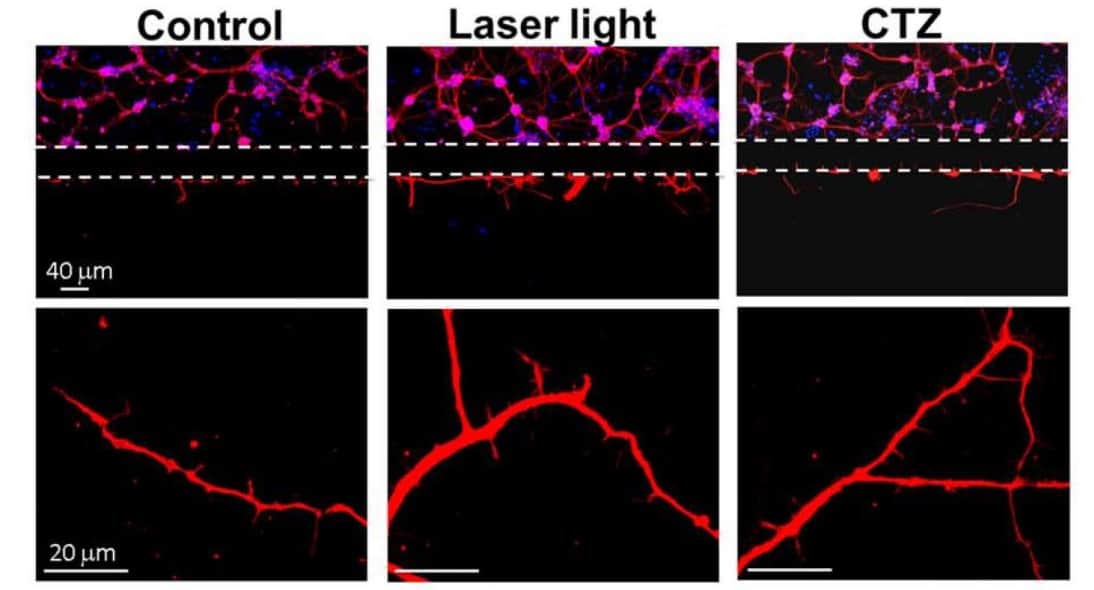
The researchers demonstrated increased neurite growth of LMO3–iPS-NPCs in laser light and CTZ exposure groups compared to control. (Courtesy: S P Yu et al J. Neuroscience 10.1523/JNEUROSCI.2010-18.2019)
The second leading cause of death worldwide, according to the World Health Organization, stroke often causes structural damage and functional deficits. Research suggests that neuroprotective treatments for stroke are largely ineffective but that regenerative methods may offer the structural and functional improvements patients and their families are looking for.
“In stem cell transplantation therapy in basic or clinical research, transplanted cells are usually left in the implanted site(s) without continuous care and guiding signals to support these cells… Optochemogenetics can take the full advantage of optogenetics as well as a drug treatment,” lead author Shan Ping Yu explains.
Combining the best of both worlds
So, what is optochemogenetics? It’s a combination of two techniques – optogenetics and chemogenetics – that activate transplanted stem cells in the brain, promoting cell differentiation, growth and recovery. Optogenetics uses light to selectively activate transplanted stem cells. Because of this, it is invasive and limited by light scattering, meaning that light introduced by an optical fibre can only travel about 200 µm from the fibre tip. Chemogenetics uses chemically engineered molecules instead of light to activate cells, so that cells can be stimulated over larger brain regions. This feature is especially important because transplanted cells are mobile and capable of travelling long distances.
The researchers developed an optochemogenetics fusion protein, luminopsin 3 (LMO3), and introduced LMO3 to induced pluripotent stem-cell derived neural progenitor cells (iPS-NPCs). They then studied the behaviour of the LMO3–iPS-NPCs before injecting them into the brains of stroke-affected mice.
iPS-NPCs have three desirable properties for research: they can be directly generated from adult cells; they propagate indefinitely; and they differentiate into almost every other body cell type, including neural cells. LMO3 is special because it allows LMO3–iPS-NPCs to glow and be activated by either an external light source or a substrate called CTZ.
Increasing neuronal structure and connectivity
After introducing LMO3 to the iPS-NPCs, the researchers performed several experiments. They first studied the behaviour of LMO3–iPS-NPCs in vitro in three groups: LMO3–iPS-NPCs exposed to blue laser light (473 nm); to CTZ; and to no external stimulation. The researchers then used confocal microscopy to image neurites and neurite outgrowth. Western blot analysis showed that LMO3–iPS-NPCs activated by the blue light or CTZ glowed, promoted growth, and increased expressions of proteins and growth factors key to neural structure and function compared with the control group.
Experimental design, hypothetical mechanisms and benefits of optochemogenetics stem cell therapy. (Courtesy: S P Yu et al J. Neuroscience 10.1523/JNEUROSCI.2010-18.2019)
In the second experiment, the researchers triggered ischemic stroke in mice and injected LMO3–iPS-NPCs into the ischemic region. They monitored the status of the LMO3–iPS-NPCs using in vivo bioluminescence imaging and techniques including immunogold electron microscopy, hoping to observe LMO3 expression and the formation of synapses, a critical step for signal transmission between neural cells.
They saw that the LMO3–iPS-NPCs differentiated into mature neurons, and after digging deeper, found that the LMO3–iPS-NPCs glowed for about an hour after stimulation by intranasal injections of CTZ. Daily CTZ injections resulted in improved structural and functional recovery in stroke-affected mice. By avoiding having to cross the blood–brain barrier, CTZ appeared to have a synergistic effect on stroke recovery.
The team performed the third experiment using ex vivo brain slices and found that both CTZ and light stimulation facilitated synaptic transmission and induced neuroplasticity in forebrain slices. Further experiments are required to explain gender and age differences in recovery.
“All levels of studies – cellular, molecular, tissue, networks and behavioural – should be performed” to better understand the effects of the combined LMO3–iPS-NPC/CTZ treatment in the mouse model, and, ultimately, translate this into clinical human therapies, Shan Ping Yu says. The current research was conducted 2–3 days after ischemia was induced until 1–2 months after stroke. The fact that this is equivalent to a few human years raises hopes of a future treatment for structural and functional recovery after stroke.
On Monday the American gymnast Simone Biles made history as the first woman to do a triple twisting double somersault on the floor. Watch the above video and you will be amazed at both the height reached by Biles and the speed of her twists.
The astronomer David Kipping has a knack for coming up with interesting ideas that really make you think. In 2016 he and a colleague at Columbia University published a paper that described how lasers could be used to hide a planet from distant and potentially hostile observers.
Kipping’s latest proposal is to use the Earth’s atmosphere as a giant lens to create a “terrascope” with an imaging capability of a standard 150 m optical telescope. In comparison, the Extremely Large Telescope (which will be the world’s largest when completed in 2025) will have a 39 m diameter mirror.
Kipping shows that light from distant astronomical objects is focussed by Earth’s atmospheric ring to a point at about 85% of the distance to the Moon’s orbit. There, he proposes, a detector could be placed to create a huge telescope at a much lower cost than a comparable terrestrial or space-borne conventional instrument. You can read more in this preprint on arXiv.
Perhaps the biggest mystery of experimental physics is the origin of the huge signal that has been measured by the DAMA dark-matter experiment in Italy. Operating for 22 years, DAMA has detected an annual oscillation of events that could be the result of Earth’s relative motion through galactic dark matter. The problem is that no other detectors have managed to measure a similar oscillation. In “Testing DAMA”, Jim Daley explains how two new experiments will be trying to confirm the DAMA result.
The UK, France, Ireland and Canada have already taken the symbolic step of declaring a climate emergency, but many believe that the actions of these and other countries do not yet match the boldness of their rhetoric. In this episode of the Physics World Stories podcast, Andrew Glester speaks to Will Cook of Extinction Rebellion – a movement that wants governments to accelerate their response to the climate crisis – about the need for politicians around the world to commit to meaningful action.
Glester also explores how academics and physicists are taking steps to reduce their carbon footprint. He speaks to Anna Lewis, the sustainable labs officer at the University of Bristol – the first UK research institution to declare a climate emergency – who explains how the university plans to meet its pledge of becoming carbon neutral by 2030.
Lewis point out that science labs can be some of the biggest users of energy, and Glester talks to Caroline Jarrett, technical manager for the university’s school of science, about the practical measures that researchers can take to make their labs more sustainable. Finally, Glester tackles the thorny question of air travel, not least to academic conferences, and speaks to Matthew Tulley from Solid Carbon Storage about an innovative way to offset your carbon emissions on the occasions when you do need to fly.
German scientists have proposed a startling new way of slowing sea level rise and saving New York, Shanghai, Amsterdam and Miami from 3.3 m of ocean flooding − by using artificial snow.
They suggest the rising seas could be halted by turning West Antarctica, one of the last undisturbed places on Earth, into an industrial snow complex, complete with a sophisticated distribution system.
An estimated 12,000 high-performance wind turbines could be used to generate the 145 GW of power (one gigawatt supplies the energy for about 750,000 US homes) needed to lift Antarctic ocean water to heights of, on average, 640 m, heat it, desalinate it and then spray it over 52,000 square kilometres of the West Antarctic ice sheet in the form of artificial snow, at the rate of several hundred billion tonnes a year, for decades.
Such action could slow or halt the apparently-inevitable collapse of the ice sheet: were this to melt entirely – and right now it is melting at the rate of 361 billion tonnes a year – the world’s oceans would rise by 3.3 m.
“The fundamental trade-off is whether we as humanity want to sacrifice Antarctica to save the currently inhabited coastal regions and cultural heritage that we have built and are building on our shores,” says Anders Levermann of the Potsdam Institute for Climate Impact Research.
“It is about global metropolises, from New York to Shanghai, which in the long term will be below sea level if nothing is done. The West Antarctic ice sheet is one of the tipping elements in our climate system. Ice loss is accelerating and might not stop until the West Antarctic ice sheet is practically gone.”
The Potsdam scientists report in the journal Science Advances that their simulations of ice loss from West Antarctica and the measures needed to halt such loss are not an alternative to other steps. Their calculations would be valid “only under a simultaneous drastic reduction” of the global carbon dioxide emissions that drive global heating, and sea level rise, in the first place.
That is, the world would need to abandon fossil fuels, agree to switch to renewable energy, and then use that renewable energy to in effect destroy the Antarctic’s unique ecosystem but save the great cities of the world from the advancing waves later in this millennium.
The researchers acknowledge that the solution is somewhere between impractical and impossible (in their words, it would have to be undertaken “under the difficult circumstances of the Antarctic climate”). But the mere fact that they could write such a proposal is itself an indicator of the accelerating seriousness of the planetary predicament.
In Paris in 2015, 195 nations agreed to take steps to limit global temperature rise to “well below” 2 °C above the level that obtained for most of human history. Such steps for the most part have yet to be taken.
“The apparent absurdity of the endeavour to let it snow in Antarctica to stop an ice instability reflects the breathtaking dimension of the sea level problem,” Levermann says.
“Yet as scientists we feel it is our duty to inform society about each and every potential option to counter the problems ahead.
“As unbelievable as it might seem, in order to prevent an unprecedented risk, humankind might have to make an unprecedented effort, too.”
Gravitational waves from the merger of a black hole and a neutron star may have been spotted for the first time by the LIGO and Virgo detectors. The signal was detected on 14 August and appears to come from an event that occurred about 900 million light-years away.
The detection has been logged on the Gravitational-Wave Candidate Event Database, where the LIGO–Virgo team say that there is a greater than 99% probability that the gravitational waves are from a black-hole–neutron-star merger. It is likely that the larger object was heavier than five solar masses and the smaller object lighter than three solar masses.
There is no indication so far that any electromagnetic observations of the object have been made by any other telescopes. This will come as a disappointment to the astronomy community because “multimessenger” observations across the electromagnetic spectrum could provide important insights into black holes, neutron stars and how they merge. So far, the only multimessenger observations to involve gravitational waves were made in 2017 when LIGO–Virgo spotted a signal from the merger of two neutron stars.
This is not the first time that LIGO–Virgo has reported preliminary evidence of a black-hole–neutron-star merger. Earlier this year on 26 April the detectors recorded a possible signal from such an event, which may have occurred 1.2 billion light-years away. The signal from this object, however was too weak to confirm.
After upgrades that started in mid-2017, the LIGO and Virgo detectors were back in operation on 1 April 2019. By the end of July, they had spotted 18 binary black hole merger candidates and four binary neutron star merger candidates. However, unlike the neutron star merger of 2017 , no accompanying electromagnetic radiation from the four neutron-star mergers has been detected. Work is ongoing to confirm whether any of these candidates can be considered full-fledged discoveries.
Scientists at Texas Heart Institute (THI) and Rice University have used biocompatible fibres made of carbon nanotubes (CNTs) as electrical bridges to restore conductivity to damaged hearts. By sewing the fibres directly into damaged cardiac tissue in animal models, they could deliver the electrical signals needed to keep the animals’ hearts beating (Circ. Arrhythm Electrophysiol. 10.1161/CIRCEP.119.007256).
“Instead of shocking and defibrillating, we are actually correcting diseased conduction of the largest major pumping chamber of the heart by creating a bridge to bypass and conduct over a scarred area of a damaged heart,” explains THI’s Mehdi Razavi, who co-led the study with Matteo Pasquali from Rice.
“Today there is no technology that treats the underlying cause of the number one cause of sudden death – ventricular arrhythmias,” Razavi adds. “These arrhythmias are caused by the disorganized firing of impulses from the heart’s lower chambers and are challenging to treat in patients after a heart attack or with scarred heart tissue due to such other conditions as congestive heart failure or dilated cardiomyopathy.”
And while many effective antiarrhythmic drugs are available, they are often contraindicated in patients after a heart attack. What’s really needed therapeutically, is a way to increase conduction.
CNT fibres can bridge damaged tissue to keep hearts beating.
To achieve this, the researchers employed CNT fibres invented by Pasquali’s lab. The fibres combine the mechanical properties of suture materials with the conductive properties of metals. The team demonstrated that the polymer-coated fibres, with their ends stripped to create electrodes, could restore function in sheep and rodents with damaged hearts, whether the initial conduction was slowed, severed or blocked.
The researchers used radiofrequency ablation to create epicardial conduction delay in sheep and then applied CNT fibres. They found that sewing the conductive fibres across the ablation-induced scar significantly improved conduction, to near baseline values.
In an acute electrophysiology study on rodents, the fibres restored myocardial conduction across scar in sinus atrial rhythm without controlled external pacing. In a chronic study, the fibres maintained conduction for one month after atrioventricular nodal ablation, but required atrial pacing. The researchers note that no gross or histopathologic evidence of toxicity was observed.
“Our experiments provided the first scientific support for using a synthetic material-based treatment rather than a drug to treat the leading cause of sudden death in the US and many developing countries around the world,” says Razavi.
Many questions remain, however, before the procedure can move toward human testing. The researchers must establish a way to sew the fibres in place using a minimally invasive catheter, and ensure that the fibres are strong and flexible enough to serve a constantly beating heart over the long term. The team also needs to determine how long and wide the fibres should be, precisely how much electricity they need to carry and how they would perform in the growing hearts of young patients.
“Flexibility is important because the heart is continuously pulsating and moving, so anything that’s attached to the heart’s surface is going to be deformed and flexed,” says Pasquali. “Good interfacial contact is also critical to pick up and deliver the electrical signal,” he said. “In the past, multiple materials had to be combined to attain both electrical conductivity and effective contacts. These fibres have both properties built in by design, which greatly simplifies device construction and lowers risks of long-term failure due to delamination of multiple layers or coatings.”
At times, Gopal Narayanan admits, putting together the telescope that captured the first image of a black hole was an “organizational–logistical nightmare”. Narayanan is an astronomer working at Mexico’s Large Millimeter Telescope (LMT) Alfonso Serrano, which is one of eight ground-based radio observatories that make up the Event Horizon Telescope (EHT). Narayanan is therefore well-versed in the project’s complexities, from high-level discussions between collaborators down to the many layers of equipment that made the image possible. The fact that this group of 250 or so scientists and engineers pulled off such a tricky observation is, he says, “a testament to human ingenuity”.
That ingenuity comes into sharper focus when you consider how many different technologies had to work together before the black hole could come out of its shadow. The idea of bringing together existing radio telescopes operating at millimetre wavelengths originated in the mid 2000s, and rests on a concept known as Very Long Baseline Interferometry. The “very long baseline” part refers to the large distances separating the observatories: the EHT’s other telescopes are located in Hawaii, Arizona, Chile, Antarctica and Spain. The “interferometry” part is what enables the collaboration to decode detailed images from the radio signals that each telescope receives. The astronomers combine signals from the different telescopes, creating constructive interference from which meaningful signals emerge. In doing so, they create what Narayanan calls “the next best thing to an Earth-sized telescope”.
But it’s a strange kind of telescope. Each observatory is unique, and therefore faces highly individual challenges, like overcoming local conditions to point to the right place in the sky. Yet to become a successful interferometer, they also must strive to record data in harmony, meaning all must use similar maser clocks and digital electronics.
Interferometers seek to add together amplitudes of desired signals, explains Miguel Sánchez Portal, station manager of the EHT’s Spanish member, the Instituto de Radioastronomía Milimétrica (IRAM) in Granada. Within an interferometry network, each telescope’s receiver collects signals from radio waves, for example as voltages from the sensors in its receivers. Later, the continuous recorded signals go into a system that correlates the data from different observatories. EHT has two correlator centres, one at the Max Planck Institute for Radio Astronomy in Bonn, Germany, and one at the Massachusetts Institute of Technology’s Haystack Observatory near Boston, US. These correlators shift the observatories’ data sets until they add coherently, increasing the wave’s amplitude, Sánchez Portal explains.
Precision pointing
Before the signals can be added together with any confidence, each telescope needs to be able to point very precisely at whatever celestial target the collaboration wishes to observe. For the EHT’s largest telescopes, this is literally a tall order. When the LMT helped record the iconic image, its primary reflector surface was 32 m in diameter – half the height of the famous pyramids at Teotihuacán, a few hours’ drive away. The LMT also sits 4600 m above sea level, on a mountain, Sierra Negra, that is frequently exposed to buffeting winds. To make matters worse, changes in the amount of solar radiation hitting the LMT over the course of a normal day and night makes its supporting structure curl “almost like a potato chip”, Narayanan says.
To make the telescope both stiff and routinely able to return to the same position, LMT’s scientists and engineers must fight the elements. The telescope’s primary reflector is currently composed of 180 plates, all of which require micrometre-range adjustments. To accomplish this, each plate is mounted on a set of four electromechanical actuators that maintain the appropriate shape. A similar set-up exists at the heart of the telescope, in the smaller secondary mirror that collects light from the primary reflector and directs it onto the final receiver. This secondary mirror, or subreflector, is aligned by a “hexapod” system that can shift and twist it in all three spatial dimensions, explains Christoph Stiebel, an engineer at the Karlsruhe, Germany-headquartered company Physik Instrumente (PI), which has supplied hexapods to other EHT facilities.
Hexapods, Stiebel notes, are complex mechatronic systems, incorporating mechanics, motors, sensors and electronic control units. All of these components must work together to compensate for small shifts in position due to temperature changes and differences in mechanical load as the telescope’s orientation moves. In many telescope environments, that isn’t easy. The hexapods PI supplied for the Atacama Large Millimetre/Submillimetre Array’s (ALMA) and the Atacama Pathfinder Experiment (APEX) in Chile, for example, were custom designed to have especially rigid joints, to help achieve the high precision levels needed. Being in Chile also meant that the hexapods had to withstand earthquakes and being blasted with Atacama Desert sand. Worse still, the region’s low humidity raised the risk of electrostatic discharge. High altitudes bring unusual extra problems, like poor cooling conditions and cosmic radiation, Stiebel says, making electronics more likely to fail. “All these unusual environmental conditions led to unexpected failures and the need to develop new designs, which we did,” he adds.
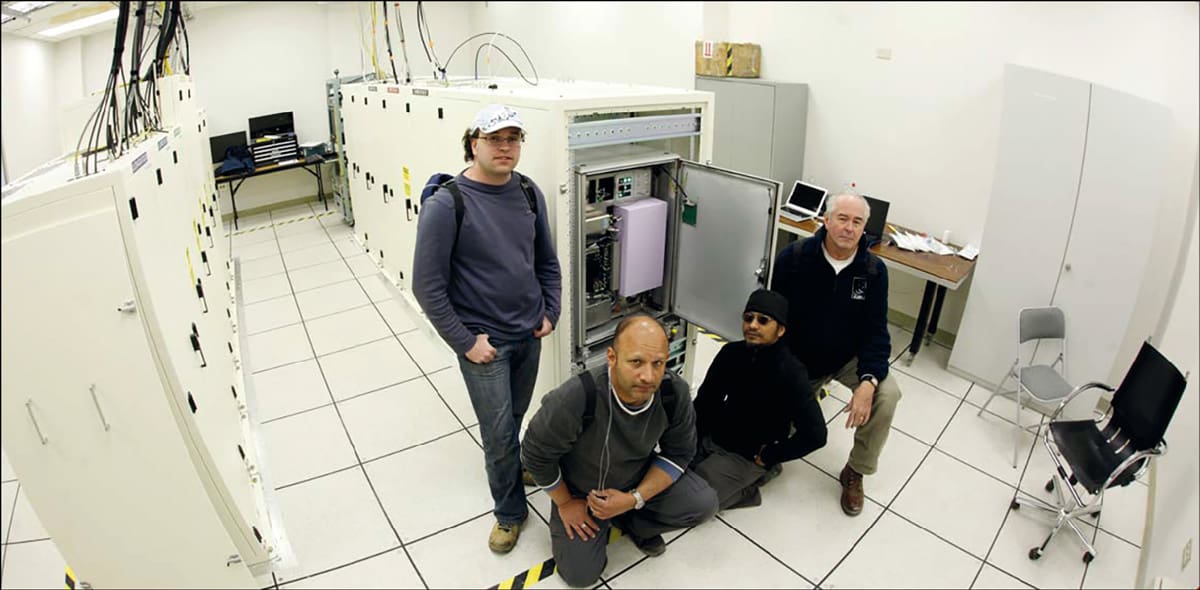
Keeping time Hydrogen maser atomic clock installed at the ALMA Array Operations Site, along with the technicians who installed it. (Courtesy: ALMA (ESO/NAOJ/NRAO), C Padilla)
Tuning in
Even with good adjustment and positioning technology, getting the telescope pointing and focusing correctly is a time-consuming task. At the LMT, Narayanan and his colleagues run calibration routines to ensure that their systems are working optimally. Typically, this involves observing well-known, bright, point-like astronomical bodies and feeding any inaccuracies into a complex mathematical model. For each hour of EHT data-gathering, Narayanan estimates that the LMT team spent 10 hours on calibration.
Then, to collect the signal from the subreflector, Narayanan and his colleagues at the University of Massachusetts built a concentrating system for the LMT involving metal waveguides and so-called “feedhorns”. From there, the signal goes to superconducting receiver mixers – the most sensitive way to down-convert radio signals available – that were built at the University of Virginia. To keep them below the temperature at which they become superconducting, these receivers sit inside cryostats at 4K, under vacuum.
The astrophysical phenomena around black holes emit radiation in the 227–230 GHz range. However, it’s impossible to record frequencies above 100 GHz directly onto digital computers. EHT receivers therefore employ a heterodyning approach. Narayanan describes heterodyning as similar to amplitude modulated (AM) radio, where audio signals are combined with a continuous sine wave “carrier” at a frequency of, say, 1400 MHz. Because the receiver “knows” that the incoming frequency is 1400 MHz, it removes the carrier, and the remaining audio is then sent into your loudspeakers, Narayanan explains.
At the LMT, heterodyning reduces the raw signal frequency to an easier-to-process 6–8 GHz range by subtracting the output of a local oscillator that provides a 221 GHz waveform. From there, the 6–8 GHz signal passes through a device called a block downconverter, which reduces the frequency still further. The lower frequencies make it easier to both transport and digitize the signal. Digitization is done using devices called ROACH2 Digital Back Ends (R2DBEs), which are made at Haystack, in Bonn, or at Radboud University in Nijmengen, the Netherlands. An R2DBE, Narayanan explains, takes the digitized data packets and sends them to the recorders. From there, the time-stamped data is “pretty much streamed directly into the hard drives” which are then physically shipped to the correlation centres for the data to be extracted.
Excellent timing
To ensure a successful correlation, the EHT collaboration sets standards for how observations are made across all its telescopes. In some cases, that has meant adjusting the facilities’ equipment. For example, the 30 m diameter dish telescope at IRAM had previously recorded light that was polarized along horizontal and vertical axes. EHT specifications, however, call for circular polarization, so the Granada telescope installed additional filters into its optical path. The correlation process also requires the data to be time-stamped to picosecond accuracy, which meant that the rubidium optical lattice clock that IRAM previously used wasn’t up to the job, says Sánchez Portal. Using a central timing device to synchronize observations remotely wasn’t an option either, since signal propagation delays would have limited accuracy to mere nanoseconds. Instead, IRAM and all the EHT observatories upgraded to hydrogen masers – at a cost of $250,000–500,000 each, according to Narayanan.
The masers provide both accurate timing and a frequency standard. “If you have the same signal at two antennae in different places on the Earth, you tag packets with a timer,” explains Sylvère Froidevaux, chief operating officer of Neuchâtel, Switzerland-headquartered T4Science. His company supplies the hydrogen maser clocks used at ALMA, which can tag events to precisions better than the nearest femtosecond.
While the hydrogen masers can be used directly for timing, their output must be boosted to higher frequency to serve as a reference standard. For example, the maser that LMT bought from California-headquartered Microsemi, produces just a 10 MHz frequency base, much too low for heterodyning with the 227–230 GHz black hole signals. From there, observatories use devices called synthesizers to multiply the reference signal, which might raise the frequency to 1 GHz, Sánchez Portal explains. From that intermediate step “several signal multipliers” provide the boost to provide the 221GHz local oscillator, he adds.
A ‘miraculous’ result
Every stage of setting up the EHT brought its own challenges, and Narayanan stresses that this is far from a complete list. Yet in the 2017 observing campaign that led to the image of the M87 galaxy’s black hole, all of these problems were, somehow, resolved – an outcome he calls “miraculous”. “All sites had various different issues and technical glitches ahead of the campaign,” he recalls. “We all seriously worked together and solved all the problems. Then the weather was sweet, the whole seven days. At the end of that run I remember thinking ‘This must be it.’ ”
In months since that first run, LMT, IRAM and the other EHT observatories have steadily been upgrading their capabilities, Narayanan and Sánchez Portal note. With the collaboration now working on 2018’s data, the picture unveiled in 2019 was just a taster. And as astronomers gradually improve their planet-sized telescope they will continue to draw us in with detailed pictures of the hypnotic beauty of black holes.
What makes a cake airy and soft, while bread is bouncy and chewy? And what makes certain pastries puffy and flaky, while others are brittle and crisp?
This short video introduces the physics of baking, explaining how it all depends on the right proportions of fat, flour and other key ingredients such as eggs, sugar and yeast. To find out more, read the feature article “Ready, set, bake” by Rahul Mandal, a metrology researcher and the winner of The Great British Bake Off in 2018.
Cyclo[18]carbon. Artistic representation of AFM data of a cyclo[18]carbon molecule, with the determined molecular structure fading in. Credit: IBM Research
Bonding matters. It explains the difference between diamond and pencil lead (graphite) – both pure carbon – but one has each carbon bonded to another four carbons, while the layers of graphite have carbons bonded to just three other carbons in a hexagonal honeycomb lattice. A question that has plagued researchers for a long time, is could a form of carbon exist where the atoms bond to just two other carbons, and if so, how would they bond?
“This was really debated,” says Leo Gross, a researcher at IBM Zurich in Switzerland. “There were people proposing this and that; papers coming out that contradicted and then again contradicted previous works – it was clearly an open question.”
Not any more. In recent work that demonstrates the frontiers of scanning probe microscopy capabilities, a collaboration led by Gross, and Przemyslaw Gawel and Harry L. Anderson at Oxford University in the UK, have for the first time isolated pure carbon rings, as well as imaging them with sufficient resolution to characterize their bonding structure.
Scanning probe precision
Researchers have pondered the existence of cyclocarbons since the 1960s, long before “nanocarbons” hit the limelight. But along with their posited existence came two theories for the bonding in cyclocarbons: a “cumulenic” ring of even double bonds; or a “polyynic” ring of alternating single and triple bonds, and consequently alternating bond lengths. While there have been glimpses of gas-phase cyclocarbons these have been too fleeting to pin down what is going on between the carbon atoms.
The IBM Zurich and Oxford University researchers produced a cyclocarbon of 18 carbon atoms from precursor molecules that are effectively C18 cyclocarbons with additional molecular C-O groups “masking” the pure carbon allotrope. They focused on C18 because the precursors proved less complicated to synthesize. In addition, Hückel’s rule – devised by Erich Hückel in 1931 to explain the delocalized electrons in benzene and derivative “aromatic” molecules in terms of quantum mechanics – predicted that C18 would also have delocalized aromatic bonding, making it more stable.
Previously people had attempted to burn off masking molecules by heating or illuminating the precursors, but a conversation at a conference spawned the idea to bring the precision of scanning tunnelling microscopy (STM) to the approach. First invented in the mid-1980s, STMs use the highly sensitive tunnelling current to map samples with atomic precision. The IBM Zurich group had devised ways of manipulating atoms with STMs and the Oxford University researchers were keen to apply the techniques for isolating cyclocarbon. However, despite the mutual enthusiasm to try the idea, as Gross tell Physics World, “It was a new type of reaction triggered to get rid of the CO masking groups – it was not clear this would work.”
Clockwise from top left Leo Gross, Katharina Kaiser and Fabian Schulz (left to right). Credit: IBM Research. Przemyslaw Gawel, Lorel M Scriven and Harry L. Anderson. Credit: Oxford University
By ramping up the STM voltage from 0.2 V to 3 V for a few seconds the researchers successfully removed the extra C-O groups to form pure cyclocarbon molecules. The isolated cyclocarbons proved very reactive, so that they could easily react with other molecules, which as lead author of the Science paper IBM Zurich’s Katherina Kaiser points out “actually happened very often.” While posing practical complications for experiments that already pushed STM precision to its limits, this reactivity meant that the researchers could demonstrate how pushing two cyclocarbons together would cause them to fuse with a covalent bond between them. This additional capability brings the IBM Zurich team a step closer to their goals in developing designer molecules for single-electron circuits that enable ultralow-power electronics and possibly neuromorphic computing.
Seeing is believing
The real surprise came when the researchers then examined their samples with an atomic force microscope functionalized with a CO molecule at the tip for enhanced resolution. The atomic force microscope (AFM) came soon after the development of STM, and again uses a probe with a nano-sharp tip but this time to feel across the sample a little like the needle of a vinyl record player, which means it can image non-conducting samples.
From left to right, precursor molecule C24O6, intermediates C22O4 and C20O2 and the final product cyclo[18]carbon C18 created on surface by dissociating CO masking groups using atom manipulation. The bottom row shows atomic force microscopy (AFM) data using a CO functionalized tip. (Courtesy: IBM Research)Kaiser describes how the resolution revealed details as fine as the increasingly even brightness for the more planar cyclocarbons as they removed CO groups from the precursor. What they saw when all CO groups were removed were nonagons clearly indicating triple bonds at the bright corners of the nonagon with longer single bonds inbetween, in contrast to Hückel’s prediction. “We were surprised and delighted,” adds Gross. “because any other result would have been hard to interpret.”
Gross explains that they are familiar with the inert bilary NaCl surface the cyclocarbons formed on. Several other molecules they produced on this surface have had very similar structures to the gas phase so there is reason to expect little impact from the surface on the cyclocarbon structure.
“This work brings us a novel experimental fact about an sp-hybridized carbon allotrope,” says Hiroyuki Isobe, a researcher at the University of Tokyo in Japan, who was not involved in the work but has also pioneered new allotropes of carbon. “In a cyclic form on salt, the molecule adopts a polyynic conjugation and can be manipulated by AFM for unique chemical reactions. This study deepens our understanding of the important element, carbon, and stimulates our interest about the uniqueness of cyclic conjugated systems.”
The debate over the cumulenic and polyyinic bonding in cyclocarbons echoes similar discussions over the bonding in benzene C6H6 – a ring of six carbon atoms like the hexagons that form the honeycomb lattice of graphite and graphene, but with each carbon bonding to hydrogen instead of another hexagon of carbon atoms. For a long time, bonding in benzene posed a riddle.
F August Kekule first proposed a ring structure of alternating single and double bonds in 1865 not long after developing ideas of chemical structure and the tetravalency of carbon (i.e. that it has four outer electrons). Since derivatives of benzene gave no suggestion of a fixed position for the single and double bonds, the idea arose of a resonance between two structures of alternating bonds that evolved into the concept of a delocalized electron orbital.
A hundred years passed after Michael Faraday first successfully isolated benzene in 1825 before Kathleen Lonsdale finally confirmed the hexagonal structure of benzene with x-ray crystallography. With the advent of scanning probe techniques, the IBM Zurich and Oxford University researchers report the isolation and characterization of cyclocarbon in the same paper.