Low-cost laser sensors survey earthquake damage

A low-cost, laser-based sensor that can monitor and rapidly assess earthquake damage to a building has been created by scientists in the US. Designed to be installed in multilevel buildings in earthquake-prone regions, the system can determine whether floors in a building have shifted relative to each other. Its inventors say that the device could allow for the rapid assessment of critical buildings like hospitals in the wake of a disaster.

During earthquakes, horizontal ground motions can cause different floors of multilevel buildings to be displaced sideways in relation to each other, a phenomenon that engineers call “interstorey drift”.

Assessing this drift plays a vital role in ensuring that a building is safe to use after an earthquake and to identify if structural repair work is needed. Finding a reliable method to do this quickly and cheaply, however, has proven challenging.

Expensive and time consuming

A traditional approach uses accelerometers that are installed in key points around a building. These determine the forces exerted on the structure during an earthquake and subsequently calculate the extent of drift. This method, however, is time-consuming, impeded by the frequency limitations of the sensors and sometimes unsuccessful in the event of permanent structural damage. Also, accelerometers are expensive to implement on a wide-spread basis.

“Until now, there’s been no way to accurately and directly measure drift between building stories, which is a key parameter for assessing earthquake demand in a building,” explains David McCallen, of the Lawrence Berkeley National Laboratory and the University of Nevada – who led the research.

“The major earthquakes that struck in southern California this [month] serve as a reminder of the risks associated with seismic activity,” notes McCallen. He adds that it is very important to develop “sensors and data analysis that can rapidly measure infrastructure health and inform the most effective response after the next major quake”.

Disaster response

To achieve this, McCallen and his colleagues have spent four years developing sensors that — when placed within a building — can directly and rapidly measure interstorey drift and potentially relay their findings to a disaster response centre.

Their device is called a discrete diode position sensor (DDPS) and works by shining a laser from the ceiling of a room to a sensor pad on the floor. This autonomous detector contains an array of inexpensive, photo-sensitive diodes that can determine, by measuring the displacement of the laser beam, if, by how much and in what direction the ceiling has drifted relative to the floor after an earthquake. From this, engineers can work-out the effect of the quake on the building’s integrity.

“Previous generations of DDPS were quite a bit larger than the system we are now able to deploy,” says McCallen. “Based on design advancements and lessons learned, the sensor is a quarter of the size of our original sensor design, but features 92 diodes staggered in a rectangular array so that the laser beam is always on one or more diodes.”

Shake table

So far, the researchers have only tested the drift sensor in the laboratory, putting the device through its paces in three rounds of trials on a shake table. “The rigorous testing the DDPS has undergone indicates how the drift displacements measured on the three testbeds compared to representative drifts that could be achieved on an actual full-scale building undergoing strong shaking from an earthquake,” McCallen says.

In the coming months, the team will install sensors in a multistorey building at the Lawrence Berkeley National Laboratory. The structure is located adjacent to California’s Hayward Fault Zone, which is one of the most potentially dangerous earthquake regions in the US. In the future, the devices could be installed in buildings throughout regions that are particularly earthquake prone. Emerging 5G communications systems could be used to link the sensors to central disaster response centres, say the researchers.

However, McCallen explains, “we also need to have back-up hardened communications in a post-earthquake environment in case existing network connectivity is down, so we envision back-up communications that could blip data through a satellite so that there would be high certainty in the ability to send building response data to remote locations”.

Looking to the future, McCallen adds “We are excited that this sensor technology is now ready for field trials, at a time when post-earthquake response strategies have evolved to prioritize safe, continued building functionality and re-occupancy in addition to ‘life safety’.”
Inexpensive thermoelectric material works at room temperature

Researchers have fabricated a room-temperature thermoelectric material that is as good as the best commercially available material in its class but is much cheaper. The material, which is based on n-type Mg3Bi2, could be used in solid-state cooling applications.

Thermoelectric materials make use of the flow of heat from a cooler area to a warmer one and have a large Peltier effect, which describes how heat transfers between two electrical junctions. Bismuth telluride alloys are the best room-temperature thermoelectric materials known today but they are costly because of the large amounts of expensive tellurium they contain.

A team of researchers led by Zhifeng Ren of the University of Houston and Gang Chen of the Massachusetts Institute of Technology have now made new thermoelectric materials based on an electron-doped magnesium-bismuth alloy. These have a thermoelectric figure-of-merit, ZT (which defines how efficiently a thermoelectric material works) of around 0.9 at 350 K, which is comparable to that of the commercial Bi2Te3-xSex.

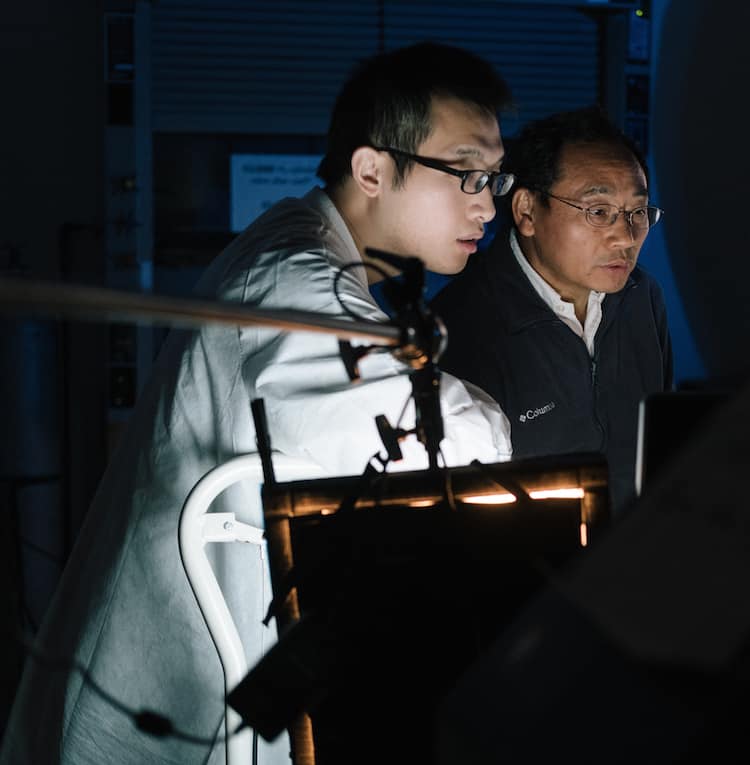
Zhifeng Ren and Jun Mao

The new material is much cheaper than Bi2Te3-xSethough, explains study lead author Jun Mao. “Although the high cost of this material has recently dropped, it remains about $50/kg. That compares to about just $6/kg for magnesium, which is a primary component of our new material.”

Delta T of more than 90 K

The researchers made a cooling device from their material (n- type Mg3.2Bi1.498Sb0.5Te0.002) and p-type Bi0.5Sb1.5Teand measured how efficiently it can cool the surface of a copper plate.

“The Peltier effect allows us to remove heat from the top, cold side of the copper plate and dissipate it into the bottom, hot side when we apply an electric current to the device,” says Mao. “This results in a temperature difference (delta T) between the two sides that increases with increasing current until it eventually saturates at 91 K while we maintain the hot side temperature at 350 K.”

And that is not all. The Houston-MIT team also found that the material is much easier to contact electrically (with metals like iron or nickel for example) in a simple one-step process than nanostructured Bi2Te3-xSex.

“The new material can be used for both cooling and generating power, but we have only reported on its cooling performance in this work,” Mao tells Physics World. “We are now focusing on improving its ZT further and its cooling delta temperature.”

The researchers, reporting their work in Science 10.1126/science.aax7792, say they will also look at using the material for power generation up to 400°C.

MedPhys Slam highlights the art of science communication

The inaugural MedPhys Slam at last year’s AAPM Annual Meeting proved such a success that the conference organizers brought it back for AAPM 2019 in San Antonio.

The MedPhys Slam is a research communication competition in which participants – PhD students, medical physics residents and postdoctoral researchers – have just three minutes and three slides with which to share the significance of their research in a compelling and coherent manner.

This year’s competition was judged by a panel of four non-medical physicists: sports broadcaster Dan Weiss, education and leadership program coordinator Amanda Gamez, meteorologist Bill Taylor and David Weiss, Dean of the Graduate School of Biomedical Sciences at UT Health San Antonio.

Eighteen competitors took part this year – all winners of their local AAPM regional chapter competitions. The speakers covered a wide range of themes, from Monte Carlo plan optimization to  AI and machine learning, motion management to electronic brachytherapy, and even how to use teeth to measure dose exposure after an unplanned radiation event.

The winner was Ricardo Rademacher, a resident at Genesis Healthcare Partners, who presented a talk entitled “We wouldn’t spray paint the Mona Lisa – so why do we spray paint our patients?”.

Rademacher asked the audience to imagine trying to create the Mona Lisa with spray paint – it would be impossible to create fine details and the edges would be blurry. He compared this to the situation in radiotherapy, where the diverging X-ray beams delivered by linacs result in beam dilution and blurred edges. This, in turn, can make it difficult to deliver radiation solely to the tumour.

“If instead, we used a pencil to draw the Mona Lisa, we could create fine sharp details,” he explained. “So what if we focus the beam from the linac? With no dilution and no penumbra, we could more effectively deliver radiation to the tumour and reduce dose to healthy tissue.”

To achieve this, Rademacher is developing a compound refractive lens containing thousands of tiny drilled holes. The lens, which is currently being created and will then be tested, could be installed on existing linacs to eliminate divergence. “I look forward to future when we can treat more effectively and efficiently than ever before,” he concluded.

Salt monitor

The runner-up of the 2019 MedPhys Slam was Mychaela Coyne, a PhD Student from Purdue University, who presented “A new way to measure sodium”. Coyne explained that while many of us consume too much salt, which can lead to high blood pressure and other diseases, there is currently no clinical method available to measure sodium retained in the body.

To address this, Coyne proposes the use of in vivo neutron activation analysis to measure sodium concentrations in bone. The method works by irradiating tissue with low-energy neutrons and detecting the produced gamma rays, which provide information on the elements present in the irradiated sample.

Coyne is developing a system that measures sodium concentration in the hand, which she notes can provide information about levels in the whole body. She has used the device to show that sodium is stored in bone with a concentration related to consumption of salt. “This is the first system that can measure this directly,” she said.

People’s choice

Finally, the audience got their say, with online voting used to determine the “People’s Choice”. The winner here was Mary Peters, a graduate research assistant at MD Anderson Cancer Center. In a talk entitled “Big data for big change”, she explained that cancer patients need to begin their treatment as soon as possible, but often wait days or even weeks for treatment. Her goal is to reduce this to hours.

Prior to delivering radiation therapy, each patient requires a unique treatment plan. Starting from scratch for each patient makes this a time-consuming process. Peters’ proposal is to dramatically reduce waiting times by exploiting the large amount of data available from previous treatments of similar cancers.

For each patient, Peters explains, an algorithm finds similar patients in the database and uses these data to help select the best plan for the new patient. Once the algorithm is fully developed, she plans to share it with other cancer centres. “We hope to harness our experience in treating thousands of patients to help new patients,” she told the assembled delegates.

India’s Chandrayaan-2 mission launches to the Moon

India’s second Moon mission has been successfully launched today from Sriharikota island in the Bay of Bengal. Costing $141m to build and launch, Chandrayaan-2 consists of an orbiter, lander and rover and was fired into space by India’s Geosynchronous Satellite Launch Vehicle MK-III.

India’s first mission to the Moon – the Chandrayaan-1 orbiter – was launched in 2008 and featured 11 payloads, six of which were built by outside countries. Chandrayaan-2’s orbiter will operate for two years and will contain nine payloads, most built by Indian institutes. One foreign payload will be NASA-built reflecting mirrors that will be used to calculate the Earth–Moon distance.

There will 15 terrifying minutes when the lander separates and before it soft lands on the Moon

Kailasavadivoo Sivan

Chandrayaan-2’s lander, dubbed Vikram, is set to touch down on the Moon in September between the craters Manzinus C and Simpelius N, close to the lunar south pole. “The site is at a latitude of 70.9° south [whereas] previous missions by other countries landed close to the equator,” ISRO chairperson Kailasavadivoo Sivan told Physics World. The lander’s three instruments will search for moonquakes as well as examine the Moon’s thermal properties and plasma density on the surface. The orbiter, meanwhile, will search for water, identify minerals and study the composition of the surface and the tenuous lunar atmosphere.

“It is the most complex mission ever to be undertaken by the Indian Space Research Organisation (ISRO),” says Sivan. “There will 15 terrifying minutes when the lander separates and before it soft lands on the Moon.”

The lander will enclose a six-wheeled rover called Pragyan that will make sorties for 14 Earth days. It will carry laser and X-ray spectrometers to study the lunar surface rocks and soils near the landing site. “The giant South Pole- Aitken Basin was an early giant impact on the lunar far side, which then formed a large ridge near the south pole even on the near side, which Chandrayaan-2 will be able to explore,” says Bernard Foing, director of the International Lunar Exploration Working Group.

Green water could help California’s farming woes

More effective use of green water – rainfall stored in soil – could mitigate irrigation demand for some of California’s most important perennial crops. So say US researchers who simulated 13 years’ growth of alfalfa, grapes, almonds, pistachios and walnuts under different irrigation strategies.

Though the Midwest might be America’s breadbasket, in value terms the nation’s agricultural output is dominated by California, which has become a globally significant producer of fruit and nuts.

With its dry Mediterranean climate, however, California can only sustain farming on this scale with large inputs of so-called blue water, diverted from streams and reservoirs and pumped from deep within the ground, for irrigation. Without these inputs, farmland would be in water deficit, with crops demanding more throughout the summer growing season than rainfall could replenish over the winter.

In water accounting, water use by plants is synonymous with evapotranspiration—a combination of moisture carried from the soil to the atmosphere via roots and leaves, and moisture lost from the soil directly by evaporation. Evapotranspiration sits in the negative column of the accounts ledger, balanced by inputs from rainfall and irrigation. Any outstanding deficit is taken from the water stored in the soil.

Allowing greater green water depletion before recharging the soil lessens the need for irrigation directly, according to Scott Devine and Anthony O’Geen of University of California, Davis. It also decreases water loss through evaporation, surface runoff and percolation to deeper groundwater stores.

To quantify the relationship between green-water use and irrigation, Devine and O’Geen compiled detailed soil data for nearly 1.5 million hectares of farmland growing alfalfa, grapes, almonds, pistachios and walnuts. Daily weather records from 2005 to 2017 indicated how much rainfall the farmland received to balance evapotranspiration and allowed the researchers to estimate the irrigation requirement.

Reflecting a “business-as-usual” approach to blue-water use, Devine and O’Geen ran a 13-year simulation that assumed fields were irrigated when green water had been depleted by 30% during a crop’s growing season. The length of a mature plant’s roots depends on how deep below the surface the water lies; in this shallow-irrigation scenario the plant rooting depth was just half a metre. In other runs, the researchers simulated later, less frequent irrigation applied at green-water depletion thresholds of up to 80%, and rooting depths of up to 3 m.

As expected, meeting more of the plants’ evapotranspiration budget with green water decreased demand for blue water. But tolerating depletion to greater depths also produced an additional saving.

“Soil is porous like a sponge, and it dries from the top down, just like a dish sponge would if you left it on the counter,” says Devine. “Constant replenishment of soil water at the surface from frequent rainfall or irrigation ensures maximum evaporative rates: a dry upper soil layer from less frequent and deeper irrigations prevents evaporative loss.”

Compared to the baseline shallow-irrigation strategy, deep-irrigation scenarios saw green-water use nearly double, and the quantities saved by limiting surface evaporation were even larger. Over the 13 years, the savings in the model from moving from a shallow to a moderate (1 m rooting depth) scenario were enough to fill California’s largest reservoir, Shasta Lake, more than six times.

California still needs irrigation, however. In the deep-irrigation scenarios green water accounted for only 12% of growing-season evapotranspiration on average. And in some parts of the state a large, periodic input of blue water is necessary to maintain soil quality by flushing out salt from the root zone.

“Silver bullets do not exist in land management,” says Devine. “The study was designed to make growers and policy makers aware of opportunities by quantifying a potential resource, while also highlighting some real challenges of capitalizing on that resource. We hope the study will help stimulate a constructive, global dialogue about irrigation practices, crop breeding and soil management in dry climates like California’s.”

Devine and colleagues reported their findings in Environmental Research Letters (ERL).

First-ever ferromagnetic liquid surprises researchers

Permanent magnets made of small droplets of liquid have been created and studied by scientists in the US and China. The researchers believe that these are the first-ever liquid permanent magnets to be made. The shapes of the magnetized droplets can be changed, and this could lead to practical applications such as actuators for tiny soft robots.

Many materials have magnetic moments that line up when exposed to an external magnetic field. In a ferromagnetic material (a permanent magnet), coupling between moments ensures that the material remains magnetic after the field has been removed. In other materials called paramagnets, thermal fluctuations quickly overcome the coupling once the external field has been removed and the material ceases to be magnetic.

Ferrofluids are paramagnets that consist of magnetic nanoparticles dispersed in a liquid. When exposed to a magnetic field, the combined effects of gravity, surface tension and the magnetic attraction between nanoparticles can create unusual spiky structures on the surfaces of ferrofluids. However, when the magnetic field is removed, ferrofluids return to a normal liquid state.

Rocket fuel

The first ferrofluids were created in the 1960s by a NASA scientist so that a magnetic field could be used transfer liquid fuel in low-gravity environments. While this use never came to fruition, ferrofluids have found several niche applications in more recent years – such as vacuum seals and dampers for loudspeakers. But the latest research could potentially give the materials a much wider range of uses.

Thomas Russell of the University of Massachusetts Amherst and Xubo Liu of the Beijing University of Chemical Technology made their discovery while working with scientists at the Lawrence Berkeley National Laboratory in California. The researchers were developing ways to create durable structures of one liquid within another by using a surfactant to create a layer of particles to surround the interior structure and prevent it from breaking up. This has allowed the researchers, for example, to create tubes of water within silicone oil.

Liu decided to try this with ferrofluids so that the structures could be manipulated magnetically. Using a 3D printer with an adapted nozzle, Liu injected millimeter-sized water droplets containing billions of iron oxide nanoparticles into toluene oil mixed with a surfactant. Normally the nanoparticles would simply diffuse within the droplets, but the surfactant pinned some of the nanoparticles to the inside of the droplets’ surface. As the nanoparticles built up, they jammed together and stopped moving, creating a kind of solid crust around the edge of the droplets.

Big surprise

Liu applied a magnetic field and found, as expected, that the droplets became magnetized. But the big surprise came when the field was switched off. Making measurements with a magnetometer, Liu discovered that droplets retained some amount of magnetization in the absence of an applied field.

Russell points out that the moments of the nanoparticles within the crust might be expected to retain a slight coupling once the field is removed, given how closely packed they are. But when carrying out the same experiment using progressively larger droplets, he and Liu observed that the remnant magnetization increased roughly in line with the droplets’ volume. This, he argues, implies that even the nanoparticles diffusing within the bulk of the liquid contribute to the droplets’ magnetization – and that as such the remnant magnetization is far larger than it would otherwise be.

Russell says that this is the first time anyone has observed ferromagnetism in a liquid rather than a solid. He admits that he cannot explain how the magnetism persists, given that the distance between nanoparticles within the bulk of the droplets is far larger than the typical separation of coupled moments within a solid. But he says he has no doubt that the liquid ferromagnetism is real. “There is a lot of talk about high-temperature superconductivity, but people don’t understand that either,” he adds.

Shape shifting

What is more, the shape and magnetic state of the droplets can be altered. The team transformed a ferromagnetic droplet into a cylinder by drawing it into to a narrow capillary tube, and showed the droplet remained magnetic by exposing it to a rotating magnetic field. They then turned the droplet back into a sphere by increasing the pH of the oil mixture to unstick the surfactants and nanoparticles. This also demagnetized the droplet, but they were able to remagnetize it with a simple bar magnet.

The team describes the research in Science and writing in an accompanying commentary article, Rémi Dreyfus of the CNRS in France and University of Pennsylvania says that the new research “challenges the established physics that ferromagnetic magnets can only be made of hard materials”. He also says that the work could have several applications, such as in the growing field of soft robotics – potentially allowing bulky pneumatic equipment to be replaced by smaller magnetically-operated actuators.

Dreyfus tells Physics World that the observed remnant magnetization is “puzzling” but says the lack of a clear explanation does not undermine the results. “The published data provided by the authors seem convincing to me,” he says.

Nevertheless, Russell says that he plans on getting to the bottom of the mystery. There are several tools that could be used to study the magnetic behavior inside the droplets, he says, including neutron scattering and electron microscopy. “There is quite strong interest in these materials,” he adds, “so I’m fairly confident we can get to the underpinning of this entire process”.

Quantum tic-tac-toe, Stanley Kubrick and Moon landing fakes, why become a particle theorist?

Loyal readers may remember that a few years ago I wrote an April Fool’s Day spoof news article that claimed that physicists had built a quantum computer that played Jenga – a game that involves removing wooden blocks from a tower so that it does not collapse.

Maybe that was not so crazy after all, because a physicist at Caltech has come up with a quantum version of tic-tac-toe (or noughts and crosses to readers in the UK). Dubbed Quantum TiqTaqToe, the game was devised by Evert Van Nieuwenburg and is described in the Quantum Frontiers blog.

Why do so many Americans believe the Moon landing was fake?” is a fascinating article in Slate by Mark Jacobson. One of the more bizarre conspiracy theories that he mentions is that the film director Stanley Kubrick was involved in creating fake video images from the Moon – the evidence being that a character in Kubrick’s film The Shining wears an Apollo 11 T-shirt.

With a paucity of recent experimental results and the spectre of this drought persisting into a “nightmare scenario”, why choose a career in theoretical particle physics when quantum computing is beckoning? “Get to know 10 early-career theorists” by Emily Ayshford profiles mostly particle physicists in junior university faculty positions. Discovering the nature of dark matter emerges as a key driver for many of them.

Girls’ reading ability drives the science gender gap, claims study

The gender gap in maths-related fields could be determined by girls’ superior reading skills, which leads them to favour humanities-based professions. That is the conclusion of an analysis carried out by researchers in France of the reading and maths performance of thousands of high-school students from around the world.

Previous research has shown that while girls and boys have similar abilities in maths at school, a gender gap persists in science, technology, engineering and mathematics (STEM) subjects in further education. Women are therefore less likely to pursue STEM careers, especially in maths-intensive subjects such as physics.

A girl that is good at maths but even better at reading may feel less confident in maths and may favour humanities because she perceives herself as a verbal person

Thomas Breda

In the latest research, Thomas Breda from the Paris School of Economics and Clotilde Napp from the Université Paris Dauphine looked at test scores of 300 000 15-year-old students in 64 countries from 2012. The data came from the Program for International Student Assessment — an international assessment of 15-year-old students in mathematics, reading and science that takes place every three years.

Breda and Napp found that while girls and boys have comparable scores in mathematics, there is significant differences in their reading scores. Female students who are good at maths are more likely to be even more proficient in reading than their male counterparts. The analysis shows that two-thirds of boys have higher scores in maths than reading, compared with just one-third of girls.

Reading between the lines

Breda told Physics World that this results in girls having a comparative advantage in reading and boys having a comparative advantage in maths. “Our interpretation is that students make comparisons of achievement in maths and reading to reach conclusions about their ability in a given field and to make educational decisions,” says Breda. “A girl that is good at maths but even better at reading may feel less confident in maths and may favour humanities because she perceives herself as a verbal person.”

The researchers claim that these differences “can explain up to 80% of the gender gap in intentions to pursue maths-studies and careers”. They add that the contrast in reading and maths ability between 15-year-old girls and boys “is likely to be determined by earlier socialization processes”.

Breda says that their results support the idea that the gender variation in comparative maths and reading advantages is linked to social pressures and cultural norms. “We observe that the gender gap in comparative advantage at 15 years old is larger in countries where the stereotype associating maths with men is stronger,” he explains. “We cannot fully prove it, but gender differences in abilities for maths and reading at 15 years old and in turn the gender gap in maths-related fields can be entirely driven by social pressures and stereotypes.”

AAPM 2019: medical physicists assemble in Texas

I’ve just returned from the AAPM Annual Meeting in San Antonio, and the mild drizzle of South-West England is proving a welcome relief from the searing temperatures of Texas in July. Oppressive heat aside, the event provided an invaluable opportunity for medical physicists from around the globe to catch up with colleagues and old friends and discover the latest innovations in all areas of medical physics.

This year’s meeting was attended by some 3000 delegates. And many of the conference sessions, notably those covering themes such as FLASH radiotherapy and machine learning, were packed full of attendees eager to hear more about these hottest of topics. Other conference highlights included the MedPhys Slam competition, the Young Investigator Symposium and the Best in Physics poster session, all of which I’ll be reporting on in due course.

One high point was the outstanding President’s Symposium. AAPM president Cynthia McCollough from Mayo Clinic kicked off the session with a talk entitled “Is Everyone at Your Table?”, in which she examined diversity and inclusion within AAPM and emphasized how to harness the collective talents of diverse individuals.

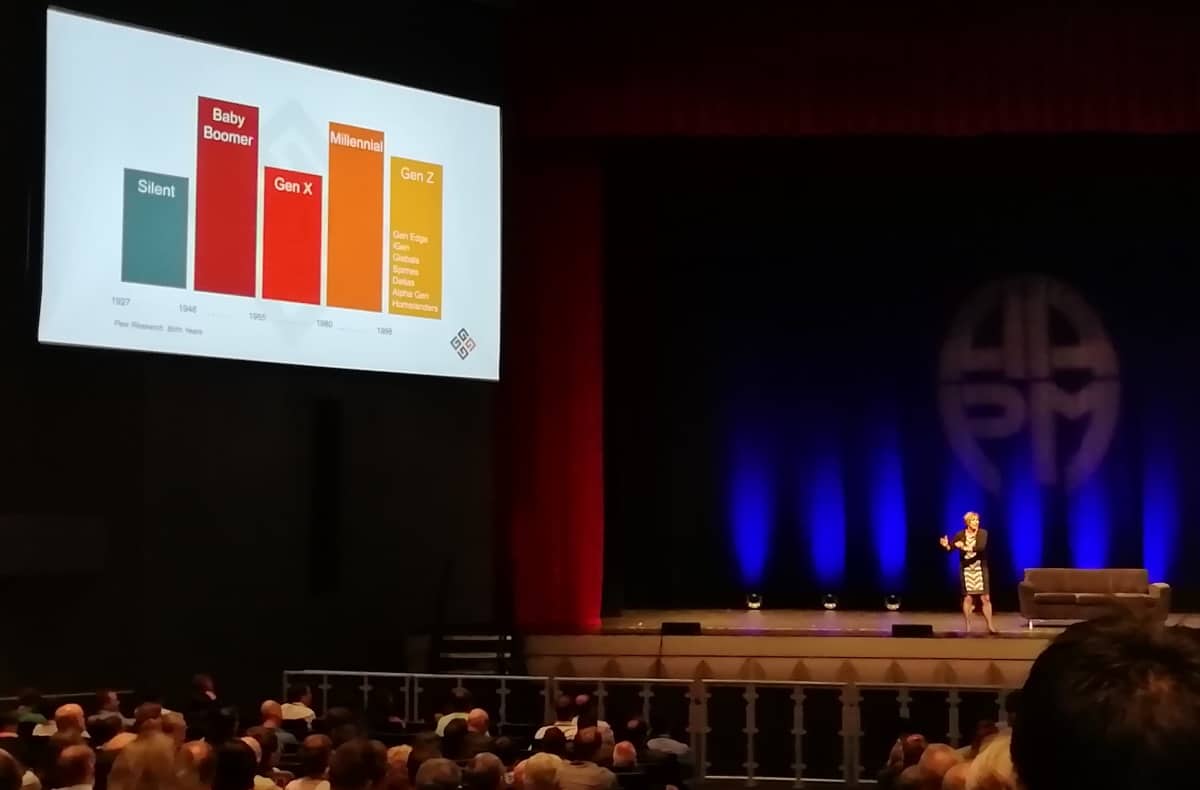
Guest speaker Amy Lynch – triathlete, stand-up comic and generations expert – then discussed the importance and power of multi-generational teams. In a fully interactive presentation, Lynch shared some entertaining insight on the different outlooks of current generations in the workforce, providing helpful tips, for example, on how Baby Boomers can best understand the thinking of Millennials and vice versa.

Keynote speaker Amy Lynch

Over at the AAPM exhibition, more than 100 companies showcased their product developments. One that caught my eye was DoseOptics, which exhibited its C-Dose radiotherapy verification system. The device works by imaging Cherenkov light emitted when the treatment beam traverses tissue and provides real-time visualization of the beam on the patient.

Research engineer Cedar Farwell told me that the C-Dose camera intensifies the detected Cherenkov signal and converts it to a measure of radiation dose. “The system is synchronized with the treatment beam, it detects X-ray scatter in the room and only captures signal when the beam is on,” he explained. C-Dose is already being used in five clinics for research, and DoseOptics is in the process of getting FDA approval.

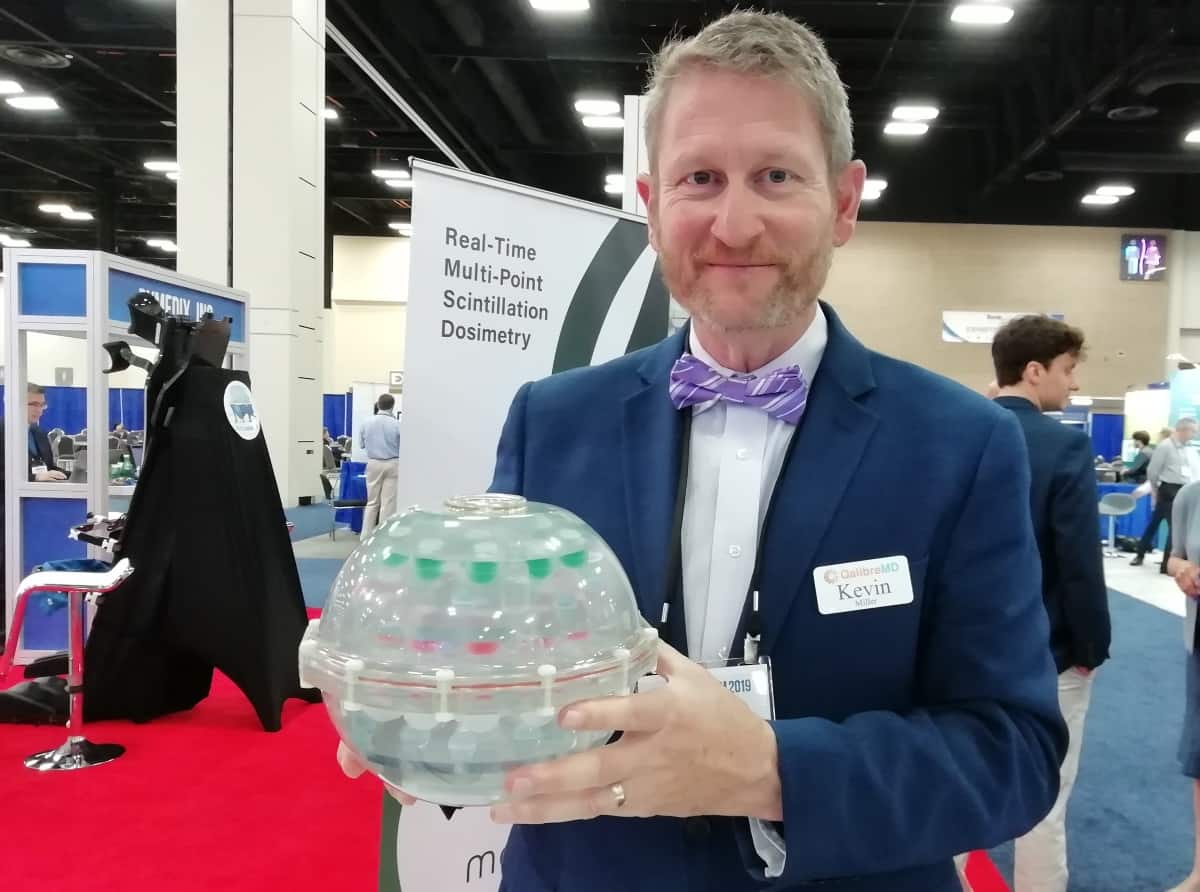
The show also featured several start-up companies, such as QalibreMD, which creates a range of phantoms designed to enable quantitative MR imaging. The company’s System Phantom, for example, contains spheres of different T1 values, ranging from healthy to necrotic tissue. While MR scans are currently analysed like photographic images, with the reader trying to discriminate grey scales and pick out features, imaging the phantom will provide absolute reference values with which to assess the scanner’s response. The end result: more accurate diagnostic results.

Kevin Miller

I also spoke to Kris Huang, CTO at Pymedix, who explained how the company is using machine perception to improve deformable image registration (DIR). “Our motivation is that registration software doesn’t have a good awareness of what’s in the image,” he said, noting that his four-year old daughter managed to match image features that DIR software sometimes missed. “There’s something in the human visual system that is extraordinarily powerful, and that’s the basis of our system.”

Huang emphasized that it’s not deep learning, as no training is needed. Instead, Pymedix’s Autofuse software interprets data in a similar way to human vision and perception. “We are two-thirds done with the software development, and plan to submit to the FDA this year,” he told me.

Elsewhere, IBA Dosimetry showed the latest release of its SciMoCa software, which provides Monte Carlo-based patient quality assurance (QA) for Varian’s Halcyon system. Alongside, the company unveiled several new proton therapy products, including Blue Phantom PT, a water phantom for commissioning and machine QA of pencil-beam scanning, and myQA iON for patient QA.

I chatted to IBA’s Bao Nguyen, who described three focus areas for future proton therapy development. One is motion management, another is the introduction of FLASH, which he noted could “completely change the way we treat patients”. The final, rather intriguing idea is the notion of spot-scanning proton arc therapy, or proton VMAT. “This is very complex, as you need to rotate the gantry while the delivering beam,” Nguyen explained. “Lots of people thought it was not possible, but we have now demonstrated this on the ProteusONE gantry.”

AAPM 2019 also saw the event’s first tweetup, where all the show’s prolific Twitter users met up in person, took a photo of the group… and then tweeted it. Overall, it was a fantastic few days of medical physicists sharing breakthrough developments, discussing hot topics, presenting new products, and more. I look forward to next year in Vancouver.

AAPM 2019 tweetup

Climate crisis needs radical food changes

To feed 9 billion people by 2050, and keep planet Earth from overheating, will mean massive and radical food changes – and not just in the way food is grown.

To contain global temperatures to no more than 2 °C above the average for most of human history will require humanity to change its diet, contain its appetite and reform the entire system of food production and distribution.

This is the verdict of the latest study of the challenge set in Paris in 2015, when 195 nations promised to limit global warming – driven by profligate use of fossil fuels and by the conversion of forest, grassland and wetlands into commercial use – to “well below” 2 °C by 2100.

Researchers report in the journal Sustainability that they looked at 160 studies and analyses of global agriculture and food systems and most closely at the world’s smallholders and markets that sustain as many as 2.5 billion people, mostly in the developing world.

Farming’s massive impact

Small farmers account for about a third of global agriculture’s greenhouse gas emissions, but these include also many of the people most vulnerable to the coming climate crisis, which is likely to put harvests at hazard on a global scale.

Agriculture, together with forestry and changes in land use, accounts for a quarter of all the carbon dioxide, methane and oxides of nitrogen that fuel global warming.

Just on its own, the action of growing grain, fruit and vegetables or feeding grazing animals accounts for no more than 12% of global warming, but a third of all the food that leaves the farm gate is wasted before it arrives on the supper table.

This is enough to provide 8% of the world’s emissions, and if just one fourth of the waste could be saved, that would be enough to feed 870 million people for a year.

Agronomists, crop researchers, climate scientists and ministry planners know of many steps that can be taken to reduce the greenhouse impact of agriculture: even under the most hopeful forecasts, these are likely to be deployed slowly.

The researchers see reductions in food loss as a “big opportunity” that will benefit farmers and consumers as well as reduce emissions. A more challenging problem is to change global appetites: the meat and dairy business accounts for about 18% of all human-triggered emissions, counting the clearance of forests and the impact of changes in the way land is used to feed the demand for meat, milk, butter and cheese.

A shift to plant-based diets would save on land and water and deliver more and healthier meals and permit more forest restoration.

“If you think about the two degree increase, efforts need to go beyond the agriculture sector,” said Anna Maria Loboguerrero, of the climate change, agriculture and food security programme of CGIAR, once known as the Consultative Group for International Agricultural Research, who led the study.

Drastic cuts needed

“This means reducing emissions by stopping deforestation, decreasing food loss and waste, reducing supply chain emissions and rethinking human diets, if we really want to get on track to that target.”

The researchers acknowledge that what they propose will constrain farm choices and increase costs. But a second study reports once again that the health benefits of immediate, dramatic cuts in carbon dioxide emissions will save lives, improve human health, and offset the immediate costs of containing planetary heating and adapting to the climate crisis.

“The global health benefits from climate policy could reach trillions of dollars annually, but will importantly depend on the air quality policies that nations adopt independently of climate change,” they write in the journal Nature Communications.

And Mark Budolfson of the University of Vermont, one of the authors, said: “We show the climate conversation doesn’t need to be about the current generation investing in the further future. By making smart investments in climate action, we can save lives now through improved air quality and health.”

Copyright © 2026 by IOP Publishing Ltd and individual contributors