Gravity sits at the heart of some of the most important open problems in astrophysics, cosmology and fundamental physics, while black holes harbour some of the most remarkable predictions of Einstein’s general theory of relativity. Now, more than 200 researchers from all over the world have come together to create a roadmap that surveys current and future research in strong-field gravity, with topics ranging from the astrophysics of black holes to the modelling of gravitational-wave signals. Vitor Cardoso, one of four editors of the roadmap, offers a brief introduction.
The long-held promise of gravitational-wave astronomy as a new window onto the universe has finally materialized, with several dramatic discoveries made by the LIGO–Virgo collaboration over the past few years. But these are just first steps along a new and exciting avenue of exploration that is only now opening up before us. The questions we want to tackle cut across disciplines and research interests, and the answers will undoubtedly reshape our understanding of black-hole-powered phenomena, the formation of structure in the universe, and the nature of gravity at all scales.
Harvesting useful information from gravitational-wave (GW) signals and understanding its broader implications demand a multidisciplinary effort. What exactly will GWs tell us about how, when and in which environment black holes were formed? How fast do black holes spin, and how have some of them grown to become supermassive? GWs from merging black holes probe the environment in which they reside, potentially revealing the effect of dark matter or new fundamental degrees of freedom.
The analysis of GW data will also enable precise tests of general relativity, and of the black hole paradigm itself. However, collecting and interpreting the information encoded in the GWs requires faithful and accurate theoretical models of the predicted waveforms. To accomplish the far-reaching goals of gravitational-wave science it is of paramount importance to bring together expertise over a very broad range of topics, from astrophysics and cosmology, through general-relativistic source modelling, to particle physics and other areas of fundamental science.
Collaboration across disciplines
In 2016, a short time before the announcement of the first gravitational-wave detection, a cross-disciplinary initiative in Europe led to the establishment of the new COST Action on “Black holes, gravitational waves and fundamental physics” (GWverse). GWverse aims to maintain and consolidate leadership in black-hole physics and gravitational-wave science, linking three scientific communities that are currently largely disjointed: one specializing in gravitational-wave detection and analysis; another in black-hole modelling (in both astrophysical and general-relativistic contexts); and a third in strong-gravity tests of fundamental physics.
The idea is to form a single, interdisciplinary exchange network, facilitating a common language and a framework for discussion, interaction and learning. The action supports the training of the next generation of leaders in the field, and the very first “native” GW/multimessenger astronomers, ready to tackle the challenges of high-precision GW astronomy with ground and space-based detectors.
The roadmap, published in Classical and Quantum Gravity, is one of the outcomes of this collaboration. The aim of the roadmap is to summarize our current knowledge and highlight the most compelling questions that still remain. The synthesis of these results has the potential to shed light on some of the most enigmatic issues in contemporary physics, and the authors hope that the roadmap can serve as a guide for the exciting road ahead.
The roadmap on black holes, gravitational waves and fundamental physics is published in Classical and Quantum Gravity, which is published by IOP Publishing (which also publishes Physics World). The editors of the roadmap are Leor Barack of the University of Southampton, UK, Vitor Cardoso of the University of Lisbon, Samaya Nissanke of the University of Amsterdam, Netherlands, and Thomas P Sotiriou of the University of Nottingham, UK.
The Institute of Physics and Engineering in Medicine (IPEM) has announced the winners of its two 2019 journal awards: the Roberts Prize for the best paper published in Physics in Medicine & Biology (PMB) during the previous year, and the Martin Black Prize for the best paper published last year in Physiological Measurement (PMEA). These annual prizes are jointly awarded by IPEM and the journals’ publisher, IOP Publishing.
The Roberts’ Prize was awarded to Sonja Schellhammer, Aswin Hoffmann and co-authors at OncoRay and IBA. Their winning paper, Integrating a low-field open MR scanner with a static proton research beam line: proof of concept, examines the feasibility of performing real-time MR imaging during proton therapy to improve targeting accuracy (Phys. Med. Biol. 10.1088/1361-6560/aaece8).
The team integrated an MR scanner with a static proton research beam line and tested the MRI performance without the proton beam. MR images of a healthy volunteer and a patient with a soft-tissue sarcoma were sufficient for target volume definition and positioning. Phantom images recorded with and without the proton beam showed no beam-induced image degradation.
The researchers also imaged a sausage sample, without the beam, with energized beam line magnets and during proton irradiation. Difference images between the three conditions revealed a sub-millimetre shift in frequency-encoding direction, which can be corrected for. No additional artefacts or deformations were seen, indicating that neither the beam line magnets nor the beam itself degraded the images.
“We are delighted and honoured that our article on the world’s first prototype system that combines an in-beam MRI scanner with a horizontal proton research beam line has been awarded the 2019 Roberts’ Prize,” says Hoffmann. “The appreciation for our work shows that there is a strong scientific interest and urge in efforts to explore the capabilities of MRI-guided proton therapy.”
Analysing big data
The Martin Black Prize was won by John Prince, Siddharth Arora and Maarten de Vos from the University of Oxford. Their paper, Big data in Parkinson’s disease: using smartphones to remotely detect longitudinal disease phenotypes, analysed finger tapping and memory test data collected using smartphones to better understand the longitudinal characteristics of Parkinson’s disease (Physiol. Meas. 10.1088/1361-6579/aab512).
“The application of machine learning in the neuroscience sphere has boomed over the last decade or so and it seems that with every new answer comes ten new questions,” explains Prince. “The intention of my paper was to clarify some of the ambiguity surrounding objective measurement of neurodegenerative diseases, namely Parkinson’s Disease.”
Prince notes that the biggest challenge shared by all artificial intelligence systems in healthcare is how well algorithms perform when used by consumers outside of a clinical environment. “My paper showed how by just using an iPhone regularly in day-to-day life it’s possible to detect neurodegeneration, whilst also highlighting the current shortcomings in the current clinical measurement techniques,” he says.
The suite of algorithms presented in the paper and subsequent publications are scalable to large amounts of longitudinal data. They are also memory efficient, meaning they can easily run on most wearable devices and give real-time feedback to either the user or a clinician.
“I think the same goal is common across both academia and industry and is independent of application – be it neuroscience, cardiology, drug delivery, or genomics – and that is to create affordable and robust algorithms that can be put into the hands of users across the globe to not only improve but also widen access to healthcare,” says Prince.
Prince and Schellhammer have both been invited to present their papers at IPEM’s annual Medical Physics and Engineering Conference (MPEC), to be held in Bristol in September.
Radiotherapy technologies have advanced significantly over the past couple of decades. The introduction of intensity-modulated irradiation and particle therapies have helped maximize the dose differential between tumours and normal tissues, while image guidance has reduced delivery uncertainties. One remaining hurdle to address is motion of the patient and tumour during treatment.
Conventional motion management approaches assume that radiation delivery is far slower than physiological motion. But recent preclinical studies have shown that FLASH radiotherapy – an ultra-rapid approach using dose rates exceeding 50 Gy/s – vastly reduces normal tissue toxicity without impacting therapeutic efficacy. And in addition to this potential radiobiological advantage, this high-speed irradiation effectively freezes motion.
FLASH has been demonstrated preclinically, but current clinical linacs are too slow to deliver FLASH to deep-seated tumour targets in humans, requiring a dose rate increase of at least 300 times. With this goal, US researchers are developing the PHASER platform for FLASH radiotherapy. They designed PHASER to be compact, power efficient, economical and clinically efficient – factors that will also help increase global access to radiotherapy (Radiother. Oncol. 10.1016/j.radonc.2019.05.005).
“PHASER is designed to fit inside a standard shipping container for rapid deployment, and to run on solar power and battery storage,” explains Billy W Loo Jr from Stanford University School of Medicine. “The 3D machining techniques used to create accelerator components greatly reduce the part count and thereby the manufacturing costs. The extremely rapid treatment combined with fast high-quality imaging also enable workflows that greatly increase patient throughput. All these features benefit advanced clinics, but also reduce access barriers in lower resource settings.”
Four core technologies
PHASER will provide near-instantaneous delivery of highly conformal image-guided radiotherapy. Loo and co-authors Peter Maxim and Sami Tantawi describe four core technical innovations that enabled its development.
First, they designed a compact, power-efficient linac called DRAGON that exploits a fundamentally new accelerator technology to generate hundreds of times the beam output of a conventional medical linac.
Production of high accelerating gradients (above 100 MeV/m) in linacs is usually limited by RF breakdown, caused by high surface magnetic fields that create localized pulsed heating. In their design, the researchers optimized the shape of the accelerating cells to minimize the peak surface magnetic fields. This reduces RF breakdown at high gradients and maximizes power efficiency by minimizing heating losses.
To install PHASER in an existing treatment vault, it must incorporate an extremely compact RF power source with a large duty factor. The researchers developed a 50 cm-high klystron that generates 330 kW peak RF power when operating at only 60 kV. The outputs of multiple “klystrinos” are combined via an RF phased-array power distribution network.
PHASER will incorporate 16 klystrinos and direct their summed power (5.3 MW peak) to any one of 16 stationary DRAGON linacs, providing 16-beam intensity-modulated FLASH radiotherapy. The system can switch beam direction in just 300 ns without requiring gantry rotation.
The researchers also created an all-electronic scanning pencil-beam high-speed intensity-modulated X-ray source (SPHINX) to replace the multileaf collimator (MLC) and eliminate mechanical motion. Each electron beam pulse is electromagnetically steered onto a stationary target to form a rapid scanning source of X-rays, which are collimated by an array of channels in a tungsten block.
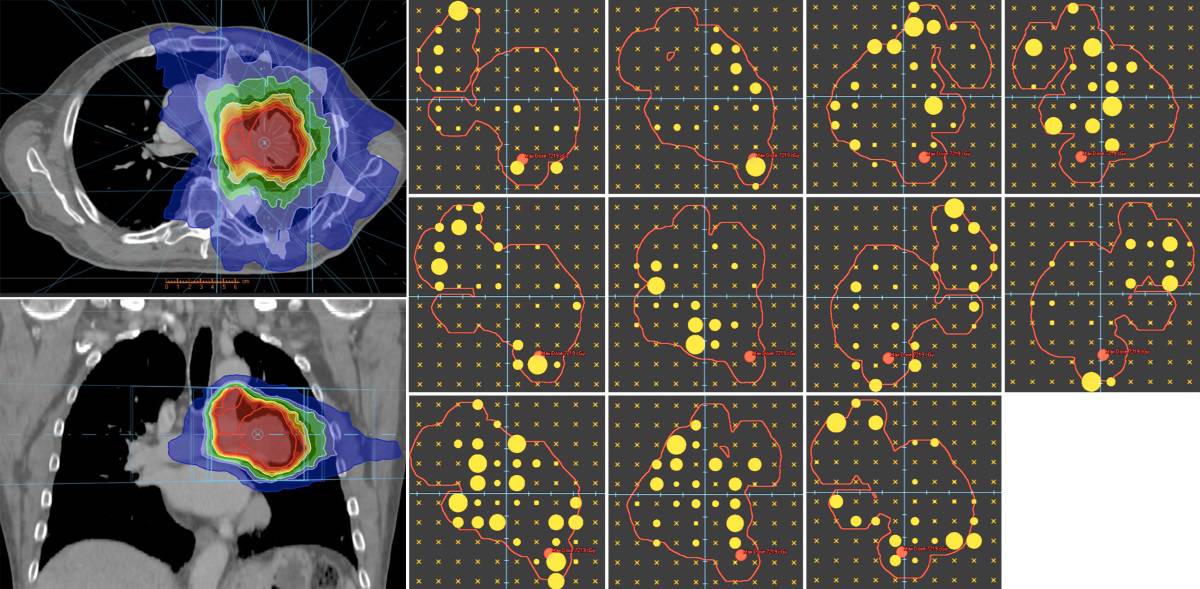
Each channel forms a diverging beamlet and the spacing between beamlets ensures complete tumour coverage. For a sample lung-cancer case, a simulated SPHINX-based treatment plan demonstrated similar dose conformity as the clinically delivered MLC-based plan.
Simulated SPHINX-based IMRT treatment plan for a locally advanced lung cancer. (Courtesy: Radiother. Oncol. 10.1016/j.radonc.2019.05.005)
Ultra-rapid beam delivery also requires fast, high-quality image guidance. For this, the team integrated a multi-detector CT into the system, providing diagnostic-quality volumetric imaging at sub-second speed. A non-coplanar beamline geometry allowed the beams to share a common isocentre with a full-ring CT scanner for simultaneous imaging and treatment.
As well as providing position verification before and during treatment, this set-up enables an efficient adaptive planning workflow. Combining rapid imaging and delivery also creates new therapeutic possibilities, for example, temporally synchronizing irradiation with the intra-tumoural concentration peak of an injected systemic agent monitored via dynamic CT.
The team has prototyped all of these individual components, which are in various states of testing. “We are now finalizing the component designs to the specifications required for a clinical version of PHASER,” explains Loo. “We are also building a fully integrated single beamline, which will be a stepping stone to building multiple integrated beamlines and, eventually, the full 16-beamline version envisioned for clinical use.”
Loo notes that the single beamline will also be used for radiobiology research. “We are currently engaged in FLASH radiobiology research using modifications of existing accelerators, but the beamline based on PHASER technology will enable more advanced experiments,” he tells Physics World.
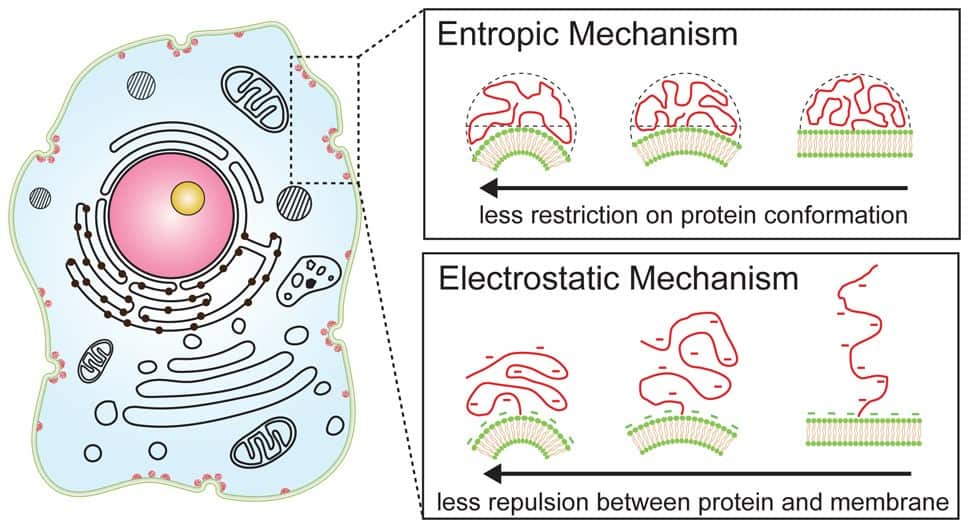
Illustration of the mechanisms at play during membrane curvature sensing of disordered proteins. Credit: Zeno et al, JACS 2019 doi:10.1021/jacs.9b03927
Curved lipid membranes are abundant in cells. Most folded proteins are thought to interact with the membrane directly via specialized folded regions, which prefer curved regions. These proteins contain large, disordered domains (independent three-dimensional structures inside the protein) without any well-defined structure. Indeed, these disordered regions resemble random coils, tangled like cooked spaghetti, yet they can still sense and localize to curved membrane regions. As a result, it has not been clear how proteins sense curved membranes to localize there.
To understand the interactions between disordered protein structures and curved regions of the membrane, researchers from the University of Texas led by Jeanne Stachowiak tethered small unilamellar vesicles (SUVs) to a glass surface and tagged them with a red fluorescent dye. The researchers then incubated the SUVs with a disordered region of a protein that plays a role in sensing natural membrane deformation. By truncating the region from the rest of the protein, and tagging it with a green dye, the researchers were able to quantitatively measure how much protein had accumulated on the red SUVs as a function of SUV diameter and chain length.
Observing the mixture using fluorescence microscopy, the researchers found that the fluorescence intensity of the protein (green) increased as the SUV diameter decreased, which they could see from the lower red fluorescence coming from the labelled SUVs – “smaller SUVs appeared more green while larger SUVs appeared more red” reported the researchers. When the disordered region is longer, the length difference between the protein region and SUV diameter increases, which suggests a stronger curvature sensing when the protein is longer.
The effects of disordered protein region length suggest the role of entropy in curvature sensing since there are more possible configurations for a longer region than a shorter one. Simply put, the disordered protein is merely maximizing its entropy as a curved membrane allows the coiled chain to occupy more volume with more possible configurations than a flat one.
Ionic strength dictates which force drives curvature sensing
The researchers then modified the salt concentration of their solution to change the ionic strength felt by their disordered domains. At high salt concentrations, the longer chains were more sensitive to membrane curvature. Conversely, in the low salt regime, they observed no difference in curvature sensitivity for different chain lengths. However, in this regime, the curvature sensing of the shorter chains was much stronger than at high salt concentrations.
The effects of salt concentration suggest that for smaller disordered chains, electrostatic forces drive membrane curvature sensing behaviour as curved membranes allow for increased distance between repulsive amino acid chains and charged membrane lipids. Adding small amounts of an anionic lipid (DOPS) into their SUVs increased curvature sensing for all cases, with the strongest effect being observed for the shortest disordered chain, reinforcing the case for electrostatic forces dominating curvature sensing for short chains.
The researchers’ report in the Journal of the American Chemical Society, shows how non-specific interactions can play important roles in very specific interactions – such as that of proteins and cell membranes. Their results remind us that, despite the complexity of biology, simple physics processes still play important roles in nature.
Meeting a net-zero emissions global target by mid-century — as recommended by the Intergovernmental Panel on Climate Change – needs accelerated innovation. But the IEA says that in 2017 only 4 of 38 energy technologies and sectors were on track to meet long-term climate, energy access and air pollution goals. In the UK, moving from the existing target of cutting annual greenhouse gas emissions by 80% towards a net zero emissions target by 2050, as now agreed by the UK government, certainly implies a greater role for key technologies.
Moving from invention to widespread deployment can take many decades, yet only around three decades remain to meet the net zero emissions goal
Against this backdrop, the Aldersgate Group commissioned Vivid Economics and the UK Energy Research Centre (UKERC) to look at conditions and policy approaches that could speed up the cycle of innovation to achieve a net zero target. The resulting Accelerating innovation towards net zero report sees innovation as “learning that occurs during R&D, demonstration and the early stages of deployment”, so that the lessons drawn from its case studies are about ways to accelerate learning related to deployment, as well as during R&D. But learning takes time: “moving from invention to widespread deployment can take many decades, yet only around three decades remain to meet the net zero emissions goal”. It also needs consistent support, as indicated by the case study on wind power.
Lessons from wind
Drawing on a comparison of wind development in Denmark and the UK, the Aldersgate report says that “feed-in tariffs [FiTs] for wind projects were vital to move towards industrial-scale deployment”, as happened initially in Denmark and then massively in Germany. It notes a little lamely that “the UK was not at the forefront of the early development of onshore wind turbines”. Well, yes, the UK resisted FiTs for a long time, right up to 2008, and then only, from 2010 onwards, for small, mostly photovoltaic (PV) solar, projects. But it’s not quite true that the UK was a laggard in wind engineering terms. A 100 kW unit was built on the Orkney archipelago in 1955, while in the 1980s Howden, based in Renfrew, Scotland, developed a pioneering 330 kW machine; California installed 26 MW-worth of the kit in 1984. And in 1987, the UK government backed a very large 3 MW Wind Energy Group project on the Orkneys, as well as smaller ones elsewhere, including a novel 100 kW vertical axis device. But it is true that nothing much came of any of them, in part since there was no UK market for wind projects. In the 1990s, when a UK market was created via the Non Fossil Fuel Obligation (NFFO) and then, in the 2000s, the Renewables Obligation (RO) system, the machines for the UK’s wind farms had to be imported, mainly from Denmark and Germany.
As this suggests and as the report notes, it is vital to provide support through market creation policies and investment to help technologies go from early deployment to widespread commercialization. “Such policies, from the early voluntary power purchase agreements in Denmark, through to feed-in tariffs in numerous countries including the UK’s Contract for Difference [CfD] auctions, are crucial to help support technologies in early or pre-commercialisation stages,” the report continues. It may be a stretch to include market-based CfDs along with fixed-price FiTs, but it is true that, while FiTs helped wind expand in Denmark and in Germany especially, of late market-based CfDs have helped offshore wind expand to near 8 GW in the UK, though with mostly imported technology.
Banks to the rescue
Direct funding has also helped. “Investment support from governments or government-supported funding agencies has also been important in providing loan capital or loans to invest in projects where the market was not yet sufficiently confident due to the new technologies involved,” says the report, adding that the UK Green Investment Bank (GIB) — now known as the Green Investment Group — invested £1.6 bn in the offshore wind sector, across nine projects with a combined total capacity of 3.2 GW. It also set up and manages the UK Green Investment Offshore Wind Fund, which has a portfolio of six projects with a combined capacity of 1.45 GW. “There is strong evidence that the GIB and European Investment Bank (EIB) provided important support to offshore wind deployment,” the report continues. “They did so by: absorbing early deployment and technology risk and filling investment gaps, allowing the private sector to invest; buying equity stakes in existing offshore wind farms, allowing developers to “recycle and reinvest capital in new projects”; and using their investments to support the development of innovative financial products such as portfolio aggregation, which attracted new investors to the sector.”
Overall bills need not rise as a result of climate policy
UK Committee on Climate Change
The GIB and the EIB were evidently vital — pity then that the GIB was sold off and presumably the UK won’t have access to the EIB post-Brexit. But life goes on. And the government’s advisory Committee on Climate Change (CCC) is quite optimistic about the costs of making the energy transition. It says that, while it will need increased investment, that would be offset by reduced fuel costs, so “overall bills need not rise as a result of climate policy”.
A future for CCUS?
The UKERC/Vivid Economics report also looks to Carbon Capture Utilisation and Storage (CCUS). “New markets must now be created to fully commercialise early-stage low-carbon technologies,” it says. “Market creation mechanisms to be considered include CfDs for power sector CCUS and obligations or incentives for fossil fuel using industries to sequester their CO2 emissions.”
That assumes that CCUS has a future. Although the Committee on Climate Change also seems keen and hopeful, it does admit that it would require “both increased upfront spend and higher fuel costs”. It notes that what was then called CCS, along with nuclear and heat pumps, played significant roles in its earlier plans, but says that they have all under-performed “as projects have been delayed and costs have overrun (e.g. nuclear) or as policy has failed to drive take-up effectively (e.g. heat pumps and carbon capture and storage, CCS)”.
As implied by the current use of the label “CCUS” instead of “CCS”, the emphasis these days is moving away from just CCS to CCU, and the production of synfuels by reacting carbon dioxide — captured directly from the air or from power plants — with hydrogen, perhaps produced electrolytically, using electricity from renewables or nuclear.
However, CCUS “is not proceeding on the innovation pathway required to meet the IEA’s Sustainable Development Scenario (2018)”, notes the UKERC/Vivid Economics report. “While incentives have been implemented in the US, UK, Canada, and Norway, projects have stalled or not translated into a pipeline of future projects. A common feature of these cases is a stop-start approach to demonstration, which has been ineffective in the context of promoting CCUS deployment.” It suggests using an infrastructure demonstration approach to move things on. That seems a very long shot.
Done fully, “CCUS would involve the construction of a large-scale infrastructure which would be shared by numerous point sources and storage points”, according to the UKERC/Vivid Economics report. “It is instructive that most comparable national level infrastructure systems have been constructed under the guidance of national level coordinating bodies, such as the Central Electricity Board in the case of the original electricity transmission network in the UK, and the Gas Council for the natural gas grid.” Is it really worth it? Just to be able to continue to use fossil fuels? What’s more, when we burn CCU-derived synfuels, we get the CO2 back again. It seems like a case of costly diminishing returns. Why not use the green power, and the green hydrogen, directly? Nevertheless, some UK funding is being provided for CCUS work and the debate continues, with Direct Air Carbon Capture and Storage (DACCS) also being talked up.
Up in the air
That’s interesting, but the proportion of CO2 in the air is — still! — only around 0.039%, so to capture a ton of CO2 you have to chemically process over 2500 tons of air and then store the CO2 somewhere. Doing all this needs energy. You could use PV solar. But trees/plants do all this for free. Of course, some are still keen on biomass energy carbon capture and storage (BECCS) as another negative carbon option. To have much impact that would involve a lot of land-use for biomass and, as with DACCS, a lot of carbon storage space. In terms of CO2 sequestration, it might be better just to plant more trees and as far as energy generation goes, expand renewables fast. And the UKERC/Vivid Economics report does offer some ideas about how to accelerate renewables. So does the recent Climate Manifesto from Greenpeace. In my next post I look at some of the problems efforts like this might face in relation to curtailment.
Researchers at Imperial College London have developed a prototype mini MRI scanner that fits around a patient’s leg and could quickly and accurately diagnose knee injuries. The small-scale device could help diagnose conditions such as anterior cruciate ligament injuries, which are particularly common among footballers, or be used in local clinics and surgeries to reduce waiting times for MRI scans.
Knee injuries affect millions of people and MRI scans are crucial to establish which part of the joint is injured. Knee injuries commonly affect either the tendons, meniscus or ligaments. However, these structures are not usually visible with MRI, due to the way that water molecules are arranged in such areas.
“These structures are normally black on an MRI scan – they simply don’t produce much signal that can be detected by the machine to create the image. This is because they are made mostly of the protein collagen, arranged as fibres,” explains Karyn Chappell from Imperial’s MSK Lab. “The collagen fibres hold water molecules in a tight configuration, and it is in fact water that is detected by the MRI. If you do see a signal, it suggests there is more fluid in the area, which suggests damage, but it is very difficult for medical staff to conclusively say if there is injury.”
To overcome this problem, Chappell plans to exploit the “magic angle” effect, in which the brightness of tissues such as tendons and ligaments in MR images strongly depends on the angle between the collagen fibres and the scanner’s magnetic field. If this angle is 55°, the image can be very bright, but for other angles it is usually very dark.
The magic angle is easily achieved in the mini MRI scanner by changing the orientation of the magnetic field. While the patient sits in a chair, a specially designed magnet rotates around the leg and orientates the magnetic field in multiple directions.
“Previously the magic angle phenomenon was thought of as a problem, as it could mean medical staff mistakenly thinking the knee is injured,” says Chappell. “However, I realised that if we took a number of scans around the knee, we could use the signal produced by the magic angle effect to build a clear picture of the knee structures.”
“Specifically, we can combine images obtained at different magnet angles and not only increase the brightness, but also see how the collagen fibres are arranged,” she explains. “This enables us to establish the pattern of collagen fibres in the knee structures, which is crucial information ahead of treatments such as repairing a torn meniscus.”
To determine the feasibility of magic angle scanning, the team used a conventional MRI scanner to scan the knee joints of six goats and 10 dogs at various orientations to the main magnetic field. They saw that MRI scans using the magic angle could accurately detect ligament and tendon damage (Magn. Reson. Med. 10.1002/mrm.27794).
Having demonstrated that magic angle scanning can visualize the knee, the researchers now plan to combine this approach with their prototype mini scanner. They hope to progress to human trials of the mini scanner within a year.
“Although this is an early-stage proof-of-concept study, it shows the technology could potentially be used to accurately detect knee injury. We now hope to enter human trials – and explore if this technology could be used for other joints such as ankles, wrists and elbows,” Chappell explains.
When the Soviet spacecraft Luna 3 sent back the first images of the far side of the Moon in October 1959, scientists were shocked to see a world very different from what they expected. The photos, although patchy and blurry, showed few of the large, flat, dark expanses that dominate the near side of the Moon – the side that is tidally locked to face Earth. Instead, the previously hidden far side proved to be densely peppered with mountains and impact craters. However, six decades after Luna 3’s pioneering journey, every Moon landing since then – 27 by the end of 2018 – has touched down on the near side. The far side had been studied via orbiting spacecraft but remained an unexplored and enigmatic territory for both manned and unmanned missions to the surface.
That was, however, until earlier this year, when a Chinese probe, Chang’e-4, touched down on 3 January 2019 in the Von Kármán crater in the South Pole-Aitken Basin – one of the Moon’s most scientifically rich regions. About 2500 km in diameter, the basin is the largest and most ancient impact crater on the Moon and is thought to have formed from a collision that penetrated through the Moon’s crust. The basin may even have exposed parts of the lunar mantle itself – allowing scientists to peer directly into the body’s interior.
Sharing its name with a lunar goddess in Chinese mythology, the Chang’e missions to the Moon began in 2007 with the launch of the Chang’e-1 lunar orbiter. It was followed three years later by the similarly designed Chang’e-2 probe. Having thus demonstrated it had the technical prowess to reach and orbit the Moon, China’s next target was to land on it. That was achieved when Chang’e-3 successfully touched down on the near side in December 2013. While the mission provided the first in situ measurements of the lunar surface in four decades, the accompanying small rover travelled barely 100 m before it shut down as a result of a short circuit, meaning that it failed to execute commands.
Off the beaten track: The first images from the Chang’e-4 lander on the far side of the Moon show the South Pole-Aitken Basin and the rover making its first journey. (Courtesy: CLEP/Imaginechina/Shutterstock)
Chang’e-4 was originally designed as a back-up for Chang’e-3 but after that mission largely succeeded, it was re-purposed with the ambitious intention to become the first mission to land on the Moon’s far side. Launched on 7 December 2018, Chang’e-4 consists of a lander containing four instruments – two cameras, a low-frequency radio receiver and a neutron detector – as well as a small 135 kg rover that carries a camera, radar, spectrometer and a particle analyser. To help mission controllers communicate with the lander, which being on the far side is out of view from Earth, the relay satellite Queqiao was launched in May 2018 (see box).
By 11 May 2019 the Chang’e-4 lander and rover had already completed the fifth lunar day of their adventure in the Von Kármán crater (one lunar day being 29 Earth days long). In that time the mission produced around 7 GB of data, with scientists now beginning to analyse and publish the first batch of results. As the rover finished its work that night, it had already accomplished its design lifespan of three months and driven almost 200 m on the Moon’s surface – sparking widespread relief among officials following the problems with the Chang’e-3 rover.
The story of Queqiao – the lunar gateway
Fly me to the Moon: Scientists and engineers prepare the Queqiao lunar satellite for launch. (Courtesy: China Academy of Space Technology)
When engineer Lihua Zhang at the DFH Satellite Company in Beijing was asked in early 2015 if he wanted to design a communications satellite for China’s upcoming Chang’e-4 mission to the far side of the Moon, his first reaction was one of excitement. But it quickly dawned on him that building such a craft would be an enormous challenge. Zhang had successfully developed several previous satellites, but all of them orbited the Earth.
As the far side of the Moon is not visible from Earth, a satellite is crucial when relaying data to a lunar lander and rover. However, before Chang’e-4, no spacecraft had attempted to land on the lunar far side, so the satellite needed to be designed from scratch. Young and adventurous, Zhang embraced the challenge and his team beat strong competition to win the contract in June 2015.
The biggest question facing Zhang was where to place the satellite. After studying the literature, Zhang and his team noticed one particularly attractive possibility: the Earth–Moon Lagrange Point 2, or L2. This virtual, gravitationally balanced point in space behind the Moon offered the perfect option as the satellite could see both the Earth – via a “halo” orbit around L2 – and the far side of the Moon, thereby making it easier to transmit data between the two.
This option had originally been proposed by the aeronautical engineer Robert Farquhar as part of his PhD thesis at Stanford University in the late 1960s. Farquhar became a pioneer of orbital trajectories during his 23-year career at NASA, but much to his disappointment, the space agency considered landing a mission on the far side of the Moon too risky.
Zhang was intrigued by Farquhar’s proposal, but implementing it would be another story. His team needed to figure out the most time-saving, energy-efficient way to arrive and remain in that orbit. This involved taking into account the influences of the Sun, because once in orbit, the satellite would have to regularly go through cycles of complete darkness and extreme temperatures as low as –230 °C.
The other major challenge was designing a communication antenna to receive and relay signals between the lander and rover and about a dozen ground stations on Earth. As the satellite could be as far as 79,000 km away from the possible landing site, the antenna needed to be as large as possible. But it also had to be light and easy to deploy. After months of work, Zhang’s team came up with a 4.2 m-diameter umbrella-shaped antenna – the largest of its kind ever used in deep-space exploration.
After 30 months of development, the relay satellite took off from Xichang Satellite Launch Center on 21 May 2018. By 14 June it had entered the planned orbit and was given a new nickname by Chinese “netizens”: Queqiao. This name, taken from Chinese mythology, signifies a bridge formed by magpie birds to reunite lovers in heaven. “Two things went beyond our expectations,” says Zhang. “The antenna was our big concern, but we developed a novel pointing-control method and in-orbit calibration showed the pointing accuracy to be well above the design threshold. The other is that by precision control we needed fewer orbital corrections than originally thought.” Thanks to this, Queqiao was able to save some fuel, meaning that it may now operate for up to a decade – well beyond its design lifespan of three years.
Farquhar visited China in 2015 where he learnt that his L2 design would finally be implemented by the Chang’e-4 mission and was apparently very happy to hear the news. Sadly, Farquhar died in October that same year at the age of 83. He never saw how this orbital design would become a reality and, in doing so, open a new chapter in lunar exploration and science.
Taking on the mantle
A long-standing puzzle about the Moon is the composition of its mantle – a layer inside a planetary body bounded below by a core and above by a crust. Studies suggest that the Moon’s crust is dominated by a mineral called plagioclase. We know that the mantle beneath is rich in iron and magnesium but otherwise has a somewhat unknown composition. Gaining a better understanding of the far-side mantle would provide an insight into the formation of planetary interiors and magma oceans as well as answer questions such as why the lunar crust is thicker on the far side than on the near side.
Before Chang’e-4, researchers had managed to obtain only indirect measurements of the Moon’s far side using satellites orbiting our nearest neighbour. The conventional thinking is that craters such as Von Kármán would have been flooded by basaltic lava flows soon after they had formed and so would not easily yield information about the mantle. Chang’e-4’s location in the South Pole-Aitken Basin now gives us the first opportunity to test this notion by carrying out in situ geochemical measurements. As the Chang’e-4 rover roams around, its visible and near-infrared imaging spectrometer is examining the mineralogy of rocks while the lunar-penetrating radar is looking down to about 100 m beneath the surface, probing the depth of the regolith – the loose material that covers the solid rock. It is also searching for subsurface structures.
In May this year, researchers reported the first results from Chang’e-4 (Nature569 378). Having analysed the spectra of material collected during the first lunar day, they have already identified signals that seem different from those seen on the near side. On the near side, the lunar surface is mostly made up of plagioclase and low-calcium rock-forming silicate minerals, known as pyroxene. But Chang’e-4 found that on the far side it is made up of olivine – a magnesium-iron silicate – as well as pyroxene. Scientists think that both these materials originated from the upper mantle of the Moon – particularly olivine – and conclude that they were excavated from below the basin’s floor during the creation of the nearby large crater Finsen and then transported to where Chang’e-4 is currently located.
Patrick Pinet, a lunar geologist from the Institute of Research in Astrophysics and Planetology in Toulouse, France, notes that the findings, although initial, are “very exciting”. “If it can be established that we are indeed observing lunar mantle materials, it will be very important for setting up a sample-return mission in this region of the Moon,” he says. “The mission is already an amazing success and I predict that it is going to be considered as quite a remarkable landmark in lunar exploration in the coming years.”
However, Ian Crawford, a planetary scientist from University College London, says that more samples need to be analysed from the landing site to confirm the results, particularly the levels of olivine in the mantle. “The argument that deep crustal and/or mantle materials may be mixed into the Chang’e-4 landing site from the nearby Finsen crater is plausible,” he adds. “And the dominance of orthopyroxene in the spectra is convincing and interesting in itself.”
If further measurements by Chang’e-4 in the crater can confirm the existence of mantle materials, it would be the perfect reason for a future sample-return mission to the region. That is because more precise measurements of materials are currently possible through carbon-dating techniques here on Earth. Indeed, China is already planning its next lunar adventure that will involve two sample-return missions. First up is Chang’e-5, which is set to launch in December 2019. If it successfully lands on the Moon’s near side, it would mark the first lunar-sample return in over 40 years and would aim to collect 2 kg of material, reaching down to 2 m below the surface. Meanwhile, Chang’e-6 will target the South Pole-Aitken Basin when it launches in 2023 or 2024, though the details of what and how much material it will collect will partly depend on the success of Chang’e-5.
Probing the dark ages: The Netherlands–China Low-frequency Explorer instrument aboard the Queqiao lunar satellite will perform radio astronomy jointly with Chang’e-4. (Courtesy: NCLE team, Radboud University, ASTRON, Innovative Solution In Space)
To the dark ages
But Chang’e-4 is not just about studying the far side of the Moon itself. That’s because this region is also a dream location for making low-frequency radio observations (see “Defending the lunar landscape” p23). There is no atmosphere on the Moon and behind it there is little radio interference from Earth. Indeed, for radio astronomer Linjie Chen from the National Astronomical Observatories, Chinese Academy of Sciences, the last few months since Chang’e-4 touched down have been busy. Chen earned his PhD degree from the Netherlands when very-low-frequency radio astronomy in China was in its infancy. But his training and contacts have been pivotal while working on the Netherlands–China Low-frequency Explorer (NCLE), which is set to be deployed on the Queqiao relay satellite by the end of July.
One key target is detecting the radio emissions from hydrogen from a period in the early universe known as the cosmological “dark ages”. This is the era before the first stars were born and so to understand it better, scientists need to study the hydrogen during the early universe that emitted radiation with a wavelength of 21 cm. While this emission is still present, the expansion of the universe means it now has a wavelength of around several metres, causing it to be easily reflected by the Earth’s ionosphere.
To attempt to detect this radiation, the NCLE consists of three 5 m antennas to map the radio sky at 1–80 MHz. It will also carry out joint observations with the low-frequency spectrometer on board the Chang’e-4 lander to form a prototype Earth–Moon–space very-long-baseline experiment. This will aim to study solar bursts, space-weather events and the near-Moon low-frequency radio environment.
Marc Klein Wolt from Radboud University Nijmegen in the Netherlands, who is the NCLE’s principal investigator, is cautious about what the NCLE will uncover given its experimental nature. “While we are trying to measure a very faint signal from the very early universe, the satellite itself will be giving off noise signals that may be difficult to remove,” he says. “But if we succeed, we pave the way for a large-scale radio facility on or near the Moon that will allow us to trace the hydrogen in the dark ages.”
All together now
One feature of Chang’e-4 that sets it apart from previous Chang’e missions is the involvement of countries from outside China. Besides the Dutch involvement in the NCLE, there are two further European-led payloads riding along with Chang’e-4. One is the German-led Lunar Lander Neutrons and Dosimetry experiment, which will measure the radiation dose on the lunar far side to help prepare for possible future human exploration of the Moon. The other is the Swedish-led Advanced Small Analyzer for Neutrals on the Chang’e-4 rover, which explores how solar wind might be involved in the production of water on the Moon.
One feature of Chang’e-4 that sets it apart from previous Chang’e missions is the involvement of countries from outside China
“Chang’e-4 is the first time that space scientists in China and Europe have worked together in such a broad and deep level,” says Chi Wang, director general of the National Space Science Center, Chinese Academy of Sciences, who is deputy chief engineer of the Chang’e-4 mission. Indeed, discussions between Europe and China began around two years ago and a joint lunar research team has recently been established to co-ordinate future work. In April the China National Space Administration (CSNA) released a call for payloads for Chang’e-6. Both its orbiter and lander will reserve 10 kg for payloads selected from proposals made by researchers at Chinese universities, private companies and foreign research institutions. “The call is open to all countries without exceptions,” adds Wang.
That call, however, might be challenging for US scientists to answer. Although NASA’s Lunar Reconnaissance Orbiter worked briefly with the CNSA in January and released photos of the Chang’e-4 landing site, NASA scientists, who are federally funded, have been prohibited from co-operating with China on space activities. In Chang’e-4’s case, NASA had to request Congress’s permission in advance. According to space-policy expert John Logsdon from George Washington University in the US, this is likely a one-time move rather than a request for a change of policy.
US researchers interested in the far side of the Moon may then have to go it alone. Clive Neal from the University of Notre Dame in the US says lunar geologists have already submitted three separate proposals to NASA for a sample-return mission from the basin – dubbed MoonRise – to understand how old it is. But each time, NASA has considered it too risky to give it the go-ahead. Neal adds that the successful landing of Chang’e-4 shows that such a mission is technically feasible, and the Chinese lander’s scientific findings now give strong support for a future NASA mission to the far side.
For now, though, the world has only one craft on the far side of the Moon and scientists will be anxiously waiting for more results to emerge from the Chang’e-4 mission, especially its newly commissioned radio-astronomy payloads and additional analyses of the lunar mantle. Indeed, planetary geologist Jim Head from Brown University in the US even compares Chang’e-4’s mission to the 16th-century Chinese novel Journey to the West – a legendary pilgrimage of a Tang-dynasty monk who travelled to central Asia and India to obtain sacred Buddhist texts through much personal suffering. “The messages from Chang’e-4’s journey are fundamentally meaningful,” he says. “They inspire us to pursue samples from that area for further study and interpretation.”
Andrew Gibbons (left) and Masateru Ito (right) showing coloured patterns obtained via polymer crazing. Photo credit: Yuan Shao Hsuan
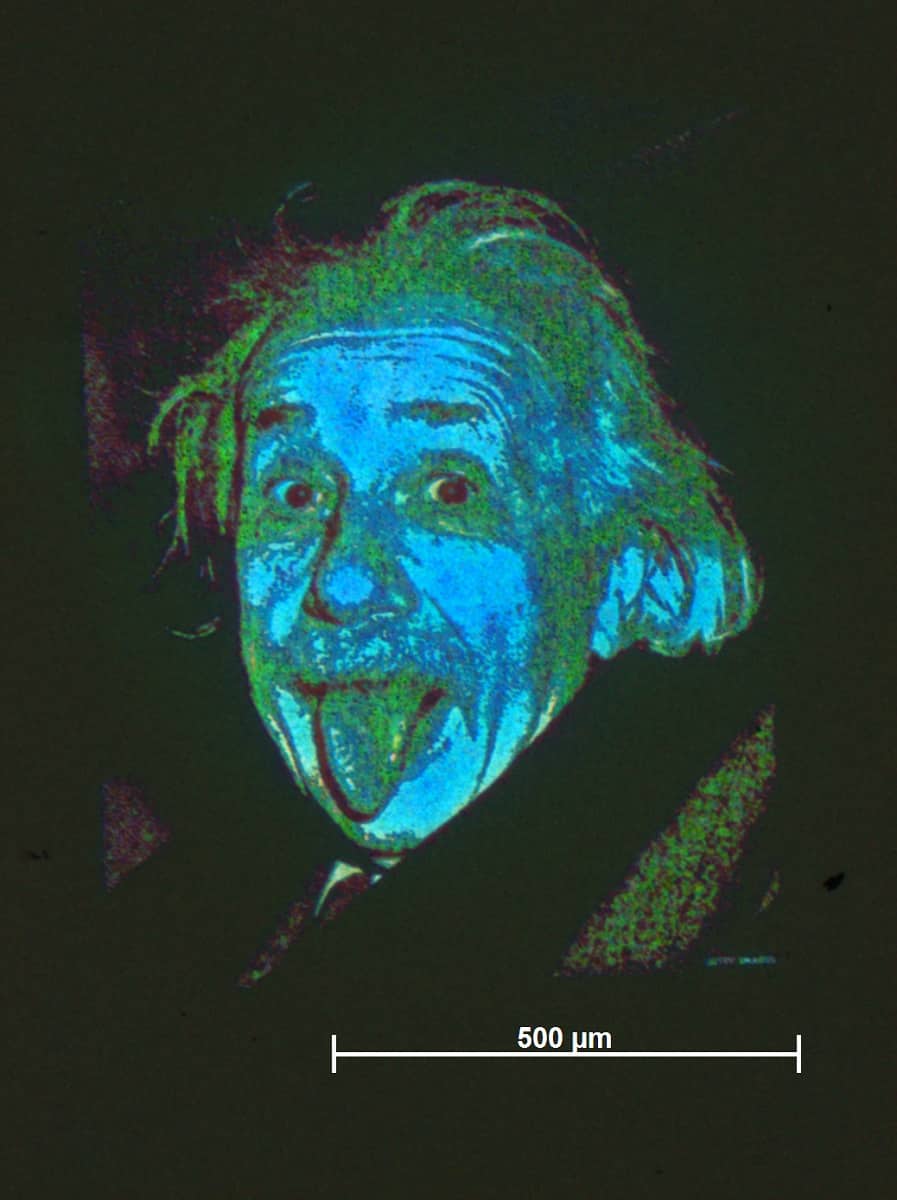
Controlled stress in polymers, including polystyrene, polycarbonate and polysulfone, can cause a change in visible-light reflection that results in inkless colouring, report researchers from the University of Kyoto, led by Easan Sivaniah in their recent Nature paper. They describe how they used the technique to produce high-resolution ‘structurally coloured’ polymers, without ink.
The researchers suggest multiple uses for this technology, including banknotes and rapid 3D-printing (using ink to colour 3D printing polymers is a rate-limiting step), food and medicine packaging, production of porous networks for gases and liquids, and use in wearable devices.
Example of crazed polymer of 1mm x 500μm photographed by Andrew Gibbons. The original picture was printed by Arthur Sasse (UPI) 1951.opti
Controlled Crazing
Molecular stress of polymers can lead to the formation of micropores and microfibrils within their structures. This phenomenon, called crazing, can cause material failure, but, if used in a controlled manner, it can tune the polymer’s colour.
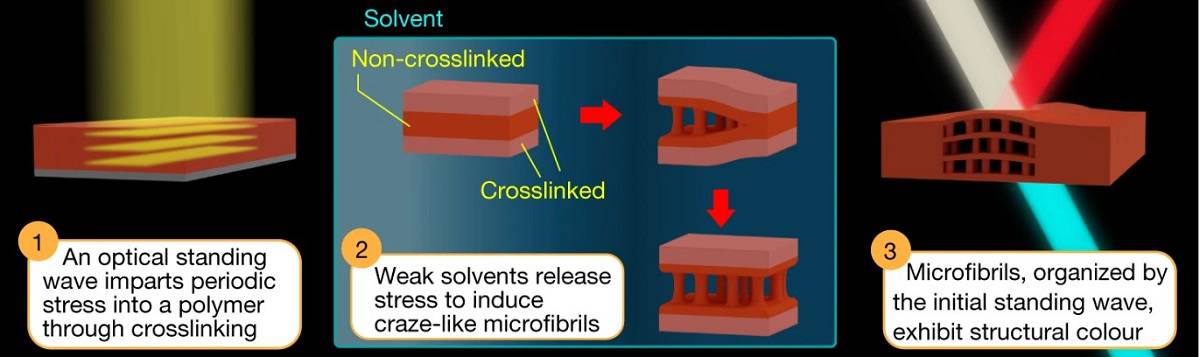
The interaction of standing-waves with polymers naturally produces cross-links (bonds between polymeric chains) in alternate layers, which causes stress in the non-crosslinked ones. In addition when a polymer interacts with non-dissolving solvents, it can relieve the stress and form crazes. The presence of these layered structures modifies the refractive index of the material and its light scattering properties.
Sivaniah and his team use this combination of standing-wave cross-link formation and non-dissolving solvents – to modify the polymer’s colour. The process – defined as organized stress microfibrillation – can lead to controlled and tunable crazing. By protecting the dark areas of the image from the standing wave and avoiding the formation of crosslinks they showed they could obtain patterns and images.
Method for preparation of crazed polymers. Credit: Nature Masateru M. Ito et al. (2019).
Technique improving
In principle, this method generates all the colours of the visible spectrum, by varying the craze structures and patterns. However, not every colour has been obtained so far. Exploring different conditions such as temperature, solvents and material may help to refine this technique, increasing its impact on applications of ink-free colour.
A new type of glass created by mimicking the nacre (or mother-of-pearl) structure in mollusc shells is ductile yet tough and highly resistant to impacts. The material could come in useful for countless applications, including windows, windshields, solar panels and touchscreens. The technique used to make it is also relatively easy and scalable, which means that it could readily be manufactured in industrial volumes and at a reasonable cost.
Glass has outstanding optical, thermal, chemical and electrical properties as well as being hard and durable, but it is inherently brittle and has poor impact resistance. Although lamination and tempering can improve its impact resistance so that it can be used in applications such as car windshields, for example, these techniques do not unfortunately reduce brittleness.
Bricks and mortar
Researchers led by François Barthelat of the Department of Mechanical Engineering at McGill University in Canada have now succeeded in duplicating the way mollusc shells make use of a brittle mineral (calcium carbonate) and turn it into the tough structure of their shells. These shells, which protect the soft bodies of molluscs from strong predator jaws, are made of nacre. This material has a complex hierarchical structure in which flat polygonal tablets or “bricks” of calcium carbonate are embedded in an organic biological polymer (protein) “mortar” and arranged in sheets.
Nacre is resistant to impacts thanks to the fact that the bricks in the material can slide past one another when stress is applied, so dissipating the energy of an impact and preventing shattering.
Laser engraves hexagonal patterns
Barthelat and colleagues engineered a laminated glass with similar properties using borosilicate glass sheets (220 μm thick) layered and bonded together using 125-μm-thick interlayers of the polymer ethylene-vinyl acetate, which is transparent. “This material is the same as traditional laminated glass except that we engrave a hexagonal pattern in each glass layer using a precision-focused ultraviolet laser beam,” explains Barthelat. “We then assemble the engraved glass layers with the polymer and precisely shift each layer with respect to the previous layer.”
This technique allows the researchers to obtain a staggered arrangement of the hexagonal tablets in 3D, much like a 3D brick wall. The mortar between the hexagons is the polymeric layer.
Two to three times more resistant
The bioinspired glass is two to three times more resistant to impacts than laminated and tempered glass while having the same static strength, says Barthelat. It also breaks in a “graceful” fashion, which means that instead of breaking catastrophically with many cracks and shards like regular glasses, it dents and deforms. “A window made of our material can thus be damaged or be punctured in a small area leaving the rest of the window intact. This damage tolerance is very different to that in regular glass, in which any local damage destroys the entire window.”
The researchers confirmed, using micro-computed tomography (CT) images, that it is indeed the sliding mechanism between the bricks in the material and the viscoelastic properties of the polymer matrix that give the glass its exceptional properties.
The glass is not perfect though and one of its main shortcomings is that it might be too ductile for some applications – like in large windows, for example. The researchers say that this problem could be overcome by adding layers of plain glass to the material, but this might make it as prone to breaking as normal glass even though it is more impact-resistant overall.
Powerful source of inspiration
“Our results prove again though that nature is a powerful source of inspiration for engineering materials design,” Barthelat tells Physics World. “And that controlling materials and architecture, even on the scale of millimetres (rather than the micro- or nanoscale), can produce outstanding properties and high-quality structures.”
The technique used to make the glass also proves that removing material and applying seemingly weakening processes can actually improve a structure, he adds. “Ask any glass scientist and they will tell you that shooting a powerful laser into a piece of glass is a bad idea because it creates defect and decreases strength, but we have shown that the opposite can be true.”
Towards bendable versions
“Glass has excellent optical properties and is a durable material, making it the material of choice in numerous applications, but glass components in a structure are always the “weakest links”. With our material, we address this drawback and have made glass tougher and more resistant to impact. This could extend its range of applications and operating conditions.
The McGill researchers, reporting their work in Science 10.1126/science.aaw8988, say they would now like to make nacre-glass materials in other shapes – such as curved and ultrathin structures for use in touch-screens, for example. “We would also like to develop bendable versions of our glass,” reveals Barthelat. “A thin plate of this glass would flex to large deformations and then recover without damage.” This type of structure might be used to make foldable screens.
The condensed-matter physicist Michael Pepper has won the Isaac Newton Medal and Prize “for the creation of the field of semiconductor nanoelectronics and discovery of new quantum phenomena”. Presented by the Institute of Physics (IOP), the international award is given annually for “world-leading contributions to physics”.
The Isaac Newton Medal and Prize attracts a prize of £1000 and is the only one of the IOP’s awards that is open to physicists worldwide. It also includes an invitation to give a lecture at the IOP.
Pepper holds the Pender Chair of Nanoelectronics at University College London and has an appointment at the London Centre for Nanotechnology. He is also chief scientific officer of the terahertz imaging company TeraView – which he cofounded in Cambridge in 2001.
Quantum hall effect
Pepper’s achievements include collaborating on research that led to the discovery of the quantum Hall effect in 1980 – work that won his colleague Klaus von Klitzing the 1985 Nobel Prize for Physics. Recent accomplishments include the first observation in 2018 of fractional quantized conductance in the absence of an applied magnetic field.
Pepper did a PhD in physics at the University of Reading in 1967 and then worked on semiconductor research at the Caswell Research Laboratory of the Plessey Company. In 1973 he joined the Cavendish Laboratory at the University of Cambridge where he collaborated with Nobel laureate Nevil Mott.
While at Cambridge he maintained strong connections with industry — collaborating with General Electric and becoming managing director of the newly-established Toshiba Cambridge Research Centre in 1991. Pepper received a knighthood in the 2006 for his services to physics and joined University College London in 2009.
“I am greatly honoured to receive this prestigious award from the IOP for work which is based on collaboration with many colleagues to whom I am greatly indebted,” says Pepper.
The IOP has also announced the winners of 25 other awards today and you can find a full list here. Among the winners is Philip Ball, a science journalist and regular contributor to Physics World. He takes home the William Thomson, Lord Kelvin Medal and Prize “for being an informed and lucid writer and broadcaster who opens doors into science, and especially physics, for many people who otherwise find them closed”.