

New definition of the kilogram comes into force

The redefinition of four units of the International System of Units (SI) will come into effect on Monday 20 May meaning that all seven base units are now based on fundamental physical constants. The kilogram, the ampere, the kelvin and the mole are now defined in terms of physical constants rather than an object or phenomenon. The decision to redefine of the four SI base units was taken in November 2018 when metrologists and policy-makers from 60 countries around the world met at the General Conference on Weights and Measures in Versailles, France. The change will now become a reality on 20 May to mark World Metrology Day.

There are seven base units of the SI: the second, metre, kilogram, ampere, kelvin, mole and candela.  Some have long been based on physical constants. The second, for example, is set as 9,192,631,770 times the period of the radiation corresponding to the transition between the two hyperfine levels of the ground state of the caesium-133 atom. The metre, meanwhile, has been defined since 1983 as the length of the path travelled by light in vacuum during a time interval of 1/299,792,458 seconds.

The biggest change is to the kilogram, which was set by a 143-year-old platinum alloy cylinder, dubbed “Le Grand K” housed in the International Bureau of Weights and Measures (BIPM) in Paris. The kilogram is now defined in terms of the Planck constant, h, which has been measured with extraordinary precision in recent years. Its agreed value will be set as 6.626,070,15 × 10-34 kg m2 s–1, with researchers able to make precise mass measurement using equipment such as the Kibble balance.

Universal constants

“The redefinition of the kilogram may seem like a small change, but it will have an enormous impact on science,” says Ian Robinson from the UK’s National Physical Laboratory. “There will be no change to the mass scale currently used in trade and industry, but by using a universal constant of nature to ensure the long-term stability of the kilogram, we are both reunifying the SI and setting the stage for robust, reliable science that could pave the way for new ideas and inventions.”

The ampere, meanwhile, will now be set by the elementary electrical charge, e, which is given as 1.602,176,634 × 10-19 when expressed in coulombs. The kelvin is defined by taking the fixed numerical value of the Boltzmann constant k to be 1.380,649 × 10-23 when expressed in the unit J K-1 . Finally, the mole is defined as the amount of substance with exactly 6.02,214,076 × 1023 elementary entities. This number is the fixed numerical value of the Avogadro constant, NA, when expressed in the unit mol-1.
Atomic force microscopy goes 3D

Constant current AFM

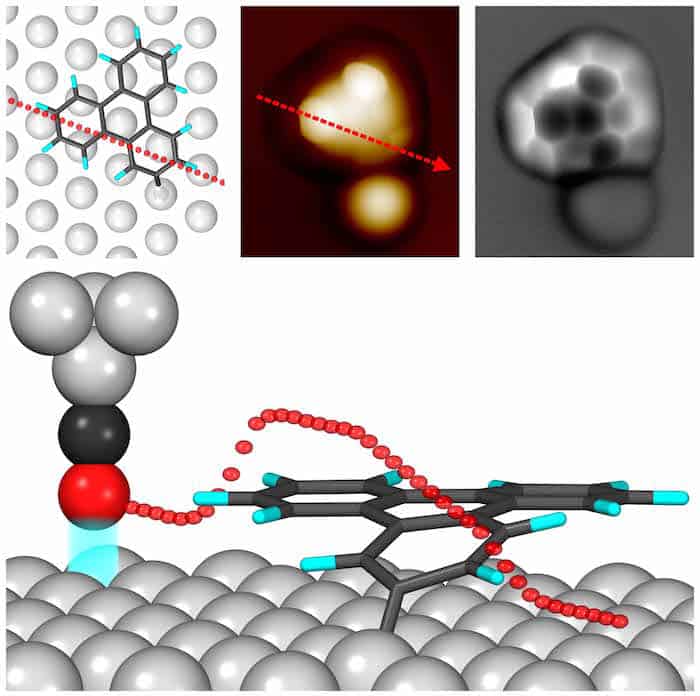
Ten years ago, researchers succeeded in significantly increasing the lateral resolution of low temperature atomic force microscopy (AFM) by functionalizing the AFM tip with a single carbon monoxide (CO) molecule. This so-called bond-imaging technique was a new landmark for visualizing the atomic structure of single molecules. Unfortunately, the technique, which works by scanning the AFM tip, kept at a constant height, across a surface sample, is only suitable for flat or nearly flat molecules and not bulky, 3D ones. A team at the Justus Liebig University Giessen in Germany has now overcome this problem by exploiting the tunnelling current between the AFM tip and sample to control the tip height so that it closely follows the molecule’s topography.

Both AFM and STM (scanning tunnelling microscopy) were invented in the 1980s and both make use of a sharp tip that scans the sample surface to produce an image of it. STM measures the tunnelling current that flows between the tip and the sample while AFM exploits the force that the surface exerts on the tip. Researchers often use both techniques at the same time – STM to obtain information on a sample’s electronic structure and AFM on its atomic structure.

In bond-imaging AFM, the CO molecule at the AFM tip acts as a tiny force sensor and usually works in constant-height mode, explains Daniel Ebeling, who led this new research effort. Here, the tip that is attached to one prong of an oscillating quartz tuning fork is scanned across the surface of a molecule. This leads to small changes in the resonant frequency of the tuning fork that can be monitored. Repulsive interactions between the CO tip and the atoms of the molecules being imaged produce positive frequency shifts and bright image contrast, while attractive interactions lead to negative frequency shifts and dark contrast. In this way, an image reflecting the bond structure of the molecule can be obtained.

While the method is perfectly suited to analyse flat molecules, it falls short when imaging bulky, non-planar ones. The reason is straightforward: only the top of the 3D object can be imaged since the frequency shift is measured at a constant height and the tip is simply too far from areas underneath to collect a useful signal.

Exploiting the constant tunnelling current mode of an STM

Being able to make the AFM tip closely track a molecule’s topography would be a solution to this problem. Previous attempts to do this, however, have involved complex procedures and additional apparatus.

Ebeling and colleagues have now found a way around this stumbling block by exploiting the constant tunnelling current mode of an STM instead of operating the AFM at a constant height. Since the tunnelling current between the AFM tip and the sample surface depends on the distance between them, this means that the tip’s height can track the molecule’s topography during scanning.

“At the same time, we can achieve sub-molecular contrast by monitoring the frequency shift channel,” says Ebeling. “This simple method, which can be easily implemented on any noncontact AFM setup, allows us to directly image 3D molecular structures.”

The new technique yields the same information as the classic bond-imaging technique for flat surfaces, he adds.

Valuable add-on

In their experiments, the researchers began by studying a flat molecule, 2-iodotriphenylene (ITP) (C18H11I) deposited on a silver (Ag) substrate. They then removed one of the iodine atoms on the molecule, which made it form a radical with a complex 3D structure.

“In this molecule, one of the carbon rings is bent towards the Ag(111) surface since the position of the radical at the corner of the molecule is strongly interacting with the Ag,” explains Ebeling. “We cannot detect this tilted carbon ring in conventional constant-height mode since it is too far away from the tip. In constant-current mode, however, it is possible to image it and even determine its tilting angle, thanks to the tip-sample feedback signal.”

The new technique represents a valuable add-on that could be widely applied in the field of surface science for studying 3D molecular systems, he tells Physics World. “Self-assembly processes, molecular recognition, and on-surface reactions of bulky compounds are some of the phenomena that could be investigated.”

Ideal for taking large overview scans

“We also show that the technique is ideal for taking large overview scans over obstacles, such as step edges, on sample surfaces without the risk of the tip crashing into them thanks to the tip-sample feedback.”

And that is not all. Ebeling says that the parameters of this STM feedback can be adjusted to obtain atomic-scale images of the substrate on which the molecule sits. This allows the researchers to determine molecular adsorption sites and how molecular properties are modified by the surface.

The Giessen team, reporting its present work in Physical Review Letters, has already used the technique to image aliphatic compounds such as diamondoids and for imaging nanographenes with bulky functional groups, which proves just how versatile the method is. “We will now be focusing on developing further operational modes. We are, for example, looking into whether the technique can be used with multifrequency imaging schemes, in which several eigenmodes of the tuning fork sensor are simultaneously excited,” reveals Ebeling.

Boron neutron capture therapy progresses towards clinical cancer treatments

Boron neutron capture therapy (BNCT) delivers targeted radiation directly into tumour cells, with minimal damage to healthy tissue. It offers the potential to treat micrometastases that can’t be visualized on medical images and typically requires just one or two treatment sessions. So why is BNCT not yet a mainstream cancer treatment?

The main obstacle is that, historically, BNCT required a nuclear reactor to generate the neutron beams needed for treatments. To overcome this problem, California-based TAE Life Sciences is developing an accelerator-based neutron source. “We have created a low-energy neutron beam source that is reliable, compact and can be installed in a hospital facility,” says Bruce Bauer, CEO of TAE Life Sciences. “This changes the game on BNCT.”

BNCT is a two-step treatment. First, the patient is given a drug that contains boron-10 and preferentially targets cancer cells. The drug is non-toxic and has no effect on its own. The most prevalent targeting drug is boronophenylalanine (BPA), which is taken up by highly metabolic cells and accumulates roughly 3.5 times more in cancer cells than in normal cells.

Bruce Bauer

Next, the tumour region is irradiated with a low-energy neutron beam, which also causes little impact on tissue by itself. When the neutrons impact the boron atoms, however, this causes a fission reaction that creates two alpha particles. These high-linear-energy-transfer particles cause double-strand breaks within the cell, with about three times the relative biological effectiveness of photon or proton irradiation.

“This is cellular targeted particle therapy, where the cytotoxic radiation is generated by secondary reactions inside the cell,” Bauer explains. “The benefits are that it delivers far more lethal damage and the damage is limited to just that cell.”

Early promise

Around 2000 patients have been treated with BNCT over the last couple of decades, until recently, using nuclear reactors as the neutron source. “The results were encouraging enough to keep the research efforts alive,” says Bauer. “But everyone said that this will only have a future once you can generate neutrons in a hospital facility.”

TAE Life Sciences’ neutron generator is a product of 20 years of research and development by its parent company TAE Technologies, a specialist in fusion energy technology. “Our accelerator has a unique design, it is a component of their fusion reactor, downsized to create an accelerator that’s well suited for medical use,” says Bauer. He notes that the system can be installed in a single room and requires less than 1 m of shielding.

The accelerator also benefits from generating an ideal energy spectrum for BNCT: 1–30 keV neutrons. Lower energies can lead to surface damage, while higher energies cause more damage while traversing tissue. TAE Life Sciences’ beam has very few neutrons on either side of that spectrum, minimizing side-effects from the neutron beam.

Bauer notes that a few other companies are also creating accelerator-based neutron sources, including Sumitomo, which is developing a cyclotron, and Massachusetts-based Neutron Therapeutics, which last month installed its accelerator-based BNCT system at the University of Helsinki. “The first wave of these systems are now being installed in clinics,” he says, noting that Japan is pioneering this treatment with over six BNCT programmes underway. “Over the next two years we will see more of these systems being installed.”

Clinical transition

Because it enables cellular targeting, BNCT is ideally placed to treat complex targets, such as tumours that infiltrate normal tissue or are near critical structures, as well as radioresistant and recurrent tumours. And for large head-and-neck tumours, BNCT provides better cosmetic outcomes and less scarring than surgery or standard radiotherapy.

“BNCT lends itself well to cancers that are difficult to map and treat by other means,” says Bauer. “It has been shown to be very well tolerated, with negative side effects substantially less than other treatments. This gives another option to the oncologists.” It is also more convenient for the patient, as only one or two treatment fractions are required and less immobilization is needed than with conventional radiotherapy.

The targeting drugs used to deliver boron-10 are also under continual development. And as better drugs become available, this will enable treatment of more diseases, such as glioblastoma, for example, where early studies have shown promise. Once proven, BNCT could be employed to treat a broader range of cancers, such as liver, lung and breast tumours

“The first-generation data are encouraging, we need to show that we can optimize the neutron source and understand the dosimetry in order to treat larger cohorts of patients,” Bauer tells Physics World. “We want BNCT to be part of the cancer treatment arsenal, complementing existing treatments and eventually as its own modality.”

TAE Life Sciences will install its first BNCT system later this year in China, with the first patient treatment aimed for next year.

Crops at risk from changing climate

Climate change is leaving crops at risk. Driven by global warming – and with it ever greater extremes of heat, drought and rainfall – the rising mercury can explain up to half of all variations in harvest yields worldwide.

Unusually cold nights, ever greater numbers of extremely hot summer days, weeks with no rainfall, or torrents of storm-driven precipitation, account for somewhere between a fifth to 49% of yield losses for maize, rice, spring wheat and soy beans.

And once international scientists had eliminated the effect of temperature averages across the whole growing season, they still found that heatwaves, drought and torrential downfall accounted for 18% to 43% of losses.

In a second study, US researchers have a warning for the Midwest’s maize farmers: too much rain is just as bad for the harvest as too much heat and a long dry spell.

In a third study, British researchers have identified a new climate hazard for one of the tropical world’s staples: climate change has heightened the risk of a devastating fungal infection that is already ravaging banana plantations in Latin America and the Caribbean.

The impact of climate change driven by global warming fuelled by profligate fossil fuel use had been worrying ministries and agricultural researchers for years: more carbon dioxide should and sometimes could mean a greener world.

More warmth and earlier springs mean a longer growing season with lower risks of late frost. A warmer atmosphere can hold more moisture, which means ultimately more rainfall.

But the average rise in temperature worldwide of just 1 °C in the last century is exactly that: an average. What cities and countryside have observed is an increase both in the number and intensity of potentially lethal heatwaves, of longer and more frequent parching in those landscapes that are normally dry, with heavier downpours in places that can depend on reliable rainfall.

Knowledge allows preparation

In Europethe US and Africa, researchers have started to measure the cost to the grains, pulses and tubers that feed 7.7 billion people now, and will have to feed 9 billion later this century.

Scientists in Australia, Germany, Spain, Switzerland and the US report in the journal Environmental Research Letters that they developed a machine-learning algorithm to make sense of climate data and harvest data collected worldwide from 1961 to 2008.

The aim was to isolate the factors within climate change that might affect harvests, on the principle that if farmers know the hazards, they can prepare.

“Interestingly, we found that the most important climate factors for yield anomalies were related to temperature, not precipitation, as one could expect, with average growing season temperature and temperature extremes playing a dominant role in predicting crop yields,” said Elisabeth Vogel of the University of Melbourne, who led the study.

Big picture reached

Nowhere was this more visible than in the figures for maize yield in Africa. “While Africa’s share of global maize production may be small, the largest part of that production goes to human consumption – compared to just 3% in North America – making it critical for food security in the region.”

Dr Vogel and her colleagues looked at crop yields, mean seasonal temperatures, extremes and regions to arrive at their big picture. But impacts of extremes vary according to region, soil, latitude and other factors too.

US scientists report in the journal Global Change Biology that yield statistics and crop insurance data from 1981 to 2016 on the Midwest maize harvest told them a slightly different story. In some years excessive rain reduced the corn yield by as much as 34%; drought and heat in turn could be linked to losses of 37%. It depended on where the crop was grown.

“As rainfall becomes more extreme, crop insurance needs to evolve to better meet planting challenges faced by farmers,” said Gary Schnitkey of the University of Urbana-Champaign, one of the authors.

Bananas in danger

And British scientists report in the Philosophical Transactions of the Royal Society B that changes in temperature and moisture linked to global warming could be bad for the banana crop.

These have increased the risk of infection by the fungus Pseudocercospora fijiensis, or Black Sigatoka disease, by more than 44% in Latin America and the Caribbean. The disease can reduce yield in infected plants by up to 80%.

“Climate change has made temperatures better for spore germination and growth, and made crop canopies wetter, raising the risk of Black Sigatoka infection in many banana-growing areas of Latin America,” said Daniel Bebber, of the University of Exeter.

“While fungus is likely to have been introduced to Honduras on plants imported from Asia for breeding research, our models indicate that climate change over the past 60 years has exacerbated its impact.”

Plans for particle colliders and intriguing neutrino results

In this week’s episode of the Physics World Weekly podcast, Hamish Johnston discusses the future prospects for particle physics. Hamish reports back from the April Meeting of the American Physical Society in Denver, Colorado, where he spoke to Fermilab’s Vladimir Shiltsev about the process of selecting the next big European collider that could one day replace the LHC. Shiltsev is one of many particle physicists who gathered in Spain this week to discuss various proposals from the community, including the 100 km Future Circular Collider that some physicists want to build at CERN.

But particle physics is not all about colliders. Hamish also speaks to Alysia Marino and Eric Zimmerman of the University of Colorado about recent findings in neutrino physics. As well as explaining what we can learn from these ghostly particles, Marino and Zimmerman discuss intriguing results from the T2K neutrino experiment in Japan that could offer some clues to help solve the mystery of why the Universe contains more matter than antimatter.

European physicists look to the future of particle colliders

Hundreds of physicists from Europe and beyond have met in Granada, Spain to develop a plan for a next-generation collider that will eventually supersede the Large Hadron Collider (LHC) at CERN. While no decisions were taken about specific collider technologies at the open symposium of the European Strategy for Particle Physics, the 600 participants had their say on the important physics questions that need to be addressed by future collider facilities.

Speaking after the meeting, Ursula Bassler, president of the CERN Council, said it is “important for decision makers to get a very broad input from as may physicists as possible. It is important to hear what the scientists say, not just heads of labs.”

Fabiola Gianotti, director-general of CERN, said she received two main messages from the meeting. “Number one is that the particle-physics community is incredibly productive,” she said. “It’s amazing to see how much we have done since the last European Strategy for Particle Physics in 2013. The second message is there is an incredible amount of ideas.” Among the many “interesting questions” that she said Europe needed to address were the Higgs boson, dark matter and the “flavour problem”.  “The Higgs is still mysterious [and] understanding the behaviour of the Higgs boson is a must. “

“Frank and open discussions”

Fermilab’s Vladimir Shiltsev told Physics World that he was very pleased that participants from across the particle-physics community were able to have “frank and open discussions” at the meeting, adding, “participants did not stay away from hard questions”. Shiltsev, who has worked on accelerators worldwide said that he was also impressed with the organization that was done before the symposium that resulted in more than “160 well-thought-through input documents and suggestions that allowed fact-based discussions to take place in Granada”.

Europe is not the only region that could host a next-generation collider, with plans afoot in both Japan and China. Indeed, about 15% of participants in Granada were from outside of Europe and Gianotti says that global cooperation will be crucial for the future success of particle physics. She added that it is possible that CERN could participate in collider projects outside of Europe but said that it is crucial that Europe has its own next-generation collider. Bassler adds that there is a strong will in the European physics community to have a facility in Europe – adding that Europe is leading the way towards a next-generation collider.

One CERN proposal for a next-generation collider is the Future Circular Collider, which would have a 100 km circumference and collide protons at energies up to 100 TeV. In contrast, the LHC has a 27 km circumference and a collision energy of 13 TeV. Another CERN proposal is the Compact Linear Collider, which would smash together electrons and positrons.

  • You can listen to Vladimir Shiltsev talk about the process of selecting a next-generation collider in the latest Physics World Weekly

Graphite lithium-ion batteries get a boost from halogen intercalation

Lithium ion batteries are a useful and powerful energy storage option. Commonly used in products ranging from portable electronics to hybrid and electric cars, these batteries show high overall stability and are low maintenance. Lithium ion batteries also display higher charge storage densities and voltages and consistently out-perform typical lead-acid batteries, as the small lithium-ions can pack densely into the anode material.

To further improve battery performance, researchers Chongyin Yang and Ji Chen with co-workers under the direction of Chunsheng Wang at University of Maryland developed a novel graphite lithium ion battery that utilizes high density helper ion packing and a unique water-in-salt electrolyte to achieve a potential of over 4 volts in aqueous batteries. The aqueous nature of their battery is also an advantage, because as the researchers highlight in their report, the intercalation of the helper ions within a water environment “comes with intrinsic safety and environment insensitivity.”

Ions in close quarters

Graphite, stacked layers of the two-dimensional nanomaterial graphene, excels as a battery anode material, particularly in lithium ion batteries where ion packing directly correlates to battery performance. Graphite has a high capacity of 372 mAhg-1 for lithium ions in between its graphene layers. Polyhalogen ions can also insert themselves into the graphite.

University of Maryland has collaborated with Army Research Lab on water-in-salt electrolyte batteries for several years. As a result Yang and Chen et al. were able to use graphite’s advantages along with helper halide ions to achieve a “densely packed stage-I graphite intercalation compound, C3.5[Br0.5Cl0.5].” Specifically, they designed an electrode containing lithium and the helper halide ions. When exposed to the aqueous electrolyte solution and charged, the halide ions give up electrons and lithium ions travel through the battery to the cathode, a favorable reaction that generates a useful current. The helper halides then intercalate into the graphite. This insertion stabilizes the halogens and makes the entire process energetically favorable.

An excellent battery that goes and goes and goes

This helper halide insertion process is very reversible, meaning the battery can be recharged and used multiple times without a major loss in performance. Yang and Chen et al. measured battery performance over usage to find a typical capacity of 243 mAhg-1 with an average voltage of 4.2 V, and 74% of this capacity was retained over 150 battery cycles, meaning battery performance remained consistent over usage. Impressively, this novel battery displayed an energy density of 460 Whkg-1 at material level. For comparison, lead-acid batteries show energy densities around 40 Whkg-1 and leading lithium ion batteries display values near 350 Whkg-1.

Reversible packing

A key component of this consistency and excellent performance is the reversibility of the helper ion intercalation. By using extensive Raman spectroscopy, Yang and Chen et al. show that the helper halide ions pack into the graphite instead of absorbing onto the outside graphite surface. This allows more ions to intercalate, meaning more lithium ions are free to move across the cell and generate a useful current. Upon charging, lithium ions move back across the cell and recombine with the helper halide ions, as released from the graphite.

Additional X-ray diffraction and absorption data show optimal close-packing within graphite occurs when the chloride and bromide ions alternate, which was also confirmed using density functional theory calculations. This implies both halide helpers are required to make the lithium ion movement across the battery favorable. Additionally, without the graphite present to stabilize the ions post-electron loss, the halides may gas off.

Yang and Chen et al. hope this novel battery design will eliminate previous flammability issues with lithium ion batteries while also offering “an energy-dense concept for a future battery that is cost-effective, safe, and flexible.”

Full details are reported in: Nature

New device excels at making hydrogen using concentrated sunlight

The large-scale and renewable production of hydrogen could soon be possible thanks to a new photoelectrochemical device that is driven by concentrated sunlight. When scaled-up, the technology could revolutionize how hydrogen is produced and make the gas a viable alternative to fossil fuels.

Sunlight and water are both in great abundance on Earth so using light to split water molecules to create hydrogen fuel has great potential for creating a clean and renewable energy source. Now mechanical engineers at the Swiss Federal Institute of Technology in Lausanne (EPFL), led by Sophia Haussener, have created an electrochemical device that uses concentrated solar radiation to create hydrogen fuel from water with no undesirable byproducts.

The demonstrator device can be held in one hand and consists of a triple junction tandem photovoltaic cell (or photoabsorber) that is integrated directly with an electrochemical cell that incorporates catalysts. Water performs two functions in the device: it is both a reactant and a cooling agent that controls the temperature of the photoabsorber. The dissipated heat also finds a use – it enhances the rate of the catalytic reaction.

Innovative use of heat

“Using water with a double purpose is the specialty and the real innovation [of the device],” says Haussener. “The water first flows across the photoabsorber, is heated up by cooling the photoabsorber and then drops to the backside, where the higher temperature electrochemical reaction takes place,” she explains.

Concentrated sunlight strikes the device, creating electron-hole pairs. After separation, the holes are used to drive anodic oxygen evolution, whereas the electrons drive cathodic hydrogen evolution. Commercially-available catalysts support and enhance the reaction rate. The device was tested under lab conditions, where it operated under concentrated artificial solar irradiation originating from lamps with an intensity up to 474 kWm−2.

Concentrating sunlight instead of using more photoabsorber and catalyst materials limits the overall size and cost of the system – thus reducing its environmental impact and the cost of the produced hydrogen.

Still more expensive

However, making hydrogen this way is not yet commercially competitive with producing the gas from fossil fuels, explains Haussener. “Initially, [hydrogen production] will be more expensive than what is currently being produced by a non-renewable way of steam reforming of natural gas,” she says. “The price difference will not be orders of magnitude, but rather two to four times more expensive.”

Even at a higher production cost, there are several reasons why solar hydrogen could be attractive. It can be made on-demand and on-site, for example, thus eliminating costs associated with transportation and long-term storage. The process also delivers hydrogen at a very high purity.

The system itself has some important limitations. Deionized water must be used as the reactant, for example and the researches reckon that the catalyst must be replaced every four years.

Scaled-up version

While the amount of hydrogen produced by the lab-scale demonstration is rather modest, only tens of milligrams per minute are formed, the team is developing a scaled-up version that should produce nearly one kilogram per day – depending on the local solar flux.

This larger version is being built outdoors and uses a parabolic mirror with a diameter of 7 m to concentrate the solar radiation by a factor of 1000 (see figure). “The dish is already installed at the EPFL campus and we are finalizing the installation of the reactor, which is the core piece of the whole system,” says Haussener, adding “We hope that in the next two to three months the system might be inaugurated”. A start-up company called SOH-Hytec is working towards commercializing the technology.

Artur Braun at EMPA, the Swiss materials science and technology lab, says “the concentration of solar energy by using focusing mirrors brings an economical advantage because a large area of projected solar light can be collected cheaply and then focused on a small photoelectrochemical reactor”. Braun, who was not involved in the development of the device adds, “The other advantage [of the device] is that it uses the thermal energy from the Sun, which is typically not used in solar photovoltaic and solar photoelectrochemical reactors”. As a result he says the system should be “seriously considered as one additional alternative for solar hydrogen fuel production”.

The new device is described in Nature Energy.

Battle of the elements: nitrogen gives life and takes it away

Nitrogen. It’s a gas. (Addendum for pedants: it’s a gas at standard temperature and pressure when two atoms of this element bind together with a strong triple bond.) Nitrogen may not have the glamour of a shiny conductive metal, but it brings us life. None of us could exist without this group 15 element inside the proteins, DNA, RNA and energy-carrying adenosine triphosphate (ATP) that make up our cells; that’s why it gets my vote. No nitrogen, no physicists.

Physicists use nitrogen outside their bodies too. It’s a key constituent of caffeine, and in pure liquid form nitrogen brings cooling to 77 K, or 63 K in a vacuum. That’s essential for many applications in cryogenics, superconductivity, space-craft testing, astronomy, blood storage, wart removal, ice cream production and more, as well as science outreach demos involving clouds of Frankenstein-like smoky vapour.

Nitrogen gas isn’t only found in labs and demos – it makes up nearly four-fifths of our atmosphere. Our bodies can’t absorb it from the air, that triple bond is too strong for us. We get our nitrogen from plants, which take it from nitrogen-fixing bacteria in the soil.

We couldn’t fix nitrogen from air ourselves until Fritz Haber and Carl Bosch developed a chemical technique in the early 20th century, destroying the trade in guano – nitrogen-rich bird droppings – in one fell swoop. The new chemistry was a key factor in the Green Revolution of the 1960s, with chemical fertilizers such as ammonia and nitrates enabling the growth of more food. Polymers containing nitrogen have also enabled modern materials such as Kevlar and superglue.

But nitrogen has a dark side too. If excess nitrates flow from our fertilized fields into rivers and the sea, blooms of toxic plankton flourish. Nitrogen oxides bring us acid rain, destroy the ozone layer, or act as greenhouse gases. And nitrogen is a key component of many explosives; when nitrogen atoms bonded into those compounds reform molecules of nitrogen gas, they free large amounts of energy. This element both brings life and takes it away. But without it there’s nothing.

What’s your favourite element? Contact us at pwld@ioppublishing.org with your pick – and the reason why – or via Twitter using the hashtag #battleofelements.

  • This article was updated on 22nd May to correct the section about explosives.

Across the universe

When you think about the universe, the stuff within it and just the sheer vastness of its grandeur, it is easy to find yourself simultaneously fascinated and overwhelmed by it all. However, something I have found with popular-science books that take on this overarching subject is that they pack too much into a limited number of pages, potentially leaving a reader with a blown mind that absorbed nothing once they have turned the final page.

But as soon as I finished the first chapter of Paul Parsons’ The Beginning and the End of Everything: From the Big Bang to the End of the Universe I realized this would be a different type of read. This is not so much a book, but a guided tour from the beginning to the present and on to the sobering end of the universe as we currently understand it. Indeed, Parsons’ offering stands apart from other such books because it educates as well as entertains, with light touches of humour interwoven throughout.

Parsons begins with a detailed introduction to the universe, which in the 13.8 billion years since its birth has gone from something smaller than a subatomic particle, to the unimaginably vast entity it is today, all thanks to a mysteriously cataclysmic event known as the Big Bang. However, this isn’t just a tale about the universe – it is an enlightening account of humankind’s journey towards understanding and explaining the origins of our universe and our place within it. The book touches on Ptolemy’s geocentric model – where the Earth sat at the centre of the universe while all celestial objects, including the planets, Sun and stars, orbited around it – and the heliocentric model that we have used since the 16th and 17th centuries, in which it is the Sun, not the Earth, that sits at the centre.

As Parsons brings to light, we have come a long way in our understanding of the universe since then, thanks to many curious minds. They include Isaac Newton and his formulation of his three laws of motion, which quantified the gravity between two objects and paved the way for Albert Einstein’s ground-breaking theories that laid the groundwork for modern cosmology.

The chapters in this book take on heavy subjects including the Big Bang, the birth of galaxies, the existence of dark matter, quantum theory and even the “Big Crunch” theory – a hypothetical scenario where our universe stops expanding, and instead begins to contract until all the matter in it collapses to a singularity. These are weighty topics and Parsons has a lot of ground to cover in fewer than 300 pages – but I found that each chapter provided the perfect amount of introductory information to act as a guide to those areas, without overloading the reader. Indeed, there was enough intrigue to make you want to go and learn more for yourself.

One subject that Parsons tackles is one of the biggest unsolved mysteries in astronomy: dark matter, a form of matter thought to make up 95% of the universe. As we are still unsure what constitutes dark matter, Parsons turns his attention to how the concept was first conceived, introducing us to the astronomers from Jan Oort and Fritz Zwicky, who proposed the concept in the 1930s, to American astronomer Vera Rubin’s studies on rotation curves of disc galaxies, uncovering the discrepancy between predicted angular motions of galaxies and observed motions. Her work led to the realization that there is matter we cannot see, which nevertheless influences how galaxies move. This chapter is short and sweet and those readers after something more in-depth on dark matter might feel short-changed. However, Parsons offers plenty to whet your appetite on the subject.

What Parsons has done with The Beginning and The End of Everything is take the reader on an eye-opening tour of the entire cosmology of the universe, adding the physics to support it, but without the maths and complicated details

What Parsons has done with The Beginning and The End of Everything is take the reader on an eye-opening tour of the entire cosmology of the universe, adding the physics to support it, but without the maths and complicated details. He also includes the history of the development of theories that have led to our current understanding of how the universe came to be and how it is currently evolving.

Parsons’ narrative is vast and involving, but told in a warm and engaging way from the perspective of a person who has not only a great knowledge of the subject, but also an enthusiasm that shines through each page. Clearly and accessibly, he explains the complex science of how the universe came into being and how it is likely to end. This book is a wonderful addition to the popular-science genre, and has taken a subject that normally sits firmly in the university lecture theatre, and bought it to life in a way that will appeal to both an experienced cosmologist and anyone looking for an introduction to the subject.https://www.mombooks.com/book/the-beginning-and-the-end-of-everything/

  • 2018 Michael O’Mara Books 288pp £16.99hb

Copyright © 2026 by IOP Publishing Ltd and individual contributors