Global energy challenges: is there room for growth?

Many global energy scenarios see renewables as expanding rapidly, with projections from the IRENA ranging past 50-60% by 2040 on the way to 80% or more of global electricity by 2050. Some even look to 100% by then. However, others offer slower expansion projections. One energy company thinks renewables will supply about 30% of global electricity by 2040, another 45%. Even so, a 50% share of electricity supply by around 2050 now seems an unexceptional global aim. Some countries can do much better than that. Several countries are already at well over 50% and, with generation costs falling, many others should be able to follow their lead. It may be worth noting that, according to an OECD/NEA report, between 2008 and 2015 renewable energy deployment “caused an electricity market price reduction of 24% in Germany and of 35% in Sweden”.

While attaining high electricity contributions seems relatively straightforward, many countries have found it harder to meet heat and transport needs directly from renewables. Instead the main approach has been to try to use electricity for electric vehicles while, in some cases, the plan is to install electric heat pumps for domestic heating. However, rates of growth of renewable electricity have fallen in some countries. For example, the demise of Feed-In Tariffs across Europe has slowed deployment rates and China has throttled back on its very rapid PV expansion to reduce subsidy costs. The result of this, along with continued growth in energy demand in most countries, for transport use especially, is that emissions have risen — the switch to electric vehicles has not as yet had much impact. Although the use of coal for power production is being phased out in many countries, it is still expanding in some.

The call to consider what some may see as desperate, expensive and possibly dangerous technical measures heightens the underlying more fundamental debate over the role of economic growth

The situation isn’t entirely gloomy. Demand for electricity had fallen in some countries, notably the UK, but with demand for oil (for transport) and coal (for power) still growing globally, the prospects are not too good and the IPCC is painting ever-worsening pictures of what horrors climate change may bring if we do not act soon. In response, while some call for much more attention to be given to energy efficiency and to much more rapid expansion of renewables, including non-electrical renewables, others suggest that urgent attention should also be given to carbon capture technology, including carbon negative initiatives, as well as to nuclear power and even to planetary geoengineering.

Can growth continue for ever?

The call to consider what some may see as desperate, expensive and possibly dangerous technical measures heightens the underlying more fundamental debate over the role of economic growth. Can it really be sustained on a finite planet even given clever new technologies? The debate has become rather polarized.  Bloomberg’s Michael Liebreich has put the essentially technological/market fix view that growth is vital for humanity. Pushing an ecological view, Tim Jackson from the University of Surrey, UK, says that it is not, actually it’s lethal for the planet.

The Post Carbon Institute in the US has been struggling with this issue for some time, looking to stable state economics. It’s no longer a fringe issue. Leading US journal Foreign Policy has asked whether economic growth can continue, even so-called “green growth”. Certainly, a deep green view is that on its own, green energy is little use unless growth is tamed. But growth is collapsing as global economies falter. Tim Jackson says that economic stagnation is likely, a social and economic disaster given the way the world is run at present, but a boon for almost all – and the planet – if we consciously designed a sustainable stable state economy.

The debate continues, with a core issue being whether what’s sometimes called eco-modernism can really enable sustainable growth. Technology may be able to help but possibly the real issue is whether we can change our consumption patterns and expectations.

Although some look to major social and economic changes as vital, some of the changes needed may not have to be that radical — for example, changes in diet away from so much meat-eating would help a lot. And that has begun to appear in plans and scenarios. For some that might be perceived as an appalling infringement on individual freedom, almost as bad as the parallel recommendation that population growth should be reduced. And as for the idea that we should fly less, well that’s heresy! Dare I add to the sense of injury by noting that carbon emissions from the energy supplies needed to run IT systems, including mobile devices and servers, is now said to be comparable with those from aircraft. I can envisage laptop and smart phone users talking of resistance to prising these devices from their “cold dead hands”.

Hope for the future

Are things quite so desperate? Some global political trends are not good. For example, it’s commonplace to worry about the climate impacts of Trump’s policies. Yet US emissions are falling and renewables are still booming there, as in most places, although the export of coal by the US (and gas from Russia) will undermine global emission reduction. The shift to electric vehicles may help to reduce carbon emissions, as long as green power is used, even if that shift won’t reduce congestion or other social/eco impacts. While much of Europe seems to be in thrall to populist urges, there are nevertheless some progressive renewable energy programmes, as I noted in my last two posts. A lot more is needed and can be achieved if we do not get sidetracked into panicky measures. Cutting demand across the board would help too, making it easier for renewables to supply the reduced amount needed.

Interestingly, in that context, Mark Jacobson of Stanford University, US, has released a revised chart from his upcoming new book 100% Clean, Renewable Energy and Storage for Everything, updating his earlier data, with global energy demand falling by 57.9% by 2050 due to fuel substitution and energy efficiency upgrades, and with renewables then meeting the residual demand in all sectors. With similarly positive news, IRENA has backed a study by the Global Commission on the Geopolitics of Energy Transformation that includes a brave new global energy scenario, based on Shell data, with renewables accelerating exponentially to almost totally eclipse fossil fuels by 2100. In terms of winners and losers, the Commission said that “no country has put itself in a better position to become the world’s renewable energy superpower than China” and it warned that countries reliant on oil exports might lose out. That may also be true for those still backing coal — see my next post. Certainly there is a need for change as the new quite grim report from the World Economic Forum argues: while some progress has been made, few countries are ready for the transition, it says, and calls for “swift action”.

Antimicrobial coating kills multi-resistant pathogens on the ISS

Elisabeth Grohmann

A new antimicrobial coating made of silver and ruthenium can kill multi-resistant pathogenic bugs. The substance, dubbed AGXX®, has been tested on contamination-prone surfaces inside the International Space Station, which is an extreme, closed, hostile habitat where bacteria develop particular defence mechanisms against antibiotics and detergents.

“On the ISS, bacteria develop a thicker cell wall, for example, or highly express virulence genes,” explains Elisabeth Grohmann of Beuth University of Applied Sciences Berlin, who led this research study. “But despite the harsh conditions and these defence mechanisms the AGXX® remains active.”

The microorganisms on a spaceship come from humans themselves – the crew and the helpers who prepared the mission. On Earth, these bacteria are generally harmless, but microgravity and cosmic radiation can increase their virulence and transform them into potential pathogens. These conditions also lower the immune defences of the astronauts, which, when coupled with the psychological stress associated with spaceflight, makes them much more prone to infection.

The bacteria humans carry in fact become hardier, says Grohmann. They develop thicker, protective cell walls and resistance to antibiotics, becoming more vigorous, multiplying and metabolizing faster. Unfortunately, that is not all: the genes responsible for this newfound resilience can readily be shared among different bacterial species as they come into direct contact with each other or via the increasing amounts of biofilm they produce.

Micro-galvanic silver and ruthenium

The new antimicrobial coating is made of micro-galvanic silver and ruthenium, conditioned with ascorbic acid. It can be coated onto any kind of surface, including steel, plastics and wood, and can be incorporated in bead/powder form in creams and lacquers, explains Grohmann.

Another of its advantages is that it is only slightly cytotoxic (it has been declared as a medical product). “No bug-resistance has been detected so far, and this is likely due to the reaction mechanism by which it damages biomolecules, such as DNA, proteins and lipids. These reactions occur via reactive oxygen species (ROS) that penetrate biological cells rather than via released silver ions, which would trigger silver resistance.

Effective against a variety of Gram-negative and Gram-positive bacteria

The researchers tested the AGXX® on both Gram-negative and Gram-positive bacterial strains, including MRSA, Enterococcus faecalis, Staphylococcus epidermidis, pathogenic E. coli (ESTEC), Pseudomonas aeruginosa, Acinetobacter baumannii and Legionella. It was active against all these but to a different extent.

The effects of AGXX® are similar to bleach, except that it is self-regenerating so it never gets used up, says Grohmann. “As well as all kinds of bacteria, it also inhibits the growth of certain fungi, yeasts and viruses. And after six months of exposure on the ISS, no bacteria were recovered from AGXX®-coated surfaces.”

After 12 and 19 months, the researchers say they recovered a total of just 12 bacteria. This is 80% less compared to those from bare steel, which was used as a control. A conventional silver antimicrobial coating also tested only reduced the number of bacteria by 30% compared to steel.

Contact effect

Since the coating works through contact with bacteria, its effectiveness can decrease over longer periods of time though, says Grohmann. The antimicrobial test-materials are static surfaces, on which dead cells, dust particles and cell debris can accumulate, interfering with the direct interaction between the coating and bacteria, she explains. The isolates obtained from such surfaces after 19 months are able to form immunity-invading biofilms and are resistant to at least three antibiotics, including sulfamethoxazole, erythromycin and ampicillin. They are also able to share the genes responsible for resistance between them.

“However, by simply rinsing off the dead cells and dust particles with water, the efficiency of AGXX® can be fully recovered, at least on Earth where this was done successfully,” insists Grohmann.

“Immunosuppression, bacterial virulence, and therefore infection, increase with spaceflight duration, so we must continue to develop new approaches to combat bacterial infections if we are to attempt longer missions in the future – to Mars and beyond.

“AGXX® shows promise because it is already used on Earth in cooling towers to keep water free from contaminants and in water tanks in vans. It is also being tested as an antimicrobial coating in urine catheters and wound dressings, and as an anti-fouling agent on ship hulls.”

Improved filter systems and antimicrobials

The researchers, reporting their work in Frontiers in Microbiology, are now busy developing a prototype water filter system with Uwe Landau’s team at Largentec GmbH Berlin and Rainer Haag’s group at Free University Berlin. This filter consists of AGXX® and functionalized graphene oxides (GOX) and it should be more durable and longer lasting than existing filters. A similar system is planned for air filters (for air-conditioning).

“We are also testing AGXX® and GOX as antimicrobials in a four-month isolation project (SIRIUS habitat, IBMP Moscow) co-funded by ESA and NASA,” Grohmann tells Physics World. “This project started on the 19thof March.

“The next steps in our work will be to see if the coating materials can inhibit the germination process of the most resistant life-modes of bacteria – the so-called endospores, she adds. “In addition, we are looking into the molecular stress response of the bacteria that do survive on the AGXX® coating to understand why they survived and what makes them that resistant. We will try and further improve the materials based on the findings of this study.”

Nine nanoparticles for multicolour electron microscopy

Lanthanide nanoparticles

Electron microscopy is unique in its ability to provide high-resolution cellular imaging, but it does not give information about the location of specific proteins in a cell. Labelling with electron-dense particles like gold enables visualization of proteins, but is limited to one type of protein at a time. To overcome this limitation, a group of researchers in the US have presented nine nanoparticles with distinct colours that might allow multicolour electron microscopy in the future (Nature Nanotechnol. 10.1038/s41565-019-0395-0).

Maxim Prigozhin, Peter Maurer and colleagues made nanoparticles from NaGdF4 or NaYF4 and spiked them with one of nine lanthanide ions: Eu3+, Er3+, Ho3+, Tb3+, Sm3+, Dy3+, Nd3+, Tm3+ and Yb3+. These rare-earth elements determine the colour of the nanoparticle via a phenomenon called cathodoluminescence. The resulting nanoparticles represent the first ever coloured labels for electron microscopy.

Stanford researchers

What is cathodoluminescence?

Cathodoluminescence is a phenomenon in which electrons impacting on a material, in this case the lanthanide-spiked nanoparticles, emit light of material-specific wavelengths. In this study, the electron beam of the electron microscope was used to excite the nanoparticles. The resulting light emission spectra of the nine types of nanoparticle were distinct, making them a potential stepping stone towards multicolour imaging.

The researchers also tested three additional lanthanides, which did not yield sharp spectra like the other nine elements. A number of lanthanides remain to be tested and might yield further colours to expand the repertoire. To create even more colours, the researchers are also thinking about co-doping nanoparticles with multiple lanthanides.

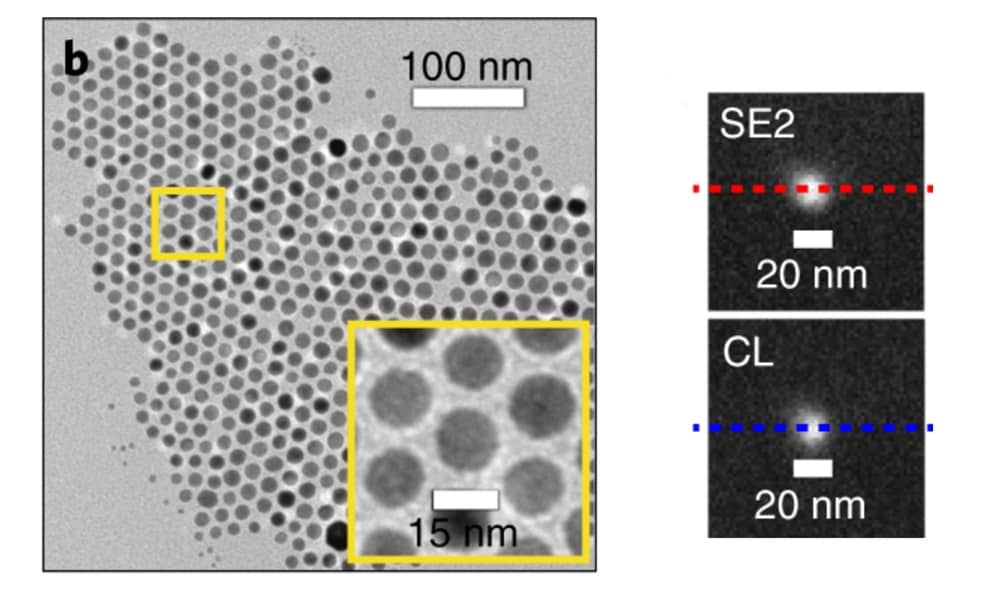
The resulting nanoparticles had diameters of less than 20 nm, which is comparable to the quantum dots, gold nanoparticles and immunoglobulin antibodies typically used to label proteins in electron microscopy. The big advantage of the new nanoparticles is that they come in nine different colours, such that co-labelling of several proteins might be possible. At the same time, cathodoluminescence-electron microscopy images of the new nanoparticles showed that this method is suitable for nanoscale imaging.

The main problem that the researchers encountered was variability between experiments in the level of the coloured signal emitted from the nanoparticles. However, they are confident that this will be manageable with further optimization.

Future potential

The team, led by Nobel Laureate Steven Chu, outline many ways in which their method can be optimized. These include further reducing the nanoparticle size, optimizing the nanoparticle surface and making use of the long-excited state of the lanthanides to distinguish signal from noise by time-gating the measurements. Combined, these approaches might allow the design of even smaller labels for biological multicolour electron microscopy. Another way to improve the signal-to-noise ratio might be to reduce the energy of the electron beam, thereby matching it to the size needed to excite the nanoparticle.

In the future, the researchers envision that instead of scanning the whole sample for cathodoluminescence, imaging might be accelerated by identifying the nanoparticles through conventional electron microscopy and then only using cathodoluminescence to identify the colour of each nanoparticle.

Using research insights to open up university pathways

The high-level data suggest that the pipeline into UK university education is in good shape. In England, a record 33.7% of the 18-year-old population were accepted onto undergraduate courses last year through the Universities and Colleges Admission Service (UCAS). In Scotland, UCAS accepted 26.7% of all 18-year-olds into undergraduate education in 2018 – also a record – while Northern Ireland and Wales saw entry rates similar to 2016.

Look a little closer, though, and systemic imbalances hove into view – not least in terms of students’ backgrounds versus their route into higher education. Take England specifically: while one in four school students from the most advantaged quintile of 18-year-olds will progress to a highly selective UK university (broadly speaking the top 30 research-intensive universities), just one in fifty of the most disadvantaged quintile will progress to those same institutions.

This disparity in participation provides the raison d’être for Researchers in Schools (RIS), an ambitious, government-backed teaching initiative that puts PhD graduates front and centre in the battle to widen access to highly selective universities for under-represented groups. The programme is managed by The Brilliant Club, a charity, and delivered through a network of partnerships: 15 initial teacher education (ITE) providers and more than 75 schools working together to provide a “uniquely tailored route into teaching” exclusively for PhD graduates.

Back to basics

One of the main aims of RIS is to increase the number of high-level subject specialists – with physics and maths PhD students among the priorities – in nonselective secondary schools across England. Since the programme’s inception in 2014, RIS has placed more than 270 teachers in schools, with over 200 of those trainees specializing in maths or physics.

Because of my network of contacts within UK academia, I have been able to provide students with opportunities that otherwise would not exist

RIS teacher Carly Wright

On the back of that, says Nicholas Cater, recruitment director for RIS, those researchers are trained to become in-school champions for higher education – the hope being that they will acts as catalysts in building a more diverse talent pipeline for the UK’s research-intensive universities.

“When you’ve spent a lot of time at university – and maybe at different institutions for your undergraduate and postgraduate degrees – you get a real familiarity with how the system works and how to be successful in that environment,” Cater explains.

That familiarity means PhD graduates are well placed to deal with a lot of the misconceptions that school pupils can have when thinking about university and higher education. “Even just the knowledge of what a doctorate is,” he adds, “and that it’s something you can do after an undergraduate degree. Being able to talk to pupils about this from a first-hand perspective is really important.”

The PhD students who win places on the RIS programme undergo a three-year programme of intensive training. In their first 12 months, trainees spend one day a week at an ITE provider, working towards Qualified Teacher Status (a statutory requirement to teach in any state school in England and Wales). Formal teacher training is reinforced by three days a week in the classroom, building expertise through a structured programme of observation and feedback with an RIS mentor. The in-classroom work increases to four days a week in the second and third years of the programme.

Research leadership

Among the unique features of the RIS training scheme is the Research Leader in Education (RLE) award. This fully funded, three-year programme of professional development requires trainee teachers to spend one day a week “off-timetable”, enabling them to focus on education research projects and evidence-informed teaching.

The RLE award comprises a phased schedule of research activity, starting with a series of university-style tutorials, dubbed Uni Pathways, that the trainee teacher will develop for a small group of pupils to increase their chances of attending a highly selective university. In every case, the tutorials are based on the teacher’s own PhD research and experience.

Students at a Uni Pathways event

“As a PhD student you draw on a lot of different learning methods – independent enquiry, multidisciplinary collaboration, peer review and the like,” says Cater. “The RLE modules aim to tap that PhD skill-set and help trainee teachers start to introduce those concepts into their classroom.”

During year two of the RIS programme, trainee teachers progress to deliver a pilot project of their choice in a specific area of education research. The physics teaching cohort has pursued diverse lines of enquiry to date, including the relationship between the autistic spectrum and mathematical ability; barriers to girls engaging with physics; the use of augmented reality as an aid to science comprehension; and whether practical experiments for students and parents lead to improved examination results.

According to Cater, it’s not just pupils who gain from this research-centric approach to teacher training. “Our trainee teachers are given leadership development [in their final year] so that they can roll out the learning and experience from their pilot project – essentially to encourage innovation and new ideas in teaching practice across the school,” he explains. “The quid pro quo is that the trainees themselves are still learning, so they need the reciprocal support of their colleagues to complete the picture on what it takes to become a great teacher.”

Applications for the latest RIS recruitment round are open now, with successful candidates required to attend induction training in August. As well as providing an opportunity to meet the rest of their cohort, as well as current teachers on the RIS programme, the training will focus on the transition from research career to secondary education, and strategies for widening participation at selective research universities.

The view from the classroom

Carly Wright

Carly Wright completed a PhD in meteorology at the University of Reading in 2017. Her research focused on rain bands that form downwind of mountain ranges and why they are inaccurately forecast. Here she tells Physics World about the transition into the classroom and her experience as a second-year teacher within the RIS programme.

How did you find the transition from postgraduate research into teaching?

It was a challenge to move from a research project to a more structured working platform. However, carrying out the PhD gave me the foundations to fully embrace the ever-changing environment of the RIS programme. Conducting outreach activity and tutoring duties during my PhD provided me with the skills and resources needed to work in a classroom confidently.

Why did you opt for the RIS programme versus other teacher-training routes?

The RIS programme is simply unique and was a natural follow-on from the educational work that I was conducting during my PhD. The programme meets the need for me to continue my research whilst forging my career in education – something which no other teacher-training route allows. After two years within the RIS programme, it has provided an engaging and inspiring training environment and is now allowing me to train in educational leadership – a solid foundation for the rest of my career in education.

How does your research background benefit pupils and teaching staff?

Because of my network of contacts within UK academia, I have been able to provide students with opportunities that otherwise would not exist – for example, trips to Oxford and Cambridge universities and workshops at the University of Manchester. Within the school, I have been able to provide mentorship, advising students about their further-education choices and routes into academia or alternative scientific career options.

At the same time, I work closely with my teaching colleagues, taking the lead on bespoke physics training programmes as well as providing professional advice in regard to specialist subject knowledge or practical work. The programming skills I gained during my PhD have also enabled me to lead a student robotics club to the UK national championships.

Billion-volt thunderstorm studied using muons

A thundercloud with a record-breaking voltage of 1.3 GV has been observed by physicists in India and Japan.  Sunil Gupta at the Tata Institute of Fundamental Research in Mumbai and colleagues calculated the voltage from changes in the intensity of atmospheric muons detected by the GRAPES-3 muon telescope. The existence of such high voltages could explain the origin of the mysterious, high-energy gamma-ray flashes, which are occasionally seen in cloud tops during thunderstorms.

Thunderstorm clouds are normally studied by flying weather balloons and aeroplanes straight through their centres.  Indeed, a balloon was used several decades ago to measure the previous record high voltage of 130 MV – which was observed inside a thunderstorm over New Mexico.  Such a voltage is high enough to create atmospheric particle accelerators that can generate X-rays and low-energy gamma rays. However, it is not high enough to create high-energy (about 100 MeV) gamma rays that are sometimes detected during thunderstorms.

In the 1920s, Scottish physicist and meteorologist Charles Wilson predicted that thunderstorms could induce far larger potentials; on scales of billions of volts. Voltages this large could only form across storm clouds that are several kilometres high and his prediction had been untested because balloons and aeroplanes are not able to measure voltages on such length scales.

Deflecting fields

Gupta and colleagues have got around this problem by using the GRAPES-3 muon telescope at Ooty in southern India to measure voltages across entire clouds. The telescope detects muons created when cosmic rays smash into the atmosphere. Muons are charged particles and are therefore deflected by the electric fields associated with huge voltages in thunderclouds. This means that fewer muons should be detected by GRAPES-3 when thunderclouds are nearby – which the team verified by studying 184 thunderstorms over three years.

To understand their results, the team modelled a thundercloud as a colossal parallel-plate capacitor– with the plates representing positively- and negatively-charged cloud layers that are separated by several kilometres. Using this model to interpret muon observations gathered during a storm in December 2014, they concluded that a voltage of 1.3 GV had developed between cloud layers – confirming Wilson’s prediction.

The voltage appears to be large enough to create flashes of gamma rays with energies as high as 100 MeV – which the team could not detect with their set-up. The researchers now plan to install  gamma-ray detectors close to GRAPES-3, allowing them to pick up gamma rays in coincidence with gigavolt-scale thunderstorms.

The study is described in Physical Review Letters.

Early-career failure can lead to future success, according to US study

When it comes to science, success does not always beget success. That is at least according to researchers in the US who claim that setbacks at the start of a scientist’s career could —counterintuitively — lead to success later. By looking at scientists’ citation records, Dashun Wang from Northwestern University and colleagues found that early-career researchers who just missed out on grants are actually more productive in the long term than those who just pass the funding threshold.

To study the effect of early-career setbacks, the team looked at the citation records of researchers in the 10-year period after their first application for a US National Institutes of Health (NIH) grant. They focused on junior scientists who made the proposals between 1990 and 2005 and who either just missed out on funding (703 researchers) or whose proposals just passed the funding threshold (656 people) and who therefore on average received $1.3m over five years. Most NIH researchers work in medical and biosciences, not physics.

While the performance and demographic profiles of the two groups were indistinguishable, the researchers found that in the five years after their first grant application, 16% of papers produced by the near-miss group were judged “highly-cited” — defined as being in the top 5% of citations in the same field and year. In contrast, 13% of publications by the near-win group were highly cited. This trend continued over the following five years, with those researchers who missed out on funding publishing more highly-cited papers.

Comparing those just above and below a funding threshold is an excellent strategy for investigating the consequences of getting a lucky break

Arnout van de Rijt

Other measures of publication success revealed a similar pattern. These include the average citations within five years of publication and the relative citation ratio — a measure of how a paper is cited compared to others in the same field. Overall, compared to those in the near-win group, junior scientists who missed out on funding attracted on average 19% more citations in the first five years after their initial grant application, and 11% more in years six to 10 afterwards. According to the researchers, just missing out on grants early in a scientist’s career increased the probability of publishing a highly-cited paper in the next decade by 61% and boosted the scientist’s average number of citations per paper by 34%.

Losing out on a grant, however, did have some negative consequences. Over the 10-year period after the grant application, unsuccessful applicants were 13% more likely to disappear from the NIH system, the team found. “An early-career setback has powerful, opposing effects, hurting some careers, but also, quite surprisingly, strengthening outcomes for others,” the authors write.

‘Stronger’ scientists

Arnout van de Rijt, a sociologist at Utrecht University, in the Netherlands, who was not involved in the study, told Physics World that the work advances “the interesting and novel claim” that losing in an early-career research funding competition may result in “stronger” scientists. “Comparing those just above and below a funding threshold is an excellent strategy for investigating the consequences of getting a lucky break,” he says.

Indeed, van de Rijt adds that the finding raises some interesting questions such as whether failure to land a grant makes researchers switch to more productive areas. Another issue is whether the top papers from “non winners” tend to be co-authored with senior scientists in whose labs they must continue to work, while winners work more independently.

Stationary digital breast tomosynthesis increases diagnostic accuracy

The addition of digital breast tomosynthesis (DBT) to a 2D mammography exam can significantly improve breast cancer detection by making lesions more conspicuous on a pseudo-3D image. DBT has limitations, however, including image degradation due to focal spot blurring, noise, scatter and motion artefacts, as well as the inability to visualize breast microcalcifications as well as conventional mammographic images.

To overcome these shortcomings, researchers are developing stationary DBT (sDBT) devices. Existing commercial DBT systems work by moving a single X-ray tube — either by continuous motion or a step-and-shoot technique — to collect a series of projection views at multiple angles. In sDBT, the single rotating X-ray tube is replaced by a fixed array of carbon nanotube-enabled (CNT) X-ray sources. This allows for rapid, motion-free collection of multiple projection views over a wide-angle span.

Stationary DBT

A team at the University of North Carolina are developing an sDBT device based on a modified commercial DBT system (Selenia Dimensions) in which a fixed array of 15 CNT-enabled X-ray sources replaces the standard X-ray source. Each source consists of a CNT cathode, a gate and an individual tungsten anode. The CNT cathodes release electrons at room temperature in response to an applied voltage, allowing for precise X-ray production on demand. The researchers have now published results from their initial clinical evaluation of this first-generation sDBT system (Acad. Radiol. 10.1016/j.acra.2018.12.026).

Lead author Yueh Lee and colleagues conducted a paired-image study, evaluating mammography and sDBT images of 43 women with suspicious findings identified on a prior mammogram. The subjects included 28 patients with dense breasts. The average compressed breast thickness was 4.7 cm for sDBT, and 4.6 cm for mammography. Twelve of the patients had breast cancer, six with infiltrating ductal carcinomas, five with intraductal carcinomas and one with invasive lobular carcinoma.

The scan time to acquire 15 projection images using sDBT was less than 5 s for both craniocaudal and mediolateral oblique views, with a radiation dose equivalent to that of a conventional tomosynthesis scan. The researchers reconstructed the image slices using a thin depth increment of 0.5 mm to ensure that small features were displayed sharply.

Four radiologists with 10 to 25 years of experience reading mammograms and up to five years interpreting DBT assessed the images. For each exam, they were asked to rate the likelihood of malignancy in increments of 10%, as well as the confidence of their overall impression. They also used BIRADS A-D classification to record the density of breast tissue.

After reading both sets of images, the radiologists rated their preference for the set of images presented first — either mammography or sDBT — when assessing diagnostically important image features. They repeated this exercise at least four weeks later, first interpreting the images from the modality that they had reviewed last.

On average, the radiologists were more likely to identify a malignancy correctly when interpreting the sDBT images. This higher diagnostic accuracy held true for each breast density category and breast thickness range. Only the most experienced radiologist, with 25 years of mammography experience, performed better when reading mammograms. The readers preferred sDBT when interpreting soft-tissue features, including mass shape and margins, architectural distortion and asymmetry. As expected, they preferred mammography images for identification and characterization of microcalcifications.

“The team’s goal is to continue to improve resolution and reduce imaging time through further tube development,” Lee tells Physics World. “We are also exploring improvements in synthetic 2D mammograms based on our technology. Our hope is that the sDBT can completely eliminate the need for the 2D mammography shot, and reduce breast compression time, in addition to all the benefits of conventional breast tomosynthesis.”

“In addition to advancing woman’s imaging, our collaborative team is working hard to develop novel, low-dose clinical applications of the carbon nanotube X-ray source, including chest, cardiac, dental, orthopaedic and brain imaging,” Lee adds.

The researchers also plan to investigate the effects of slice thickness on the visibility of microcalcification clusters with sDBT. They also are considering measuring the relationship between experience with both modalities and level of training with respect to sDBT interpretation performance.

Out of the margins

Although there have been repeated calls over the years to increase the number of women and minority students in science, technology, engineering and mathematics (STEM) subjects, the demographics show that these fields still have a long way to go.

According to the American Physical Society, people who identify as Black, Hispanic or Native American are significantly under-represented in the numbers earning physics degrees in the US (APS survey). The American Institute of Physics found that the percentage of physics bachelor’s degrees earned by women in the US has decreased since 2000 to around 20% (AIP Statistical Research Center; www.aip.org/statistics). The reasons why these numbers remain so low are complex, but research suggests that the underlying culture of physics is unwelcoming for women, people of colour, LGBTQ+ physicists and other minority groups.

Many physics departments in the US have worked to shift towards “student-centred”, active learning in the classroom, which has widely been shown to improve students’ learning. However, while these changes are necessary, they are not sufficient. We must broaden our understanding of “student-centred” to include a focus on the different experiences and backgrounds of our students, particularly those outside of the dominant culture. Otherwise, even in classes where it appears that student retention and learning is positive overall, minority students and their voices will continue to be pushed to the margins.

The physics department at Pomona College prides itself on student-centred teaching and on building a welcoming community for physics students, but the demographics still match those seen across the rest of the US. We carried out a department-wide survey and also held classroom discussions to try to understand why. We found that most students seemed pleased with their experiences and spoke positively about the department community-building activities.

However, when we looked at the responses of women and students of colour, these minority voices – otherwise buried in those of the majority – painted a dramatically different picture. These students spoke of being marginalized, isolated and subjected to microaggressions both by individuals and by the departmental culture. Formal interviews with graduating students elicited similar responses, with one student stating that there seemed to be “two different departments” rather than one cohesive unit.

Many US universities have tried to foster a more inclusive educational experience for minority students by creating identity-based cohorts or clubs to promote community and provide resources for minority students. Some institutions have also created optional classes that are focused specifically on issues of equity, bias and social justice in STEM, which helps students build a deeper understanding of these issues and their relevance in the field they are studying.

We decided, however, to try a different approach by integrating anti-bias, pro-equity material into an otherwise standard modern physics course taken by second-year physics students. This integrated curriculum aims to educate students about the biases – both implicit and structural – that shape STEM culture and also how they can change that culture. This approach has several advantages. First, it reaches all physics students, rather than an already aware subset. It also helps students develop an understanding that scientific achievements are not created in an intellectual vacuum but are shaped and even driven by society.

We start the curriculum by considering the class textbook. Students quickly discover that this standard and widely used modern physics textbook focuses almost entirely on the contributions of white men. This is followed by a student-led discussion about the role that bias and privilege plays in physics. For the first half of the term, students complete weekly assignments in which they read about a form of bias or privilege in STEM and then write about how the topic plays out in our physics department.

During the second half of the term, students divide into groups to carry out projects intended to help to make the department culture more inclusive. For example, one project last year focused on identifying why students chose not to continue physics after the first year. Another considered the ways the department could be more welcoming of LGBTQ+ students. The projects are showcased in a public symposium at the end of the semester and are displayed on a video screen in the main hallway of the physics building.

We are currently assessing whether this approach is effective, which involves going beyond the standard, aggregated, end-of-semester teaching evaluations as these largely express the majority voice. Instead, we want to consider the impact on individual students’ experiences and on the wider departmental culture.

Preliminary results from interviews have been positive, suggesting that under-represented students feel that the integrated curriculum has helped them individually. Minority and majority students alike also spoke of learning to practice empathy with their peers. These students, in considering both their experiences and those of their peers, could help to bridge the gap between the “two different departments”. Other students spoke of the impact beyond the class, with several describing how they had stopped to read the projects on display. Some students even spoke of the work sparking conversations in the department that inspired other faculty members to change their own curricula to make their classes more welcoming to students from different backgrounds.

It is not enough for physics educators to simply say that we are supportive of equality. Our curriculum acts as one of many steps in recognizing our students’ humanity and empowering them not only to continue in physics but to transform it altogether.

Advanced laser technique sheds light on lung treatment surfactants

Recent advances in next-generation laser technology could take us a step closer to understanding the structure, orientation, and dynamics of lipid monolayers. These monolayers are key materials for the development of artificial lung surfactants, which are used to treat several respiratory diseases, including respiratory distress syndrome. Zsuzsanna Heiner, a researcher at SALSA – School of Analytical Sciences Adlershof and Humboldt Universität zu Berlin , alongside colleagues in Berlin, Germany, have now provided an alternative method to characterize lipid monolayers using broadband vibrational sum-frequency generation (VSFG) to gain new insights into lung surfactants.

In healthy lungs, a surfactant layer covers the alveoli to support the pulmonary functions. An insufficient coverage requires the immediate administration of lung surfactants from external sources, which often means the use of artificial mixtures. To understand the behaviour of artificial mixtures at the lung-air interfaces, scientists use experimental approaches such as VFSG that provide information about surfaces. However previous VSFG investigations have struggled to optimize the data retrieved without causing potential damage to structures like lipid monolayers.

Obtaining a molecular fingerprint

VSFG is a nonlinear vibrational spectroscopic technique for studying surfaces, and is based on two spatially and temporally overlapping laser beams – one in the mid-infrared and one at a visible wavelength. The mid-infrared laser is resonant with the molecular vibrations of interest, so that spectral measurements retrieve detailed information characteristic to the molecules, that is, the “molecular fingerprint”. The visible laser pulses then upconvert this vibrational fingerprint to higher frequencies in the visible range, which is easy to detect with silicon-based devices.

Unlike many other spectroscopic techniques this VSFG approach is label-free and provides information about the interfacial functional groups of the molecules.  In this work Heiner and her colleagues exploit these capabilities to study  the groups at the calcium fluoride-air interface, which is ideal for studying the orientation of lipid molecules at interfaces.

The need for speed

Previous experiments have mostly used VSFG with lasers operating at a relatively low 1 kHz repetition rate. As a result a longer laser excitation time is needed to collect the necessary data, which could potentially disrupt the delicate structure of the monolayers and induce changes in the structure of unsaturated lipids.

“Researchers usually use spectral filters or etalons to produce visible pulses with narrow bandwidth,” explains Heiner, head of SALSA Photonics Lab. Here the drawback is the negative impact on the conversion efficiency of the process and the bandwidth, which is then limited to 20-30 cm-1, reducing the spectral resolution and hence the precision of the quantitative spectral analysis and resulting molecular orientation calculations.

Heiner explains how she and her colleagues used “chirped” sum-frequency generation, where the femtosecond near-infrared laser pulses are split into two parts: for one part the dispersion – the spread of the pulse as a result of different frequency components travelling at different velocities – is positive, while for the other part it is negative. The two oppositely chirped pulses are then focused into a birefringent barium borate crystal to produce narrowband visible pulses. “With this we can reach up to 25% conversion efficiency, while decreasing the bandwidth,” says Heiner.

Shorter exposure times, more spectral information

In their experiments, Heiner and colleagues study lipid monolayers with different mixtures of 1,2-dipalmitoyl-sn-glycero-3-phosphocholine (DPPC) and 1,2-dioleoyl-sn-glycero-3-phosphocholine (DOPC) – two phospholipids that are major constituents of lung surfactants. They couple their broad-band VSFG with a pump laser operating at 100 kHz repetition rate, which dramatically reduces the excitation time and shows a tenfold improvement in the spectral resolution. With this improvement in instrumentation, the research team were able to conduct the first systematic study of surfactant monolayer models at the interfaces with varying surface pressure and composition.

The researchers demonstrated how it is now possible to study monolayers containing unsaturated lipids without sample deterioration due to long exposure times and other time-dependent experimental artefacts. The spectral features they observed are consistent with similar studies in the field, however they also found additional vibrational bands in the carbon-hydrogen stretching region with the signal-to-noise ratio of approximately 2000.

“In our experiments we could resolve eleven vibrational bands of the sample with a solid-supported DPPC monolayer in the 2800-3000 cm-1 region, more than previously observed,” explains Heiner. “This is especially important when our goal is to retrieve information about the structure and physicochemical properties of the interfacial molecular layer.”

Full details of these recent results are published in Analytical and Bioanalytical Chemistry.

Inuit skill mitigates change in travel conditions

The travel skills of Inuit peoples have mitigated against the changes in environmental conditions wrought by climate change. That’s according to researchers who studied communities in the eastern Canadian Arctic and found that trail access was affected much less than expected.

“Previous studies on Arctic transportation and climate change do not take into consideration different types of trail users,” says James Ford of the University of Leeds, UK. “We found that an understanding of how trail conditions are affected by changing conditions, as well as a knowledge of alternative routes and a well-developed skillset, such as being adept with snowmobile or recognizing dangerous ice conditions, had a greater impact in determining whether trails were safe to use – more so than the change in travel conditions due to climate.”

Inuit peoples in this region use semi-permanent trails on sea-ice, rivers and frozen ground to travel between settlements, to cultural sites and for traditional hunting, fishing and gathering. The trails are vulnerable to sea-ice melt and flooding but it had been difficult to pin down whether climate change has affected local people’s ability to use them.

Ford and colleagues found that highly skilled travellers were able to use the trails more than twice as often as those who were less skilled. The study accounted for trail users’ skill level and risk tolerance. For example, trail users with a high risk-tolerance and good skills were assigned a maximum ice coverage threshold for boat access of 50%, while lower-skilled boat users looking for low risk were set a cut-off of 10% ice coverage. Accidents in small boats, such as sinking or people being thrown overboard, are more frequent in high ice conditions.

The team examined changes in conditions between 1985 and 2016. Mean monthly temperatures increased by an average of more than 2 °C. Overall trail access increased by roughly one or two days. Reduced sea-ice trail access in autumn and winter was offset by better access to land and water trails in spring and summer because of improved visibility and wind conditions.

Travellers with high skill can expect roughly 100 more days suitable for travel each year than travellers with lesser skills, the researchers found.

“While climate models can provide a bigger picture of the overall effects of climate change, it can be harder to determine how environmental variables are affecting specific activities within different communities in affected regions,” says Ford. “The study highlights how the close involvement of the people in question is essential to understanding how the ongoing changes to the environment will affect specific activities of different groups.”

While the skill set of the Inuit community may mitigate the effects of climate change on travel conditions for now, Ford adds, there is no doubt that the warming in the Arctic has detrimental effects.

“The shrinking sea-ice and shifts in seasonal temperatures are a serious threat, particularly to the region’s native species and ecology which form an essential part of the Inuit community’s tradition and culture,” he says. “And while the effects of climate change to date on trail access were not totally what we expected, communities are very concerned about what future change may mean.”

Ford and colleagues reported the study in Nature Climate Change.

  • This article is based on a press release by the University of Leeds, UK.
Copyright © 2026 by IOP Publishing Ltd and individual contributors