Convention signed to establish governing body for the Square Kilometre Array

Officials from 15 countries have met in Rome today to create an intergovernmental governing body for the Square Kilometre Array (SKA) – the huge radio telescope that is under construction in South Africa and Australia. At the meeting at the Italian Ministry of Research and Education, seven countries – Australia, China, Italy, the Netherlands, Portugal, South Africa and the UK – signed a convention to create the Square Kilometre Array Observatory. SKA officials are hopeful that the six remaining participating members of the SKA – Canada, France, India, Sweden and New Zealand – will sign the convention at a later date.

The SKA will consist of hundreds of radio dishes and thousands of antennas that will be spread out across thousands of kilometres in both Australia and southern Africa. It will aim to study gravitational waves, investigate the nature of fast-radio bursts, map hundreds of millions of galaxies as well as look for signs of life in the universe.

Rome wasn’t built in a day. Likewise, designing, building and operating the world’s biggest telescope takes decades of efforts

Catherine Cesarsky

All the signatories in Rome will now become founding members of the SKA Observatory. As an intergovernmental organization, the SKA Observatory will be equivalent to the CERN particle-physics laboratory near Geneva and the European Southern Observatory and will oversee building and operating the SKA telescopes over the next 50 years.

For the SKA Observatory to come into existence, however, the convention will first need to go through national parliaments to be ratified. That process varies depending on the country, but it is expected to take between 12 and 15 months according to SKA spokesperson William Garnier from the SKA’s headquarters at the Jodrell Bank Observatory near Manchester, UK. The SKA Observatory could then come into force by mid-2020. In the meantime, other countries that have not yet taken part in formal negotiations to form the SKA Observatory could do so.

“Rome wasn’t built in a day,” says Catherine Cesarsky, chair of the SKA board of directors. “Likewise, designing, building and operating the world’s biggest telescope takes decades of efforts, expertise, innovation, perseverance, and global collaboration. Today we’ve laid the foundations that will enable us to make the SKA a reality.”

Data deluge

Nine multinational consortia are now finalizing the SKA’s design, which is expected by the end of the year. From late 2020, around €700m of contracts to build SKA are expected to be awarded to companies in SKA member countries, which marks the start of construction for the first phase of the project. When the SKA begins science operations by the mid-2020s, it will generate some 600 petabytes of data every year that will be processed by two supercomputers.

“The SKA project is not only about astronomy but also about pushing the boundaries of computing and technology,” says Anna Scaife, from the Jodrell Bank Centre for Astrophysics in the UK. “Signing the treaty for the SKA brings us closer to answering some of the most important questions in advancing our understanding of the universe.”

Radiotherapy is more effective in warmed-up tumours

Radiotherapy for prostate cancer could be more effective if preceded by mild hyperthermia. This is the finding of researchers at the University of Maryland School of Medicine, who used radiofrequency (RF) fields to heat tumours in mice before administering a single dose of X-rays. Treatments that combine the two techniques could spare surrounding tissue by using a smaller overall dose to achieve outcomes similar to those of conventional radiotherapy (Br. J. Radiol. 10.1259/bjr.20180759).

Long-term survival rates for patients receiving radiotherapy for prostate cancer are relatively high, so a focus of current research is on minimizing the secondary effects of treatment. These effects arise because irradiation of deep-seated tumours inevitably involves damage to healthy adjacent tissue, which in prostate cancer can result in quality-of-life-lowering conditions like erectile, urinary and bowel dysfunction.

One way of limiting such complications is to make the tumour especially susceptible to radiation damage while preserving the surrounding tissue’s natural level of radioresistance. Various chemical means exist to increase radiosensitivity, but the difficulty of applying these selectively to the tumour means that healthy cells can be sensitized too.

Previous work has shown that applying mild hyperthermia — producing temperature increases too small to kill cancer cells directly — could be a more targeted way to specifically sensitize tumours. Now, Justin Cohen and colleagues have demonstrated in a preclinical study that such radiosensitivity can be induced even in deep tumours by externally applied RF fields.

To test the approach, the researchers cultured human prostate cancer cells and modified their DNA to express a luminescent protein. The cancer cells were introduced by surgery into the prostates of mice, and left to develop into tumours; the presence of a bioluminescent signal confirmed that cancers had become established. The researchers then monitored the growth of the tumours using ultrasound.

Splitting the 40 test animals into four groups, the researchers applied either radiotherapy alone, radiotherapy preceded by hyperthermia, or hyperthermia alone. A quarter of the subjects were left untreated as a control group.

The hyperthermia procedure involved using electrodes on the animal’s skin to produce an RF field in the prostate, heating the organ to 41°C. In comparison, ablative hyperthermia — a commonly used technique to kill cancer cells directly — requires temperatures above around 54°C.

After the interventions, tumours were allowed to continue growing, with the time taken for the volume to double serving as a measure of treatment’s effectiveness. In animals in the control and hyperthermia-only groups, the tumours doubled in volume after four days, with the hyperthermia procedure slowing growth by just a few hours on average. In animals that received just radiotherapy, and hyperthermia followed by radiotherapy, the average doubling times were 30 and 33 days, respectively. These findings indicate that the combination of hyperthermia and RT has a synergistic effect.

There are many possible mechanisms behind the radiosensitivity enhancement, but in this case, the effect can probably be attributed to denatured DNA-repair proteins, which hamper recovery of damaged cancer cells, and dilated local blood vessels, which raise oxygen levels in the tumour.

Clinical potential

Next, the team hopes to show that sensitizing the tumour using hyperthermia means that a smaller radiation dose can be used without compromising treatment efficacy. “Half of all prostate cancer patients receiving radiotherapy experience erectile dysfunction post-treatment. If we can achieve the same level of tumour kill at a lower dose, we hope to reduce this toxicity significantly,” says principal investigator Amit Sawant.

If the results are promising, it should be straightforward to translate the research into clinical practice, as previous studies have already demonstrated mild prostate hyperthermia in human patients. “Those trials were done a couple of decades ago and the main barrier to the widespread clinical adoption of hyperthermia was that, back then, there were no accurate and non-invasive in vivo thermometry techniques to validate the temperature distribution,” says Sawant. “Now, with the availability of modern modalities like MR thermometry, this is no longer a barrier.”

Happy 30th birthday to the World Wide Web

“Vague but exciting…”

Those are the now-classic handwritten words that appear on a document, dated March 1989, entitled “Information management: a proposal”. The document was composed by Tim Berners-Lee, who was then a little-known British physicist working as a computer scientist at the CERN particle-physics lab near Geneva. As for the handwritten words themselves, they were penned by Berners-Lee’s boss Mike Sendall, who was also a physicist by training.

Although the document initially attracted little attention, Berners-Lee’s revolutionary idea was to provide a way to let the thousands of scientists at CERN keep track of all the information needed to build and operate the upcoming Large Hadron Collider. Envisaging the use of hypertext to link documents, Berners-Lee’s proposal was the birth of what became the World Wide Web.

The rest, as they say, is history.

Image of the document "Information Management: A Proposal" by Tim Berners-Lee

With its roots in physics, the Web has transformed all aspects of life over the past 30 years. From buying books and finding information to streaming music and watching videos, it’s hard to imagine life without the Web, smartphones and super-fast Internet connections. And without the Web, there’d be no social media either – which, depending on your point of view, is either a blessing or a curse.

To celebrate the 30th anniversary of the Web, we’ve got plenty of treats for you, including the special March 2019 issue of Physics World magazine. You can enjoy many of that issue’s articles – along with a host of others – in a special online-only collection. The collection includes a brilliant graphic by Jess Wade, a look at the business impact of the Web, and a podcast in which Hamish Johnston and I chew the fat over how on earth we got anything done before the Web came along.

And finally, we’ve dug up this fantastic article from the Physics World vaults by Berners-Lee himself. Published as a feature in the June 1992 issue of the magazine, the article spells out his predictions for how the Web will transform academic publishing and the wider world. Some of Berners-Lee’s views proved off the mark – he did not predict the invention of search engines – but he proved astoundingly right on one thing, which was to envision an online platform that pretty much resembles what we know and love today as that invaluable information resource: Wikipedia. You can read Berners-Lee’s article “Electronic publishing and visions of hypertext” here.

• For more on CERN’s own celebrations, check out their 30th-anniversary programme or download a PDF of their special issue of CERN Courier magazine.

Illustrating 30 years of the Web

Timeline of the World Wide Web

Is reforestation ‘our most poorly understood weapon’?

Reforestation is “our most poorly understood weapon” against climate change, according to Tom Crowther of the Swiss Federal Institute of Technology (ETH Zurich) at the annual meeting of the American Association for the Advancement of Science (AAAS) in Washington, DC.

During his production of the first global map of Earth’s trees in 2015, Crowther located ancient forests that no longer exist but could be replanted. There is room for an additional 1.2 trillion trees outside urban and agricultural areas, he believes. And restoring these forests would be “our most effective weapon in the fight against climate change”.

The amount that reforestation would reduce atmospheric carbon is not yet clear, but the year-old Crowther Lab at ETH plans to address that uncertainty, using a bottom-up approach. The researchers are extrapolating data from millions of on-site observations using artificial intelligence and machine learning, and combining these data with satellite observations to gain “unprecedented insights into the scale of the global forest system and global soil carbon storage”.

The ETH findings will help scientists assess how much carbon could be stored if 1.2 trillion trees were planted to supplement existing forests. Crowther expects this figure would greatly exceed the carbon input reduction from other measures, such as effective refrigeration management worldwide, which has a potential saving of 89 gigatonnes, and plant-only diets for all humans, which could save 66 gigatonnes.

Humans put some 10 gigatonnes of carbon into the atmosphere each year, Crowther said, and in total have increased the atmospheric budget by around 300 gigatonnes.

Complicating the analysis are the roughly 15 billion trees that Crowther estimates are harvested each year, and the loss of soil-sequestered carbon to the atmosphere due to warming in Arctic and boreal regions. The latter releases around 1.5 gigatonnes of carbon annually, Crowther reported, accelerating the rate of climate change by 12–17%.

Biodiversity datasets from the tree-counting and related experiments are being made public, Crowther says, which should help scientists and policy-makers develop effective global-scale targets and identify the most critical regions to restore ecosystems and protect soils. Already, under the auspices of the United Nations, 17 billion trees have been restored in high carbon-capture areas over the past three years, he added.

The 2015 map revealed that Earth currently hosts 3.04 trillion trees, rather than the 400 billion of previous estimates. The discrepancy arose because earlier data were based on satellite imagery alone. These data noted the location of forests but gave no information on the structure below the forest canopy or on biodiversity, according to Crowther.

Crowther’s larger estimate was based on more than a million ground-sourced measurements of trees worldwide, that were then scaled up using satellite data.

STM measurements redefine protein conductances

“Properly connected, proteins are the world’s best molecular wires,” says Stuart Lindsay, Director and Professor at the Biodesign Center for Single Molecule Biophysics at Arizona State University (ASU). His comments refer to recent experiments at ASU to measure the conductance of single proteins between electrodes for the first time with what he describes as “staggering” results that may have uses for direct, label-free, sensitive, and very selective (background-free) single-molecule detection as well as protein motion sensing. “Measurements on peptides (small protein chains) show they are the world’s worst molecular wires,” he adds. So what changed?

Contact control

The conclusion that proteins have a terrible conductance tallies well with their general physical characteristics – they lack both electronic conduction bands and high levels of structural order. Previous experiments have attempted to investigate the conductance of proteins by injecting electrons from optically excited chromophores, but contacting the molecule to an electrode allows studies of the response to injection of electrons with much lower energies. However so far these have struggled against the uncertainty in the number of molecules contacted, the size of the gap, the nature of the contacts, and possible ionic contributions to the current measured.

Here scanning tunnelling measurements present significant advantages over macroscopic contact devices as Lindsay explains because they allow for single-molecule contacts.  “In addition, we carry out the experiments under electrochemical potential control so we can be certain there are no ionic currents and we use chemically well-defined contacts, so that we know (and can control) the metal-molecule interface.”

The resulting conductances measured in the nanosiemens range over distances of several nanometres. Having ruled out ionic currents the researchers were also able to eliminate possible meaningful contributions from tunnelling, which would be five orders of magnitude weaker. Crucially, while the conductance varied little with the length of the protein, the conductance was highly dependent on the chemistry of the electrodes, which the researchers functionalized with specific ligands for different proteins.

Current pathways

The researchers found that the chemistry of the contacts was so significant that weaker coupling to the hydrophobic interior of the protein provided a stronger current than a stronger coupling to the hydrophilic exterior. The researchers describe the role of contact chemistry in terms of the path the current takes either across the surface or through the interior. “We hypothesize that the hydrophobic interior of proteins is a wonderful place for electrons to propagate and that electrons are injected into the interior of the protein using specific ligands,” Lindsay tells Physics World.

The experiments also reveal fluctuations that set in above a threshold applied bias of 100 mV in magnitude. Comparison of the lifetime of the on states with the peak current magnitude indicate a single barrier that determines both the current and bonding strength at the contact. The magnitude of this barrier within the relevant exponential expression matches that of a hydrogen bond suggesting that a hydrogen bond may be playing the role of “weak link in the circuit”. The conductance values measured are also compatible with those calculated for thermally activated hopping over a 0.22–0.47-V barrier, the size of the hydrogen bond. “We have devised and implemented a new scheme to extract the electronic decay length, and temperature dependent measurements are underway as well,” adds Lindsay.

Significant findings

Further experiments demonstrated the potential for using the strong ligand specific conductance for single-molecule, highly specific, label- and background free electronic detection of IgG antibodies to HIV and Ebola viruses, and the researchers are now working on technological applications of the results. “The wonderful thing about sorting out the connections issue is that we have a “tool kit” for bioelectronics mapped out,” says Lindsay as he lists them. “(1) For wires, use ligand connected proteins.  This not only makes a fantastic contact, but it also makes a self-assembling, directed contact. (2)  Multivalent proteins complete circuits and can generate branched wiring. (3) Since the conductivity “reads” the internal state of the protein, enzymes can be wired as single molecule sensors with an exquisite response.  Future results from the lab will illustrate this.”

What may take a little longer to unravel is the biological role of protein conductances.  Here Lindsay points towards theoretical calculations by Gabor Vattay , which show that the calculated energy level distribution in a number of proteins matches that expected for a very unusual state of matter called “quantum critical”, which also matches certain previous observations of giant protein conductance fluctuations. “If this is true, then proteins must have evolved a rather special structure.  So why?” asks Lindsay. “I don’t know, but it is very interesting that ligand mediated contacts allow for sharing of electrons. Does this play a role in recognition?” he adds, highlighting the weaker contacts forged by strong, covalent modifications of residues on the outside of a protein compared with weaker contacts made by ligands that reach into the protein. In terms of biological significance, it seems these latest results raise at least as many questions as they answer.

Full details are reported in the Proceedings of the National Association of Science.

Ionic transistor can be used in medical bioelectronics

A new ion-driven transistor that can safely interact with human skin has been built and tested by scientists in the US. The team says the device is fast, flexible and capable of the real-time sensing and processing of signals given off by the body. Described as the first biocompatible ion-driven transistor, it could become an important element of integrated bioelectronics systems.

Biocompatible transistors are key components of bioelectronic devices that interact with the body. This growing field of technologies is already recording and processing a range of body signals and delivering electrical and chemical stimulation to the body.

However, with current silicon-based transistors, precautions need to be taken to avoid direct contact between the body and the device. This shielding requirement means that most bioelectronic devices are bulky and rigid, making them uncomfortable for patients. Previous studies have attempted to solve the issue by fabricating flexible, polymer-based transistor devices, but they have generally been far slower and less reliable than their silicon counterparts.

Sugar coated

Now, team of scientists and engineers led by Dion Khodagholy and Jennifer Gelinas at Columbia University have created the “internal-ion-gated organic electrochemical transistor” (IGT), which is a device that uses self-contained, mobile ions to exchange signals with the body. Unlike previous devices, the IGT is fabricated from a flexible polymer containing sugar molecules. Since the molecules attract water, the transistor channel stays hydrated. This is unlike conventional electronics, which must be protected from moisture from the body.

According to the team, the IGT is integrated easily onto the skin, where it can support a host of different interactions between its own ions and those in the body. This can be used to detect and amplify electrochemical signals from the body. The transistors can be gated independently to create scalable logic circuits. In addition, the polymer used in the device shortens the distances over which ions need to travel, making the transistors much faster  that previous devices.

The IGT is small enough to fit between the hair follicles on a patient’s head, where the interface is barely perceptible to the patient. The team showed that the device can sense and stimulate real-time brain signals from the surface of the scalp and then carry out complex calculations at fast enough speeds to study the function of the nervous system.

Khodagholy, Gelinas and their colleagues now hope to study how their IGT’s capabilities vary when fabricated using different self-contained ions, and from different polymer materials. Their research could pave the way for implantable, closed-loop bioelectronic devices which can record and manipulate patients’ heart, muscle, and eye movements.

The IGT’s are described in Science Advances.

Major revamp complete at SuperKEKB particle-physics facility

One of Japan’s premier particle-physics experiments has finished a major eight-year upgrade programme and will soon begin taking data. Physicists at the SuperKEKB accelerator based at the KEK particle-physics lab in Tsukuba will start ramping the accelerator over the next few weeks. First collisions in the completed detector are due to take place by the end of March.

SuperKEKB is a ¥29bn ($370m) upgrade to the 3 km-circumference KEKB collider, which consists of two underground circular accelerators – one carrying electrons and the other positrons. The collisions between these particles are then studied in the Belle-II detector – an upgrade to the original Belle detector. As Japan’s biggest electron–positron collider, KEKB shut down in 2010 for construction to start on SuperKEKB. The work involved upgrading the machine to produce electrons with an energy of 7 GeV, with the positron beam having an energy of 4 GeV.

We are very excited about the start of the physics run with the full detector

Thomas Browder

The upgrade will also increase the number of collision events by a factor of 40 over KEKB, which is achieved by shrinking the beams at the collision point to around 20 times smaller than the beam sizes achieved at KEKB while also doubling the beam currents. This should allow the machine to produce around 50 billion pairs of B mesons as well as other particles such as D mesons and tau leptons. Studying the decays of these particles could allow researchers to search for any deviations in the Standard Model of particle physics and also shed light on why there is more matter than antimatter in the universe.

Exploring the dark sector

The first electron–positron collisions at SuperKEKB were recorded last April before engineers began a six-month process fine-tuning the accelerator. Work then began on installing the final components of the Belle-II detector to help it handle the huge increase in the collision rate as well as survive the radiation damage caused by the increased flux. Staff also installed a vertex detector in Belle-II, which should make the detector better at pinpointing where particles decay.

“We are very excited about the start of the physics run with the full detector, including the vertex detector, in place,” Belle-II’s Thomas Browder from the University of Hawaii told Physics World. Browder says that by the end of June, SuperKEKB should have accumulated an integrated luminosity of around 10 fb–1 (inverse femtobarn), which will enable first results on the search for “dark sector” particle such as dark photons and axion-like particles. “If all goes well, we will have first Belle-II results by the end of July,” he adds.

Droplets move through narrow channel by bending the walls

Droplets of both oil and water will move along specialized narrow channels by causing the channel walls to bend. That is the discovery of Dominic Vella and colleagues at the UK’s University of Oxford, who have dubbed this unusual motion “bendotaxis”. The phenomenon could be exploited in a range of applications from targeted drug delivery to labs-on-a-chip.

Controlling the flow of liquid droplets in narrow channels is playing an increasing role in technologies such as labs-on-a-chip and tiny devices that deliver drugs to targeted parts of the body. It can be a very complicated process because fluid motion in small channels is strongly affected by interactions with channel walls.

Currently, liquid droplets are propelled through narrow channels using driving forces created by things such as temperature gradients, electric fields or chemical gradients. As soon as these forces are removed, however, droplets will no longer move. This makes these methods unsuitable for applications where a driving force cannot be easily maintained, such as in a capsule placed inside the body for targeted drug delivery.

Clamped coverslips

Vella and colleagues have now created a channel in which no external driving force is needed to transport droplets. To do this, they formed a channel from two thin glass coverslips, coated in a material that attracts oil but repels water. The coverslips are clamped at one end and are held apart by a glass spacer just few hundred microns thick (see figure). This creates a channel with walls that are able to move together or apart.

Droplets of both oil or water were placed at the clamped end of the channel. To the team’s surprise, both types of droplet transported themselves towards the open end of the channel at speeds of several hundred microns per second. Vella and colleagues believe that the motion is a result of pressure gradients forming along the length of the droplets, as the droplets act to minimize their surface tension energy.

The team says that different mechanisms are involved in the propulsion of oil and water. Oil droplets tend to spread-out on the coverslip surfaces to make as much contact as possible. This pulls the walls of the channel together, narrowing the end of the droplet facing the open end of the channel. Then, a pressure gradient forms within the droplet, pulling it towards the channel’s open end as it acted to minimize its surface tension.

In contrast, water droplets are repelled by the coverslip surfaces, pushing the channel walls apart. This makes the droplet wider towards the channel’s open end, creating a pulling force in the same direction as experienced by the oil droplet, again to minimize surface tension.

Vella’s team coined the term ‘bendotaxis’ to describe the motions they observed, since the droplets propel themselves – a behaviour called “taxis” – by bending their surroundings.

The research is described in Physical Review Letters.

Quantum state teleportation verifies information scrambling

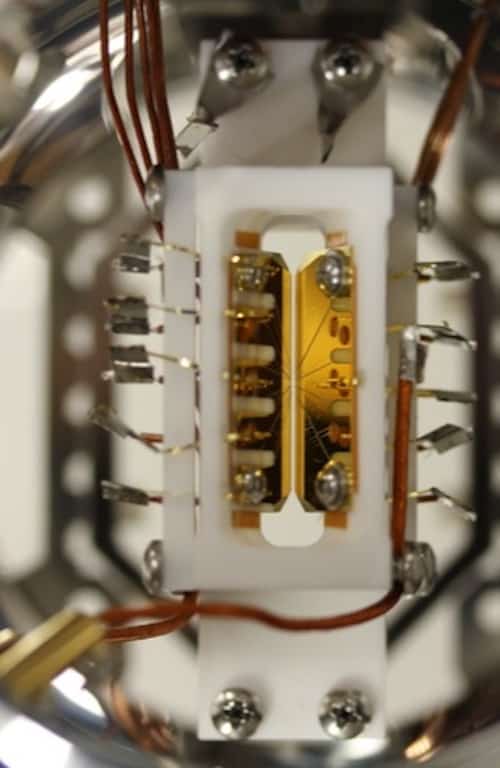
A quantum circuit that can unambiguously test for information scrambling in an experiment could help verify the calculations of quantum computers and even shed more light on what happens to quantum information when it falls into a black hole. The new test, designed by researchers at the Joint Quantum Institute at the University of Maryland in the US, involves carefully manipulating the quantum behaviour of seven charged ions using well-timed sequences of laser pulses. It correctly determines whether information has been scrambled (as opposed to being completely lost) to an accuracy of around 80%.

The ion trap

Quantum information scrambling can be likened to shuffling a newly-bought deck of playing cards, which come ordered in a specific sequence, explain the researchers, led by Christopher Monroe and Norbert Linke. Although not something to try at home, because it would be tedious to say the least, the pack could be unshuffled by keeping a very careful track of how each shuffle exchanged the cards, and performing these shuffles in reverse.

In the same way, quantum scrambling mixes up the information stored inside a set of atoms and can also be reversed. This is the key difference between scrambled and true, irreversible, information loss, say the researchers.

In their work, Monroe, Linke and colleagues made use of a protocol first put forward by Beni Yoshida of the Perimeter Institute in Canada and Norman Yao at the University of California at Berkeley. Their approach distinguished between the two scenarios by teleporting the quantum states of particles through a quantum circuit and taking their correlations into account.

Unambiguous test for quantum scrambling

The new JQI approach consists of two steps. The researchers begin by scrambling up one set of qubits (in this case seven trapped 171Yb+ions in a crystal) in a fully connected quantum computer using a family of three-qubit scrambling “unitaries” and performing a related scrambling operation on a second set. Any mismatch between the two operations proves that the process is not scrambled, causing the second, and final step, to fail. This final step in fact relies on quantum teleportation, which is a way to transfer information between two quantum particles that are far apart (in this case 35 microns separate the first atom from the seventh). It serves as an unambiguous test for quantum scrambling, says the JQI team.

If information is successfully teleported from one atom to another across the quantum circuit, it means that the state of the first atom is correlated across all of the atoms, which can only happen if the information is scrambled. If the information is lost, successful teleportation is not possible.

Key to the success of the experiment comes from the fact that the researchers can finely control the qubits, which is no easy task. “We control the trapped-ion qubits by shining meticulously designed laser pulses that are resonant with the qubits to change their states individually,” explains study lead author Kevin Landsman. “We can use the same lasers to entangle qubits by leveraging the naturally occurring Coulomb repulsion between the positively charged ions.

“Measuring scrambling is very difficult and the measurements can easily by tainted by experimental error,” he tells Physics World. Previous tests for scrambling couldn’t distinguish between hidden and lost information, mainly because the individual atoms in both cases look very much the same.

Better understanding black holes

The measurements performed in this new work were, interestingly, inspired by the physics of black holes – and how information flows inside purely quantum-mechanical versions of these, which are believed to quickly scramble information. Researchers have previously suggested that any information falling into a black hole can be almost immediately recovered from its Hawking radiation (the light that is released by the black hole).

Quantum scrambling is one way of explaining how information can fall into a black hole, scramble, and emerge as random radiation, say the JQI researchers. “The experiment we have set up mimics this theoretical scenario – and likens the input quantum state being teleported as the information falling into a black hole and the output as Hawking radiation.”

Since the three-qubit scrambler studied in this work is not strictly “many-body”, Landsman says that he and his colleagues would now like to build bigger and powerful quantum computers so that they can test for scrambling in these.

Full details of the present research are reported in Nature.


Copyright © 2026 by IOP Publishing Ltd and individual contributors