For as long as computers have existed, physicists have used them as tools to understand, predict and model the natural world. Computing experts, for their part, have used advances in physics to develop machines that are faster, smarter and more ubiquitous than ever. This collection celebrates the latest phase in this symbiotic relationship, as the rise of artificial intelligence and quantum computing opens up new possibilities in basic and applied research
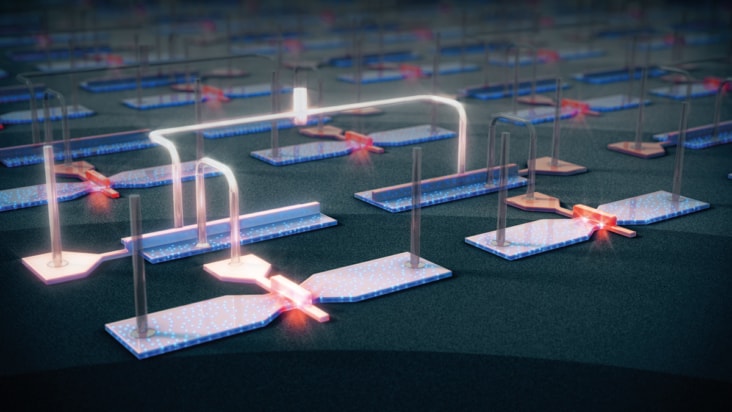
As quantum computing matures, will decades of engineering give silicon qubits an edge? Fernando Gonzalez-Zalba, Tsung-Yeh Yang and Alessandro Rossi think so
Physicist and Raspberry Pi inventor Eben Upton explains how simple computers are becoming integral to the Internet of Things
Physics World journalists discuss the week’s highlights
James McKenzie explains how Tim Berners-Lee's invention of the World Wide Web at CERN has revolutionized how we trade.

Tim Berners-Lee predicts the future of online publishing in an article he wrote for Physics World in 1992
Jess Wade illustrates the history of the World Wide Web, from the technology that enabled it to the staple it is today
Emerging technologies shaping our connected world
Fifth episode in mini-series revisits the birth of the Web and the challenges it now faces
Computing is transforming scientific research, but are researchers and software code adapting at the same rate? Benjamin Skuse finds out
New models show that high-speed rupture propagation produces stronger and longer-duration ground motion
 Read article: Earthquake fault irregularities control rupture speed and influence ground motion
Properties of a merger remnant can be predicted using a simple entropy-maximization principle
 Read article: Physicists find unexpected connection between black hole mergers and thermodynamics
Accessible new database could accelerate research on solar thermal power generation and allow wider deployment
 Read article: Solar tower power plants get a data boost
Global conflicts are making renewable energy more attractive, but an all-renewable grid will require solving physics problems as well as political and economic ones
 Read article: Wanted: an electrical grid that runs on 100% renewable energy
MaterialsGalaxy platform will reduce unhelpful “silos” within the field, say scientists
 Read article: New project takes aim at theory-experiment gap in materials data
CGI pioneer Pat Hanrahan is our podcast guest
 Read article: Oscar-winning computer scientist on the physics of computer animation
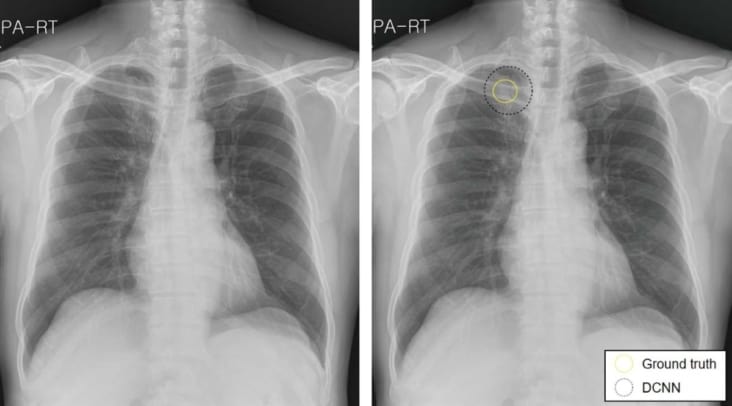
Introducing artificial intelligence into the clinical workflow helps radiologists detect lung cancer lesions on chest X-rays and dismiss false-positives
Algorithms help materials scientists recognize patterns in structure-function relationships

A deep learning algorithm detects brain haemorrhages on head CT scans with comparable performance to highly trained radiologists
An artificial intelligence model can identify patients with intermittent atrial fibrillation from scans performed during normal heart rhythm
Proof-of-concept demonstration done using two superconducting qubits
An image-based artificial intelligence framework predicts a personalized radiation dose that minimizes the risk of treatment failure
A machine learning algorithm can read electroencephalograms as well as clinicians
Two superconducting qubits, a metre of cable apart, have been driven into an entangled state not in spite of their environment, but by it
 Read article: Noise that entangles may accelerate the dawn of quantum technologies
Classical computation is more accurate that quantum annealer for some Ising spin glasses
 Read article: No quantum advantage (yet) in the world of tensor networks
New classical simulation technique makes it practical to benchmark large-scale logical magic-state preparation protocols under realistic noise conditions
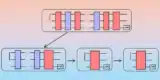 Read article: Shortcut for simulating logical magic states could accelerate the design of fault-tolerant quantum computers
Discovery could help in the development of on-chip quantum information technologies that can be scaled down to the nanoscale
 Read article: New class of magnons live a hundred times longer
Counterintuitive quantum property turns out to be the hidden backbone of fault-tolerant quantum computers
 Read article: The weirdness of quantum contextuality is not a bug – it’s a feature
New work could help optimize quantum memories and information processing
 Read article: Extracting entropy information from quantum dots
Can you make an impact through peer review?
Join more than 15,000 researchers who have achieved IOP Trusted Reviewer status – Tell me more