For people whose travel plans got shredded by this morning’s snowfall across the north-eastern US, it won’t be a surprise to hear that the world’s aviation network is vulnerable to disruption. Some travellers might, however, raise a weary eyebrow at the news that losing highly-trafficked nodes in that network – Logan Airport in Boston, say – is less damaging to the network’s integrity than losing less-busy “feeder” nodes.
This counterintuitive result formed part of a talk by Nuno Araujo on the opening day of the American Physical Society’s March Meeting, which is taking place this week in the snowbound city of Boston. Araujo and his colleagues at Lisbon University, Portugal, have been studying the world aviation network, or WAN, for several years. Their model is based on data from openflights.org, and it takes in such information as the locations of the world’s 3237 airports (nodes) and the structure of the 18125 connections between them (links).
On average, each airport in this network is connected to 19.21 others, while the average number of connecting flights required to get from point A to point B is 4.05. The maximum number of connections, meanwhile, is 12 – and if a 12-connection journey doesn’t sound like your idea of a relaxing holiday, you aren’t alone. The Lisbon group’s latest research combines the WAN information with data on where travellers actually go, and one of their findings is that people who fly for leisure – tourists – strongly prefer destinations that are either nearby (defined as less than 1000km distant), or connected by a single, direct flight.
Speaking as someone who once flew from north-east England to my hometown of Kansas City via London, Reykjavik, New York and Atlanta, I can’t say I’m shocked by this result. The group’s other findings, however, include some head-scratchers. It’s become a commonplace to say that we live in a highly interconnected world. Indeed, the fact that it is theoretically possible to fly from the tiniest, most remote airport in country A, to an equally off-the-beaten-track destination in country B, in no more than 12 “hops”, is in some ways proof of this connectedness. In practice, however, the Lisbon researchers found that only 15% of the world’s countries experience bi-directional flows of tourists. Instead, the dominant pattern is of imbalance: some countries send out lots of tourists but receive few, and many others experience mass influxes of visitors while their own citizens stay at home (presumably, in some cases, to work in the tourism industry).
The group’s map of the world’s tourism “communities” also turns up a few surprises. In tourism terms, Madagascar is part of Europe’s community, not Africa’s. Colombia and Venezuela share more tourists with North and Central America than they do with fellow South American countries such as Argentina and Brazil. And for some reason, the west African nation of Mauritania belongs to a tourism community that includes China, south Asia, Australia and Oceania, but not any of its neighbours, which are instead part of communities centred in sub-Saharan Africa and North America.
Araujo’s latest research is full of such fascinating facts, and it also has a serious purpose. At the end of their paper, the authors state that it is “imperative to further explore how wealth is transferred through tourism” in order to optimize the WAN to meet the demands of this $1340bn-a-year industry. In a highly connected world, it’s not just the major nodes that matter.
In this short video, Heather Williams from the Christie Hospital explains the principles of how gamma cameras are used within oncology. Williams, a senior medical physicist for nuclear medicine describes how the equipment is used for functional imaging, by tracking radioactive tracers injected into patients. Such gamma cameras are typically used as part of cancer diagnosis and for the monitoring of treatment.
This video was part of a series of films recorded at the Christie NHS Foundation Trust in Manchester, UK. They included a look inside the centre’s proton-therapy system, its brachytherapy options and MRI equipment.
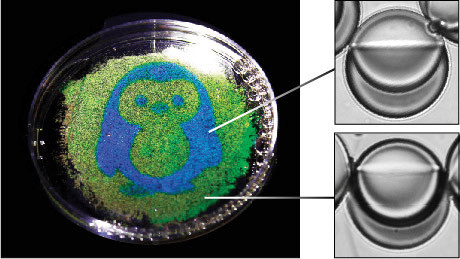
Pennsylvania Penguin: the images on the right show the two Janus droplets used to create the blue and green in the Penguin pattern (left). The top part of both droplets is heptane and the bottom portion is perfluorohexane. (Courtesy: Zarzar Laboratory/Penn State)
A new technique for creating iridescence in droplets has been developed by Lauren Zarzar and colleagues at Pennsylvania State University and the Massachusetts Institute of Technology. The team discovered the technique accidentally and believes that it could have a wide range of applications, from paints to sensors.
The familiar iridescent colours in films of oil or bubbles of soap are caused by interference between reflections from the front and back of the film. A similar effect occurs a result of diffraction from the ridges on a CD or the scales on a butterfly’s wing. All these effects require features on the scale of the wavelength of visible light, which is approximately 400-700 nm.
Zarazar’s team, however, observed iridescent colours in hybrid droplets that were 100 micron in diameter and made from the hydrocarbon heptane and the fluorocarbon perfluorohexane. The droplets had “Janus” morphologies – each was essentially half a heptane droplet stuck to half a perfluorohexane droplet (see figure).
Seeking tuneable lenses
The team was interested in these droplets because heptane and perfluorohexane is a combination that breaks the usual correlation between refractive index and density. Denser materials normally have higher indices of refraction, but as Zarzar explains: “We were intentionally trying to flip it the other way. The fluorocarbons tend to be very dense but also very low refractive index.” The researchers’ intention was that the droplets would behave as miniature, tuneable lenses.
They were amazed, however, to find that the droplets reflected brilliant colours that varied with viewing angle when they were illuminated with far-field white light. “When we see this iridescence, I’m immediately thinking we have something that’s giving us periodicity on the wavelength of light,” says Zarzar, “Because that’s what would lead to interference and structural colour.”
However, they could find no evidence for such periodicity. Moreover, when they looked at the droplets under a microscope, many features they observed made no sense from the point of view of traditional diffractive optics. For example, each droplet seemed to reflect a specific colour of light when viewed from a particular angle, irrespective of the position of other droplets.
“It didn’t matter whether the droplets were close packed or randomly oriented, so it didn’t come from some kind of diffraction grating happening between the droplets or something like that,” says Zarzar.
Counterintuitive effect
An emulsion containing droplets of one size reflected pure colours that changed with the viewing angle. Droplets of different sizes reflected multiple colours at any given angle, however, with such an emulsion producing white light. “There was something happening in a single, 100 micron scale droplet that was somehow causing this effect, and it wasn’t intuitive that you could get interference from something that large that didn’t have any periodicity within it, says Zarzar.
After much head scratching, the researchers realized the phenomenon could arise by total internal reflection. Because it has a lower density, the heptane nestles within the perfluorohexane, with a concave interface between the two liquids (see figure). When light hits this interface at an angle, classical ray optics dictates that, as the perfluorohexane has a lower refractive index, it should refract away from the normal. If the angle of incidence is too great, however, the light cannot escape and undergoes total internal reflection.
“The light may bounce several times around that concave interface depending on the initial angle of incidence, and rays that have bounced different numbers have different path lengths and end up out of phase,” explains Zarzar. “That’s what gives rise to the interference. Our collaborators at MIT have a model that can use the refractive index contrast, the geometry of the interface and the incoming angle of the light to predict the pattern of iridescence that you generate.”
The researchers also showed that, by incorporating an ultraviolet-responsive surfactant into the droplets, they could use UV light to change the interfacial properties of the liquids and thereby control the colours of visible light reflected by the droplets. “We have several publications where we sensitize these biphasic droplets to things like temperature and pH,” says Zarzar. “You could use the colour as a readout of the morphology of the emulsion, which could be used for sensing.” In the nearer term, they hope to produce iridescent paints that do not require nanoscale structures.
Commenting on the team’s discovery, David Weitz of Harvard University says, “I give them a lot of credit for recognizing it and figuring it out. I don’t see that structural colour has ever really had a huge impact technologically, but maybe this will have more of a chance because here you don’t have to worry about precisely controlled thicknesses – I don’t know.”
Mammals can detect light in the visible wavelength range of the electromagnetic spectrum, that is, between 400 and 700 nm. A team of researchers have now extended this capability to the near-infrared in mice by injecting photoreceptor-binding upconverting nanoparticles (pbUCNPs) into the back of their eyes. The technique could be used to develop improved near-infrared and night vision technologies for military and civilian applications and help treat certain ocular defects.
The photoreceptors (rods and cones) in mammalian eyes contain light-absorbing pigments consisting of opsins and their covalently-linked retinals. Wavelengths greater than 700 nm are too long to be absorbed by these photoreceptors, so when these hit the retina no corresponding electric signal is sent to the brain.
Extending the normal wavelength range
In recent years, researchers have been looking to integrate nanoparticles with photoreceptors in the eye so that it can detect light outside of the normal wavelength range. In the new work, a team led by Tian Xue of the University of Science and Technology of China is saying that it has now used pbUCNPs to extend the mammalian visual spectrum to the near-infrared (NIR) range. The particles tightly bind to photoreceptor cells and act as NIR light transducers – capturing longer NIR wavelengths and emitting shorter ones in the visible light range. The rods or cones then send a normal signal to the brain, as if it was dealing with visible light.
The human eye is most sensitive to light around 550 nm. To convert NIR light to this wavelength, Xue and colleagues generated core-shell-structured upconversion nanoparticles (UCNPs) made of β-NaYF4:20%Yb, 2%Er@β-NaYF4. When irradiated with NIR light around 980 nm, these particles convert it into light with an emission peak at 535 nm. To design photoreceptor binding UCNPs, the researchers conjugated concanavalin A protein (ConA) with polyacrylic acid-coated UCNPs (paaUCNPs).
Retina and visual cortex both activated by NIR light
They injected the nanoparticles into the sub-retinal region of the eyes in mice. Thanks to in vivo electroretinograms (ERGs) and visually evoked potential (VEP) recordings in the animals’ visual cortex, they found that the retina and visual cortex of the pbUCNP-injected mice were both activated by NIR light.
Animal behaviour tests (in a water maze) also revealed that the mice were sensitive to NIR light and that they could sense it even in daylight conditions. This means that both NIR and visible light vision are possible at the same time. They were able to distinguish NIR light shape patterns, such as triangles and circles too. The researchers say that they were also surprised to discover that ConA-conjugated nanoparticles allowed the animals to see the patterns with exceptionally low-power density LED light because this is sufficient to activate the nanoparticles.
The pbUCNPs are long-acting and NIR pattern vision can last for over 10 weeks without interfering with normal vision, they report.
The team, which includes scientists from the University of Massachusetts Medical School, says it now wants to try out the technique in dogs and primates
Self-powered
“Current NIR vision technology, such as night vision goggles, makes use of detectors and cameras that do not work at all during the day,” says team member Jin Bao. These devices also require external power sources. In contrast, our injectable solution is self-powered and works with both visible and NIR light at the same time.
“The nanoparticles employed in our work could also allow us to explore a variety of vision-related behaviours in animals,” she adds. “What is more, they could serve as an integrated and light-controlled system in medicine and might be used to improve human red colour vision deficits, as well as in drug delivery for ocular disease.”
Full details of the research are reported in Cell.
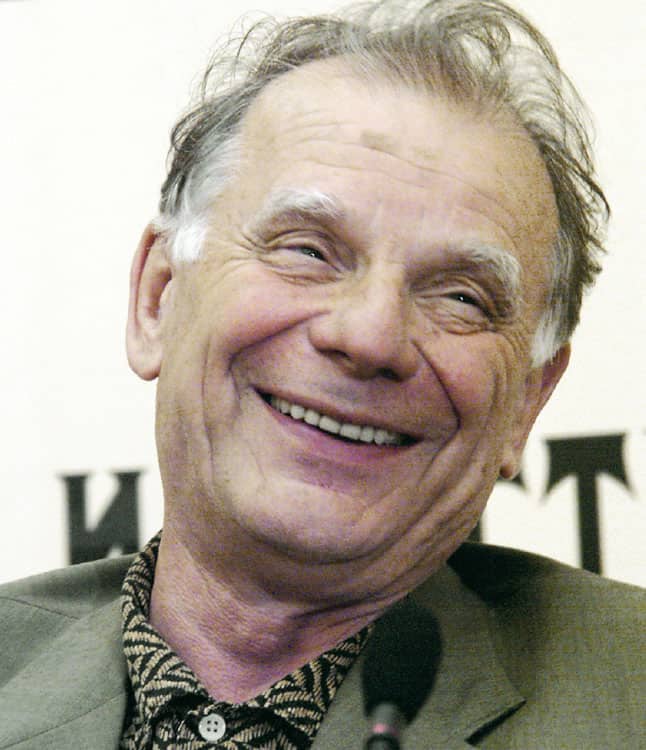
The Russian physicist Zhores Alferov, who shared the 2000 Nobel Prize for Physics with the US scientists Herbert Kroemer and Jack Kilby, died on 1 March aged 88. Alferov pioneered the creation of semiconductor lasers, which led to a vast number of applications that are now ubiquitous in modern life such as DVD players and mobile phones.
Alferov was born on 15 March 1930 in Belarus, which was then part of the Soviet Union. After graduating from the Electrotechnical Institute in Leningrad in 1952, Alferov moved to the Ioffe Institute in St Petersburg, where he spent the remainder of his career. In 1970 he was awarded a doctorate in physics and mathematics from the institute and became its director in 1987 — a position he held until 2003.
An optics revolution
It was at the Ioffe Institute where Alferov carried out his Nobel-prize-winning research. In the early 1960s, Alferov began working on semiconductor heterostructures – devices that contain thin layers of different semiconductors, usually based on gallium arsenide, stacked on top of each other. In 1963 he proposed building semiconductor lasers from such heterostructure devices, which was also made independently by Kroemer. In 1969, Alferov and his team built the first semiconductor laser from gallium arsenide and aluminium gallium arsenide and the following year his team managed to get them to work continuously at room temperatures.
The finding revolutionized the control of light signals in electronics in much the same way that the transistor had earlier revolutionized the technology of electric currents. The heterotransistor, or heterojunction, allowed the development of affordable miniaturized semiconductor appliances that have transformed daily life, underpinning a whole range of gadgets, including CD players, fibre-optic-cable networks and more efficient solar cells.
For this work, Alferov shared half the 2000 Nobel Prize for Physics with Kroemer “for developing semiconductor heterostructures used in high-speed- and opto-electronics”, while the other half was given to Kilby for the invention of integrated circuits.
Alferov was awarded many other honours such as the Lenin Prize in 1972, the USSR State Prize in 1984 and was made an Order of Lenin in 1986 – the highest civilian distinction that was bestowed by the Soviet Union. Alferov was also a fellow of the Institute of Physics, which publishes Physics World. In his later life, Alferov moved into politics. In 1995, he was elected to the Russian Parliament, the State Duma, where he was successfully re-elected in 1999, 2003 and 2007.
A portable fluorometer designed to detect fluorescence emitted from labelled cancer cells has been successfully validated by researchers at the University of Saskatchewan. The device — constructed of inexpensive, off-the-shelf products — is targeted at researchers in hospitals and laboratories for use as an alternative to expensive fluorescence imaging microscopes (Biomed. Opt. Express 10.1364/BOE.10.000399).
Principal developer Mohammad Wajih Alam and colleagues developed the device to promote the use and availability of fluorometers to medical and research labs throughout the world, especially in regions where resources are limited. They believe their fluorometer will overcome the prohibitive purchase and maintenance costs of conventional fluorescence detection instruments and the need for trained staff to operate the sophisticated imaging equipment. They hope that their design will foster clinical and biomedical research into fluorescence-based detection of multiple types of cancer.
The team designed the system so that it can be easily assembled using readily available, economical equipment. The fluorometer consists of a flashlight, a photodiode that responds in the range 400–1100 nm, an emission filter, a microcontroller and an LCD screen. The photodiode, which is immediately below the emission filter, is placed inside a custom-built 3D-printed sample chamber that houses the detection circuitry.
Visible light from the flashlight excites the sample, in this study, a breast cancer cell line engineered to express green fluorescent protein (GFP). As soon as a fluorescent signal is generated, the emitted signal is detected by the photodiode. The emission filter, chosen to match the emission wavelength of the GFP, ensures that only the emitted fluorescence from the sample reaches the photodiode. The microcontroller controls the detected signal, converting the analogue signal generated by the photodiode to digital, and communicating it to the display.
To validate the fluorometer, the researchers tested the system using cultured cells seeded on coverslips and mounted on glass slides. They first measured the fluorescent signal from a control cell sample (breast cancer cells without GFP), repeating the process 10 times to obtain an average base measurement. They then measured breast cancer cells expressing GFP in the same way. The system compares the average values from the samples, and if the difference is greater than 700 mV, the LCD screen displays a “Cancercell found” message.
As the confluency of cultured cells can affect readings, the researchers evaluated cell samples with confluency of between 30% and 95%. They determined that their fluorometer required a minimum of 60% confluency to differentiate between control and cancer cells. Using cultured samples with confluency greater than 60%, the device identified all control cells, and correctly detected nine out of 10 cancer cells.
Co-author Khan Wahid.
“Our fluorometer detected fluorescence emitted from human breast cancer cells genetically engineered to express the green fluorescence protein. These cells served as a biologically appropriate and technically convenient clinical proxy of patient tissue for the fluorescence-based selective-detection of breast cancer cells,” wrote the authors.
“We are trying to expand the use of this device, which we designed to detect fluorescence emitted from cancer cells cultured in vitro, to see if our already compact prototype system can be further miniaturized,” Alam tells Physics World. “We are also currently working towards investigating other types of cancer with our fluorometer.”
“This device can work as an alternative to expensive commercial microscopes where the resources are limited. It can be used in remote places where diagnosis is not possible due to resource constraints,” Alam adds. “Our fluorometer is not a substitute for an MRI scanner, nor is it intended to be. But it does exhibit immense potential for future applicability in the selective detection of fluorescently-labelled breast cancer cells.”
When your bank calls to ask about a suspiciously large purchase made on your credit card at a strange time, it’s unlikely that a kindly member of staff has personally been combing through your account. Instead, it’s more likely that a machine has learned what sort of behaviours to associate with criminal activity – and that it’s spotted something unexpected on your statement. Silently and efficiently, the bank’s computer has been using algorithms to watch over your account for signs of theft.
Monitoring credit cards in this way is an example of “machine learning” – the process by which a computer system, trained on a given set of examples, develops the ability to perform a task flexibly and autonomously. As a subset of the more general field of artificial intelligence (AI), machine-learning techniques can be applied wherever there are large and complex data sets that can be mined for associations between inputs and outputs. In the case of your bank, the algorithm will have analysed a vast pool of both legitimate and illegitimate transactions to produce an output (“suspected fraud”) from a given input (“high-value order placed at 3 a.m.”).
But machine learning isn’t just used in finance. It’s being applied in many other fields too, from healthcare and transport to the criminal-justice system. Indeed, Ge Wang – a biomedical engineer from the Rensselaer Polytechnic Institute in the US who is one of those pioneering its use in medical imaging – believes that when it comes to machine learning, we’re on the cusp of a revolution.
The inside story
Wang’s research involves taking incomplete data from scans of human patients (the input) and “reconstructing” a real image (the output). Image reconstruction is essentially the inverse of a more common application of machine-learning algorithms, whereby computers are trained to spot and classify existing images. Your smartphone, for example, might use these algorithms to recognize your handwriting, while self-driving cars deploy them to identify vehicles and other potential hazards on the road.
Image reconstruction is not just a medical technique – it’s found in ports and airports, where it allows security staff to use X-rays to peer inside sealed containers. It’s also valuable in the construction and materials industries where 3D ultrasound images can reveal dangerous flaws in structures long before they fail. But for Wang, his goal is to overcome the noise and artefacts that arise when reconstructing a volumetric image of an object (such as a patient’s heart) based on imperfect and incomplete medical-physics data.
When less is more: Taking MRI scans quickly avoids capturing unwanted movements of the internal organs, but it can result in compromised images. Machine learning, however, could reconstruct improved images based on incomplete data. (Courtesy: Zephyr/Science Photo Library)
There are good reasons for making do with as little data as possible. In magnetic-resonance imaging (MRI), for example, taking scans quickly avoids unwanted movements of the patient’s heart and lungs that would otherwise smear the resulting picture unacceptably. In X-ray computed tomography (CT), meanwhile, you want to minimize the radiation dose to the patient, which means capturing just enough data to produce an image – and no more.
Traditional “analytic” reconstruction methods produce images by combining measurements made from every angle around the patient, which is difficult as it means taking complete data sets. Although “iterative-reconstruction” algorithms developed in recent years are better at tolerating gaps in the data, they need lots of computer power. That’s because these algorithms produce multiple candidate images, each of which has to be compared to “correct” data, so that a final reconstruction is arrived at gradually.
In the short term, Wang envisages machine-learning techniques replacing specific individual components of the reconstruction process. The techniques would be based on “artificial neural networks” (see box below), which approximately emulate the workings of a biological brain, with each input processed by one or more “hidden” layers of artificial neurons. Interactions between the layers are weighted so that the process is nonlinear, and these parameters change as the system learns, modifying the output accordingly. So-called “deep-learning” approaches are those that make use of “deep” networks when there are many hidden layers.
To begin with, Wang thinks that improvements will be marginal rather than revolutionary. In iterative reconstruction, for example, using a neural network to make the initial “guess” for the image based on a large data set would simply make the whole process more efficient. Another substitution would see a neural network take the role of deciding when enough iterations have been performed to produce an adequate output.
Longer term, however, Wang is more ambitious. He calls for a completely integrated system, in which machine-learning algorithms – using raw imaging data as inputs – reconstruct the image and then extract and classify pathological features like cancers and neural diseases. Such a system could even be extended to encompass treatment planning, automating the whole process from data acquisition to therapy.
Yet despite its achievements and its promise, Wang says, deep learning lacks a decent overarching theory, which means the technique’s inconsistencies are still mysterious. “By changing one small pixel’s value, the artificial neural network could return weird results. It’s not always right,” says Wang. A goal for the future, then, is to develop more easily explainable, interpretable AI, opening the black box, which – Wang jokes – “is still a grey box”.
Quantum questions
Machine learning could also have a profound impact on quantum physics, notably solving “quantum many-body problems”. Such problems arise when you have a set of interacting objects that can be understood only by accounting for their quantum nature. “What these problems have in common is the fact that studying their properties requires, in principle, a full knowledge of the many-body wave function,” says Giuseppe Carleo, a physicist at the Simons Foundation’s Flatiron Institute in New York, US.
The many-body wave function is, in Carleo’s words, “a monster, whose complexity scales exponentially with the number of constituents”. Imagine, for example, a system of particles that can each spin either clockwise or anticlockwise. With two particles, you have four possible states. With three particles, eight states, which is still manageable. Go much further, however, and things quickly get out of hand.
Traditional methods are ineffective at tackling the problem for more than a few components, so Carleo and Matthias Troyer – who was then a colleague at ETH Zurich in Switzerland – applied a machine-learning approach. The pair found that a relatively “shallow” neural-network architecture – using just a single hidden layer – could efficiently “learn” a representation of the wave function, for an example problem of spins on a 1D or 2D lattice.
The same difficulties in solving the quantum many-body problem arise in “quantum-state tomography”. Just as tomographic imaging reconstructs the interior of an object from measurements made from without, so quantum state tomography determines a system’s quantum state from a small number of measurements made on its more accessible parts. As with the quantum many-body problem, the information encoded in the wave function grows exponentially with the number of components in the system.
One quantum state that would be useful to describe is the way in which qubits are entangled in a quantum computer, making quantum state tomography vital for understanding how such a computer would cope with noise and loss of coherence. The problem is, any quantum computer worth having will include dozens or hundreds of qubits, so a brute-force approach to determining its quantum state will be inadequate. That’s where artificial neural networks come to the rescue, making it possible – Carleo found – to efficiently reconstruct the state of a quantum computer comprising 100 qubits. Standard approaches, in contrast, are limited to around eight qubits.
New kind of learning: Artificial neural networks approximately emulate the workings of a real biological brain, with each input processed by one or more “hidden” layers of artificial neurons. (Courtesy: Laguna Design/Science Photo Library)
And there’s more to come. Machine-learning approaches have been applied to this field only recently, which means that the techniques used by researchers are still at the proof-of-principle stage. Indeed, the methods demonstrated by Carleo and colleagues typically involve neural networks with just one or two hidden layers, whereas more mature commercial applications – such as those used by the likes of Google and Facebook – can employ much deeper architectures, and run on dedicated hardware that has been optimized for the job.
Unfortunately, the notorious weirdness of quantum physics means that these more complex neural networks could not simply be translated directly to the quantum regime; Carleo and others had to rewrite the algorithms almost from scratch, and are yet to match the complexity seen at the cutting edge of machine-learning applications. Catching up with those mature systems will allow artificial neural networks to solve even more complex quantum problems. “I think that the next few years will see this methodological and technological gap shrink more and more, leading to applications we cannot even imagine right now,” says Carleo.
Artificial neural networks will be able to solve even more complex quantum problems within the next few years
Finding new materials
Whereas artificial neural networks must typically be fed large data sets before they produce useful results, over at the University of Virginia in the US, Prasanna Balachandran employs tools that are not so data-hungry. The aim of his research is to identify, from the vast, multidimensional space of possibilities, the relatively few formulations that yield materials with favourable properties. To explore such a space by trial and error would take much too long, and the mapped regions – corresponding to materials whose properties are known – are a vanishingly small part of the whole.
Sorting the wheat from the chaff: Statistical learning can be used to filter down large sets of possible material structures to a manageable number for experimentation. (Courtesy: Robert Brook/Science Photo Library)
The method that Balachandran uses to solve this problem is a particular form of machine learning known as statistical learning. This approach gets around the need for large training sets by assuming that patterns in the data follow strict statistical rules. “We train machine-learning models to learn about things that we already know, and we apply those models to predict things that we do not know,” he explains.
In this case, we know the behaviour of certain material combinations, and what we essentially want to predict are the properties of every other possible formulation. However, the confidence with which the properties of a given material can be predicted depends on how well the surrounding neighbourhood is known, so – for each prediction – Balachandran also quantifies the error bars associated with every expected value.
Regions where knowledge is lacking can therefore be identified, and the system can suggest the most profitable experiments to do next. It’s a novel approach. “Generally, in materials science, the way that experiments have been carried out is biased by the intuition of the scientist who is running them,” says Balachandran.
Balachandran and colleagues in the US and China recently demonstrated the fruitfulness of this approach by discovering a set of high-performing “shape-memory alloys” from nearly a million possible compositions (Nature Comms7 11241). Such materials are useful because they deform as they change phase upon heating or cooling. The temperature of the phase change depends on the direction of the transition, with this difference – the thermal hysteresis – determining the applications that the alloy is suited to. Balachandran’s group was particularly keen on materials with the smallest possible thermal hysteresis and found that almost half of the few-dozen alloys that they synthesized on the basis of the machine’s predictions beat the best sample to date.
Exploring the infinite space of material properties might be one of those activities derided by Ernest Rutherford as mere “stamp collecting”, but it could be key to discovering new physics. “In the next five to 10 years we want to go beyond correlation and start thinking about causation,” says Balachandran. “You need to have the right kind of data to explore the concept of causation itself. In my opinion we have the solution to that part of the puzzle, and we know how to find representative samples for any given problem that is of interest to us – fast.”
Statistics, statistics, statistics
While machine-learning techniques have yielded concrete results and insights in medical, quantum and materials physics that wouldn’t be possible otherwise, progress has been less clear in statistical physics. “We are still waiting for the big example that the community would agree we would not have done without machine learning,” admits Lenka Zdeborová, who studies the theory of machine learning at Université Paris-Saclay in France.
Sure, there have been promising developments in statistical physics, but Zdeborová says these techniques have so far not been deployed at the frontiers of the field. She points to dozens of papers that use neural networks to study models such as the 2D Ising model, which describes the interactions between spinning particles on a 2D lattice, but says none so far are telling us anything fundamentally new.
It may be disappointing that machine learning is not yet driving advances in statistical physics, but knowledge and insight are certainly flowing the other way. Imagine, for example, a neural network required to identify images. Each image will contain lots of data (pixels) and be noisy (because any given image will be masked by masses of irrelevant features); and there will also be correlations between the different weights in the network.
Happily, problems that are multidimensional, noisy and correlated are just the sort of thing that statistical physicists have been learning how to deal with since the middle of the last century. “Just think about the theories that physics has developed in disordered systems,” says Zdeborová, whose own background is in a specific kind of disordered magnet known as spin glasses. Such systems have lots of particles (i.e. lots of dimensions), have a finite temperature (i.e. are thermally noisy) and many inter-particle interactions (i.e. lots of correlations). In fact, in some cases the equations that describe models of machine learning are exactly the same as those used to handle systems in statistical physics.
This insight could be key to developing a comprehensive theory that explains just why these methods work so well. Machine learning may have advanced further than was generally predicted a couple of decades ago, but its successes still arise largely from empirical trial-and-error approaches. “We want to be able to predict the optimal architecture, how we should set the parameters, and what the algorithm should be,” Zdeborová concludes. “Currently we have no clue how to get those without huge human effort.”
Machine-learning jargon buster
Artificial intelligence (AI)
Intelligent behaviour exhibited by machines. But the definition of intelligence is controversial so a more general description of AI that would satisfy most is: the behaviour of a system that adapts its actions in response to its environment and prior experience.
Machine learning
As a group of approaches to endow a machine with artificial intelligence, machine learning is itself a broad category. In essence, it is the process by which a system learns from a training set so that it can deliver autonomously an appropriate response to new data.
Artificial neural networks
A subset of machine learning in which the learning mechanism is modelled on the behaviour of a biological brain. Input signals are modified as they pass through networked layers of neurons before emerging as an output. Experience is encoded by varying the strength of interactions between neurons in the network.
A new IOP Publishing ebook Machine Learning for Tomographic Imaging by Ge Wang, Yi Zhang, Xiaojing Ye and Xuanqin Mou will be published later this year.
We need to prepare our health systems to manage changes in the magnitude and pattern of climate-sensitive health outcomes as climate changes, says Kristie Ebi, who recently reviewed the health risks of warming in Environmental Research Letters (ERL).
Why did you decide to investigate the health risks at different warming targets?
In response to the Paris Agreement on climate change, the research community quantified the differences in risks, sector by sector, between 1.5 °C and 2 °C increases in global mean surface air temperature above pre-industrial levels. Few publications on human health specifically addressed this question; most projections of the health risks of climate change were for future time periods, such as 2030, 2050 or the end of the century. And few of these studies reported what the concurrent temperature change would be. This is problematic because the magnitude of changes in global and regional ambient temperatures in any time period varies across climate models; some models project much lower — or much higher — changes in temperatures than others.
We decided to conduct a comprehensive review of the 109 papers published from 2012 through November 2017 on the health risks of climate change. The years for which global mean surface temperature was projected to reach 1.5 °C or 2 °C above preindustrial levels were estimated using the global climate model projections and scenarios employed within each health study. One challenge is that the pre-industrial baseline period is not well characterized. So we defined the decade 2010-2019 as the baseline for analysis because the centre year of this decade – 2015 – is the first year for which observed global mean surface temperature reached 1.0 °C above pre-industrial temperatures. Using this baseline, warming of 1.5 °C is projected to be reached in about the 2030s for all multi-model means under all scenarios of greenhouse gas emissions, with warming of 2 °C in about the 2050s under most scenarios.
What did you discover?
We found that the health risks of 2 °C increases in global mean surface air temperature exceeded those at 1.5 °C for consequences associated with exposures to high ambient temperatures, heat stress, ozone and undernutrition. There were regional variations. The risks associated with vector-borne diseases and particulate matter could increase or decrease with higher global mean temperatures, depending on regional climate responses and disease ecology.
Our findings highlight the generally high degree of agreement among projections of the health risks of climate change, with broadly similar estimated risks for each health outcome. We identified areas for model improvement, including considering how to most appropriately represent exposure-related risks in what are now the tails of the distribution: specifically, what is assumed about the shape of the relationships in warmer climates. Understanding these assumptions is important because the effectiveness of public health interventions will depend on the accuracy of estimates of health risks as warming continues.
What action should we take as a result of your findings?
We recommend that studies report global and regional mean temperature changes along with time period for the projection; doing so will increase understanding of the magnitude and timing of when adaptation interventions will likely be necessary. This information will provide insights into the urgency associated with developing adaptation interventions and into how quickly mitigation policies can reduce the magnitude of climate change to which individuals, communities, and health systems will need to adapt. Further, it would be helpful to develop a set of common scenarios, combining climate projections under a range of emission pathways and multiple socioeconomic development pathways to facilitate comparisons across studies. By comparing different scenarios at each degree of temperature change, it would be possible to compare the outcomes under the same temperature but different economic development pathways, e.g. economic growth, population, technology change. Depending on climate and development pathway, exposure to climate-related hazards and adaptive capacity will differ in 2050 and 2100, and will thus place different demands on health systems to promote and protect population health.
Overall, our results strongly support the ambition of the Paris Agreement to rapidly reduce greenhouse gas emissions to increase the probability that health risks will stay within manageable boundaries. The results also indicate the need for proactive adaptation to ensure health systems are adequately prepared and have sufficient human and financial resources to manage changes in the magnitude and pattern of climate-sensitive health outcomes. Our hope is that these results will be used to inform policy and planning processes at local, regional, national, and international levels.
A new recycling process to transform polyethylene terephthalate (PET), which is widely used to make drink bottles and synthetic fibres, can transform the common plastic into a more valuable material with better properties. The new technique could help with the serious and urgent problem of ever-increasing amounts of plastic waste in our oceans and the environment.
With more than 26 million tonnes being produced each year, PET is the most abundantly produced polyester in the world today. Its popularity comes from the fact that it is lightweight, impermeable to water and strong. 60% of this plastic is used in synthetic fibres (for carpets, for example) and 30% in single-use drink bottles. Despite good recycling programmes in many countries, less than 30% of PET bottles are recycled, which means that the material ends up in landfills, where it takes hundreds of years to biodegrade.
Upcycling to fibre-reinforced plastic
“Most PET recycling today is mechanical and results in materials that have a lower value than the virgin plastic so it is actually downcycling,” explains study leader Gregg Beckham of the US Department of Energy’s National Renewable Energy Laboratory (NREL). “Our process takes reclaimed PET and combines it with non-food plant-based building blocks to make materials that are much more valuable (and hence upcycled), have different functions and a longer life than the starting single-use plastic.” Indeed, the fibre-reinforced plastic (FRP) produced could be used in car parts, wind turbine blades, surf- and snow-boards, he says.
The researchers begin by first deconstructing PET (obtained from cut up plastic drink bottles) and glycolyzing it with linear diols (which can be obtained from renewable sources). They then react it with renewably-sourced monomers to produce a series of unsaturated polymers or diacrylic polymers. Finally, they dissolve these polymers in a solution containing reactive free radical molecules to form a resin that they apply to woven fibreglass mat and react to produce a series of rPET-FRPs. The materials produced are as good as, or in some cases even better than, standard composites made from petroleum in terms of both mechanical and thermal properties.
“We hope that this study will motivate other research groups to combine reclaimed low-value plastics with bio-based building blocks and find new strategies for PET and other single-use plastics upcycling,” Beckham tells Physics World. “We need to incentivize the economics of plastics reclamation to keep it out of oceans and landfills.
“For our approach in particular, we hope that industry and publicly-funded organizations will come together to further develop this technology.”
The researchers, reporting their work in Joule, say they are now planning to scale up their technique. They also want to find out if they can recycle the composites they have made. “Our reclaimed materials are not inherently recyclable at the end of their useful lifetime so we are working with different formulations and combining them with other bio-based building blocks.”
Fearing the future: Many physics-based firms are worried about the consequences of a “no-deal” Brexit, including York Instruments.
“Please do not mention that word in our presence.”
The word Steve Self doesn’t want to hear is “Brexit”, and his comments will surely provoke sympathetic nods across swathes of the physics community. As the commercial director of Stream Bio, a UK-based start-up that manufactures nanoparticles for applications in bioimaging, Self is responsible for steering his firm through an often-complex marketplace. The UK’s impending departure from the European Union – which was, as Physics World went to press, still scheduled to take place on 29 March – could lead to changes in tariffs, customs arrangements, export regulations and other trading conditions for British and Northern Irish businesses. It’s fair to say that Self isn’t looking forward to it.
Probe a little deeper, though, and even Self, an advocate of staying in the EU, shows signs of – well, not optimism, exactly, but certainly a determination to make the best of the situation. Although Stream Bio may have to establish an EU trading base after the UK’s departure, Self and the company’s chief executive officer, Andy Chaloner, see this as a hurdle, not a deal-breaker. “Business will continue,” Self says phlegmatically. “Business always finds a way.”
Alternative arrangements
Other leaders of hi-tech, physics-related companies have similarly nuanced views. At York Instruments, which manufactures brain scanners based on a novel type of superconducting quantum interference device, chief technology officer Gary Green offers a measured response to questions about the company’s Brexit plans. The UK is, he observes, a good place to do business, with a strong intellectual property regime and a system of tax credits for companies that do research and development (R&D).
However, if Brexit leads to increased tariffs on exports, York Instruments is making plans to move its manufacturing base elsewhere. “It’s a shame, because we were very pleased that our equipment is manufactured here,” Green says. The company recently acquired a subsidiary in Finland, and while the purchase was not directly related to Brexit, Green thinks it will be helpful to maintain a presence within the EU.
For Arnab Basu, specific changes to tariffs or regulations are less of a headache than the uncertainty surrounding what will happen after 29 March. Basu is the founder and chief executive officer of Kromek Group, a publicly listed company that makes radiation-detection components and devices for medical imaging and nuclear security. Because Kromek gets most of its revenues from sales to customers outside the EU, Basu and his employees are already used to dealing with different export control and tariff regimes, and to complying with other countries’ regulations on product certification. “If we knew what we were planning for, we could plan for it,” he argues. “But we can’t plan for five different scenarios.”
As an example, Basu cites potential changes to compliance and certification programmes. Currently, companies wishing to sell products within the European Economic Area (EEA) need to meet certain environmental, health and safety standards, and have their compliance recognized under the CE marking scheme. If the UK leaves the European single market as well as the EU – as it would under the deal negotiated by Prime Minister Theresa May, but not under some alternative, “softer” Brexit proposals – a new, UK-specific mark would need to be developed to replace CE marks.
However, if Kromek and other UK businesses want to continue selling to markets that require the CE mark, they will still need to comply with CE rules – only now with the added hassle of sending all their technical files related to CE compliance to a European location, to be held by a European company. “It’s additional work, another layer of complexity, and I don’t know what we’re trying to solve by doing this,” says Basu in exasperation. “We don’t have an issue today, as a business, in doing business with any of the 30 countries where we’re active, whether that’s under an EU trade deal or other arrangements. All I see at the moment are disruptions.”
No deal, big problem
Kromek currently manufactures almost 50% of its products at its UK headquarters – which, like Stream Bio, is located in County Durham, where a majority (57.7%) voted to leave the EU in the referendum of June 2016. Most of Kromek’s other manufacturing takes place in the US, and Basu says that Brexit may influence the company’s next investment decisions. “We are currently looking at a capital investment programme of £6–10m over the next 6–9 months, and depending on what happens in March, we have the flexibility to alter where that capital investment programme happens,” Basu says. “If it’s complete chaos, the board will have a duty to go to where we have a better visibility” of market conditions, he adds.
The prospect of a chaotic Brexit also worries Ralf Kaiser, a physicist at the University of Glasgow and founding chief executive of a spin-out firm, Lynkeos Technologies. “Brexit can, if we’re not lucky, kill our business outright,” he tells Physics World. Lynkeos makes systems that use muons to image barrels of intermediate-level nuclear waste, and therefore depends heavily on government funding for nuclear decommissioning. If this funding dries up – which it might, if some of the more alarming Brexit predictions come to pass and the government struggles to cope with food and medicine shortages – then companies like Lynkeos will be, as Kaiser puts it, “further down the chain”. Another Lynkeos employee, David Mahon, adds that many of the components in their systems are manufactured in America or Japan, meaning they would be exposed to a fall in the value of the pound.
Brexit uncertainties are also affecting some hi-tech UK businesses in more personal ways. Chris Meadows, head of open innovation at IQE, a multinational semiconductor manufacturer, says that Brexit has hurt his ability to recruit skilled employees from EU countries to IQE’s headquarters in Cardiff. Business leaders are concerned about current employees, too. About a third of workers at the Glasgow-based laser firm MSquared Lasers hail from outside the UK, and the company’s chief executive, Graeme Malcolm, says his priority is to preserve that diversity. “The world’s a big global community now and science has led the way on that,” he says. “The more that’s the case, the better for mankind.”
Situation unknown
During the Brexit referendum campaign, some Brexit supporters argued that UK companies needed to be “freed” from onerous EU regulations in order to do more business in higher-growth markets, especially in Asia. According to John Lincoln, who heads a UK industry trade body called the Photonics Leadership Group, this kind of thinking was “certainly a discussion point” within the UK’s photonics sector two years ago. Today, though, Lincoln believes those potential benefits have receded from people’s minds, because the UK’s future trading relationships remain so uncertain.
When asked about possible Brexit benefits, Meadows of IQE suggests that the removal of EU rules on state aid could make it easier for companies like his to get government funding for R&D. Lincoln adds that a chaotic Brexit could, perhaps counter-intuitively, yield more support for industry, because the government “would need to go back to the industries that were exporting stuff and say, ‘Um, how can we help you do this?’”
Basu, however, dismisses the idea of a Brexit dividend for export-focused companies like his. “Whether we are going to do better trade deals or worse trade deals, at the moment our business flourishes based on arrangements we already have,” he says. When asked what the government could do to help his business do even better, his answer is immediate. “Give us clarity,” he says. “Give us clarity of what’s going to happen, give us clarity over what time scale it will happen. As businesses we are slightly less bothered about the politics. What we are really bothered about is, give us enough time to plan so that we can cope.”