Metamaterial enables superscattering to be observed for the first time

A four-fold increase in the scattering of microwave light has been observed from a cylindrical rod structured on the subwavelength scale. The “superscattering” structure could offer exciting new opportunities for applications ranging from highly-efficient antennas to devices that harvest energy from infrared radiation.

Light scattering is a well known optical phenomenon that happens when light interacts with structures smaller than its wavelength. The incident light perturbs electrons in the structure to form oscillating dipole moments that re-emit the light in many different directions. The intensity and direction of this scattered light depend both on the incident wavelength and specific properties of the structure, including its size, shape, and refractive index. Ultimately, these values are quantified by a parameter known as the scattering cross-section – which, until recently, appeared to have a fundamental upper limit.

In a 2010 study, however, physicists Zhichao Ruan and Shanhui Fan at Stanford University in the US proposed that the supposed limit in scattering cross-section could be overcome by inducing oscillations of higher-order electric moments in the structures, including quadrupoles. If these additional modes have the same resonant frequency as the dipole oscillations, Ruan and Fan said that they could work together to increase the overall scattering cross-section.

To induce these oscillations, the duo proposed a theoretical design for a metamaterial rod containing multiple nanolayers. However, their structure was too complex to build experimentally, and would have led to a loss of scattering power due to finite metal conductivity at optical wavelengths. Now, an international team led by Hongsheng Chen at Zhejiang University in China, and Baile Zhang at Nanyang Technological University in Singapore, has used new calculations to further investigate the ideas raised in Ruan and Fan’s research.

In their study, the team fabricated a rod made from three concentric cylindrical metasurfaces, separated by dielectric materials. These metasurfaces consisted of copper strips with far smaller widths and periodicities than microwaves, allowing surface waves with microwave frequencies to form when illuminated with microwave light. At a result, light scattered by the structure should be polarized along the length of the rod, which minimizes power loss. By fine-tuning the periodicity and width of the strips, the team ensured that the metasurfaces could support dipolar and quadrupolar modes resonating at the same frequency.

Chen and colleagues tested their rod using microwaves of two different frequencies, and clearly demonstrated superscattering in both the near- and far-field regions. Compared with a continuous copper rod of the same size and shape, their induced scattering cross-sections were four times greater than those achievable with dipole moment oscillations alone.

The result shows a substantial improvement in light–matter interactions on subwavelength scales. Chen’s team proposes that the high scattering efficiency and directionality produced by their rod could allow it to be used as a highly-efficient antenna, for applications including wireless communication, data transmission, and remote sensing. In the future, the researchers hope to expand the rod’s superscattering abilities to infrared wavelengths, which could lead to extensive opportunities in areas such as imaging, sensing, optical displays, and energy harvesting.

Quantum effects boost engine performance

Physicists have in recent years built a number of microscopic heat engines to investigate how the laws of thermodynamics might change on the atomic scale. To date, however, no such machine has demonstrated quantum-mechanical effects. Now, researchers in the UK and Israel have created miniscule engines within a block of synthetic diamond, and have shown that electronic superposition can boost their power beyond that of classical devices.

A heat engine is any device that does work by exploiting a flow of heat between hot and cold baths. Usually it contains a physical piston that moves up and down as a gas or other fluid expands and contracts. But its performance does not depend on any quantum-mechanical property of the gas.

That would not be true of a so-called quantum heat engine. In 2015 Ronnie Kosloff and colleagues at the Hebrew University of Jerusalem in Israel theoretically analysed the workings of an engine that exploits quantum coherence via a superposition of energy states. They found that although such a machine could not exceed the Carnot efficiency – which sets a performance limit for any reversible heat engine – over short cycles it should generate more power than any equivalent classical device operating between the same thermal baths.

In the latest work, James Klatzow of Oxford University, Raam Uzdin of the Hebrew University of Jerusalem, Eilon Poem of the Weizmann Institute of Science, also in Israel, and co-workers at Oxford and Bath University, have built such an engine in the laboratory. As they report in a paper recently accepted for publication in Physical Review Letters, the device exploits what are known as nitrogen-vacancy centres, gaps within a diamond lattice created by nitrogen impurities that act as if they were atoms containing a set of discrete energy levels. The diamond in question is a slab about 5 mm by 5 mm, which is exposed both to microwaves and green laser light.

Two-stroke engine

The engine cycle consists of two strokes, each lasting just a few tens of nanoseconds, although these do not involve the movement of a piston as would, say, a combustion engine. The first stroke is thermal, in which electrons are boosted to a higher energy level by the laser light before dropping back down to an intermediate level and fluorescing in the red portion of the spectrum. Then comes the power stroke, during which microwave photons of just the right frequency stimulate the electrons to drop back down to their ground state. The net result is that two photons are emitted for every one absorbed.

As well as transferring electrons between the ground and intermediate states, the microwave interaction creates a quantum superposition between these states. The engine is rendered quantum-mechanical by making use of this superposition to increase the production rate of stimulated photons – an effect that comes into play only when the strokes are very brief and the quantum superposition remains coherent. This doesn’t boost the engine’s overall energy output – meaning there is no contravention of thermodynamic laws – but it does lead to a speed-up. In other words, it raises the device’s power compared to an engine without quantum superposition.

Klatzow and colleagues demonstrated this performance boost by measuring how much work the engine could do in each cycle as they varied the duration of the thermal stroke. The idea was to find out what happened as the stroke duration approached the decoherence time (about 75 ns) – which is when the engine becomes less quantum-like. And indeed they found that the work done per cycle dropped as the stroke got longer.

As Klatzow points out, four years ago a group in Germany built a heat engine using just a single ion of calcium, which the researchers forced back and forth along a small funnel by turning electrodes on and off at a certain rate. He describes that work as “very impressive” but says they did not show that quantum coherence affects the engine’s performance, even though a single ion is unquestionably a quantum object.

Quantum power

In contrast, he says, the latest device is susceptible to quantum effects because it can be operated using miniscule amounts of heat – thanks to extremely sensitive measurements they carry out via laser fluorescence. “We are the first to have shown quantum coherence effects in the operation of heat engines,” he says.

Klatzow reckons that practical applications of the research remain some way off, particularly those relying on high efficiencies – with the current performance, he says, being “certainly nowhere close to Carnot”. On the other hand, he believes it may help improve our understanding of photosynthesis, since plants work in effect like a heat engine by converting sunlight into stored electrical energy. “People suspect that there might be some sort of quantum coherent processes, which would be fantastic if we could mimic it,“ he says. “That might potentially be useful for very efficient solar cells.”

Kosloff congratulates the experimental group for its “very important contribution” to quantum thermodynamics, and is quite bullish about applications. The latest research, he argues, “paves the way to asking about quantum supremacy” in designs of heat engines and refrigerators. “In the near future quantum refrigerators will become a crucial enabler in quantum technology,” he says.

‘Grape plasma’ phenomenon explained at long last

YouTube videos of grape halves sparking in a household microwave oven and igniting a plasma have amassed millions of views, but the physical mechanisms behind this phenomenon are in fact little understood. Thanks to thermal imaging experiments and finite element simulations, a team of researchers in Canada has now discovered that the grapes form resonant cavities at their centres that concentrate microwaves to much smaller wavelengths, which leads to the creation of the plasma. The observations, which are usually only seen in nanoscale metallic objects, could be useful for experimental research in nanophotonics.

The “grape plasma” phenomenon, as it is commonly known, is usually demonstrated in grapes cut in half but still connected by a thin strip of skin. Until now, a popular explanation was that the skin acted as a short dipole antenna and that the conducting ion-rich skin “bridge” played an important role.

Central heat spot

“This picture may not be correct, however, since we have now found that whole grapes, which are essentially aqueous dielectric objects, and ‘skinless’ hydrogel beads can also produce a plasma, as long as they are physically touching,” explains study co-author Pablo Bianucci of Concordia University in Montreal. “Our thermal imaging experiments show that single grapes placed separately in the microwave oven heat from the inside, from a central spot, instead of warming on the outside first (as most food in the microwave does).”

The grapes act as spheres of water, which, because of their large index of refraction and the fact that they absorb little light, form cavities resonating at 2.4 GHz, he says. These are so-called Mie resonances, which describe the near-field effects of resonant interactions of light with objects that are about the same size as the irradiating wavelength.

Mie resonances add up

When individual grapes are brought together, the Mie resonances add up to create an intense hotspot at the point at which the spheres contact. This hotspot has a field strength high enough to ionize sodium and potassium ions in the fruit, and ignite a plasma, and it is confined to a very small region – on the order of 1/100 of the wavelength. This hotspot is similar to that found in the plasmonic resonances of metallic nanospheres.

“Our work shows that it is possible to see this hotspot effect with non-metallic, weakly light absorbing particles,” Bianucci tells Physics World. “If we were to find a material that reduces the wavelength of visible light as much as water reduces that of microwaves, the effect could be used to focus light to very small spots. This could be useful for high resolution imaging and enhancing spectroscopy and sensing.

Modified microwave ovens

The researchers performed their experiments in modified microwave ovens. “The doors of these ovens have screens that are mostly transparent to the wavelengths of light employed by the thermal camera we used to obtain images of the grapes and the plasma, but which are still opaque to microwaves,” explains study co-author Hamza Khattak of Trent University in Peterborough.

The team also performed finite element simulations of the phenomenon (using the COMSOL software). Many of these modelling experiments so far are static, however, and do not consider changes in the system, says Bianucci. “For example, as the grapes heat up, the optical properties of water change and we don’t yet know how this could affect the plasma phenomenon.”

Full details of the research are reported in PNAS 10.1073/pnas.1818350116.

The life ahead is electric

It’s full steam ahead for renewables in the DNV-GL consultancy’s latest Energy Transitions Outlook. It looks to wind and solar power having a 29% and 40% share, respectively, of total global electricity generation by 2050, with nuclear stalled and energy demand peaking by 2035. That’s despite there being a boom in electric vehicle (EV) use – renewables can support that, with electrification carrying all before it. “Electrification and its inherent efficiency will contribute to humanity’s energy demand declining from the mid-2030s onwards,” the report says. “Global expenditure on energy, as a percentage of GDP, will fall 44% by 2050.”

However, DNV-GL says it won’t be automatic: “high fractions of solar and wind will create a need for increased use of market mechanisms and changes to the electricity market fundamentals”. So the consultancy wants policy makers to intervene and put in place “measures to incentivize a demand shift towards clean energy, to stimulate innovation in new efficient and clean technologies”. Otherwise we won’t hit the Paris climate targets.

It all sounds most exciting, but very electricity oriented. “DNV GL sees energy efficiency improvements being so strong that it from the 2030s onwards outpaces the economic growth that globally gradually will reduce towards around 2%/yr,” said Sverre Alvik, programme director of the Energy Transition Outlook. “Behind the strong efficiency improvements is a strong belief in electricity taking over as the dominant energy carrier, more than doubling its share to 45% of final energy demand in 2050.”

Alvik believes this means DNV GL has a distinctive take on what may happen. “The strong electrification of all sectors, but most of all in the transport sector, and the high renewable share, are two distinct differences from DNV GL’s forecast and many scenarios from other forecasters, and this is the main reason for DNV GL seeing world energy peak, while most other forecasters do not,” he said.

Free energy and endless growth?

Efficiency may in theory mean energy demand growth can be contained and even reduced, as DNV-GL suggests, but a boom in EV use is now widely predicted, and most see that as leading to a power demand surge, at least in the short term. DNV GL evidently thinks that the fact that green electricity use is more efficient than fossil fuel energy use will compensate — we won’t need so much primary energy. However, there are also other factors. With green power generation costs falling, it’s hard to predict what will happen. Analysts at Swiss investment bank UBS seem to believe that, by 2030, the cost of energy from renewables like PV solar will be so low they will “effectively be free”, at least for power use in the domestic sector. But won’t people use more power if it’s cheap? For driving and many other things. Or will demand stabilize? There may be natural limits. It’s certainly the case that UK electric power consumption has been falling and is now back to 1994 levels.

the future could be more nuanced than that, with electric taxis hailed electronically reducing congestion and parking

Dave Elliott

This all sounds miles away from the doom and gloom that often seems to be the norm when we talk about energy futures: a Cornucopian future of plentiful cheap clean power. Cynics will rush in to put the mockers on it – won’t we just have queues of EVs congesting the streets and more roads being built and land lost to accommodate the vehicles and their parking spaces? But the future could be more nuanced than that, with electric taxis hailed electronically reducing congestion and parking. As well, of course, as cheap electric-powered mass transit systems. A familiar Utopia!

Back in the world of today, there are some potential downsides to the rapid fall in renewable prices. Perversely, the success of this competitive “race to the bottom” makes it less attractive for generation companies to invest in more capacity – the profit margins are reduced. This so-called “market self-cannibalization” problem can be avoided if demand for energy is increasing – but is more demand growth what we want? Don’t we want to move to a sustainable stable-state system, to avoid ever more stress being placed on the environment? Or do these new clean technologies allow us to escape from that constraint, as some eco-modernists suggest? Although, apparently, some of them would prefer nuclear. Indeed, jumping over several steps in the usual debate over weapons proliferation and dual-use technology, some even say that expanding civil nuclear would be an aid to weapons-use deterrence.

Cutting demand

Maybe a less risky approach is just to push on fast with renewables, and also with energy efficiency. The latter recently received a new stimulus from a study claiming that “one quarter of the energy currently used in UK households could be cost-effectively saved by 2035; and this could increase to one half if allowance is made for falling technology costs and the wider benefits of energy efficiency improvements”.

Following that up, a UK Centre for Research on Energy Demand Solutions (CREDS) was launched in 2018, led by one of the paper’s authors, Professor Nick Eyre of the University of Oxford, and funded with £19.5 million from the Engineering and Physical Sciences Research Council (EPSRC) and the Economic and Social Research Council (ESRC). “The goals of a secure, affordable, low carbon energy system are only achievable if energy demand is reduced, decarbonized and made more flexible,” Eyre said. “Understanding how these changes can happen is a major interdisciplinary research challenge.”

A shift to flexible demand management is certainly now high on the agenda. That’s unsurprising, since it may turn out to be the cheapest way to respond to variable renewable supply. For example, introducing “time of use” electricity tariffs can shift demand away from times when renewable inputs are low. And it involves no extra capital cost, unlike installing storage capacity or using back-up supply capacity. What’s more, the consumer market system can hopefully be improved – there is certainly a need for some rationalization of the existing, sometimes perverse, pricing system for heat supply.

In parallel, the prospects for self-generation of power by prosumers are looking up, as is argued in the interesting series of essays published by the UK Institute for Public Policy Research, which explore decentralized renewable energy options, including storage and peer-to-peer trading of surpluses. It is visionary stuff, with the hope being that the new smart energy system “empowers citizens and communities to be more self-sufficient while being part of a connected, inter-dependent system that offers security of supply and resilience in the face of changing demand and climate”.

There are certainly changes underway in how we perceive local energy markets and in what they might deliver. And as I will be exploring in my next post, DNV GL is actually not alone in predicting big savings. In the US, Amory Lovins of the Rocky Mountain Institute also says that the result of all these changes, if an integrated approach is taken, could be massive energy efficiency improvements. Big changes do seem likely, with new approaches to electricity generation and use emerging. See Walt Patterson’s fascinating papers on the joys of electricity – if done right. Though, in a later post, I will ask if electricity is all we need.

Donna Strickland gives inside story of her Nobel-prize-winning research

“It’s scary when the phone rings at that time.”

So said Donna Strickland at a lecture at the Institute of Physics in central London last night as she recalled the moment last October when her life was to change for ever. It was the Royal Swedish Academy of Sciences on the phone, calling at 5 a.m. local time to tell her she’d won the 2018 Nobel Prize for Physics with Gérard Mourou and Arthur Ashkin.

Strickland, who is based at the University of Waterloo in Canada, was told to hold the line, but bizarrely the phone went dead. “Technical glitch”, she recalled. “Something had gone wrong. Then I saw an e-mail saying they were desperately trying to phone me.”

After having the news confirmed, she texted family members, but her daughter didn’t quite believe the message. “She thought mom’s phone had been hacked,” Strickland laughed.

Strickland was awarded the prize for her discovery in 1985 of “chirped pulse amplification” with Mourou, who at the time was her PhD supervisor at the University of Rochester in the US. In a nutshell, the technique involves taking a short, low-energy laser pulse, stretching it to make a long, low-energy pulse, amplifying it to get a long, high-energy pulse, before finally compressing it to get a short, high-energy pulse.

In her lecture, which was held in association with the High Commission of Canada, Strickland gave an entertaining, charming and lucid account of the science behind generating ultrashort, high-intensity optical pulses, starting with Einstein’s explanation of the photoelectric effect, via the discovery of the laser and discussing the subtle distinction between non-linear interactions and multi-photon physics.

She also mentioned some of the numerous applications of CPA. It is, for example, used in industry for high-precision micromachining and in medicine for repairing damaged corneas. Indeed, CPA has been used for 24 million eye operations since 2011, and – although it’s pain free – Strickland winced as she showed a video of one such treatment.

Witty, frank and down-to-earth, Strickland gave some fascinating insights into the “fairytale” Nobel-prize ceremony that she attended in Stockholm last December, including how she ended up accompanying Swedish king Carl Gustaf and spotted The Edge from U2 in the audience, who apparently was a guest of US cancer expert and fellow Nobel laureate James Allison.

Strickland’s lecture was followed by questions the audience, which largely consisted of hand-picked sixth-form students studying physics. I found it a lovely touch for the IOP, which publishes Physics World, to have invited those who will stand to gain the most from such an inspiring figure.

Most of the questions concerned Strickland’s science, which is what she is most passionate about. Inevitably, though, one or two touched on the fact that she’s only the third woman to have won the Nobel Prize for Physics.

Asked by one student whether she had ever suffered from “impostor syndrome”, Strickland said it was “hard to believe that anyone hasn’t had to deal with that.” The answer to feeling an impostor, Strickland said, is to work hard. “It also helps to have a loud voice!” she added.

But why, she wondered, do people – men and women alike – want to become physicists in the first place, given that it’s probably not for the money. Strickland believes it’s all a question of confidence.

“At conferences, men love to say ‘Look what I did!’. Boys are raised to be like that. Women aren’t. We have to push women to say ‘Don’t be demure and not be proud of what you do. Women have to teach other women this.”

3D printing enables gel dosimetry in complex phantoms

Polymer gel dosimeters can measure complex 3D dose distributions for use in patient-specific radiotherapy quality assurance. The gels polymerize upon irradiation as a function of absorbed dose — an effect that can then be measured using MRI.

Polymer gels offer high spatial resolution, enabling measurements in steep dose gradients. However, they react strongly with oxygen and other contaminants, requiring the use of special containers of glass or BAREX, which limits the size and shape of the resulting phantoms. Now, a team from the German Cancer Research Center (DKFZ) has investigated the use of 3D printing materials and techniques to create polymer gel phantoms with arbitrary geometries (Phys. Med. Biol. 10.1088/1361-6560/aafef0).

“Printing complex shaped gel dosimeters allows us to construct phantoms that have the same shape as organs of real patients,” explains first author Alina Elter. “Tumour-shaped structures and organs-at-risk located in close proximity to the tumour are of high interest. With these so-called anthropomorphic phantoms, we are now able to verify complex dose distributions in 3D under patient-like conditions.”

Take your pick

Elter and colleagues compared six potential 3D printing materials. For the polymer gel, they chose PAGAT, which can be produced in-house at low cost, shows a small dose rate dependence and is evaluated with MRI, making it especially interesting for new hybrid MR-linac devices.

“We picked the five printing materials most commonly used and easiest to handle with the 3D printers available at our institute, and selected materials for a variety of different printing techniques,” says Elter. “To further extend the range of printing techniques, one additional set of test vials was printed externally.”

The researchers used each material to create a test vial with the same size and shape as BAREX vials (which are already verified for PAGAT dosimetry). They irradiated the gel-filled test vials with a clinical 6 MV linac, using opposing 10.0 × 10.0 cm beams to create a homogeneous dose distribution over the entire volume. As a reference, they irradiated a gel-filled BAREX container under identical conditions.

As the gel polymerizes, this alters the relaxation rate, R2, of the transversal magnetization, enabling evaluation of the absorbed dose via MR imaging. Approximately two days after irradiation, the researchers imaged the containers using MRI with a high resolution of 1 mm3.

The relative R2-profiles of the irradiated vials revealed that one vial material — VeroClear, printed using an Objet30 Pro PolyJet 3D printer — exhibited a homogenous R2 profile with a mean deviation of -1.2% relative to the BAREX reference (for a representative transversal slice). Over the entire evaluated volume (15 slices; 4072 voxels), they observed a mean deviation of -1.4%.

For three other materials examined – PLA (polyactic acid), PVB (resin based on polyvinyl butyral) and VisiJet photopolymer — the R2 signal decreased near to the vial walls. This is likely due to the oxygen-permeability of the materials, which leads to a partial inactivation of the polymer gel. For two other materials printed using stereolithography, the team found tiny holes in the container wall.

Focusing on VeroClear

Based on their findings, the team evaluated VeroClear further. The PolyJet technique used requires a support material to create structures with overhanging shapes. After printing, this support has to be removed. The team examined three approaches: removal with a water jet; applying a 2% sodium hydroxide lye; and using support material only on the outside of the vials to avoid contact with the polymer gel. In the latter case, the vials were printed in two parts and put together using the printing material itself as glue.

Comparing R2 profiles for irradiated VeroClear vials revealed that only the approach with no support material on the inside created vials that agreed well with the BAREX reference. The other methods exhibited a lower signal that decreased towards the vial walls — likely due to chemical reaction of the gel with residual support material or the lye.

Next, the researchers used VeroClear, printed without support material on the inside, to create irregularly-shaped containers. Homogeneous irradiation of the gel-filled containers generated a homogenous signal response with a similar profile to the BAREX vial. The absolute signal was about 3% smaller in the VeroClear container than the reference vial.

Finally, the researchers investigated small-field dosimetry using a regularly-shaped VeroClear vial. They irradiated the gel-filled vial with three 1.0 × 1.0 cm beams, with high dose gradients located within the polymer gel. The R2 profiles of this small-field irradiation were comparable for the BAREX and VeroClear vials. Steep gradients were measured with high accuracy, with a deviation between the positions of the maximum signal of less than 1 mm.

“As we demonstrated that the 3D printing material shows results comparable to our gold standard, we are now focusing on more complex-shaped gel containers,” says Elter. “One project deals with validation of a new prostate cancer treatment method where, prior to each fraction, the calculated plan is adapted to the new anatomy of the patient. Although the idea of performing this adaptive treatment is quite old, its realization was lacking the possibility of acquiring daily images with high soft-tissue image contrast.”

Elter notes that the University Clinic Heidelberg recently installed a clinical MR-linac system. “As this system is quite new, validation of real patient treatments with anthropomorphic phantoms and 3D dosimetry is an excellent way to validate new treatment procedures and to gain confidence in applying these new adaptive procedures in patients,” she tells Physics World.

Flying aircraft can intensify rain and snowfall

Planes flying through clouds can increase rain or snowfall by as much as a factor of ten, scientists in Finland have discovered. This intensification of precipitation is not caused by emissions, say the researchers, but by ice crystals created as the aircraft’s wings pass though cloud layers above active rain or snow.

Researchers at the University of Helsinki first noticed odd patterns in the data from their weather radar, which monitors clouds and precipitation in the region. “On some days we observed unnatural looking features in the radar observations,” explains Dimitri Moisseev, head of the university’s Radar Meteorology Group. “These features looked like tracks of airplanes approaching or departing from Helsinki-Vantaa airport. So the next natural step was to figure out whether our hypothesis that these radar features are caused by airplanes was correct and to understand the physics behind this phenomenon.”

The tracks showed up as straight patches of intense precipitation that were up to 10 times stronger than the background rain or snow. Looking back at historic data, the team identified 17 days that featured large numbers of these events between 2008 and 2018. Using flightpath data they were able to link most of these tracks to specific aircraft that were arriving or departing from Helsinki-Vantaa airport.

The researchers wondered if the physics was similar to hole-punch clouds, which form when planes pass through clouds of supercooled liquid. Although the temperatures within these clouds are below 0 °C, they are generally not cold enough to trigger homogeneous freezing – when a water droplet freezes without a solid particle, such as a speck of dust, to act as a nucleus for ice formation.

But aircraft travelling through the cloud can cause the droplets to freeze. As the tips of the plane wing pass through the cloud, the air behind them expands and causes a local drop in pressure and a fall in temperature of around 20 °C. Ice crystals forms through homogeneous freezing if the temperature drops lower than about –40 °C, which leads to further cooling and additional freezing. When the heavy ice crystals drop out of the cloud they leave a clear patch of sky in the middle to form the “hole-punch”, with the ice crystals normally evaporating before they hit the ground.

To work out what was going on with the tracks of intense precipitation, Moisseev and his colleagues turned to lidar, radar and satellite data. This gave them information on the past events they had identified, such as cloud height, temperature, particle size and precipitation rate.

They discovered that the planes were not flying through the precipitating clouds, but through supercooled cloud layers above them. Their data showed that, like with hole-punch clouds, the adiabatic cooling created by the aircraft wings was also causing homogeneous freezing. But the resulting ice crystals were dropping from the upper cloud layer into the cloud layer below, from which the rain and snow were falling.

“The aircraft produce ice particles that seed this lower cloud, which leads to collisions between newly formed ice crystals by aircraft and ice crystals in the lower cloud,” Moisseev told Physics World. “These collisions create larger, heavier [droplets], that fall faster. The result is that we get heavier snowfall or rainfall.”

However, says Moisseev, this phenomenon is unlikely to have much impact on the wider weather, and won’t be moticed on the ground among natural variations in snow- and rain-storms. But he says that the work does help advance our “understanding of ice and mixed-phase clouds and precipitation formation in such clouds”, in particular how precipitation can work in mixed-phase clouds and what processes could be responsible for the intensification of rain and snow in natural conditions. “I consider it like a great ‘laboratory’ experiment in cloud physics,” Moisseev says.

Full details are reported in Journal of Geophysical Research: Atmospheres.

Japanese spacecraft set to attempt asteroid sample grab

There is a scene in the film Hayabusa (2011) that brilliantly gives the audience a tantalizing first-hand experience of a space mission. It’s 20 November 2005 and the Japanese spacecraft Hayabusa (which means peregrine falcon) is attempting to touch down and grab a sample from the asteroid Itokawa. As strings play gently in the background, film director Yukihiko Tsutsumi keeps cutting smoothly between shots of the slow descent of Hayabusa towards the asteroid’s surface, and the intense concentration of scientists and engineers gathered around monitors in mission control.

Then something goes wrong, and the strings are replaced by a low, pulsing synthesizer. And now the director cruelly stops cutting back to show us what is happening with the spacecraft. Instead — frustratingly, maddeningly — we are trapped on earth with the mission control team, 180 million miles from Itokawa, and desperate to know what is happening.

Hayabusa2, a follow-up to that dramatic first Hayabusa mission launched by the Japanese space agency, JAXA, is now about to attempt to collect a rock sample from the asteroid Ryugu. In a show of country-wide excitement normally reserved for a big game in the World Cup, Japan will hold its collective breath on Friday 22 February for the planned touchdown at around 8 a.m. local time (11 p.m. on the Thursday evening in the UK).

If we find organic matter in it, this is the material that would eventually become life on Earth

Makoto Yoshikawa

The first Hayabusa spacecraft eventually returned to Earth with 1500 miniscule grains of rock from Itokawa. Apart from the rocks and soil that the Americans and Soviets brought back from the moon between 1969 and 1976, it was the first time a sample had been obtained from the surface of a body in space

“The original Hayabusa had lots of serious troubles,” says Makoto Yoshikawa, the mission manager for Hayabusa2. “But we were able to overcome these problems, and it came back to earth in 2010, seven years after launch. Hayabusa itself went into the atmosphere and burned up, but it successfully got the sample back to the ground. Many Japanese people were very moved to see such a thing.”

That underdog spirit captivated the Japanese public at the time, and has now extended to the Hayabusa2 mission. Yoshikawa wistfully compares Hayabusa2 to OSIRIS-REx, the US spacecraft that is preparing to touch down on the asteroid Bennu next year. “Our spacecraft is much smaller than theirs, and our budget is very small,” he notes. “But our mission is very ambitious, very challenging.”

Both Hayabusa2 and OSIRIS-REx have the same mission, says Yoshikawa: to go to an asteroid and get a sample. “But Hayabusa2 is more challenging because we have three small rovers and one small lander, and we have an impactor.”

The first two rovers landed last September. They explored Ryugu by “hopping”, becoming the first probes to send back pictures from the surface of an asteroid. The following month Hayabusa2 deployed a German-French package of instruments called the Mobile Asteroid Surface Scout (MASCOT), with the final rover scheduled to be sent down to Ryugu in July or later this year.

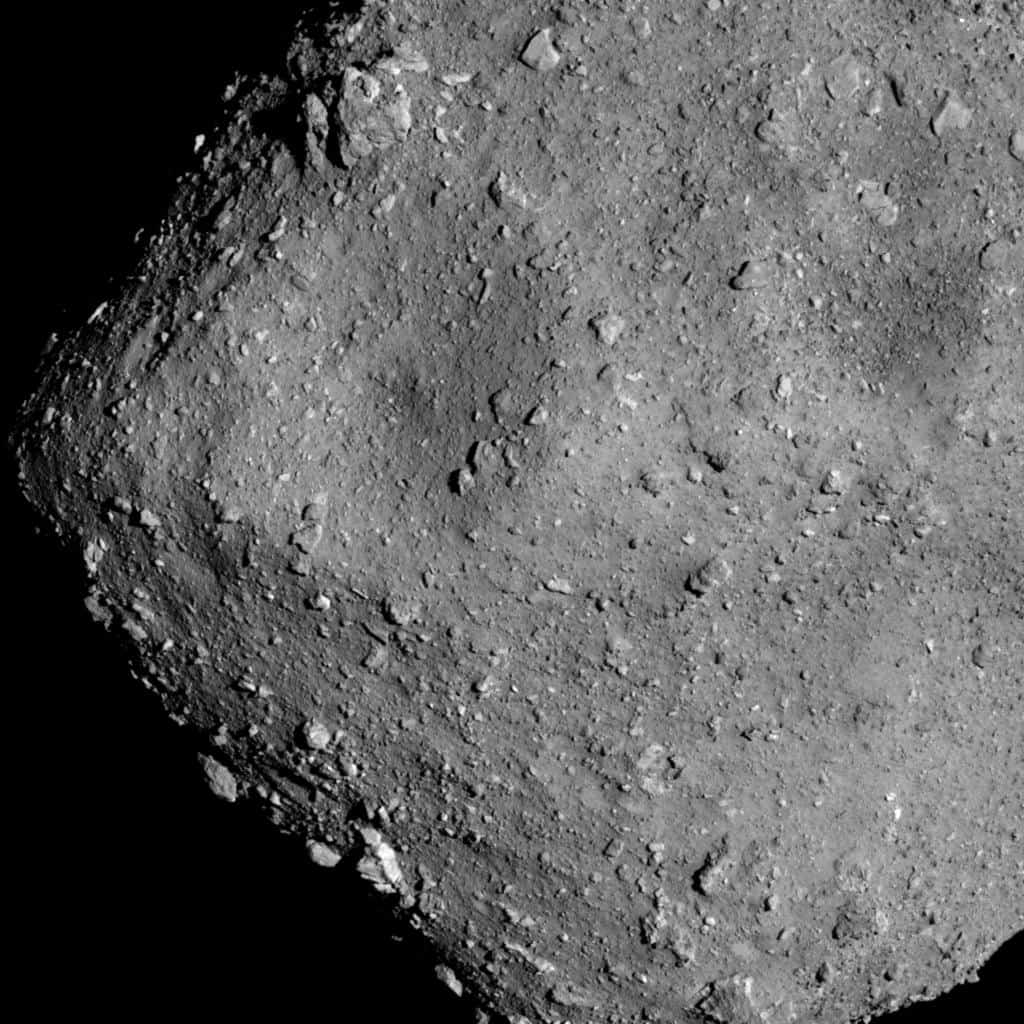
Image of the asteroid Ryugu

In addition to the sampling device that will be used on 22 February, Hayabusa2 also carries an impactor. This is a high-speed projectile, due to be fired in March or April, that will make a crater on the asteroid and enable Hayabusa2 to collect “fresh” material from beneath the surface.

Bold mission

Stephan Ulamec, the payload manager for MASCOT — and, before that, a member of the European team that landed Philae on the comet Churyumov-Gerasimenko in 2014 — praises Japan for its willingness to do “bold missions” and “take risks”. Yoshikawa agrees, but only up to a point. “In fact, now Japan is becoming rather conservative,” he thinks. “Twenty or thirty years ago when we started Hayabusa, and again in 2006 when we began Hayabusa2, challenge was a good thing. But I think if we proposed Hayabusa2 now, it would be difficult to pass the review.”

Attitudes may change after Hayabusa2 returns to Earth in December 2020. Ryugu is a C-type asteroid that dates back to the earliest days of the solar system, and the mission has already produced a number of surprises. But Yoshikawa wonders if the biggest revelation might be yet to come.

“When we first saw Ryugu last June we were very surprised, because the shape is a spinning top and we never imagined that. Our next surprise was that the surface of the asteroid is covered by lots of boulders and rocks,” he explains. “Maybe the next surprise will be the sample. If we find organic matter in it, this is the material that would eventually become life on Earth. We want to find that original material.”

Physics World readers can follow the progress of Hayabusa2 via the mission’s Twitter account. And Yukihiko Tsutsumi’s film provides a 140-minute insight into the original Hayabusa mission and Japan’s unique science culture. It was the first of three feature-length films made about Hayabusa, although it is the only one to have been given English subtitles, and it is available from various streaming services.

“The people in the films are totally fictitious, but they’re all based on the actual things that Hayabusa did,” says Yoshikawa, “Some parts are true, some parts are fiction. I think these films are very nice; they show the important points about the human relationships.”

Design evolution yields streamlined positioning platform for ultrahigh vacuum

Manipulator stages are critical components for ultrahigh vacuum (UHV) experiments, providing precise control over the position of the sample for improved measurement accuracy. Coupled with a suitable probe, such positioners can be used, for example, to bring features into focus during high-resolution imaging or to gather chemical and structural data from different surface areas on a sample. Positioning units can be found not just on standalone systems in the lab, but also at synchrotron facilities supporting a raft of end-station instruments.

Conventional solutions involve a coupled arrangement of cross-roller slides and micrometers, but UK-based company UHV Design knew it could squeeze more out of the concept by applying a combination of production experience, design flair and simulation expertise. “We looked at all of the features that would improve the user experience,” explains Jonty Eyres, director of engineering at UHV Design.

The result of this design innovation is the firm’s latest generation of sample positioners, dubbed TETRAXE, which combines high precision with a small footprint – which is essential for use with vacuum chambers that are typically crowded with other equipment.

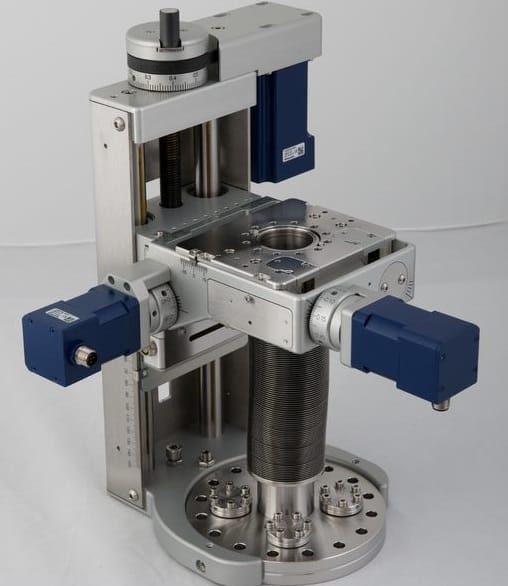
Available in both manual and motorized versions, the TETRAXE range exploits new thinking on actuation design. The unit’s XYZT micrometers, which provide precise linear motion along their respective axes along with a tilt feature to correct for any slight misalignments in the host vacuum chamber, are now embedded into the body of the positioning stage.

Compact footprint, flexible use

Embedding the micrometers into the positioning stage makes the platform more compact, but offers other advantages too. One is that the embedded micrometer assembly can withstand bake-out at 250 ºC, which simplifies the overall installation process. This feature also applies to the limit switches, which are part of the motorized package. Only the motors and connecting wires, which are quick and easy to reconnect, need to be unscrewed or unplugged.

“We developed bakeable printed circuit boards to avoid the situation where a user, who would ordinarily have to remove limit switches for bake-out, finds that one of the end-stops has moved during the process and needs to be readjusted,” says Eyres. “It’s a unique feature of the design and makes setup much easier.”

One of the TETRAXE manipulators

Ease of setup and configuration are also addressed with a choice of left- or right-hand mounts for manual/motorized drives, which are swappable for each axis of motion. “It gives customers more options – for example, when they have a view port next to the mounting site on the vacuum chamber and need to keep that area clear,” says Lukasz Rybacki, a product designer at the firm, who’s played a key role in TETRAXE’s evolution. “The new micrometer design also helps if users want to upgrade from a manual to a motorized drive, as we can provide a kit.”

There are more choices too when it comes to bolting the XYZT positioner to the vacuum chamber, thanks to the option of flanges with either straddled or in-line mounting holes. Again, it’s a design feature that could make all the difference when the ability to slightly re-orientate the unit avoids a clash with neighbouring equipment outside the chamber.

Another important consideration for clients is the stability of the manipulator – particularly in high-resolution imaging applications, where vibration and drift can compromise results. As part of the development process, Rybacki used finite element analysis to optimize the stiffness of all load-bearing components in the assembly. “There’s a stainless-steel channel on the back of the unit that provides extra support, as well as bearing arrangements that allow for differential expansion, which is necessary for bake-out,” Eyres explains, describing just a couple of the design highlights.

Precision positioning

Positioning performance, naturally, is also high up the customer wish list. In situations where distance needs to be extremely tightly controlled, linear encoders can be fitted to give closed-loop feedback of motion along each axis. “They allow the micrometer stages to seek a particular position and know when they’ve got there,” says Eyres.

As well as the positioning platform, UHV Design can also provide the sample probe, with or without sample holder, as required. Additional specifications can include extra degrees of sample rotation as well as other services such as heating, cooling and thermocouple measurements – to name just a few options.

CAD drawing showing the tilt function of the TETRAXE manipulator

This flexibility makes it straightforward for OEM customers to add on their own head design and specify which services and connections they require. “For example, Scienta Omicron have an X-ray photoelectron spectroscopy platform called the XPS-Lab, which uses such a hybrid version of our TETRAXE XYZT manipulator,” points out Nick Clark, technical director at UHV Design.

UHV Design is responsive to its customers’ ideas, and the team often provides bespoke solutions to achieve the probe configuration and heating/cooling requirements needed for the application. For example, cooling the sample in electron spectroscopy can help to provide sharper chemical and structural features by reducing thermal broadening, while heating single-crystal samples enables recrystallization. Alternatively, heating may be used to clean a sample or as part of a dynamic measurement.

One of the latest additions to the TETRAXE line is a large bellows design (100 mm diameter clear bore) which boosts clearance around the probe – which is needed, for example, to provide liquid-helium cooling at the sample head. What’s more, this space is preserved when using the tilt feature, present on all TETRAXE manipulators, thanks to the location of the pivot – which allows internal and external components to move in unison. “By adjusting a screw you can tilt the axis with respect to the mounting flange without reducing the ability of the probe to move in the x- and y-axes,” says Eyres.

Gravitational waves could reveal the birth of a quark star

Gravitational waves could be the key to detecting a new phase transition to quark matter when two neutron stars merge. In simulations of these explosive events, performed independently by two international research groups, distinct signatures of the phase transition were uncovered in the resulting gravitational wave spectra. Both research teams published their findings last week in Physical Review Letters.

The merging of two neutron stars was observed for the first time in 2017, an event labelled GW170817 by astronomers. During such a merger the temperatures and pressures far exceed those that can be achieved in any laboratory, and scientists have wondered whether it’s possible for these extreme conditions to facilitate a new type of phase transition – one to quark matter.

Quarks have so far only been found in a group, forming all known subatomic particles such as protons and neutrons. But scientists have speculated that these subatomic particles could break down at ultrahigh pressures and temperatures to create a uniform sea of quarks.

Researchers believe that evidence for this phase transition might be found in the spectra of the gravitational waves, such as those detected in the GW170817 event.  Identifying a specific signature of such a phase transition in the gravitational wave spectra would also allow quark matter to be detected from future merger events – and also enable astronomers to identify new stellar objects such as hybrid or even purely quark stars.

Stars collide

The two research teams searched for this distinct signature by performing simulations of two neutron stars merging, focusing on sizes and masses similar to those observed in GW170817. Some of the models allow quark matter to exist, while others do not – which the researchers hoped would uncover prominent differences in the simulated gravitational-wave spectra that could identify the phase transition.

Each group differed in their modelling approach. Elias Most and colleagues from the US and Germany used fully relativistic models, in which they observed a gradual phase transition on millisecond timescales after the neutron stars had merged. Their simulations suggest that the proportion of quark matter reached 20% of the total baryonic mass before the resulting object collapsed as a black hole about 17 milliseconds after the merger. The distinctive signature of the transition, they found, is a dephasing of the gravitational-wave signal as the fraction of quark matter increased.

Meanwhile, Andreas Bauswein and colleagues from Europe and North America analysed the results from 22 different models that all assume asymptotically flat space – of which 7 allow for a phase transition to quark matter at the exact moment of the neutron star merger and 15 are based only on  hadronic matter. This multi-model approach should reveal a general trend of behaviour when a quark-matter phase transition occurs that cannot be attributed to any other phenomena.

The signs are there

Most of these models showed a strong dependence between the maximum peak value in the gravitational wave frequency spectrum and the tidal deformability, a parameter that depends on an object’s mass and radius. However, the models that allow for a quark-matter transition exhibit significant deviations from this trend – of the order of half a kilohertz. In these simulations the object resulting from the merger remained gravitationally stable.

The results from these simulations suggest that a phase transition to quark matter does indeed happen in a neutron-star merger, but current measurements are not accurate enough to confirm the findings experimentally. To detect these signatures  in future neutron star mergers, more precise measurements will be needed of quantities such as mass, gravitational-wave frequency and tidal deformability.

The ongoing improvement of detection methods should reduce the uncertainties on such measurements in the next few years, which could enable future researchers to identify these signatures and even witness the birth of a new astronomical object – the hypothesized quark star.

Copyright © 2026 by IOP Publishing Ltd and individual contributors