Space–time crystal emerges in a liquid crystal

A new type of  “space–time crystal” has been created in the US by Hanqing Zhao and Ivan Smalyukh at the University of Colorado Boulder. The system is patterned in both space and time and comprises a rigid lattice of topological solitons that are sustained by steady oscillations in the orientations of liquid crystal molecules.

In an ordinary crystal atomic or molecular structures repeat at periodic intervals in space. In 2012, however, Frank Wilczek suggested that systems might also exist with quantum states that repeat at perfectly periodic intervals in time – even as they remain in their lowest-energy state.

First observed experimentally in 2017, these time crystals are puzzling to physicists because they spontaneously break time–translation symmetry, which states that the laws of physics are the same no matter when you observe them. In contrast, a time crystal continuously oscillates over time, without consuming energy.

A space–time crystal is even more bizarre. In addition to breaking time–translation symmetry, such a system would also break spatial symmetry, just like the repeating molecular patterns of an ordinary crystal. Until now, however, a space–time crystal had not been observed directly.

Rod-like molecules

In their study, Zhao and Smalyukh created a space–time crystal in the nematic phase of a liquid crystal. In this phase the crystal’s rod-like molecules align parallel to each other and also flow like a liquid. Building on computer simulations, they confined the liquid crystal between two glass plates coated with a light-sensitive dye.

“We exploited strong light–matter interactions between dye-coated, light-reconfigurable surfaces, and the optical properties of the liquid crystal,” Smalyukh explains.

When the researchers illuminated the top plate with linearly polarized light at constant intensity, the dye molecules rotate to align perpendicular to the direction of polarization. This reorients nearby liquid crystal molecules, and the effect propagates deeper into the bulk. However, the influence weakens with depth, so that molecules farther from the top plate are progressively less aligned.

As light travels through this gradually twisting structure, its linear polarization is transformed, becoming elliptically polarized by the time it reaches the bottom plate. The dye molecules there become aligned with this new polarization, altering the liquid crystal alignment near the bottom plate. These changes propagate back upward, influencing molecules near the top plate again.

Feedback loop

This is a feedback loop, with the top and bottom plates continuously influencing each other via the polarized light passing through the liquid crystal.

“These light-powered dynamics in confined liquid crystals leads to the emergence of particle-like topological solitons and the space–time crystallinity,” Smalyukh says.

In this environment, particle-like topological solitons emerge as stable, localized twists in the liquid crystal’s orientation that do not decay over time. Like particles, the solitons move and interact with each other while remaining intact.

Once the feedback loop is established, these solitons emerge in a repeating lattice-like pattern. This arrangement not only persisted as the feedback loop continued, but is sustained by it. This is a clear sign that the system exhibits crystalline order in time and space simultaneously.

Accessible system

Having confirmed their conclusions with simulations, Zhao and Smalyukh are confident this is the first experimental demonstration of a space–time crystal. The discovery that such an exotic state can exist in a classical, room-temperature system may have important implications.

“This is the first time that such a phenomenon is observed emerging in a liquid crystalline soft matter system,” says Smalyukh. “Our study calls for a re-examining of various time-periodic phenomena to check if they meet the criteria of time-crystalline behaviour.”

Building on these results, the duo hope to broaden the scope of time crystal research beyond a purely theoretical and experimental curiosity. “This may help expand technological utility of liquid crystals, as well as expand the currently mostly fundamental focus of studies of time crystals to more applied aspects,” Smalyukh adds.

The research is described in Nature Materials.

Quantum fluid instability produces eccentric skyrmions

Physicists at Osaka Metropolitan University in Japan and the Korea Advanced Institute of Science and Technology (KAIST) claim to have observed the quantum counterpart of the classic Kelvin-Helmholtz instability (KHI), which is the most basic instability in fluids. The effect, seen in a quantum gas of 7Li atoms, produces a new type of exotic vortex pattern called an eccentric fractional skyrmion. The finding not only advances our understanding of complex topological quantum systems, it could also help in the development of next-generation memory and storage devices.

Topological defects occur when a system rapidly transitions from a disordered to an ordered phase. These defects, which can occur in a wide range of condensed matter systems, from liquid crystals and atomic gases to the rapidly cooling early universe, can produce excitations such as solitons, vortices and skyrmions.

Skyrmions, first discovered in magnetic materials, are swirling vortex-like spin structures that extend across a few nanometres in a material. They can be likened to 2D knots in which the magnetic moments rotate about 360° within a plane.

Eccentric fractional skyrmions contain singularities

Skyrmions are topologically stable, which makes them robust to external perturbations, and are much smaller than the magnetic domains used to encode data in today’s disk drives. That makes them ideal building blocks for future data storage technologies such as “racetrack” memories. Eccentric fractional skyrmions (EFSs), which had only been predicted in theory until now, have a crescent-like shape and contain singularities – points in which the usual spin structure breaks down, creating sharp distortions as it becomes unsymmetrical.

“To me, the large crescent moon in the upper right corner of Van Gogh’s ‘The Starry Night’ also looks exactly like an EFS,” says Hiromitsu Takeuchi at Osaka, who co-led this new study with Jae-Yoon Choi of KAIST. “EFSs carry half the elementary charge, which means they do not fit into traditional classifications of topological defects.”

The KHI is a classic phenomenon in fluids in which waves and vortices form at the interface between two fluids moving at different speeds. “To observe the KHI in quantum systems, we need a structure containing a thin superfluid interface (a magnetic domain wall), such as in a quantum gas of 7Li atoms,” says Takeuchi. “We also need experimental techniques that can skilfully control the behaviour of this interface. Both of these criteria have recently been met by Choi’s group.”

The researchers began by cooling a gas of 7Li atoms to near absolute zero temperatures to create a multi-component Bose-Einstein condensate – a quantum superfluid containing two streams flowing at different speeds. At the interface of these streams, they observed vortices, which corresponded to the predicted EFSs.

The behaviour of the KHI is universal

“We have shown that the behaviour of the KHI is universal and exists in both the classical and quantum regimes,” says Takeuchi. This finding could not only lead to a better understanding of quantum turbulence and the unification of quantum and classic hydrodynamics, it could also help in the development of technologies such as next-generation storage and memory devices and spintronics, an emerging technology in which magnetic spin is used to store and transfer information using much less energy than existing electronic devices.

“By further refining the experiment, we might be able to verify certain predictions (some of which were made as long ago as the 19th century) about the wavelength and frequency of KHI-driven interface waves in non-viscous quantum fluids, like the one studied in this work,” he adds.

“In addition to the universal finger pattern we observed, we expect structures like zipper and sealskin patterns, which are unique to such multi-component quantum fluids,” Takeuchi tells Physics World. “As well as experiments, it is necessary to develop a theory that more precisely describes the motion of EFSs, the interaction between these skyrmions and their internal structure in the context of quantum hydrodynamics and spontaneous symmetry breaking.”

The study is detailed in Nature Physics.

Top quarks embrace in quasi-bound toponium

For decades, physicists believed that the top quark, the heaviest known subatomic particle, was too short-lived to form a temporary pair with its antimatter partner. Unlike lighter quarks, which can combine to form protons, neutrons, or longer-lived quark–antiquark pairs, the top quark decays almost instantly. This made the idea of a top–antitop bound state – a fleeting association held together by the strong force – seem impossible. But now, the CMS collaboration at the Large Hadron Collider (LHC) has found the first evidence of such a state, which is dubbed toponium.

Gautier Hamel de Monchenault, spokesperson for CMS, explains, “Many physicists long believed this was impossible. That’s why this result is so significant — it challenges assumptions that have been around for decades, and particle physics textbooks will likely need to be updated because of it.”

Protons and neutrons are formed from quarks, which are fundamental particles that cannot be broken down into smaller constituents.

“There are six types of quark,” explains the German physicist Christian Schwanenberger, who is at DESY and the University of Hamburg and was involved in the study. “Five of them form bound states thanks to the strong force, one of the four fundamental forces of nature. The top quark, however, is somehow different. It is the heaviest fundamental particle we know, but so far we have not observed it forming bound states in the same way the others do.”

Quasi-bound state

The top quark’s extreme mass makes it decay almost immediately after it is produced. “The top and antitop quarks just have time to exchange a few gluons, the carriers of the strong force, before one of them decays, hence the appellation ‘quasi-bound state’,” Hamel de Monchenault explains.

By detecting these ephemeral interactions, physicists can observe the strong force in a new regime – and the CMS team developed a clever new method to do so. The breakthrough came when the team examined how the spins of the top quark and antitop quark influence each other to create a subtle signature in the particles produced when the quarks decay.

Top quarks are produced in proton–proton collisions at the LHC, where they quickly decay into other particles. These include bottom quarks that then decay to form jets of particles, which can be detected. Top quarks can also decay to form W bosons, which themselves decay into lighter particles (leptons) such as electrons or muons, accompanied by neutrinos.

“We can detect the charged leptons directly and measure their energy very precisely, but we have to infer the presence of the neutrinos indirectly, through an imbalance of the total energy measured,” says Hamel de Monchenault. By studying the pattern and energy of the leptons and jets, the CMS team deduced the existence of top–antitop pairs and spotted the subtle signature of the fleeting quasi-bound state.

Statistical significance

The CMS researchers observed an excess of events in which the top and antitop quarks were produced almost at rest relative to each other – the precise condition needed for a quasi-bound state to form. “The signal has a statistical significance above 5σ, which means the chance it’s just a statistical fluctuation is less than one in a few million,” Hamel de Monchenault says.

While this excess accounts for only about 1% of top quark pair production, it aligns with predictions for toponium formation and offers insights into the strong force.

“Within the achieved precision, the result matches the predictions of advanced calculations involving the strong force,” explains Hamel de Monchenault. “An effect once thought too subtle to detect with current technology has now been observed. It’s comforting in a way: even the heaviest known quarks are not always alone – they can briefly embrace their opposites.”

Future directions

The discovery has energized the particle physics community. “Scientists are excited to explore the strong force in a completely new regime,” says Schwanenberger. Researchers will refine theoretical models, simulate toponium more precisely, and study its decay patterns and excited states. Much of this work will rely on the High-Luminosity LHC, expected to start operations around 2030, and potentially on future electron–positron colliders capable of studying top quarks with unprecedented precision.

“The present results are based on LHC data recorded between 2015 and 2018 [Run 2]. Since 2022, ATLAS and CMS are recording data at a slightly higher energy, which is favourable for top quark production. The amount of data already surpasses that of Run 2, and we expect that with such huge amounts of data, the properties of this new signal can be studied in detail,” Hamel de Monchenault says.

This research could ultimately answer a fundamental question: is the top quark simply another quark like its lighter siblings, or could it hold the key to physics beyond the Standard Model? “Investigating different toponium states will be a key part of the top quark research programme,” Schwanenberger says. “It could reshape our understanding of matter itself and reveal whatever holds the world together in its inmost folds.”

The results are published in Reports on Progress in Physics.

Celebrating 10 years of gravitational waves

It was early in the morning of Monday 14 September 2015, exactly 10 years ago, when gravitational waves created from the collision of two black holes 1.3 billion light-years away hit the LIGO detectors in the US. The detections took place just as the two giant interferometers – one in Washington and the other in Louisiana – were being calibrated before the first observational run was due to begin four days later.

In one of those curious accidents of history, staff on duty at the Louisiana detector had gone to bed a few hours before the waves rolled in. If they hadn’t packed in their calibrations for the night, it would have prevented LIGO from making its historic measurement, dubbed GW150914. Of course, it would surely only have been a matter of time until LIGO had spotted its first signal, with more than 200 gravitational-wave events so far detected.

Observing these “ripples in space–time”, which had long been on many physicists’ bucket lists, has over the last decade become almost routine. Most gravitational-wave detections have been binary black-hole mergers, though there have also been a few neutron-star/black-hole collisions and some binary neutron-star mergers too. Gravitational-wave astronomy is now a well-established field not just thanks to LIGO but also Virgo in Italy and KAGRA in Japan.

In fact, physicists are already planning what would be a third-generation gravitational-wave detector. The Einstein Telescope, which could do in a day what took LIGO a decade, could be open by 2035, with three locations vying to host the facility. The Italian island of Sardinia is one option. Saxony in Germany is another, with the third being a site near where Germany, Belgium and the Netherlands meet.

A decision is expected to be made in two years’ time, but whichever site is picked – and assuming the €2bn construction costs can be found – Europe would be installed firmly at the forefront of gravitational-wave research. That’s because the European Space Agency is also planning a space-based gravitational-wave detector called LISA. It is set to start in 2035 – the same year as the Einstein Telescope.

The US has its own third-generation design, dubbed the Cosmic Explorer. But given the turmoil in US science under Donald Trump, it’s far from certain if it’ll ever be built. However, if other nations step in and build a network of such facilities around the world, as researchers hope, we could well be in for a new golden age for gravitational-wave astronomy. That bucket list just got longer.

Researchers map the unrest in the Vulcano volcano

The isle of Vulcano is a part of the central volcanic ridge of the Aeolian archipelago on the Tyrrhenian Sea in southern Italy. Over the course of its history, Vulcano has undergone multiple explosive eruptions, with the last one thought to have occurred around 1888–1890. However, there is an active hydrothermal system under Vulcano that has shown evidence of intermittent magma and gas flows since 2021 – a sign that the volcano has been in a state of unrest.

During unrest, the volcanic risk increases significantly – and the summer months on the island currently attract a lot of tourists that might be at risk, even from minor eruptive events or episodes of increased degassing. To examine why this unrest has occurred, researchers from the University of Geneva have collaborated with the National Institute of Geophysics and Volcanology (INGV) in Italy to recreate a 3D model of the interior of the volcano on Vulcano, using a combination of nodal seismic networks and artificial intelligence (AI).

Until now, few studies have examined the deep underground details of volcanoes, instead relying on looking at the outline of their internal structure. This is because the geological domains where eruptions nucleate are often inaccessible using airborne geophysical techniques, and onshore studies don’t penetrate far enough into the volcanic plumbing system to look at how the magma and hydrothermal fluids mix. Recent studies have shown the outline of the plumbing systems, but they’ve not had sufficient resolution to distinguish the magma from the hydrothermal system.

3D modelling of the volcano

To better understand what could have caused the 2021 Vulcano unrest, the researchers deployed a nodal network of 196 seismic sensors across Vulcano and Lipari (another island in the archipelago) to measure secondary seismic waves (S-waves) using a technique called seismic ambient noise tomography. S-waves propagate slowly as they pass through fluid-rich zones, which allows magma to be identified.

The researchers captured the S-wave data using the nodal sensor network and processed it with AI – using a deep neural network. This allowed the extensive seismic dispersion data to be quickly and automatically recovered, enabling generation of a 3D S-wave velocity model. The data were captured during the volcano’s early unrest’s phase, and the sensors recorded the natural ground vibrations over a period of one month. The model revealed the high-resolution tomography of the shallow part of a volcanic system in unrest, with the approach compared to taking an “X-ray” of the volcano.

“Our study shows that our end-to-end ambient noise tomography method works with an unprecedented resolution due to using dense nodal seismic networks,” says lead author Douglas Stumpp from the University of Geneva. “The use of deep neural networks allowed us to quickly and accurately measure enormous seismic dispersion data to provide near-real time monitoring.”

The model showed that there was no new magma body between Lipari and Vulcano within the first 2 km of the Earth’s crust, but it did reveal regions that could host cooling melts at the base of the hydrothermal system. These melts were proposed to be degassing melts that could easily release gas and brines if disturbed by an Earthquake – suggesting that tectonic fault dynamics may trigger volcanic unrest. It’s thought that the volcano might have released trapped fluids at depth after being perturbed by fault activity during the 2021 unrest.

Improving risk management

While this method doesn’t enable the researchers to predict when the eruption will happen, it provides a significant understanding into how the internal dynamics of volcanoes work during periods of unrest. The use of AI enables rapid processing of large amounts of data, so in the future, the approach could be used as an early warning system by analysing the behaviour of the volcano as it unfolds.

In theory, this could help to design dynamic evacuation plans based on the direct real-time behaviour of the volcano, which would potentially save lives. The researchers state that this could take some time to develop due to the technical challenge of processing such massive volumes of data in real time – but they note that this is now more feasible thanks to machine learning and deep learning.

When asked about how the researchers plan to further develop the research, Stumpp concludes that “our study paves the ground for 4D ambient noise tomography monitoring – three dimensions of space and one dimension of time. However, I believe permanent and maintained seismic nodal networks with telemetric access to the data need to be implemented to achieve this goal”.

The research is published in Nature Communications.

High-speed 3D microscope improves live imaging of fast biological processes

A new high-speed multifocus microscope could facilitate discoveries in developmental biology and neuroscience thanks to its ability to image rapid biological processes over the entire volume of tiny living organisms in real time.

The pictures from many 3D microscopes are obtained sequentially by scanning through different depths, making them too slow for accurate live imaging of fast-moving natural functions in individual cells and microscopic animals. Even current multifocus microscopes that capture 3D images simultaneously have either relatively poor image resolution or can only image to shallow depths.

In contrast, the new 25-camera “M25” microscope – developed during his doctorate by Eduardo Hirata-Miyasaki and his supervisor Sara Abrahamsson, both then at the University of California Santa Cruz, together with collaborators at the Marine Biological Laboratory in Massachusetts and the New Jersey Institute of Technology – enables high-resolution 3D imaging over a large field-of-view, with each camera capturing 180 × 180 × 50 µm volumes at a rate of 100 per second.

“Because the M25 microscope is geared towards advancing biomedical imaging we wanted to push the boundaries for speed, high resolution and looking at large volumes with a high signal-to-noise ratio,” says Hirata-Miyasaki, who is now based in the Chan Zuckerberg Biohub in San Francisco.

The M25, detailed in Optica, builds on previous diffractive-based multifocus microscopy work by Abrahamsson, explains Hirata-Miyasaki. In order to capture multiple focal planes simultaneously, the researchers devised a multifocus grating (MFG) for the M25. This diffraction grating splits the image beam coming from the microscope into a 5 × 5 grid of evenly illuminated 2D focal planes, each of which is recorded on one of the 25 synchronized machine vision cameras, such that every camera in the array captures a 3D volume focused on a different depth. To avoid blurred images, a custom-designed blazed grating in front of each camera lens corrects for the chromatic dispersion (which spreads out light of different wavelengths) introduced by the MFG.

The team used computer simulations to reveal the optimal designs for the diffractive optics, before creating them at the University of California Santa Barbara nanofabrication facility by etching nanometre-scale patterns into glass. To encourage widespread use of the M25, the researchers have published the fabrication recipes for their diffraction gratings and made the bespoke software for acquiring the microscope images open source. In addition, the M25 mounts to the side port of a standard microscope, and uses off-the-shelf cameras and camera lenses.

The M25 can image a range of biological systems, since it can be used for fluorescence microscopy – in which fluorescent dyes or proteins are used to tag structures or processes within cells – and can also work in transmission mode, in which light is shone through transparent samples. The latter allows small organisms like C. elegans larvae, which are commonly used for biological research, to be studied without disrupting them.

The researchers performed various imaging tests using the prototype M25, including observations of the natural swimming motion of entire C. elegans larvae. This ability to study cellular-level behaviour in microscopic organisms over their whole volume may pave the way for more detailed investigations into how the nervous system of C. elegans controls its movement, and how genetic mutations, diseases or medicinal drugs affect that behaviour, Hirata-Miyasaki tells Physics World. He adds that such studies could further our understanding of human neurodegenerative and neuromuscular diseases.

“We live in a 3D world that is also very dynamic. So with this microscope I really hope that we can keep pushing the boundaries of acquiring live volumetric information from small biological organisms, so that we can capture interactions between them and also [see] what is happening inside cells to help us understand the biology,” he continues.

As part of his work at the Chan Zuckerberg Biohub, Hirata-Miyasaki is now developing deep-learning models for analysing dynamic cell and organism multichannel dynamic live datasets, like those acquired by the M25, “so that we can extract as much information as possible and learn from their dynamics”.

Meanwhile Abrahamsson, who is currently working in industry, hopes that other microscopy development labs will make their own M25 systems.  She is also considering commercializing the instrument to help ensure its widespread use.

Juno: the spacecraft that is revolutionizing our understanding of Jupiter

This episode of the Physics World Weekly podcast features Scott Bolton, who is principal investigator on NASA’s Juno mission to Jupiter. Launched in 2011, the mission has delivered important insights into the nature of the gas-giant planet. In this conversation with Physics World’s Margaret Harris, Bolton explains how Juno continues to change our understanding of Jupiter and other gas giants.

Bolton and Harris chat about the mission’s JunoCam, which has produced some gorgeous images of Jupiter and it moons.

Although the Juno mission was expected to last only a few years, the spacecraft is still going strong despite operating in Jupiter’s intense radiation belts. Bolton explains how the Juno team has rejuvenated radiation-damaged components, which has provided important insights for those designing future missions to space.

However Juno’s future is uncertain. Despite its great success, the mission is currently scheduled to end at the end of September, which is something that Bolton also addresses in the conversation.

Optimizing upright proton therapy: hybrid delivery provides faster, sharper treatments

A combination of static proton arcs and shoot-through proton beams could increase plan conformity and homogeneity and reduce delivery times in upright proton therapy, according to new research from RaySearch Laboratories in Sweden.

Proton arc therapy (PAT) is an emerging rotational delivery technique with potential to improve plan quality – reducing dose to organs-at-risk while maintaining target dose. The first clinical PAT treatments employed static arcs, in which multiple energy layers are delivered from many (typically 10 to 30) discrete angles. Importantly, static arc PAT can be delivered on conventional proton therapy machines. It also offers simpler beam arrangements than intensity-modulated proton therapy (IMPT).

“In IMPT of head-and-neck cancers, the beam directions are normally set up in a complicated pattern in different planes, with range shifters needed to treat the shallow part of the tumour,” explains Erik Engwall, chief physicist at RaySearch Laboratories. “In PAT, the many beam directions are arranged in the same plane and no range shifters are typically needed. With all beams in the same plane, it is easier to move to upright treatments.”

Upright proton therapy involves rotating the patient (in an upright position) in front of a static horizontal treatment beam. The approach could reduce costs by using compact proton delivery systems. This compactness, however, places energy selection close to the patient, increasing scattering in the proton beam. To combat this, the team propose adding a layer of shoot-through protons to each direction of the proton arc.

The idea is that while most protons are delivered with Bragg peaks placed in the target, the sharp penumbra of the high-energy protons shooting through the target will combat beam broadening. The rotational delivery in the proton arc spreads the exit dose from these shoot-through beams over many angles, minimizing dose to surrounding tissues. And as the beamline is fixed, shoot-through protons exit in the same direction (behind the patient) for all angles, simplifying shielding to a single beam dump opposite the fixed beam.

Simulation studies

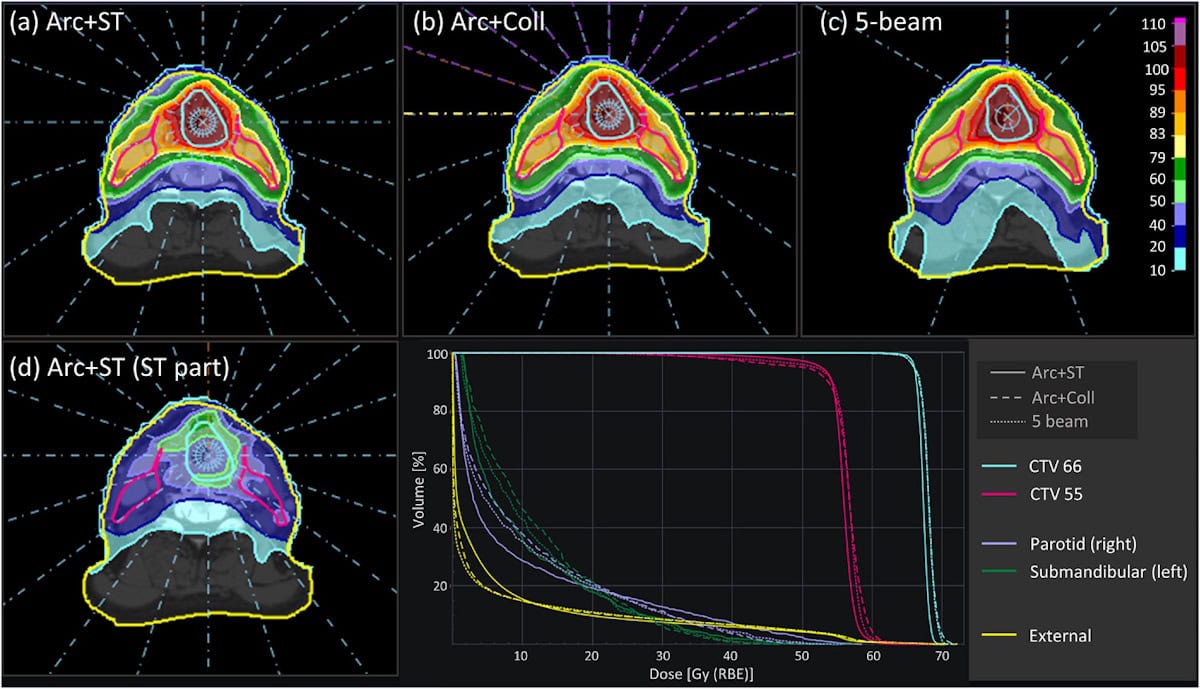
To test this approach, Engwall and colleagues simulated treatment plans for a virtual phantom containing three targets and an organ-at-risk, reporting their findings in Medical Physics. They used a development version of RayStation v2025 with a beam model of the Mevion s250-FIT system (which combines a compact cyclotron, an upright positioner and an in-room CT scanner).

For each target, the team created static arc plans with (Arc+ST) and without shoot-through beams and with/without collimation, as well as 3-beam IMPT plans with and without shoot-through beams (all with collimation). Arc plans used 20 uniformly spaced beam directions, and the shoot-through plans included an additional layer of the highest system energy (230 MeV) for each direction.

For all targets, Arc+ST plans showed superior conformity, homogeneity and target robustness to arc plans without shoot-through protons. Adding collimation slightly improved the arc plans without shoot-through protons but had little impact on Arc+ST plans.

The IMPT plans achieved similar homogeneity and robustness to the best arc plans, but with far lower conformity due to the shoot-through protons delivering a concentrated exit dose behind the target (while static arcs distribute this dose over many directions). Adding shoot-through protons improved IMPT plan quality, but to a lesser degree than for PAT plans.

Clinical case

The researchers repeated their analysis for a clinical head-and-neck cancer case, comparing static arcs with 5-beam IMPT. Again, Arc+ST plans performed better than any others for almost all metrics. “The Arc+ST plans have the best quality due to the sharpening of the penumbra of the shoot-through part, even better than when using a collimator,” says Engwall.

Treatment plan comparisons

Notably, the findings suggest that collimation is not needed when combining arcs with shoot-through beams, enabling rapid treatments. With fast energy switching and the patient rotation at 1 rpm, Arc+ST achieved an estimated delivery time of less than 5.4 min – faster than all other plans for this case, including 5-beam IMPT.

“Treatment time is reduced when the leaves of the dynamic collimator do not need to move,” Engwall explains. “There is also no risk of mechanical failures of the collimator and the secondary neutron production will be lower when there are fewer objects in the beamline.”

Another benefit of upright delivery is that the shoot-through protons can be used for range verification during treatments, using a detector integrated into the beam dump behind the patient. The team investigated this concept with three simulated error scenarios: 5% systematic shift in stopping power ratio; 5 mm setup shift; and 2 cm shoulder movement. The technique successfully detected all errors.

As the range detector is permanently installed in the treatment room and the shoot-through protons are part of the treatment plan, this method does not add time to the patient setup and can be used in every treatment fraction to detect both intra- and inter-fraction uncertainties.

Although this is a proof-of-concept study, the researchers conclude that it highlights the combined advantages of the new treatment technique, which could “leverage the potential of compact upright proton treatments and make proton treatments more affordable and accessible to a larger patient group”.

Engwall tells Physics World that the team is now collaborating with several clinical research partners to investigate the technique’s potential across larger patient data sets, for other treatment sites and multiple treatment machines.

LIGO could observe intermediate-mass black holes using artificial intelligence

A machine learning-based approach that could help astronomers detect lower-frequency gravitational waves has been unveiled by researchers in the UK, US, and Italy. Dubbed deep loop shaping, the system would apply real-time corrections to the mirrors used in gravitational wave interferometers. This would dramatically reduce noise in the system, and could lead to a new wave of discoveries of black hole and neutron star mergers – according to the team.

In 2015, the two LIGO interferometers made the very first observation of a gravitational wave: attributing its origin to a merger of two black holes that were roughly 1.3 billion light–years from Earth.

Since then numerous gravitational waves have been observed with frequencies ranging from 30–2000 Hz. These are believed to be from the mergers of small black holes and neutron stars.

So far, however, the lower reaches of the gravitational wave frequency spectrum (corresponding to much larger black holes) have gone largely unexplored. Being able to detect gravitational waves at 10–30 Hz would allow us to observe the mergers of intermediate-mass black holes at 100–100,000 solar masses. We could also measure the eccentricities of binary black hole orbits. However, these detections are not currently possible because of vibrational noise in the mirrors at the end of each interferometer arm.

Subatomic precision

“As gravitational waves pass through LIGO’s two 4-km arms, they warp the space between them, changing the distance between the mirrors at either end,” explains Rana Adhikari at Caltech, who is part of the team that has developed the machine-learning technique. “These tiny differences in length need to be measured to an accuracy of 10-19 m, which is 1/10,000th the size of a proton. [Vibrational] noise has limited LIGO for decades.”

To minimize noise today, these mirrors are suspended by a multi-stage pendulum system to suppress seismic disturbances. The mirrors are also polished and coated to eliminate surface imperfections almost entirely. On top of this, a feedback control system corrects for many of the remaining vibrations and imperfections in the mirrors.

Yet for lower-frequency gravitational waves, even this subatomic level of precision and correction is not enough. As a laser beam impacts a mirror, the mirror can absorb minute amounts of energy – creating tiny thermal distortions that complicate mirror alignment. In addition, radiation pressure from the laser, combined with seismic motions that are not fully eliminated by the pendulum system, can introduce unwanted vibrations in the mirror.

The team proposed that this problem could finally be addressed with the help of artificial intelligence (AI). “Deep loop shaping is a new AI method that helps us to design and improve control systems, with less need for deep expertise in control engineering,” describes Jonas Buchli at Google DeepMind, who led the research. “While this is helping us to improve control over high precision devices, it can also be applied to many different control problems.”

Deep reinforcement learning

The team’s approach is based on deep reinforcement learning, whereby a system tests small adjustments to its controls and adapts its strategy over time through a feedback system of rewards and penalties.

With deep loop shaping, the team introduced smarter feedback controls for the pendulum system suspending the interferometer’s mirrors. This system can adapt in real time to keep the mirrors aligned with minimal control noise – counteracting thermal distortions, seismic vibrations, and forces induced by radiation pressure.

“We tested our controllers repeatedly on the LIGO system in Livingston, Louisiana,” Buchli continues. “We found that they worked as well on hardware as in simulation, confirming that our controller keeps the observatory’s system stable over prolonged periods.”

Based on these promising results, the team is now hopeful that deep loop shaping could help to boost the cosmological reach of LIGO and other existing detectors, along with future generations of gravitational-wave interferometers.

“We are opening a new frequency band, and we might see a different universe much like the different electromagnetic bands like radio, light, and X-rays tell complementary stories about the universe,” says team member Jan Harms at the Gran Sasso Science Institute in Italy. “We would gain the ability to observe larger black holes, and to provide early warnings for neutron star mergers. This would allow us to tell other astronomers where to point their telescopes before the explosion occurs.”

The research is described in Science.

Physicists set to decide location for next-generation Einstein Telescope

A decade ago, on 14 September 2015, the twin detectors of the Laser Interferometer Gravitational-Wave Observatory (LIGO) in Hanford, Washington, and Livingston, Louisiana, finally detected a gravitational wave. The LIGO detectors – two L-shaped laser interferometers with 4 km-long arms – had measured tiny differences in laser beams bouncing off mirrors at the end of each arm. The variations in the length of the arms, caused by the presence of a gravitational wave, were converted into the now famous audible “chirp signal”, which indicated the final approach between two merging black holes.

Since that historic detection, which led to the 2017 Nobel Prize for Physics, the LIGO detectors, together with VIRGO in Italy, have measured several hundred gravitational waves – from mergers of black holes to neutron-star collisions. More recently, they have been joined by the KAGRA detector in Japan, which is located some 200 m underground, shielding it from vibrations and environmental noise.

Yet the current number of gravitational waves could be dwarfed by what the planned Einstein Telescope (ET) would measure. This European-led, third-generation gravitational-wave detector would be built several hundred metres underground and be at least 10 times more sensitive than its second-generation counterparts including KAGRA. Capable of “listening” to a thousand times larger volume of the universe, the new detector would be able to spot many more sources of gravitational waves. In fact, the ET will be able to gather in a day what it took LIGO and VIRGO a decade to collect.

The ET is designed to operate in two frequency domains. The low-frequency regime – 2–40 Hz – is below current detectors’ capabilities and will let the ET pick up waves from more massive black holes. The high-frequency domain, on the other hand, would operate from 40 Hz to 10 kHz  and detect a wide variety of astrophysical sources, including merging black holes and other high-energy events. The detected signals from waves would also be much longer with the ET, lasting for hours. This would allow physicists to “tune in” much earlier as black holes or neutron stars approach each other.

Location, location, location

But all that is still a pipe dream, because the ET, which has a price tag of €2bn, is not yet fully funded and is unlikely to be ready until 2035 at the earliest. The precise costs will depend on the final location of the experiment, which is still up for grabs.

Three regions are vying to host the facility: the Italian island of Sardinia, the Belgian-German-Dutch border region and the German state of Saxony. Each candidate is currently investigating the suitability of its preferred site (see box below), the results of which will be published in a “bid book” by the end of 2026. The winning site will be picked in 2027 with construction beginning shortly after.

Other factors that will dictate where the ET is built include logistics in the host region, the presence of companies and research institutes (to build and exploit the facility) and government support. With the ET offering high-quality jobs, economic return, scientific appeal and prestige, that could give the German-Belgian-Dutch candidacy the edge given the three nations could share the cost.

Another major factor is the design of the ET. One proposal is to build it as an equilateral triangle with each side being 10 km. The other is a twin L-shaped design where both arms are 15 km long and each detector located far from each other. The latter design is similar to the two LIGO over-ground detectors, which are 3000 km apart. If the “2L design” is chosen, the detector would then be built at two of the three competing sites.

The 2L design is being investigated by all three sites, but those behind the Sardinia proposal strongly favour this approach. “With the detectors properly oriented relative to each other, this design could outperform the triangular design across all key scientific objectives,” claims Domenico D’Urso, scientific director of the Italian candidacy. He points to a study by the ET collaboration in 2023 that investigated the impact of the ET design on its scientific goals. “The 2L design enables, for example, more precise localization of gravitational wave sources, enhancing sky-position reconstruction,” he says. “And it provides superior overall sensitivity.”

Where could the next-generation Einstein Telescope be built?

Three sites are vying to host the Einstein Telescope (ET), with each offering various geological advantages. Lausitz in Saxony benefits from being a former coal-mining area. “Because of this mining past, the subsurface was mapped in great detail decades ago,” says Günther Hasinger, founding director of the German Center for Astrophysics, which is currently being built in Lausitz and would house the ET if picked. The granite formation in Lausitz is also suitable for a tunnel complex because the rock is relatively dry. Not much water would need to be pumped away, causing less vibration.

Thanks to the former lead, zinc and silver mine of Sos Enattos, meanwhile, the subsurface near Nuoro in Sardinia – another potential location for the ET – is also well known. The island is on a very stable, tectonic microplate, making it seismically quiet. Above ground, the area is undeveloped and sparsely populated, further shielding the experiment from noise.

The third ET candidate, lying near the point where Belgium, Germany and the Netherlands meet, also has a hard subsurface, which is needed for the tunnels. It is topped by a softer, clay-like layer that would dampen vibrations from traffic and industry. “We are busy investigating the suitability of the subsurface and the damping capacity of the top layer,” says Wim Walk of the Dutch Center for Subatomic Physics (Nikhef), which is co-ordinating the candidacy for this location. “That research requires a lot of work, because the subsurface here has not yet been properly mapped.”

Localization is important for multi­messenger astronomy. In other words, if a gravitational-wave source can be located quickly and precisely in the sky, other telescopes can be pointed towards it to observe any eventual light or other electromagnetic (EM) signals. This is what happened after LIGO detected a gravitational wave on 17 August 2017, originating from a neutron star collision. Dozens of ground- and space-based satellites were able to pick up a gamma-ray burst and the subsequent EM afterglow.

The triangle design, however, is favoured by the Belgian-German-Dutch consortium. It would be the Earth equivalent to the European Space Agency’s planned LISA space-based gravitational-waves detector, which will consist of three spacecraft in a triangle configuration that is set for launch in 2035, the same year that the ET could open. LISA would detect gravitational waves with even much lower frequency, coming, for example, from mergers of supermassive black holes.

While the Earth-based triangle design would not be able to locate the source as precisely, it would – unlike the 2L design – be able to do “null stream” measurements. These would yield  a clearer picture of the noise from the environment and the detector itself, including  “glitches”, which are bursts of noise that overlap with gravitational-wave signals. “With a non-stop influx of gravitational waves but also of noise and glitches, we need some form of automatic clean-up of the data,” says Jan Harms, a physicist at the Gran Sasso Science Institute in Italy and member of the scientific ET collaboration. “The null stream could provide that.”

However, it is not clear if that null stream would be a fundamental advantage for data analysis, with Harms and colleagues thinking more work is needed. “For example, different forms of noise could be connected to each other, which would compromise the null stream,” he says. The problem is also that a detector with a null stream has not yet been realized. And that applies to the triangle design in general. “While the 2L design is well established in the scientific community,” adds D’Urso.

Backers of the triangle design see the ET as being part of a wider, global network of third-generation detectors, where the localization argument no longer matters. Indeed, the US already has plans for an above-ground successor to LIGO. Known as the Cosmic Explorer, it would feature two L-shaped detectors with arm lengths of up to 40 km. But with US politics in turmoil, it is questionable how realistic these plans are.

Matthew Evans, a physicist at the Massachusetts Institute of Technology and member of the LIGO collaboration, recognizes the “network argument”. “I think that the global gravitational waves community are double counting in some sense,” he says. Yet for Evans it is all about the exciting discoveries that could be made with a next-generation gravitational-wave detector. “The best science will be done with ET as 2Ls,” he says.

Copyright © 2026 by IOP Publishing Ltd and individual contributors