US agencies are preparing for the possibility of a fresh government shutdown that could restart on 15 February if President Donald Trump and a bipartisan Congressional panel fail to agree on plans for security at the US-Mexico border. While science-related agencies are assessing the impact of the recent partial government shutdown, which lasted 35 days and ended on 25 January, they are also working to keep facilities open should another shutdown hit later next week.
At a press briefing on 1 February, officials at the National Science Foundation (NSF) outlined that the roughly 1400 NSF employees who had been laid-off or had worked for nothing during the shutdown have already received their back pay. The NSF also noted that on the very first day after the shutdown, it set out to deliver $220m in grants promised to individual scientists and research teams. During “normal times”, the NSF typically receives requests for just $20m every day.
Losing a month really hurts, especially for people who are working on things that are time-sensitive or who are just getting started
Albert Presto
Yet reorganizing and rescheduling the 111 panels that review and fund research proposals will take longer. “It’s a pretty complex juggling act,” says Erwin Gianchandani, the NSF’s assistant director for computer and information science and engineering. “I expect it’s going to take us several weeks and probably a couple of months to have all the panels that were scheduled during the lapsed period completed this spring.”
However, NSF executives are now meeting every day to plan for a possible further government shutdown. “We’ll be working to obligate sufficient funds out to our facilities so they can continue to operate even in the unfortunate event of another lapse,” says James Ulvestad, NSF chief officer for research facilities.
Reduced data collecting
The Environmental Protection Agency, meanwhile, is updating its database on enforcement actions, which had no inputs during the shutdown. As for NASA, it has been hit with delays to several missions, including IceBridge — a project started in 2009 that uses aircraft to measure ice loss at the Earth’s poles. Delays in maintaining the aircraft during the shutdown have already prevented a programme of Arctic flights from starting on 4 March as planned, which will reduce the amount of data collected.
Similarly, a research cruise in the Atlantic Ocean as part of a National Oceanic and Atmospheric Administration study of oceanic acidity has been delayed owing to lack of preparation during the shutdown. That will leave a gap in the data used in weather forecasting.
For many recipients, however, a shutdown can mean more than just an intermission. “Losing a month really hurts, especially for people who are working on things that are time-sensitive or who are just getting started,” notes climate scientist Albert Presto from Carnegie Mellon University, who studies air quality. “It’s hard to quantify in terms of dollars how much the shutdown cost scientists in lost time.”
Perhaps the longest-lasting impact of the shutdown, however, concerns morale. Scientists and engineers in government have said privately that they are polishing their CVs in the hope of job offers from the private sector. They also fear that the shutdown will have reduced the appeal of government service for potential recruits.
A new material that increases in strength in response to mechanical stress, much like muscle during strength training at the gym, could be used to make fatigue-free structures for a host of industrial applications. The material is made from double-network hydrogels designed to self-repair the damage that occurs when tensile forces are applied.
“This is the first demonstration in the world of a synthetic material improving its properties thanks to supplied ‘nutrients’ in a way that is similar to the process of muscle growth,” explains study lead author Takahiro Matsuda of Hokkaido University in Japan.
Overcoming damage and failure
Biological tissues such as bone and muscle are dynamic materials that change their properties depending on the load applied to them. For example, during strength training, skeletal muscle fibres are destroyed, triggering new tissue growth, a process that makes the muscle stronger overall. Such a property would be very welcome in synthetic materials that generally fail and become damaged following repetitive mechanically applied load and stress.
Matsuda and colleagues made use of double-network hydrogels that mimic the behaviour of natural muscle. These hydrogels are made up of two intertwined networks of polymer strands in which one network is rigid and brittle and the other soft and stretchable. When a stress is applied to the system the rigid strand breaks down. This triggers a localized polymerization reaction that adds new cross-links to the network, thus strengthening the material. The soft, second network keeps its shape and maintains the structure of the bulk gel.
With increased stretching, the hydrogel breaks and “bulks up” even further. Indeed, its strength increases by 1.5 times and its stiffness 23 times. The weight of the polymers increases by 86%.
Double-network hydrogels and monomers
The researchers used a series of double-network hydrogels consisting of poly(2-acrylamido-2-methylpropanesulfonic acid) sodium salt (PNaAMPS) as the brittle network and poly(acrylamide) (PAAm) as the stretchable network. Many other types of double-network gels could be used, however, since they behave in the same way in response to mechanical stress.
They then placed the hydrogel inside a “nutrient” solution containing monomers such as 2-acrylamido-2-methylpropanesulphonic acid sodium salt (NaAMPS) and trifunctional monomer N,N’,N-triacryloyl diethylenetriamine (TADETA). They stretched the samples from an initial gauge length of 15 mm to a gauge length of 90 mm, and then returned them to the initial position. This loading-unloading process was repeated over four cycles.
Self-growing fatigue-free tough materials
When the material is stretched, some of its rigid and brittle polymer chains break, which lead to mechano-radical chemical species being generated at the end of the broken chain. These radicals cause the monomers absorbed into the hydrogel to join up to form a polymer network, which strengthens the material. This process is similar to what happens in muscle that needs to be supplied with amino acids – the building blocks of proteins – that join together and form muscle fibres, explains Matsuda.
According to the team, the new work, which is detailed in Science 10.1126/science.aau9533, could help in the development of self-growing fatigue-free tough materials for use in a variety of applications. These include soft robots that can adapt to their surrounding mechanical environment as well as flexible exosuits for patients with skeletal injury that become stronger the more they are used. “To achieve these practical applications, however, we need to improve our system and find a way to provide a sustained monomer supply to it,” Matsuda tells Physics World.
A study involving nearly 500,000 patients seen at a top London hospital over 10 years has shown that artificial intelligence (AI) can accurately identify chest X-rays that contain abnormal findings, enabling automated triage of these exams and getting them seen quicker by radiologists (Radiology 10.1148/radiol.2018180921).
Researchers led by Giovanni Montana, of the University of Warwick in Coventry, used more than 470,000 adult chest radiographs to train an AI system that was able to identify normal chest radiographs with a 73% positive predictive value and a 99% negative predictive value. In a simulation compared with historical data, the AI system would have sharply decreased the average reporting delay for exams with critical or urgent findings.
“The results of this research show that alternative models of care, such as computer vision algorithms, could be used to greatly reduce delays in the process of identifying and acting on abnormal X-rays — particularly for chest radiographs, which account for 40% of all diagnostic imaging performed worldwide,” Montana said in a statement from the University of Warwick. “The application of these technologies also extends to many other imaging modalities including MRI and CT.”
Increasing clinical demands
Radiology departments worldwide are facing increasing clinical demands that have challenged current service delivery models, and AI-led reporting of imaging could be a valuable tool for improving radiology department workflow and workforce efficiency, according to Montana.
Giovanni Montana. (Courtesy: University of Warwick)
“It is no longer feasible for many radiology departments with their current staffing level to report all acquired plain radiographs in a timely manner, leading to large backlogs of unreported studies,” Montana said. “In the United Kingdom, it is estimated that at any time there are over 300,000 radiographs waiting over 30 days for reporting.”
The researchers hypothesized that an AI-based system could identify key findings on chest radiographs and enable real-time prioritization of abnormal studies for reporting. They set out to develop and test a system based on an ensemble of two deep convolutional neural networks (CNNs) for automated real-time triaging of adult chest radiographs based on features that could indicate they were urgent.
Montana and colleagues from King’s College London first gathered 470,388 consecutive adult chest radiographs acquired from 2007 to 2017 at Guy’s and St. Thomas’ Hospitals in London. They divided the 413,403 studies that were performed before 1 April 2016 into training (79.7% of the studies), testing (10% of the studies) and internal validation (10.2% of the studies) datasets. The remaining exams generated after 1 April 2016 were used later in a simulation study to assess the performance of the deep-learning system in prioritizing studies.
The researchers then developed a natural language processing (NLP) system to process each of the radiology reports included in the training set and extract labels from the written text that indicated specific abnormalities were visible on the image. By inferring the structure of each written sentence, the NLP system was able to identify the presence of clinical findings, body locations, and their relationships, according to the researchers.
“The development of the NLP system for labelling chest X-rays at scale was a critical milestone in our study,” Montana said in a statement from the RSNA.
Predicting clinical priority
Based on its analysis of the reports, the NLP system was able to prioritize each image as critical, urgent, nonurgent or normal. Using these image labels, the CNNs were trained to predict the clinical priority of the X-ray images based only on their appearance. Predictions were averaged from the two different CNNs, which operated at two different spatial resolutions, to arrive at the final prediction for the system.
In testing, the system was able to separate normal from abnormal radiographs with 71% sensitivity, 95% specificity, 73% positive predictive value and 99% negative predictive value. In terms of determining priority level, the AI system achieved 65% sensitivity, 94% specificity, 61% positive predictive value and 99% negative predictive value for identifying critical studies.
Example radiographs that were correctly and incorrectly prioritized by the AI system. A: radiograph was reported as showing large right pleural effusion (arrow). This was correctly prioritized as urgent. B: radiograph was reported as showing “lucency at the left apex suspicious for pneumothorax”. This was correctly prioritized as normal. C: radiograph was reported as showing consolidation projected behind the heart (arrow). The finding was missed by the AI system, and the study was incorrectly prioritized as normal. (Courtesy: Radiology)
The researchers then assessed the system’s performance for prioritizing radiographs in a computer simulation involving an independent set of 15,887 images. They simulated an automated radiograph prioritization system in which abnormal studies determined by the AI system to be critical or urgent could be automatically placed higher in the queue on the basis of their predicted urgency level and waiting time of other already queued radiographs.
The AI triage system would have led to a significant reduction in reporting delays of critical and urgent studies, compared with when the studies were actually interpreted, Montana and colleagues found.
Effect of AI triage algorithm on radiography reporting times.
“The initial results reported here are exciting as they demonstrate that an AI system can be successfully trained using a very large database of routinely acquired radiologic data,” Montana said. “With further clinical validation, this technology is expected to reduce a radiologist’s workload by a significant amount by detecting all the normal exams so more time can be spent on those requiring more attention.”
Using AI to accurately triage chest X-rays and speed up the diagnosis and treatment of patients with significant illness will be “a real game-changer” worldwide, said co-author Vicky Goh, chair of clinical cancer imaging at King’s College London and a consultant radiologist at Guy’s and St Thomas’ NHS Foundation Trust.
Future work
The researchers hope to expand their project to include a much larger sample size, as well as use more complex algorithms to achieve better performance. They would also like to prospectively assess the triaging performance of the software in a multicentre study.
“A major milestone for this research will consist in the automated generation of sentences describing the radiologic abnormalities seen in the images,” Montana said. “This seems an achievable objective given the current AI technology.”
Evidence points to a concentration of lightning strikes around major urban areas compared with their rural surroundings. It’s estimated that 55% of the world’s population lives in cities; by 2050 this proportion could be as high as two-thirds.
“The urban areas of major cities cover just a small percentage of the Earth’s surface, yet they exert a noticeable and non-negligible effect on their surroundings,” writes Yoav Yair of the Interdisciplinary Center (IDC) Herzliya, Israel in Environmental Research Letters(ERL).
Yair and his colleagues are paying close attention to the effects of mega-cities on lightning properties – analysis that could benefit the inhabitants of Beijing, Tokyo, Shanghai, São Paulo and Mexico City.
“New lightning detection networks, such as ENTLN [Earth Networks Total Lightning Network] and other networks, offer more detailed information on physical characteristics such as peak current, polarity (negative or positive), and multiplicity,” says Yair. “This information can then be compared with ambient conditions such as particle pollution (PM2.5) and the urban topography – for example, areas where high-rise buildings and skyscrapers are located – to find correlations and to understand the physical mechanisms by which cities enhance lightning.”
Yair’s main field of research is atmospheric electricity, including understanding the physical processes behind lightning and identifying ways to forecast lightning. More recently, he’s considered global trends in lightning strikes and severe weather, and their impacts on future generations.
As well as threatening human lives directly, lightning can also cause forest fires, damage wind turbines and disrupt aviation and other transport. Aircraft are designed to withstand lightning strikes but storms can be a problem for airports. Shipping lanes could also see more lighting strikes as sea freight volumes rise and ship particle emissions increase, affecting clouds and charging processes in the sky.
Yair is keen to see improvements in short-term lightning forecasts, as well as how outcomes are communicated, for example, by indicating the probability of occurrence, location and timing.
Today, building and design codes help mitigate the risk of lightning strikes to major infrastructure, but what about the population at large?
“Many people are unaware of the safety rules that should be followed in order to minimize vulnerability to lightning hazards and this lack of understanding should be addressed in formal and non-formal educational settings – much like earthquake hazards are treated in Japan”, he says.
A few years ago, as part of the European COST Action (P18: Physics of Lightning), Yair and others helped produce a leaflet of lightning safety rules, which has been translated into multiple languages. The safety literature included a comic strip designed for younger audiences dubbed “Ziggie and Zack: Your Lightning Heroes”.
Hundreds of people die every year from lightning strikes and while a leaflet may seem like a simple concept, it could save lives.
Information can also be accessed via the web – for example, agencies such as the US National Weather Service list a range of lightning fact-sheets.
You might think it would be a tough gig to hold a scientific session at 7 p.m. on a Saturday night anywhere, let alone in San Francisco. But several hundred attendees – including me – turned up at the Moscone Center for a whirlwind tour of the latest breakthroughs in biomedical optics.
The occasion was the Hot Topics session of the BIOS conference, held alongside Photonics West since 2004 to provide a forum for highlighting novel research in biophotonics. Over the years it has become the largest scientific meeting to focus on this increasing important subdiscipline, and the Hot Topics evening slot has become popular among attendees for providing a snapshot some of the most exciting new technologies.
Before the Hot Topics got under way, a keynote address by Samuel Achilefu from Washington University in St Louis offered a brief insight into the use of real-time optical imaging of cancer cells during surgery. Achilefu and his team invented a device that enables surgeons to see cancer cells during an operation, and his focus on producing practical solutions for clinical use was recognized by this year’s Britton Chance Award – given by the SPIE for pioneering contributions to biophotonics techniques and devices.
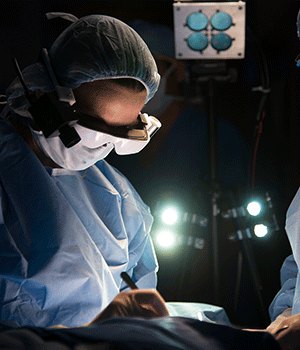
The cancer vision goggles being used in surgery.
The motivation for Achilefu is to “eliminate guesswork, prevent local relapse, and allow surgeons to selectively kill cancer cells”. It is also important to ensure that the optical equipment can fit into a crowded operating room, and the solution devised by Achifelu and his team was to engineer a head-mounted display that he calls “cancer vision goggles”. The fluorescence goggle system allows the surgeon to visualize the cancer cells in real time, ensuring that all the diseased cells are removed during the operation. The portability of the cancer goggles also makes them suitable for use in any operating theatre, anywhere in the world.
Among the following Hot Topics presentations, one that captured my interest was by Clare Ewell, a professor of medical physics at University College London. Ewell and her team have been investigating a functional brain imaging technique based on near-infrared spectroscopy (NIRS), and have developed a broadband NIRS system that offers better performance that more common dual-wavelength versions. The wearable system provides high-density optical measurements of cerebral oxygen metabolism, which is important, for example, for investigating cognitive function in brain-damaged patients.
Ewell pointed out that functional NIRS is a particularly useful tool for assessing the brain function of infants and young children. One recent study measured the fNIRS response in babies’ brains, and showed that measurements from babies less than six months old could be used as an early predictor of autism in later childhood.
Ewell is also working the make optical brain imaging available to children who do not have easy access to sophisticated medical equipment. Through the BRIGHT Project, funded by the Bill and Melinda Gates Foundation, fNIRS has been used to investigate the impact of malnutrition on the brains of infants in rural Gambia within their critical first 1000 days of life – which Ewell says is the first time that functional brain imaging has been offered to children in Africa. Her research aims to identify which nutritional and other interventions could protect the infants’ brains and ensure that they reach their full developmental potential.
“One third of the children living in resource-poor settings fail to meet developmental milestones,” Ewell pointed out. “This can impact academic achievements, mental health, and the ability to form and sustain healthy relationships. These children are surviving, but not thriving.”
Researchers in the UK and the Netherlands have succeeded in identifying for the first time all of the solid phases present within whiteish lead-rich deposits on the surface of an Old Master painting using a technique called X-ray diffraction computed tomography (XRD-CT). The work, carried out at the UK’s National Synchrotron, the Diamond Light Source, proves how important it is to house these precious works of art in a protected environment.
Old Master paintings often have a layer of whiteish crust on their surface. Although barely visible this indicates that potentially damaging chemical reactions have occurred. It is difficult to characterize these crusts, however, since only a very small amount of sample is usually available to test.
Synchrotrons are incredibly useful here, explains study lead author Stephen Price from the Diamond Light Source and Finden Ltd. “Our sample was less than 100 μm in size, so a lab-based source (with typically mm-sized beams) wouldn’t have the resolution to spatially resolve the lead compounds in it.
“The XRD-CT we employed works in the same way as any other 3D-imaging technique (such as medical CT scans, for example) in that you image the sample from as many projections as possible,” says Price. “Computer algorithms then reconstruct the information obtained into a 3D volume.”
Micro-focused X-ray beam
The key difference in the technique employed in this work is that the researchers scan the sample through a micro-focused X-ray beam at the synchrotron instead of taking a 2D X-ray “photo” of it at each projection (which would only yield absorption contrast), collecting multiple XRD patterns.
XRD-CT in fact uses diffraction to take a “fingerprint” of the different chemicals present and tomography to take a 3D picture of how different chemical species are distributed throughout the painting stratigraphy, adds team member Claire Murray, also of Diamond.
Rembrandt, Homer, 1663. (The Hague, Mauritshuis, bequest of Abraham Bredius, 1946)
The technique revealed that the lead-containing paint in Rembrandt’s Homer (painted in 1663 during a period known as the Dutch Golden Age) had reacted with atmospheric pollutants such as sulphur dioxide (SO2) to form insoluble lead-rich SO4 salts. This SO2 was present in the harsh environments the painting was exposed to in its past.
Complex mixture of lead sulphate minerals
The researchers identified the surface crust as being a complex mixture of lead sulphate minerals – palmierite (K2Pb(SO4)2 and anglesite (PbSO4). The reaction products depend on how much SO2 had diffused/been absorbed into the paint layers, say Price and colleagues.
Deeper in the painting’s layers, the researchers found that lanarkite (Pb2(SO4)O) and leadhillite (Pb4SO4(CO3)2(OH)2), were the main components. This shows that SO2 permeated to these lower layers to a lesser extent than to the upper ones. Underneath these lower layers, they identified lead soaps of palmitate and azelate, which suggests that multiple chemical reactions had occurred.
No further degradation from SO2
“The change in the S:Pb ratio away from the surface we observed allows us to conclude that the S came from an external source in the past,” Price tells Physics World. “Since this SO2 is no longer present in the environment in which the painting finds itself today (the Mauritshuis collection at the Rijksmuseum in Amsterdam), further degradation from this pollutant should not continue. This result shows how important it is to keep valuable paintings in a stable climate.”
The team, which includes conservation scientists from University College London (UCL), the Mauritshuis in the Hague, the Rijksmuseum in Amsterdam and the University of Amsterdam, says that it has now begun to study other similar painting using its technique. “We already knew that the same phenomenon had affected many Old Master paintings and our work will help us better understand the complex Pb chemistry that takes place in these oil paintings over time.”
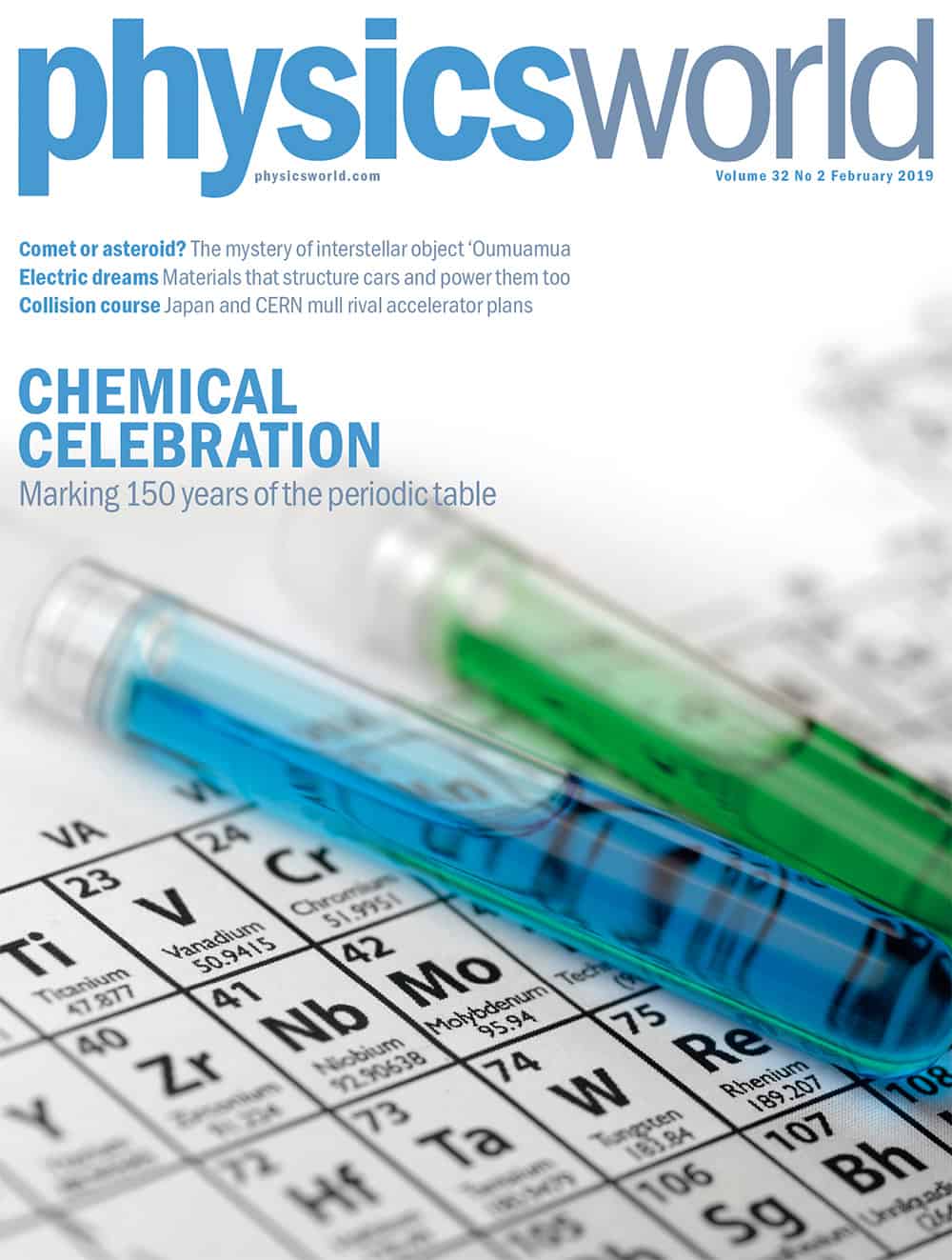
In 1869, Russian scientist Dmitri Mendeleev sketch out a table, putting the elements in columns and rows, ordering them by atomic weight in a way that showed their chemical similarities. To celebrate the anniversary, 2019 has been designated the “International Year of the Periodic Table of Chemical Elements (IYPT2019)” by the United Nations General Assembly and UNESCO. Over the past century and a half, more than a thousand different versions of the periodic table have been created. In the February 2019 issue of Physics World, our columnist Robert P Crease explores why Mendeleev’s system has remained the dominant approach.
In the article, Robert P Crease examines the events that led to Mendeleev creating that first table – and traces how it developed over the decades that followed. Turns out, there have been hundreds of different versions – and the one we know and love today bears little resemblance to Mendeleev’s primitive early version.
Chemical celebration: the 150th anniversary of the periodic table.
Elsewhere in the issue, you can find out about the strange interstellar object ‘Oumuamua – is it comet or asteroid? – and explore the science of materials that can power a car and structure it too.
You can enjoy the January 2019 issue of Physics World magazine via our digital apps for iOS, Android and Web browsers. (membership of the Institute of Physics required). Let us know what you think about the issue on Twitter, Facebook or by e-mailing us at pwld@iop.org.
For the record, here’s a run-down of what’s in the issue.
• Physicists await ILC decision – Japanese particle physicists are hoping that the government will give the green light to the International Linear Collider next month. But as Michael Banks reports, they may be disappointed
• Europe unveils successor to the Large Hadron Collider – A CERN blueprint calls for the construction of a huge 100 km circular collider that would smash together electrons with positrons to study the Higgs boson in unprecedented detail, as Michael Banks reports
• China makes historic Moon landing – With Chang’e-4, China is the first nation to land a craft on the far side of the Moon, as Ling Xin reports
• Modernizing classical physics – David Nolte says it is time to bring the undergraduate physics curriculum into the 21st century
• Innovation, innovation – A year after his first Transactions column, James McKenzie reflects on how to get more physicists to embrace business challenges
• An unelementary affair – More than a thousand different versions of the periodic table have been created since Dmitri Mendeleev drew the first 150 years ago – but why is one version more familiar to us than practically every other? Robert P Crease finds out
• Structural supercapacitors – Energy-storage devices that perform multiple functions, such as powering a vehicle and letting it withstand mechanical loads, offer several potential benefits, as Natasha Shirshova explains
• Visitor from another star – Asteroid, comet, alien ship or something else altogether? Astronomers are still unsure about the true nature of ‘Oumuamua – the first confirmed interstellar object to be detected in our solar system – as Andrew Glester finds out
• Pathway to Pluto – Louisa Preston reviews Chasing New Horizons: Inside the Epic First Mission to Pluto by Alan Stern and David Grinspoon
• Quantum tea and toast – Tushna Commissariat reviews Breakfast with Einstein: the Exotic Physics of Everyday Objects by Chad Orzel
• With stars in my eyes – Tushna Commisariat reviews Seeing Stars: a Complete Guide to the 88 Constellations by Sara Gillingham
• Taking photonics into the future – Hugo Thienpoint talks to Anna Demming about the importance of collaboration for the continued success of the photonics sector
• Once a physicist – Meet Will Foxall, a creative technologist for the South West Creative Technology Network, based at the Watershed in Bristol, UK
• The physics of a youth hostel – Richard Hollins describes how his physics background helped him hen serving as a volunteer helping to run youth hostels in north Wales.
Some time ago, we published an April fool’s joke story about a new quantum computer that can play Jenga. Now, life has imitated art (sort of) because scientists at the Massachusetts Institute of Technology have made a robot that can play the game almost as well as a human player. A new type of machine-learning method enables the robot to adapt its approach not only with help from visual clues, but also from its physical interaction with the stacked blocks.
The researchers describe their findings in Science Robotics and hope their method could one day lead to robots assembling phones and other small-part devices.
Physics is home to some complicated and abstract ideas. Conveying them to others can be a subtle art. And so many physicists have put their creativity to the task by authoring their own graphic novels. This way they hope people can explore complex ideas through illustration and narrative.
This genre of comics is growing in popularity and boasts titles such as “Max the Demon vs. Entropy of Doom” by Assa Auerbach and Richard Codor, and “The Dialogues” by Clifford Johnson.
This coming spring, during the UN’s International Year of the Periodic Table, there will be a chemistry-themed festival in the South Kensington district of London. The Science Museum will host many family-friendly activities including weekend chem-mystery workshops. 150 years to the day from when Dmitri Mendeleev’s periodic table was announced in 1869, the museum is to uncover a new free display of over 50 elements once owned by Napoleon’s nephew.
During the festival, there will also be a couple of one-day conferences jointly hosted by the Science Museum and Imperial College London. The first will be on the 11th of April and is to focus on the history of people and institutions that made chemistry part of the intellectual and public life in South Kensington. The following day, the Chemistry Futures 2040 conference will cover the newest breakthroughs in the field with some speculation as to how it might evolve.
A single layer of silver and tellurium atoms (AgTe) has been grown on the (111) facet of a silver substrate (Ag(111)) for the first time ever. Little is known about this material other than that its electrons experience strong spin-orbit coupling, which could lead to novel and potentially useful electronic properties. This development happened by chance, when researchers in China were attempting to grow the promising topological insulator candidate, 2D Ag2Te.
New and interesting 2D materials have been sought by physicists ever since the discovery of freestanding graphene about 15 years ago. This search has yielded silicene, germanene, phosphorene and other materials with atoms adjacent to the diagonal line on the periodic table that connects boron and astatine. It is no surprise, therefore that scientists are now looking for potential 2D materials containing tellurium.
Recently, a theoretical study suggested that a 2D Ag2Te crystal could be a topological insulator at room temperature. Most known 2D topological insulators require very low temperatures so such a material would be an ideal candidate for use in energy-efficient electronic and spintronic devices that make use of topological materials. And so a research team at the University of Chinese Academy of Sciences, Beijing, China, took it upon themselves to try and grow a 2D monolayer Ag2Te onto a Ag(111) substrate.
A nice surprise
The researchers used molecular beam epitaxy in ultrahigh vacuum onto an atomically flat substrate. They used a scanning tunnelling microscope (STM) to identify regions in the monolayer that had distinct patterns. One region resembled a flat honeycomb structure with periodic buckled ridges. As they had expected monolayer Ag2Te to be hexagonal, this was the first clue that they had grown AgTe instead. Team member Geng Li, said that discussions with several epitaxy experts confirmed their suspicion. “Scientific research often gives people surprises, which are not always bad”, comments Li.
AgTe is even less studied than Ag2Te and this is the first time it has been fabricated in a monolayer. It is known, however, to have strong spin-orbit coupling, so Li is optimistic about its potential for having interesting physical properties. The researcher also speculates that “the buckled honeycomb structure may have anisotropic electronic or thermal transport properties” if isolated from the substrate.
The origin of the buckled structure is unclear, and it has not been seen in monolayer copper selenide (CuSe), which is expected to be similar to AgTe. The researchers, however, strongly suspect that it arises in order to relieve some of the strain from the substrate-monolayer lattice mismatch. This is also the expected origin of another observed region, which has a striped pattern. In this region the honeycomb is stretched along one direction and forms stripes that resemble a Moiré pattern.
The team also tried increasing the tellurium dosage onto the substrate, which resulted in a spotted-pattern structure. Multiple holes appeared throughout the general honeycomb lattice (see figure) – with silver and tellurium atoms removed from the lattice to strengthen the overall structure. Such a pattern has also been seen in cerium selenide (CeSe). All these phenomena – lattice distortions and formation of holes – are related to strain in the thin film.
The first-time fabrication of a new and unstudied 2D material is an exciting development for Li and colleagues, who have already started work on investigating the electronic properties of the monolayer, but Li reminds that it is still early to talk about potential applications. And the researchers have not given up on trying to grow monolayer Ag2Te and Li says that they are considering other inert substrates and growing conditions.