Physics World 30th anniversary podcast series – gravitational waves

As regular readers will know, Physics World has just turned 30 and we have been celebrating the anniversary with a range of special content. This includes a 5-part series for our monthly podcast, Physics World Stories, exploring key areas in physics that evolved significantly during the past 30 years. This second episode in the series looks at gravitational waves by revisiting the celebrated first detections by the LIGO collaboration, then looking to the exciting future for multimessenger astronomy.

Along the way, presenter Andrew Glester speaks with several members of the LIGO team: Mark Hannam of Cardiff University; Chris Messenger from the University of Glasgow; and Lisa Barsotti from the MIT Kavli Institute who received of a New Horizons Breakthrough prize for her work on the LIGO detectors. He catches up with Paul McNamara, a project scientist on the European Space Agency’s LISA Pathfinder mission – a precursor to the first space-based gravitational wave observatory.

Glester also examines the controversy surrounding a recent analysis suggesting that LIGO has not yet discovered gravitational waves. The group at the Niels Bohr Institute in Denmark claimed in a paper on the arXiv preprint server that the positive detections could just be correlated “noise” from LIGO’s two detectors, and they have since followed up with further analyses of the LIGO data. Glester speaks with the group’s spokesperson Andrew Jackson and offers LIGO researchers the chance to respond.

If you enjoy what you hear, then you take a listen to the first episode in this special podcast series, which looked at the past and future of particle physics. Don’t forget you can also subscribe to Physics World Stories via the Apple podcast app or your chosen podcast host.

Biophysicists strain to reveal why wombats have cube-shaped poo

Wombats are the only animals known to produce cubic droppings, and now a team of scientists claims to have worked out why. The team, based in the US and Australia, reckons that the unique elastic properties of tissues in the very last section of a wombat’s intestine cause the organ to become roughly square in cross section when expanded. As well as solving a long-standing biological mystery, the study could lead to new manufacturing techniques for cubic structures.

Wombats are Australian marsupials that live mainly in the south-east of the country and Tasmania. All three species of wombat are known to produce fairly uniform, cube-shaped droppings – but how they do it was not immediately obvious to biologists.

Moulding muscles or square anuses?

Past theories have suggested that wombats might have square anuses, that their pelvis compresses faecal matter as it passes through, and that blocks of intestinal muscles could mould faeces into cubes. According to the authors of the latest research, however, these hypotheses are all speculative and have not been investigated.

For their study, Patricia Yang at the Georgia Institute of Technology and her colleagues examined the intestines of two bare-nosed or common wombats (Vombatus ursinus) that had been euthanized after being hit by cars in Tasmania.

“The first thing that drove me to this is that I have never seen anything this weird in biology. That was a mystery,” said Yang. “I didn’t even believe it was true at the beginning. I Googled it and saw a lot about cube-shaped wombat poop, but I was sceptical.”

Luckily for the researchers, the dead wombats’ intestines were full of faecal matter. In the last 150 cm, or 25%, of the intestine the dimensions of the faeces were quite consistent, and much more solid than higher up in the bowel, they found. But when the team looked closely at the faeces in the final 50 cm, or 8%, of the intestine they discovered that it had sharp corners. This lead them to conclude that the cubic shape is formed in this final section of intestine, so they ran further tests on its properties.

Peak strain

When they inflated a piece of this last section of intestine with a small balloon they discovered that its strain – or elasticity – varied around the intestines circumference. Three areas had an average peak strain of 75%, while two had an average peak strain of just 25%. For comparison, they checked an intestine from a pig and found that the average peak strain was fairly consistent around its circumference, at 53%.

The researchers say that this variation in strain helps mould the faeces into cubes, with the areas of high strain producing the corners, and the areas of low strain corresponding to the sides.

To produce a cube, however, four areas of high strain and four of low strain are needed, and they only found three and two, respectively. According to the researchers, the mostly likely explanation for this discrepancy is that the balloon did not stretch the tissue enough. The balloon was able to inflate the intestine to an 8 cm circumference, while some of the faeces they found would stretch the tissue to 9.6 cm. With further stretching you could reveal additional peak strains, they explain.

Soft tissue

Yang says that that the novel cube production method that wombats use could be applied to the manufacturing of cubic objects. “We currently have only two methods to manufacture cubes: We mould it, or we cut it. Now we have this third method,” she explains. “It would be a cool method to apply to the manufacturing process – how to make a cube with soft tissue.”

But, of course, the big question is why do wombats produce cube-shaped poo? There is some debate, but Scott Carver, an ecologist at the University of Tasmania, who was involved in the research, told Physics World, “The general belief is that it assists with stacking and not rolling away when they deposit it on or next to prominent landmarks within their home ranges – logs, rocks, small mounds – as a form of chemical communication.”

Yang presented her findings at the American Physical Society’s Division of Fluid Dynamics 71st Annual Meeting, in Atlanta earlier this month.

US faces economic threat from climate change, warns report

The US economy could lose as much as 10% of its gross domestic product by the end of the century if the country does not take significant steps to rein in global warming. That is according to a 1656-page report  released on Friday by the US government that looks at the impact of climate change on the US.

The document is the second volume of the fourth US National Climate Assessment, following similar exercises in 2000, 2009 and 2014. The first volume, focusing on the science of climate change, was released last year. Written by 13 federal agencies, the second volume outlines the present and possible future effects of climate change on US life including human health, water quality, infrastructure and tourism.

“The impacts of global climate change are already being felt in the United States and are projected to intensify in the future,” the report states. “But the severity of future impacts will depend largely on actions taken to reduce greenhouse gas emissions and to adapt to the changes that will occur.”

If President Trump continues to ignore climate change, then he will abdicate his responsibility to protect the well-being and prosperity of future generations

Bill Foster

Philip Duffy, president of the Woods Hole Research Center, notes in a statement that the report paints a picture of “pervasive and increasingly severe impacts” of climate change throughout the US. “These impacts have never been more apparent,” he says. “California’s mega-fires are only the most recent example; in the past two years we’ve seen many other events — hurricanes, droughts, floods — of the sort that we expect to be made more frequent and/or more severe by climate change”.

“Anti-science posture”

The report complements a special report by the United Nations International Panel on Climate Change (IPCC), which was issued in October. While the IPCC assessment focused on what it would take to limit warming to less than 1.5 ˚C and 2.0 ˚C, the National Climate Assessment instead focuses on the changes in climate and associated impacts that will result from different fossil fuel emissions scenarios. “There are no inconsistencies with regard to the underlying science [between the two reports]; just different focus and framing,” climatologist Michael Mann from Pennsylvania State University told Physics World.

While scientists have welcomed the report, the Trump administration has been dismissive. “We think that this [assessment] is the most extreme version and it’s not based on facts,” noted White House press secretary Sarah Sanders.

Political opponents, however, disagreed. “If President Trump continues to ignore climate change, then he will abdicate his responsibility to protect the well-being and prosperity of future generations,” says Democratic representative and physicist Bill Foster. “The report shows that his anti-science posture could wreak havoc on the American economy and hurt the American people.”

Other critics excoriated the timing of the report’s release during the busy Thanksgiving holiday weekend in the US. But any apparent effort to reduce coverage of the report seems to have backfired. “Trump trying to bury climate report is such a compelling media narrative that it might lead to greater coverage…,” Mann tweeted immediately after the report’s release. “And indeed,” Mann told Physics World, “it looks like it did.”

All power to gas

Hydrogen gas made via the electrolysis of water using surplus renewable electricity can be stored then used when needed for power production, heating, industry and in vehicles. It’s an ideal multi-purpose fuel; it only produces water, and some NOx, when burnt in air or used in a fuel cell to re-generate electricity. And now this power to gas (P2G) approach is becoming cheaper.

Perhaps the most exciting prospect is that P2G offers a way to balance variable renewables. Indeed, it turns their variability into a solution rather than a problem. In order to meet demand most of the time, at non-peak demand times a power system based on renewables would be likely to have substantial overcapacity, so that there would be surplus renewables output. If that can be converted to storable hydrogen, it can be used to generate power later, when renewable supplies are low and power demand high. Since there could be a lot of this hydrogen, some of it could also offset fossil gas use, by being injected into the gas grid, possibly after conversion into methane. In addition, some of the hydrogen or methane could be used as a vehicle fuel. It all sounds wonderful, but is P2G really viable at scale? A recent report on green heating options from the UK’s Climate Change Committee (CCC) was unconvinced, but there are other views.

A study for the UK’s Department for Business, Energy and Industrial Strategy (BEIS) by Northern Gas Networks (NGN) and UK hydrogen pioneer ITM Power says that large scale power-to-gas conversion could integrate with current gas networks, with hydrogen being storable at scale and suited to injection into the gas network. The study examined the potential for the deployment of storage capacity, at 50 MW and above, within the boundaries of NGN’s distribution network, and the use of the hydrogen in the network.

After accounting for seasonal variations in gas demand and the amount of hydrogen that would be able to be produced and blended with natural gas, the report concluded that a large part of the existing NGN grid could be supplied via P2G conversion. Specifically, it identified four potential sites for P2G units, with NGN’s existing InTEGReL (Integrated Transport Electricity and Gas Research Laboratory) site in Gateshead highlighted as the best location for a first-of-its-kind large-scale demonstration plant of 50-100 MW. ITM claimed that the system could use renewable power to produce low carbon hydrogen that could then be blended with natural gas to provide greener gas to over 243,000 domestic and industrial customers in the region, while also providing hydrogen to a local hydrogen refueling station.

Mark Horsley, NGN’s CEO, said: “Power-to-gas technology has the potential to answer some of our key energy storage challenges because of the gas network’s sheer size and flexibility. This study has delivered some compelling results and insight into how a whole systems approach and green hydrogen can facilitate decarbonisation across all energy vectors.”

Costing the future

What about the cost? At present most hydrogen is produced using high-temperature steam reformation of fossil methane (SMR) and it’s usually said this is far cheaper than the electrolytic route, which is seen as less efficient, with maybe 50% conversion losses. For example, French company Engie, which is looking to shift to green hydrogen production and distribution, says steam reforming of hydrocarbons, which accounts for 95% of hydrogen produced today, costs about €2/kg, compared to €6/kg for electrolysis.

However, as electrolysis technology improves, the situation may change. Last year Chris Goodall estimated that, at then common power and electrolyser prices, hydrogen made from surplus renewable electricity was almost at the same price as hydrogen made via steam reforming of fossil methane. That looked a little optimistic at that stage, but perhaps not if you include the significant cost of carbon capture and storage (CCS) to make the latter route less carbon intense.

Certainly, as green power prices fall and electrolysers become cheaper and more efficient, the relative advantage of using electrolysis will improve; increasingly so as surplus renewable output becomes more available – it’s in effect free and would be wasted otherwise. Progress does seem to be underway, with the advent of high efficiency cells.

Perhaps the most exciting prospect is that P2G offers a way to balance variable renewables. Indeed, it turns their variability into a solution rather than a problem.

Dave Elliott

ITM Power claims that its PEM cell has an overall efficiency, with heat recovery, of 86% and it has been winning orders for its technology in Germany, as well as the UK. ITM clearly sees this as the way ahead and it’s not alone. A recent academic overview presents some favourable conclusions. Looking at experience with pressurized solid oxide cells with internal methanization, some of which have recently returned good experimental results, it claims, on the basis of its system modeling, that “electricity can be stored as synthetic natural gas with an energy efficiency of 89%”, and that “the gas to electricity efficiency is equally high, resulting in a round-trip storage efficiency of 80% (DC-to-DC)”.

So, despite the CCC’s reservations, P2G does look promising. Some say that, with renewable costs falling, we may reach the point where P2G becomes fully competitive. A recent study for Greenpeace Energy by Berlin-based Energy Brainpool claimed that hydrogen from surplus renewables will be cheaper than gas in the 2030s. It cites the International Energy Agency view that natural gas prices are set to rise steadily until the 2040s, from €0.017/kWh in 2020 to €0.032/kWh by 2030 and €0.041/kWh by 2040. By contrast, IEA analysts forecast that production costs for hydrogen generated by wind power are set to fall from “about €0.18/kWh” to €0.13/kWh by 2020, to €0.12/kWh by 2030, and to between €0.021/kWh and €0.032/kWh by 2040.

Fuelling the options

As I have noted in earlier posts, there are other approaches. For example, the Leeds H21 100% hydrogen heating project is getting some support. But it is focused on SMR using fossil gas with CCS — P2G has been relegated to a possible longer-term option. However, the case for P2G is building up, not least since, unlike the H21 plan, it doesn’t need costly and uncertain CCS, and can deliver fully carbon-neutral hydrogen.

P2G and its derivatives are becoming quite well established on the European continent, led by Germany with, as German Energy Agency DENA notes, 20 or so hydrogen/methane projects for grid-balancing, vehicle fuel production and gas mains injection. There are videos promoting the Falkenhagen project from UTV and E.ON. Amongst many other projects across Europe, Austria is exploring novel ideas including a range of end uses, such as steel production.

Clearly, there is a lot happening in this field, and novel improved technologies may also be on the way. The focus during the initial phase has been on options with high added-value, vehicle fuel production inevitably being one, with German car companies much in evidence. But the wider potential for P2G is now also being explored. It’s still mostly in its infancy around the world, but DENA says that Germany is looking to have 1 GW of P2G capacity by 2022 and, as the technology develops and costs fall, the idea seems certain to spread.

How far remains to be seen. As I reported in an earlier post, the UK Policy Exchange was a little unsure, but did say that electrolysis “has the potential to achieve far greater cost reductions than other technologies”. And a new report from The Oxford Institute for Energy Studies notes that there are now about 50 pioneering P2G projects around the EU, though most of them are small — under 10 MW. The institute says it will take concerted government action to make P2G happen on a wide scale. The UK’s ITM is one of the leaders. Maybe we should capitalize on that.


Varying graphene’s conductivity modulates THz wave

Compared with other regions of the electromagnetic spectrum terahertz (THz), the frequency range between the infrared and the microwave, has been relatively neglected. A group from the Chinese University of Hong Kong and Warwick University have recently shown that broadband, large and fast modulation of THz beams is in fact possible, and can even be achieved with one very neat device.

Much effort has been spent designing cameras and spectrometers that operate at THz frequencies. They have already proved useful in airport security scanners, and for identifying underlying layers of old paintings.

One important component of these pieces of equipment are modulators, which control the amplitude or phase of a THz beam. These must operate quickly, consume little energy, give consistent modulation over a large frequency range, and produce large changes in the intensity or phase of a THz beam. Approaches so far include metamaterials, semiconductors and liquid crystal devices, none of which meet all the necessary requirements.

In comes Mr. Brewster…

In 1815 David Brewster published a paper describing the angle of incidence required to achieve zero reflection from a transparent body. Now over two hundred years later a team of scientists led by Jianbin Xu and Emma Pickwell-MacPherson have applied this knowledge, along with some more recent technological advances, to create a record-breaking THz modulator.

Pickwell-MacPherson commented, “Our first step was to demonstrate that broadband THz modulation can be achieved with a much lower change in the conductivity by employing  total internal reflection (TIR) geometry rather than transmission geometry (read more about it in Advanced Optical Materials). This has blossomed into the realization of several new device designs, with this latest one exploiting the Brewster angle.”

The device consists of a single stack of graphene, aluminium oxide (Al2O3) and titanium oxide (TiO­­x) on a quartz substrate. A p-polarized THz beam is reflected from the stack, and when Brewster’s angle is reached the reflection goes to zero. The addition of a layer of graphene here allows for an extra element of tunability. When a voltage is applied across the graphene between two gold contacts, the conductivity changes. This alters the Brewster angle for the stack, so for a given angle of incidence the reflected THz may be “switched on or off” by controlling the voltage.

Choose your mode of operation

Shining the p-polarized THz beam onto the device at an angle of 65°, and altering the voltage across the graphene from -12V to +14V, you can modulate the amplitude of the THz by between 99.3% and 99.9% across the entire frequency range of 0.5–1.6 THz. This range is limited by the experimental constraints; in theory even larger bandwidths could be achieved.

But that’s not the only option they have. The researchers took advantage of the fact that at angles greater than the Brewster angle, the reflected beam undergoes a 180° phase change. A THz beam incident at an angle of 68° will experience a phase change of at least 140° across the same frequency range when the voltage is changed from -12V to +16V. Across this range of voltages the Brewster angle varies between 72° and 64°.

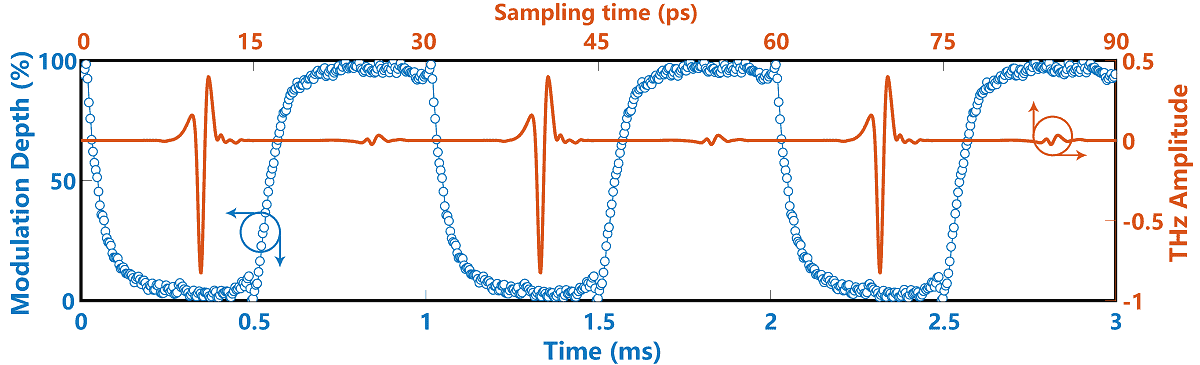
Modulated terahertz time-domain waveform (red) and the modulation depth response (blue) to a 1 kHz square-wave electrical signal. Credit: Chen Xuequan.

The need for speed

The rise time of the modulation is around 1ms, so modulation frequencies of 1 kHz are easily achieved. However, if the modulation depth can be compromised, frequencies of up to 10 kHz can also be reached. Although other solid-state THz modulators operate at significantly higher frequencies of around 2.4 MHz, all is not lost as some small tweaks can improve the modulation frequency of this device. Currently it is limited by the resistance and capacitance of the layers between the gold contacts. By reducing the size to around 1 mm and replacing the TiOx with another layer of graphene, the modulation can reach speeds comparable to other devices.

Xu, who is Director of Materials Science and Technology Research Centre, the Chinese University of Hong Kong, explained that, “the additional benefit of this device is that it can be retrofitted into existing commercially available THz spectrometers.” This graphene-controlled Brewster angle THz modulator truly propels us into the future of THz technologies in real-life applications.

Read more about the work in the paper published in Nature Communications.

Cryoablation shows promise in treating low-risk breast cancers

MRI after cryoablation

Cryoablation — the destruction of cancer cells through freezing — may offer a promising alternative for treating low-risk breast cancers, according to interim results from the Ice 3 Trial presented today at the RSNA annual meeting. Ice 3 is a large scale multi-centre trial designed to assess image-guided cryoablation as a primary treatment for breast cancer, without surgical lumpectomy. Over the first four years of the study, there has been just one cancer recurrence out of 180 patients.

“If the positive preliminary findings are maintained as the patients enrolled in the study continue to be monitored, that will serve as a strong indication of the promise of cryotherapy as an alternative treatment for a specific group of breast cancer patients,” says lead author Kenneth Tomkovich from Princeton Radiology and CentraState Medical Center.

Cryoablation involves inserting a probe into the tumour via a tiny incision in the skin. The probe is guided by high-definition ultrasound in conjunction with mammography images. Once in place, liquid nitrogen is introduced into the probe causing the formation of an ice ball around the tumour, which destroys the cancer cells.

The ice ball

The Ice 3 Trial started in 2014, when Tomkovich and colleagues at 18 centres across the US began performing cryoablation on women aged 60 and over with biopsy-proven, low-risk breast cancer. The procedure, which includes two eight-minute freeze cycles, separated by a thaw cycle, takes less than an hour. Patients can return to their normal activities shortly thereafter. After treatment, patients are followed for recurrence with mammography at six and 12 months and then annually for five years.

The researchers now have three-year follow-up data on about 20 patients and two-year follow-up data on more than 75. The preliminary results are highly promising. The procedure was successfully completed in all patients, with no serious adverse events reported. Only one patient experienced a recurrence, giving the procedure a 99.4% success rate so far.

“Lumpectomy is 90 to 95% effective at removing cancer,” says Tomkovich. “We were going for something close to that, but our preliminary results have been even better. We’re getting the same results at 18 centres around the country.”

Cryoablation also has advantages over heat-based ablation techniques. Tissue retains its appearance when frozen, while heating tends to deform it, making imaging less reliable. In addition, there is preliminary evidence from studies on mice that cryoablation can stimulate an immune response against cancer cells in the body.

The final results of the study will be published when five-year follow-up data are available for all the women who were treated. “If it’s proven that cryoablation works, then some women might be more inclined to opt for it over surgery,” says Tomkovich.

Once a physicist: Anand Kamalakar

Anand Kamalakar

What sparked your initial interest in physics?

Growing up as a teenager in Hyderabad, India, my family had an annual subscription to National Geographic magazine. I would be engrossed for hours – any article about space and astronomy would immediately grab my attention. The beautiful images of a rising space shuttle at Cape Canaveral, or the first Hubble images of deep space, are still etched in my mind. When I graduated from high school, as is the norm in India, friends in my peer group were frantically studying for the myriad entrance exams to get into engineering or medical schools. I could not escape that pressure. I always wanted to be an architect. When that did not work out, as I did not clear the entrance test, I opted for the next best thing: a three-year BSc in maths, physics and chemistry at Nizam College, Osmania University.

What did your physics focus on, and did you ever consider a permanent academic career?

Though my primary interest was in the field of astronomy and astrophysics, due to the way the curriculum is structured in India, I did not have the option of choosing it as a major. My only option was to specialize in this field at master’s level. But when that time arrived, my interests had taken a different turn. I had never entertained the idea of a permanent academic career in science – though I am currently an adjunct professor at Brooklyn College, which is part of the City University of New York.

How did your interest in the arts, and film especially, emerge?

As a teenager my father exposed me to works by filmmakers such as John Ford, Orson Welles, Akira Kurosawa and Satyajit Ray, when most of my friends were watching mainstream Bollywood cinema. When I completed my BSc, I was still uncertain which career path to choose. A chance visit to the media department at the University of Hyderabad alleviated that ambiguity. Shiny new cameras, monitors and recording studios all spoke to me with such clarity that I knew I had to get my hands on them. Three graduate degrees later, I arrived in New York City to start my professional career in film.

What was it like working on your recent film, Salam – The First ****** Nobel Laureate?

In 2014 I directed a documentary on the life of renowned American physicist Richard Garwin (www.garwinthemovie.com). Earlier in my career I had edited a three-hour-long PBS series called Mysteries of Deep Space, when my love for astronomy and astrophysics and film had come together. When the producers of Salam, Zakir Thaver and Omar Vandal, approached me with the offer to edit and direct this film, they knew my experience in making films about science, as well as my Indian heritage, would be a good fit. Resurrecting the remarkable life of Abdus Salam in all its complexity for the screen, for generations to come, was deeply gratifying. Omar and Zakir had invested more than a decade accumulating exhaustive archival material on Salam. My two-year contribution was a journey of discovery and learning, which still has not ended. It has been my most satisfying and illuminating experience so far, not only because the story was so close to home, but also because it gave me the opportunity to learn about particle physics and other fascinating scientific concepts I otherwise would not have.

What are you working on now?

A feature-length documentary tentatively titled In Search of Bengali Harlem, which explores the arrival of South Asians in New York City on colonial British steam ships in the late 1800s and early 1900s. A rare piece of New York history is being revealed in this film. I am also in the midst of developing a project about Cuban music, to coincide with the 60th anniversary of the Cuban Revolution next year.

How has your physics background been helpful in your work, if at all?

This, together with an innate interest in science, has always informed the way I see the world. Physics is in everything we do, including filmmaking. While filmmaking is storytelling at its core, there is a mechanical and electronic aspect to it, which is constantly evolving. As I always say to my students, filmmaking is both an art and a craft. The craft aspect of filmmaking has a lot to do with physics, and science in general.

Any advice for today’s students?

Always search for your inner voice. When you find it, pursue it with passion. There is nothing more gratifying than having your passion be your life’s work. The road is never easy. Sometimes the monetary reward is not there or is hard to come by. But do not give up hope as, in the long run, it is always more satisfying to look back and know that you followed your inner calling.

Bacteria manipulate bubbles to maximize airborne dispersal

Bacteria can alter the behaviour of bubbles on the surface of contaminated water – which could maximize the airborne dispersal of the microorganisms. That is the conclusion of Lydia Bourouiba and colleagues at the Massachusetts Institute of Technology in the US, who have discovered that the bacteria do this by secreting chemicals that affect the physical process by which the of the tops of bubbles become thinner with time. This results in more droplets flying farther through the air when the droplet bursts.

Bursting bubbles can spread bacterial contamination, but little is understood about how bacteria can influence the process. Physicists do know that the thickness of the curved top of a large bubble – called the film cap – affects how droplets are spread. It is also known that before the bubble bursts, the cap thins as some of the liquid drains out of the bubble film.

This latest study began when Bourouiba’s team noticed that bubble caps in stagnant water behaved differently from caps in clean water. Bacterial contaminants were identified in the water and this motivated the team to do a controlled study of how different strains of bacteria influence bubble evolution.

Capturing bubble behaviour

The team diluted cultured bacteria with deionized water and placed the liquid in a vertical tube. Single bubbles of constant size were released at the bottom of the tube by an air pump. High speed imaging was used to capture bubble behaviour at the surface.

Bourouiba says that the team found that, “Bacteria enabled the bubbles to live much longer than relatively clean bubbles that are not biologically contaminated”. This is important because older bubbles with thinner caps produce a greater number of film droplets that are much smaller in size and fly faster and farther.

When a bubble first emerges above the surface, liquid drains from the bubble cap thereby reducing its thickness. The team found that liquid began draining from bacterially-contaminated bubble caps in much the same way as short-lived (1-10 s) clean bubbles. But after about 30 s, the bacteria-containing bubble caps thinned dramatically, making Bourouiba suspicious that they had entered different regime of thinning

Bacterial density

Using interferometry and schlieren imaging, the team confirmed the presence of bacteria in the bubble cap. They also found that the microorganisms did not appear to drain readily into the bulk as the bubbles aged.

The team looked at whether the effect was caused by the presence of bacteria, or rather by chemicals secreted by the microorganisms. The team filtered the bacteria from the liquid and repeated the experiment. They obtained comparable results and concluded that bacterial secretions are responsible for the effect.

The team then turned its attention to understanding how bacterial secretions were causing the peculiar cap thinning that occurred in the aging bubbles. They looked at whether surfactants, compounds commonly found in detergents that lower surface tension, caused similar bubble dynamics. They found that bubbles containing surfactants all had the same extended life-span and underwent a similar dramatic change in thinning after a certain time — so the group concluded that bacterial secretions contain biosurfactants.

Evaporative effect

Bouriouiba and colleagues then set out to understand why this second thinning regime occurs. In previous studies on clean water, the team had calculated the effect of evaporation on cap thinning. However, because clean bubbles are relatively short-lived, the small amount of liquid lost to evaporation can be ignored. But over the longer timescales of contaminated bubbles, evaporation is a prime candidate for thinning.

“We eliminated all of the other chemical, biological and physical hypotheses that were reasonable to consider…the last reasonable hypothesis was evaporation,” explains Bourouiba. This was confirmed by studying bubbles in air that was saturated with water vapour, where the second thinning regime was not observed.

The team’s models further verified the experimental evidence that evaporation caused the dramatic drop in bubble cap thickness observed in both bacterially contaminated water and surfactants.

One puzzling aspect of the study is that some types of bacteria used by the team do not have biofilm-forming or waterborne stages in their life-cycles, yet these microorganisms still caused bubble-thinning effects. This could mean that a common waste product of bacteria could be causing the effect.

“The work has critical implications in terms of understanding organism dispersal,” said Bourouiba, who is excited by how her physics-based approach has illuminated complex biology. “Our next steps will focus on various aspects, including the physics of dispersal, but also the evolutionary aspect and ecological applications of these processes.”

The research is described in Physical Review Letters.

How can we use MRI in radiotherapy?

In this short video for our 100 Second Science series, Rob Chuter explains how radiotherapy can be aided by magnetic resonance imaging (MRI). Chuter, a principle clinical scientist at the Christie Hospital in Manchester, explains how these two technologies are combined into a so-called MR Linac device. The resulting technique, which has already been used to treat patients in the Netherlands, is now being clinically deployed at the Christie where it will improve the efficacy of radiotherapy and help with treatment planning.

Hierarchical nanostructures bolster high-performing alloys

Developing materials capable of withstanding high-temperature environments has been a major concern for materials scientists in recent years due to their demand in aerospace engineering and solar energy applications. These ‘superalloys’ contain multiple components and are often of complex structure. Researchers at the Idaho National Laboratory have studied the hierarchical structure of a novel superalloy on both the nanoscale and microscale to understand its origins and its role in enhancing the material stability at high temperatures.

Superalloys is the name given to a group of metallic alloys that are especially stable at high temperatures (> 800 °C) and they are usually based on iron, titanium, cobalt, or nickel. The defining characteristic of these materials is the presence of two distinct phases, referred to as γ and γ’. Typically these phases exist in a form where precipitates of the γ’ phase are embedded in within the larger γ phase. It is these γ’ precipitates that undergo “coarsening”, a process where small grains grow at the expense of larger ones to form new morphologies, at elevated temperatures.

Coarsening ultimately leads to degraded mechanical properties and shorter lifetimes. In this case a team of researchers led by Subhashish Meher have analysed the chemical composition and physical morphology of a hierarchically structured γ-γ’ superalloy system in order to understand the mechanisms through which the phase hierarchy forms and leads to enhanced resistance against coarsening.

The higher stability from within

The material developed by Meher and colleagues is similar to the conventional γ-γ’ structure, however in this case the γ’ precipitates also contain even smaller precipitates of the γ, hence they use the term “hierarchy”. The researchers used transmission electron microscopy to observe the evolution of the γ’ precipitates and found that nanoscale γ precipitates act to slow the rate of coarsening of the larger γ’ precipitates at 800 °C but are dissolved after a certain time, after which coarsening then resumes as for a conventional γ-γ’ system.

Having established that hierarchical structure is the means to enhanced thermal stability, the researchers were then concerned with understanding the mechanism of how these stabilizing nanoprecipitates are formed and dissolved. Atom probe tomography provides local chemical information on the nanoscale and was used by the team to identify the supersaturation of cobalt, ruthenium and rhenium driving the formation of the hierarchical structure.

Complementary modelling

To further explain the microstructural properties that result in mitigated coarsening, the scientists simulated the material structure using phase-field modelling. This enabled them to vary the composition of the material in order to calculate conditions optimized for the formation of a stable hierarchical structure, as well as measure the timescales and temperatures over which such a material would be stable. The model was consistent with the experimental findings, indicating a decrease in precipitate size at 800 °C is to be expected for times as long as 200 hours.

Making use of complementary microscopy and modelling methods is the key to developing and understanding the formation of materials capable of withstanding demanding environments. Based on these results, the researchers expect that alternative elements such as platinum may further increase the thermal stability of superalloys through the formation of more stable hierarchical nanostructures, bringing efficient manufacture of long-lifetime alloys one step closer. More details can be found in Science Advances.

Copyright © 2026 by IOP Publishing Ltd and individual contributors