Artificial intelligence helps reduce gadolinium dose in MR imaging

A team headed up at Stanford University is using artificial intelligence (AI) to reduce the dose of gadolinium contrast required for MRI exams, while maintaining diagnostic quality. Recent studies have found that trace amounts of gadolinium, a heavy metal used in MRI contrast, can remain in the body after scans. The effects of this deposition are not known; thus the radiology community is working to optimize patient safety while preserving the vital information that gadolinium-enhanced MRI scans provide.

“There is concrete evidence that gadolinium deposits in the brain and body,” explains lead author Enhao Gong, who presented the study today at the RSNA annual meeting. “While the implications of this are unclear, mitigating potential patient risks while maximizing the clinical value of the MRI exams is imperative.”

To achieve this goal, Gong and colleagues are employing deep learning – an advanced AI technique. To train the deep learning algorithm, the researchers used MR images from 200 patients who had received various contrast-enhanced MRI exams. They collected three image sets for each patient: pre-contrast (zero-dose) scans; low-dose scans using 10% of the standard gadolinium dose; and full-dose scans, acquired after 100% dose administration.
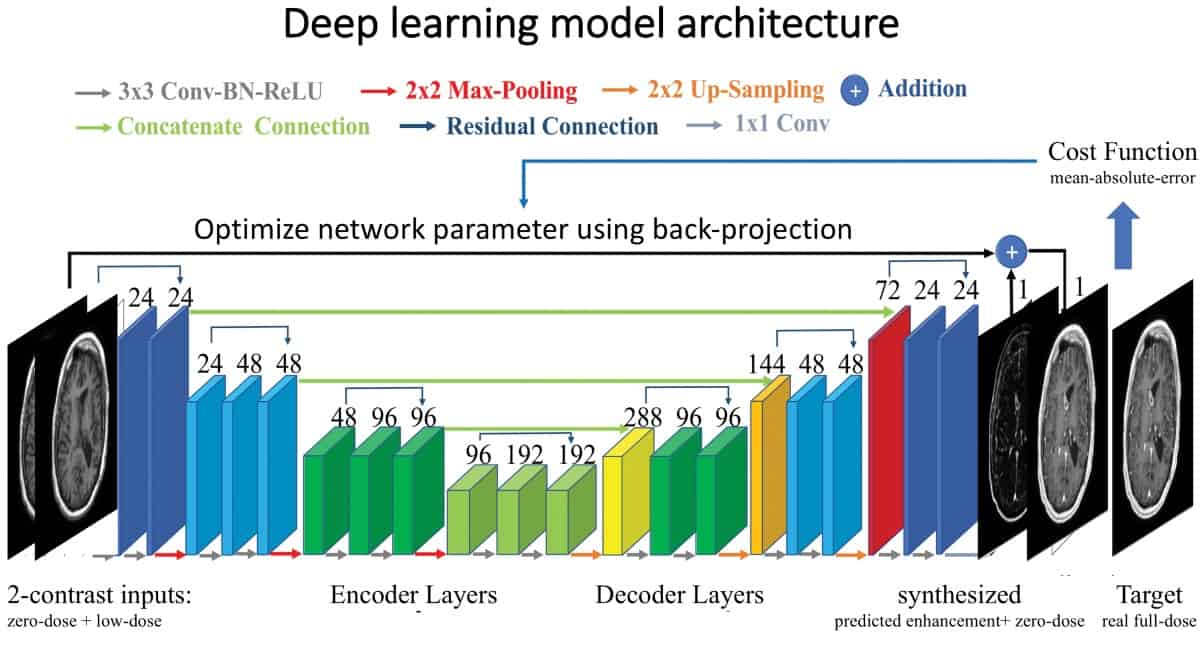
Deep learning model

The algorithm learned to approximate the full-dose scans from the zero-dose and low-dose images. Evaluation by neuroradiologists showed that the algorithm improved image quality, with no significant different between low-dose, algorithm-enhanced MR images and full-dose, contrast-enhanced MR images. The initial results also demonstrated the potential for synthesizing the equivalent of full-dose, contrast-enhanced MR images without using any contrast agent.

The findings suggest the potential for dramatically reducing gadolinium dose without sacrificing diagnostic quality. “Low-dose gadolinium images yield significant untapped clinically useful information that is accessible now by using deep learning and AI,” says Gong.

Next, the team plans to study the method further in a clinical setting. Future research will include evaluation of the algorithm across a broader range of MRI scanners and with different types of contrast agents. “We’re not trying to replace existing imaging technology,” Gong explains. “We’re trying to improve it and generate more value from the existing information while looking out for the safety of our patients.”

Novel tools reveal material secrets

At this week’s meeting of the Materials Research Society in Boston, US, scientists from all over the world will be sizing up the latest equipment for materials characterization. Here’s a few of the highlights.

Combined microscope offers flexibility at the nanoscale

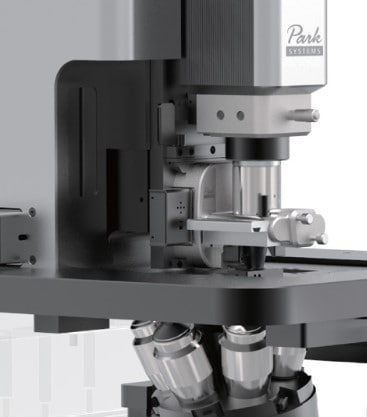
An affordable and versatile platform for analytical chemistry and electrochemistry has just been released by Park Systems. The Park NX12 combines an inverted optical microscope (IOM) with an atomic force microscope to enable advanced research on materials such as membranes, organic devices and electronics, and biological and pathological samples.

The NX12 from Park Systems“We just purchased the Park NX12 because we wanted a research-grade platform for AFM and scanning-ion conductance microscopy (SICM) that was also easy to use,” commented Dr Yixian Wang at the California State University in Los Angeles. “The Park NX12 was the only comprehensive platform that could perform all scanning probe techniques – including pipette-based SICM – while also utilizing IOM for the nanoscale measurement flexibility we needed. We are happy with a very affordable product with so many features and such accurate data.”

According to Park Systems, the NX12 is ideally suited for multi-user facilities, with a modular design that lends itself to further development. It has also been designed to handle the pipette probes commonly used to study the electrochemistry of transparent materials such as nanopore membranes for fuel cells and biomembranes.

Impedance measurements benefit from precision

A powerful impedance analyser from Zurich Instruments offers precision measurements of electrical parameters such as capacitance, inductance and resistance at frequencies ranging from DC to 5 MHz. The MFIA digital impedance analyser offers a guaranteed accuracy of 0.05% over a measurement range from 1 mΩ to 1 TΩ. With excellent repeatability and a small temperature drift, the MFIA addresses the shortcomings of legacy impedance analysers, and offers a number of innovations for materials researchers – without the need for any additional software to be installed.

The MFIA impedance analyser from Zurich InstrumentsThe MFIA combines an impedance analyser with a precision LCR meter. While the LCR meter measures impedance parameters at a single frequency, an impedance analyser can sweep the frequency and graphically display the acquired parameters. For a hands-on demo, visit Zurich Instruments at booth #1308 at this week’s MRS Fall.

Laser lights up nanophotonics research

A tunable continuous-wave laser from HÜBNER Photonics has been specifically designed for demanding applications in nanophotonics, atomic physics, and quantum optics. The high-precision C-WAVE laser delivers single-frequency radiation in the 450–650 nm and 900–1300 nm ranges, with output powers reaching 200 mW at visible wavelengths and 400 mW in the near infrared.

The C-WAVE laser in action“A vast number of experimental studies call for high-quality CW laser light that is tunable throughout the visible spectrum, but it is not straightforward to cover this region with most common tunable laser designs” says Korbinian Hens, a product manager for HÜBNER Photonics. “Sources based on CW optical parametric oscillator (OPO) technology have become commercially available relatively recently, and are quickly gaining popularity.”

The C-WAVE, which exploits OPO technology to generate tunable CW laser light across a wide range of wavelengths, is ideal for experiments that require narrow linewidths with moderate output powers. It can be used, for example, to obtain fluorescence excitation spectra of single molecules in a solid-state crystal, or excitation energy-dependent Raman spectra of a mixture of single-wall carbon nanotubes.

“Tunable CW OPOs offer a competitive alternative to conventional lasers and related technologies, in particular for experimental studies in molecular physics and quantum nanophotonics,” comments HÜBNER Photonics’ Jaroslaw Sperling. “We can predict further applications and increasingly sophisticated experimental approaches, including state-of-the-art methodologies in Raman scattering of single molecules.”


Visit the Physics World Buyer’s Guide to find the best technology and supplier for your next scientific project.

Vegetation ‘browning’ threatens Arctic carbon balance

The Arctic is already under severe threat from climate change. Now, research has revealed that damage to Arctic vegetation hampers its ability to absorb greenhouse gases from the atmosphere.

An increasing number of extreme climatic events are taking place in the Arctic, ranging from fire to unusual winter conditions such as sudden temperature fluctuations and changes in snow cover. These extreme conditions damage plants by killing them or by causing a stress response, visible as high levels of brown anthocyanin pigments. Extreme events cause huge areas of the Arctic to turn brown and bring major disturbances to Arctic ecosystems.

Despite the growing frequency and obvious adverse effects of these “browning” events, until now little was known about how they change the ecosystem’s carbon balance – the equilibrium between emission and absorption of carbon dioxide. New research led by Rachael Treharne of the University of Sheffield, UK, with colleagues from Norway and Italy, has revealed a steep drop in the amount of carbon dioxide absorbed by plants affected by an extreme climatic event, regardless of whether the plants were killed or just stressed.

Photo of Arctic vegetation showing anthocyanin pigments after a browning event

The research focused on the Lofoten archipelago in northern Norway, an area that has suffered numerous browning events. A sealed chamber placed over an area of ground allowed measurement of the gas exchange of the plants and soil inside. Plants absorb carbon dioxide, while both plants and soil release it.

The study found a reduction in CO2 uptake of 48% in areas where extreme climatic events had killed many plants, but also a 50% reduction in areas where plants had been stressed and produced protective anthocyanins.

“The large reductions in net CO2 uptake have implications for the whole ecosystem,” says Treharne. A large reduction across the growing season severely decreases the ecosystem’s capacity as a carbon sink; it cannot absorb as much carbon dioxide from the atmosphere as undamaged vegetation.

Damaged vegetation usually recovers its green colour by the peak of the growing season, the researchers point out, complicating attempts to quantify the severity of browning by remote sensing from satellites.

“Many climate models assume an arbitrary level of greening — and therefore increasing carbon dioxide uptake — across the Arctic,” Treharne says. “The scale of the browning we’ve seen in recent years suggests the reality may be more complex.”

Scientists may need to reassess their predictions of future climate change to account for Arctic browning.

“It couldn’t be clearer that our current efforts to tackle climate change are deeply and dangerously inadequate,” says Treharne. “However, if we take ambitious action now, we can cut how much the Arctic is expected to warm by as much as 7°C. This is critical to minimizing the impacts of climate change in these globally important ecosystems.”

Treharne and colleagues reported their research in Global Change Biology.

A Monkee visits Fermilab, physics of stir frying, six strange facts about ‘Oumuamua


Fans of Fermilab, the Monkees and vintage American pickup trucks will love the above film. It was shot in 1970 by Monkees drummer Mickey Dolenz and shows construction of the National Accelerator Laboratory (now Fermilab) on the outskirts of Chicago. Dolenz is a big fan of particle physics and his seemingly random footage captures the essence of what it was like to create a world-class physics lab on land previously occupied by prairie farms and a village called Weston.

Dolenz was there just as the underground ring that housed the 200 GeV accelerator was being assembled by burying prefabricated concrete sections in a trench. Those of you who were around in North America in the 1970’s might also appreciate the vintage automobiles in the film, and in particular, the pickup trucks.

“Cooking fried rice with a wok is a subtle art and an even subtler science.” That is the claim of Anna Kusmer, who has written “Breaking down the physics of wok tossing” in Atlas Obscura. She speaks to David Hu  and Hungtang Ko of the Georgia Institute of Technology, who have studied the physics of stir frying. “The food has to do this dance where rice grains are basically charred and then spun up in the air, so they don’t get too charred,” explains Hu. The ultimate goal of the duo’s research is to create a robot that can function as a skilled stir-fry chef – but Hu admits that half the fun of eating at a stir-fry restaurant is the spectacle of a good chef.

Regular readers of Physics World will know that we have become fascinated with ‘Oumuamua – the cigar-shaped interstellar object that is currently passing through the Solar System. But our interest in the object pales in comparison to that of Avi Loeb, who is an astrophysicist and cosmologist at Harvard University.

Earlier this month, Loeb and colleague Shmuel Bialy posted a preprint arguing that ‘Oumuamua, which came from outside of the Solar System, could be a light-sail created by an alien civilization. Now, Loeb has written an article for Scientific American called “6 strange facts about the interstellar visitor ‘Oumuamua”.

One point he makes is that ‘Oumuamua appears to be at the local standard of rest (LSR), which is defined by averaging the random motions of all the stars in the vicinity of the Sun. He likens the object to a buoy standing still in the sea as the Sun and most other local stars pass by like ships. He asks, “Could there be an array of buoys that serves as a network of relay stations or road posts, defining the average galactic frame of reference in interstellar space?”.


Soft contact lens has integrated LED microchip and RF antenna

A soft contact lens with an integrated LED microchip, RF antenna and stretchable interconnections has been created by scientists in Belgium and Japan. Made from a hydrogel-based material, the prototype device could lead to the development of contact lenses with integrated sensors and drug-delivery systems that could be used to treat diseases and injuries of the eye.

The contact lens was developed by Andrés Vásquez Quintero and colleagues at Belgium’s imec electronics research centre, the University of Ghent and SEED, which is a Japan-based maker of contact lenses.

Described as a “semi-passive smart lens”, the device is powered by an onboard RF antenna that converts radio waves to electrical currents. Signals sent and received via the antenna can also be used to control the on-board electronics and read data from measurements made by sensors.

Spherical curvature

The device comprises a ring-shaped flexible antenna and an electronics system that has a spherical curvature to match the curvature of the eye. Electrical connections between components are laid-out on a thermoplastic polyurethane (TPU) substrate that can be moulded to match the curvature of the eye. As well as being transparent, TPU is permeable to oxygen and has similar softness and flexibility as the hydrogel-based soft lens onto which the device is mounted.

“The integration of a LED light in a semi-passive RF wireless platform is the first important step towards a device that will change the life of many,” says Vásquez Quintero.

The team is now working towards the creation of active lenses with integrated transducers that can be powered over long periods of time. “Major challenges have to be overcome to make a truly autonomous smart lens that is comfortable to wear and stable for a few days or even weeks,” he says.

Ritsuko Arai of SEED says that such devices are suitable for mass production and could be installed on the inner or outer sides of a contact lens – or even within the lens itself. This, she says, could lead to a wide range of biosensing applications.

Bioinspired e-skin could help domestic robots sense touch

A soft and sensitive electronic skin containing an array of capacitors that can measure the direction of applied pressure in real time might be used as the artificial skin of domestic robots in the future. It might also be useful for robot-assisted surgery and in industry – for handling eggs and fruit, for example, on a production line. The new e-skin was made by researchers at Stanford University in the US who based it on a 3D hierarchical structure that mimics the interlocked dermis-epidermis interface in human skin.

“Manufacturing robots have been around for more than half a century and surgical robots are currently revolutionizing health care, but domestic robots are still not part of our everyday lives,” says team member Marc Negre, who is in the Department of Chemical Engineering at Stanford. “One of the reasons for this is because these robots lack the equivalent of human skin, and in particular dexterity and “in-hand manipulation” (tactile sensing on palm and fingertips). Such sensing is required for manipulating objects.”

Sensor can measure both normal and shear forces

“We have now designed a sensor that can measure both normal and shear forces in real time with great sensitivity. Once integrated on the fingertips of a robot, for instance, this pressure direction sensing capability is key for dexterous tasks like handling delicate objects.”

The new e-skin mimics the spinosum in human skin. This microstructure, which is composed of interlocked hills and localized at the interface between the epidermis and the dermis, produces localized stress at the wrinkle tips near mechanoreceptors when it senses external mechanical pressure. There are four types of receptors: two slow-adapting receptors that respond to low-frequency static pressures and two fast-adapting ones that respond to high-frequency dynamic forces and vibrations.

“Our e-skin mimics the hills and mechanoreceptors present in the spinosum to detect normal and shear forces,” says Negre. “It is composed of two electronically flexible layers (formed by carbon nanotube top and bottom electrodes embedded into a polyurethane matrix) separated by an insulating dielectric layer to create a capacitance effect. Each hill corresponds to 25 capacitors, each 90,000 μm2 in size (one capacitor on the top of the hill, four on its slopes, four in the corners and 16 surrounding the hill).

3D hill structure is key

“This 3D hill structure and the way the top layer anisotropically deforms with applied tilt force is key to obtaining information about the pressure direction,” explains Negre. “The capacitors located on the side of the hill, and exposed to a greater pressure, show a larger increase in capacitance than those located on the side opposite to the applied force direction. We can thus map the direction of this pressure.”

The e-skin is highly sensitive (comparable to state-of-the-art levels reported in the literature) and is able to detect pressure direction over time scales of milliseconds, he tells Physics World.

The researchers, led by Zhenan Bao, tested out their e-skin by attaching it to the fingers of a glove worn by an artificial hand, itself mounted on a robot arm, to show that it can be integrated, in principle, in a real-world robotic application. The experiment includes placing a round, light object (a ping-pong ball) between two fingers of the robot hand that then grasp and transfer the ball to and from different holes without squashing or dropping it. The robot fingers can also lightly touch a fresh raspberry without crushing it.

“Our e-skin could find use in a variety of applications, such as robot-assisted surgery where very accurate touch control is necessary,” says Negre. “It might also be used to handle delicate objects like eggs and soft fruit on a production line.”

Bao and colleagues, reporting their work in Science Robotics 10.1126/scirobotics.aau6914, say that they ultimately hope “to create control systems to enable a robot to perceive the characteristics of objects and autonomously calculate how much force to apply.”

Flexible sensor maps blood oxygen levels

Yasser Khan

A flexible sensor developed by engineers in the US and  the UK can map blood-oxygen levels over large areas of skin, tissue and organs, potentially giving doctors a new way to monitor wound healing in real time (PNAS 10.1073/pnas.1813053115 ).

Oxygen is vital to organs, especially when they are healing, and a range of devices exist to monitor oxygen levels in blood. The most popular ones, oximeters, use a combination of light-emitting diodes (LEDs), which shine either red or near-infrared light through the skin, and photo diodes (PDs) that detect how much light is transmitted for each wavelength. Since oxygen-rich blood preferentially absorbs infrared light and oxygen-poor blood absorbs more red light, the oximeter uses the Beer-Lambert law (which links transmitted light and tissue composition) to quantify how much oxygen is in the blood.

However, because they rely on transmitted light, oximeters only work on areas of the body that are partially transparent, such as the fingertips or the earlobes. Moreover, they can only assess blood-oxygen at a single point in the body, preventing the assessment of a large region over time.

Designing a new flexible sensor

To address the shortfall of oximeters, researchers from the University of California, Berkeley led by Ana Claudia Arias, in collaboration with Cambridge Display Technology, decided to use a different mode of oximetry based on reflected rather than transmitted light. After modifying the Beer-Lambert law to account for this, the team showed that the sensor worked on many locations, such as the forehead, forearm, abdomen and legs.

The authors

The sensor consists of a grid of alternating four red and four near-infrared organic LEDs and eight organic PDs printed on one side of a flexible material that moulds to the contours of the body. The team chose the wavelengths of light emitted by the organic LEDs to unambiguously differentiate oxygenated and deoxygenated blood. This was also facilitated by the printing technique that increased the signal-to-noise ratio and reduced ambient noise.

Mapping blood oxygenation

The researchers tested the performance of their sensor by attaching a facemask to a volunteer to control the oxygen concentration of the air being inhaled, simulating breathing at progressively higher altitudes. Depending on the oxygen concentration of the air, the volunteer’s oxygenation changed. This trend was accurately rendered by both the new sensor attached to the volunteer’s forehead and a control commercial finger probe sensor. The oxygenation estimates between the two devices differed by only 1.1% over a test period of 8 min, during which the inhaled oxygen concentration was varied from 21% to 15%.

In the case of a medical shock, low blood circulation or organ injury, arterial blood is not pulsatile enough to be used for pulse oximetry. The researchers tested their sensor in similar conditions by using a pressure cuff to restrict blood supply to the arm. Similar variations in saturated oxygen levels to those reported in the literature were found, confirming the sensor’s ability to monitor blood oxygenation even in the absence of pulsatile blood flow.

More importantly, the grid arrangement of the sensor enabled the mapping of oxygen concentration across an area rather than at a single point. This feature is promising for monitoring oxygenation of tissues, wounds and newly transplanted organs, providing an important indicator to guide post-surgery recovery management. The sensor can also be coupled with electromyography and electrocardiography electrodes for muscle assessment during exercise.

Could an anti-global-warming atmospheric spraying programme really work?

A programme to reduce Earth’s heat capture by injecting aerosols into the atmosphere from high-altitude aircraft is possible, but unreasonably costly with current technology, and would be unlikely to remain secret.

Those are the key findings of new research published today in Environmental Research Letters (ERL), which looks at the capabilities and costs of various methods of delivering sulphates into the lower stratosphere, known as stratospheric aerosol injection (SAI).

The researchers examined the costs and practicalities of a large scale, hypothetical “solar geoengineering” project beginning 15 years from now. Its aim would be to halve the increase in anthropogenic radiative forcing, by deploying material to altitudes of around 20 km.

They also discuss whether such an idealized programme could be kept secret.

Gernot Wagner, from Harvard University’s John A Paulson School of Engineering and Applied Sciences, is a co-author of the study. He says “Solar geoengineering is often described as ‘fast, cheap, and imperfect’.

“While we don’t make any judgement about the desirability of SAI, we do show that a hypothetical deployment program starting 15 years from now, while both highly uncertain and ambitious, would be technically possible strictly from an engineering perspective. It would also be remarkably inexpensive, at an average of around $2 to 2.5 billion per year over the first 15 years.”

The researchers confirm earlier studies that discuss the low direct costs of potential stratospheric aerosol geoengineering intervention, but they arrive at those numbers with the help of direct input from aerospace engineering companies in specifying what the paper dubs the “SAI Lofter (SAIL)”.

Wake Smith, a co-author of the study, is a lecturer at Yale College and held former positions as CEO of Pemco World Air Services (a leading aircraft modification company), COO of Atlas Air Worldwide Holdings (a global cargo airline) and president of the flight training division of Boeing. He says “I became intrigued by the engineering questions around SAI and the many studies that purport to show that modified existing planes could do the job.

“Turns out that is not so. It would indeed take an entirely new plane design to do SAI under reasonable albeit entirely hypothetical parameters. No existing aircraft has the combination of altitude and payload capabilities required.”

Smith says “We developed the specifications for SAIL with direct input from several aerospace and engine companies. It’s equivalent in weight to a large narrow body passenger aircraft. But to sustain level flight at 20 km, it needs roughly double the wing area of an equivalently sized airliner, and double the thrust, with four engines instead of two.

“At the same time, its fuselage would be stubby and narrow, sized to accommodate a heavy but dense mass of molten sulphur rather than the large volume of space and air required for passengers.”

The team estimates the total development costs at less than $2 billion for the airframe, and a further $350 million for modifying existing low-bypass engines.

The new planes would comprise a fleet of eight in the first year, rising to a fleet of just under 100 within 15 years. The fleet would fly just over 4000 missions a year in year one, rising to just over 60,000 per year by year 15.

Wagner says “Given the potential benefits of halving average projected increases in radiative forcing from a particular date onward, these numbers invoke the ‘incredible economics’ of solar geoengineering. Dozens of countries could fund such a programme, and the required technology is not particularly exotic.”

However, in the authors’ view, this should not reinforce the often-invoked fear that a rogue country or operator might launch a clandestine SAI programme upon an unsuspecting world.

Smith says “No global SAI programme of the scale and nature discussed here could reasonably expect to maintain secrecy. Even our hypothesized Year one deployment programme entails 4000 flights at unusually high altitudes by airliner-sized aircraft in multiple flight corridors in both hemispheres. This is far too much aviation activity to remain undetected, and once detected, such a programme could be deterred.”

Blending science with art and industry

In this episode of Physics World Weekly, researchers Jess Wade and Susanne Klein discuss the benefits of approaching a physics career with an open mind about the possibilities. Both scientists have found ways to combine their research with a range of other activities including art, industry and outreach.

Also in the episode, Hamish Johnston discusses some of the top stories making the headlines this week on physicsworld.com.  While Matin Durrani shares his highlights from the annual Institute of Physics awards ceremony, which took place in London on Tuesday evening.

If you enjoy what you hear, then you can subscribe via the Apple podcast app or your chosen podcast host.

Raindrop formation in turbulent clouds is observed at long last

An aeroplane-mounted 3D imaging system has been used to show that turbulence causes water droplets in clouds to cluster together. The long-predicted effect has been confirmed by scientists in the US and Germany who found that droplets group together in clouds in ways that would not be expected if they were randomly distributed. The clustering may have an impact on rainfall, particularly in highly turbulent clouds, but the researchers say more data is needed to confirm this.

Rain falls when gaseous water vapour in clouds condenses, forming tiny water droplets about 15 µm in diameter that must grow to about 100 µm before they fall as rain. Once the droplets reach around 40 µm in diameter they start to move down through the cloud and collide and merge with other droplets, increasing in size. But, neither condensation nor gravitational collisions effectively explain how the size of droplets increases from 15–40 μm. This is known as the “size-gap problem”.

Scientists believe that turbulent flows within clouds help droplets cross the size-gap: the turbulent flows cause the mid-size droplets to cluster together, increasing the likelihood of them colliding and merging. “The prevailing theory is that naturally turbulent air motion within the cloud induces cloud particles to have some tendency to cluster,” explains Michael Larsen, a physicist at the College of Charleston in the US.

Challenging measurements

While theoretical models and laboratory experiments have confirmed this idea, most clouds are clearly much larger than anything that can be simulated on the ground, and in-cloud measurements have proved challenging.

To explore whether turbulent flows in clouds help water droplets cross the size-gap, Larsen and his colleagues, flew a 3D holographic imaging system through clouds and took thousands of images of water droplets. This enabled them to analyse the 3D distribution of droplets in the clouds for the first time.

“We used holographic images taken by a cloud probe – HOLODEC [Holographic Detector for Clouds] – mounted on the bottom of an aircraft wing,” Larsen told Physics World. “By carefully analysing the data from this instrument, we were able to statistically demonstrate that there was a greater likelihood for cloud droplets to be found 1-5 mm apart than you would expect if the cloud droplets were distributed perfectly randomly in space.”

Three key predictions

Their results are also consistent with three key predictions: droplets tend to cluster in common regions of the turbulent flow; droplets cluster more densely as the space between them decreases,; and droplets start to cluster when their diameter is roughly within the size-gap.

Wojciech Grabowski, from the National Center for Atmospheric Research, in Colorado in the US, says that while the study is not ground-breaking “it does confirm without doubt what we knew and expected”, and provides “a solid observational foundation” for the effects seen in model simulations.

Larsen says that it is hard to say what impact droplet clustering has on rainfall until we have a better understanding of the amount of clustering in different turbulent conditions. He adds, however, “It is possible that ambient drop clustering – if strong enough in highly turbulent clouds – could make the process of cloud droplet growth through drop–drop collisions more efficient than currently expected and ultimately result in more rapid cloud drop growth to rain drop sizes than current theories typically suggest.”

Grabowski says, “It is now well appreciated that turbulence does affect rain formation in clouds and that the effect strongly depends on the droplet sizes and levels of turbulence. That said, I do not think the effects of turbulence on rain formation have any significant impact on weather forecasting: there are simply more uncertain aspects of weather prediction.”

The research is described in Physical Review Letters.

Copyright © 2026 by IOP Publishing Ltd and individual contributors