Heather Williams is the principal physicist in nuclear medicine at the Christie Hospital in Manchester. In this interview, she speaks about the different aspects of her role and the challenges she faces along the way. That could involve managing clinicians expectations over medical scans or thinking carefully about the best way to explain scan images to patients.
Williams is also passionate about sharing her work with the public, whether that’s on Twitter or through public lectures. She speaks about her motivations for doing this and provides advice for other medical physicists who want to get involved with outreach but perhaps don’t know where to start.
This profile is part of a series of Physics World films produced at The Christie, which we will be sharing on this site over the next few weeks. In the meantime, take a look at our medical physics research updates, as well the careers section of our site, which contains lots of case studies and practical information for physics graduates.
Three different papers by three different groups on the same theme back-to-back in Nature? That is unusual.
Yes, which is why they caught my eye. The papers all look rather interesting: they are about the discovery of universal behaviour in systems far from equilibrium.
That sounds pretty heavy going. Can you remind me what a system far from equilibrium is all about?
Physicists are pretty good describing matter at or near equilibrium. We can predict, for example, how a wide range of materials will respond to gradual changes in temperature, applied magnetic field and other parameters. However, many processes that occur in nature are very far from equilibrium and can involve rapid changes. These occur at hugely different length scales and include the clustering of matter in the universe; the formation of hurricanes; the function of biological molecules; and the quark-gluon plasma created when nuclei are smashed together.
Ok, I get that. What is universality in physics?
Universality is the observation that a wide range of macroscopic systems behave in much the same way, even if the systems have different microscopic components. A familiar example is the phase transition from liquid to gas. It usually occurs the same way regardless of what molecules comprise the gas and how the molecules interact with each other.
So universality usually applies to systems that are at equilibrium?
That’s right. But now three independent groups of researchers have found universality in different systems very far from equilibrium. In all three experiments atomic gases were trapped and chilled to ultracold temperatures to form either a Bose-Einstein condensate (BEC) or an uncondensed gas. A BEC is a quantum-mechanical state of matter in which all the constituent atoms are in a single quantum state.
And why did they use ultracold atoms?
Interactions between trapped ultracold atoms can be controlled and changed by applying magnetic fields or electromagnetic radiation. The teams could therefore make rapid changes to their experimental parameters to knock their systems very far from equilibrium. Such a rapid change is known as a “quench” as it is like the quenching used in materials processing whereby a very hot sample is cooled rapidly by plunging it into liquid.
I think we are getting there. So who did what?
Christoph Eigen, Zoran Hadzibabic and colleagues at the University of Cambridge and University of Colorado quenched their BEC of atoms by causing a rapid change in the “scattering length” of the atoms. This parameter is controlled using an applied magnetic field and describes the maximum distance between two interacting atoms, beyond which the atoms will not be affected by each other’s presence.
The team began with a BEC with a scattering length of zero (no interactions between atoms) and suddenly changed it to infinity (all atoms interact with one another). They did this with BECs at different initial densities and temperatures and measured several dynamical properties of the system such as the spectral energy density. These properties showed universal behaviour in systems with a range of different densities and temperatures – something that the team describes as surprising.
And what did the second group do?
Jörg Schmiedmayer and colleagues at the Technical University of Vienna and the University of Heidelberg used an ultracold gas of bosonic atoms. Their experiment began with the gas held in a pencil-shaped 3D trap (see figure). Then, the gas was quenched by changing the parameters of the trap so that atoms moving radially away from the long axis of the trap could escape. The trap was then adjusted so that the remaining atoms were no longer able to move in the radial direction – thus creating a 1D gas far from equilibrium.
The team then measured the density and momentum of the gas as it approached equilibrium. Over a time scale of 0.7-75 ms, they found that the relationship between the density and momentum of the gas remained the same, regardless of the initial conditions – which is evidence for a type of universal behaviour called a “non-thermal fixed point”.
Were they the only team to see a non-thermal fixed point?
No, Maximilian Prüfer and colleagues at the University of Heidelberg also spotted one in a very different system comprising a BEC of atoms with intrinsic spins. Their experiment began with all the atoms in the spin-zero state. Then, a microwave signal was applied to the BEC, which suddenly allows the spins to fluctuate. The team measured the correlation between the directions of the spins as a function of the momentum of the atoms. These measurements were made at different times (between 4-9 s) after the quench as the system approached equilibrium. The relationship between spin correlation and momentum remained the same – evidence for “non-thermal fixed point” universal behaviour.
You could say that, but it could prove very useful. Describing their work in Nature, Prüfer and colleagues write, “Predicting the dynamics of quantum systems far from equilibrium represents one of the most challenging problems in theoretical many-body physics”.
Any chance I could study far-from-equilibrium physics in my kitchen?
Check-out Jennifer Ouellette’s feature article “When cold warms faster than hot”, which is all about the Mpemba effect. No fancy equipment is needed, just an ice-cube tray and a freezer. I look forward to reading your paper.
The astrophysical dynamo effect could be tested in the laboratory using electronic materials such as hydrodynamic Weyl metals. So says a team of physicists in the US who has determined the conditions under which the effect can appear in these topological materials by calculating the Reynolds number – an important figure of merit for the onset of turbulence in the electron liquid in a Weyl metal, which leads in turn to the dynamo effect. This number can be large enough to create a dynamo-induced magnetic field that might be detected in an experiment.
“The dynamo effect is a beautiful astrophysical phenomenon, first proposed by Larmor in 1919, that is believed to be responsible for generating and sustaining magnetic fields in galaxies, stars, and planets, including the Sun and Earth,” write Victor Galitski of the University of Maryland, Mehdi Kargarian, now at Sharif University in Tehran, and Sergey Syzranov of UC Santa Cruz. Although there are many different dynamo mechanisms, they all share the same key ingredient, they say: the turbulent motion of viscous, electrically conducting gases and plasmas over large length scales.
Recreating the dynamo effect in lab experiments
To better understand this theory, researchers have been trying to recreate smaller versions of the dynamo effect in lab experiments. These are challenging to set up to say the least since they often involve large and complex apparatuses containing conducting fluids made to rotate very fast.
Galitski and colleagues are now saying that the dynamo effect might be observable in a much simpler system – a hydrodynamic Weyl metal. This is a recently discovered class of topological materials in which electronic excitations behave as massless fermions.
They studied how charges (electrons and holes) travel in these metals and show that they can exhibit effects such as turbulence, the likes of which are seen in weakly viscous fluids. The charge motion in Weyl metals obeys the same equations that underlie dynamo theory – that is, the Navier-Stokes equations (which describe the hydrodynamic motion of the medium) and Maxwell’s equations of electromagnetism. Under nonrelativistic conditions, these give rise to nonlinear magnetohydrodynamics (MHD) equations that are complicated and difficult to solve.
Simplified MHD models and a large R and Rm
This problem can be overcome, however, by considering solutions of simplified MHD models. These suggest that the dynamo effect can occur when the terms in the equations that enhance the magnetic field are greater than those that enhance magnetic diffusion. These figures of merit are the all-important hydrodynamic (R) and magnetic (Rm) Reynolds numbers.
The researchers calculated these numbers for a Weyl metal and found that they can be large enough (>>1) to generate a dynamo-induced field that could be detected in experiments. Astrophysical bodies naturally have large magnetic Reynolds numbers thanks to the huge distances involved, say the researchers, and the larger the R and Rm, the more effective the dynamo action.
“The conductivity of astrophysical media varies greatly – from 10-11 S/m for interstellar plasma to 103 S/m for the solar convention shell and 105 S/m for the Earth’s core, but in all of these cases the large magnetic diffusion coefficient is compensated by literally astronomical distances resulting in large magnetic Reynolds numbers, however small the conductivities are,” they explain.
The new study, which is detailed in Physical Review Letters 10.1103/PhysRevLett.121.176603, is just the start and many electronic materials other than these 3D Dirac materials might serve as platforms for observing the dynamo effect, they say. For example, electronic metals near critical points (such as those just above a superconducting transition) represent promising systems to look at in this context. These “could pave the way to simulating in solid-state materials the effect of magnetic field excitation – a remarkable phenomenon, usually delegated to the fields of geophysics, astrophysics, and cosmology”.
Proton therapy offers dosimetric advantages over conventional photon radiotherapy, but is far less forgiving to tumour localization uncertainties, anatomy changes and set-up variations. In proton treatments of lung tumours, for example, a recent study reported that daily imaging and frequent treatment adaptation should be mandatory for a high proportion of patients.
Currently, image guidance in proton therapy is based on 2D kilovoltage (kV) imaging, which lacks soft tissue contrast. Some newer proton machines incorporate cone-beam CT for 3D image guidance, but a wide variation in Hounsfield units (HU) can result in unacceptable uncertainties in calculations of relative stopping power ratio.
“The mCT provides superior imaging quality with a larger field-of-view than cone-beam CT,” explains first author Baozhou Sun. “It does not need rails installed in the treatment room and is not mechanically constrained. In addition, it can be shared in multiple treatment rooms for a more cost-efficient solution.”
System comparisons
Sun and colleagues integrated a large-bore, 32-slice BodyTom mCT into the clinical workflow for image-guided adaptive proton therapy, using a patient couch that rotated 90° between treatment and imaging positions.
The researchers first compared the imaging quality of the mCT with that of a helical CT scanner used for proton simulation and planning. Overall, image quality parameters were comparable for the two scanners, for both abdomen and pelvis scans. They note that maximum and mean HU deviations were slightly smaller for the mCT.
A major challenge when employing an mCT without rails is accurate alignment of the imaging isocentre with the treatment (and room) isocentre. To achieve this, the researchers attached a stereotactic reference frame to the treatment couch. The frame contains four radiopaque fiducials for detection by the mCT, and four infrared markers visible to a ceiling-mounted camera calibrated to the room isocentre.
During scanning, instead of couch motion, the CT scanner moves across the floor. Thus, any vibration or mis-calibration of the CT gantry motion could result in poor image quality. To evaluate the mCT’s geometric accuracy, the team scanned a spiral phantom with 25 high-contrast markers and compared coordinates from the planning CT and the mCT. While the mCT performed slightly worse, its mean and maximum deviations were all less than 1 mm. It also achieved a geometric accuracy comparable to that of any gantry-mounted cone-beam CT.
The researchers next compared the localization accuracy of the mCT with that of an orthogonal kV imaging system installed in the treatment room and aligned with the treatment isocentre. They found a maximum deviation of 0.3 mm between mCT and kV localization.
To evaluate the accuracy of the relative stopping power ratio, the researchers compared water equivalent distance (WED) on scans of brain and lung phantoms. Absolute differences between WEDs measured on the mCT and planning CT were 0.8 ± 0.6 mm and 1.3 ± 0.9 mm, for brain and lung phantoms, respectively. Maximum differences occurred at relatively large proton ranges, but even for the worst-case scenarios, WEDs agreed within 2.3%.
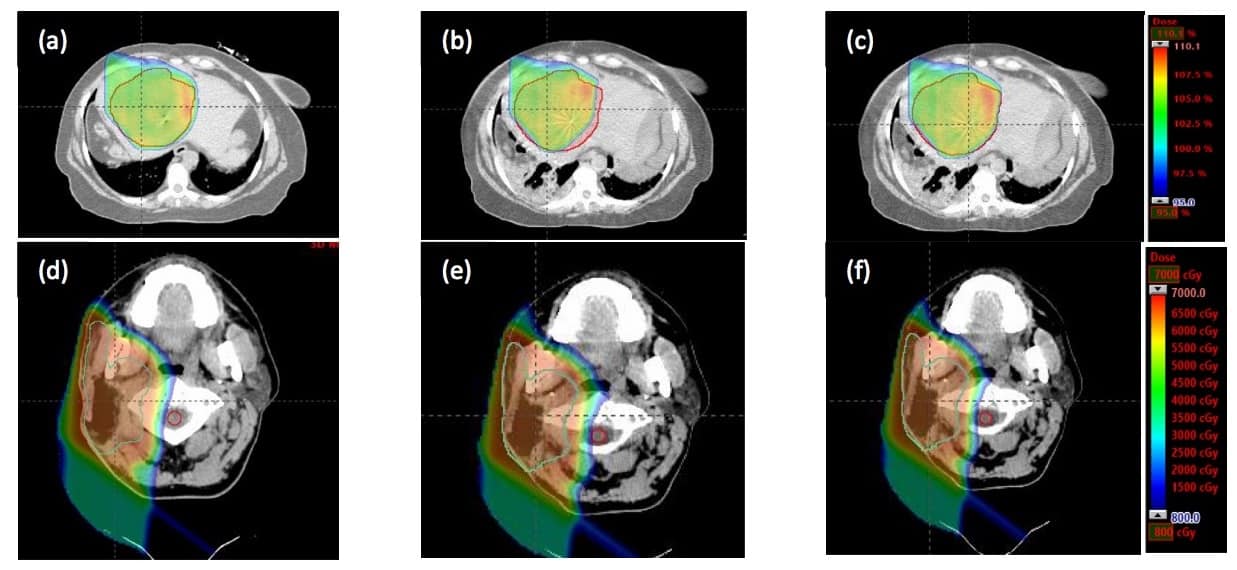
The researchers also examined the proton dose distribution to a target volume delineated on the planning CT and copied to the registered mCT image. Overall, dose differences between the two were small, with the largest discrepancies observed at distal range locations with high dose gradients. A 3D gamma analysis (3%/3 mm) showed passing rates of 95.1% and 95.3%, for the brain and lung cases, respectively.
Adaptive planning
Since the end of 2016, the mCT has been used in clinical proton treatments at Washington University in St. Louis. To demonstrate the mCT’s use in guiding plan adaptation, the researchers presented two example patient cases. In both, mCT images were acquired prior to treatment delivery and registered with the planning CT images to evaluate any changes in target coverage or dose to organs-at-risk.
Dose distributions of the original treatment plans on the pCT (a, d), the original plans on the mCT (b, e) and the new adaptive plans on the mCT (c, f) for liver (top row) and head-and-neck (bottom row) cases. (Courtesy: B Sun et al Radiother. Oncol. 10.1016/j.radonc.2018.08.021)
For a liver SBRT case, comparing dose distributions on the planning CT and mCT revealed a reduction in the target volume receiving 50 Gy from 98.1% to 92.4%, caused by changes in the abdominal air cavity. Replanning by adding 1.5 cm range on one beam increased this volume to 98%.
In the second case, a head-and-neck cancer patient had previously undergone radiotherapy and was retreated with proton therapy due to tumour recurrence. The mCT images revealed a maximum spinal cord dose of 19.6 Gy, twice the dose seen on the planning CT and exceeding the maximum specified dose of 10 Gy. Revising the treatment plan by reducing the beam range slightly reduced the cord dose to 9.8 Gy.
“We are in the process of installing a second compact proton machine with pencil-beam scanning capability,” Sun tells Physics World. “The mCT has the potential to provide online adaptive proton therapy for intensity-modulated proton therapy.”
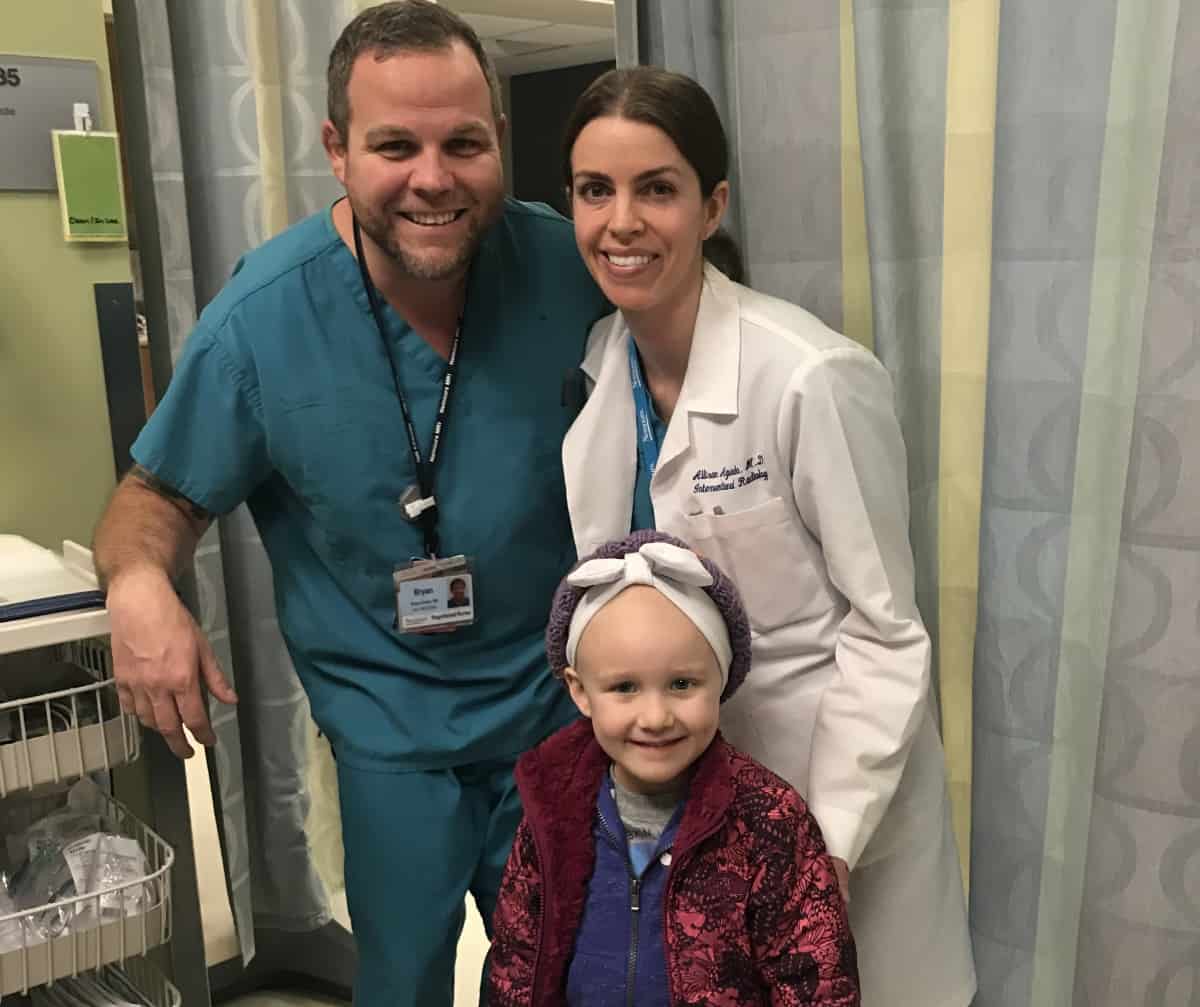
Four-year-old Blakleigh Grace, who underwent TARE-Y90 treatment for chemotherapy-resistant Stage 3 hepatoblastoma, with lead author Allison Aguado and nurse Bryan Green. After treatment, the liver tumour responded to the treatment and shrank, enabling her to undergo surgery. (Credit: Kasi Camden)
Transarterial radioembolization with yttrium-90 (TARE-Y90) — a treatment that delivers high doses of radiation directly to the tumour — shows promise for treating children with inoperable, chemotherapy-resistant liver cancer. The approach can help improve survival time for such patients, or shrink the tumour to enable surgical resection or liver transplant (Pediatr. Blood Cancer 10.1002/pbc.27510).
TARE-Y90 uses an image-guided catheter to deliver microspheres impregnated with the radioisotope Y-90 directly to the tumour sites, via a tiny incision in the groin. Y-90 emits high-energy beta particles that travel extremely short distances (2.5 mm on average) in tissue and induce direct cytotoxic destruction to their target. TARE-Y90, which is approved by the US Food and Drug Administration for adults with liver cancer, thus delivers high radiation doses to the tumour while sparing normal surrounding tissue.
“When chemotherapy fails, additional treatment options for children with non-surgical liver cancers are limited and not very effective,” says lead author Allison Aguado, an interventional radiologist at Nemours/Alfred I duPont Hospital for Children, one of the few locations in which paediatric patients can receive this therapy. “TARE-Y90 has the potential to offer children with the hardest to treat liver cancer a treatment that is less toxic than current options and could facilitate a cure.”
Aguado and colleagues performed a retrospective review of 10 children between two and 18 years old with primary liver cancer treated with TARE-Y90. All patients had previously been treated unsuccessfully with chemotherapy and had no curative surgical options, but did have preserved liver function.
Each child was treated with Y-90 in one or two sessions and received doses of up to 192 Gy. Patients were generally observed overnight before being discharged. This regime is in distinct contrast to external-beam radiation, which delivers typical total doses of 36–54 Gy, fractionated into 20–30 treatments. Five patients experienced no side-effects from TARE-Y90, whilst the others had mild effects including fatigue and fever.
Following TARE-Y90 treatment, seven patients showed temporary disease control and two demonstrated a partial response. Median survival after TARE-Y90 was four months (range, 2–20 months). Retreatment was well tolerated in three patients, with these three demonstrating the longest survival times (17–20 months). One child exhibited a robust response and was able to receive a transplant six weeks after TARE-Y90 treatment.
The authors concluded that TARE-Y90 could be considered as adjunctive therapy in paediatric patients with unresectable liver cancers, and could be used as a bridge to surgery or liver transplant. They note that more research is required to determine the efficacy of this treatment in children and to understand which patients would likely benefit the most.
“TARE-Y90 should be considered effective and feasible for children with liver cancers and has the potential to be used earlier in treatment, alongside chemotherapy, to help reduce tumour size to provide better surgical treatment options and improved prognosis,” says Aguado.
“This will have far-reaching implications, well beyond the Arctic,” says Julienne Stroeve of University College London, UK. “The impact of this sea-ice loss on climate at lower latitudes and sea-level rise will be profound.” But the findings also indicate that Arctic sea-ice could be stabilised if we prevent global warming from overshooting 1.5 °C.
Stroeve and her colleagues assessed the changing state of Arctic sea ice by combining knowledge from observational records, atmospheric analyses and large-scale climate model simulations. The 40-year record of satellite observations together with measurements of sea-ice thickness enabled them to see if there were any trends in the data. Reanalysis of atmospheric data provided insights into changes in atmospheric circulation and air temperatures. Finally, climate model simulations, mostly from the Coupled Model Inter-comparison Project Phase 5 (CMIP5), enabled the scientists to understand why these changes have occurred.
These anomalies were larger than anything we had seen before in summer, and were not something we expected
Julienne Stroeve
Although losses of summer sea-ice often make the headlines, the researchers discovered that the anomalies in spring and winter sea-ice coverage have been most significant. For example, sea ice extent during the months of May and November 2016 was nearly four standard deviations below average, based on the years 1981 – 2010.
“These anomalies were larger than anything we had seen before in summer, and were not something we expected,” says Stroeve.
Meanwhile, decadal ice loss during the winter months has accelerated from -2.4% per decade from 1979-1999 to –3.4% per decade from 2000 onwards.
Because it’s highly reflective (it has a high albedo, in other words), sea ice bounces a large chunk of the Sun’s radiation back to space, cooling the planet. Once the ice melts, the dark waters underneath absorb more radiation, warming the ocean and the atmosphere.
“The melt season is starting earlier and ending later, which means that the warming ice-albedo feedback is bleeding into the shoulder months and operating over a longer time period,” says Stroeve. Eventually the sea ice melt and its associated warming will impact large-scale atmospheric and ocean circulation patterns, with far-reaching implications.
The research also shows that there is no doubt that carbon dioxide emissions are the culprit. Stroeve and her colleagues demonstrate a clear linear correlation between sea-ice extent and anthropogenic carbon dioxide emissions, with just over 1 sq. m of ice loss in winter and more than 3 sq. m of ice loss in summer every year for every ton of emissions.
By extrapolating this linear relationship, the researchers show that after a further 800 Gt of carbon dioxide emissions – by 2040 if current trends persist – the Arctic Ocean will become sea-ice free in August and September each year. After 1400 Gt of emissions, in around 2060 under current trends, the region will become sea-ice-free throughout the summer, from July to October.
“Given today’s emission rate of about 40 Gt of carbon dioxide per year, the time window is closing very rapidly to preserve Arctic sea-ice cover all year round,” the scientists warn in Environmental Research Letters (ERL). But if the world can manage to keep global warming under 1.5 °C, we might just manage.
Programmes that include non-scientists contributing to research need to be more diverse and inclusive. That is the conclusion of a report by the National Academies of Sciences, Engineering, and Medicine, which claims that initiatives that bring together professional researchers with non-scientific but interested laypeople – known as “citizen science” – can be beneficial for science.
Citizen science is a growing area of research that has its own societies and even journals. Projects now go beyond efforts to count migrating birds, monitor waterways or even spot new comets and other astronomical phenomena. For example, Higgs Hunters, which is run by researchers from Oxford, Birmingham and New York universities, involves participants scouring data for a particle dubbed a “baby Higgs” that could be produced when a Higgs boson decays.
The report affirms that citizen-science projects can help participants learn scientific practices and content
Rajul Pandya
Other projects include Gravity Spy, run by researchers at Northwestern University in the US, that uses citizen scientists and computer algorithms to classify and characterize glitches in machine learning when detecting gravitational waves. Meanwhile, Steelpan Vibrations, which is overseen by Andrew Morrison from Joliet Junior College, aims to classify vibrations from Caribbean steelpans to learn how the drums work.
The goal of such citizen-science efforts, however, do more than just advance scientific understanding. “The report affirms that citizen-science projects can help participants learn scientific practices and content,” says committee chair Rajul Pandya, who is director of the Thriving Earth Exchange – a unit of the American Geophysical Union that help communities to tackle problems with science.
However, the 12-member committee found that those that do citizen science tend to be white and well educated. As citizen science can be used to engage traditionally underrepresented and underserved individuals and communities, the committee recommends that designers should “carefully consider and address issues of equity and power throughout all phases” of project design and implementation. “There is clear and ample evidence that diverse, equitable and inclusive program design advances learning in all participants,” the report states.
Researchers at the Stevens Institute of Technology in New Jersey have used 3D printing to fabricate the first ever bionic mushroom. The structure, which is made from an ordinary button mushroom whose cap is patterned with energy-producing cyanobacteria and graphene nanoribbons printed alongside the bacteria, is capable of generating around 65 nanoamps of current. While not enough to power an electronic device, an array of such mushrooms could provide enough current to power a light-emitting diode.
“We report on seamless merging of cyanobacteria (Anabaena) and functional nanomaterials via a 3D printing technique,” says team leader Manu Mannoor of the Neuro-Bionics and Neuro-Electric medicine Laboratory at Stevens. “Our goal was to better access the unique properties of both these components, augment them and create an entirely new functional bionic architecture on a mushroom.”
Cyanobacteria boast an unmatched internal quantum efficiency of nearly 100% for photosynthetic energy conversion – the result of 2.5 billion years of evolution, he explains. Such organisms are nature’s most efficient antenna systems for absorbing photons from the Sun and systematically directing them to reaction centres (made up of enzymes), followed by separation of charges (electrons and holes). This separation in space means that they are unable to neutralize one another by charge recombination and the electrons are thus available to produce a photocurrent.
Densely-packed cyanobacterial cells
Thanks to 3D printing, the team was able to assemble densely-packed cyanobacterial cells in an anisotropic pattern on the mushroom’s pileus (cap), whose porous structure is ideally suited to such a purpose. This arrangement boosts the amount of bioelectricity the cells are able to produce compared to isotopically-casted bacteria (using a simple laboratory pipette), explains study first author Sudeep Joshi.
“Ours is an artificial symbiosis between the mushroom and the cyanobacteria/graphene nanoribbons in which the mushroom provides the right biophysiological conditions, such as shelter, moisture, nutrients, suitable pH conditions and temperature. Such mutually beneficial symbiosis naturally occurs in many living organisms but we have exploited it in an engineered device.”
The researchers began by 3D printing an electronic ink (which has a conductivity of around 0.47 S/cm) containing graphene nanoribbons onto a mushroom’s cap in a Fibonacci series pattern to act as a working electrode. They selected this specific pattern because it produces a uniformly branched electrode network that efficiently covers almost all of the pileus surface area. They then extended this electrode through the stem of the mushroom.
Activating photosynthesis
“Next, we 3D printed a bioink containing cyanobacteria onto the cap in a spiral pattern that intersected with the electronic ink at multiple points,” says Joshi. “At these contact sites, electrons transfer through the outer membranes of the cyanobacteria to the conductive network of the graphene nanoribbons when we shine a light source on the mushroom. This activates photosynthesis in the cyanobacteria that generate bio-electrons, which are then driven under an applied bias voltage in an electrochemical set-up.”
The techniques developed in this work, which is published in Nano Letters 10.1021/acs.nanolett.8b02642, could be extended to 3D print other types of bacterial colonies with materials such as hydrogels, Mannoor tells Physics World. “Such structures could be used to advance studies on bionic hybrids like the ones we have made and be used to develop next-generation devices that perform other useful functions, such as bioluminescence.”
The researchers say they are now looking at ways to generate higher currents using their system.
In this episode of the Physics World Weekly podcast, Chinese science journalist Xiaoxue Chen tells the story behind a much talked about science news service in China. Despite being only three years old, the Intellectual already has over a million followers on the microblogging site Weibo.com and over 900,000 followers on the social networking site WeChat. It has also won various awards including “Best Investigative Reporting” 2017 from the Chinese tech giant Tencent. Chen explains to Physics World journalist James Dacey why the Intellectual does not shy away from controversial stories – an approach that is not often seen in China.
Later in the episode, Dacey is joined by Physics World’s general physics editor Hamish Johnston to discuss the week’s news from the Physics World website. One of the more eye-catching stories is the suggestion by serious scientists at Harvard University that the interstellar object ‘Oumuamua could be a “light-sail” created by an alien civilization. There’s also a round-up of some of the medical and environmental news making the headlines this week.
If you enjoy what you hear, then you can subscribe via the Apple podcast app or your chosen podcast host.
Serving the community: Theoretical physicist Valery Rubakov is editor-in-chief of the reviews journal Physics Uspekhi. (Courtesy: Valery Rubakov)
How did your interest in physics begin?
I studied physics at Moscow State University, graduating in 1978 and then was awarded a PhD at the Institute for Nuclear Research of the Russian Academy of Sciences in 1981. I have been affiliated to both institutions ever since, working in areas such as quantum field theory, elementary particle physics and cosmology.
What has been your most notable achievement?
Hard to say, but what I am probably best known for is the idea of baryon number non-conservation in the early universe within the Standard Model of particle physics and its extensions. This result, obtained together with Vadim Kuzmin and Mikhail Shaposhnikov, was initially widely debated because under conditions that can be reached in the laboratory this effect is totally negligible. Yet we claimed that it becomes relevant at extremely high temperatures that were most likely present in the very early universe. Today this idea is widely accepted in the community and is a basic ingredient towards explaining the matter–antimatter asymmetry in the universe. A review on this topic (Physics Uspekhi39 461) was published in the issue dedicated to the 75th birthday of Andrei Sakharov who, among other things, pioneered the study of matter–antimatter asymmetry.
What are you currently working on that you find most exciting?
I think studying the “extremely early” universe is very exciting, i.e. the time just a tiniest fraction of a second after the Big Bang (possibly 10–35 s). Observations of the cosmic microwave background (CMB) unequivocally show that the hot cosmological epoch was not the first one – it was preceded by another epoch in which matter density inhomogeneities were generated. What was that epoch? The best guess is inflation, but this is not yet proven. There are competing theories such as a “bouncing” scenario in which the universe starts contracting, then stops before a hot expansion begins. But are there theoretically consistent models that agree with existing observational data? And can one discriminate between different scenarios on the basis of future observations?
So what’s your verdict?
It appears that the answer to all these questions is yes. I find it fascinating that observations at cosmological scales can tell, at least in principle and most probably in reality, what the universe was like at these very early times at extremely high energy density and high expansion rate. This is a rapidly developing area, and we regularly publish reviews on this and related topics in Physics Uspekhi.
After communism, science in Russia suffered badly and many researchers moved abroad. Were you ever tempted to leave?
Yes, I seriously considered various offers from the US and Europe in the 1990s and 2000s. But in all cases I found that I felt a lot more comfortable in Moscow. It paid off. I am now a member of an excellent group of theorists at my institute and have several former students worldwide with whom I keep in contact.
Research funding plummeted in Russia in the early 1990s, but slowly began to pick up and the country has been spending about 1% of its gross domestic product on research and development. Do you think this is enough?
If I compare today’s situation with the 1990s then we are a lot better off now. However, doing fundamental science is still difficult. I have no idea of the share of fundamental science in overall research and development spending, but I definitely feel that fundamental science is either underfunded or funded improperly, or, most likely, both.
If I compare today’s situation with the 1990s then we are a lot better off now
In 2014 Russian president Vladimir Putin called for all state research funding to be distributed via a competitive grants system. What happened to this plan?
I think it is impossible to distribute all state research funding via a grants system. Therefore such a proposal could not work – and indeed it didn’t. In fact, this idea would be very destructive, especially in view of a large network of research institutions in Russia. And I think it would be destructive anywhere: fighting for grants instead of doing science is not a good use of a scientist. On the other hand, it makes sense to distribute some, fairly substantial, part of state funding in the form of grants. Today, there are two foundations in fundamental science that do this in Russia: the Russian Foundation for Basic Research and the Russian Science Foundation. Overall, I think the balance between institutional and grant funding is reasonable in Russia. I emphasize the balance, rather than the amount of funding or the ways the money is spent.
Is Russian physics competitive?
My experience with Physics Uspekhi shows that physics in Russia is reasonably healthy and may become even more competitive internationally in the foreseeable future.
Are you happy with the amount of international collaboration Russian physicists have with other countries?
I think the level of international collaboration is very uneven. It strongly depends on the topic, institution and even the research group in the institution. Sometimes the collaboration is very strong, but often it barely exists. Overall, I think Russian physicists should take more advantage of international partnership.
Physics Uspekhi was founded in 1918 shortly after the First World War had ended for the Soviet Union. What role would you say the journal has played in Russian physics over the last 100 years?
If I want to learn something beyond my current expertise, I’ve always turned to Physics Uspekhi, as well as to other review journals like it. The fact that it is a Russian journal is, of course, important as well. In the Communist era, publishing abroad, especially review papers, was quite difficult, so the journal served as a bridge between Russian physics and the outside world. Indeed, this year we are celebrating not only 100 years of the journal, known officially as Uspekhi Fizicheskih Nauk, but also 60 years of its English translation. The English-language version was originally entitled Soviet Physics Uspekhi before being renamed Physics Uspekhi in 1993 and is now published in partnership with IOP Publishing.
If I want to learn something beyond my current expertise, I’ve always turned to Physics Uspekhi, as well as to other review journals like it
How does the journal serve the Russian physics community?
I think this journal still has a place not only in Russian science but also internationally. After all, it is a good review journal that publishes excellent authors. Yes, they are mostly Russians, but they are writing for the whole community. Physics Uspekhi is one of a few Russian physics journals that sets the standard and, I hope, also at international level.
When I was starting my career, it was my dream to publish in Physics Uspekhi, and I am confident that having a review paper published in the journal is still considered prestigious. The journal also serves the Russian physics community in various other ways such as by publishing biographical notes and conference proceedings.
When Physics Uspekhi celebrated its 90th birthday, then editor-in-chief Vitaly Ginzburg called on the editorial board to commission more papers to ensure the journal stays “relevant”. Were his wishes fulfilled?
One can never be satisfied with what is done, but I think Ginzburg’s wishes did become reality. In the last 10 years we have attracted more quality papers and the current list of accepted papers is impressive. But we certainly continue our efforts to remain even more relevant.
Do you think the journal will still be around in another 100 years? And, if so, what changes do you envisage?
I think Physics Uspekhi has a good future for another 100 years and more but its role will change. The journal per se will no longer be a major source of information and that is already partially true today. The easiest way to retrieve a paper will be through arXiv, with the journal serving as a quality stamp. The role of review journals, including Physics Uspekhi, will increase, I think. As the amount of information will grow, searching for good authors and persuading them to write reviews for the benefit of community will become more important. As for content, I expect many more interdisciplinary papers and technological advances will be incorporated too such as 3D images and animations.
Would you still study physics if you were a student again?
Yes. But I think I would try to be more diverse. Besides studying particle physics, astroparticle physics and cosmology, I would try to become an expert in condensed-matter physics, biophysics and other areas.