Is interstellar object ‘Oumuamua an alien space probe?

The interstellar object ‘Oumuamua could be a “light-sail” created by an alien civilization. That is the highly speculative conclusion of Shmuel Bialy and Avi Loeb of Harvard University, who say that the unexplained trajectory of the object as it travelled through the solar system could be the result of it being accelerated by sunlight.

In a statement about the research, Loeb says that it is “unclear whether ‘Oumuamua might be a defunct technological debris of equipment that is not operational any more or whether it is functional”. Bialy and Loeb believe the object could be a light-sail, which would have used the radiation pressure of starlight – or perhaps even light from a giant laser – to reach the solar system. Japan’s IKAROS mission, which launched in 2010, has already used a light-sail to accelerate a spacecraft using sunlight.

First spotted in October 2017 by the Hawaii-based Pan-STARRS survey telescope, ‘Oumuamua appears to be a highly elongated, 230 m-long object that originated from outside the solar system. Named after the Hawaiian word for “scout” to commemorate its interstellar voyage, the cigar-shaped object has both a highly eccentric orbit and a shiny surface, leading some astronomers to identify it as a comet. However, the lack of a coma of gas and dust around ‘Oumuamua suggested to others that it is an asteroid.

Rotational stability

In June 2018, Marco Micheli of the European Space Agency and colleagues showed that the trajectory of the object through the solar system cannot be explained solely by the gravitational attraction of the Sun, planets and large asteroids. Instead, the team suggested that outgassing was propelling ‘Oumuamua – making it a comet. Then in October 2018, Roman Rafikov at the University of Cambridge argued that the object is far too rotationally stable to have comet-like ejections of gas

Now in a paper accepted for publication next week in The Astrophysical Journal Letters, Bialy and Loeb suggest that ‘Oumuamua could be a piece of technology created by an alien civilization. Indeed, they write that “‘Oumuamua may be a fully operational probe sent intentionally to Earth vicinity by an alien civilization,” with the caveat that this is an “exotic scenario”.

In their paper, which has been peer reviewed, the astronomers show that ‘Oumuamua’s trajectory can be explained by the acceleration caused by sunlight reflecting from the object. For this to happen, however, ‘Oumuamua must be less than 1 mm thick and be just a few metres across – which is much smaller and thinner than previously thought.

Highly reflective

To support their claim, Bialy and Loeb point out that resolved images of ‘Oumuamua are not available and that estimates of its size and shape are based on the amount of light reflected by the object as it tumbles through the solar system. However, the lack of infrared thermal emissions from the ‘Oumuamua suggest that it is much more reflective than previously thought – and therefore could be much smaller than previous estimates, they argue.

Instead of being 230 m long, they suggest that ‘Oumuamua could be just a few tens of metres long. They also say the object could be shaped like a sheet, which the astronomers claim would be consistent with the observed tumbling motion of the object. Bialy and Loeb say, however, that ‘Oumuamua need not be flat, but could be a curved sheet, hollow cone or even a sheet that has been folded up like an umbrella.

Random origin

Loeb says that if ‘Oumuamua is an asteroid from another star that arrived here by random chance, then each star in the Milky Way would have to have about 1015 similar objects associated with it. This number is much higher than a theoretical calculation of asteroid numbers done a decade ago by Loeb and collaborators, suggesting that a natural origin is very unlikely.

Bialy and Loeb are not the first to suggest that ‘Oumuamua could be an alien spacecraft. Indeed, researchers from the SETI Institute scanned the object for radio emissions when it passed near Earth in 2017, although none were found.

Unfortunately, ‘Oumuamua is now too far away from Earth to study further so we may never know its precise nature and origin. Loeb says that astronomers should be scanning the sky for other interstellar objects, including possible light-sails.

A preprint of the paper is available on arXiv.

Global energy in 2050 – can renewables supply it all?

There are now many reports suggesting that renewables can supply most of global electricity, or in some cases most of global energy, by around 2050. One of the more recent is from the International Renewable Energy Agency (IRENA). Its Global Energy Transformation: a Roadmap to 2050 claims that renewable energy and energy efficiency can, in combination, provide over 90% of the necessary energy-related CO2 emission reductions needed to keep the global temperature rise below 2 °C. It says that to achieve this, the total share of renewable energy must rise from the 2015 figure of around 18% of total final energy consumption to roughly two-thirds by 2050. Over the same period, the share of renewables in the power sector would have to increase from around one-quarter to 85%, mostly through growth in solar and wind power generation. That was also the level projected in the most ambitious scenario outlined by the Intergovernmental Panel on Climate Change (IPCC) in its Special Report on keeping global temperature rise to 1.5 °C.

Can it be done? IRENA says it can and would make economic sense, but a lot more effort is needed. It noted that the power sector has already seen significant decarbonization, but says progress must be accelerated. As low-carbon electricity becomes the main energy carrier, the share of electricity consumed in the end-use sectors – buildings, heat and transport – would need to double, from approximately 20% in 2015 to 40% in 2050. Renewables must also expand significantly as a source for direct uses, including transport fuels and direct heat.

Balancing act

There are clearly many issues, one being the need to balance variable renewables and maintain synchronous supply stability. There are now many reports on that too. Some focus on individual countries; Vivid Economics recently produced one about the UK, in partnership with Imperial College consultants, for the US Natural Resources Defense Council, who were worried about the UK’s use in large biomass combustion plants of forest wood pellets imported from the US. Removing that, and indeed all biomass, from the mix certainly makes it harder. However, the report says that wind and solar could provide over 60% of UK electricity generation by 2030.

In the report’s High Renewables scenario, wind capacity is 56 GW in 2030, of which 37 GW is offshore wind and 18 GW onshore, and solar capacity is 41 GW. 20 GW of thermal generation capacity is needed to provide system inertia for frequency stability. This consists of 4.5 GW of nuclear – the existing plants, plus Hinkley if completed – and 15.5 GW of gas generators. The latter are run part-loaded for balancing, so their emissions are lower. Smart power systems provide extra flexibility — they include 20 GW of batteries, to store renewable output for use at times of high demand, 5 GW of demand response, which can shift demand to periods of high renewable output, and 18.5 GW of interconnector capacity, which can import electricity from neighbouring markets if they have a relative surplus, or export it if they have a relative deficit.

Finding security

The report says a security margin is also needed “to ensure that there is sufficient capacity available to address unexpected stress events, such as multiple generator outages coinciding with zero output from variable renewables. The greater the volume of variable renewables, the higher the need for security margin plant.” So, in its High Renewables scenario, there’s 37 GW of security margin. It says “this could be additional battery storage or demand response, or peaking generators that would operate only during extreme system stress events”. It’s basically what is now provided by the plants contracted via the UK Capacity Market auctions, though at present that is mostly made up of fossil and nuclear capacity – around 30 GW and 8 GW respectively, with only limited amounts of storage/demand response/ interconnector capacity.

Looking beyond 2030, the report says “there are additional options to facilitate deeper decarbonization of the electricity system. Gas capacity could be run at lower load factors; and inverter-based renewables, synchronous condensers and synchrophasors/phasor measurement units could further reduce the need for thermal generation and allow integration of larger volumes of variable renewables”. That sounds reasonable. As does the conclusion on “Baseload”, which “is not an appropriate concept to analyse system reliability”.

However, while avoiding biomass imports is an understandable aim, the exclusion of all biomass use does mean that nuclear is kept in the mix, whereas there are many indigenous biomass sources, for example farm and food wastes, which can be converted to biogas via Anaerobic Digestion, and which aren’t controversial, as well as some biogas sources – sewage gas and landfill gas – that are very cheap. Yet another high renewables scenario, this one from the Institute for Public Policy Research, includes options like that in its ambitious decentralized renewable energy scenario

Gas on?

Certainly, the use of storable biogas in power plants would make balancing variable renewables much easier – something that nuclear isn’t too good at doing (see my last post). So too could the use of hydrogen produced by electrolysis using surplus wind and solar power, the so-called Power-to-Gas (P2G) option.

The role of hydrogen, including P2G, is the topic of another recent study, by the Policy Exchange, although it focuses on its use for heating. This “Fuelling the Future” study is also quite critical of P2G. It says “while it is fashionable to posit electrolysis as the perfect way of using up surplus wind and solar power, this is probably wrong.” The argument is basically that there’s not that much surplus energy: “curtailed wind serves as a proxy for surplus wind energy. Curtailments can result when operators or utilities command wind and solar generators to reduce output to minimize transmission congestion. In 2017, 1.5 TWh of wind was curtailed, representing 0.4% of total power demand. This amount of curtailment could only produce enough hydrogen to replace <0.5% of natural gas used domestically. Curtailed wind cannot produce the volumes of hydrogen needed to make a substantial contribution to decarbonized gas production. Even in the longer term if the curtailment levels reach a high level of 75 TWh by 2050 and heat demand stays relatively constant, curtailed wind could only provide approximately 14% of the UK domestic heating load”. But the report adds, “this is not to say that hydrogen production using wind power and electrolysis will not and should not expand, it’s just unlikely this will be with curtailed wind alone”.

Exactly. Curtailment due to grid congestion won’t be the only source of surpluses and curtailment may in fact reduce as smart grids develop. What will grow, as renewables expand to be able to meet most demand most of the time, will be periods when demand is low and there is too much output – see my last post. There could be quite a lot of spare power available, enough to provide some heat for storage in large heat stores and to make sufficient hydrogen for multiple uses – direct heating, replacing some fossil gas as the Policy Exchange discusses, and also making electricity again to balance the grid when energy demand is high and renewable inputs low. The Policy Exchange doesn’t address that use directly but it does say that “electrolysers have very fast response times which may enable them to provide frequency and voltage control,” and can also “help facilitate higher penetrations of intermittent generation”. It estimates the gain to be “150 MWh per annum for every new MW of hydrogen production capacity”. It also says that electrolysis “has the potential to achieve far greater cost reductions than other technologies” and notes a Sustainable Gas Institute projection that from 2014–2050 electrolysis costs will fall by 54%. So it is in with a chance.

I will be looking at that in a later post, but the next one will examine criticisms of high renewables scenarios and the responses to them.

Radiomics-based metastases prediction model wins journal prize

The authors

A research paper describing a texture-based model that predicts lung metastasis risk in soft-tissue sarcomas has won its authors the 2018 Physics in Medicine & Biology (PMB) citations prize. This annual prize recognizes the PMB paper that received the most citations in the preceding five years.

The paper, A radiomics model from joint FDG-PET and MRI texture features for the prediction of lung metastases in soft-tissue sarcomas of the extremities, was written by researchers from McGill University. The authors describe the development and evaluation of a model that analyses FDG-PET and MR images using radiomics — in which large amounts of quantitative features are extracted from medical image data.

“Quantitative information from imaging has been underutilized, with simple (first order) features unable to provide necessary diagnostic or predictive guidance, which radiomics (higher order features) is able to compensate for,” says senior author Issam El Naqa. “Multi-modality imaging can provide a better representation than any single modality. We aimed to develop a robust approach for radiomics while avoiding overfitting with large number of variables, which is a common problem in the field.”

About one quarter of patients with soft-tissue sarcomas develop distant metastases, rising to roughly half for those with high-grade tumours, with the lungs the main site of metastases. A model that can assess lung metastasis risk at the time of diagnosis could enable better adapted treatments and improve survival.

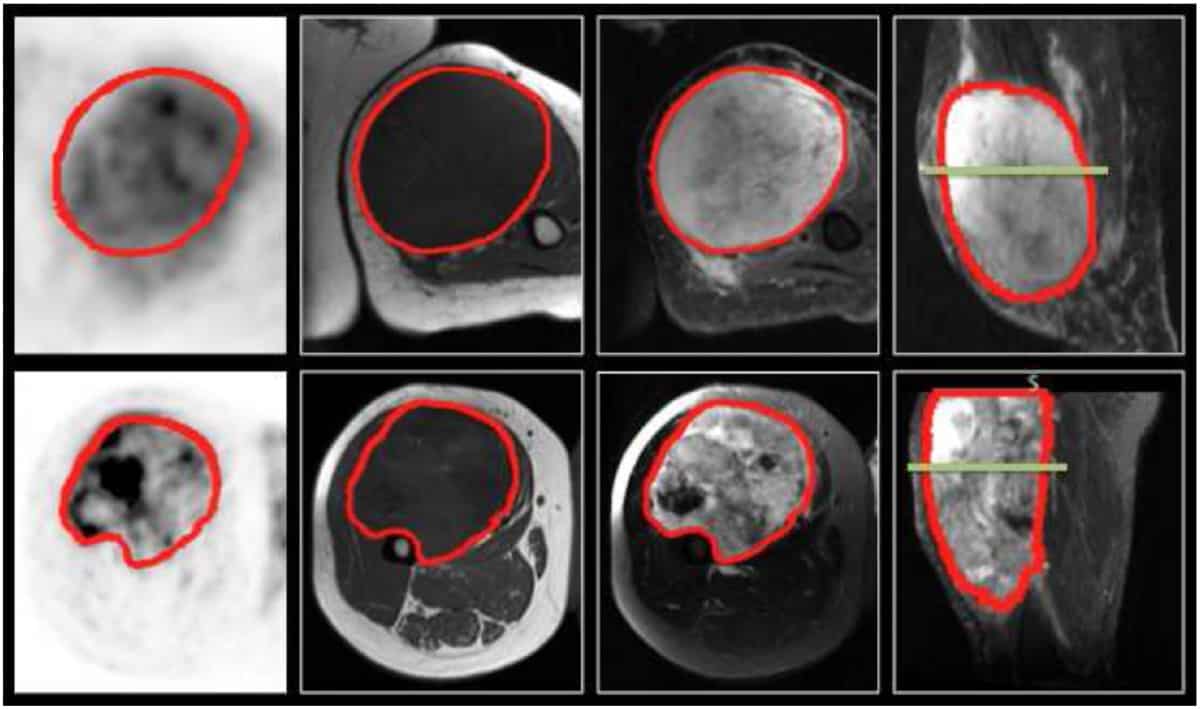
In many solid tumours, heterogeneity is associated with higher metastasis risk, thus the researchers employed texture analysis to quantify tumour heterogeneity. They retrospectively evaluated FDG-PET and MRI scans from 51 patients with soft-tissue sarcomas, extracting features from the tumour region of separate and fused scans. “The idea is that with radiomics, the spatial distribution of image intensities can reveal tumour aggressiveness, allowing for early intervention,” explains El Naqa.

They found that texture features extracted from fused PET/MRI scans significantly outperformed those from separate scans in terms of lung metastases prediction. The researchers identified a combination of four texture features that delivered the best predictive performance and used these to create the predictive model.

PET and MR images

“We observed that patients who developed lung metastases often exhibited large low-uptake regions in the inner portion of their tumour on FDG-PET scans, most likely representing necrotic areas,” explains first author Martin Vallières. “The presence of such regions suggests that the tumour is rapidly increasing in size and might be more at risk to metastasize. The model we developed contains texture metrics that most likely detect the presence of these sub-regions inside other regions, for example, high-uptake tumour sub-regions.”

Moving ahead

The paper’s high number of citations is likely due to its introduction of new methods for combining multi-imaging modalities and applying texture analysis to fused hybrid PET/MR images. The authors also developed texture optimization techniques to enhance predictive values and created a robust strategy for constructing radiomics-based prediction models. In addition, notes Vallières, all of the imaging data and code are shared online (on The Cancer Imaging Archive and GitHub), allowing others to fully reproduce the results.

Since the paper was published, the researchers have tested their prediction model on a prospective cohort of patients. They found that the model provided comparable performance to original estimates, when uncertainties were accounted for (phiRO 6 53).

“In that work, we also verified a strategy for soft-tissue sarcoma management,” notes Vallières. “This involves: identifying patients at higher risk of developing lung metastases using the developed radiomics-based prediction model; delineating hypermetabolic and hypoxic tumour sub-volumes via functional imaging; and planning radiotherapy delivery with dose escalation to tumour sub-volumes.”

The PMB citations prize is marked with the presentation of the Rotblat medal, named in honour of Sir Joseph Rotblat, PMB’s second and longest-serving editor. “I feel honoured to receive this prize,” El Naqa tells Physics World. “I agree with Issam, this is an honour!” adds Vallières.

• The winner of the 2018 Physics in Medicine & Biology citations prize is: A radiomics model from joint FDG-PET and MRI texture features for the prediction of lung metastases in soft-tissue sarcomas of the extremities M Vallières, C R Freeman, S R Skamene and I El Naqa Phys. Med. Biol. 60 5471

Prize thoughts

I sometimes wonder if the magic of the Nobel prizes has gone. For one thing, they’re eclipsed financially by newer awards such as the Breakthrough, Shaw and Kavli prizes. For another, they’re hamstrung by the rule that no more than three people can share each award. The sexual misconduct scandal currently surrounding the Nobel Prize for Literature hasn’t helped their reputation either. And while I’ve never been to a Nobel awards ceremony in Stockholm, I reckon attending a Breakthrough-prize ceremony would be more fun – this year’s was hosted by Piers Brosnan, with Lionel Richie singing “Say You, Say  Me” as the musical act.

But for me, one of the biggest issues with the Nobel Prize for Physics is that it perpetuates the image of physics as a pursuit for mostly old men. In the past 10 years, the average age of those winning the prize has been almost 70. Arthur Ashkin, who has received half of this year’s award for developing optical tweezers, is 96 – making him the oldest person ever to win a Nobel prize.

Quite rightly, the physics Nobel committee wants to avoid crediting work that might seem significant in the short term yet turns out to be wrong or unimportant: after all, it can take years to figure out the “best” physics research. However, by honouring work done decades ago, as is often the case, the Nobel Prize for Physics can unintentionally suggest there’s little that’s exciting going on right now.

Even more significant is that so few women have ever won the physics Nobel prize. Donna Strickland, who shares the other half of this year’s award with Gérard Mourou for their work on highly intense, ultrashort optical pulses, is only the third female physics Nobel laureate after Marie Curie (1903) and Maria Goeppert-Mayer (1963). The other 207 are all men.

The reason often trotted out to explain the lack of women is that there were few top female physicists decades ago and, ah well, the committee can only go on who’s been nominated by the community. Plus, Curie won a prize so, obviously, there can’t be a problem.

What, though, if good work done by women is being unfairly overlooked? No-one’s suggesting giving the prize to women just for the sake of it. But there are probably all sorts of unconscious biases in the Nobel committee – and in those who nominate physicists for the award – that have unwittingly given men an unfair advantage.

Gender studies are complicated and it’s easy to misinterpret data or draw the wrong conclusions. Just look at the furore following ill-informed comments made by Alessandro Strumia from the University of Pisa at a workshop on high-energy theory and gender at CERN in September, where he bizarrely suggested men (not women) are being discriminated against.

Unfortunately, the documents surrounding each Nobel prize remain secret for 50 years, which provides handy cover for those making the award. In the interests of creating a level playing field, surely it’s time to open up the Nobel archives as soon as each prize is announced. Making it harder to sweep the biases under the carpet might restore some of the prize’s shine.

Radiotherapy is ‘undervalued and needs greater investment’

“Radiotherapy is undervalued and needs greater investment”, reports a new white paper commissioned by the Marie Curie Legacy Campaign, an initiative of ESTRO and the ESTRO Cancer Foundation to raise awareness of the benefits of radiotherapy and optimize the provision of radiotherapy in Europe and beyond. The report was launched today to coincide with the anniversary of the birth of Marie Curie.

“Radiotherapy saves lives – either used alone or in combination with other types of cancer treatment,” says report author Yolande Lievens, chair of radiation oncology at Ghent University Hospital and a past-president of ESTRO. “Currently, radiotherapy is recommended as part of treatment for more than 50% of cancer patients, but across Europe, at least a quarter of people who need radiotherapy do not receive it. This is wholly unacceptable and a missed opportunity for cancer patients.”

The white paper, Radiotherapy: Seizing the Opportunity in Cancer Care, recommends a five point plan to boost uptake of radiotherapy:

  • Make radiotherapy a central component of cancer care in policies, planning and budgets
  • Achieve recognition of all radiotherapy professions and harmonize education and training standards across Europe
  • Invest in research and use of data to continuously improve radiotherapy outcomes for patients and maximize the potential of innovation
  • Fully integrate radiotherapy into treatment planning and decision-making
  • Help improve general awareness and understanding of radiotherapy to ensure it can achieve its full potential for patient care

The report calls on all stakeholders – governments and policymakers, healthcare professionals, patients and professional societies, along with national and international research funds – to become “radiotherapy ambassadors” to help raise awareness of the benefits of radiotherapy and secure its valuable position in comprehensive, optimal cancer care.

The authors – a panel of radiation oncology experts from across Europe – cite shortages of high-quality equipment, variations in training, insufficient integration of radiotherapy into treatment plans, lack of investment in research, lack of general understanding of radiotherapy as a cancer treatment and misconceptions regarding the safety of radiotherapy among the important factors contributing to radiotherapy’s poor image and underuse. They note that the demand for radiotherapy is expected to see a 16% increase by 2025.

“Radiotherapy appears to be left on the side-lines of national health policy agendas,” says Lydia Makaroff, director of the European Cancer Patient Coalition. “Greater investment, improved access and better understanding of radiotherapy – both at a national and international level – is vital. This will ensure that patients get the best possible and most effective care for their particular type of cancer, leading to better outcomes and more lives saved.”

Microscopic materials hint at the origin of phagocytosis

A previously unidentified physically activated pathway for cellular uptake in the body’s immune defence system could predate commonly recognized receptor-mediated processes. The pathway relies on activation of the Moesin anchor protein through membrane deformation by physical objects, and is believed to have developed, at least 0.8 billion years ago. The researchers, a collaboration led by Tie Xia and Yan Shi at Tsinghua University in China and the University of Calgary in Canada, suggest that this ancient material-based pathway laid the groundwork for the evolution of immune receptor signalling.

PIP2 lipids locate around physical objects

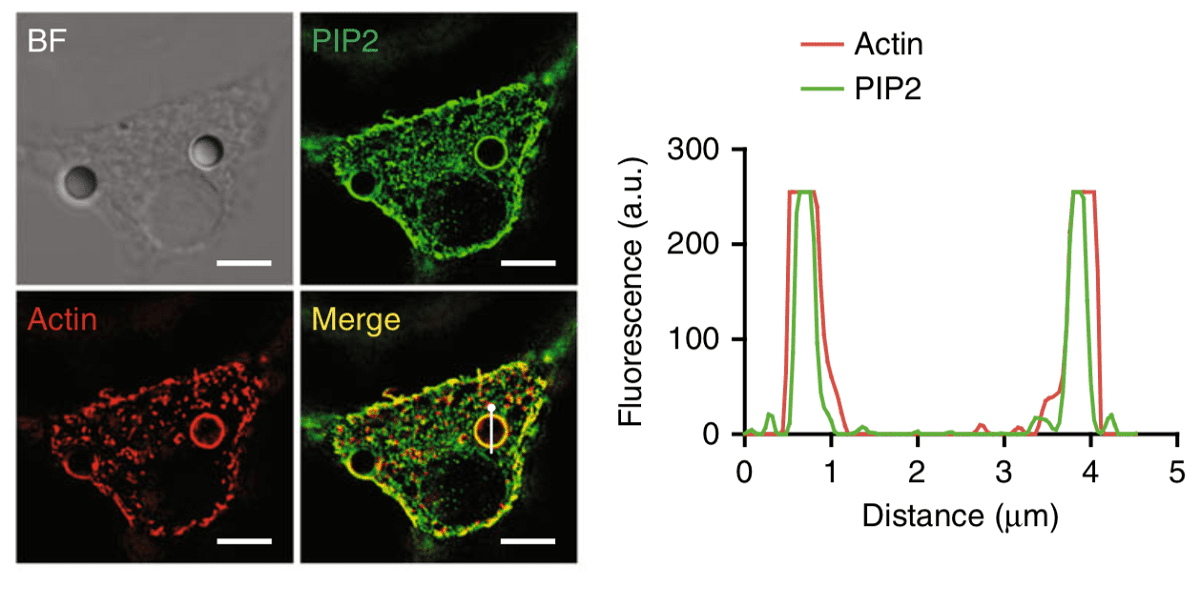
Phagocytosis is one of the main methods by which cells, in particular white blood cells, defend our body from external objects. Phagocytes, such as macrophages, neutrophils and others, rely on this process to physically ingest foreign particles, cellular debris and bacteria in our body and subsequently destroy and clear them from our system. In this work, Xia, Shi and colleagues incubated phagocytes with polysterene beads and deformed them with beads attached to an atomic force microscope (AFM) cantilever. When in contact, they observed clear localization of PIP2 lipids within the membrane around these objects. These lipids bind the Moesin anchor protein that activates phagocytosis.

Physically activated: Bright circles showing fluorescently-labelled PIP2 lipids in phagocytes surrounding polysterene beads. Adapted from Mu et al/Nature Communications under Creative Commons Attribution 4.0

Furthermore, by generating giant plasma membrane vesicles (GPMVs), the researchers were able to study how these lipids organize when in contact with topographical modified surfaces. By using micropatterned PDMS substrates consisting of square, circular and triangular pillars, the authors observed spontaneous localization of PIP2 lipids around these structures, suggesting that these lipids accumulate at deformed membrane regions in a purely physical manner without any cellular activity.

In addition, they showed that the stiffer the bead, the more efficient the phagocytosis. These results suggest key material properties for applications in microparticle drug delivery as well as how materials engineers can exploit cellular processes to deliver contents into cells.

Evolution from physical deformation

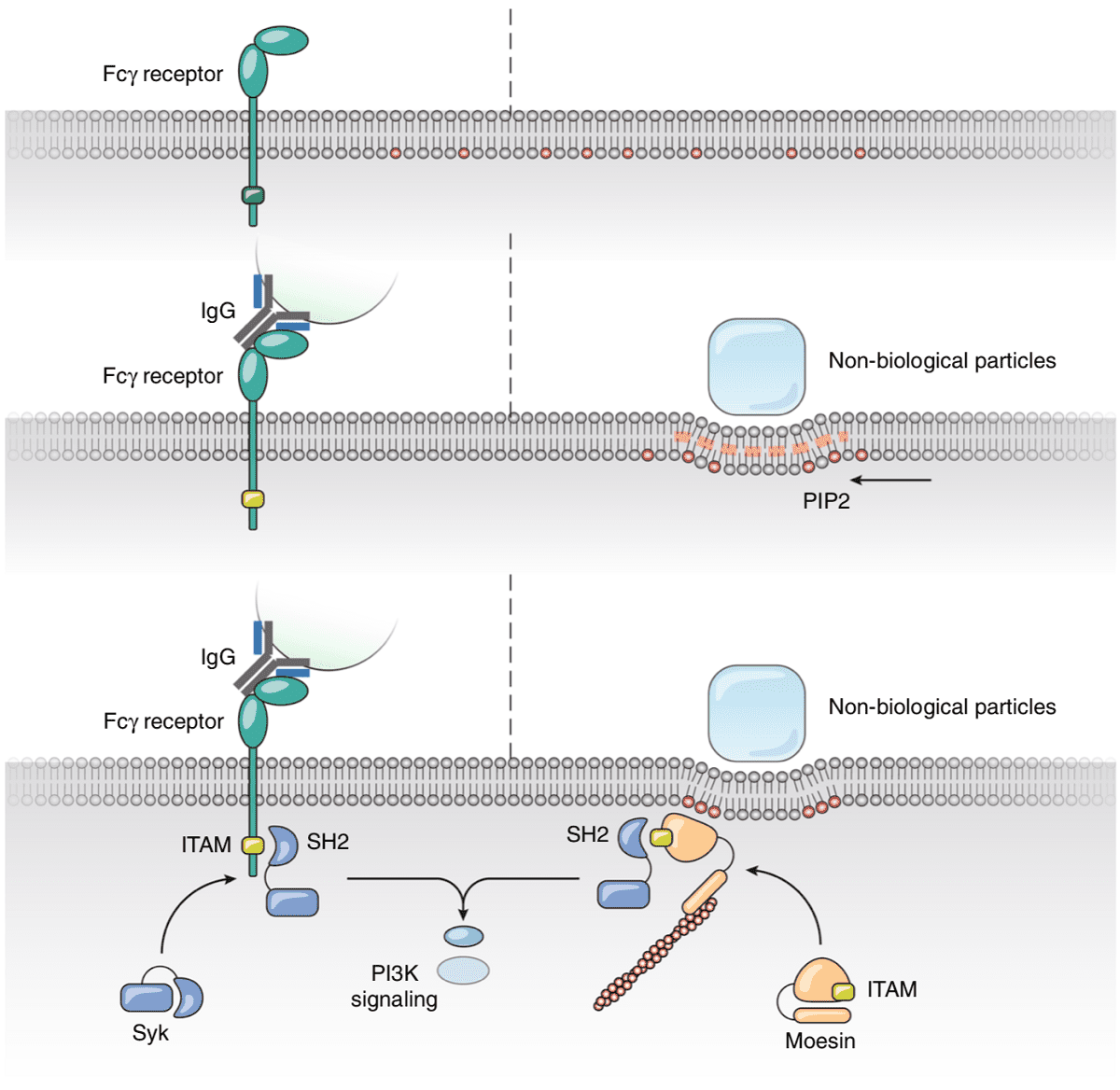
Finally, the authors knocked down the Moesin protein from their human phagocytes, disabling their phagocytotic behaviour, and then re-introduced it via transfection of the same protein cloned from fruit flies (Drosophilae Melanogaster), roundworms (C. Elegans) and zebrafish (Danio Rerio). These foreign proteins restored the cells’ phagocytotic response to physical deformation. Phylogenic analysis suggests that this protein has been conserved for over 797 million years as opposed to  435 million years for the first appearance of any protein with signaling potential (FcR γ chain) in FcR mediated phagocytosis.  In fact, modern FcRs appeared only 90 million years ago. Hence, phagocytosis via physical membrane deformation by microscopic materials could be one of the original methods from which our immune systems developed.

New versus old: ‘Modern’ receptor-based entry (left) as opposed to ‘ancient’ deformation-based entry (right) (Reproduced from Mu et al/Nature Communications under Creative Commons Attribution 4.0)


In conclusion, these results have significant implications not only for the way we think about the origins of cellular functions but indeed on how we think about the cell-material interface.

Nanotechnology has led to many potential applications in the field of biology and medicine but many questions still remain unanswered as to how materials affect cells at the nanoscale. This work goes to show that, however modern our approach may be, cellular life is often a few hundred million years ahead of us.

Full details of the research are reported in Nature Communications

New York air con set to spike electricity demand by 80%

For many people in the northern hemisphere, the summer of 2018 was a taste of things to come. Record-breaking heatwaves occurred on all four continents, and electricity demand surged as people turned their air con to maximum. For energy suppliers the spikes in demand during warmer weather is a growing headache. Now a study shows that by the end of the century New Yorkers could demand as much as 80% more electricity on some days to keep themselves cool.

Currently summer air conditioning accounts for 9% of New York’s electricity consumption. Yet it is responsible for some of the biggest peaks in demand. Anticipating and preparing for these peaks – and working out how they might change in the future — is a key challenge for energy suppliers.

Luis Ortiz from The City College of New York, US, and colleagues combined a high-resolution (1 km) Weather Research and Forecasting model with a building energy model. The team calculated how energy demand from air conditioning is likely to change for a variety of urban environments under two global warming scenarios – RCP4.5, a stabilization scenario that results in around 1.8 °C warming by 2100, and RCP8.5, a high emissions scenario that brings an average temperature rise of roughly 3.7 °C by 2100.

Under RCP4.5, cooling demand increased by between 1 and 20%, while under RCP8.5 it rose as much as 80%. The largest increases in demand occurred on ‘cooler’ summer days – below the 50th percentile of cooling demand. This suggest that even “cool” summer days will be uncomfortable in future, and that air conditioning units are likely to run throughout the summer months.

“The increase in frequency of days above a comfortable temperature appears to be happening at a faster rate than the warm extremes are,” explains Ortiz, who published the findings in Environmental Research Letters (ERL).

The increased demand was not distributed evenly across the city. The largest projected increases were over low-rise and less densely populated boroughs, including Brooklyn, Queens and Staten Island; it takes proportionally more energy to cool a spacious mansion than it does to cool a high-rise apartment in Manhattan.

Ortiz and colleagues projected that maximum summer electricity demand for cooling across the whole city would increase by 5% by 2100 under RCP4.5 conditions and by 27% under RCP8.5.

Energy companies with plans to phase out old power stations or build new ones must take account of the expected day-to-day peaks in demand to ensure that their systems can cope and avoid energy brownouts and blackouts.

“We’re likely to see more ‘demand response’ programs, which incentivize users to reduce their energy use during particularly warm periods,” says Ortiz. Meanwhile, city authorities will need to ensure that all homes have access to adequate and efficient cooling systems, to ensure people can cope with the increased heat.

For New York these results are just the start of a journey to become more resilient to climate change. Other cities around the world are likely to follow suit, using similar modelling techniques to explore their vulnerabilities, and adopting mitigation measures to cope with the warmer summers ahead.

MRI reveals how space travel alters the brain

Volume changes in the brain tissues of long-term visitors to the International Space Station (ISS) have been accurately measured for the first time. An international team of neuroscientists, led by Floris Wuyts at the University of Antwerp, quantified the changes after performing MRI scans on  Russian cosmonauts before, shortly after, and months after their trips into space. Their findings could help to identify some previously-unforeseen risks of long-term spaceflight (N. Engl. J. Med. 10.1056/NEJMc1809011).

Microgravity can have profound effects on the bodies of astronauts spending long stints of time aboard the ISS. Most notably, the greatly reduced demand on their muscles and bones presents the danger of atrophy once they return to Earth, driving space programmes to enforce rigorous exercise regimes on their astronauts.

The cognitive effects of long-term space travel are far less understood, however. Without any significant measures to prevent damage to astronauts’ brains after their return to Earth, it is currently unknown whether prolonged stays on the ISS could result in cognitive deterioration in their later lives.

To better understand the risks involved, Wuyts’ team performed MRI scans on the brains of 10 Russian cosmonauts, with an average space-mission duration of 189 days. For each subject, the researchers performed scans both before and shortly after their flight, as well as a third scan several months later for seven of the candidates.

The approach represents a significant advance for neurological studies of astronauts. “This is the first study in which it has been possible to objectively quantify changes in brain structures following a space mission also including an extended follow-up period,” says co-author Peter zu Eulenburg at the Ludwig Maximilian University of Munich.

In particular, the team observed volume differences in each cosmonaut’s grey matter – comprising neuronal cell bodies, white matter – or nerve fibres, and cerebrospinal fluid (CSF) – which occupies the brain’s internal ventricles and the spaces between the brain and the skull.

Wuyts and colleagues found that, on average, the volume of the cosmonauts’ grey matter declined during their spaceflights, then partially recovered after seven months – although not completely. In contrast, their white matter volumes remained unchanged while in space but were greatly reduced after six months back on Earth. CSF volumes increased aboard the ISS, then continued to expand in the spaces outside the brain once back on Earth; although volumes returned almost back to normal inside the ventricles.

The neuroscientists propose that the post-flight reduction in white matter that they observed could be explained by the combined recovery of grey matter and continued expansion of CSF reducing the space available for white matter. If correct, the team’s findings suggest that the long-term changes to the brain following spaceflight could be far more unpredictable than currently realised.

“Our results point to prolonged changes in the pattern of cerebrospinal fluid circulation over a period of at least seven months following the return to Earth,” says zu Eulenburg. “However, whether or not the extensive alterations shown in the grey and the white matter lead to any changes in cognition remains unclear at present.”

So far, the only known clinical condition affecting long-term ISS visitors long after their return is a reduced eyesight – an effect Wuyts’ team now believe could be caused by an increased pressure exerted by expanded CSF on the retina. However, the researchers suspect that other, as-yet unobserved and potentially dangerous cognitive conditions could manifest long after an astronaut’s return to Earth. Wuyts and colleagues now believe a wider range of diagnostic methods will be essential in identifying and mitigating the risks of prolonged space travel.

Silicon device reads and writes quantum information

A silicon-based device that performs two functions vital for error correction in quantum computers has been created by an international team of researchers. The device was produced using conventional semiconductor manufacturing processes, and the team now hopes to scale up the technology to create a silicon-based quantum-computer chip.

The device can write quantum information to an individual spin and can also readout data from a pair of spins. While both these actions have been accomplished on silicon-based technologies before, the team says this is the first time both have been performed simultaneously on the same device.

Quantum computers use quantum bits, or qubits, for information storage. Unlike a conventional bit, which can have the value 0 or 1, a qubit can be in a quantum superposition of both 0 and 1. One way of achieving this is to use the spin of an electron as a qubit – with the spin pointing up corresponding to 0, for example, and spin down corresponding to 1.

Quantum dots

Spin qubits have already been created using tiny pieces of semiconductors called quantum dots. In 2015 researchers lead by Andrew Dzurak at the University of New South Wales (UNSW) in Australia coupled two such qubits together to create a controlled NOT (CNOT) gate – which is a fundamental component of quantum computers.

The two quantum dots were made by placing an array of electrodes on top of a piece of silicon-28, which is the most common silicon isotope. By applying voltages to some of the electrodes, two electrons are trapped within the silicon, separated by about 100 nm. The researchers then showed that they can adjust the spin state of one of the electrons without disturbing its neighbour, a process known as single-spin addressability.

The spin states are set by generating a microwave pulse using one of the electrodes as an antenna – a technique known as electron spin resonance (ESR). The states of the spin qubits can be set individually by using the electrodes to apply an electric field to one of the spins, which changes how that spin responds to the microwave signal.

Pauli spin blockade

Now, Dzurak and colleagues at UNSW, Delft University of Technology in the Netherlands, Keio University in Japan, and HRL Laboratories in the US have added a single-electron-transistor sensor to the two-qubit logic gate. This allowed them to make a quantum readout of both qubits using Pauli spin blockade while controlling the spin of the individual electrons using ESR. A Pauli spin blockade is a phenomenon that allows a measurement to be made on the singlet-triplet quantum state created when two electrons occupy a double quantum dot.

While none of the techniques demonstrated in the paper are new, combining them in one device is novel. According to the researchers, combining single-spin control with a readout based on Pauli spin blockade is a key requirement for quantum error correcting codes that will be necessary to ensure accuracy in large spin-based quantum computers.

“We’ve demonstrated the ability to do Pauli spin readout in our silicon qubit device but, for the first time, we’ve also combined it with spin resonance to control the spin,” says Dzurak. “This is an important milestone for us on the path to performing quantum error correction with spin qubits, which is going to be essential for any universal quantum computer.”

Key requirement

Lead researcher Michael Fogarty, who has now moved from UNSW to University College London, adds, “Quantum error correction is a key requirement in creating large-scale useful quantum computing because all qubits are fragile, and you need to correct for errors as they crop up.”

Working in silicon is important because the low-cost material has been at the heart of the global computer industry for almost 60 years, so its properties are well understood, the researchers say. The team is now working with a consortium of industry and other universities with the target of producing a 10-qubit demonstration device in silicon by 2022, as the forerunner to creating a silicon-based quantum computer.

“By using silicon CMOS technology we have the ideal platform to scale to the millions of qubits we will need, and our recent results provide us with the tools to achieve spin qubit error-correction in the near future,” Dzurak says. “It’s another confirmation that we’re on the right track. And it also shows that the architecture we’ve developed at UNSW has, so far, shown no roadblocks to the development of a working quantum computer chip.”

The new device is described in Nature Communications.

Next steps for quantum communication

Creating a quantum Internet: Stephanie Wehner

Stephanie Wehner is a professor of quantum information at QuTech, Delft University of Technology, Netherlands

You’re the co-ordinator for the Quantum Internet Alliance, which is one of the first projects to be funded by the Quantum Flagship. What are you most excited about in this project?

The prospect that I’m most excited about is advancing technology towards a quantum repeater, so we can send qubits over very long distances. The other thing I’m quite excited about is our goal of linking small quantum processors together, which will allow us to do things that are more complicated than quantum key distribution. For example, we want to run a very elementary secure quantum computation via the cloud.

What are the biggest challenges in building a quantum repeater?

The first thing you want is a very good quantum memory. In a cartoon version of a quantum repeater, you make entanglement between A and B, and also between B and C, and then you perform a sort of “gluing” operation on point B to create end-to-end entanglement between A and C. In order to do this, there is some moment in time when you need to capture both of these qubits, and this is why you need a quantum memory.  You also want this quantum memory to be very good and very efficient, because you want to be able to produce entanglement fast, but if your memory doesn’t have the corresponding capabilities, that’s not good. You need the right “quantum link efficiency” between memory and the speed of entanglement generation.

Where do you expect the field to be in 10 years?

That’s a very difficult question – ten years is a long time into the future. But I hope that in 10 years we’re at the point where we can say, okay, we have a quantum repeater – now let’s scale it and use them everywhere. Currently we have quantum links that are point-to-point. The next thing would be to go to a star-shaped configuration, which would allow more people to talk to each other without a direct fibre connection. That would already be very interesting, if we could connect metropolitan areas. The next step after that is to go for very long distances. For quantum communication to become commercially usable on a broad scale you want quantum repeaters so that you can bridge arbitrary distances.


Rupert Ursin

Supporting diverse technologies: Rupert Ursin

Rupert Ursin is the deputy director of the Institute for Quantum Optics and Quantum Information at the Austrian Academy of Sciences in Vienna

 What are you most excited about right now?

There’s a lot of new developments going on in quantum communications. But most of it is in physics-oriented experiments; we are not yet in the phase of doing real engineering work. The flagship is, however, so the very first projects that have been selected are trying to avoid risk by doing things we know a lot about already and developing them further. The real new stuff is in semiconductor-type quantum sources for both quantum communication and computation, but that is not funded yet in the flagship. I hope this will improve in the future, because if we just do the “obvious” things, this will not help Europe keep up with the Chinese or the Americans.

Do you think Europe is playing catch-up against China and the US in this field?

The amount of money that is available in Europe is negligible compared to what is available in China, and to keep up with the Chinese is not easy because the decision-making process there is quick and efficient. But I don’t think that trying to avoid risk is the best way to do it. Think about the development of classical computers. In the early 1960s, even the late 1960s, semiconductor-based computers were not the obvious thing to do. So I hope the flagship will fund a plethora of projects in diverse technologies to support all kinds of ideas, because that is of utmost importance. We have to find a way to use the given amount of money in an efficient way.

Where do you expect the field to be in 10 years’ time?

I have to be very clear here: I am a physicist by training and I have no clue about engineering or how to make money out of quantum technologies. I run a spin-off company but it’s my students who are in charge – they are the real economic experts. We physicists tend to find very bad applications for our technology. Quantum cryptography, for example, might not be the best idea, but it’s an idea that the physics community came up with, so…! And the fact that I don’t know, and nobody else should claim that they know either, again shows that we have to look at this field in a much broader way.


Rob Thew

Engaging with industry: Rob Thew

Rob Thew is a physicist at the University of Geneva, Switzerland, and leader of the Quantum Flagship Support Action Team’s work package on strategy and structuring

What area of quantum technologies are you most excited about?

Personally, I’m most excited about quantum communications – that’s where I work. But over the whole range of applications, whether it’s computing, sensing, simulation or communication, there seems to be a nice focus on how these things can serve society. Whether it’s quantum sensing for health, quantum communication for securing your medical records, or quantum computation for, potentially, developing new drugs, there’s a nice trend towards taking technology out of the lab and making it into applications.

What has surprised you most about recent developments in the field?

The engagement from industry. I’ve been talking to people in industry for the last 10 years trying to get them interested, but there’s been a real shift in the last few years towards a belief that this technology is sufficiently mature. That has helped bring engineering into the labs and made the rate of technological progress much faster.  Academia is historically where a lot of the blue-sky thinking takes place, bringing new ideas to the table and making devices that function. What industry adds to that is to make devices that function not just once or twice, to get a nice scientific publication, but are truly robust in the sense that they can just be turned on and operated by someone who knows nothing about quantum physics.

Where do you hope this field will be in 10 years’ time?

I’d like to look back and think we were a bit crazy, maybe, and a little too optimistic – but not much. I’d like to see us really succeed in developing a lot of these technologies, so that we’re not talking about what the Quantum Flagship did, but what we’re going to do next.

Copyright © 2026 by IOP Publishing Ltd and individual contributors