Nanostructured device measures blood flow after an aneurysm

Aneurysms occur when a blood vessel weakens and widens, forming a structure known as an aneurysmal sac in which blood then collects. Implantable “diverters” equipped with medical stents can be used to treat aneurysms in the brain, for example, by guiding blood flow back on track and into a normal vessel path. It is difficult to monitor this flow post-treatment, however. A team of researchers in the US and Korea has now developed a new implantable, stretchable and highly sensitive nanostructured flow-sensor system that overcomes this problem because it can actively monitor and quantify intra-aneurysmal blood flow. The device has already been successfully tested in vitro in pig aorta.

“Existing techniques to monitor intra-aneurysmal haemodynamics rely on either angiography or magnetic resonance imaging, both of which require dedicated facilities with sophisticated equipment and time-consuming, cumbersome procedures,” explains study team leader Woon-Hong Yeo of the Georgia Institute of Technology and Virginia Commonwealth University. “The soft-flow diverter system we have developed will be a game changer for the treatment of aneurysms in the future.”

Capacitive ring-type flow sensor

Yeo colleagues made their device using nanofabrication and material transfer printing techniques. The multilayered hybrid system includes a hyper-elastic thin film nitinol membrane wrapped around a stent backbone and a nanostructured capacitive ring-type flow sensor sandwiched by the polymer polyimide fully encapsulated in a soft elastomeric membrane. The soft, capacitive ring-type sensor is placed at the centre of the flow diverter, explains Yeo, which allows it to respond to varying intra-aneurysmal blood flow rates. “In fact, the capacitance sensor quantifies the change in incoming flow to the aneurysm sac from the parent blood vessel,” he says.

The device has an open mesh design and can thus be implanted in neurovascular vessels. It is extremely stretchable (it can be stretched by 500% in the radial direction) and is highly bendable (it can be bent by 180° over a curvature radius of 0.75 mm). The elastomeric membrane is also haemo-compatible (fewer blood platelets deposit on it compared to many other implantable materials).

Towards in vivo animal studies

The researchers tested out their device in vitro by implanting it in pig aorta and, thanks to fluid dynamics experiments, found that it is sensitive to blood flow rates as small as 0.032 m/s. They say that they are now planning to undertake an in vivo animal study. “Once this has been done and we have proved device safety and performance, we will then move on to human clinical trials,” says Yeo.

Reporting the work in ACS Nano 10.1021/acsnano.8b04689, the team made the stent in the flow sensor from magnesium, which is biodegradable, and confirmed that the device can be programmed to disappear in human blood and then be eliminated by the body. “We will now be studying other material compositions and device surface coatings processes to programme the functional lifetime of the sensor,” Yeo tells Physics World. 

Tidal lagoon fallout         

The UK government has decided not to support the proposed 320 MW Swansea tidal lagoon. Energy minister Greg Clark said it was just too expensive compared to alternative options: “The proposal for the Swansea tidal lagoon would cost £1.3 billion to build. If successful to its maximum ambition, it would provide around 0.15% of the electricity we use each year. The same power generated by the lagoon, over 60 years, for £1.3bn, would cost around £400m for offshore wind even at today’s prices, which have fallen rapidly, and we expect to be cheaper still in future. At £1.3bn, the capital cost per unit of electricity generated each year would be three times that of the Hinkley Point C nuclear power station”.

He added, “If a full programme of six lagoons were constructed, the Hendry Review found that the cost would be more than £50bn, and be two and a half times the cost of Hinkley to generate a similar output of electricity. Enough offshore wind to provide the same generation as a programme of lagoons is estimated to cost at least £31.5bn less to build”.

Tidal Lagoon Power (TLP), the developer behind plans to build the lagoon project in Swansea Bay, hit back at the government’s decision, disputing the cost estimates used by the Department for Business, Energy and Industrial Strategy (BEIS). TLP claimed that a number of figures cited by the government were inaccurate and overestimated the cost of the project to taxpayers and bill payers. For example, the BEIS suggested the capital cost for the Swansea Bay project would be three times higher than for new nuclear projects on a per unit of power generated basis. But TLP claims its project would have a capital cost per unit of power generated that was 1.5 times higher than Hinkley and would lead to larger lagoons where the costs would be the same as for new nuclear projects.

And whereas BEIS said the programme of six lagoons across the UK that could be kick-started by Swansea Bay would cost 2.5 times more than the Hinkley Point nuclear project to secure the same amount of power, TLP claims the cost is actually closer to 1.2 times higher, even before considering additional costs associated with nuclear waste and decommissioning. The BEIS decision statement also said it would cost £400m to secure the same power output from offshore wind as sourced from the £1.3bn Swansea Bay Tidal Lagoon, but TLP claims the cost of comparable offshore wind capacity would actually be far higher, at around £1.5bn.

The differences in the projections might be partly explained by an alleged failure to take into full account the longer lifespan of a tidal lagoon project – at one stage TLP proposed a Contract for Difference (CfD) over 90 years. But, even so, the new policy review by the National Infrastructure Commission, or NIC (see my last post) was fairly dismissive of lagoons. It says “an entire fleet of tidal lagoons would only meet up to 10 per cent of current electricity demand in the UK”, and its annex on tidal power by Aurora Energy Research is quite critical of the Hendry study on lagoons and the developer’s claims on costs, concluding that: “tidal lagoon projects are unlikely to ever be economic without government support, unlike other renewables”. It’s hard to disentangle all the competing claims, assertions and assumptions, but one NIC/Aurora chart does seem to show that the lagoons’ strike price-based costs could fall below that fixed for Hinkley by 2045 or so (not too hard), but will never catch up with offshore wind.

The lagoon idea had been backed at one time by the Conservatives. It was even mentioned in their manifesto. But now it’s off the agenda – as too costly. As the Telegraph said: “On a like-for-like basis the Swansea Tidal project would need a contract price of £150/MWh. The sum is well above the eye-watering price of the Hinkley Point C nuclear power project, which will cost bill payers £92.50 for every megawatt produced over 35 years.” It is also almost triple the price of the newest offshore wind power projects, which will be built for £57.50/MWh.

In somewhat similar terms, in a Facebook post on 1 June Ecotricity’s Dale Vince said “The Swansea project is twice as expensive as tidal lagoons need to be, even for the first of a kind. There are alternative approaches and locations that would be far better value for money – if tidal lagoons are going to get government support (and I hope they do) – then it should be done through a proper competitive tender process – to make sure it’s value for money. The Swansea scheme would be an absurd waste of money, given the alternatives that exist. And it would tarnish the whole renewable energy industry. Currently Hinkley is the go to project (to cite) for ridiculous costs – it can and should remain so.”

That was presumably not how the government saw matters, but clearly it was not happy. Though no doubt it was also worried about a potential backlash against a decision not to support the lagoon, given that it had also cut support for on-shore wind and large PV. Certainly, as you would expect, the tidal decision did not go down well in Wales.

Welsh First Minister Carwyn Jones had called for TLP to be offered price support on the “same terms” as the under-construction Hinkley Point C nuclear plant. In a letter to UK energy secretary Greg Clark, Jones said Swansea Bay should be given a CfD worth £92.50 per megawatt-hour in 2012 prices for 35 years. The CfD would represent a “joint offer” to TLP, which would also include a £200m equity and/or loan investment by the Welsh government: “Such an offer would strike an appropriate balance between supporting a pathfinder project in line with the findings of your own Hendry review while providing value for money,” the letter stated. It added “It would need to be a maximum, full and final offer from both governments.”

For good or ill, this was not to be. Instead Wales is now being asked to accept a nuclear plant at Wylfa, to be built by Hitachi, possibly with some direct UK government funding, and though the economic comparisons for that may not be similar, nuclear is not that popular in Wales. All in all, it was maybe not a good time for the government to also announce details of the new £200m nuclear sector deal. But then Wales is to get a £40m nuclear sweetener.

Pity that tidal lagoons didn’t get some cash too…other variants might do better, as Ecotricity has claimed. That company’s own proposal, which it claims would be more economic, is for Solway Firth on the Scottish border. But a very large project has also been proposed for North Wales.

And ever hopeful, it’s also been suggested that water companies might help with funding lagoons. However, for now, it seems to be all over. The attraction of lagoons over tidal barrages is that they do not block off entire estuaries, so their environmental impact is likely to be much lower. But that’s also true for free-standing tidal current turbines, like those being installed step by step in Pentland Firth as part of the eventual 398 MW Meygen project. What’s more, their modular nature means that the installation programme can be incremental and staged, as funding allows. You can’t build half a barrage or lagoon.

I did promise to run an already delayed piece on oil company views next, but that will now be held over, to make way for a report on the closure of the UK feed-in tariff and its impact on solar PV, and also for a post on a new Aurora study for the NIC. Oil can wait a bit longer.


SLAM: a real-time imaging tool for tissue diagnostics

Simultaneous label-free autofluorescence-multiharmonic (SLAM) microscopy is a novel intravital microscopy technique that permits imaging of living tissues in real time. Previously, researchers have used various configurations of intravital imaging to understand tissue biology, but with many limitations. Now, Stephen Boppart and his team at the University of Illinois at Urbana-Champaign  have addressed these limitations with the development of SLAM, a powerful technique for real-time diagnostics of tissues, such as tumours (Nature Communications 10.1038/s41467-018-04470-8).

How does SLAM work?

SLAM microscopy uses a single-excitation band laser of low energy that elicits the autofluorescence (natural emission of light from a biological component after absorbing it) of some cellular components, whilst also creating an optical signal from other tissue structures.

In other words, this system employs four different microscopy mechanisms to visualize different cellular and tissue structures from a single source of light. Such processes are called two/three photon autofluorescence and second/third harmonic generation. Then, the different signals are resolved through detection channels to create an optical image.

The integration of these modalities is possible due to the uniquely generated ultrafast pulses and represents a great improvement on previous methods, overcoming existing limitations of intravital microscopy.

Firstly, the lack of a label prevents variable signal intensity or interference with biological processes. Secondly, using a single source of light permits simultaneous detection of the different signals, while previous systems needed time to shift between different lasers to detect the different tissue components. The use of ultrafast pulses permits a high resolution with molecular sensitivity from the different channels. The development of these ultrafast pulses reflects a decade of laser source engineering effort by Haohua Tu, the senior research scientist and co-corresponding author of this project.

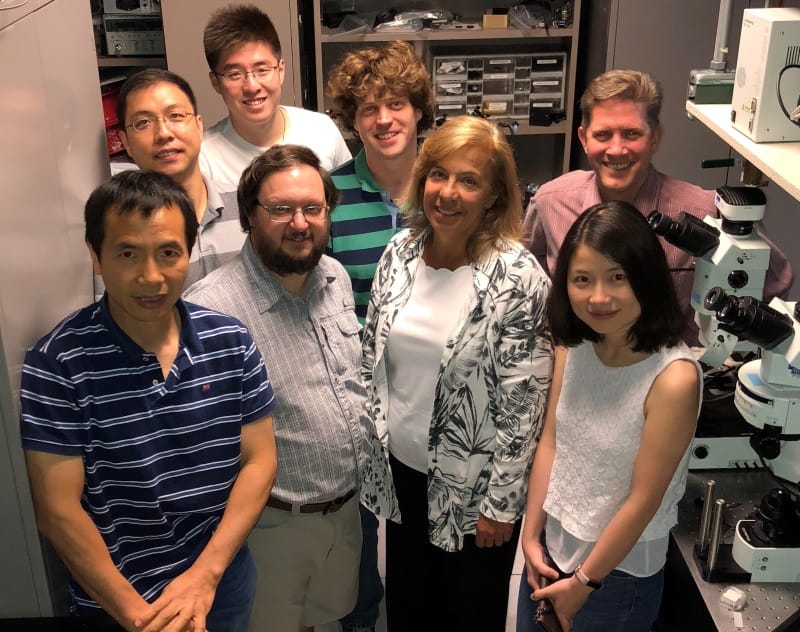
The SLAM team

What is the potential of this technique?

The real-time simultaneous imaging of multiple cellular and tissue components provides a valuable tool for the understanding of pathologies. For instance, the researchers employed the SLAM platform to image mammary tumours of rats. They were able to detect differences in the metabolism and morphology of cells around the tumour, suggesting the influences that it elicits on them.

Since long exposure in real time is possible – due to the low energy of the laser, which does not damage the tissue – SLAM also permits dynamic tracking of cells in the microenvironment over time. This can provide information on how the cells interact and move, or how the tumour evolves. For instance, in this study, the researchers were able to track the movement of leukocytes (white blood cells), which have a crucial role in the immune response and metastasis of the tumour.

The SLAM platform enables live-imaging of multiple components, overcoming the limits of other intravital techniques. Thus, SLAM presents an enormous potential for dynamic tumour diagnostics that other imaging techniques cannot provide. The possibilities of this platform could be expanded further with new laser technologies and SLAM could easily be implemented in multiple clinical applications.

Once a physicist: Eline van der Velden

Eline van der Velden

What sparked your initial interest in physics?

I’ve always been interested in nature and why things are the way they are. My mother told me that I used to perform experiments as a child, endlessly letting a toy car come down a ramp and studying it as it crashed over and over again, never tiring of seeing the effect of gravity, for hours on end. I attended a performing arts school, ArtsEd Tring, during my A-levels, and decided to pursue physics and maths A-level alongside the musical-theatre course. Fortunately, our maths and physics teachers were both female, and very inspiring, so it never crossed my mind that they may not be “cool” or “girly” subjects to study. I thought it was completely normal until I counted the number of girls in the lecture theatre at university in first year.

You did a Master’s degree in physics at Imperial College – what was it that you studied specifically?

I always thought it was important to contribute something to the world. Considering energy is currently finite, I hoped to help in the field of nuclear fusion. I did the MSci course at Imperial, which includes a year in Europe – my project was on the statistical properties of ion flows in a toroidal plasma and I spent my third year at the École polytechnique fédérale de Lausanne (EPFL).

Did you ever consider a permanent academic career in physics?

I did, but I also had a strong desire to fulfill my performing and writing ambitions as well. After graduating I went on to act professionally while supporting myself financially by tutoring in maths and physics, an ideal combination really. Alongside acting in a few TV series, I made a lot of silly comedy videos online, but after a good decade of acting and comedy, I’m being pulled back towards scientific content. There is still part of me that misses the academic side of things. The perfect balance for me is writing and creating content that includes science.

How did your interest in comedy and acting emerge?

From a young age I was writing and performing my own plays, and singing and dancing for my parents’ friends at every opportunity. Not much has changed there. I like to do both my straight comedy, like the BBC Three iPlayer series Miss Holland, as well as my online comedy-with-science series Putting It Out There. With both comedy and science, you’re always trying to educate people. And in the end education is everything. It’s the best thing to empower people. The production company I started, Particle6 Productions, aims to educate and entertain with every video.

What was it like moving from academia to writing, directing and producing TV shows?

I was living in Los Angeles when I first started writing, directing and producing. I did a lot of improv at the UCB theatre, which really helped develop my writing and creativity for making great content. However, when I moved back to the UK, it took a long time to get started. I had no contacts or friends in the TV industry, and everything is about who you know. Very few people from Imperial end up working in the media, so my alumni network didn’t help much. Over the years you make your connections and people start to know your work, but until then it’s all about knocking down doors. It’s amazing to see Alex Mahon at the helm of Channel4 right now. It’s always great to see a physicist in a position like that in media.

What projects and shows are you working on now, both as a producer and as an actor?

I always have at least 10 projects on the go. Very few come off each year. Miss Holland took five years before it got commissioned. It’s always good to keep some projects in your back pocket for when the time is right. I’m currently working more in the science–comedy space again, and hope to make some very cool science series in the coming years, both scripted and non-scripted. My passion for science hasn’t gone away, I’m just pursuing it in a different medium.

How has your physics background been helpful in your work, if at all?

I am continuously underestimated by people, and the physics degree is like a golden ticket. Once people know I studied physics it’s like they see me as a completely different person. This is why I often encourage women to study science. I get taken seriously. It also gives me permission to make content about science, which I love.

Any advice for today’s students?

I’ve only recently delved into the philosophy of science. I wish I had done that earlier. Getting a physics degree was the best decision I ever made, and I would do it again in a heartbeat.

Fast photon source lights up quantum technologies

Researchers at the University of Sheffield in the UK have built a nanoscale chip that can emit rapid pulses of single, mostly indistinguishable photons. The research team, led by Feng Liu, exploited the physics behind the Purcell effect to design the system, helping them to reduce losses and achieve increased photon production rates.

Physicists have been keen to develop on-chip sources of single photons with indistinguishable quantum states for several applications, such as secure data transmission and photonic quantum technologies. However, previous designs have suffered from high losses of single photons, mainly due to imperfect geometries in the chips. Currently, the most advanced technologies can only efficiently create pulses containing no more than three to five photons.

To solve the issue, Liu’s team made use of the Purcell effect, which describes how the spontaneous emission rates of quantum systems can be enhanced by their surrounding environments. In their design, the necessary conditions are created by incorporating a quantum dot – just a few atoms of a semiconducting material – into the resonant cavity of a larger photonic crystal. When a rapid laser pulse is fired at the dot, one of its electrons becomes excited and then releases a single photon as it relaxes back into its ground state. The photons created in this process resonate inside the cavity, before being emitted in rapid succession.

Liu and colleagues coupled the quantum dot to a waveguide that funnelled the emitted photons away from the cavity, ensuring they did not interfere with the laser pulse. The technique enabled the cavity to produce one photon every 22.7 ps – around 50 times faster than would be achievable without the Purcell effect. This may not be the fastest photon production rate yet developed but, unlike previous systems, more than 90% of the photons remained indistinguishable from each other on sufficiently long timescales for 20 photons to be emitted.

Using the insights gathered by Liu and colleagues, chips containing rapid single-photon sources could soon be used in a variety of applications. Since a single photon cannot be interfered with without alerting its sender, such chips would be highly desirable for government or security organizations wishing to transmit large amounts of data confidentially. They would also be advantageous in photonic quantum technologies, with applications including boson sampling, and improving the sensitivity of interferometers.

The research is described in Nature Nanotechnology.

CT-based biomarkers quantify radiation-induced lung damage

Radiation therapy of lung cancer can cause toxic side-effects to healthy lung tissue, known as radiation-induced lung damage (RILD). RILD can significantly impact patient quality-of-life post-treatment, but with historically poor prognoses of lung cancer, long-term RILD reporting is piecemeal, with only a few subjective and unreliable scoring systems available. Recently, however, improvements in lung cancer survival have triggered interest in more rigorous RILD assessment.

To establish a standardized methodology for RILD scoring, medical physicists and engineers from University College London (UCL) teamed up with clinical oncologists and thoracic radiologists from Guy’s and St. Thomas’s NHS Trust and Royal Brompton Hospital.

The multidisciplinary team analysed CT scans of cancer patients before and after treatment, and developed software to semi-automate quantification of 12 identified biomarkers of RILD. This is the first time that RILD has been quantified using a broad spectrum of radiological findings (Int. J. Radiat. Oncol. Biol. Phys. 10 1016) .

“As we start to get long-term survival, looking at the lasting damage to the patients becomes more important,” says first author Catarina Veiga, research associate at UCL. “We wanted to develop methods to quantify this in a very objective manner.”

Spot the difference

In the first stage of the study, clinicians carefully examined CT scans of 27 non-small cell lung cancer patients who had taken part in a phase I/II clinical trial of isotoxic chemoradiation. By aligning the baseline images with those taken 12 months post-treatment, they identified common changes.

“All patients at 12 months had some type of lung damage, but the degree of change could be different,” explains Veiga. “Some just have a bit of lung volume loss, while others have extensive parenchymal damage, pleural effusion and anatomical distortions.”

Previous to this study, the main RILD marker recognised was parenchymal changes – scarring or inflammation that can be easily seen on CT imaging as “bright” regions within the lung. Here, the clinicians identified three main categories of RILD – parenchymal, pleural and anatomical.

In the pleura – the area between lungs and chest – inflammatory changes were observed. And the clinicians noted that as treatment scars shrunk, they distorted the lung’s anatomy, so reducing lung volume. From these observations, the team settled on 12 measurable biomarkers of RILD.

Automating for objectivity

At this point, the engineers stepped in to quantify the biomarkers and establish an image analysis pipeline in a modular and semi-automated fashion within MATLAB. The pipeline was validated by comparing results to the original visual observations.

Of the 12 biomarkers, 10 showed a significant change, and statistical analysis highlighted that biomarkers were independent of one another. This made the authors confident that they have a system that can accurately report RILD, and they plan to make it fully automated and freely available to the community in the future.

“By automating all of this, we can speedily process the results from trials and clinical practice, and have evidence of how the different treatments we are using may or may not impact the long-term outcome,” says Veiga.

Technical challenges

The scientists note that there are some technical limitations to their methodology. Imaging protocols are of key importance, with inconsistency easily introduced between scanning time points. For example, variations in a patient’s breathing during imaging could influence biomarker measurement.

“For this particular clinical trial, the majority of patients had consistent imaging, but in routine clinical practice it is likely that this will become more of a challenge,” says Veiga.

Another technical consideration that the team is trying to address is the use of manual segmentation methods. Although most stages of the pipeline are automated, images were sometimes manually segmented to calculate the biomarkers. This is a laborious process that could introduce subjectivity to the results, and so Veiga and colleagues are currently running a pilot study that fully automates segmentation.

Improving life quality for survivors

“Once we are able to fully automate the system then we want to start looking at how the damage evolves over time,” notes Veiga, who is planning to examine the three, six and 24 month images that they have from the same clinical trial. “We are also interested in looking at the relationship between the identified damage, radiation dose delivered and clinical outcomes.”

Ultimately, Veiga hopes that the multidisciplinary team has created a tool that can improve clinical practice and be used in future trials to find the critical radiation dosage that clears tumour cells with minimum toxicity.

Organic ferroelectrics finally stick in the memory

Inorganic ferroelectrics have promised to change the face of semiconductor electronics for almost a century, but high processing costs have so far limited development. Now, researchers at Southeast University in Nanjing, China, have paved the way for progress by fabricating the first metal-free perovskite crystals. They present a set of materials that can achieve the performance of inorganic ferroelectrics but with the versatility, low-cost and low-toxicity inherent in organics.

To induce the directional switching of polarization characteristic of ferroelectricity, a material must contain a spontaneous dipole that can respond to an electric field. In other words, the centres of positive and negative charge within a crystal must be different. For metal-free perovskites, this should theoretically happen when a highly symmetric non-ferroelectric state is ‘frozen’ into a state with polar symmetry.

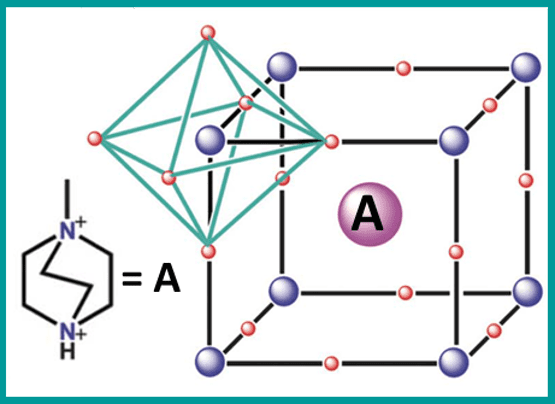
The MDABCO molecule (bottom-left) and the perovskite structure with the central “A” site highlighted. Credit: Yu-Meng You and Xiong Ren-Gen

From database to device

With this in mind, Ren-Gen Xiong and Yu-Meng You instructed their students to scour the hundreds of thousands of entries in the Cambridge Structural Database for molecules of suitable size and symmetry. Such candidates could then be incorporated into the traditionally metallic “A” site of the perovskite structure, yielding an all-organic perovskite ferroelectric.

The result of their efforts is the discovery of 23 metal-free perovskites including MDABCO-NH4I3 (MDABCO is N-methyl-N’-diazabicyclo[2.2.2]octonium). This particular crystal displayed a spontaneous polarization of 22 microcoulombs per centimetre square, close to that of the state-of-the-art perovskite ferroelectric, BaTiO3 (BTO). In addition, crystals can be formed readily at room temperature, avoiding the excessive heat (>1000 oC) required to make inorganic ferroelectrics. This will lower fabrication costs and open the door for more delicate device applications such as flexible devices, soft robotics and biomedical devices.

The MDABCO molecule is crucial to the large spontaneous polarization that the researchers observed. At high temperatures, excessive thermal energy leaves the MDABCO molecule in a state of free rotation within the crystal. Here, the average centres of positive and negative charge at the molecule site are the same and ferroelectricity is forbidden. However, when cooled below the phase transition temperature of 448 K, the MDABCO molecule becomes locked in place revealing a significant dipole with eight possible polarization directions.

Beyond binary

Ferroelectric random access memory (Fe-RAM) works on the principle that individual cells are charged to states “0” and “1”, represented by different polarization directions of the active material.  As ferroelectric crystals tend to have two polarization states, we obtain the well-known binary system. The eight possible polarization directions in MDABCO-NH4I3 then, will pique the interest of those looking to make next-generation memory devices.

“In principle, eight polarization directions could be used to make an octonary device with eight different logic states”, explains Yu-Meng You. “This is a potential strategy for increasing the density of future RAM devices”. While You expresses concern over increased architectural complexity in such a device, the potential for cramming eight bits into a single cell could add to the commercial prospects of this set of materials.

Prospects for perovskites

But the opportunities for advancement don’t stop at memory applications. “We have demonstrated a new system of perovskites with compositional flexibility, adjustable functionalization and low toxicity. We expect the metal-free perovskite system will attract great attention in near future”.

Full details are reported in Science.


Reality of ‘pristine’ cloud forest revealed

The cloud forest of Ecuador today harbours more biodiversity than almost anywhere else in the world. But it has a long record of human exploitation, as a new study has detailed.

In the mid-19th century, Western visitors described the cloud forest as a region that “has remained unpeopled by the human race” harbouring “a dense forest, impenetrable save by trails”. The study shows, however, that this was more than 30 years after human alteration of the forest resumed; the explorers weren’t seeing unspoilt forest at all.

These results could feed into the modern conservation of this cloud forest and other at-risk habitats. Historical records of ecosystems before modern damage, often used as targets for conservation efforts, may instead show habitats already altered by centuries of human impact.

The study also revealed that although indigenous people in the past carried out more deforestation than we have today, the forest was able to recover in only around 130 years.

Nicholas Loughlin of the Open University, UK, and colleagues from Ecuador, the Netherlands and Spain analysed pollen records preserved in lake sediment for the past 700 years to discover the plant species history of the cloud forest in unprecedented detail. The researchers distinguished four distinct plant communities over time, indicating changing human land use.

Loughlin and the team took cores from the bottom of Lake Huila, more than 2.5 km above sea level. They examined over 2 metres of sediment, providing a radiocarbon-dated record back to around the year 1300. Pollen arrived at the site of the lake from the local area and was preserved with the sediment, giving an excellent window into the species making up past communities.

The first phase of plant life recorded in the sediment contains maize, cultivated by the local Quijos people, and other open space-loving plants, indicating significant deforestation by humans.

The year 1588, according to the radiocarbon date, saw an abrupt change in the pollen record, with maize disappearing and huge increases in grasses and forest plants. Agriculture had ceased and the forest had begun to encroach back. The lake sediment from this time also contains large amounts of burnt charcoal; this point coincides with the height of a rebellion by indigenous peoples against the Spanish conquistadors, who arrived around 1560.

Following the rebellion, the population declined catastrophically. The cloud forest continued to re-establish through this period and into the next. After 1718, grass pollen is almost absent from the core and the pollen record is dominated by the plants you’d expect to find in a cloud forest. This period is the one most like the forest before humans arrived some 40,000 years ago, demonstrating the ecosystem’s ability to recover to a near-natural state following the end of human impacts. Following 1819, the flora in the sediment changes again, with less forest pollen, more grasses and the appearance of fungi that live on dung; this shows the beginning of cattle farming and the resumption of deforestation.

Loughlin and colleagues published their findings in Nature Ecology and Evolution.

A quantum leap for industry

In the July edition of Physics World Stories, Andrew Glester looks at the latest developments in technologies based on quantum mechanics. While quantum computing often steals the headlines, there is a whole world of other quantum-based devices in the pipeline for a range of applications.

Glester speaks first with Raphael Clifford and Ashley Montanaro at the University of Bristol about quantum computing. They are interested in the prospects of achieving “quantum supremacy” – the point at which quantum computers can outperform classical computers at specific tasks.

Next, Glester hands the reigns over to Physics World’s Margaret Harris who recently attended the 2018 Photonics West conference in San Francisco. At that event, Harris caught up with Anke Lohmann, the director of ESP Central Ltd, which supports the transfer technology form academic settings to the marketplace. Lohmann gives her opinion on the quantum innovations most likely to have the most significant impacts in the coming years, among them is quantum key distribution for secure communication.

Finally, Glester heads to the University of Birmingham, the site of one of the UK Quantum Technology Hubs. He is given a tour of the lab by Kai Bongs who explains how the goal is to transform scientific concepts in practical applications that are economically viable. The focus at the Birmingham hub is on developing sensors and metrology techniques. Targeted applications include gravity-mapping beneath the Earth’s surface and highly precise optical clocks.

Co-ordinated action required to boost ‘open-science’ initiatives

Making research papers, data and methodologies freely accessible for anyone to read and use has gained significant ground in recent years, but several challenges remain to widespread implementation. That’s the conclusion of a new report into “open science” by the National Academies of Sciences, Engineering, and Medicine (NASEM), which calls on universities and publishers to issue new processes to improve how science can be freely accessed.

Open science aims to make research papers and data, as well as methodologies such as code or algorithms, freely available. NASEM’s report, Open Science by Design: Realizing a Vision for 21st Century Research, identifies several recent initiatives that have advanced open science – such as citizen-science projects – and highlights the increase in research funded by organizations that require the outputs to be open for everyone to read and use.

Automated search and analysis of open publications and data can make the research process more efficient and more effective

Alexa McCray

While the 190-page report notes that the use of open-access publishing and open data is the “norm” in some areas of physics, notably high-energy physics and astronomy, other areas lag behind. The report points out several issues stopping open science becoming more widespread, such as researchers refusing to share their data, as well as the high number of journals that are only available via subscription.

A critical point

To overcome such challenges, the report calls on universities to develop training progammes that focus on open science for their researchers. It also recommends that professional societies change their journal publication strategies from a subscription-based model to approaches that support open science.

“We are at a critical point where new information technology tools and services hold the potential to revolutionize scientific practice,” says Alexa McCray of Harvard Medical School, who chaired the 10-strong committee that produced the report. “Automated search and analysis of open publications and data can make the research process more efficient and more effective, working best within an open science ecosystem that spans the institutional, national, and disciplinary boundaries.”

The report has already gained some support, notably from the Texas Republican Lamar Smith, who heads the US House of Representatives science, space, and technology committee. He sees the report as confirming a rule that, if implemented, would require the Environmental Protection Agency to base its decisions only on information that is publicly available to scientists and the general public.

Yet critics of the move argue that such a rule prevents the use of confidential or proprietary information – particularly in medical research – in scientific decisions. “Environmental regulations, which are ultimately funded by taxpayers, should be based on open and replicable studies,” Smith noted in a statement.

Copyright © 2026 by IOP Publishing Ltd and individual contributors