The Lawrence Berkeley National Laboratory (Berkeley Lab) has joined forces with window companies Andersen Corporation and Alpen High Performance Products to resurrect its “thin triple” super window design, first patented in 1991. The new collaboration aims to commercialize the super window, which is at least twice as insulating as 98% of the windows for sale today – potentially halving the estimated $20 billion in heating energy lost every year by windows in the US.
Window of opportunity
The new design is an evolution of the common double-glazed window. It has two layers of 3 mm thick glass that sandwich a third layer of very thin glass that is less than 1 mm thick. A standard low-emissivity coating that helps to block long-wave infrared rays is applied to the thin central glass. Finally, argon that would usually fill the double-glazed window cavity to reduce heat transfer is replaced by krypton, which has superior insulating properties.
Ahead of its time in 1991, the super window garnered “little commercial interest,” according to recently retired Stephen Selkowitz, former leader of the Windows and Daylighting research group at Berkeley Lab. But after gathering dust for 22 years, rising public awareness of climate change and green technology prompted the researchers to revisit the concept five years ago. In the 1990s, the costs of both the thin central glass and krypton were too high to be viable. Now however, market forces have seen these prices dramatically fall, convincing the window companies to invest in technology.
Unlike other highly insulating designs that have struggled – such as triple, vacuum and aerogel glazing – the super window is almost the same thickness and weight as a double-glazed window, requiring no costly redesign of window frames. What is more, only small changes in the window manufacturing process are needed.
“The key here is to provide a path for window manufacturers to make the transition to dramatically new product capabilities, but without the cost and risk of a full production line makeover,” adds Selkowitz. “We call it a ‘drop in’ replacement for the existing insulating glass unit.”
Although Selkowitz warns that “it will likely be a year before we collectively have done enough ‘due diligence’ for the window companies to decide to invest in creating of a marketable product”, simulations and prototypes built and tested in the lab suggest widespread adoption of the super window could have a significant impact on home energy efficiency. Indeed, the windows exceed the performance of a well-insulated wall over the course of a year, and can even help heat homes located in colder climates by locking in heat from the Sun.
An MR conditional afterloader that can operate simultaneously with an MRI scanner could enable real-time high-dose-rate (HDR) brachytherapy source localization for treatment verification. Image guidance is critical for accurate and safe radiation dose delivery. Such an afterloader, which enables the patient to remain in the same position during dwell position reconstruction, treatment planning and irradiation, could increase the safety of HDR brachytherapy, as well as streamline clinical workflow.
This research, leading to eventual commercial availability of an MR conditional afterloader, could have a huge impact on HDR brachytherapy. A patient could remain in the MRI bore throughout the treatment process. MR-based localization could also be applied for a direct reconstruction of the source dwell positions after catheter insertion, using a dummy source. Upon completion of this treatment planning process, the dose could be delivered under MRI guidance.
A new design
Current commercial brachytherapy afterloaders interfere with and are affected by MR scanner operation. Radiofrequency (RF) signals generated by the scanner can impact the correct functioning and reliability of the afterloader. Its electronic system contains parts that are affected by the scanner’s strong magnetic field. In addition, RF signals generated by the afterloader can interfere with the RF signals emitted by nuclear spins of the object to be imaged. Finally, the steel source cable poses safety risks of RF-induced heating and torque, as well as acting as an RF antenna from inside the afterloader into the MR bore.
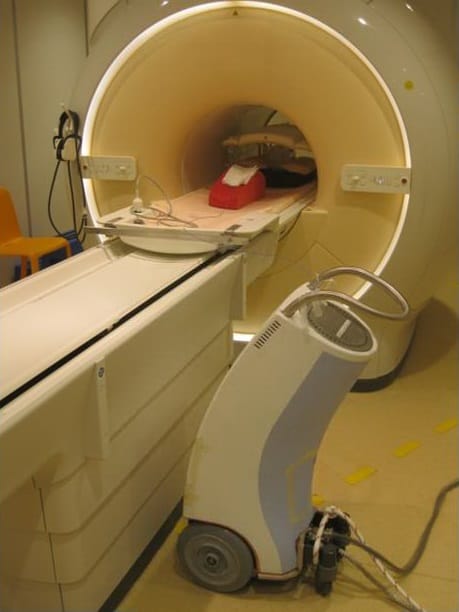
The prototype MR conditional afterloader, developed by Elekta in cooperation with researchers at the university’s department of radiotherapy and Image Sciences Institute, was RF-shielded with a copper/aluminium coating. The data cable connecting the afterloader with the treatment control station was shielded with a conductive hose and brought into contact with the Faraday cage of the MRI room.
A 2.65 m plastic test cable containing a piece of steel at its tip, which served as a dummy source, replaced the 1.4 m steel source cable. This enabled the source to be sent to the scanner’s isocentre while the afterloader remained at a sufficient distance outside the 20 mT line (which indicates the position where the magnet’s fringe field has a strength of 20 mT).
Proof-of-concept
For the tests, the researchers placed a prototype afterloader next to a 1.5 T MRI scanner, 2.1 m from the isocentre. A plastic catheter placed inside a cylindrical Agar phantom via a prototype plastic transfer tube was connected to the afterloader. They conducted two tests with different programmed source positions and dwell times.
The researchers acquired MR images and performed localization of the dummy source for coronal and sagittal images, using a method based on MR artefact simulation and a phase correlation localization algorithm. They combined the two 2D positions into a 3D position of the dummy source and analysed the simultaneous functioning of the afterloader and the scanner. They also analysed RF interference, signal-to-noise ratio (SNR) and B0 homogeneity to evaluate the impact of the afterloader on the scanner’s performance.
Results of all tests showed that there was no deterioration of either system. The afterloader was able to send the dummy source to the predefined dwell positions through the catheter with fixed step size as the MR scanner was acquiring images. There was negligible RF interference, the SNR was not affected, and there were no significant distortions of the B0 magnetic field that would disturb the MRI performance.
A MR conditional source cable is required before the afterloader can be tested clinically. Lead author Ellis Beld tells Physics World that Elekta is developing such a cable. When this becomes available, they will conduct a patient study demonstrating the functioning of the MR conditional afterloader, to prove accurate treatment verification.
For now, the researchers are planning to test the source localization method as a first clinical test. They will insert a marker manually into a catheter in the prostate instead of using the afterloader and determine the position of this marker using the source localization algorithm.
“We also will need to perform safety tests, as well as all the tests required to obtain a CE Mark. However, we have now shown proof-of-concept of MR-based treatment verification of HDR brachytherapy with no degradation caused by either the MR scanner or the prototype MR conditional afterloader,” says Beld. “We believe that an MR conditional afterloader that enables source localization and treatment verification might have an enormous impact on the clinical workflow and practice of HDR brachytherapy.”
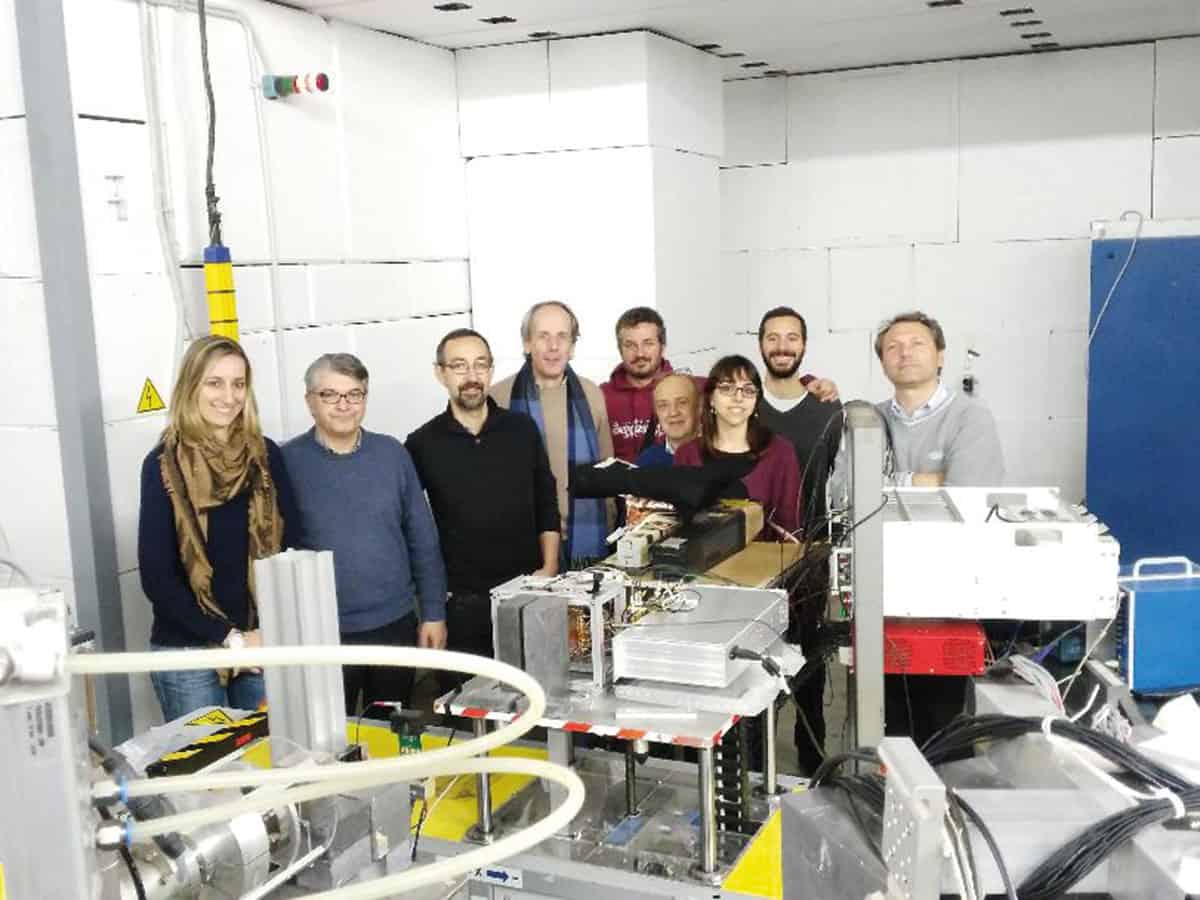
Probing the dark side The PADME experiment at the National Institute of Nuclear Physics in Frascati will search for exotic new particles. (Courtesy: C. Di Giulio)
Physicists in Italy are about to start up a new experiment designed to hunt for hypothetical particles such as the “dark photon” and carriers of a possible fifth force of nature. The Positron Annihilation into Dark Matter Experiment (PADME), located at the National Institute of Nuclear Physics (INFN) laboratories in Frascati outside Rome, will blast a thin diamond target with energetic positrons and record the mass of any exotic new particles produced in the collisions.
The group at Frascati will mainly target the dark photon, which is a heavy version of the ordinary photon. Predicted by various extensions of the Standard Model, it would interact with both dark matter and ordinary matter. Dark photons are not themselves usually considered to be dark matter, since they would carry relatively little mass and would tend to have decayed earlier in the history of the universe. But according to collaboration spokesperson Mauro Raggi of the University of Rome “La Sapienza”, they would provide a “portal between the visible and hidden sectors” and might also help solve other problems, such as the muon’s anomalous magnetic moment.
Dark photons are also being pursued at experiments in other laboratories, such as CERN in Geneva and the Jefferson Lab in Virginia, US. But according to Raggi, PADME will have the edge in being able to search for the “missing mass” of dark photons – allowing the particles to be detected even when they leave no visible decay products.
The experiment will involve recording collisions that happen when positrons from the Frascati lab’s linear accelerator collide with the electrons in a 100 μm-thick film of diamond. The resulting annihilations would normally yield two ordinary photons but, if the dark photon exists, just a single visible photon would be created. The mass of the missing particle could then be calculated by subtracting the measured 4D space–time-momentum of the single visible photon in each case from that of the incoming positron, plotting a spectrum of this missing mass and then reading off the mass value of the spectral peak.
The energy sweet spot
Raggi and colleagues plan to start taking data at the end of July and then run the experiment until the end of the year. For most of that time they will use positrons with the maximum energy provided by the linac – 550 MeV – to explore the biggest range of possible dark-photon masses (the highest mass being about 24 MeV). However, for a few weeks they also intend to operate at 283 MeV to maximize the production of particles weighing around 17 MeV.
That is the mass of a new particle that Attila Krasznahorkay at the Hungarian Academy of Sciences’s Institute for Nuclear Research and colleagues claimed in 2015 is generated when beryllium-8 radioactively decays. The Hungarian group made its claim after firing protons at lithium-7 targets and observing that the electrons and positrons created in the subsequent decays had an unusual angular distribution. Jonathan Feng and colleagues at the University of California Irvine then calculated that the particle could be a new type of force-carrying boson.
Although PADME is set up mainly to search for invisible decays, it also comes equipped with electron and positron detectors that could be used to check the Hungarian result. The measurements in this case will involve firing 283 MeV positrons at the diamond target and recording the number of electrons and positrons produced, before doing the same thing at slightly higher and lower energies. If the Hungarians are right, says Raggi, the number of collision products should drop away from the energy sweet spot.
Once the initial run is over, the group hopes to carry on running the experiment in 2019, says PADME colleague Paolo Valente of INFN, with the extra data lowering the threshold of observable coupling strength for dark photons and the putative 17 MeV boson. “We don’t have a big region of parameter space to explore,” he says, “but we are in a region that is hotter than others.”
Odds against
Another researcher on the hunt for dark photons is Dmitri Nikolenko of the Budker Institute of Nuclear Physics in Russia, who is developing a rival project at the lab’s VEPP-3 electron-positron storage ring that is due to switch on in about three years’ time. He points out that PADME will receive its positron bunches at quite a low rate – no more than 50 times a second – and so is likely to be much less intense than his VEPP-3 experiment. Nevertheless, he says that the Italian experiment might still yield “an interesting result”.
Nikolenko’s colleague at the Budker Institute, Igor Rachek, is more cautious. Despite having “no doubts” about the capability of the PADME collaboration and the quality of the equipment it has built, he thinks its chances of finding any exotic new particle are extremely slim. In fact, he puts the odds against such a discovery at “99.99%”.
To expand the region of parameter space that it can probe, the PADME collaboration plans to transfer its detector to Cornell University in the US after it has finished taking data at Frascati. Once in America, the group will be able to take advantage of the Cornell Synchrotron’s 6 GeV of energy and high intensities. Cornell’s Jim Alexander says that if he and his colleagues can get funding to add a new beamline, they hope to start firing positrons at a slightly modified PADME in the “early 2020s”.
A sea of grass ripples in the wind, whilst occasional clumps of heather stand proud, refusing to bend. In the distance gullies on the Pentland Hills hold the remnants of winter snow. Sheep graze and lapwings sound their distinctive “peewit” call. If it weren’t for the cluster of boxes, tubes and metal rods, you’d be hard pressed to identify that this is the 21st century. But the Auchencorth Moss peatland, around 20 km south of Scottish capital Edinburgh, is very much in the present, and its pristine environment is proving invaluable in pinpointing where air pollution comes from.
The negative health consequences associated with air pollution are on a par with obesity. Essentially it accelerates all age-related health conditions.
Caleb Finch
Knowing more about that air pollution is crucial. From the fug of exhaust fumes in traffic-clogged streets to invisible vapours dispersed by industrial plants and gases released from fertiliser applied to fields, Earth’s atmosphere contains a cocktail of added ingredients. Many of these atmospheric extras turn out to be bad for our health. Scientists are just beginning to unravel the chronic impacts, but the early evidence is worrying. Long-term exposure to poor quality air has been linked to everything from low birthweight babies and teenage misbehaviour to arterial disease, respiratory problems and increased risk of dementia.
“The negative health consequences associated with air pollution are on a par with obesity,” says Caleb Finch of the University of Southern California, US, who studies brain development and ageing. “Essentially it accelerates all age-related health conditions.”
Back on Auchencorth Moss, the bracing breeze makes air pollution seem the last thing worth worrying about. Its distance from belching industrial chimmneys and fume-filled city streets is exactly what makes this peatland valuable, and the odd-looking tubes, boxes and wires are high-tech instruments that monitor the composition of the air each hour.
“The site was chosen due to the lack of sources of anthropogenic pollution in the dominant wind direction,” says Marsailidh Twigg of the Centre for Ecology and Hydrology in Edinburgh. On a good day, the air at Auchencorth is as pristine as the air usually found in rural Scandinavia. But other days may see pollution plumes emanating from continental Europe and the UK. “When we get large pollution events the measurements from Auchencorth help us to separate out what has been transported into our cities and what has been generated within our cities,” says Twigg.
Pollution can travel far, sometimes hitching a ride on a storm, or surfing the breeze to cross an ocean. At Auchencorth during high pollution episodes the winds are often easterly, with a larger than usual fraction of pollutants coming from Western Europe. “Air pollution is not limited by boundaries and transport between countries is driven by meteorology,” says Twigg. “We need to tackle emissions collaboratively across nations since this is a global problem.” Averaged across the year, however, the dominant source of particulate pollution originates from UK emissions.
Spring peaks
There are seasonal changes too. In spring, Auchencorth’s male lapwings display spectacular aerobatics, zigzagging, rolling and diving to impress a mate whilst the hardy sheep have their first lambs. But Twigg and her colleagues have shown that there’s often a peak of pollution, as well as spring, in the air. These spring pollution events result from ammonia – mostly from spreading manure on fields – interacting with nitric acid, typically formed from emissions of nitrogen dioxides by transport in cities. Together, these two chemicals form particles of ammonium nitrate. Under stable atmospheric conditions, such as a “blocking” high pressure system, there’s less mixing to dilute the pollutants. Cool spring temperatures, meanwhile, allow the pollutant to accumulate rather than evaporate. There’s no easy solution.
“Fertilisation of our crops is important, otherwise half the world’s population would not have access to food, but in some countries the current methods and the quantity of fertiliser applied can result in nitrogen escaping into the atmosphere as ammonia gas, rather than being taken up by the plant,” says Twigg.
Courtesy: M. Coyle at the Centre for Ecology and Hydrology.
Away from Auchencorth, it is the inhabitants of large cities who often experience the ill effects associated with air pollution. The cocktail of fumes from idling engines mixed with pollution blown in from further afield creates a particle-laden fug; on still days some cities sit inside their own toxic haze. Jiu-Chiuan Chen, a co-worker of Finch’s at the University of Southern California, lives in one of those large cities – Los Angeles. In recent years he’s researched how air pollution affects our brains.
Chen and colleagues analysed health data gathered during the Women’s Health Initiative Memory Study, which followed a large group of healthy older women from across the US from 1999 to 2010. Using an air quality model, the scientists estimated the particulate pollution where the women lived. Women who were exposed to higher levels of particulate pollution suffered faster rates of cognitive decline and had nearly double the risk of developing dementia, the study showed. “If our results are applicable to the general population, fine particulate pollution in the ambient air may be responsible for about one out of every five cases of dementia,” Chen and Finch wrote in an article for The Conversation.
Exactly how air pollution enters and harms the brain isn’t yet clear. But experiments show that mice that are genetically predisposed towards Alzheimer’s disease accumulate larger deposits of beta-amyloid proteins on their brains when exposed to particulate matter. “We think that the particles alter membranes in cells, which changes the activity of certain enzymes and ultimately leads to increased production of beta-amyloid proteins,” says Finch, who recently authored a book, The Role of Global Air Pollution in Aging and Disease. In humans these proteins are a major target of therapies to prevent the onset of Alzheimer’s disease.
It’s not just air pollution’s long-term impacts on physical health that should concern us. People with mental and behavioural disorders, according to a study published in Environment International, were significantly more likely to die on days when air pollution was very high. Analysing a decade of statistics, Lin Yang from Hong Kong Polytechnic University and colleagues showed that the mortality risk for people in Hong Kong with pre-existing mental health conditions increased by 16% on the first day of haze and 27% on the second day. If ozone pollution accompanied the haze, the mortality risk rose by a whopping 79%. The precise mechanism behind the link isn’t yet known, but it may be linked to mood. “Haze days are very likely to trigger an acute depression response in people,” Yang told the Guardian. “This has been shown in surveys in 2013 in Indonesia, where there was a big disaster of haze from forest fires.”
There’s clearly a need for action and with determination we can reduce air pollution. The rewards would follow relatively soon, as they have in the past. “In Los Angeles, where I live, there was a local decision to reduce the use of black coal back in the 1970s and since then we have seen the bad-air days decrease by 90%,” says Finch. The Auchencorth measurements also bring some good news, showing a drop in sulphur dioxide concentrations of more than 90% over the course of two decades. “This reflects the more stringent emissions targets,” says Twigg.
But it’s hard for local authorities to know how to act unless they know where the air pollution is coming from, why it’s produced, and what could reduce emissions. Which is where sites like Auchencorth Moss play a role. It would be easy to blame high pollution days in UK cities on traffic jams, but as the data from Auchencorth show, it isn’t that simple. Often pollution events have a combination of causes – traffic pollution, fertilising fields and meteorology. Tackling these complex events requires understanding their roots.
Back at Auchencorth, the lapwings wheel, the grasses bend, and the sheep are unconcerned. In the midst of that rural idyll the tubes and pipes whirr and click, taking a quarter of a million measurements each year. Together with data from similar networks, these measurements will provide the evidence to help the next generation breathe more easily. The answer is blowing in the wind.
It’s been a busy few days for the history of science in Ireland.
On Saturday, the European Physical Society unveiled a plaque at Dunsink Observatory in Dublin – where the mathematician William Rowan Hamilton, among others, worked – designating it a European Site of Historical Significance.
But Dunsink isn’t the only place in Dublin of interest to science historians. The entire city, it turns out, is full of interesting artefacts of physics history; for a guide see either Thomas O’Connor’s article “Daedalus in Dublin: a physicist’s labyrinth” in the journal Physics in Perspective (16 98) or the Ingenious Ireland website.
I had to miss the Dunsink ceremony. That’s because I was two hours south in Dungarvan, on Ireland’s eastern coast, at the seventh annual Robert Boyle summer school, held in honour of the natural philosopher who co-founded the Royal Society. The school promotes popular appreciation of Boyle, the history of Irish science, and the relevance of science to current issues.
Dungarvan’s notable natives include Ernest Walton, the only Irish Nobel laureate in physics. A week ago, an article in the Irish Times touted Walton as an emblem of Ireland’s scientific strength and an argument for Ireland’s joining the CERN particle-physics lab. But as someone here reminded me, that argument is backwards. Walton achieved his scientific potential – for his role in the first artificial nuclear disintegration (1932) – only thanks to an international scientific collaboration, with John Cockcroft, in which he was already involved.
The school opened on Thursday night with a costumed stage show about Boyle’s life performed by two of the organizers, Eoin Gill and Sheila Donegan of Waterford Institute of Technology. Gill played Boyle, giving rudimentary demonstrations of Boyle’s development of the pH and flame tests for materials, his use of the vacuum pump, and of course the eponymous law involving an inverse relation between the pressure and volume of a gas. Donegan played Boyle’s older sister Katherine (Lady Ranelagh), who ran a salon and was one of the most influential European women of the era.
A taste of physics: the award-winning Robert Boyle gin. (Courtesy: Robert P Crease)
Other speakers outlined Boyle’s theory of knowledge, the nature of scientific discovery, and neuroscientific findings about the brain. Peter Mulryan of the nearby Blackwater Distillery, spoke about the science of gin. Blackwater’s signature gin, as it happens, is called Robert Boyle gin, which was the prize for the best Irish gin of 2016, the first year it appeared. It’s bottled in an old-fashioned apothecary bottle and has Boyle’s Law and an image of his air pump on the inside of the label. The samples he provided during the talk made the dinner afterwards…well, I don’t have a clear recollection.
I gave my talk on Saturday in Lismore, near Lismore Castle, Boyle’s birthplace. My topic was science denial. There couldn’t have been a better location, given that two hours away, on Ireland’s western shores, is the Trump International Golf Links in Doonbeg. While Trump himself has famously characterized global warming as a hoax, his company has applied to build a seawall to protect this property, citing danger from rising seas due to global warming. Trump is thus using a scientific finding to protect his own financial interest, while denying that possibility to US citizens, as I have written about before.
Another speaker was the writer and comedian Timandra Harkness. She began by lamenting that, having been identified as a comedian by the moderator, the audience would expect a joke. So she delivered one: “Why should you never tell a statistician that they are average? Because it’s mean.”
Her talk, based on her book Big Data: Does Size Matter?, began with her reflections on a 30,000 year old wolf bone that some early hominid had used as a tally stick. She described it as containing a “bite” of data. Harkness only grew funnier from there.
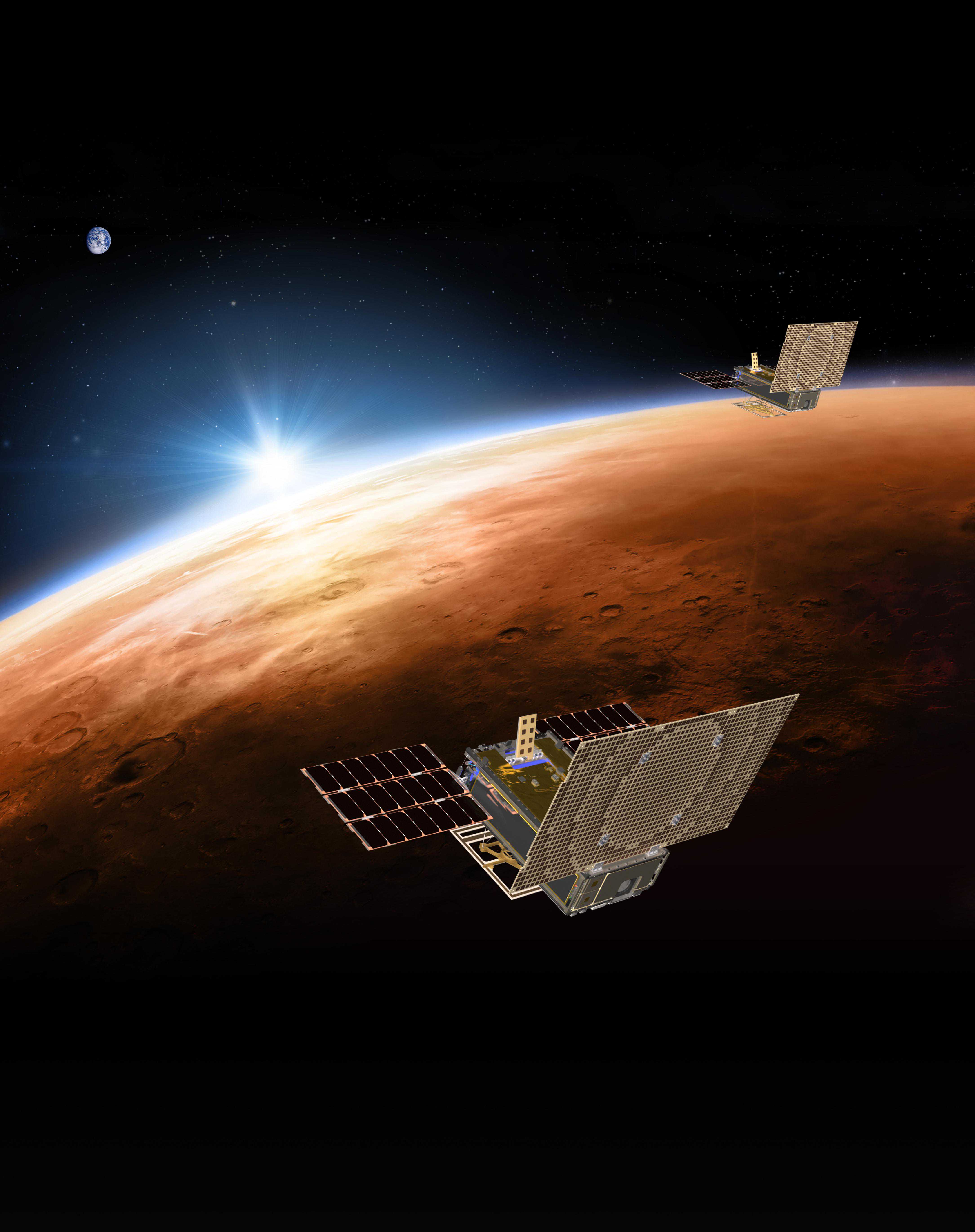
An artist’s rendering of the twin Mars Cube One (MarCO) spacecraft flying over Mars with Earth in the distance.
Scientists have big hopes for NASA’s Mars InSight mission. When this billion-dollar spacecraft reaches its destination on 26 November, after a six-month trip, a robotic lander will descend to the red planet’s surface. If the lander survives this hazardous final journey, it will spend the next two years studying the interior of our nearest planetary neighbour, burrowing into Mars’ crust with a self-propelled, mole-like hammer and attempting to detect quakes using a special seismometer placed directly onto the planet’s surface. For mission scientists at NASA’s Jet Propulsion Laboratory (JPL), the reward for all this effort and expense will be a wealth of information about the Martian crust, mantle and core.
Even before the lander arrives, though, the Mars InSight mission has already made history – thanks to a pair of briefcase-sized objects that travelled into space atop the same Atlas V rocket. The twin Mars Cube One (MarCO) satellites cost a relatively modest $9m each, and with a combined mass of just 26 kg, they made up less than 4% of the mission’s total payload. Their goals are correspondingly limited: in NASA parlance, the MarCOs are a “technology demonstration”, meant to perform communication and navigation experiments and not to make scientific discoveries. Even so, these unassuming little boxes are pioneers. As the first in a class of miniature spacecraft known as CubeSats to travel beyond Earth orbit, the successful launch of the MarCOs marks the latest milestone in a trend that is sweeping the space industry — changing not only what spacecraft look like but also the types of missions they can perform, and who gets to perform them.
To understand why CubeSats are such a game-changer, consider the Mars InSight mission again, this time in a slightly different light. The lander at the mission’s heart is a highly capable object, but it is also a complete one-off. Most, if not all, of its components were designed specifically for the InSight mission, and before they got anywhere near the launch pad, they underwent a rigorous, lengthy and expensive testing process to reduce the risk of malfunctions. This degree of care and precision is crucial when dealing with instruments and systems that come with six- or seven-figure price tags, but it pushes up the total mission cost, too. The result is an amazing piece of equipment that is, alas, completely beyond the reach of all but a handful of organizations worldwide.
In contrast, CubeSats like the MarCOs have been built and flown by private companies, university research groups, countries without multibillion-dollar space programmes, and even high-school students. Naturally, these miniature satellites can’t do as much as a robotic Mars lander — but then, they don’t cost as much either. In fact, many are such bargains that, in the words of Patricia Beauchamp, a programme manager at the JPL, “you can send up three of them and lose two, and that’s just fine.” The twin MarCOs are a good example of this ethos. Although somewhat costly by CubeSat standards (thanks in part to the demanding environment of interplanetary space), they are still sufficiently small and inexpensive that there was room and budget to include two in the Mars InSight mission – just in case one of them didn’t work.
Off the shelf
The low cost of CubeSats is partly due to their size, but it’s also a question of shape and standardization. As the name implies, CubeSats pack all of their instruments into a box measuring 10cm on a side. Some CubeSat missions incorporate three, six or even 12 such boxes (the MarCOs, for example, are six-unit CubeSats), but regardless of how many units are involved, the standard size and set of connections for each module means that many components, such as radiofrequency antennae or electronic interfaces, can be purchased off the shelf. That reduces costs even further, to the point where satellite manufacturers are beginning to talk seriously about economies of scale – a concept that has long been alien in an industry dominated by highly specialized, custom-built systems. “We are not handcrafting satellites so much anymore,” says Rafael Jordá Siquier, founder and CEO of Open Cosmos, a UK-based start-up that specializes in building CubeSats and other small satellites. “We are following a mass production process where we make and provide the services for many satellites at the same time.”
Open Cosmos CEO Rafael Jorda Siquier (r) and Head of Lean and Finance Bastian Paetzold (l) with some of the company’s CubeSats. (Courtesy: Open Cosmos)
Truly mass-manufactured satellites are some way off, and Jordá Siquier cautions that in the space industry “many satellites” might still mean 10 or fewer. However, CubeSats and similarly-sized craft (known generically as smallsats) are already helping to break what had been a vicious circle, where the inherent riskiness of the space business tended to push up already high technology costs, putting off new entrants. “We’re living in a time when I believe there is a big space revolution, and it’s empowered by this technology,” Jordá Siquier says. “I compare it to what happened in the 1980s, when computers stopped being big and expensive and available to a few key players and became small and affordable enough that more people could start using them.”
Small size, big impact
Jordá Siquier also likes to draw parallels between the capabilities of smallsats and those of early microcomputers. “Ten or 15 years ago, people thought that nothing useful could be done with this sort of technology,” he explains. “They didn’t know what they would be using them for. However, as time has gone by and companies like ours have been able to provide technology and services that are more customer-oriented and simple to use, we are starting to see applications emerging in a broad range of domains.”
As examples, Jordá Siquier cites several applications related to Earth observation, including the remote monitoring of crops, major pieces of infrastructure and shipping. The telecommunications industry, too, stands to benefit from the CubeSat revolution: dedicated smallsats could act as relay stations to facilitate satellite-to-satellite communications, while constellations of dozens or even hundreds of CubeSats could bring fast Internet connections to remote areas. On the scientific side, Beauchamp says that groups of smallsats could facilitate new types of missions, such as sending multiple small spacecraft to rendezvous with a single planetary body. “Those are very attractive concepts for getting data that you currently can’t get, or getting it at much lower cost,” she says. “You might have 10 satellites with the same instruments, or you could have all of them have slightly different instruments. There’s lots of games you can play to look at the risks and evaluate what you can do.”
[With CubeSats] you can send up three of them and lose two, and that’s just fine
Patricia Beauchamp, NASA-JPL
Fixing a bottleneck
With so many potential applications for smallsats, and decreasing amounts of money and know-how required to build them, it is hardly surprising that launch providers are struggling to meet demand. Most CubeSat and smallsat missions travel into space on a “rideshare” basis, tucked in alongside bigger, more expensive satellites like stowaways in the hold of a cargo ship. This makes it possible to launch several CubeSats on the same rocket, and helps keep overall costs down, but Jordá Siquier observes that it also restricts customers to whichever orbits the prime contractor wants to reach. In practice, these are often the most crowded geostationary or Sun-synchronous orbits, which may not be suited to the smallsat mission’s needs. Their popularity also means that launch windows are limited, raising the likelihood of weather-related delays.
Sharing a ride restricts the types of payloads that smallsats can carry as well. Natalya Bailey is the CEO and co-founder of Accion Systems, a Boston, US-based start-up that builds ion engines for small spacecraft. She explains that commercially-launched smallsats usually have no onboard propulsion systems because of the attendant hazards. “It’s quite dangerous to put a large pressurized canister of a gas on board,” she explains. “If you were trying to launch your spacecraft as a secondary payload, the primary payload might not accept it. Some of these primary spacecraft are worth one to two billion dollars. They don’t typically want to risk that.”
Limits on payload type and launch slots help to explain why a January 2018 test launch by a small and relatively little-known start-up, Rocket Lab, drew so much attention in the smallsat community. The second-ever launch of the company’s Electron rocket was code-named “Still testing”, but it nevertheless succeeded in placing three customer payloads in orbit: two CubeSats from Spire, a US-based weather data firm, and one from an Earth-imagery specialist, Planet.
Rocket Lab’s first real commercial launch was due to take place on 22 June at its dedicated launch facility in New Zealand’s Mahia peninsula, but was postponed because of a problem with a tracking dish. A company spokesman told members of the press that they hope to try again later in the week. However, even if weather or technical problems produce further delays, the US-headquartered firm appears well-placed to capitalize on the burgeoning launch market for smallsats. According to mission management and integration director Daniel Gillies, Rocket Lab aims to provide affordable, frequent launch services designed specifically for smallsat customers. “You want to go to a 650 km Sun-synchronous orbit with a launch date and time that no-one else wants? No problem,” Gillies told Physics World a day before the scheduled launch. “You can buy the entire vehicle, or at least charter a large proportion of it, and effectively it’s like chartering the private jet. You’re getting to go exactly to the place you want to go, when you want to arrive there.”
With a payload capacity of just 150 kg, Rocket Lab’s Electron is a minnow compared to older launch vehicles like the United Launch Alliance’s Atlas V or SpaceX’s Falcon 9. However, it can carry up to 24 CubeSat-type payloads into low-Earth orbit on a single launch, and it is also relatively quick to construct: Gillies says that 3D printing technology allows them to build up to one engine every day. By the end of 2018, the company hopes to be launching an Electron every month, either from its Mahia facility or from a second launch site at a still-to-be-determined location.
Satellites on the move
Some of the longer-term possibilities for smallsat technology would require all of this launch capacity and then some. Bailey, of Accion Systems, is confident that better, safer propulsion systems (such as the one she and her colleagues have developed, which uses an ionic liquid as a propellant) will significantly extend what smallsat makers can do, and where their craft can go. As an example, she describes a hypothetical customer who wants to launch many satellites at once, then spread them out along a particular orbit — perhaps to conduct ground observations over a large area or set up a telecommunications network. Satellite constellations of this type cannot be constructed without onboard propulsion or separate multi-stage launches, and even the enthusiastic Gillies says that Rocket Lab hopes to replenish mega-constellations of 1000+ satellites, not launch them in the first place.
Onboard propulsion also gives satellites a longer lifespan, enabling them to nudge themselves back into a higher orbit or take evasive action if they end up on a collision course with a piece of space debris. Such collisions are real possibility: Bailey explains that she was once in the control room of another space start-up when they received an alert from NASA about a potential collision risk to their prized satellite. “They had no propulsion, so the whole room was just silent, holding their breath, hoping that it didn’t happen,” she recalls.
Of course, CubeSats aren’t just at risk of being hit by space debris. They’re also at risk of becoming debris themselves, and the potential environmental implications of launching large numbers of small, expendable satellites into Earth orbit are not lost on the smallsat community. “Space debris is one of the key things that people developing this industry have to be very, very aware of – and very responsible for,” Jordá Siquier says. “We have to be careful of not polluting the environment where we develop our business.” Beauchamp, however, is less concerned. “Things are beginning to get a little crowded in various spots, but I think it’s going to be a while before it’s a problem,” she says. The reason, she explains, is that most smallsats are launched into low-Earth orbits, and without onboard propulsion, their orbits will decay – ensuring that they self-destruct by burning up in the Earth’s atmosphere within a few years.
It is also possible that CubeSats, far from adding to the collection of space junk, could help to reduce it. In 2017, an Italian start-up called D-Orbit test-flew a CubeSat designed to direct itself (and, in future, any other craft it attaches to) into a doomed orbit on command. As missions go, it may not be as glamorous as relaying messages from a Martian lander, but if CubeSat technology is to achieve its full potential, an army of little clean-up craft might be just what the industry needs.
Two independently-prepared identical particles can become entangled when they overlap spatially, even if there is no interaction between the particles. What is more, this entanglement can be used a resource for quantum-information proocessing – according to Rosario Lo Franco and Giuseppe Compagno at Italy’s University of Palermo.
Entanglement is a purely quantum-mechanical phenomenon that allows two or more particles to have a much closer relationship than is allowed by classical physics. While entanglement plays a crucial role in quantum-information protocols such as quantum teleportation and quantum cryptography, not all entangled states are useful as quantum resources.
One important open question is whether identical quantum particles – which are therefore indistinguishable – can be used a practical resource for quantum technologies. One problem, for example, is that identical particles cannot be addressed individually as quantum bits (qubits).
Spatially localized
Lo Franco and Compagno began their study of indistinguishable particles by looking at the “local operations and classical communication”, or LOCC, protocol, which is a quantum-information protocol that involves two distinguishable particles. Then they modified LOCC by considering the effect on two indistinguishable particles (such as photons) that overlap spatially. This could occur, for example, if two photons are in a waveguide at the same time. They call their new protocol “spatially localized operations and classical communication” (SLOCC).
“We have found the novel characteristic that the indistinguishability of identical elementary systems is a source of useful quantum features, especially entanglement,” Lo Franco told Physics World. “We also prove this operational entanglement is physical in that it can be directly exploited by SLOCC to activate quantum teleportation,” he said, adding “the results open the way to new quantum-enhanced applications”.
Lo Franco describes SLOCC as “experimentally friendly” and points out that it can create entangled pairs of photons without the need for an interaction between the particles. As a result, he claims that a source of entangled photons could be created simply by firing two photons into the same waveguide. Such a source has the potential to be much more efficient at producing entangled pairs than current technologies such as those involving parametric down-conversion in nonlinear crystals.
Lo Franco and Compagno describe their calculations in Physical Review Letters and say that as well as working for photons, SLOCC could also be applied to other quantum systems including solid state circuit quantum electrodynamics and Bose-Einstein condensates.
The 2017 red sun event in the UK provided striking images but photographers weren’t the only ones to benefit. Measurements have shown that the airborne particles that turned the sky a deep orange were highly negatively charged, adding more evidence to the idea of “dust electricity”.
Scientists at Reading University used sensors on balloons to find out more about the dust cloud moving overhead. Although the event was unexpected, the team had new instrumentation ready thanks to a recent project focusing on volcanic ash.
“We had to act quickly, but we managed to send one of our balloon probes into the dust plume above,” says Giles Harrison. “The measurements confirmed that there was charge in the plume, near turbulent regions of motion too.”
More details were obtained as winds carried particles above several well-instrumented sites on the ground.
“The surface measurements at Reading showed a particularly dramatic dip in the atmospheric electric field, which turned out to be very similar in measurements at Chilbolton and Bristol,” says Harrison.
Dust plumes strongly influence the local atmosphere by changing the energy balance of incoming and outgoing radiation. As observers witnessed, light scattered by the particles altered the appearance of the sky from blue to orange/red. Direct evidence of charged behaviour could provide new insight into these and other effects.
“Electric fields in the atmosphere have been suggested to encourage alignment of charged particles, rather than being randomly oriented, which changes how sunlight and radiation from the Earth are transferred,” says Harrison. “Some large dust particles have been observed much further from their source than can currently be explained, and it might be that charge reducing their fall speeds helps to explain this.”
The plume of Saharan dust and Iberian smoke responsible for the red sun event in the UK on 16th October 2017 was transported by the remnants of Hurricane Ophelia.
Scientists have been aware for more than 150 years that atmospheric dust can become electrically charged through frictional interactions between colliding particles – a process dubbed triboelectrification.
The researchers were keen to gather as much new information as they could. The balloon-borne sensors highlighted an unexpected dry region within the plume. It’s hoped that this unusual data, which also includes land-based laser measurements, will help to incorporate the electrical effects of dust clouds into analyses.
Optogenetics is a relatively new biological technique that uses light to control the behaviour of cells in living tissue that have been genetically modified (using proteins) to become sensitive to light. Researchers at EMBL in Germany have now used this technique to induce tissue folding and shaping (morphogenesis) in a living embryo for the first time. The work could have implications for tissue engineering and regenerative medicine.
In their work, researchers led by Stefano de Renzis used optogenetics to reconstruct epithelial folding. This is a fundamental process in development in which cells move inwards and fold into the embryo (a process known as invagination), eventually producing internal tissues. They made use of a light-sensitive protein heterodimerization system that allowed them to control a particular protein, which, when present at the plasma membrane triggers a process called phosphorylation and activates a molecular motor called mysosin-II. When activated, this motor pulls on cortical actin filaments and makes the plasma membrane contract.
Rho signalling
“The protein we made light sensitive is the enzyme RhoGEF2, which activates the small GTPase Rho1,” explains de Renzis. “Rho1 then activates a signalling cascade and activates the molecular motor myosin-II. We employed a technique called two-photon illumination, which is very precise because we can activate volumes as small as a femtolitre.”
Surprisingly, we found that we could induce invagination in tissues that normally do not undergo this process by simply activating Rho signalling and apical constriction,” he tells Physics World. “Rho signalling in fact transforms specific chemical inputs into mechanical forces and being able to control this signal pathway and induce morphogenesis in a living embryo was a real thrill for us.
“Equally interesting was the fact that we could make cells and tissues respond in a different way and form into various shapes by modulating the frequency and power of the light. This gave us the feeling of being in total control of morphogenesis. Until now, we had to let the embryo ‘reveal’ its behaviour to us, but now it appears that we can actually start to guide it.”
Towards a synthetic embryo?
The researchers did their experiments on developing fruit flies (Drosophila) but de Renzis says that the technique described in this study could also be applied to other organisms and even ex vivo stem cell cultures. “In this case, optogenetics could be ideal for reconstructing and directing tissue development and be used to re(build) artificial tissue in regenerative medicine,” he explains.
The team, reporting its work in Nature Communications 9 2366, says that it is now focusing on reconstructing embryonic development in “mutant” embryos that would otherwise not undergo morphogenesis. “Looking longer term, we would like to build a synthetic embryo,” reveals de Renzis. “Can we engineer patterning systems up to the point that we can completely guide embryonic development?”
Monatomic glassy antimony might be used as a new type of single-element phase change memory. This is the new finding from researchers at IBM Research-Zurich and RWTH Aachen University who say that their approach avoids the problem of local compositional variations in conventional multi-element PCMs. This problem becomes ever more important as devices get smaller.
New-generation non-volatile memory
The worldwide volume of digital information is doubling every two years and could reach 160 zettabytes (109 terabytes) by 2025 according to the latest whitepaper from the International Data Corporation (IDC). Phase change memories are one of the new types of non-volatile memory being studied to meet this demand. These memories are based on a material’s ability to switch between two “0” and “1” states: a crystalline state with high electrical conductivity and a meta-stable amorphous state with low electrical conductivity. They are switched using electrical pulses that heat up the material and drive the transitions. The energy of the electrical pulses is lower when there is less material to heat up.
Conventional PCMs are usually made from a complex mix of alloys doped with additional chemical elements to tune their physical properties. While such materials can be used to make chips with good data storage densities, these could be increased further by scaling down the cell size of memory units. There is a problem, however, in that the smaller the device, the more sensitive it becomes to local compositional variations in the alloy, which deteriorates the cell’s properties.
“Our work shows that we can solve this problem by making the PCM from just one simple element instead of these complex doped alloys,” explains Martin Salinga, lead author of this study. “Antimony (Sb) is semi-metallic in its crystalline phase and semiconducting as an amorphous thin film and shows a large contrast in resistivity between these two states. It can also crystallize very easily and quickly. This makes it a good choice for a PCM in a highly-confined structure, which usually slows down the crystalline kinetics.”
Rapid melt-quenching in a nanoconfined volume
The researchers, reporting their work in Nature Materials 10.1038/s41563-018-0110-9, made pure Sb films that are between 3 and 10 nm thick and confined inside thermally and electrically insulating SiO2 layers that are 40-200-nm thick. They were able to electrically switch between the amorphous and crystalline states in these films in just 50 nanoseconds.
Until now, it had been difficult to make amorphous Sb because the element rapidly crystallizes at room temperature. Salinga and colleagues have now managed to do this by rapidly cooling (or quenching) the material from the melt at a rate as high as 1010 kelvin per second in a nanoconfined volume. The result: amorphous Sb that is stable for nearly 51 hours at 20°C.
Immediate applications
“The first applications that could benefit from a ‘monatomic PCM’ might be in the area of ‘in-memory’ computing, ‘memory-type storage class memory’ or ‘brain-inspired computing’,” IBM scientist and study co-author, Abu Sebastian tells Physics World. “These devices could be operated with 10-ns-long electrical pulses. We will likely be able to scale these devices down to ultra-small dimensions that will consume very little energy. Their monoatomic nature might also make them more robust to repeated switching cycles.”
It is not all plain sailing though: the amorphous state of Sb only lasts for around 100 seconds at 60-70°C, which is the typical operating temperature inside electronic devices, so the researchers say that this will have to be improved. “This may be achieved, for instance, by further reducing the Sb film thickness, confining Sb in all three dimensions, and designing better confinement materials,” suggest Wei Zhang and Evan Ma at Xian Jiaotong University in China and Johns Hopkins University in the US in a related Nature news & views article. “The voltage pulse (currently 50 ns) required for amorphization (also) needs to be shortened to become competitive with DRAMs and SRAMs.
“What has been achieved by Salinga and colleagues is nevertheless unprecedented and eye-opening, in terms of the perspective that monatomic PCMs are indeed feasible, and that an elemental glass, usually considered impractical due to its poor glass-forming ability, may be rendered useful in memory devices,” they add.