Could the breakdown of rocks mitigate climate change?

Limiting average global temperature rise to 2°C will require strong commitment and innovative solutions. In the first study of its type, a German team has assessed whether removing carbon dioxide from the atmosphere by enhancing the weathering of rocks has potential.

Chemical rock weathering, where rainwater reacts with the minerals in rock and breaks it down, naturally removes around 1.1 Gt of carbon dioxide per year from the atmosphere. This process could be enhanced by grinding rocks and spreading them over the ground in humid regions, so that the rock grains dissolve in water and travel to the ocean, storing the carbon dioxide.

Jessica Strefler and Thorben Amann from Potsdam Institute for Climate Impact Research and Universität Hamburg assessed the potential of this method, considering the amount of carbon dioxide that it can trap and the associated economic costs for different rock types and areas worldwide.

The team showed that this method needs a high weathering rate to be a significant and economically viable option. In sub-tropical regions such as Brazil, India and south China, it has potential due to higher temperatures, humidity and suitability of the land. In such areas, chemical rock weathering could remove as much as 95 Gt of carbon dioxide per year using dunite – a volcanic rock made up primarily of one mineral – and 4.9 Gt of carbon dioxide per year using basalt, a volcanic rock of mixed minerals.

Although it traps significantly less carbon dioxide than dunite, the use of basalt would have many co-benefits for the soil, as it is rich in nutrients such as phosphorus, magnesium and calcium, whereas dunite contains harmful substances, such as chromium and nickel, that the process could release. From an economic perspective, the method is estimated to be more than twice as expensive as afforestation, but just less than 10 times cheaper than direct air capture.

“This first comprehensive assessment of costs and possibilities shows that enhanced weathering, especially of basalt rock, could be an attractive option to support climate change mitigation, especially for tropical and subtropical regions where the carbon dioxide uptake potential is the highest,” said Strefler. “However, given the costs and the mass of rocks that would need to be moved, it can likely provide only a small additional contribution.”

There are currently major uncertainties in the estimation of carbon dioxide consumption by this weathering method, so there is a need to improve models to determine its full potential.

Scientists must quantify the weathering rate under natural conditions, as well as the rate at which the soil naturally produces carbon dioxide through respiration. An accurate estimation of these variables should reveal the true potential of carbon dioxide capture via weathering and whether it is viable for use on a large scale.

Graphene-based skin patch measures glucose levels

A new, non-invasive skin patch made from thin-film graphene could measure glucose levels without the need for a finger-prick blood test. The device works by drawing out glucose from the fluid between cells across hair follicles, which are individually accessed via a miniaturized pixel array platform using a small electric current, in a process called electroosmotic extraction. Readings can be taken every 10 to 15 minutes over several hours and the data wirelessly transmitted to a mobile device, such as a smartphone or watch.

Diabetes is a serious worldwide health problem that is set to become even worse. The World Health Organization estimates that the number of people suffering from diabetes will increase to 366 million in 2030. This number was 171 million in 2000.

Diabetics regularly need to monitor their blood glucose levels, and they usually do this with a finger-prick test, which is uncomfortable to say the least. Researchers have recently developed a variety of non-invasive alternatives based on detecting glucose in sweat, tears or saliva but these techniques have their limits. For one, the levels of glucose detected can vary significantly, and secondly, many still require calibration with a conventional finger-stick.

Until now, the only technology to provide non-invasive, continuous glucose monitoring was the Gluco Watch Biographer, which received Food and Drug Administration approval in 2001. This watch works using reverse iontophoresis to extract interstitial fluid through the skin via electroosmosis. In this technique, a small electric field is applied across the skin, causing ions to flow. Since the skin has a net negative charge under normal physiological conditions, interstitial fluid flows from within the skin towards a cathode on the skin surface, where glucose is then detected and analysed.

Calibration via a blood sample not required

The problem with the watch is that, again, a finger-stick calibration is required, mainly because glucose is extracted indiscriminately and variably across a relatively large area (>3 cm2) of skin and is considerably diluted before it is analysed. “The device therefore does not exploit the fact that most of the electroosmotic flow during iontophoresis follows low-resistance preferential pathways associated primarily with hair follicles,” say Adelina Ilie and colleagues of the University of Bath in the UK.

The researchers have now designed a non-invasive adhesive patch containing a sensor array that can operate on a small area over an individual hair follicle. “This significantly reduces inter- and intra-skin variability in glucose extraction,” they say, “and increases the accuracy of the measurements taken such that calibration via a blood sample is not required.”

A miniature, individual pixel of such an array contains the following: a glucose oxidase-bearing hydrogel reservoir into which glucose is extracted through skin; an electrochemical glucose sensor (made of a graphene-based film or graphene ink); and miniaturized electrodes on a flexible substrate. Ilie and her team used graphene as their material of choice, thanks to its high mechanical strength, high conductivity, low capacitance, large surface area and the fact that it can be patterned and integrated into a device using standard microfabrication techniques. It is also low cost and environmentally friendly.

Monitoring glucose levels across the hypo- to hyper-glycaemic range

The glucose extracted via reverse iontophoresis reacts with glucose oxidase to produce hydrogen peroxide, which is then detected by the electrochemical sensor. One important aspect of the device is that the active area of the pixel device (into which fluid is extracted) allows it to access a single follicular pathway. “If we assume that a person has an average follicular density of 27 follicles per cm2 (for instance, on areas such as the arms and thighs), an active area of 2–6 mm2 maximizes the probability of hitting a single follicle in a randomly positioned, untargeted measurement,” say the researchers.

The team tested its patch on both pig skin (which is an excellent model for the human skin barrier) and on healthy human volunteers and found that it could accurately monitor glucose levels across the hypo- to hyper-glycaemic range in diabetic patients over six hours.

The researchers, reporting their work in Nature Nanotechnology doi:10.1038/s41565-018-0112-4, say that they would now like to further improve the design of their approach. They would also like to optimize the number of sensors in the array so that it can operate over a full 24-hour period. Finally, they would like to undertake a number of key clinical trials.

Spin-3/2 superconductor is a first, say physicists

The first known superconductor in which spin-3/2 quasiparticles form Cooper pairs has been created by physicists in the US and New Zealand. The unconventional superconductor is an alloy of yttrium, platinum and bismuth, which is normally a topological semimetal.

The research was done by Johnpierre Paglione and colleagues at the University of Maryland, Iowa State’s Ames Laboratory, the Lawrence Berkeley National Laboratory and the Universities of Otago and Wisconsin.

Conventional superconductivity arises in a material when spin-1/2 electrons form “Cooper pairs” because of interactions between the electrons and vibrations of the material’s crystalline lattice. These pairs are bosons with integer (usually zero) spin, which means that at very low temperatures they can condense to form a state that conducts electrical current with no resistance.

Spin-orbit interaction

In the alloy studied by Paglione and colleagues, charge is carried by particle-like quasiparticles with spin-3/2. These quasiparticles arise from interactions between the spins of electrons and the positive charges of the atoms that make up the alloy. This effect is called spin-orbit coupling and is particularly strong in this material. The result is that the spin-3/2 state – which combines spin and orbital angular momentum – is the lowest energy state.

When the team cooled the material, they found that it is a superconductor at temperatures below about 800 mK. This came as a surprise because this temperature is nearly 1000 times higher than expected if the superconductivity involved conventional Cooper pairs.

Paglione and colleagues also studied how magnetic fields penetrate the material. Superconductors can expel magnetic fields but the process is not perfect, with some magnetic field lines penetrating the surface of the material and persisting to small depths. Measuring this penetration effect gives important details about the nature of the pairing responsible for superconductivity.

Mind the gap

When the team measured the penetration depth as a function of temperature, they found that it increased linearly rather than exponentially – the latter being a characteristic of a conventional superconductor. This suggests that the energy gap between the superconducting and normal states of the material is not isotrophic in space, as is the case in conventional superconductors.

No one had really thought that this was possible in solid materials

Johnpierre Paglione, University of Maryland

This rules out spin-1/2 Cooper pairs so the team investigated other possibilities. They found that all possible pairings of spin-1/2 and spin-3/2 s in the alloy resulted in isotrophic gaps except the case where two spin-3/2 quasiparticles join to make a pair with a combined spin of 3.

“No one had really thought that this was possible in solid materials,” says Paglione, adding it “was quite a surprise given the simplicity of the electronic structure in this system”.

Non-trivial topology

What is particularly exciting about the material, say the researchers, is the topological nature of how the superconductivity arises. The spin-3/2 quasiparticles are a result of topology related to the strong spin-orbit coupling. Paglione also says, “the superconductivity that forms may itself have a non-trivial topology”. “This is a more subtle thing and harder to prove,” he adds, “but essentially the phase of the superconducting wave function may have a ‘twist’ in it that gives a non-trivial (chiral) topology. This has profound implications, such as possibility of Majorana fermion excitations from the superconducting condensate.”

Paglione says that spin-3/2 superconductivity could exist in other materials and the phenomenon could have technological and fundamental applications. If such superconductors are indeed topological, he believes that they could form the basis for fault-tolerant quantum computers. On a fundamental level, he says that spin-3/2 fermions provide a very rich spectrum of possible pairing configurations for physicists to study – adding that their work has already garnered significant interest from other physicists.

Indeed, an important fundamental question, says Paglione, is how the spin-3/2 fermions pair up in the first place. “What’s the glue that holds these pairs together?” he asks. “There are some ideas of what might be happening, but fundamental questions remain – which makes it even more fascinating.”

The research is described in Science Advances.

AFM detects heteroatoms in graphene nanoribbons

The AFM technique

Atomic force microscopy can successfully be used to distinguish between different atoms in doped graphene nanoribbons, according to new measurements by researchers in Japan, Finland and Switzerland. The technique, which works by quantifying the differences in the van der Waals radii of the atoms, could be used as a general way to analyse technologically important functionalized 2D carbon materials.

Among 2D materials, graphene (which is a flat sheet of carbon just one atom thick) is one of the most attractive for a host of device applications thanks to its unique electronic and mechanical properties. Indeed, graphene has even been touted as being one of the best alternatives to silicon as the electronic material of choice in the future.

However, unlike the semiconductor silicon, there is a big problem in that graphene has no gap between its valence and conduction bands. Such a bandgap is essential for electronics applications because it allows a material to switch the flow of electrons on and off.

Introducing a bandgap

One way of introducing a bandgap into graphene is to make extremely narrow ribbons of the material. What is more, if heteroatoms are incorporated into a precursor when synthesizing graphene, doped graphene nanoribbons (GNRs) can be produced. The position and density of the doping elements can be controlled in these ribbons, which, in turn, allows the electronic properties of the ribbons themselves to be controlled on the atomic level.

Researchers have so far succeeded in substituting single heteroatoms of nitrogen, boron, sulphur and oxygen into GNRs. Until now, however, they have not really looked at chemically analysing these atoms and characterizing how they substitute for carbon atoms in the graphene lattice.

Discriminating between boron, carbon and nitrogen atoms

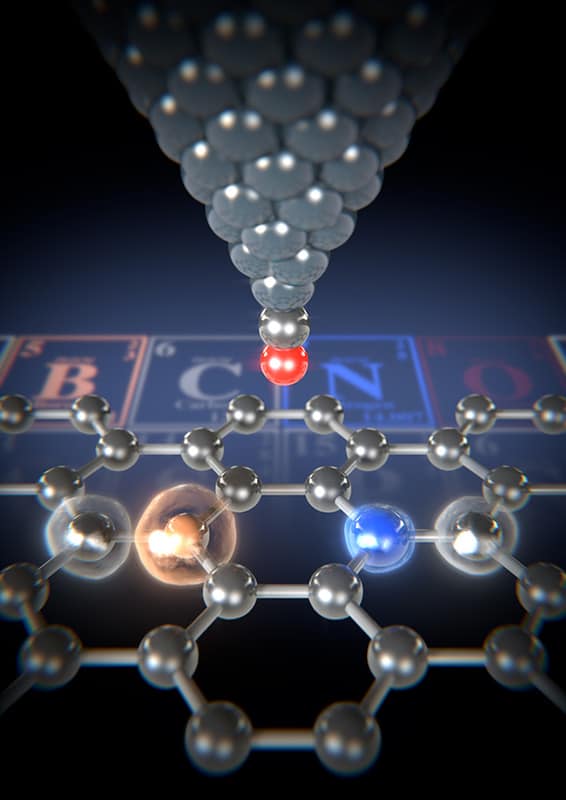
Adam Foster of Aalto University in Finland and colleagues have now used the CO-functionalized tip of an atomic force microscope (AFM) to discriminate between boron (B), carbon (C) and nitrogen (N) atoms embedded at the centre of a GNR thanks to the differences in their van der Waals radii. They were also able to measure the modulated electron density caused by the substitution.

The researchers embedded heteroatoms at equivalent atomic sites in the nanographene ribbons using in-surface chemical reactions with special precursor molecules. Similar to previous work they had done on periodic boron-doping into GNRs, they used C4BN cyclic rings to provide the boron and nitrogen atoms. They annealed these compounds with the GNRs at 200°C and then at 400°C to induce cyclohydrogenation and form BN-GNRs.

Resolving the inner structures of BN-GNRs

Atomic force microscopy is a widely-used ultrahigh-resolution technique that allows researchers to observe extremely small objects, even down to single atoms. It works by sensing the topography of a sample as it scans across it thanks to a very fine probe (the cantilever), which has an extremely sharp tip at its end that touches the surface of the sample. In this work, Foster and colleagues succeeded in resolving the inner structures of the BN-GNRs and found that a nitrogen site, for example, appears as a dark site. An adjacent bright site corresponds to a boron atom.

Thy obtained their results by taking a series of AFM images at different heights. When the tip and sample are well separated from each other, weak and bright contrast appears at the boron site but as the tip is moved closer to the BN-GNR, the researchers are able to distinguish six-membered carbon rings. And at a height of 32 picometres, three C-N bonds also appear. Since the CO-tip AFM is subject to short-range repulsive interactions, the contrast in the images shows that the onset of short-range repulsion occurs first at B sites, then at C sites and finally at N ones.

“In this work, we focused on discriminating between different heteroatoms, but this GNR is a very exciting material in its own right,” says team member and lead author of this study Shigeki Kawai of the National Institute for Materials Science in Tsukuba in Japan. “We would now therefore like to investigate its electronic properties in detail as well as make devices from it and study these too,” he tells nanotechweb.org. Kawai did the experiments for the present work, which is detailed in Science Advances DOI: 10.1126/sciadv.aar7181, while he was at the University of Basel in Switzerland.

GW170817 kilonova: what happened next

The physics highlight of 2017 – and our breakthrough of the year – was the first ever multimessenger astronomy observation that involved the detection of gravitational waves. It was the spectacular merging of two neutron stars in a kilonova explosion dubbed GW170817, which has been studied across the electromagnetic spectrum from gamma-rays to radio waves.

The first signals from the kilonova were seen in August 2017, but astronomers are still learning more about the merger and what it created – probably a black hole that is driving an astrophysical jet.

Astronomers are particularly interested in learning more about that jet. Today at the April Meeting of the American Physical Society in Columbus, Ohio, NASA’s Eric Burns gave an update about what the gamma-ray signal tells us about the kilonova.

On  the edge

GW170817 emitted a flash of gamma rays that Burns says resembles a “short gamma-ray burst”. However, it was about 10-100 times dimmer than most other observed short bursts. This could be because we are looking at the edge of the jet or that the jet is not uniform – the jury is still out.

Gravitational waves from the merger were first detected by LIGO–Virgo, and then about 1.7 s later the first gamma rays were seen by the Fermi satellite. Why the delay between the two signals? It is possible that some of that delay is associated with a hypermassive neutron star that existed briefly before collapsing to a black hole. Such a neutron star would give off gravitational waves, but they cannot be detected by LIGO–Virgo.  Another possible contributing factor to the delay is the time that it takes for the jet to form before it starts emitting gamma rays.

The precise nature of the jet was the topic of a talk by Caltech’s Gregg Hallinan, who gave a review of radio observations of GW170817. Radio waves are produced as the jet expands and cools. First, there is an increase in the amount radio waves produced, followed by a drop off that is expected after about 100 days. Hallinan explained that the precise nature of how this drop off occurs provides important clues about the nature of the jet.

Mildly relativistic

Using observations made so far, Hallinan and colleagues reckon that the radio output is consistent with a wide-angle, mildly relativistic outflow that we are viewing along the axis of rotation of the black hole.

The final talk in the session was from Tony Piro of the Carnegie Observatory, who was part of the team that used optical telescopes to pinpoint the location of GW170817. He showed measurements of the visible spectrum of the kilonova, which can be fitted to a black-body curve to give the temperature of the outflow. The first measurement revealed a temperature of 11,000 K, but this dropped quickly to 9500 K in just one hour. Knowing the cooling rate allowed the team to calculate the speed of the outflow, which they reckon is about 30% of the speed of light.

LIGO–Virgo is currently being upgraded and the detectors will come back online later this year for their third observing run. Burns reckons that about one neutron star merger per year could be seen with both gravitational waves and gamma rays, providing more insight into this fascinating phenomenon.

  • To find out more, read our special collection about the detection of gravitational waves by LIGO–Virgo and the emerging field of multimessenger astronomy

Quantum computing could revolutionize nuclear and particle physics

The theme of this year’s April Meeting of the American Physical Society is the “Feynman Century” because the iconoclastic, Nobel-prize-winning physicist was born in 1918. This morning at a special session devoted to Feynman, quantum computing expert Christopher Monroe of the University of Maryland spoke about early contributions to quantum computing that were made by Feynman before his untimely death in 1988.

That theme continued in an afternoon session at the conference where nuclear and particle physicists discussed how quantum computers could be applied to their work. A huge challenge to those studying the physics of quarks (quantum chromodynamics or QCD) is that it takes vast amounts of computing power just to calculate the properties of relatively simple systems.

Low barrier to entry

Quantum computers, which (at least in principle), can solve certain problems much more efficiently than conventional computers could offer a way forward. Earlier this year we reported what is probably the first-ever nuclear physics calculation done using quantum computers – the binding energy of the deuteron. Thomas Papenbrock of the University of Tennessee and Oak Ridge National Lab explained how commercial cloud quantum-computing services from IBM and Rigetti had made this calculation possible, pointing out that the barrier to entry to quantum computing is very low thanks to these services.

He was followed by Martin Savage of the University of Washington, who is an expert in lattice QCD, which requires mind-boggling amounts of computer power. He pointed out that the QCD community already relies on large computing infrastructures that are created and maintained by both physicists and computing experts. A similar technological and human infrastructure, he believes, must be created for lattice QCD quantum computing.

Solving the “sign problem”

Quantum computers could play crucial roles in solving the “sign problem” in lattice QCD, which makes calculations increasingly difficult as the number of particles increases. They could also be used to calculate the dynamical evolution of a system, charting particle interactions in a collider, for example.

The IBM and Rigetti quantum computers used to perform the first nuclear calculation had 16 and 19 qubits respectively, so my jaw dropped when Savage said that about 4 million qubits would be needed to do a lattice QCD better than state-of-the-art conventional computers. And my jaw dropped even further when he said that experts in the industry didn’t seem to think this would be a problem!

Supporting renewables: FiTs not tenders?

More and more national governments are transitioning from guaranteed price feed-in tariff (FiT) models for supporting renewables to competitive contract tendering/contract auction schemes, justified in the belief that this will reduce costs. That’s the EU view, and tenders have also been backed by the International Renewable Energy Agency. However, the German Energy Watch Group says this is a mistake. FiTs have been very successful and widely adopted, whereas there are big disadvantages with tenders, their main effect being that less capacity is installed, with smaller projects being excluded and competition actually being reduced.

Energy Watch says that “tenders massively curb the expansion rates of renewable energies and thus unnecessarily jeopardize climate protection”. To the extent that they reduce the amount of capacity that’s installed, it’s that which reduces costs. For example, when tenders replace FiTs,investment volumes sink because a large number of decentralised, small investments are eliminated”. Worse still, Energy Watch says, tenders also reduce competition: “Tenders reduce the diversity of actors; private investors, energy cooperatives, and SMEs in particular are virtually barred from making offers given the high application requirements. [So] tenders help cement the market power of oligopolies by large corporations and established energy industry companies, thereby diminishing competition.” One result is: “Tenders decrease local public support for renewable energy development by excluding local communities from investment and project planning. [Moreover] in the tendering model, expansion volume and tender design are determined exclusively by the state, hindering free market forces from accelerating renewable energy growth and new innovations.” And for good measure, they add, “non-transparent procedures and government procurement practices encourage corruption” and “calls for tender do not promote advanced decentralized solutions, particularly for grid integration and sector coupling”.

Overall, Energy Watch says “tenders slow the cost reduction of renewable energy technologies: according to the learning curve, specific investment costs decrease only with further increases in market volume; since calls for tender are intended to cap the market volume and keep it lower than it would be with feed-in tariffs, they contribute to a considerable slowdown in the cost reduction of renewable energies.”

Some of this may seem hard to square with the fact that consumers had to pay for the FiTs, and it was the growing scale of that cost pass-through which led Germany and others to back off FiTs, in favour of auctions, and to slow their renewable energy programmes.  It is also the case that recent contract auctions around the world have led to some very low price bids for large wind and PV projects, in South America and Asia especially, with, for example, some PV projects getting contracts below $30/MWh in Chile and on shore-wind projects getting $40/MWh in India. However, that might have occurred anyway, given the rapid development of the technology and the expanding market for it, created by the FiTs globally.

The tendering/competitive auction approach also represents a “race to the bottom”, with a few low cost projects winning contracts, the rest being sidelined, and less capacity resulting overall. It is also not certain that the low bid price projects will actually all go ahead – they may have bid too low to be able to deliver in practice.  That is what happened in some cases back in the 1980s, with the UK NFFO price/capacity auction system – a number of contracted projects were not able to deliver.  Non compliance/default penalties are being introduced to limit this risk with the new auction schemes, e.g. for the UK CfD auctions. However, we have yet to see if that will work, especially since market conditions can change rapidly, making it hard for projects with tight profit margins to continue. For example, 25 wind and solar projects that won contracts under Brazils renewable energy capacity auction process have been abandoned, 557 MW in all, 250 MW of solar and 308MW of wind. The decision was taken “because a high number of projects which were contracted in Brazil’s first reserve energy auctions between 2014 and 2015 have remained idle or unbuilt”. That may be due to falling demand for power, as the Brazilian economy retrenched, but that’s just the sort of problem that inevitably faces competitive market-based support systems.  

The latest round of solar auctions in Mexico yielded an unheard-of average price of $20.57/MWh, including a $17.7 bid by Enel. But, as developers scramble to under-bid one another in the current market, some fear the price war may eventually erode the quality that is deliverable. Always assuming that the low bid projects can actually deliver at all.  Maybe they’re speculating against future cost falls? That can be risky.

Nevertheless, despite the potential problems with auctions and tendering, Energy Watch admits ‘For large investments with individual plants over 100 MW, tenders can be quite useful. They give the state the opportunity for targeted intervention – so that it may, for example, promote grid integration or attract large investors. At the large scale, SMEs, energy cooperatives and private individuals cannot raise adequate financial resources anyway.” That is clear. Indeed, some say that, in developing countries, it would be hard to run FiTs, even for smaller projects, since, unlike in the EU, there are not sufficient affluent grid-linked consumers to support and pay for the schemes. The upfront cost of domestic PV installation can be high and so can the subsequent cost passed through to consumers. Interestingly, that has led Uganda and Zambia to introduce so called GETFIT schemes, which combine grants and FiTs. See my new book with Terry Cook.

Energy Watch, however, clearly thinks FiTs can work in most places for small projects and, as technology costs fall, that may well be true. So they suggest “Up to a capacity of at least 40 MW, state support for renewable energies should continue to be based on or return to a basis in fixed, legally guaranteed feed-in tariffs. Should tenders under 40 MW also be desired, energy cooperatives should at least be exempted from the obligation to tender.”

Going on the offensive, they also claim “Given that the innovative power of feed-in tariffs is considerably higher than that of tenders, new tasks such as grid integration and sector coupling should be addressed with feed-in laws. A combined power plant remuneration, which has not yet been implemented anywhere in the world, seems particularly well suited. In this way, the goal of 100% renewable energies can be reached quickly and democratically. Furthermore, an approach without arbitrarily set expansion caps and proscriptive tender designs will promote stakeholder diversity and thus create space for additional sources of investment and innovation.”

The 100% renewables aim is further explored by Energy Watch in a joint report with Finland’s Lappeenranta University of Technology (LUT), which says that renewables can supply near 100% of global electricity by 2050, or even earlier, at less cost than a nuclear/fossil scenario. I mentioned the UK sub-scenario in an earlier post. For comparison, the ambitious global scenario by Mark Jacobson’s team at Stanford University also reaches 100% globally by 2050, with just wind, water and solar power, and despite avoiding biomass, its claimed that it can meet all energy needs, not just power, by then.

LUT and EWG say they will publish their full “all energy” scenario in 2018. But there is plenty enough in this one for now.

LUT’s earlier 100% renewables work has attracted some criticisms: it had a 2030 goal. 2050 seems more realistic. See the links back to the Energy Matters critique in this riposte from LUT.

Some of Jacobson’s work has also been challenged. Perhaps unwisely, Jacobson was at one point seeking legal redress on this. Evidently it had gone beyond scholarly exchanges. But he has now decided to abandon this suit. And perhaps more productively, he and his team, along with researchers from Aalborg University in Denmark, have produced a new study, which addresses some of the criticisms of the previous ones. See my next post.

Talking skyrmions in Columbus, Ohio

Greetings from Columbus, Ohio, where I will soon be at the April Meeting of the American Physical Society – one of the largest conferences devoted to particle physics, with some astrophysics and cosmology thrown in too.

But before I delved into colliders, detectors and what lies beyond the Standard Model, I paid a visit to the nearby Ohio State University (OSU) where I met with the Mohit Randeria. He is a condensed matter theorist who has worked on a wide range of problems – cutting his teeth on high-temperature superconductors and doing calculations on ultracold atoms.

Over the past four years, Randeria has added skyrmions to his list of interests. Originally an idea from the world of particle physics (there is a connection to the April Meeting!), skyrmions also appear as collective quasiparticle states in some magnetic materials. They are topologically protected from external influences, which means that they could be used to store bits of data in very stable computer memories. Randeria explained to me that if certain technical challenges could be overcome, such memories could be denser and more energy efficient that current technologies.

Randeria has put together a crack team of physicists and engineers at OSU to create and study skyrmion materials. The team is based at OSU’s Center for Emergent Materials (CEM) and has recently been granted more than $6m from Defense Advanced Research Projects Agency (DARPA) to further its studies of skyrmions.

I recorded a conversation with Randeria, which you can listen to below.

Interview with Mohit Randeria

Now, it’s time for some particle physics.

Vascularizing pancreatic islets improves transplantation for diabetes

Type 1 diabetes results in the auto-immune destruction of insulin secreting β-cells in pancreatic islets. The disease is managed by insulin injections, but transplantation of pancreatic islets has been considered as a cure. However, re-vascularization of the transplanted islets is crucial for maintaining the function and viability of the β-cells, as it supports adequate nutrient and waste exchanges. Moreover, the interaction between the β-cells and the endothelial cells that line our vasculature is known to play an important role in supporting both cell types.

Recent research by Ibrahim Ozbolat and colleagues at Penn State University has highlighted how inclusion of endothelial cells into engineered pseudo-islets (termed EPIs) improves the viability and function of the EPIs, as well as promoting angiogenesis – the sprouting of new vasculature. The researchers utilized rat pancreatic beta cells (β-TC3) and rat heart microvessel endothelial cells (RHMVECs) to generate the EPIs (Biofabrication 10 035003).

To produce the pseudo-islets, the team generated a custom designed micro-mould to generate engineered 3D cell aggregates containing various ratios of β-cells to endothelial cells. These EPIs were then cultured for several days and characterized throughout to examine the effect of endothelial cells on β-cell function and viability.

The researchers found that EPIs with no endothelial cells added were fragile and had poor viability as the experiment progressed. However, EPIs formed from β-cells and RHMVECs in a 2:1 or 1:1 ratio showed increased proliferation, viability and insulin secretion.

Scanning electron microscopy allowed analysis of the surface morphology of the organoids. EPIs containing RHMVECs had a smoother surface topology and were more spheroidal, likely due to deposition of supportive extracellular matrix protein by the endothelial cells.

The team also used transmission electron microscopy to visualize insulin granules within the EPIs. Over the course of the experiment, these granules were seen to condense and form a well-defined membrane, evidence of the maturation of the cells.

They then encapsulated the various forms of EPIs in a fibrin hydrogel, which was used to induce angiogenesis. Extensive angiogenic sprouting was seen in EPIs with endothelial cells, allowing fusion of EPIs in close proximity.

The researchers employed software tools to quantify the sprouting number and length for each EPI. Histology sectioning with haematoxylin and eosin staining showed the presence of hollow channels within the endothelial-loaded EPIs, while none were present in the β-cell only EPIs. The authors theorized that the channels formed by the introduced endothelial cells improved nutrient delivery, which helped improve viability in the EPIs.

The work from Ozbolat and his team has shown the benefits of 3D organoid culture of β-cells with endothelial cells. That angiogenesis was achieved throughout the pseudo-islets raises much hope for pancreatic tissue engineering. Indeed, appropriate vascularization is a large hurdle for bio-engineered tissue, as poor nutrient permeability and gas exchange can result in necrotic areas developing. This research is a step towards the ability to scale-up to larger tissue constructs, as the intrinsic vasculature may enhance diffusion throughout the structure, allowing generation of large, viable tissue structures. Scaled-up pseudo-islets like these could be used for drug screening and disease modelling of type 1 diabetes or, eventually, even clinical transplantation.

Manga fuses nuclear physics and art, music and football fans go seismic, surf’s up for GPS

Art meets nuclear fusion in  A Small Sun on Earth, which is described as the first manga about ITER – the nuclear fusion reactor currently being built in the south of France. Published with the support of Japan’s ITER contingent, the illustrated story describes a lunch shared by a Japanese art student and a French physicist in a town near ITER.  Physicist Soléane explains her work at ITER to artist Taiyô Tenno, who is in town to visit Cezanne’s workshop. Japanese and French versions are available, with English coming soon.

Are music fans’ movements during a rock concert the same as those of fans during a football match? To answer that question, seismologist Jordi Diaz from the Jaume Almera Institute of Earth Sciences in Barcelona installed a seismometer in the basement of the institute’s building in 2016, which is near to FC Barcelona’s football stadium. Speaking at the European Geosciences Union General Assembly in Vienna this week, Diaz revealed that he could pick up signals from football fans jumping up and down when their team scores – and even as they enter and leave the ground.

Different dancing

He picked up a rather large signal in March 2017 when Barcelona were playing Paris Saint-Germain in a Champions League knock-out game. Trailing 4-1 from the first leg, Barcelona scored in the final minute of the match to win 6-5 taking them through to the next round and sparking wild celebrations. Diaz also studied the signal generated from a Bruce Springsteen rock concert in the city in 2016, finding that the seismometer could even differentiate songs because fans danced differently depending on the rhythm of a song. And as the music fans’ movements are more coordinated than those of the football fans, the seismometer could also differentiate between the two forms of activity. Yes, but what happens when football fans start dancing?

Anyone who swims in the sea or surfs knows that it is very easy to get disoriented and end up much further along the coast than you expected. Normally, this just means a long walk back along the beach but straying from safe waters can also be very dangerous. Now, four teens from Cornwall - Ellie Jones 15, Jessica Knight, 15, Summer Jeffery, 14, and Emily Haddrell, 14 – have come up with a proposal for a GPS wristband that can track swimmers and surfers to help prevent them from ending up in dangerous waters.

Compelling new ideas

Their idea is one of nine winning entries in the SatelLife Challenge, which is run by the UK Space Agency and aims to “to improve life on Earth by exploring compelling new ideas for satellites”.

The Cornish team bagged £7500 for best group project, while Ieuan Higgs, 20, from Wiltshire takes home £7500 for best individual project. He won for his idea of using satellites to understand how urban areas are changing by monitoring the construction of new buildings. The seven runners-up will receive £5000 each and all nine groups will now be able to pitch their ideas to a panel of industry “dragons”.

Copyright © 2026 by IOP Publishing Ltd and individual contributors