Body size has an influence on the dose conversion factors of a conventional chest posteroanterior (PA) examination for the organs in the field-of-view, except for the thyroid, according to an award-winning Belgian study presented last week at ECR 2018.
Previous studies have found similar results on the influence of the body mass index (BMI) or weight, and there is a growing consensus that using the automatic exposure control during a radiological examination will increase the exposure of overweight patients to maintain sufficient image quality.
“However, our study showed that the organ dose conversion factors decrease with increasing patient size,” noted lead author An Dedulle, a doctoral student in the department of imaging and pathology at the University of Leuven and also from the medical imaging software developer Qaelum, a spin-off company of the university. “This will result in a decreasing general conversion factor with increasing patient size: The radiation detriment of obese patients is lower than initially expected if only one, size independent, conversion factor would be used.”
This finding stimulates interest for patient-specific (organ) dose calculations in general radiography and should be considered in patient-specific reports of medical radiological procedures, the researchers explained in an e-poster that has received a prestigious magna cum laude award at ECR 2018.
The obesity epidemic
Nowadays, the radiation burden of the population is mostly an estimation based on general conversion factors (e.g., from dose area product to effective dose) for a reference normal-sized patient, but the prevalence of obesity has nearly tripled since 1975, and in 2008 more than 50% of the European population was overweight, according to Dedulle and colleagues.
The aim of their study was to examine the effect of BMI and water equivalent diameter (WED) on organ dose conversion factors in the case of conventional chest PA radiology examinations. They calculated dose conversion factors from voxel models made from total-body CT scans. All organs of importance could theoretically be included in the study, even though the current focus was chest PA imaging.
The study included 40 patients (20 female, 20 male) of different BMIs who underwent a CT exam from head to thighs. The researchers calculated the water equivalent diameter of every patient as the average WED over the central 20 cm of the axial CT slices in the lung region (from top to bottom of lungs).
They segmented the patients’ major radiosensitive organs: bones (for bone marrow and bone surface dose), thyroid, lungs, breasts, heart, liver, stomach, colon, kidneys, bladder, gonads, uterus (females)/prostate (males), skin, muscle, air inside the body, and the remainder. The team adjusted and configured an in-house developed Monte Carlo framework built for cone-beam CT for 2D radiography.
The researchers determined commonly used chest PA examination parameters from the dose monitoring system (Dose, Qaelum) in routine use at Leuven University Hospital, and they generated organ dose conversion factors for the typical, clinically used X-ray spectra and standard radiographic parameters.
The group used a statistical program (GraphPad Prism, GraphPad Software) to analyse and subsequently visualize the data and also analysed the female and male patients separately. The researchers tested normality and evaluated the influence of the BMI and water equivalent diameter on the organ dose conversion factors inside the field-of-view (red bone marrow, thyroid, lungs, heart and breasts) with two-tailed p-values with a confidence interval of 95% (p < 0.05).
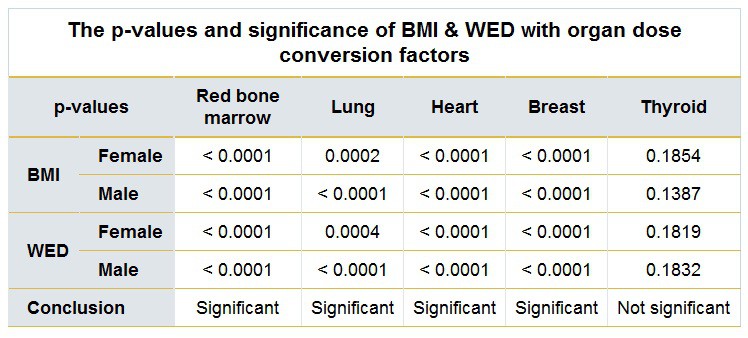
They observed significant linear correlations between the dose conversion factors and BMI, respectively WED, for both genders for the red bone marrow, lung, heart, and breast. The conversion factors fell with increasing BMI and WED, which can be explained by the extra shielding of the adipose tissue in patients with high BMI and WED. The researchers found nonsignificant results when correlating the BMI or WED with the thyroid dose conversion factors for both males and females (p > 0.05).
The results are summarized in the table below.
Two-tailed p-values to test the significance of the BMI and WED of the phantoms and the organ dose conversion factors inside the field-of-view
Study disclosures
The doctoral research of An Dedulle is supported by the Flanders Innovation & Entrepreneurship agency (grant number HBC.2016.0233). The work was conducted in cooperation with Qaelum and the University of Leuven.
A new experimental platform based on two misaligned graphene layers could be used to investigate strongly correlated physics – that is, the physics of systems in which the interactions between electrons lead to novel phenomena. The platform, which can be tuned by simply applying an electric field, could help shed important light on the underlying mechanisms at play in superconductors, in particular high-temperature ones based on cuprates, for which a fundamental understanding is still lacking.
A team of researchers led by Pablo Jarillo-Herrero of the Massachusetts Institute of Technology (MIT) in the US made the platform by stacking two sheets of atomic-thick carbon (graphene) on top of each other. They then twisted the sheets so that the angle between them, known as the (theoretically predicted) “magic angle”, was 1.1°. They found that the material became a superconductor (that is, it conducted electricity without resistance) at 1.7 K.
“We were not looking for superconductivity when we began our experiments,” explains Jarillo-Herrero. “We chose to study these structures because there were some theoretical predictions that interesting electronic properties would occur in the graphene moiré superlattice if the two layers were stacked at this angle. Our intuition also told us that there would be some interesting physics, but what we discovered went far beyond what we had anticipated.”
The researchers studied the conductivity of the graphene sheets by applying a voltage to them and then measuring the current that circulated through them. They also measured the density of the particles that carry electronic charge inside the sheets.
Two breakthrough results
“We found two things: first that we can electrically tune the graphene system so that it becomes a correlated insulator, which can happen thanks to electrons localized in the moiré superlattice. This ‘Mott’ insulator is a material that should be a metal but which, because of strong repulsion between electrons, does not conduct. We reported this result in the first of our two Nature papers published this week.
“Secondly, we found that by adding a few extra charge carriers to this insulator state (by applying a small electric field), we could tune the graphene superlattice so that it became a superconductor. This result is detailed in our second Nature paper.”
The researchers say that graphene superlattices containing a record-low 2D charge carrier density of about just 1011 per cm2 can become superconducting. This means that they can superconduct electricity with just 10-4 of the electron density of conventional superconductors (that work at temperatures near absolute zero, and which can be described by the well-established Bardeen–Cooper–Schreiffer theory of superconductivity).
This behaviour (the presence of an insulating state so close to the superconducting one) is characteristic of so-called unconventional, high-temperature superconductors, known as cuprates. These complex copper oxides can conduct electricity without resistance at the relatively “high” temperature of 133 K. Although physicists have been studying these materials for decades now, in their quest to make superconductors that work at even higher temperatures, and ideally at room-temperature, they are still unable to explain the fundamental mechanisms at play in them.
Magic-angle graphene is magic
“The technique to make our new misaligned graphene sounds simple, but it took years to perfect,” says Jarillo-Herrero. “The good thing, however, is that there are several groups around the world that can carry it out. There are also many other groups that will now be able to replicate it too and so use the platform to study unconventional superconductivity in a simple system.”
Normally, when researchers study high-temperature superconductors, they need to subject the materials to extremely high magnetic fields, he explains. With graphene, they might be able to do this by simply applying a modest magnetic field.
“First and foremost, our discovery represents an advance in terms of fundamental science, and we hope that it will allow us to gain insight into the properties of strongly correlated systems, such as high-temperature superconductors and quantum spin liquids,” he tells nanotechweb.org. “What is more, our platform is a general one and could be applied to any 2D material, not just graphene.”
Quantum computers and photodetectors might benefit
Although there might be many potential applications most of these are likely to be a way off, realistically speaking, he adds. “For example, the most advanced technology to make prototype quantum computers today are based on superconducting devices. Magic-angle graphene superlattices could offer us a new type of electrically tunable superconductor, and who knows, they might one day be exploited in quantum computation and information technologies.
“Superconductors are also used in many other applications, such as ultrasensitive detectors of light, so our result may perhaps have an impact there too.”
There is no doubt that graphene is an exceptional material in so many ways. Its unique properties, such as extremely high mechanical strength (it is stronger than steel) and extremely high electrical conductivity, with electrons zipping through it at near-ballistic speeds, have been known for a while now. Although researchers had already shown that it could behave like a superconductor before too, the superconductivity was only observed when it was in contact with other superconducting materials. What is more, this could mostly be explained by the Bardeen–Cooper–Schreiffer theory, so it was considered to be conventional.
“The relatively high superconducting temperature of 1.7 K of twisted bilayer graphene that we observed, with its charge carrier density of just 1011 per cm2, now also makes this material among the strongest coupling superconductors known,” adds Jarillo-Herrero. He says that the material might be working in a regime close to the crossover between the Bardeen–Cooper–Schrieffer regime and a Bose–Einstein condensate (a state of matter in which all the particles in a system condense into a single state), but confirming or refuting this will be the subject of future research.
How many people study physics and then go on to forge a career in environmental sciences? Perhaps not a huge number, but those who have a “physics mindset” often bring a fresh perspective to environmental research. Today an increasing number of physicists are helping to tackle some of the world’s most pressing environmental challenges. For Daniel Kammen, a self-confessed Star Trek fan and director of the Renewable and Appropriate Energy Laboratory at the University of California, Berkeley, US, the migration from physics to environmental science was serendipitous.
“My path was very random, driven by a love of physics and way too many interests,” he says. Initially, Kammen’s dream was to be an astronaut. “I learned to fly planes, took acrobatic and sea-plane landing lessons, but I was ultimately screened out of the NASA astronaut qualification on the basis of vision,” he explains. However, Kammen’s infectious enthusiasm for understanding the world around him soon opened many other doors.
While studying physics at Cornell University, Kammen learned about astronomy and cosmology, worked in the low-temperature physics laboratories and in solid-state physics, where he published his first papers on solid-state masers, and eagerly absorbed courses on electrodynamics, quantum mechanics and quantum field theory. Then at graduate school, first at Stanford University and then at Harvard University, he was drawn towards cosmology, computational physics and neural networks.
But it was while doing a postdoc in neural computing at Caltech that Kammen realized he could apply his talents to environmental problems. “During my summers I volunteered on an energy project, introducing solar ovens to communities in Nicaragua (the US was blockading the country at the time), and as a result I published my first paper on energy in Nature,” he says.
Accessing all energy
That chance volunteer work set Kammen’s career on the path of both academic and activist. For the last 25 years his focus has been finding solutions to the energy needs of developing countries. Today his passion is “energy access” and he works largely with communities in East Africa, Central America – including the country that originally inspired him, Nicaragua – and on Native American lands in the US. “Physics has provided me with the most amazing training, and I consistently use it today in work on solar cells, network studies of energy grids, and in dynamical systems methods applied to all sorts of things,” he says.
Physics has provided me with the most amazing training
Dan Kammen
Stepping sideways from physics into environmental sciences has required a flexible and open-minded approach, but Kammen relishes the challenge of learning new things. “I am keen to keep working in analytical methods and I always want to learn more in the humanities and social sciences, where I am just a baby,” says Kammen, who is editor-in-chief of the open-access journal Environmental Research Letters (produced by IOP Publishing, which also publishes Physics World).
Kammen’s unusual career trajectory led him to contribute to the Intergovernmental Panel on Climate Change (IPCC) in its early days; work which was rewarded in 2007 when the IPCC shared the Nobel Peace Prize. These days his goal is to “de-carbonize” society. Last year he joined a list of eminent scientists, business leaders, economists, analysts, influencers and representatives of non-governmental organizations to set up Mission 2020 – a collaborative campaign that aims “to bend the greenhouse-gas emissions curve downwards” by 2020. Over time Kammen’s research interests have taken many twists and turns, but his enthusiasm for Star Trek is one thing that hasn’t changed. “I still own Spock ears and generally win the game ‘identify the Star Trek episode with the shortest quote’,” he laughs.
Down to Earth
For Anny Cazenave – director for earth sciences at the International Space Science Institute in Bern, Switzerland and senior scientist at the Laboratoire d’Etudes en Géophysique et Océanographie Spatiales at the French space centre (CNES) in Toulouse, France – the journey to environmental science began with an interest in what lies beyond Earth. While doing her first degree in mathematics and physics, Cazenave, like Kammen, was fascinated by space, and had ambitions of becoming an astronomer. Gradually her interests evolved towards geophysics, and she did a PhD at the University of Toulouse on the rotation of the Earth. This led to a permanent position at CNES to develop satellite geodesy – the use of satellites to study the shape of the Earth, its gravity field and its rotation, solid Earth tides and so on.
Courtesy: istock\suprun
When Cazenave accepted the position, she had no inkling of how her work might transform environmental research. “At that time [the 1970s] environmental science was not at the forefront of space activities,” she explains.
It wasn’t until the mid-1990s, when satellite technology was far more advanced, that scientists began to fully explore the use of satellites for environmental applications. In particular altimeter satellites – which send a microwave pulse down to Earth and measure altitude from the time it takes the pulse to return – started employing two different wavelengths, massively increasing the resolution at which they could map the Earth’s surface.
Scientists, including Cazenave, spotted the potential of high-resolution satellites for mapping the peaks and troughs of the sea surface, and realized that they represented a new way of monitoring sea level changes and ocean circulation. “Although I was not an oceanographer, I learned about it while working,” says Cazenave. “At the beginning of the 2000s, I also started to develop hydrology from space – the study of terrestrial waters using space techniques.”
Interdisciplinary research needs hard work but it is highly motivating too, and I’m passionate about learning new things
Anny Cazenave
Today Cazenave’s focus is using satellite data to monitor climate change, for example, sea level rise, land ice melt, ocean thermal expansion and changes in the global water cycle. She feels that her original background in maths and physics has been a useful tool, but flexibility and willingness to learn have also been key to enabling her to move into a new field. “Interdisciplinary research needs hard work, to gain experience in the field in which we are a newcomer, but it is highly motivating too, and I’m passionate about learning new things,” she says.
Naturally outdoors
Unlike Kammen and Cazenave who came to environmental science via curiosity about space, Jennifer Burney of the University of California, San Diego, US, found her enthusiasm for the environment to be a consistent thread throughout her life. “I’ve always been an outdoorsy person, and growing up in New Mexico always had a strong interest in the natural world,” she explains.
Following a degree in history and science, Burney began a physics PhD at Stanford, developing a superconducting camera that captures images of cosmic bodies such as pulsars or exoplanets. Partway through her studies, Burney decided to defer for a year, so that she could volunteer with rebuilding efforts in Nicaragua after 1998’s Hurricane Mitch. “It was exciting to be in the field devising creative solutions,” she says.
After finishing her PhD, Burney’s desire to bring positive change to other people’s lives resurfaced and she followed a non-academic route, working for non-governmental organization the Solar Electric Light Fund on rural electrification around the world. “One project was solar-powered drip irrigation in West Africa,” she says. “They needed somebody to figure out how to evaluate the technology. That required assessing the design and how to make it cost-effective and sustainable.”
Over time Burney became intrigued by how energy and climate affect food security, water availability and agriculture, and in 2008 she transitioned back into academia via a postdoc at Stanford on food security and the environment. Her research has continued in this vein ever since. These days Burney investigates the couplings between human activity and the environment. However, her physics mindset is still at the forefront of everything she does.
I fundamentally see the world as a physicist, and ultimately most of my projects have that kind of ‘flavour’
Jennifer Burney
“I fundamentally see the world as a physicist, and ultimately most of my projects have that kind of ‘flavour’ – for example, in our projects trying to understand what role air pollutants play in impacting both climate and humans, I tend to think about how they change the radiative properties of the atmosphere and much less about the biological or chemical processes for example,” she says.
But Burney relishes the cross-disciplinary nature of her work. “You learn to see the world in a new way,” she says. And it is this willingness to see things from other people’s point of view, combined with a thirst for knowledge, that seems to have enabled Burney, Cazenave and Kammen to slide smoothly between physics and the environmental sciences. “Physics provides a fantastic toolkit, but environmental problems are the biggest challenge we have,” says Burney. “It will take all hands on deck.”
One of the challenges in using 3D printing to biofabricate cell-laden constructs for tissue repair and organ regeneration is ink optimization. Part of the puzzle is producing a printable blend, but that’s not the only consideration. It’s important to determine compositions that maximize the ability of cells to flourish and generate functional tissue.
“Here, factors such as the stiffness, composition and degradation rate of the ink play key roles in providing an appropriate niche to direct stem-cell fate,” explains Daniel Kelly, director of the Trinity Centre for Bioengineering, Ireland. “Highlights so far involve developing inks that can support vascular networks and engineer spatially complex tissues such as the osteochondral unit.”
Reporting their results in the journal Biofabrication, Kelly and his team have been comparing the performance of hydrogel bioinks by examining the printability of different blends and their capacity to support cartilage development.
Hydrogels (water-swollen polymers) have proven to be a useful addition to the mix. Softer versions of the material – with less cross-linking – favour the differentiation of cells, but construct developers also have to think about the mechanical integrity of their designs.
“This structural stability, often referred to as shape fidelity, is tightly related to the rheological properties of the bioink,” says Jos Malda, an expert in 3D bioprinting based at Utrecht University in the Netherlands. “An ideal bioink should exhibit shear-thinning behaviour – flowing as a low-viscosity fluid when extruded and behaving as a stable gel after printing.”
Malda points out that this transition should be as quick as possible to maintain the imposed shape, though the materials considerations don’t stop there. The target location of the biofabricated structure also adds to the list of design criteria and has led researchers to pursue a variety of solutions.
“The toughest applications revolve around implantation in mechanically challenging environments, which include bone, cartilage and tendons,” adds Malda. “To overcome such limitations we have been designing strategies to co-print bioinks with reinforcing thermoplastic polymers, hydrogels and microfibrous meshes.”
Fortunately, when it comes to screening potential bioinks there are some useful early indicators that can help to speed up the materials selection, particularly for characteristics such as printabilty and shape fidelity.
“Tests based on yield stress and viscosity measurements, coupled with observations of how printed bioink filaments deform due to gravity or surface-tension effects, have been proven as simple but effective approaches to evaluate bioink shape fidelity,” says Malda.
Writing up their findings in the journal Biofabrication, Malda and his colleagues highlight yield stress as a key factor in determining the bioprintability of hydrogels based on gelatin-methacryloyl and gellan gum for cartilage repair.
Adding to the appeal of 3D printed scaffolds are other developments such as being able to tune the release profile of the various active elements contained in the structure. “Increasingly, we are also designing bioinks to act as delivery systems to temporally control the release of genes, growth factors and other regulatory cues to cells within printed constructs,” Kelly reveals.
This article forms part of a series of reports reviewing progress on high-impact research originally published in the IOP Publishing journal Biofabrication.
An ultrathin material consisting of two misaligned sheets of graphene can be easily converted from being a Mott insulator to a superconductor. The surprising discovery, details of which were announced at the March meeting of the American Physical Society (APS), could lead to the development of materials with a range of engineered electronic properties.
Graphene is a sheet of carbon just one atom thick that has a wealth of unique and potentially useful electronic and mechanical properties. Graphene atoms are arranged in a hexagonal lattice and two or more atomic layers can be stacked upon each other to create bilayer and thicker stacks of carbon.
In the new work, which is published in twopapers in Nature, Pablo Jarillo-Herrero and colleagues at the Massachusetts Institute of Technology, Harvard University and Japan’s National Institute of Materials Science have shown that a graphene bilayer behaves as a Mott insulator when the two component sheets are oriented at a “magic angle”. In this form of matter, electrical conductivity is supressed by strong interactions between electrons. It can then be transformed into a superconductor by tweaking the electron density of the material
The researchers made their material by taking two sheets of graphene and rotating them out of alignment by a small angle of about 1°. Having the sheets at this magic angle creates a moiré lattice of atoms with a unit cell that is much larger than that of a single sheet of graphene. Electrons are localized at lattice sites and, under certain conditions, electrons can tunnel from one lattice site to another.
Each lattice site can accommodate a maximum of four electrons. If the electron density is high and the sites are all full, electrons cannot tunnel to neighbouring sites because there is no room for them – making the material an electrical insulator. However, if the density is lower and the sites are partially full, tunnelling can occur and the material is an electrical conductor.
By varying an electric field that is applied to the magic-angle bilayer, Jarillo-Herrero and colleagues can adjust the electron density of the material. At high density when the lattice sites contain four electrons each, the material is an insulator as expected. At lower densities and temperatures above about 4 K, the bilayer is a conductor – also as expected.
Unexpected insulator
However, something unexpected occurs at lower temperatures when the electron density is set so that each site contains one, two or three electrons. Instead of being a conductor, the material appears to be a Mott insulator – a state of matter that occurs when there is a strong interaction between electrons that inhibits tunnelling. The situation is even more interesting when the electron density is increased or decreased slightly away from two electrons per site. The material then becomes a superconductor with a transition temperature of about 1.7 K, which is surprisingly high given the relatively low electron density of the material.
The combination of a Mott-insulator phase and superconductivity is something that is also seen in some high-temperature superconductors, which tend to be 2D layered materials. As a result, magic-angle bilayers could provide important insights into the poorly-understood physics of these unconventional superconductors.
“Physicists now have an exciting new platform to probe the unusual properties of high-temperature superconductors, and possibly to design new materials that operate at even higher temperatures,” said Jarillo-Herrero at a news conference at the APS March meeting. “Usually you have to grow different classes of material to explore each different phase. We can explore all of the physics in one device electrically. It couldn’t get any simpler.”
Jarillo-Herrero also pointed out that the structures could be used to create devices with a range of useful electronic properties. “One can also imagine making a superconducting transistor out of graphene, which you can switch on and off, from superconducting to insulating,” he says. “That opens many possibilities for quantum devices.”
Arizona State University (ASU) has put the astrophysicist Lawrence Krauss on paid leave following allegations of sexual misconduct that appeared last month in Buzzfeed. Krauss is a prominent physicist and is founder and director of ASU’s Origins Project. He has also written several popular-science books and appeared in TV documentaries. The Origins Project is set to celebrate its 10th anniversary with a series of events between 5-9 April. It is not known whether this will now go ahead.
Following the allegations, ASU stated that the university had not received any complaints from ASU students, faculty or staff about Krauss. However, it added that it had begun a review on 22 February “to discern the facts” and encouraged “anyone who has concerns about faculty, staff or students to report those concerns”.
Yet in a statement released yesterday, and seen by Physics World, the university has now banned Krauss from the ASU campus. “In an effort to avoid further disruption to the normal course of business as the university continues to gather facts about the allegations, Krauss has been placed on paid leave and is prohibited from being on campus for the duration of the review,” the statement says.
ASU insists that no further details about the review will be released until it is complete. “The university encourages anyone in our community who has concerns about interactions with faculty, staff or students to report those concerns,” it says, adding that the university provides multiple reporting options, including “through the Office of Student Rights and Responsibilities, the Office of Equity and Inclusion or by calling the ASU Hotline”.
A valued member
Krauss has also resigned as chairman of the Bulletin of Atomic Scientists, which is best-known for its “Doomsday Clock”. The closer the clock is to midnight, the more likely it is that nuclear war or climate change will lead to catastrophe. In a press conference in January, attended by Krauss, the clock was moved forward to read two minutes to midnight.
Buzzfeed was provided with abundant counter-evidence that was ignored or distorted in their story
Lawrence Krauss
In a letter dated 6 March to Rachel Bronson, president and chief-executive officer of the Bulletin, Krauss denied the allegations in the Buzzfeed article claiming they were “incorrect”. “Buzzfeed was provided with abundant counter-evidence that was ignored or distorted in their story,” he wrote. “The board feels that as a result of the various reactions to the article my presence on the Board of Sponsors at this time distracts from the ability of the Bulletin to effectively carry out that work,” he added.
In a short statement, Bronson noted that Krauss “has been a valued member of the Board, and has greatly contributed to the Bulletin’s mission during this perilous moment in global affairs”.
The news comes as several events have cancelled appearances that Krauss was due to make including the American Physical Society, which announced that he would not be speaking at its April meeting that will be held in Columbus, Ohio, on 14-17 April. He was supposed to be speaking at a session on the legacy of Richard Feynman.
Update 8 March: Lawrence Krauss has published a nine-page response to the Buzzfeed allegations while ASU has reportedly cancelled the event celebrating the 10th anniversary of the Origins Project.
Carbon pricing offers economic incentives to mitigate global greenhouse-gas emissions and encourage investment in cleaner technology. But how do initiatives operating in one country affect prices in another? And how does the picture change if the carbon price is applied at the point where fossil fuels are extracted from the ground, rather than focusing on their use or on the sale of the resulting goods and services?
Jonas Karstensen and Glen Peters from Norway’s CICERO Center for International Climate Research found that using different accounting systems makes a significant difference to revenues and expenditure. In addition, the team highlights that domestic and global trade play a key role in spreading the carbon price between sectors and countries.
Examples of carbon pricing include a tax on the carbon content of fossil fuels, and emissions trading systems that cap the total level of emissions and allow industries with low emissions to sell their extra allowances to larger emitters. So far, at least 40 countries, including seven out of ten of the world’s largest economies, have put in place some form of carbon pricing. The various initiatives translate to around 13% of yearly global greenhouse-gas emissions.
Reporting their results in Environmental Research Letters (ERL), Karstensen and Peters showed that while rising carbon costs bring large relative price increases in the electricity and energy-intensive sectors, the biggest absolute increases in expenditure are in non-energy-intensive and service sectors.
“It’s the volume of expenditure that matters most when considering carbon pricing, not necessarily how much emissions are required to produce a single product,” Peters told environmentalresearchweb. “Ultimately, households bear most of the costs, rather than governments or capital investments.”
Exploring global patterns, the scientists found that emissions income becomes more evenly distributed among nations when the point of accounting is shifted from mining through to production and consumption. The EU’s carbon price revenue jumped by more than €40 billion when the study associated emissions with production rather than mining, reflecting small fossil-fuel reserves and large imports.
“Because of the implementation challenges, climate policies are often a mosaic of different policy levers, but over time we could see carbon pricing initiatives becoming more uniform – in response to industry and consumer demand,” said Peters. “Theoretically, a gradually rising carbon price would be the optimal solution, so long as distortions and exemptions were kept to a minimum, and there was confidence that the carbon price would remain in place for the long-term.”
A three-dimensional (3D) bone-on-a-chip with the potential to study cancer metastasis has been developed by researchers at The Pennsylvania State University. The bone-on-a-chip was designed within a microfluidic device – a miniaturized chamber that is continuously fed with nutrient-containing fluids to support the growth of micron-scale bone tissue (Small doi: 10.1002/smll.201702787).
The device demonstrated the ability to support the attachment, growth and spontaneous differentiation of osteoblasts (bone-forming cells) for up to 30 days. The researchers grew the cells on glass inside a cell culture chamber, which received nutrient-containing medium through a dialysis membrane. They observed that the forming bone tissues were able to mature and produce sufficient amounts of alkaline phosphatase (ALP) enzyme and collagen proteins, and accumulate hydroxyapatite minerals – all important for forming bone with structural integrity and functional relevance to real bone.
After maturation of the bone tissue, the team introduced breast cancer cells, mimicking the metastasis of breast cancer to bone. The researchers found that some breast cancer cells were dormant (or quiet) in the 3D bone environment, without any invasive behaviour and showing no noticeable effect on the bone.
On the other hand, they saw that aggressive breast cancer cells were highly invasive in the 3D bone. These cancer cells dug themselves into the bone by eroding the collagen and consuming the bone matrix, resulting in the formation of large holes in the 3D bone. After two weeks, the aggressive breast cancer cells had integrated themselves into the bone.
The 5-year survival rate of patients with breast cancer drops below 30% when the cancer spreads to other parts of the body, with 70% of such metastasis travelling to bone. Once cancer finds its way to bone, it is virtually incurable. For this reason, it is imperative to understand the interactions between cancer cells and bone. The researchers in this study constructed a model that can help reveal the mechanisms behind bone metastasis. With better understanding of the disease using such platforms, therapeutic targets could be developed to treat and prevent metastasis from occurring.
Perhaps if I had put any effort into selling “Joseph Swan” to readers, the name might have got a little further. It isn’t just that a business is like a swan – both look graceful and beautiful from a distance yet face a frantic struggle to take off. More importantly, a column named after Sir Joseph Wilson Swan (1828–1914) would have recognized the efforts of this great British physicist and chemist, who also – you might be surprised to learn – was the inventor of the light bulb.
Swan’s way
Thomas Edison might be the name that people most closely associate with the invention of the light bulb, but it was Swan who was responsible for developing and supplying the electric lights used in the world’s first electrically lit homes and public buildings, including the Savoy Theatre in London, in 1881. Swan had patented his design in 1869 but the trouble with patents is they force you to explain how your invention works. So if you don’t follow through rapidly you can expect competition. And so it proved with the light bulb. Edison’s version, which he patented in 1879, may have merely improved on Swan’s efforts, but ultimately it was more successful.
But why did Swan not do better? After all, the general principle of the incandescent light bulb is simple: if you send an electrical current through a filament, it heats up and glows, producing light. But what’s important is that the interior of the bulb is a vacuum so the filament doesn’t oxidize and lasts a long time. The vacuum in Swan’s bulb was so poor that the filament – made from carbonized paper – disintegrated rapidly and the bulb glowed for barely 15 hours.
Swan’s bulb also had a low resistance, which sounds good until you realize that it meant a high current flowing through the first bulbs. The only practical way to stop the bulb from burning out was therefore to place multiple bulbs in series, but this meant that if one bulb popped, all the lights went out. Swan worked on his bulb product and later patented a better version based on a higher resistance filament at a similar time to Edison – but not before giving his competitors plenty of time to get into the light-bulb business.
Edison had other advantages too. He had a better vacuum pump earlier. He was well funded (from the sale of his telegraph business) and his team tested thousands of materials at his Menlo Park facility in New Jersey, including a higher-resistance filament derived from bamboo. It lasted up to 1200 hours and could be used in parallel circuits, thereby avoiding the all-lights-out-if-one-bulb-pops scenario. And as there was no electrical infrastructure at the time, Edison designed his bulb with the whole system in mind.
Let there be light
To see why Edison’s bulb succeeded, let’s recall the technologies available in the 1880s to deliver light to homes and businesses when the Sun went down. The options were mostly fire based: candles, gas lights and oil lamps. Whale oil was particularly popular as it burned the brightest and didn’t produce much soot – this was a major reason why whales were hunted. The problem was that each source of light had to be individually lit every evening and then put out before you went to bed.
The beauty for businesses was that electric light was a “closed” system, with every manufacturer having their own bulbs, voltages and forms of DC distribution
James McKenzie
Electric light was a revelation. It was clean, relatively safe and multiple lights could be switched on and off simultaneously. In short, everyone wanted it. The beauty for businesses was that it was a “closed” system, with every manufacturer having their own bulbs, voltages and forms of DC distribution. Customers were forced to keep buying from the same firm – Edison’s in Edison’s case.
Edison therefore benefited from four things: a well-thought-through system; a good business model; a working product that was much better than the competition; and patents. As a result, he attracted huge investment from J P Morgan and many others to roll out his electrical DC infrastructure around the world. As the market grew, however, Edison faced growing competition himself, particularly from the alternating-current (AC) system developed by the Westinghouse Electric Corporation. The battle of the currents raged for more than two decades and, ultimately, his DC system itself lost out because AC was better at long-distance transmission.
Lessons from Edison
The physics of both Swan’s and Edison’s bulbs was exactly the same, but it was Edison’s design and product implementation that led him to succeed and spawn a business – General Electric – that is still around today. Yes, Swan patented first and was a successful inventor and entrepreneur. He even sued Edison for patent infringement, with the British courts ruling against Edison, who was forced to make Swan a partner in his UK firm Ediswan. But it is Edison who is recognized as the father of a global revolution.
To succeed in business, you not only need to solve a problem but also work hard on the features and benefits of your product. And that’s why I wanted to call the column Joseph Swan. Still, Transactions is a very good name.
Photoreceptors made from titanium dioxide nanowires coated with gold nanoparticles could restore vision in blind mice. The devices, which respond to green, blue and near-ultraviolet light when interfaced with the retina of the animals, might help in the development of improved ocular prosthetics that do not require external power sources.
Diseases like retinitis pigmentosa or age-related macular degeneration can irreversibly damage retinal photoreceptors. This leads to vision impairment and eventually blindness, even though the retinal neurons involved in signal processing and the optic nerve remain functional. There is currently no medical treatment for these diseases but researchers have been working on replacing these lost photoreceptors with artificial ones, such as those made from photodiode arrays, for example.
While showing promise, these devices are far from being optimized, with the most important problem being that they require an external power supply and microelectronic processing units. Wiring such hardware into the eye is not only very challenging technically, it is also, needless to say extremely traumatic for a patient.
1D semiconductor nanowire arrays
A team of researchers led by Gengfeng Zheng and Jiayi Zhang of Fudan University in Shanghai, China, have been studying 1D semiconductor nanowire arrays made from titanium dioxide (TiO2) and gold (Au) as possible alternative implants here.
In contrast to previous photoresponsive structures, the 1D nanowire arrays are extremely well aligned in one direction, which means that they are structurally very similar to biological photoreceptors. They can thus very efficiently absorb light and separate charges (electrons and holes) to produce a photocurrent (in the same way as photoconversion devices such as solar cells and photodetectors), so eliminating the need for trans-ocular cables or power supplies. The photocurrent they produce can then be passed to neighbouring retinal neurons to stimulate them so that they fire a signal to the brain.
Restoring the visual response
Zheng and Zhang made their oriented Au-TiO2 arrays by growing them on fluorine-doped tin oxide (FTO) or flexible polymer substrates using a hydrothermal technique. They then decorated the surface of the arrays with gold nanoparticles, which allow the arrays to efficiently photoconvert light in the visible range (as measured by UV-visible absorption spectroscopy). This is because the particles amplify the light electrical field and inject “hot electrons” generated by surface plasmons (collective excitations of conduction electrons at the surface of the gold) into the TiO2 conduction band. These hot electrons then recombine with holes to produce a photocurrent.
In their experiments, the researchers interfaced the nanowire arrays with degenerated retinas in the right eyes of blind mice. The left eyes served as a control.
They found that the arrays are able to restore electrical signalling in the mice retinal ganglion cells when the rodents are exposed to green, blue and near UV light. “More excitingly, we saw that sub-retinally implanted nanowire arrays evoke activity in the primary visual cortex in vivo as well as improved pupil dilation in response to light in the animals. Light-sensitivity, and thus visual function, is restored in about 4–8 weeks in the implanted eyes compared to controls,” says Zhang.
New treatment options for people at risk
Zheng and Zhang believe that their new study could open new treatment options for people at risk of long-term visual degeneration. “Our work could help in the development of a new generation of optoelectronic tool kits for sub-retinal prosthetic devices in human patients one day,” they tell nanotechweb.org.
The researchers, reporting their work in Nature Communications doi:10.1038/s41467-018-03212-0, say that they are now busy improving the nanowire arrays’ sensitivity and their response to the colour red. “We will also be performing more experiments that measure the visual acuity in mice with degenerated retinas,” adds Zheng


 Body size has an influence on the dose conversion factors of a conventional chest posteroanterior (PA) examination for the organs in the field-of-view, except for the thyroid, according to an award-winning Belgian study presented last week at ECR 2018.