Food truck fuels the imagination

Without doubt the most unusual exhibit at this year’s APS March Meeting was the “Food Truck for the Physics Mind”, the brainchild of educational specialists TeachSpin. Founded in 1994 by Jonathan Reichert, a physics professor at the State University of New York, Buffalo, TeachSpin devises and builds sophisticated experiments to allow undergraduate students to explore key concepts in physics and to understand how different instruments can be used to probe a range of physical phenomena.

The 44-foot food truck allows the TeachSpin team to take 20 experiments out on the road, allowing students and faculty at colleges across the United States to get hands-on experience with research-grade instrumentation. The mobile teaching laboratory has already made stops at more than 30 institutions, with more planned in California immediately after the APS meeting.

Reichert told me that he originally set up the company to provide more undergraduates with access to advanced laboratory experiments that can be used both to teach core physics principles and to allow students to produce meaningful data for experimental projects. “Of 750 institutions offering undergraduate degrees in physics, less than half provide advanced laboratories to their students,” he said. “But the advanced lab is a critical educational experience for a physics major.”

A quick tour of the food truck reveals advanced experiments in areas such as diode laser spectroscopy and optical pumping of rubidium vapour, Fourier techniques, two-slit interference one photon at a time, and a suite of experiments for condensed matter physics. But Reichert himself is most closely associated with an instrument designed for teaching pulsed nuclear magnetic resonance (NMR), which includes a spectrometer capable of one-dimensional imaging.

Hundreds of TeachSpin’s experiments are now installed in teaching laboratories all over the world, including the University of Cambridge in the UK – where Reichart says the pulsed NMR experiment has proved particularly popular. The company is run as a foundation, with all the profits used to support the education of undergraduates students through advanced physics laboratories.

“Your students deserve to have this experience,” Reichert enthuses. “Little compares to the excitement of using modern apparatus, and they mind find the laboratory the highlight of their undergraduate education.”

Heart attacks can rise during extremes of heat

Extremes of heat are dangerous. Just how dangerous is still being established. But since heat waves are on the way, city-dwellers need to know.

Extremes of heat can break your heart. Climate change can kill. The risk of heart attack increases by every 5°C leap in temperature differential, according to new research.

That is: on a baking summer day there could be nearly twice as many heart attacks on those days when the temperature swings by 35° to 40°C than on days when there is no such wild fluctuation.

Studies of the link between heat and health matter, because the past decade in North America has now been confirmed as the hottest for 11,000 years.

Climate scientists have repeatedly warned of the dangers of ever more intense and frequent heat extremes as the global average temperatures creep up, and two new studies have identified different ways in which cities themselves can become danger zones for vulnerable people.

One is that, as regional climates change in response to ever-increasing combustion of fossil fuels, which then intensify the greenhouse gas ratios in the global atmosphere, cities in now-arid regions will suffer ever more severe heatwaves, even though their rural hinterlands may enjoy higher rainfall.

And the second is that, in some cities, urban planning may have already provided ways to intensify or mitigate the impact of summer heat waves. It’s a simple but unexpected outcome of atomic physics.

Increasing fluctuation

All four studies are evidence of the subtle and often intricate connections between human civilisation and climate, and of the consequences of the simple question: what happens to communities and landscapes as average temperatures go up?

“Global warming is expected to cause extreme weather events, which may, in turn, result in large day-to-day fluctuations in temperature,” said Hedvig Andersson, a cardiology researcher at the University of Michigan.

“Our study suggests that such fluctuations in outdoor temperature could potentially lead to an increased number of heart attacks and affect global cardiac health in the future.”

She told the American College of Cardiology 67th annual scientific session that she and colleagues looked at data from 30,000 patients treated in 45 Michigan hospitals between 2010 and 2016, and then matched the patients with temperature fluctuations on the day of the attack.

Such a study cannot prove that temperature swings actually cause attacks, but there is what scientists call an association: rapid and extreme fluctuations seem to be accompanied by more cases of myocardial infarction, a serious form of heart attack.

Urban vulnerability

That heat is dangerous is not a surprise: heatwaves in the last 30 years have risen three times faster than average temperatures as a whole, and one study has identified 27 different ways in which heat waves can kill. And the greatest concentrations of potential victims will be in the cities.

The crowded urban spaces of America and Europe spread across landscapes warmer than at any time since the end of the Ice Age. US researchers report in the journal Nature that they collected fossil pollens from 642 ponds and lake beds across Europe and North America, to provide a record of local temperature shifts in the last 11,700 years, to conclude that – without global warming as a consequence of profligate human use of fossil fuels – the world ought to be in a cool phase.

“It does show that what has happened in the last 30 years — a warming trend — puts us outside of all but the most extreme single years every 500 years since the Ice Age. The last 10 years have, on average, been as warm as a normal one year in 500 warm spell,” said Bryan Shuman, an earth scientist at the University of Wyoming, and one of the authors.

Whatever the average regional temperature, it’s hotter in the cities, because concentrations of traffic, business, heating, cooking, lighting and air conditioning generate what has become known as the urban heat island effect: what makes this worse is that the asphalt, tarmacadam, stone, brick, glass and tile of which cities are made absorb radiation but prevent ground evaporation as a natural cooling device.

Researchers from Princeton University report in the journal Environmental Research Letters that they considered how future heat waves will play into the urban heat island effect in 50 US cities.

For the rest of this century, cities in the east and southeast of the US will be more severely affected: less so the cities in the arid parts of the American west.

But by 2100, this could change dramatically. Rainfall and heat extremes will increase. Cities such as Phoenix, Arizona will continue to face water shortages – once again, all that impermeable concrete and sealed highway – but climate change could make the surrounding countryside somewhat moister.

The message, once again, is that what keeps a city cool is moisture: the vapour evaporated from canals and rivers or transpired through green parks and treelined boulevards.

“Given that 50% of the world’s population currently lives in cities, and that percentage is projected to increase to 70% by year 2050, there is a pressing need to understand how cities and landscapes are affected by heat waves,” said Lei Zhao of Princeton’s Woodrow Wilson School of Public and International Affairs.

“Our study explains why cities suffer even more during extreme heat events and highlights the heat risks that urban residents face now and in the projected future.”

Seeking mitigation

The researchers say the hunt should be on for heat mitigation strategies. But a surprising study in the journal Physical Review Letters suggests that some of the problems – and the solution – may have already been built into the fabric of the modern metropolis.

A team of materials scientists and engineers simply considered the city as crystalline or glass-like: that is, was the city laid out on a planned, orderly grid system? Or did it just grow up, in an organic, disorderly fashion?

They applied the tools of classical physics normally used to analyse atomic structures. They looked at satellite images of 47 cities in the US and beyond, and graded them according to their order, or disorder. Grid cities absorbed heat compared to their surroundings far faster than the so-called glass-like cities.

Since urban populations are growing, and new cities springing up everywhere, classical physics can help in unexpected ways. “If you’re planning a new section of Phoenix,” said Roland Pellenq of the Massachusetts Institute of Technology, “you don’t want to build on a grid, since it’s already a very hot place. But somewhere in Canada, a mayor may say no, we’ll choose to use the grid, to keep the city warmer.”

The effects are significant. He and colleagues found, for example, that in the state of Florida alone urban heat island effects cause an estimated $400 million in excess costs for air conditioning. “This gives a strategy for urban planners,” he says. – Climate News Network

• This report was first published in Climate News Network

Pre-natal alcohol exposure alters functional connectivity

Here’s a sobering thought: children born to mothers who consume large amounts of alcohol during pregnancy have been found to have altered connectivity in their brain networks. Specifically, abnormal functional connections between sensorimotor areas and hubs of the “default mode” and “salience” networks (involved in motor function, cognitive control, emotions and consciousness) suggest that children with pre-natal alcohol exposure (PAE) recruit additional brain regions for sensorimotor tasks, which could imply poorer brain network efficiency. This work was performed by researchers at the Universities of Calgary and Alberta, and will help further investigations concerning sensorimotor alterations in youths with PAE (Human Brain Mapping doi: 10.1002/hbm.24004).

Foetal alcohol spectrum disorders (FASD) describe a range of effects and symptoms caused by PAE. Sufferers may have difficulties in cognition, such as learning or remembering, motor coordination problems, and sensory processing deficits. They are also at greater risk of developing mental health illnesses such as ADHD and depression. Previous research has shown abnormalities in brain function and structure, but there are only a few articles, which investigated resting-state (rs) networks in PAE, using functional MRI (fMRI).

Everything is connected

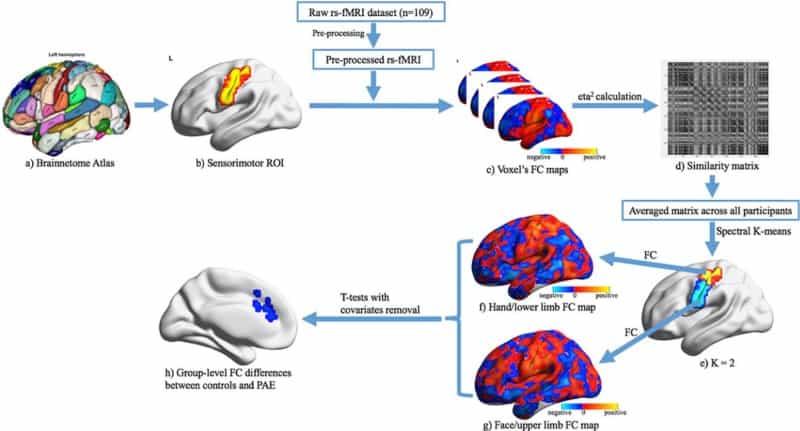
Typical fMRI studies involve the participant performing a task, or experiencing a stimulus passively. A blood-oxygenation level dependent (BOLD) signal is measured, which itself is an indirect measure of neural activity over time. In rs-fMRI, there is no task, but instead, researchers measure stimulus-free brain-states, and by using connectivity analyses, can observe background functional networks (spontaneous BOLD signal fluctuations between regions that are temporally correlated). In this study, the researchers performed rs-fMRI on 59 participants with PAE and 50 controls, with data acquired across multiple centres.

Analysis pipeline

The researchers calculated functional connectivity (FC) maps for each participant, based on a seed region in sensorimotor cortex. They generated an average similarity matrix of FC between each voxel and every other voxel within the sensorimotor region of interest (ROI). They classified two cluster ROIs, corresponding to the hand/upper limb area and the face/lower limb area. Finally, they generated FC maps between these two regions and the rest of the grey matter of the brain.

Alterations in functional connectivity

The organization of somatosensory cortex in controls and PAE participants was very similar, suggesting that there is no large disruption to sensorimotor organization, regardless of motor skill deficits.

There were, however, significant group differences in functional connectivity. For PAE participants, the researchers observed higher FC from the seed regions in sensorimotor regions to the insula and anterior cingulate (the salience network – how we perceive certain stimuli relative to other background stimuli). They also saw a decrease in FC from the seed to the superior temporal gyrus and precuneus (hubs of the default mode network – a network that activates during wakeful resting).

These FC abnormalities could imply abnormal interactions between cognition and motor functions, and could affect areas associated with face processing, emotions and memory. The decreases in FC were observed in regions that are involved in manual coordination and sensorimotor processing.

The team performed a comparison of FC across age. While they observed an increase in FC in controls (between facial sensorimotor regions and the insula) across time, this was absent in PAE participants. The authors suggest that altered development could be related to altered cognitive-motor development, noting its potential use as a biomarker.

The findings of this study show that although the topographic organization of sensorimotor areas is seemingly unaffected in PAE, there is higher FC between sensorimotor seed regions and salience and executive networks. This could be explained by an overcompensation mechanism, whereby more regions in sensorimotor networks are recruited than usual, implying a less efficient network.

3D printing yields customized spinal implants

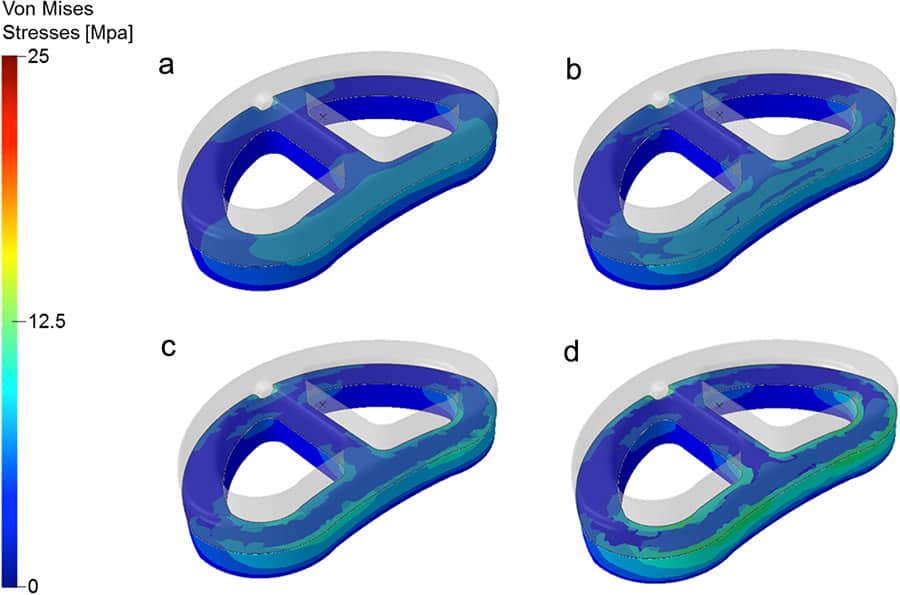
Von Mises stress distribution for the (cross-section) of model of lumbar cage design

Researchers in the UK recently designed and fabricated anatomically shaped spinal implants using additive manufacturing for the first time. The work, published in the journal Biofabrication, will help in the development of customized implants in the future using data from patients’ own CT and MRI scans.

“The publication of our paper has helped us secure a number of new national and international collaborations,” says team leader Deepak Kalaskar of University College London. “Thanks to these, we are now developing complete custom-made solutions for spinal surgery that combine our current work on spinal implants and newly started studies for developing medical devices and instruments to improve surgical outcomes for complex spinal surgeries – such as those required for treating scoliosis. This work is being funded by Orthopaedic Research UK.”

And that is not all: by closely collaborating with clinicians, Kalaskar and colleagues now have realistic computational models that take into account various patient factors, including the type and severity of their spinal diseases. These models can easily be adopted by hospitals and are a base for further refining implant design using patients’ own pre-operative CT or MRI scans.

There have been several publications in this area from the wider scientific community since the publication of the Biofabrication paper and there is a flurry of interest in the subject across academia and industry. “Our work has been cited by 10 publications within one year of being published, and NewsRX, a US-based tech company, also published an article [in Biotech Weekly] on our research in July 2017 entitled ‘3D printing in spinal surgery’, calling it ‘cutting edge’.”

The researchers say they are now working with an industrial partner to develop custom-built spinal implants. “We have developed computational validation methods and processes to test these implants using individual patient data and will be further validating these via laboratory testing to confirm their translational potential,” says Kalaskar.

Such tests include morphological analysis using scanning electron microscopy, wettability, mechanical evaluation, microstructure analysis using X-ray microcomputed tomography, topographical evaluation at the nanoscale by atomic force microscopy, and measuring the in vitro biological response of the implants.

Coming into its own

Lower back pain is a common affliction in industrialized nations and affects no less than 80% of adults during their lifetime. Severe low back pain is often linked to the degeneration of intervertebral discs and the most widely used surgical procedure to treat this problem, apart from replacing discs completely, is lumbar fusion. Here, surgeons implant an inter-body cage packed with bone graft to promote how bone grows and fuses with the spinal vertebrae.

Most cages available today are made of titanium or polyether ether ketone (PEEK), but neither of these types of device are ideal since they can only be produced in “standard” sizes that are often either too big or too small for individual patients. Anatomically shaped and perfectly matched implants would, of course, be much better since they would fit more neatly and allow bone to heal faster.

Additive manufacturing, or 3D printing as it is more commonly known, is coming into its own here because it can be used to cost-effectively fabricate customized 3D structures with complex geometries. Equally important, those structures can be reproduced perfectly.

In their Biofabrication paper, Kalaskar and colleagues describe how they designed, developed and manufactured anatomical 3D-printed lumbar cages based on a novel composite POSS-PCU – a biomaterial that has already proved itself to be promising for use in a variety of medical device applications.

New directions

The research fits in with the team’s wider research programme, which focuses on developing bespoke implants and devices for musculoskeletal disorders (such as intervertebral disc degeneration and scoliosis) and for repairing and reconstructing various bone defects and providing synthetic replacements for the repair of tendons and ligaments.

The group is also looking into biofabricating bone and cartilage tissue, which will hopefully help replace diseased or degenerated tissues. The programme brings together the group’s expertise in biomaterials, patient imaging and data analysis, computational modelling and manufacturing technologies.

“While we found 3D printing to be a good technique for printing anatomically shaped implants,” Kalaskar adds, “we are now asking ourselves several questions as regards to reproducibility, scalability and tolerance of additive manufacturing processes. Answering these questions will be essential for clinical translation.”

  • This article is one of a series of reports reviewing progress on high-impact research originally published in the IOP Publishing journal Biofabrication.

Superconductivity research gets more structured

Although you might expect quantum phenomena and nanotechnology to walk hand in hand, a lot of superconductivity research has focused on material chemistry rather than material structures.  However of late there seems to be an evident coupling between fundamental advances in superconductivity research and nanoscale science and technology – in particular 2D materials, as highlighted by the coinciding release of papers reporting superconductivity in graphene and 2D topologies in both Nature and Science this week.

The Nature paper focuses on graphene, which has previously been coerced into exhibiting superconducting properties through doping or a proximity effect when it is next to a superconducting material. As nanotechweb.org‘s freelance contributor Belle Dumé describes in her tech update, and Susan Curtis reports in Physics World, the superconducting properties in slightly twisted bilayer graphene reported this week arise in the absence of these approaches, and at record low carrier densities with the relatively high transition temperature of 1.7 K. (Superconductivity is one of the few fields where 1.7 degrees above absolute zero can be described as “high temperature”.)

The paper in Science reports on an iron-based superconductor – a type of material that can have really high transition temperatures (i.e. only a couple of a hundred degrees below freezing). Hong Ding, Shik Shin and colleagues in Japan, the US and China report 2D topologically superconducting surface states in FeTe1-xSex with a transition temperature of 14.5 K for x = 0.45. The significance of this observation is that it could host Majorana states for applications in topological quantum computing.

Of course certain nanostructures have been familiar features in superconductivity papers already, particularly when it comes to efforts towards applications using superconductivity. For example, a lot of these endeavours hinge in some way around some type of Josephson junction, often built from nanowires. However, big headlines marrying nanotechnology and superconductivity research have been arguably less common, and the recent rise in frequency of significant reports of superconductivity in nanostructures – from twisted bilayer graphene and 2D topological surface states in in FeTe1-xSex to stanene, superconductor-wrapped nanowires and nanorod powders to name a few from the past few weeks alone  – hints at the two fields simultaneously reaching points where their symbiosis can be really fruitful.

There’s a full in-depth report on the superconductivity “pairing up with nanotechnology” on nanotechweb.org.


Sci-fi future beckons for autonomous systems

On Wednesday Sarah Tesh and I took some time out of the APS March Meeting to visit the California Institute of Technology, just a 20-minute ride away from downtown Los Angeles. The focus of our visit was the newly opened Centre for Autonomous Systems Technology (CAST), which brings together Caltech’s expertise in such fields as robotics, space and Earth exploration to build futuristic systems that can adapt and respond to their surroundings.

Mory Gharib, director of the CAST facility, told us that the centre is working towards five different “moonshots” – ambitious visions that help to inspire and direct the research effort. As an example, the “explorers” challenge seeks to build integrated systems – most likely a combination of flying, walking and swimming devices – that can navigate unfamiliar environments and react to emerging situations.

An important step towards that goal is to build bipedal robots that can walk on different terrains. Robotics expert Aaron Ames showed us the latest iteration, dubbed Cassie, which can control its own gait and balance to walk unaided around the Caltech campus. But Ames also showed us amusing videos that show even the newest R&D devices falling over when walking on compressible materials such as sand.

Gharib, meanwhile, is focusing his efforts on the “transporters” moonshot, which is in part is attempting to build flying ambulances that could act as a first response for injured people in hard-to-reach locations. “The battery technology is already good enough for us to fly a machine at 75 miles per hour for about 15 to 20 minutes,” he says. “That would be enough to get a person to hospital, or to remove people from dangerous situations, such as a fire.”

Gharib and his team have built a working model one-fifth the size of the final design, which would eventually be about the size of a Toyota Prius, and have tested it in a specially constructed wind tunnel that has an array of almost 1300 fans to generate real-world weather conditions with wind speeds of up to 44 mph. Vertical take-off remains an engineering challenge, but the biggest hurdle will be to make such flying systems truly autonomous. “They will need to survive and operate without human intervention,” Gharib explains. “We want them to interact with their surroundings and react accordingly.”

Gharib believes that the wind-tunnel tests will help to ensure that the flying devices can negotiate different weather conditions. “We are using human reactions as a leapfrog for our learning,” he says. “We use the wind tunnel to create different types of turbulence, and we monitor the reaction of a human operator to see how the machine can be kept on course. The output from the remote control, along with positioning data from a series of cameras, can then be used to train a machine learning system.”

Gharib admits that the vision of fully autonomous systems may not be realized for many years, but he believes that the moonshoot approach provides a powerful impetus for such interdisciplinary research. And despite having such an ambitious destination, he is confident that many useful technologies will emerge during the journey. “The moonshots are really a teaser to inspire and excite the scientists and students,” he says. “But the best fruit will be the technologies we develop along the way, just as the journey to the moon produced many of the technologies we use today.”

And if all this talk of thinking machines sounds a bit scary, Gharib stresses that Caltech’s intention is to create machines that work alongside us to achieve new things. “We need machines that help us discover new things,” he says. “Here at Caltech we want to create autonomous tools that will work as partners to help us do better science and engineering, and to do our jobs better.”

Looking at mental-health issues in academia

Academics are one of the occupational groups with the highest incidence of mental illness, according to a recent report on mental health in education by RAND Europe for the Royal Society and Wellcome Trust. According to the report, the risk of postgraduates and university staff having or developing mental-health problems is generally higher than many other working populations. In addition, the levels of work-related stress are comparable to groups classified as “high risk”, such as health-care workers.

The cover feature in the March issue of Physics World magazine shines a light on this problem through the eyes of one physicist in the UK. The story of their seemingly endless struggles highlights  how the academic community doesn’t neccessarily handle mental-health problems well, both in terms of attitudes at a personal level and the support offered at an institutional scale. Indeed, the physicist in question chose to write the article anonymously to avoid their problems being publicly known.

In the video above, I outline our rationale for publishing the feature and explain why it’s an important topic to cover. You may also wish to look at the “Resilience toolkit”, created by the Institute of Physics (IOP), which publishes Physics World.

Remember that, as always, selected articles from Physics World magazine will appear on this website over the course of the month, but if you’re a member of the IOP you can read the entire March issue right now in digital format.


China unveils plans for next-generation X-ray observatory

China is planning to build a next-generation X-ray observatory that will study some of the most violent objects in the universe such as black holes, neutron stars and quark stars. The enhanced X-ray Timing and Polarimetry mission (eXTP), which is estimated to cost about three billion yuan (£340m), will be launched by 2025 and involve collaboration with European scientists.

At a kick-off meeting on 2 March held in Beijing at the National Space Science Center, the Chinese Academy of Sciences (CAS), CAS vice president Bin Xiangli put his support behind the mission noting that it should become “China’s flagship science satellite”. The mission team will now spend the next couple of years finalizing the design before building a prototype by 2022. “As we only have seven years to go it sounds like mission impossible,” says Xiangli. “But we will coordinate international efforts and deliver it without delay.”

Dedicated to space research

X-rays are the perfect tool to study objects under extreme conditions. By measuring the electromagnetic fields in and around these objects over time, scientists expect to investigate how black holes spin and determine the “equation of state” for neutron stars. Using both focusing and collimating technologies, eXTP will study the details of these X-ray sources in the energy range 0.5-30 keV. It will be carry four instruments: the Spectroscopic Focusing Array; the Polarimetry Focusing Array; the Large Area Detector (LAD); and the Wide Field Monitor (WFM).

As a next-generation observatory, eXTP will have a total collecting area of 4.5 m2, which is crucial for precision measurements. Its focusing array, for example, will have a collecting area three times that of Europe’s XMM-Newton probe. eXTP will also be able to measure the polarimetry of the sources to collect information about the various asymmetries at, or near, the surface of black holes and neutron stars.

eXTP will be an example of large technical and engineering collaboration mission between Europe and China

Andrea Santangelo, University of Tübingen

China is a newcomer in X-ray astronomy and space science. The Hard X-ray Modulation Telescope (HXMT) – the country’s first and only X-ray satellite – was sent into orbit last June and is now taking data. Before 2015, China did not have a single satellite in orbit that was dedicated to space-based fundamental research. However, with the support from the Chinese government, the country is making big leaps forward having recently launched a number of small missions such as the Dark Matter Particle Explorer or Quantum Experiments at Space Scale.

Chinese leadership

eXTP will be the most expensive space-science satellite China has ever approved costing three times as much as an average Chinese mission. According to physicist Shuangnan Zhang, principal investigator of eXTP from the Institute of High Energy Physics in Beijing, about two-thirds of the cost will come from China with the remainder made up of “in-kind” contributions from the European members and the European Space Agency. The two focusing arrays will be mainly developed in China, while LAD will be built in Italy and WFM in Spain and Denmark.

“Our goal is to fly a truly large, flagship mission for astrophysics in the next decade,” says Andrea Santangelo from the University of Tübingen in Germany, who is eXTP’s international coordinator. “eXTP will be an example of large technical and engineering collaboration mission between Europe and China under the leadership of China.” Indeed, he sees no major technical problem for the eXTP to overcome. “The mission’s technical readiness is really high,” he says. “And I’m not really worried about the timeframe. China has shown its ability to keep the schedule,” he added.

Paul Ray, an astrophysicist at the US Naval Research Laboratory, notes that recent advances in solid-state X-ray detector technologies have facilitated new mission concepts. He is principal investigator of STROBE-X – a similar proposed X-ray mission that will feature a large collecting area and wide-sky coverage and that could be launched in the late 2020s, if approved. “These missions will be critical in the era of time-domain astronomy and will be an essential complement to optical, radio, and multi-messenger studies of the most dynamic and energetic processes in the cosmos,” says Ray.

Celebrating International Women’s Day

Today is International Women’s Day and to celebrate we are highlighting some of our favourite content from the past 12 months that is by or about women.

Jocelyn Bell Burnell is one of the UK’s most distinguished physicists, whose career began with the ground-breaking observation of the first pulsar in 1968 and has also included the presidencies of both the Royal Astronomical Society and the Institute of Physics. In “Look happy dear, you’ve just made a discovery!” Sarah Tesh and Jess Wade look at the highs and lows of Bell Burnell’s career.

“Society expected young women to get married, not make major astronomical discoveries!” says Bell Burnell about the attitude she faced as an early-career scientist. Fortunately,  things have changed since the late 1960s and today we are also highlighting videos that look at the aspirations of two early-career scientists today. In “Faces of Physics: human organs on a chip“,  Samira Musah talks about her multidisciplinary work as a post doc at Harvard University’s Wyss Institute. Meanwhile at the University of Bristol, PhD student  Kate Wyness talks about her work on nuclear waste in “Faces of Physics: a nuclear-powered PhD“.

Our other Women’s Day recommendations are:

Sea-level rise threatens US Pacific coast wetlands

Estuarine wetlands along the US Pacific coast may be at risk of destruction if sea levels rise as much as feared, warns a study in Science Advances. Many such habitats can’t spread inland as they are hemmed in by steep geography or human coastal developments. This makes the region particularly vulnerable to sea-level rise, threatening the endangered species that call the wetlands home.

To make the assessment, Karen Thorne of the US Geological Survey and colleagues from the US and Canada modelled the effect of rising sea-level on 14 estuarine wetlands along the Pacific coast of the continental US.

If the upper estimates of sea-level rise come to pass and levels rise by around 1.5 m, 83% of tidal wetlands are predicted to become unvegetated, the team found. High and middle-height marsh habitats would disappear and only low marshes would survive past 2110. Even with less extreme predictions of sea-level rise, 95% of high and 60% of middle-height marshes look set to disappear.

This pattern differs from the Atlantic coast and Gulf of Mexico, where wetlands can often migrate inland, escaping much of the rise in sea-level. Many Pacific wetlands already occupy the maximum area available, hemmed in as they are by human developments or steep terrain, so rising sea levels will simply inundate the habitat.

The researchers simulated the effect of sea-level rise on 14 individual wetland sites in river estuaries, accounting for current wetland elevation and projections for how much sediment each wetland is set to accumulate in the next century. They simulated low, moderate and high sea-level rise scenarios for each individual site ranging from a rise of 12 cm to a 166 cm increase.

The loss of wetland areas has far-reaching effects for both human and animal communities. Vegetated wetlands in large river estuaries provide protection from storm surges for upriver towns and cities. Wetlands are also important carbon sinks, their plants absorbing greenhouse gases such as carbon dioxide and methane, so their loss threatens to worsen climate change. The habitat is home to many endangered species found only on the Pacific coast, such as the salt marsh harvest mouse and Belding’s savannah sparrow. Many bird species rely on stopovers in wetland areas during their annual migrations, and various fish forage there during at least part of their lives.

While Pacific coast wetlands are clearly under serious threat, the relatively slow sea-level rise projected for the near future provides a chance to save them. Various control measures, such as wetland restoration and “managed retreat” through geoengineering, may help save this valuable habitat. For example, the wetlands in San Francisco Bay already have a management plan. In the face of climate change, this study reveals the potential benefits of such a plan for the whole US Pacific coast.

Copyright © 2026 by IOP Publishing Ltd and individual contributors