Contractions of the uterus play an important role in successful conception, but the lack of tools for quantitative analysis limits our understanding of those contractions outside pregnancy. In recent years, several ultrasound methods based on speckle tracking have gained attention for assessment of uterine contractions, but the tracking methods are still in the developmental phase and need optimization. In order to objectively evaluate the proposed tracking methods, researchers at the Eindhoven University of Technology have developed an experimental setup based on a human ex vivo uterus (Biomed. Phys. Eng. Express4 035012).
Speckle tracking
Speckle tracking is an ultrasound-based imaging technique that analyses the motion of a contractile tissue, such as the heart, for example, by tracking the speckle pattern produced by the ultrasound waves reflected by the tissue. This non-invasive method provides information about tissue motion. “Speckles” or “fingerprints” of the tissue are traced to identify patterns in the tissue motion; this can help analyse the tissue and diagnose any possible deformation.
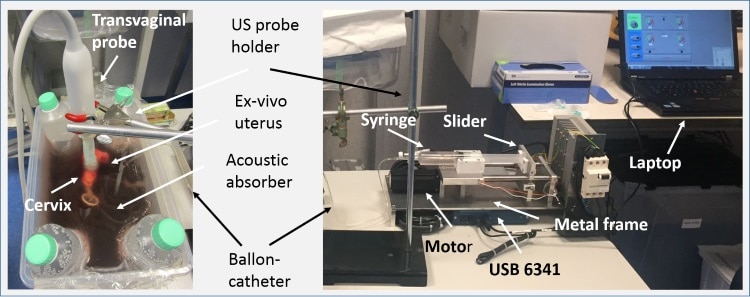
Ex vivo uterus and the experimental set-up.
Motion of the ex vivo uterus is created by an electromagnetic motor generating rotary motion at its output shaft. The voltage driving the motor is produced by a circuit board connected to a laptop and controlled by dedicated software. A screw-slider system connected to the output shaft of the motor converts the rotary motion into linear motion.
A syringe connected to the slider system is used to inject and withdraw fluid into a balloon catheter. The catheter was inserted into the uterine cavity in saline to avoid air bubbles. Rhythmic uterine motion was induced by sinusoidal inflation and deflation of the uterine cavity. The researchers used a period of 20 s (the average physiological contraction time) to simulate one cycle of rhythmic uterine motion. The motion generated by the experimental setup was validated with needles inserted in the myometrial wall of the uterus. Lin Xu, a researcher in the team, developed the hardware and accompanying software for the setup.
A total of six needle markers were inserted in three ex vivo uteri. To check the reproducibility of the produced uterine motion, the researchers tracked the motion of the needles over time and compared it with the driving signal of the electromagnetic motor. They evaluated the agreement between the signals using metrics such as the correlation coefficient and mean square error. Further, to evaluate the speckle tracking performance of block-matching, they tested the setup with different block sizes. Comparing with the reference motion of the needle markers, one particular block size showed the highest agreement.
Future direction
The researchers believe that this experimental setup can help in the development of uterine motion imaging methods, by providing objective evaluation of their tracking performance. In addition, unhealthy uteri – with pathologies such as adenomyosis or myomas – may show different tissue motion with respect to healthy uterine tissue, and this experimental setup can be extended to reproduce different pathological conditions. The resulting, optimized speckle tracking technique will enable doctors and physicians to enrich their diagnostic information and improve treatment.
If anyone has still-unheard stories to tell about Richard Feynman, the centenary of whose birth occurs next month, it’s the astronomer Virginia Trimble of the University of California, Irvine. That, plus the enduring fascination of Feynman himself, was among several reasons that a session on “The legacy of Richard Feynman” packed a ballroom on Monday at the April meeting of the American Physical Society (APS) in Columbus, Ohio. That day the city was treated to a rare April snowstorm, and I’m yearning to write that I braved a blizzard. But as the city’s convention centre was attached to the hotel I didn’t have to leave the building, so like most everyone else saw the snow comfortably from within.
Before Trimble took to the stage, we first heard from Paul Halpern from the University of the Sciences in Philadelphia, who treated the close relationship between Feynman and John Wheeler – Feynman’s doctoral advisor, friend, mentor, colleague and collaborator. Halpern, author of the recent book The Quantum Labyrinth: How Richard Feynman and John Wheeler Revolutionized Time and Reality, noted uncanny parallels between Feynman and Wheeler’s life and work: each thought the best way to learn a subject was to teach it, liked to think by visualizing, and valued mining truth from “crazy ideas.”
Halpern was followed by John Preskill, the Richard P Feynman Professor of Theoretical Physics at Caltech, where Feynman taught. Preskill’s talk, “Feynman After 40″, focused on the physicist’s later contributions, including the Feynman Lectures on Physics and the famous “Physics X” class for undergraduates, a non-credit, informal, weekly course in which Feynman insisted that “Questions had to be about trying to understand something.”.
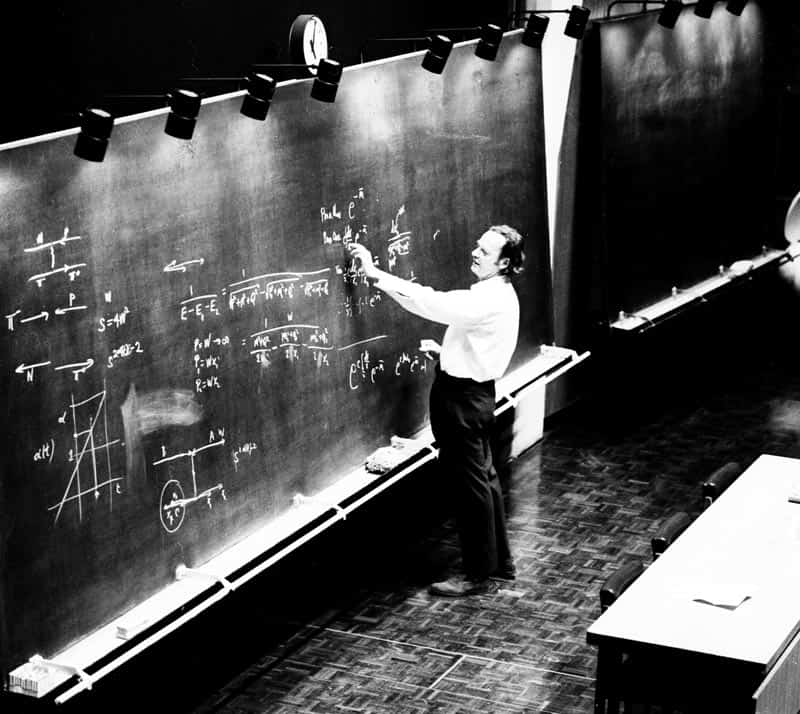
Preskill also discussed an underappreciated talk of Feynman’s 1982 called “Simulating physics with computers”, which inspired the field of quantum computing. Preskill said it was as prescient as Feynman’s more famous talk laying the groundwork for nanotechnology. He also discussed Feynman’s ruminations on the foundations of physics, which I thought illustrated yet again that physicists who disdain philosophy are condemned to engage in it – amateurishly. Maybe I’m still steaming about the time Feynman threw me out of his office for mentioning the topic. And according to Halpern, the text on Feynman’s final blackboard stated: “What I cannot create, I do not understand. Know how to solve every problem that has been solved.”
And so to Trimble, the final speaker. She is a blunt, witty and flamboyant figure in the astronomy community – and did not disappoint. The abstract she had submitted to the APS contained the sentence, “If I am remembered on my 100th birthday, it will be for the Life magazine article, my year as Miss Twilight Zone, and because I modelled naked for Richard Feynman when he was learning to draw.”
“If I am remembered on my 100th birthday, it will be for the Life magazine article, my year as Miss Twilight Zone, and because I modelled naked for Richard Feynman when he was learning to draw.”
Virginia Trimble
To Trimble’s consternation, the APS eliminated the adjective in the final clause of that sentence. But Trimble is not one to let others mute her voice. She began by telling the audience that she had complied a list of her favourite Feynman stories, labelling them A, B, C and so on, but stopped when she ran out of letters. She started through the list, with RPF [Richard Phillips Feynman] Story “C” about how she had posed for Feynman naked when he was learning to draw while she was a graduate student at Caltech (1964–1968) – and briefly showed a photo confirming that fact. “People say that Feynman didn’t know how to listen,” she said. “It’s not true. He just didn’t like silence. He’d talk if you didn’t. He talked constantly while he was drawing.”
Most – but not all – of the stories were about Trimble. Some involved things Feynman did for students or for colleagues at special events. Other stories were about Trimble seeing Feynman in action in different circumstances: helping children with homework, the day the Nobel prize was announced, his taste in leisure reading, pieces of chalk in the lecture rooms, suggestions for experiments that he made to scientists, and so on.
RPF Story “X” took place in 1972 when Trimble met – and wed – the gravitational-wave physicist Joseph Weber. According to Trimble, Feynman told her that married women should not change their names. “But he made an exception for his own wives.”
RPF Story “Y” had to do with the times she co-taught Physics X classes with Feynman.
When Trimble finally reached RPF Story Z, she stopped and apologized: “I’ve got more stories, but….”
Members of the audience will no doubt have wished there were more letters in the alphabet.
The researchers – who measured for the first time the radiocarbon content of aquatic carbon dioxide and dissolved organic carbon in headwaters of the western Canadian Arctic – believe that carbon originating from before 1750 comprises up to 37% of total fluxes.
The results hint at the existence of a permafrost carbon feedback, in which old carbon released into the atmosphere causes the melting of more permafrost and so the release of more old carbon, although the researchers say this would need to be confirmed in future studies.
“The presence of old carbon does not necessarily mean a permafrost feedback is occurring, because old carbon can [still] be released by natural seasonal thaw processes in permafrost systems,” said Joshua Dean of Vrije Universiteit Amsterdam.
Permafrost in the Arctic contains some 1500 billion tonnes of organic carbon – equivalent to roughly half the carbon emitted from fossil fuels since the beginning of the industrial revolution. Some of the permafrost carbon is 50,000 years old, or perhaps even older.
Scientists would like to know how much of this old carbon is draining away from permafrost and finding its way into the atmosphere, having been transformed by microbes into greenhouse gases such as carbon dioxide and methane. To know how old the carbon is, researchers can identify levels of radiocarbon – carbon-14 – which is present in diminishing amounts as samples age.
Over the summer of 2014, Dean and his co-workers collected samples of dissolved organic carbon, carbon dioxide and methane from remote headwaters in the western Canadian Arctic, including streams, ponds and lakes.
“Access to the site was only by helicopter,” said Dean, “so we needed to develop methods to collect our samples in a way that was possible in very difficult conditions.” To analyse the samples, the team had to separate the genuine radiocarbon signal from that imprinted by post-1950s nuclear bomb testing.
“The bomb spike complicates [our] signal because it is no longer a smooth linear trend in carbon-14… This spike is so strong that it can hide older carbon,” Dean added. “Here we use a modelling technique to try and tease these different signals apart, and it appears to work quite well.”
As the thawed layer deepened over the summer, the researchers found, the age of dissolved organic carbon rose by 120-125%, while the age of carbon dioxide rose by 59-63%. What’s more, carbon originating from before 1750 ultimately comprised between 15 and 37% of all carbon fluxes.
“This is the first time this signal has been observed directly in carbon dioxide in Arctic aquatic systems, and mirrors previous observations that considered only soil systems,” said Dean. “Aquatic systems give a more integrated signal of the whole area they drain, meaning they can provide a snapshot of a larger area than soil studies.”
To estimate the level of any permafrost feedback, Dean and co-workers must work out how old they expect the carbon exported by natural seasonal permafrost thaw to be. If the actual age is larger than expected, there may indeed be a permafrost carbon feedback.
New insights into whether a hypothetical fifth fundamental force exists have been gleaned by physicists using data from the MICROSCOPE space mission – which was launched in 2016 by France’s National Centre for Space Studies (CNES). The work was done by Joel Bergé at the University of Paris Saclay and colleagues.
Scalar-tensor theories are a wide class of theories about the nature of gravity and have some fascinating consequences. At the Newtonian limit – for small masses with weak gravitational fields – scalar-tensor theories imply a fifth fundamental force. This force can be described using a modification of Newton’s gravitational laws involving a Yukawa potential. The potential reveals how the range of the fifth force depends on the mass of the scalar field – and the range can vary from microns up to cosmological scales.
Such a fifth force should lead to the violation of the weak equivalence principle (WEP), which states that test bodies fall with the same acceleration independent of their internal structure or composition. In contrast, the Yukawa potential varies the fifth force depending on the composition of the masses involved – and this should lead to different accelerations for different types of objects.
Composition dependence
In their study, the team sought to measure the effects of this dependence on composition to put constraints on the strengths of Yukawa-type interactions. They also look at how the Yukawa potential implies variations in the fundamental physical constants that could govern WEP violation, allowing them to set constraints on these variations.
CNES’s MICROSCOPE experiment was launched in 2016 and has delivered its first data. The satellite tests the possible difference in the rates of free-fall of two test masses made from different materials as they orbit Earth – thereby detecting potential WEP violation. The equipment measures the difference in acceleration between the masses in the same gravitational field, to a precision of one part in 1014. No difference was found, and therefore there is no evidence for a fifth force at this level of precision.
The researchers also explored what this constraint says about the potential physical causes of a hypothetical fifth force. They made the case that massive scalar fields are coupled to either the baryon numbers or the difference between baryon and lepton numbers of the constituent particles in matter. The insight allowed the team to improve existing constraints on the fifth force for ranges larger than 10⁵ metres by an order of magnitude.
After the MICROSCOPE experiment ends later this year, Bergé’s team will have access to 10 times more data than they used to make their calculations. The information will allow the researchers to optimize their constraints on WEP violation and the fifth force even further.
The tallest known tree in the world is in Redwood National Park, a few hundred kilometres north of San Francisco, just inland from the Pacific coast. You won’t find its location marked on official hiking maps, however. That’s because the two amateur naturalists who discovered the tree in 2006 – Michael Taylor and Chris Atkins – have tried to keep its whereabouts a secret, fearing that tourists and looters might carve a mark or chisel off a chunky souvenir to take home (though you can see its approximate location on unofficial guides). They named the tree Hyperion and the intrepid climbers who measured it – using a laser and a measurement line dropped from the top – reported that this botanical titan rises about 116 m above the forest floor. That makes it a little over 1 m bigger than the second-tallest-known tree, a redwood called Helios.
Hyperion, like all trees, hides in its trunk a remarkable natural engineering process that keeps the plant hydrated and cool. Known as “transpiration”, it involves water entering the roots and travelling up the trunk before passing out via the leaves. It’s an invisible and silent process that lets a single, 90 m-high redwood shuttle about 2000 litres of water from roots to leaves in a single day – that’s more than 400 flushes of a low-volume toilet. Of course, you don’t have to bore into a redwood’s 6 m-wide trunk to find evidence of transpiration; small plants do it, too.
Details about the mechanics of transpiration were first published in 1727 by the English botanist and clergyman Stephen Hales. Water that has entered a tree via its roots flows up through the “xylem” – hardy, tubular cells in the stem that are stacked together to form a natural pipe that reaches all the way up. With thick cell walls that add structural support to the plant, xylem become useful as water carriers once they reach maturity, at which point they’re completely dead. The water then evaporates into the air through tiny pores, or “stomata”, lying on the undersides of the leaves (figure 1).
1. How transpiration works: Transpiration is a natural pump-free system that helps plants and trees to stay cool. Water molecules (blue) enter a tree through osmosis in the roots, pass up through the xylem vessels in the trunk and branches, before exiting through the stomata in the leaves. The red arrows show the upwards movement of the water, against gravity. The circular inset (centre right) shows hydrogen bonding (dotted lines) between water molecules that form linked strands in the xylem. (Courtesy: Science Photo Library/Claus Lunau)
The evaporation sets up a pressure gradient, pulling water up from the roots and through the xylem, as if slurped though a straw. Without transpiration, a tree could get so hot that it might be unable to photosynthesize – indeed, a 2008 study revealed that all trees regulate their temperature so they hover around the 294 K mark (Nature454 511). However, the process only occurs during the day. After the Sun goes down, the pores in the leaves close, and water molecules left inside the botanical elevator stay in place by sticking to each other and to the dead xylem.
But what makes transpiration so alluring to physicists and engineers is that it’s a “passive” fluid-transportation system. The fact that plants and trees don’t have an “active” pump to ferry water around could help us find novel ways to cool materials in high heat, where space is at a premium. Physicists and engineers have therefore been trying to mimic transpiration for decades, chasing a way to move liquids through a solid to keep it cool. Indeed, transpiration has become particularly interesting to researchers wanting to develop vehicles that can travel faster than the speed of sound. Could trees, therefore, help us to travel at “hypersonic” speeds?
Hot speed
The age of supersonic vehicles began, at least in the public eye, on 14 October 1947, when US pilot Chuck Yeager flew a bullet-shaped Bell X-1 rocket plane faster than the speed of sound. The plane was dropped at altitude from a B-29 and, after burning through its limited fuel supplies long enough to create a shock wave, it glided down to the surface before landing safely. Since then, the world record for the fastest aircraft has soared to many times the speed of sound. The Russian Soyuz capsules or NASA’s space shuttles, for example, plunge through the Earth’s atmosphere at more than 20 times the speed of sound.
“There’s always been a passion to fly faster,” says Kyle Hanquist, a postdoc at the University of Michigan, in Ann Arbor, who is trying to find ways to cool “hypersonic” vehicles – those travelling at or above five times the speed of sound. That need for speed has brought an intense focus on “aerodynamic heat”, generated from friction between the plane’s body and the air, and also from air being compressed directly in front of the craft. For a passenger jet flying slower than the speed of sound, aerodynamic heat plays a minimal role. But at around twice the speed of sound, the aerodynamic heat flux starts to rise exponentially with speed. At high enough speeds, the amount of kinetic energy converted into heat would be high enough to incinerate the plane.
In their quest to build planes and spacecraft that can travel at such speeds, physicists and aerodynamic engineers have been searching for novel cooling systems. Space capsules plunging into the atmosphere, for example, use an “ablative” heat shield at the leading edge, made from resin mixed into fibreglass. The shield is designed to melt and vaporize during descent, creating a thin protective layer as it peels away. By the time the material has vanished, the capsule has slowed enough that it won’t disintegrate.
This approach is fine for one-time uses, but what if you want to have a reusable vehicle and don’t want to waste money repainting it each time? Right now, hypersonic vehicles are built from ultrahigh-temperature composites that are engineered to withstand high heat. Based on metal alloys, these materials can withstand temperatures of around 2000 K, says Hanquist. But as vehicles get faster, they’ll encounter even higher temperatures that would melt or even vaporize these materials unless there are more cooling systems in place.
As vehicles get faster, they’ll encounter temperatures that would melt or even vaporize them unless there are more cooling systems in place
Kyle Hanquist
“We need a different method if we’re going to continue to fly faster,” admits Hanquist, who has been working in his lab in Michigan on cooling hypersonic vehicles by ejecting streams of electrons. But could tree-inspired transpiration be the answer instead? Over the last few decades, physicists have investigated a number of cooling methods that take their cues from plants. They can be found in some “scramjet” engines, for example, which compress incoming supersonic air so that it heats before it burns, making the combustion extra powerful. Such engines, which are the driving force behind many hypersonic vehicles, work most efficiently when boosting craft that are already travelling well above the speed of sound.
To mitigate against the high temperatures that those high speeds bring, some scramjets use transpiration systems that pump a coolant – usually a material with a high specific heat, like water, or gas or even the fuel itself – through the engine. But cooling an engine in this kind of extreme environment with a pump requires space and energy. So to really reap the benefits of biological engineering, physicists need to design a passive system that can cool effectively, but without pumps.
Look, no pumps
A step forward in this pursuit was announced recently by researchers led by Pei-Xue Jiang from Tsinghua University in Beijing, China. Writing in the journal Bioinspiration and Biomimetics (12 056002) from IOP Publishing, which publishes Physics World, they introduced just such a transpiration cooling system. It’s passive, which means it doesn’t use pumps, and it’s self-adaptive, which means it can adjust as the heat flux changes on the surface.
It mimics transpiration using an approach called “porous cooling”, in which a coolant flows through microchannels in a layer of porous material en route to the exterior. The system cools in two ways. First, it absorbs heat from the porous layer as it passes through. Second, when the coolant diffuses to the exterior, it forms a vapour film that protects the outer surface. This approach offers a lot of control over the temperature of the outermost surface.
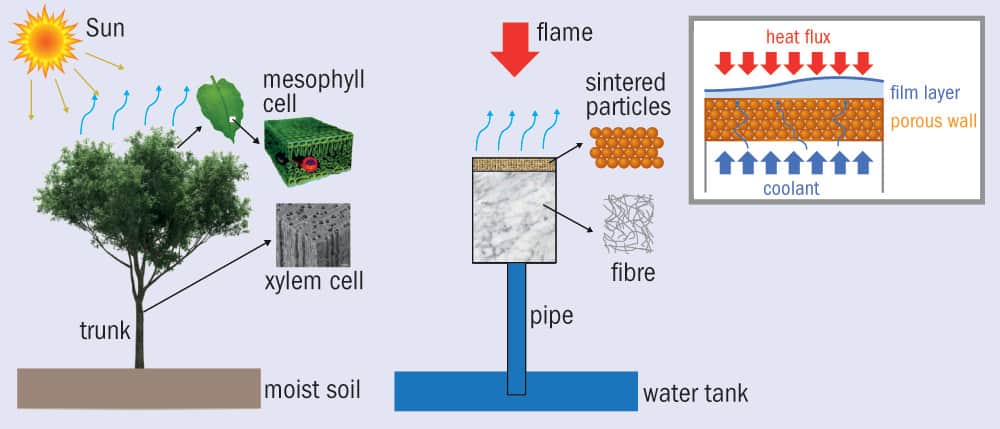
The structure of the new device is remarkably tree-like (figure 2). It’s also quite small, so maybe it’s more accurate to call it plant-like. It comprises a water tank about the size of a can of soup at the base (like roots), from which rises a flexible plastic pipe. The water travels through the pipe and into a filter that is 30 mm deep. The filter is a porous material made of sintered brass balls, each with a diameter of about 500 µm. The balls themselves are covered in tiny, stomata-like pores, about 200 µm across, that allow the water to evaporate.
2. Inspired by trees: Researchers at Tsinghua University in China, led by Pei-Xue Jiang, have developed a tree-inspired transpiration cooling system that uses no pumps. Just as a tree draws water through xylem cells in the trunk to the leaves, where it evaporates through tiny pores (stomata), so their system draws water from a tank through a fibre coated with sintered brass balls. Water evaporates through tiny, stomata-like pores on the surface of the balls, creating a capillary pressure that pulls in more water from the tank. The evaporating water also creates a thin vapour film that protects the surface from the heat so well that it stayed at 373 K even when blasted with a butane flame at 1639 K.
As water evaporates from the surface, it creates a capillary pressure that pulls in more water from the tank, lying 8 cm below. In addition, the evaporating water creates a thin vapour film that protects the surface from the heat. According to the researchers, the system is so effective that when they blasted the surface with a butane flame at 1639 K, it remained a comparably cool 373 K. As they increased the heat flux, the surface remained steady at around 373 K, showing that the system adapted to higher heat to maintain a steady temperature.
Existing transpiration systems that have been used in planes rely on pumps to control the coolant flow, but they take up valuable space and are subject to error. “The pumps significantly add to the weight, which increases the launch costs,” the researchers note in the paper. But a self-adjusting system won’t need additional devices and is closer to an ideal system for hypersonic vehicles – self-adapting and built-in. These jets fly at different altitudes and at a range of speeds, which introduce them to heat flux regimes of varying extremes.
Although lab experiments with this pumpless transpiration system tested a water column only 8 cm tall, the researchers think it could be scaled up – and even suggest how such a system might be used to cool the surface of hypersonic aircraft. “It’s very promising,” says Hanquist. The device might be useful on a smaller scale, as well. In the paper, the researchers also suggest transpiration cooling might be incorporated into heat-resistant gloves that would allow steel workers, boiler operators and others to handle materials above 1000 K. Transpiration in such a glove, note the authors, “is similar to the sweating of an animal skin”.
From the tallest redwood to the fastest aircraft, the research shows the value of a focus that extends beyond physics. If trees can inspire novel solutions to tomorrow’s high heat problems, then maybe scientists should look to evolved natural systems – and even other disciplines – for solutions to other problems. The learning curve is valuable, but steep. “A lot of people who understand hypersonic vehicles may not also understand biology and trees,” says Hanquist. It’s a case of some people not seeing the wood or the trees.
This morning Baker gave an update about the status of the LISA space mission, which involves putting three such masses in three spacecraft that will orbit the Sun – hopefully by 2034.
The relative positions of the masses will be monitored by exchanging laser light between the spacecraft. The plan is to use the configuration to detect gravitational waves from much larger objects than currently possible using the ground-based LIGO-Virgo detectors.
Ahead of schedule
Unlike many big science projects, LISA is actually well ahead of schedule – at least in terms of proving that it is actually possible to make it work. In 2016, scientists working on the LISA Pathfinder space mission were able to isolate a 2 kg test mass from acceleration noise at a special “Lagrangian point” between the Earth and the Sun. This was a proof-of-principle exercise that not only succeeded in its preliminary goal, but also met the actual requirements for the LISA mission much sooner than expected. Then about a year later, the scientists showed that the mass can also be isolated from interference associated with the buildup of static electricity.
Baker says that the next proof-of-principle test involves showing that it will be possible to use lasers to measure the relative positions of the spacecraft. This will be done very soon using the GRACE-FO spacecraft, which will be launched next month. The two spacecraft will be spaced 220 km apart as they orbit Earth and the separation between them will be monitored carefully to reveal fluctuations that are related to changes in Earth’s local gravitational field. This information can then be used to monitor the thicknesses of ice sheets or even work-out the amount of water in lakes, rivers or even underground.
Far ranging
FO stands for “follow on” from the original GRACE mission, which operated for 15 years before ending last year. What’s new about GRACE-FO is that it will include a laser ranging system similar to what will be used in LISA. Hopefully these tests will also be successful and LISA will go ahead as planned. Indeed, the main reason why the launch is planned for 2034, rather than sooner, is that the ESA and its partner agencies (including NASA) simply don’t have the budget to launch any sooner. Maybe there’s another country out there with deep pockets that could help.
Cryotherapy provides a minimally-invasive technique for the treatment of prostate cancer. The approach, which uses cryoprobes to cool and destroy cancerous tissue, can be performed as an outpatient procedure with rapid recovery, good long-term clinical outcomes and low cost. Despite these benefits, cryotherapy is used far less than surgery and radiotherapy, accounting for just 5% of prostate cancer treatments. This is largely due to inadequate control over temperature, which can lead to either insufficient damage to cancer or unwanted cooling of nearby healthy tissues.
What’s needed is a way to map temperature changes over the entire treated region during cryotherapy. To achieve this, researchers from TomoWave Laboratories and the University of Texas Medical Branch are investigating the use of optoacoustic temperature imaging (OA-Tim). The team has now demonstrated the first in vivo use of OA-Tim during prostate cryotherapy in a canine model (Phys. Med. Biol.63 064002).
“Adequate control of cryotherapy is critical for both successful destruction of malformations and minimizing damage to adjacent healthy tissues,” said corresponding author Alexander Oraevsky. “With OA-Tim guidance, the treatment accuracy should increase significantly, motivating surgeons to utilize this safe, minimally invasive therapy, rather than quite complex surgery or harmful radiotherapy.”
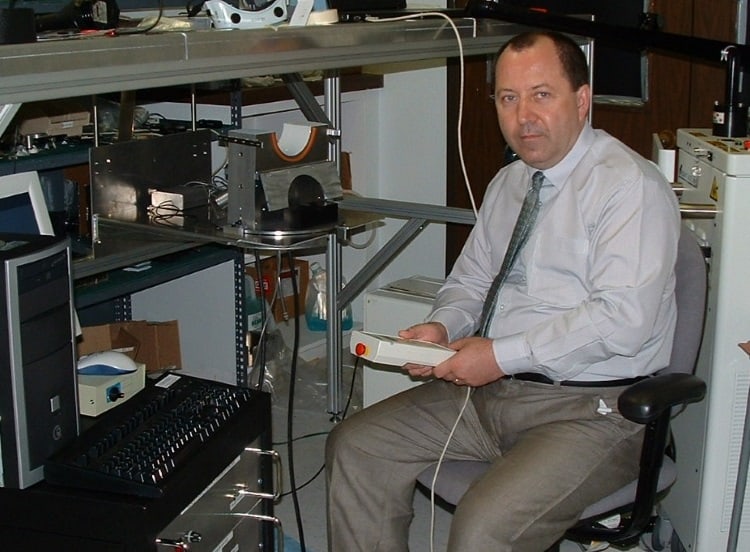
Alexander Oraevsky in the lab.
Improved monitoring
The standard procedure for prostate cancer cryotherapy uses transrectal ultrasound imaging to visualize the prostate and position cryoprobes in the lesion. Pressurized argon gas inside the cryoprobes is cooled to below -100 °C, exposing surrounding tissue to lethal temperatures of below -40 °C.
Currently, this process is monitored using two or three thermal sensors, plus ultrasound imaging to ensure that the expanding iceball does not reach the rectal wall. However, the sparse distribution of sensors within extreme temperature gradients impedes the surgeon’s ability to evaluate tissue damage – and can lead to complications.
Optoacoustic (OA) tomography, which combines pulsed optical excitation and ultrasound detection of the generated pressure waves, offers the potential for real-time temperature mapping of vascularized tissue.
“The OA signal is proportional to temperature, due to the nature of signal generation through thermal expansion of the laser-illuminated volume,” Oraevsky explained. “Thus, OA is a direct method of imaging temperature.”
An in vivo first
Previously, Oraevsky and colleagues demonstrated that OA-Tim can be performed in vascularized tissues. They also established a procedure to convert optoacoustic images to the temperature map, using a calibration equation obtained for blood. In this latest study, they developed a preclinical OA-Tim prototype based on an existing laser OA imaging system, which delivers 805 nm laser pulses, and a modified transrectal ultrasound probe that provides both OA and ultrasound imaging.
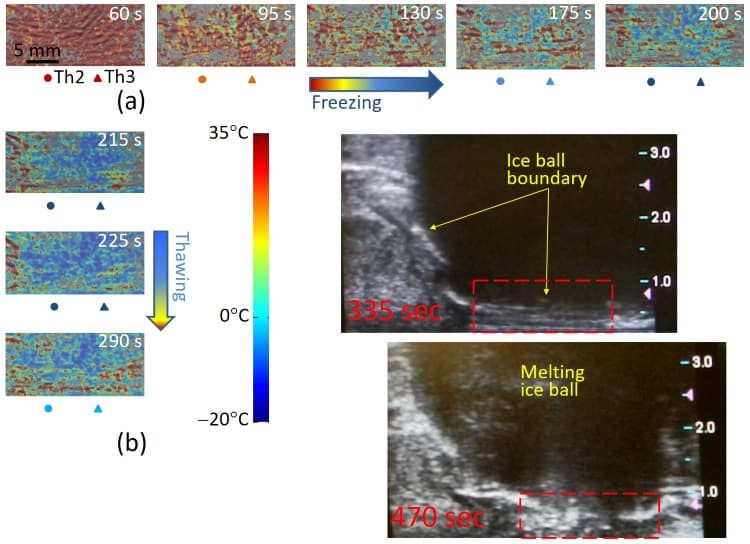
The researchers performed in vivo OA-Tim in the longitudinal view during cryotherapy of a canine prostate. The animal was fully anaesthetized during the procedure. Using transrectal ultrasound guidance, they inserted a cryoneedle into the prostate just below the urethra. They also inserted three thermal sensors: Th1, near the cryoprobe to guide the cryotherapy; and Th2 and Th3, located at the rectal wall and Denonvilliers fascia – the most critical areas to avoid during prostate cryotherapy.
Prior to treatment, the researchers obtained an OA reference frame at a known temperature. They then delivered a single freezing event for 3 min 35 s, with the freezing cycle stopped after Th1 showed temperatures below -40°C for 1 min. During cryotherapy, the system recorded OA data at two frames per second, in a 30 x 10 mm region covering the rectum, Denonvilliers fascia and posterior portion of the treated gland.
OA-Tim during cryotherapy freezing and thawing cycles.
The researchers normalized all OA frames to the reference frame, and used the blood calibration equation to convert each normalized frame to a temperature map. The resultant OA-Tim maps were consistent with the readouts of the invasive thermal sensors, but showed far more detail of the temperature distribution. Since the probes only measure a few specific locations, this non-invasive temperature imaging is far more informative for the surgeon.
To further validate OA-Tim in vivo, the researchers selected a small region-of-interest containing a high-contrast object – a blood vessel or well-perfused tissue area. Temporal profiles from Th2 and Th3 and the profile estimated from the normalized OA intensity showed significant resemblance, except for an overshoot in normalized OA intensity in the first minute of freezing. The temperature was mapped with errors of ±2°C or less, consistent with clinical requirements for monitoring cryotherapy.
“This is the first ever image in a live tissue, so we cannot be too critical of its simplifications,” noted Oraevsky. “The imaged tissue adjacent to the canine prostate was quite homogeneous, in contrast to heterogeneous tissues in a cancerous human prostate. On the other hand, we demonstrated that with a gradual decrease in tissue temperature, our image changed its brightness proportionally. This validates the technological principle.”
The team is now focusing efforts on software development. “It is a challenge to develop software with the capability of temperature imaging at video rates, i.e., in real-time with blood dynamics,” Oraevsky explained. “The speed of calculations is also important for alleviating motion artefacts in live subjects.”
When Roxana started to juggle balls with her feet it was proof, if any were needed, that G4G is the most disciplinarily diverse conference around.
G4G, or “Gathering for Gardner”, is a biennial event in honor of the recreational mathematician Martin Gardner (1914–2010). As a columnist for Scientific American, Gardner inspired generations of physicists, mathematicians, philosophers, puzzle-makers, logicians, magicians and others, including me. The 13th gathering this past weekend was called G4G13.
The conference began last Wednesday in the usual fashion: early-bird registrants flocked to the bar at the Ritz-Carlton in downtown Atlanta to show their favourite mathematics, physics, logic and magic tricks. These are called “bar bets”, for their only practical purpose is to give you cool ways to try to win money off sceptical strangers. I saw some classics on Wednesday, such as the challenge to guess whether a red wine glass is taller than its circumference – as a stranger is likely to think – or shorter, as it almost always is. The events of the next four days shared the same spirit, combining learning about the world with a spirit of playfulness – linked wherever possible to the number 13.
Gardner’s special skill was to get people to enjoy maths by acquainting them with the pleasure of solving problems in areas that ranged from physics to card playing and magic. About 120 talks were given – almost all a mere six minutes long, and each delivered to the entire gathering. We learned about such things as mathematical knitting, hyperbolic tiling patterns, the physics of dice and tops, fine points of logic, and pseudoscience. One celebrity participant was the 2014 Fields medallist Manjul Bhargava. Another was Erno Rubik, the Hungarian inventor of the eponymous cube that in the 1980s became the bestselling toy of all time.
Many attendees were inspired by Gardner’s columns when they first appeared between 1956 and 1981, while others, including Dominika Vasilkova, a third-year undergraduate physics student at Imperial College, London, learned of Gardner after his death through his 100+ books. Gabriel Kanarek, an eight-year-old first-time participant, spoke about properties of numerical sequences, while the 101-year-old British mathematician Richard K Guy had a video played about his life and work. The presence of a few infants meant that the lifetimes of G4G13’s vocal contributors spanned over a century.
Between talks, participants were treated to juggling, rope tricks, physics puzzles, and a virtual reality demonstration of hyperbolic space. James Gardner, Martin’s son, told anecdotes about his father. Rubik signed cubes.
On Friday participants assembled a series of mathematical sculptures. One, by the Danish woodcarver Bjarne Jespersen, made a dramatic entry. Virgin Airlines had lost his luggage, which contained the pieces to his sculpture, but recovered and delivered it just in time. I helped assemble “Knotted Cube”, as he called his sculpture, which illustrates what might happen if two ends of a cube passed through each other. “It’s a cube that had an accident in the fourth dimension,” one passer-by noted.
Late that evening, another attendee taught us how to find the schedules of astronomical events through sites like Heavens Above. Seeing that the International Space Station (ISS) was about to pass that part of the sky, several of us rushed outside just in time to catch the ISS glide between several of Atlanta’s skyscrapers. It was a Gardner moment, in which just a little bit of scientific knowledge and inquiry allows you to connect better with the world and enjoy its visible wonders.
Having a ball: G4G13 banquet performers including Emcee and magician Mark Mitton (far left) followed by James Gardner, Martin’s son. Acrobat Roxana is fifth from left (in black), and Rubik’s cube speed-solver Sydney Weaver ninth from left (in red and black). (Courtesy: Robert P Crease)
One G4G tradition is for a pair of participants to play “Dr Matrix”, a fictional character whom Gardner invented to spoof numerology. In a point–counterpoint duel, one Dr Matrix proves the positive power of the conference number in the universe, while the other proves that it is the root of all evil. I played “Dr Matrix pro-13”, pointing to the number’s patriotic role (the 13 original US colonies), its morality (the 13th Amendment to the US Constitution abolished slavery), its role as a glass ceiling-breaker (the 13th Doctor Who is the first female doctor), its maths contributions in the Fibonacci series and as the first emirp (a number that’s a prime backwards and forwards), etc. British mathematician Colin Wright, as “Dr Matrix anti-13”, then had the audience roaring with laughter in demolishing my claims and revealing 13 to be an “insufficiently maligned” number.
The after-dinner entertainment at the Saturday night banquet began with a set of jaw-dropping magic shows. These included a spectacular performance by the Russian acrobat Roxana Küwen in which she juggled several balls with her feet. Inspired by Roxana, conference participant Sydney Weaver, one of the world’s leading female Rubik’s Cube solvers, then came onstage to use her feet to solve a Rubik’s cube. Two other participants attempted to recreate Roxana’s patterns using conventional hand juggling, and discovered that it was much harder than it looked.
Limiting average global temperature rise to 2°C will require strong commitment and innovative solutions. In the first study of its type, a German team has assessed whether removing carbon dioxide from the atmosphere by enhancing the weathering of rocks has potential.
Chemical rock weathering, where rainwater reacts with the minerals in rock and breaks it down, naturally removes around 1.1 Gt of carbon dioxide per year from the atmosphere. This process could be enhanced by grinding rocks and spreading them over the ground in humid regions, so that the rock grains dissolve in water and travel to the ocean, storing the carbon dioxide.
Jessica Strefler and Thorben Amann from Potsdam Institute for Climate Impact Research and Universität Hamburg assessed the potential of this method, considering the amount of carbon dioxide that it can trap and the associated economic costs for different rock types and areas worldwide.
The team showed that this method needs a high weathering rate to be a significant and economically viable option. In sub-tropical regions such as Brazil, India and south China, it has potential due to higher temperatures, humidity and suitability of the land. In such areas, chemical rock weathering could remove as much as 95 Gt of carbon dioxide per year using dunite – a volcanic rock made up primarily of one mineral – and 4.9 Gt of carbon dioxide per year using basalt, a volcanic rock of mixed minerals.
Although it traps significantly less carbon dioxide than dunite, the use of basalt would have many co-benefits for the soil, as it is rich in nutrients such as phosphorus, magnesium and calcium, whereas dunite contains harmful substances, such as chromium and nickel, that the process could release. From an economic perspective, the method is estimated to be more than twice as expensive as afforestation, but just less than 10 times cheaper than direct air capture.
“This first comprehensive assessment of costs and possibilities shows that enhanced weathering, especially of basalt rock, could be an attractive option to support climate change mitigation, especially for tropical and subtropical regions where the carbon dioxide uptake potential is the highest,” said Strefler. “However, given the costs and the mass of rocks that would need to be moved, it can likely provide only a small additional contribution.”
There are currently major uncertainties in the estimation of carbon dioxide consumption by this weathering method, so there is a need to improve models to determine its full potential.
Scientists must quantify the weathering rate under natural conditions, as well as the rate at which the soil naturally produces carbon dioxide through respiration. An accurate estimation of these variables should reveal the true potential of carbon dioxide capture via weathering and whether it is viable for use on a large scale.
A new, non-invasive skin patch made from thin-film graphene could measure glucose levels without the need for a finger-prick blood test. The device works by drawing out glucose from the fluid between cells across hair follicles, which are individually accessed via a miniaturized pixel array platform using a small electric current, in a process called electroosmotic extraction. Readings can be taken every 10 to 15 minutes over several hours and the data wirelessly transmitted to a mobile device, such as a smartphone or watch.
Diabetes is a serious worldwide health problem that is set to become even worse. The World Health Organization estimates that the number of people suffering from diabetes will increase to 366 million in 2030. This number was 171 million in 2000.
Diabetics regularly need to monitor their blood glucose levels, and they usually do this with a finger-prick test, which is uncomfortable to say the least. Researchers have recently developed a variety of non-invasive alternatives based on detecting glucose in sweat, tears or saliva but these techniques have their limits. For one, the levels of glucose detected can vary significantly, and secondly, many still require calibration with a conventional finger-stick.
Until now, the only technology to provide non-invasive, continuous glucose monitoring was the Gluco Watch Biographer, which received Food and Drug Administration approval in 2001. This watch works using reverse iontophoresis to extract interstitial fluid through the skin via electroosmosis. In this technique, a small electric field is applied across the skin, causing ions to flow. Since the skin has a net negative charge under normal physiological conditions, interstitial fluid flows from within the skin towards a cathode on the skin surface, where glucose is then detected and analysed.
Calibration via a blood sample not required
The problem with the watch is that, again, a finger-stick calibration is required, mainly because glucose is extracted indiscriminately and variably across a relatively large area (>3 cm2) of skin and is considerably diluted before it is analysed. “The device therefore does not exploit the fact that most of the electroosmotic flow during iontophoresis follows low-resistance preferential pathways associated primarily with hair follicles,” say Adelina Ilie and colleagues of the University of Bath in the UK.
The researchers have now designed a non-invasive adhesive patch containing a sensor array that can operate on a small area over an individual hair follicle. “This significantly reduces inter- and intra-skin variability in glucose extraction,” they say, “and increases the accuracy of the measurements taken such that calibration via a blood sample is not required.”
A miniature, individual pixel of such an array contains the following: a glucose oxidase-bearing hydrogel reservoir into which glucose is extracted through skin; an electrochemical glucose sensor (made of a graphene-based film or graphene ink); and miniaturized electrodes on a flexible substrate. Ilie and her team used graphene as their material of choice, thanks to its high mechanical strength, high conductivity, low capacitance, large surface area and the fact that it can be patterned and integrated into a device using standard microfabrication techniques. It is also low cost and environmentally friendly.
Monitoring glucose levels across the hypo- to hyper-glycaemic range
The glucose extracted via reverse iontophoresis reacts with glucose oxidase to produce hydrogen peroxide, which is then detected by the electrochemical sensor. One important aspect of the device is that the active area of the pixel device (into which fluid is extracted) allows it to access a single follicular pathway. “If we assume that a person has an average follicular density of 27 follicles per cm2 (for instance, on areas such as the arms and thighs), an active area of 2–6 mm2 maximizes the probability of hitting a single follicle in a randomly positioned, untargeted measurement,” say the researchers.
The team tested its patch on both pig skin (which is an excellent model for the human skin barrier) and on healthy human volunteers and found that it could accurately monitor glucose levels across the hypo- to hyper-glycaemic range in diabetic patients over six hours.
The researchers, reporting their work in Nature Nanotechnology doi:10.1038/s41565-018-0112-4, say that they would now like to further improve the design of their approach. They would also like to optimize the number of sensors in the array so that it can operate over a full 24-hour period. Finally, they would like to undertake a number of key clinical trials.