As they approach a black hole’s event horizon, particles of accreting gas can take on opposing orbital trajectories – remarkably similar to the paths produced in manmade particle colliders. Using advanced new models, Andrew Mummery at the University of Oxford, together with Joseph Silk at Sorbonne University, showed how such particles could collide at colossal energies, with detectable collision products that could offer valuable new insights for particle physics.
Within a black hole’s accretion disk, gas particles travel in circular orbits that gradually shrink under its immense gravity. Once an orbit contracts beneath a critical radius, it becomes unstable, and the particles it carries will suddenly plunge toward the black hole.
“Long ago, Roger Penrose showed that these particles could extract energy from the spin of massive black holes in the region where they decay,” Silk explains. “This happens in the ergosphere – the region just outside the event horizon where debris can gain energy from the black hole’s intense gravitational and rotational fields.”
In the theory described by Penrose, a particle approaching a black hole splits into two fragments – possibly through a collision or spontaneous decay. After the split, one fragment falls into the event horizon, while the other gains enough energy from the black hole’s spin to escape its gravity – exiting the ergosphere with more energy than the original particle.
Building on this idea, Silk and two of his previous collaborators – Maximo Bañados and Stephen West – proposed an alternative escape mechanism. Their idea involves gas particles in retrograde orbits (moving opposite to the black hole’s spin) within the accretion disk. Since a retrograde orbit becomes unstable at larger radii than a prograde orbit (movement in the same direction as the black hole’s rotation), these particles fall farther before reaching the ergosphere, allowing them to gain more energy through gravitational acceleration.
Within the ergosphere, Bañados, Silk and West considered how these now highly energetic particles could collide with those originating from prograde orbits, travelling in opposite directions. If this occurred, the relative velocity between the two would be enormous – imparting extreme relativistic energies to their collision products. The trio proposed that some of these products could escape the ergosphere with more energy than either of the original particles.
In their latest study, reported in Physical Review Letters, Silk and Mummery explored this possibility in greater detail. They used models recently developed by Mummery to simulate the flow of particles accreting onto rapidly spinning supermassive black holes.
“We showed that the infalling gas would develop a pattern of turbulent rotating and counter-rotating vortices as it plunged into the black hole’s ergosphere,” Silk explains. The rotation direction of each vortex depends on whether the particles originated from prograde or retrograde orbits within the accretion disk.
When particles travelling in opposite directions collide in the ergosphere, their circular paths resemble the magnetically guided trajectories of protons and heavy ions in manmade particle colliders, such as CERN’s Large Hadron Collider – only on a vastly larger scale. “We found that the collisions occurred at hundreds of times higher energies than those reached in any existing collider, and would approach or even exceed the energies expected for the proposed Future Circular Collider,” Silk notes.
At such colossal energies, Mummery and Silk predict that the collision products could include gamma rays and ultrahigh-energy neutrinos, which might be detectable from nearby supermassive black holes – such as Sagittarius A* at the centre of our own galaxy. As a result, the process could offer an entirely new approach to observations in particle physics.
“Our predicted signatures would complement those of the next generation of giant particle supercolliders planned by CERN and in China, helping to provide evidence of new particle physics beyond the Standard Model,” says Silk. In particular, the duo suggest that these signatures could lead to a highly sensitive probe of dark matter – potentially offering more robust tests for candidates such as weakly interacting massive particles.
The Norwegian-born condensed-matter physicist Ivar Giaever, who shared the Nobel Prize for Physics in 1973, died on 20 June at the age of 96. In the late 1950s, Giaever made pioneering progress in the electron tunnelling in superconductors as well as provided a crucial verification of the Bardeen–Cooper–Schrieffer (BCS) theory of superconductivity.
Born in Bergen, Norway, on 5 April 1929, Giaever graduated with a degree in mechanical engineering in 1952 from the Norwegian Institute of Technology. Following a year of military service he worked as a patent examiner for the Norwegian government before moving to Canada in 1954 where he began working at General Electric.
Two years later he moved to GE’s research laboratory in New York, where he continued to study the company’s engineering courses. In 1958 he joined the GE’s R&D centre as a researcher.
At the same time, Giaever began to study physics at Rensselaer Polytechnic Institute in New York where he obtained a PhD in 1964 working in tunnelling and superconductivity. That year he also became a naturalized US citizen.
A Nobel life
It was work in the early 1960s that led to his Nobel prize. Following the Japanese physicist Leo Esaki’s discovery of electron tunnelling in semiconductors in 1958, Giaever showed that tunnelling also happened in superconductors, in this case a thin layer of oxide surrounded by a metal in a superconducting state.
Using his tunnelling apparatus, Giaever also measured the energy gap near the Fermi level when a metal becomes superconducting, providing crucial verification of the BCS theory of superconductivity.
At the age of 44, Giaever shared half the 1973 Nobel Prize for Physics with Esaki “for their experimental discoveries regarding tunnelling phenomena in semiconductors and superconductors, respectively”. The other half went to Brian Josephson “for his theoretical predictions of the properties of a supercurrent through a tunnel barrier, in particular those phenomena which are generally known as the Josephson effects”.
Josephson told Physics World that Giaever’s experiments were the source of his interest in tunnelling supercurrents. “An interesting point is that none the [physics] laureates that year were professors at the time,” adds Josephson. “[Giaever] and I were too junior, while Esaki was in industry”.
In 1988 Giaever left General Electric and moved to Rensselaer where he continued to work in biophysics. In 1993, he founded the New York-based Applied BioPhysics Inc.
As well as the Nobel prize, Giaever also won the Oliver E Buckley Prize by the American Physical Society (APS) in 1965 as well as the Golden Plate Award by the American Academy of Achievement in 1966.
Gaiever’s career was not without controversy. In 2011 he resigned from the APS in protest after the organisation called the evidence of damaging global warming “incontrovertible”.
In 2016 he published his autobiographyI am the Smartest Man I Know, in which he details his journey from relatively humble beginnings in Norway to a Nobel prize and beyond.
Written by science journalist Joshua Howgego, the book takes the reader on the pursuit of space rocks and how they have unravelled our understanding of the solar system. And, as is so often the way in science as it is with quests, the search and the people you meet along the way are just as interesting as the discoveries themselves.
Towards the end of Meteorite Hunters, Howgego confides that his aim for the book distils down to two questions: “how do you find them, and what do they tell us?”. Indeed, the tale follows this two-act structure pretty neatly. The first half sees the eponymous hunters and their adventures take centre stage, with enough science dotted throughout to set the scene for the second half, which takes us right up to date with the very latest missions to asteroids Itokawa and Ryugu, and the return of the Bennu sample from the OSIRIS-Rex mission. It is a tactic that is kind to the general reader, and there are plenty of interesting anecdotes and characters to keep things from getting too dry, along with some truly astonishing astrophysics.
The journey begins with a look at how people came to understand that rocks can fall from the sky. The truth of course is that civilizations throughout human history have (separately but repeatedly) come to this realization. Howgego highlights how existing knowledge and compelling physical evidence of meteorites from central South American cultures was dismissed as primitive superstitious nonsense by European invaders in the 16th century. It is the perennial story of knowledge being lost during the waves of European colonialism.
Western understanding of meteorites only really gets going in the very late 18th century, and Howgego introduces two key characters who helped cement the topic as a legitimate line of enquiry. Ernst Chladni was a German polymath who wrote the first book on meteorites in 1794 but whose ideas were initially ridiculed. Meanwhile, playwright and journalist Edward Topham had a large meteorite fall on his land in 1795 (witnessed by labourer John Shipley) and went on to the champion the idea of rocks falling from the sky. However, it would take until the mid-1960s, and the anticipation of lunar samples being returned by the Apollo missions, for this area of study to crystallize into the modern field of meteoritics.
Drama and dust
The origin story of many modern meteorite hunters – those who go out searching for these space rocks – often begin in a similar vein to that of Topham, with an inspiring find close to home leading to elaborate expeditions to track down historic falls. The meteorite scientists Howgego interviews are diplomatic when asked about the hunters – after all, they have the resources to investigate reports of fresh falls much more quickly than the hunters can decipher historical reports and local legends. But there is also a real tension between the two camps – there are serious issues with permanent loss of data from the scientific record through mishandling or denial of access to specimens in private collections.
Howgego goes on to discuss efforts to track meteorite falls in real-time, which may be more scientific and systematic but are no less dramatic. Modern programmes involving networks of automated digital cameras can trace their origins back to a resourceful young scientist, Zdeněk Ceplecha, who narrowly escaped the worst of the Stalinist purges in soviet Czechoslovakia. In 1959 he managed to reconstruct the trajectory of an incoming meteorite to within a very respectable margin of modern computations by using long-exposure photographic plates. In a beautiful full-circle moment, the tracking network initiated by Ceplecha followed a 2002 meteorite fall that turned out to have the exact same trajectory as that 1959 space rock – confirming that the two came from the same parent body.
One of the book’s more modern – and most interesting – characters is Swedish jazz guitarist Jon Larsen. His obsession of sifting through tonnes of urban dust for elusive micrometeorites has yielded invaluable (and beautifully photographed) specimens – something dismissed as an urban myth before someone with his patience and ingenuity came along. These pristine remnants of the protoplanetary disc, literal “star dust”, offer unique insights into the earliest days of our solar system.
Alongside his array of characters, Howgego creates a beautiful and accessible rendering of the complex astrophysics underlying the evolution and structure of our solar system as revealed from the study of meteorites. The descriptions of how competing theories have developed and merged also gives a realistic insight into the scientific method in action; consensus building, refinement through accretion of evidence, and an admission that the picture is not yet settled.
The hunt for, and study of, meteorites touches upon an unexpected variety of topics in modern science. But Howgego manages to weave them seamlessly together into a rich fabric, allowing his colourful cast of characters to tell their fascinating stories.
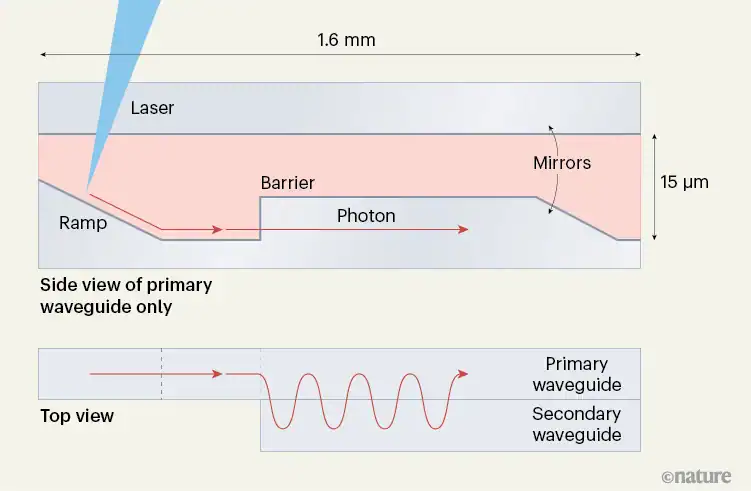
Schematic: The experiment took place in a dye-filled cavity between two mirrors. The bottom mirror was nanostructured to create two waveguides that directed the light. In the primary waveguide, photons were generated by shining a laser at fluorescent dye molecules. This waveguide formed a ramp that gave the photons potential energy. The photons travelled down the ramp until they encountered a step. When they tunnelled into the step, they also tunnelled sideways into the secondary waveguide (an evanescent wave). The rate at which the photons hopped between the two waveguides was used to measure the speed of the particles in the step. (Courtesy: Nature)
A new experiment that measures the quantum tunnelling of photons between two waveguides has produced results that are hard to reconcile with certain deterministic interpretations of quantum mechanics. According to the experimenters, this constitutes a long-sought experimental test of theories that were previously regarded as empirically indistinguishable from conventional quantum mechanics.
In the widely-held Copenhagen interpretation of quantum mechanics developed by physicists such as Werner Heisenberg and Niels Bohr in the 1920s, particles do not have definite properties (such as behaving like a particle or a wave) until they are measured. Instead, a particle’s properties are defined only by its wavefunction, and the square of this wavefunction dictates the probability of the particle being in a particular state when measured.
An alternative interpretation, favoured by physicists such as David Bohm and Louis de Broglie, is that the properties of the particle are everywhere defined by a non-local “guiding equation”. In the famous quantum double-slit experiment, therefore, the particle does not pass through both slits and interfere with itself. Instead, it passes through one slit or the other, but the probability of it passing through each slit is dictated by the value of the guiding equation. Closing or moving one of the slits alters this equation.
Though most physicists today reject Bohmian mechanics, the differences between it and the Copenhagen interpretation are largely conceptual. “Bohmian mechanics and orthodox quantum mechanics are definitely not physically equivalent – they don’t describe the same things happening in the world,” explains mathematical physicist Sheldon Goldstein of Rutgers University in New Jersey, US. “But they are empirically equivalent – they give the same predictions, the same probabilities, for all possible experiments – which is a kind of striking fact, but it’s true nonetheless.”
A test of Bohmian mechanics?
In the new work, however, Jan Klärs and colleagues at the University of Twente in the Netherlands claim to have devised a test in which the two interpretations predict different results – and Copenhagen wins. To perform this test, the researchers set up two waveguides side by side. When they sent pulses of light down one of the waveguides, light leaked into the other waveguide by quantum tunnelling. By knowing the strength of the coupling and measuring the quantum tunnelling as a function of distance, they could infer the speed of the photons.
The researchers also introduced a potential step into the first waveguide. As this step was too large for photons to tunnel through, they were largely reflected, but with an exponentially decaying evanescent field inside the step. Bohmian mechanics agrees completely with standard quantum mechanics on the expected density of particles in this field. However, the guiding equation predicts that the velocity of these particles – which can never be measured directly – is zero.
The researchers therefore used the energy of the photons to calculate their expected speeds inside the potential step, and compared this to the tunnelling rate between the two waveguides. They found that particles that were expected to have higher velocity travelled further before tunnelling into the other waveguide. “We interpret this as a speed measurement,” says Klärs. “When you interpret this as a speed measurement, it gives you a speed that is different from the fundamental guiding equation.”
Questions of interpretation
Goldstein, who was not involved in the research, is unconvinced: “There is a theory in Bohmian mechanics where the particles [inside the potential step] are at rest, but for the experiment they give, the Bohmian velocity is not especially relevant to a correct analysis,” he says. “Whatever analysis they’re doing, if they claim that it correctly predicts the analysis based on Schrödinger’s equation, then that would be the conclusion of Bohmian mechanics, and the real thing for them to look at is why was the Bohmian velocity not the thing that corresponds to the result?”
Experimental physicist Aephraim Steinberg of the University of Toronto, Canada is equally sceptical that the work refutes Bohmian mechanics. He points out that the researchers carefully note that the measurements were made in equilibrium, so whether the exponential decay into the step can be interpreted as a speed warrants further discussion by the community.
Nevertheless, he credits their ingenuity. “This particular experiment gave a result that, even after 20 years thinking about tunnelling times, I did not know the answer to,” he says. “There are things in quantum mechanics like ‘how long does a particle spend in a region?’ that sound to our classical ears like they should only have one answer, but that can in fact have multiple answers.”
It wasn’t until the second year of my undergraduate degree that someone finally put a name to why I’d been struggling with day-to-day things throughout my life – it was Attention Deficit Hyperactivity Disorder (ADHD). It explained so much; my extreme anxiety around work and general life, my poor time management, the problems I had regulating my emotions, and my inability to manage everyday tasks. Being able to put a label on it, and therefore start taking steps to mitigate the worst of its symptoms, was a real turning point in my life.
As such, when I started my PhD at the Quantum Engineering Centre for Doctoral Training at the University of Bristol, I got on the (notoriously long) waiting list for an assessment and formal diagnosis. I knew that because of my ADHD, my PhD journey would look a little different compared to the average student, and that I’d have to work harder in some aspects to mitigate the consequences of my symptoms.
People with ADHD exhibit a persistent pattern of inattention, hyperactivity and/or impulsivity that interferes with day-to-day life. It is a type of neurodivergence – when someone’s brain functions in a different way to what is considered “typical”. Other neurodivergent conditions include autism, dyslexia and dyspraxia, but the term also encompasses mental-health issues, learning difficulties and acquired neurodivergence (for example, after a brain injury).
According to Genius Within, at least 5% of the population have ADHD, 1–2% are autistic, 14% have mental health needs, and many more have other neurodevelopmental conditions. It is also common for those with one neurodivergence to have one or more other co-occurring neurodivergent conditions.
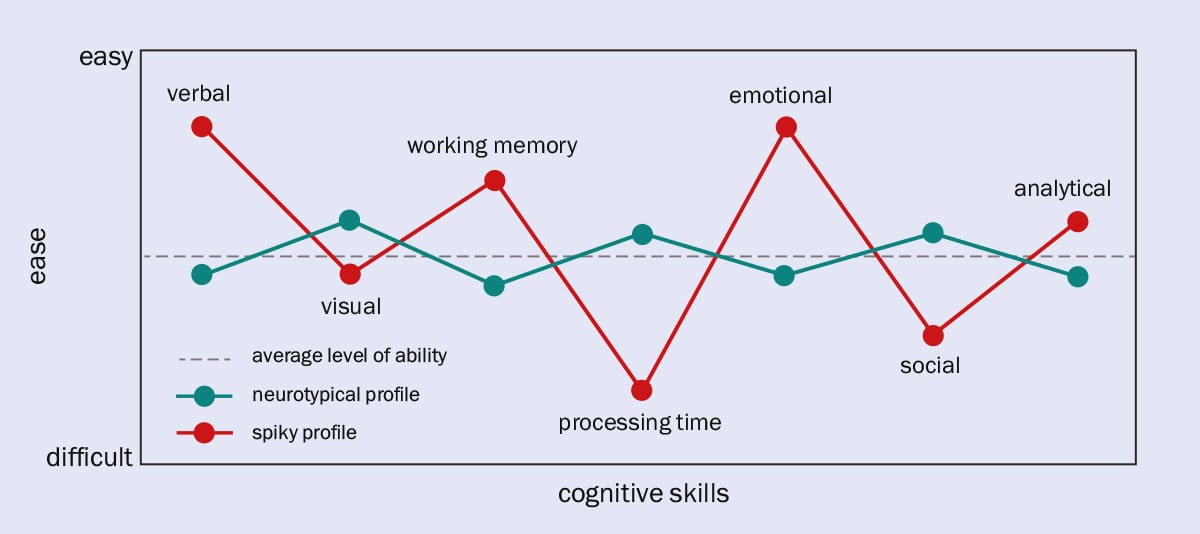
One common trait among neurodivergent people is that they have greater strengths and bigger weaknesses across skillsets when compared to neurotypical people. This is known as having a “spiky profile” – it appears as peaks and troughs above and below a “normal” baseline (figure 1). The skillsets commonly included in a profile are analytical, mathematical, motor, situational and organizational skills; relationship management; sensory sensitivities; processing speed; verbal and visual comprehension; and working memory. So while neurodivergent people may be extremely capable at certain skills, they may really struggle with others.
Figure 1 – Peaks and troughs
(Courtesy: IOP Publishing adapted from WikiCommons)
A neurodivergent person will have what is known as a “spiky profile” because they can find some cognitive skills easy (peaks) but struggle with others (troughs). Every person has an individual profile – even if two people have the same neurodivergent condition, they will have different strengths and weaknesses.
This example compares a neurodivergent profile (red) with a neurotypical one (green) and an average (dashed), for a small set of cognitive skills;
Verbal comprehension – how we communicate and understand speech and its meaning
Visual perception – how we interpret our visual environment and surroundings
Working memory – our short-term memory that assists us with decision making and problem solving
Processing speed – how quickly we take in information, interpret it and respond
Emotional intelligence – how we perceive, use, understand and regulate emotions
Social – how we develop and maintain social relationships
Analytical skills – how we solve problems by analysing information
Personally, I have problems with working memory, organization and processing speed, but each of these issues present differently in certain situations. For example, it’s not uncommon for me to reach the end of a meeting with my supervisor and feel that I understand all that was discussed and have no questions – but then I may come up with some important queries sometime later that didn’t occur to me at the time. This demonstrates a difference in processing speed, which thankfully can be accommodated for by maintaining an open line of communication between myself and my supervisors.
Meanwhile, for Daisy Shearer – who leads the outreach and education programme at the National Quantum Computing Centre (NQCC) in the UK – their autism affects their day-to-day life in other ways. “I experience sensory inputs and emotion regulation differently to neurotypical people, which uses a lot of energy to manage,” Shearer explains. “My executive functioning skills [those that help you manage everyday tasks] tend to be poor, as well as my social skills, which I work hard to overcome.”
Despite our different neurotypes, Shearer and I also have some symptoms in common. For example, we both struggle with switching between tasks, and time blindness, which means we have difficulty in perceiving and managing time. But while many traits can overlap between neurotypes in this way, even two individuals with the same diagnosis won’t have the exact same symptoms or profile.
Abilities and sensitivities can fluctuate day-to-day or even hour-to-hour, regardless of the accommodations and strategies in place
Furthermore, neurodivergent people can be “dynamically disabled”, meaning that our abilities and sensitivities fluctuate day-to-day or even hour-to-hour, regardless of the accommodations and strategies in place. Shearer, for instance, used to be primarily lab-based and would find that environment soothing, but occasionally the lab would become overwhelming when their sensory profile shifted.
Meanwhile for me, one day I may be able to focus and complete multiple large tasks in a day, attend various meetings and answer e-mails in a timely fashion. But on another day – sometimes even the next day – I may only be able to answer half of my e-mails and will flit between tasks, unable to focus deeply on any one thing. This can make monitoring progress and completing milestones difficult, and requires a high degree of flexibility and understanding from those around me.
Accommodating the troughs
So what can the physics community do to help people who are neurodivergent like myself? While we absolutely don’t want to be treated leniently – we want our work as physicists to be as high a standard as anyone else’s – working with individuals to accommodate them correctly is key to helping them succeed.
That’s why in 2019 Shearer founded Neuroinclusion in STEM, after having no openly autistic role models in their physics career to date. The project, which is community-driven, aims to increase the visibility of neurodivergent people in science, technology, engineering and mathematics (STEM), and provide information on best practices to make the fields more inclusive.
Shearer also takes part in many equality, diversity and inclusion (EDI) committees, and gives talks at conferences to highlight how the STEM community can improve the working environment for its neurodivergent members.
Indeed, Shearer’s own set up at the NQCC is a great example of workplace accommodations helping an employee thrive. Firstly, Shearer had a high level of autonomy in defining their role when they joined the NQCC. “It was incredibly helpful when it comes to managing how my brain works,” they explain. Shearer also has the flexibility to work from home if they’re feeling particularly sensory sensitive, and were consulted in the design of the NQCC’s “wellbeing room” – a fully sensorily controllable space that they can use during their work day when feeling overwhelmed by sensory stimuli. Other, small adjustments that have helped include having an allocated desk away from general people-traffic, and colleagues being educated to ensure a more inclusive environment.
For physicists working in a lab – dependent on health and safety measures – it can help to wear headphones or earplugs and have dimmable lights to minimize sensory inputs. Some neurodivergent people also benefit from visual aids and written instructions for experiments and equipment. Personally, as a theorist in an office, I find noise cancelling headphones, and asking colleagues to consider e-mailing rather than interrupting me at my desk, can help reduce distractions.
Reaching the peak
While education and accommodations are key, it’s also important to remember the strengths that come with having a neurodivergent spiky profile – the peaks, so to speak. “I have strong analytical, communication and creative skills,” explains Shearer, “which make me very good at what I do professionally.”
For me, I excel in visual, written and communication skills, and try to use these to my advantage. I’m good at spotting errors in mine and others’ work, I’m a concise but detailed writer, and when not working on my PhD, I’m trying to communicate complex ideas in quantum physics to different audiences with varying degrees of understanding of physics and science.
By recognizing all of our unique capabilities and adequately accommodating those additional neurodivergent struggles, we can build systems that empower instead of limit us
Reminding myself of these strengths is key, as it can be too easy to focus on the negatives that come with being neurodivergent. By recognizing all of our unique capabilities and adequately accommodating those additional neurodivergent struggles, we can build systems that empower instead of limit us.
I believe Shearer put this best: “By embracing our individual strengths, we can enable everyone to thrive in their professional and personal lives, but that can only come with understanding how to accommodate each other.”
A team of researchers in Sweden has demonstrated how smart optical metasurfaces can respond far more strongly to incoming light when switched to their conducting states. By fine-tuning the spacing between arrays of nanoantennae on a polymer metasurface, Magnus Jonsson and colleagues at Linköping University were able to generate nonlocal electromagnetic coupling between the antennae – vastly strengthening the metasurface’s optical responses.
Metasurfaces are rapidly emerging as a key component of smart optical devices, which can dynamically manipulate the wavefronts and spectral signals of incoming light. “They work in a way that nanostructures are placed in patterns on a flat surface and become receivers for light,” Jonsson explains. “Each receiver, or antenna, captures the light in a certain way and together these nanostructures allow the light to be controlled as you desire.”
One promising route towards such intelligent metasurfaces is to fabricate their antennae from conducting polymers, such as PEDOT. In such materials, the intrinsic permittivity – which determines how the material responds to electric fields, such as those from incoming light – can be manually switched by altering the oxidation state through a redox reaction. This, in turn, modifies the polymer’s carrier density and mobility, altering the number and behaviour of mobile charge carriers that contribute to its optical properties.
A key measure of how well these materials resonate with light is the “quality factor”, which describes how sharp and long-lived a resonance is. A higher quality factor signifies a stronger, more precise interaction with light, while a lower value indicates weaker and broader responses.
When PEDOT is in its metallic oxidation state, incident light will drive the resonance of surface plasmons: collective oscillations of mobile charges that are confined near the surface of the material. At specific wavelengths, these plasmons can strongly enhance electromagnetic fields – altering properties including the phase, amplitude and spectral composition of the light reflected and transmitted by the metasurface.
Alternatively, when PEDOT is switched to its insulating state, the resulting lack of available charge carriers will significantly suppress surface plasmon formation, leading to diminished optical response.
In principle, this effect offers a useful way to modulate the nanoantennae of smart metasurfaces via redox reactions. So far, however, the surface plasmons generated through this approach have only resonated weakly in response to incident light, and have quickly lost their energy after excitation – even when the polymer is switched to its metallic state. This has made the approach impractical for use in smart, switchable metasurfaces that require strong and coherent plasmonic behaviour.
Jonsson’s team addressed this problem by considering the spacing of PEDOT nanoantennae within periodic arrays. When separated at precisely the right distance, the array generated nonlocal coupling through coherent diffractive interactions – involving the constructive interference of light scattered by each antenna.
As a result, this arrangement supported collective lattice resonances (CLRs) – in which entire arrays of nanoantennae respond collectively and coherently to incident light. This drastically boosted the strength and sharpness of the material’s plasmonic response, boosting its quality factor by up to ten times that of previous conducting polymer nanoantennae. Such high-quality resonances indicate more coherent, longer-lived plasmonic modes.
As before, the researchers could manually switch the nanoantenna array between metallic and insulating states via redox reactions, which reversibly weakened its plasmonic responses as required. This dynamic tuning offers a pathway towards electrically or chemically programmable optical behaviour.
Based on this performance, Jonsson’s team is now confident that this approach could have promising implications for the future of smart optical metasurfaces. “We show that metasurfaces made of conducting polymers seem to be able to provide sufficiently high performance to be relevant for practical applications,” says co-author Dongqing Lin.
For now, the researchers have demonstrated their approach across mid-infrared wavelengths. But with some further tweaks to their fabrication process, allowing for closer spacings between the nanoantennae and smaller antenna sizes, they aim to generate CLRs in the visible spectrum. If achieved, this could open up new opportunities for smart optical metasurfaces in cutting-edge optical applications as wide-ranging as holography, invisibility cloaking and biomedical imaging.
I recently heard a physicist jocularly remind us that “All science is either physics or stamp collecting”. Widely attributed to the Nobel prize-winning nuclear physicist Ernest Rutherford, this quotation is often interpreted as the pre-eminence of physics over other scientific disciplines. While there is some doubt about whether Rutherford actually uttered that phrase, what’s interesting for me is not its origins but why the statement has – or ought to have – little place in today’s world.
In an era of rapid technological advancement and complex global challenges, it has never been more important for the scientific community to work together. From tackling climate change and dealing with the opportunities and risks of artificial intelligence to exploring space and ensuring everyone has advanced and accessible healthcare, we need experts from different disciplines to work together. No single domain can comprehensively address such challenges.
That’s why all of us in Science, Technology, Engineering, Mathematics and Medicine (STEMM) need to work together collectively and with one voice. Fortunately, there are many examples of where this already occurs. Biomedical engineering, for example, has seen physicists, chemists, biologists, material scientists and medical experts develop many successful innovations, such as prosthetics, joint implants, artificial organs and advanced imaging technologies.
The development of machine learning algorithms for healthcare applications, meanwhile, requires computer scientists, statisticians and medical professionals. By embracing collaboration, the strengths of multiple disciplines can be exploited to drive innovation and create solutions that would be difficult – and sometimes even impossible – to achieve in isolation
Sharing knowledge
Without such collaboration, any solution would be incomplete and likely impractical. By working together, STEMM professionals are creating holistic solutions that address our technical, environmental and societal needs. However, it’s vital that we share knowledge and expertise so that STEMM professionals can learn from one another and build on existing work.
In today’s ever-changing world, staying informed about the latest developments is critical. Collaborative efforts ensure that knowledge is disseminated quickly and efficiently, thereby reducing duplication of effort and speeding up progress. It also fosters creativity by encouraging individuals to think beyond the boundaries of their own expertise. Innovation often occurs at the intersection of disciplines.
When people from different fields collaborate, they bring unique perspectives and methodologies that can lead to ground-breaking discoveries. Just look at the Human Genome Project (HGP), which involved teams of researchers working together to achieve a common goal. The HGP was a voyage of biological discovery led by an international group of researchers looking to comprehensively study all the DNA of a select set of organisms.
Masterclass of collaboration The Human Genome Project set out to sequence the DNA of a number of organisms, including humans. (Courtesy: National Human Genome Research Institute)
Launched in October 1990 and completed in April 2003, the HGP’s major accomplishment – generating the first sequence of the human genome – provided fundamental information about the human blueprint, which has since accelerated the study of human biology and improved the practice of medicine. What we need are more such projects where people work together towards a common goal.
Avoiding siloes
Competition and siloed thinking can, however, hinder progress. Individuals and companies may be reluctant to share knowledge or resources due to concerns about leaking intellectual property, not getting recognition or losing funding opportunities. But knowledge needs to be spread, not least because vesting know-how in a single individual is risky if that person leaves an organization. When you share knowledge, you never know what it can lead to.
Collaborative teams with people from different disciplines are better equipped to handle setbacks and challenges as, when faced with obstacles, team members can rely on each other for support and help seeking alternative solutions. Collective resilience is important in STEMM fields, where failure is often a stepping stone to success. Ultimately the progress and success of humanity depends on our ability to work together.
In practical terms, I am pleased to say that the Institute of Physics (IOP) Business Innovation Awards, which have been running for almost 15 years, embrace much of what I have been talking about. They recognize and celebrate small, medium and large companies that have excelled in innovation, delivering significant economic and/or societal impact through the application of physics.
Whilst the award-winning product innovations recognized by the IOP need to have some link to physics, they almost always involve some other fundamental science. What’s more, the innovations invariably need input from engineering design and manufacture, from software development, and from expertise in, say, medicine, aerospace, nuclear power or food science. Successful winners demonstrate strong multidisciplinary collaboration within their teams.
The bottom line is that’s vital for STEMM professionals to stick together and not try to trump each other with statements like Rutherford’s. For collaboration to work effectively, it requires mutual respect across all contributors. And by working well together, we will drive innovation, help solve complex problems, and shape a better future for the world. As a physicist by training, I naturally have a certain loyalty to the subject. But I’m hugely grateful for what I’ve learnt and achieved by working with people from other disciplines.
A new microscope inspired by the design of Keplerian telescopes produces much sharper images from luminescence from biological cells than was possible with previous devices. Dubbed the “QIScope” by its creators, the device’s highly sensitive camera can detect extremely low levels of light and could be used to observe delicate biostructures in greater detail and over longer periods of time without damaging them.
Many organisms naturally produce light via special enzymes in their cells. Although most such bioluminescent creatures are found in the ocean – think of anglerfish and firefly squid – there are also examples of terrestrial bioluminescent organisms, including bacteria and molluscs.
For researchers in life sciences, harnessing this light is an attractive alternative to imaging organisms using fluorescence. This is because it does not rely on strong external illumination, which can damage cells or interfere with the subtle signals they produce. The downside is that bioluminescence is feeble by comparison, so using it produces relatively low-resolution images.
Researchers led by Jian Cui of Helmholtz Munich and the Technical University of Munich, Germany, have now used a new detector technology called a quantum image sensor (QIS) to improve the resolution of bioluminescence imaging. By integrating this sensor into an unconventional optical microscope design, they increased the number of photons per pixel without sacrificing spatial resolution or field-of-view (FOV), as previous bioluminescence microscopes did.
“Telescope-within-a-microscope”
To avoid this restriction, which is known as vignetting, Cui explains that the team separated the two lenses and inserted a Keplerian telescope between them. “This ‘telescope-within-a-microscope’ reshapes the output of the objective lens to match the width of the tube lens’ back aperture,” he says.
The resulting “QIScope”, as the researchers call it, substantially reduces the size of the image while still capturing the full FOV. The result: an instrument with a higher signal-to-noise ratio and spatial resolution, leading to crisper images than was possible before.
“New detector technologies are being developed all the time and some of them are very impressive,” Cui says. “However, we shouldn’t think about simply putting cameras on microscopes – sometimes you need to design the microscope around the properties of the camera. And this is what we have done.”
The researchers, who detail their work in Nature Methods, hope it will spur more interest in bioluminescence as an imaging tool. “There is a lot of untapped potential here and it could have advantages for certain applications such as studying photosensitive samples or low-abundance proteins,” Cui tells Physics World. “It could be used to study a range of biological systems – from single cells to organoids and tissue models. And since it can be used for long periods, it could reveal subtle and long-term changes in cell behaviour, so supporting progress in diverse research areas, including cell biology, disease modelling and drug discovery.”
A physicist from Vilnius University in Lithuania has created a 3D-printed replica of the Sorbonne Chapel so small it fits on a human hair.
Located in Paris’s Latin Quarter, the Chapel of Sainte-Ursule de la Sorbonne is a Roman Catholic chapel and was constructed in the 17th century.
To create the structure, Gordon Zyla, who carries out research in light technologies at Vilnius’s Laser Research Centre, used a laser nanofabrication technique known as multiphoton 3D lithography.
“Unlike conventional 3D printing, this approach can solidify a light-sensitive material at virtually any point in space, enabling the fabrication of truly 3D structures,” notes Zyla.
The length of the finished product is approximately 120 micrometres long, being 275,000 times smaller than the original yet still preserving its architectural details.
Late last week, the model was presented as a symbolic gift to Sorbonne University president Nathalie Drach-Temam during a visit to Vilnius.
Damage to the spinal cord can disrupt communication between the brain and body, with potentially devastating effects. Spinal cord injuries can cause permanent loss of sensory, motor and autonomic functions, or even paralysis, and there’s currently no cure. To address this inadequacy, researchers at Chalmers University of Technology in Sweden and the University of Auckland in New Zealand have developed an ultrathin bioelectric implant that improved movement in rats with spinal cord injuries.
The implant works by delivering a low-frequency pulsed electric field (EF) across the injury site – an approach that shows promise in promoting regeneration of axons (nerve fibres) and improving outcomes. Traditional EF treatments, however, rely on metal electrodes that are prone to corrosion. In this latest study, described in Nature Communications, the researchers fabricated stimulation electrodes from sputtered iridium oxide films (SIROF), which exhibit superior durability and stability to their metal counterparts.
The team further enhanced the EF treatment by placing the electrodes directly on the spinal cord to deliver stimulation directly to the injury site. Although this subdural positioning requires more invasive surgery than the epidural placement used previously, it should deliver stronger stimulation while using an order of magnitude less power than epidural electrodes.
“We chose subdural stimulation because it avoids the shunting effect of cerebrospinal fluid, which is highly conductive and can weaken the electric field when electrodes are placed epidurally,” explains co-lead researcher Lukas Matter from Chalmers University of Technology. “Subdural placement puts the electrodes directly on the spinal cord, allowing for stronger and more precise stimulation with lower current.”
Restoring motionand sensation
Matter and collaborators tested the implants in rats with spinal cord injuries, using 200 μm diameter SIROF electrodes placed on either side of the injury site. The animals received 1 h of EF treatment daily for the first 7–11 days, and then on weekdays only for up to 12 weeks.
To compare EF treatment with natural healing (unlike humans, rats can recover after spinal cord injury), the researchers assessed the hind-limb function of both treated and non-treated rats. They found that during the first week, the non-treated group recovered faster than the treated group. From week 4 onwards, however, treated rats showed significantly improved locomotion and coordination compared with non-treated rats, indicating greater recovery of hind-limb function.
The treated rats continued to improve until the end of the study (week 12), while non-treated rats showed no further improvement after week 5. At week 12, all of the treated animals exhibited consistent coordination between front and hind limbs, compared with only 20% of non-treated rats, which struggled to move smoothly.
The team also assessed the recovery of mechanical sensation by touching the animals’ paws with a metal filament. Treated rats withdrew their paws faster than non-treated rats, suggesting a recovery of touch sensitivity – though the researchers note that this may reflect hypersensitivity.
“This indicates that the treatment supported recovery of both movement and sensation,” says co-lead researcher Bruce Harland from the University of Auckland in a press statement. “Just as importantly, our analysis confirmed that the treatment did not cause inflammation or other damage to the spinal cord, demonstrating that it was not only effective but also safe.”
Durable design
To confirm the superior stability of SIROF electrodes, the researchers performed benchtop tests mimicking the in vivo treatment. The SIROF electrodes showed no signs of dysfunction or delamination, while platinum electrodes corroded and failed.
“Platinum electrodes are prone to degradation over time, especially at high charge densities, due to irreversible electrochemical reactions that cause corrosion and delamination, ultimately compromising their long-term stability,” says Matter. “SIROF enables reversible charge injection through surface-bound oxidation states, minimizing the generation of potentially toxic stimulation byproducts and enhancing their stimulation capabilities.”
In contrast with previous studies, the researchers did not see any change in axon density around the lesion site. Matter suggests some possible reasons for this finding: “The 12-week time point may have been too late to capture early signs of regeneration. The injury itself created a large cystic cavity, which may have blocked axon growth. Also, electric field treatment might improve recovery through protective or alternative mechanisms, not necessarily by promoting new axon growth”.
The researchers are now developing an enhanced version of the implant with larger electrodes based on the conductive polymer PEDOT, which enables higher charge densities without compromising biocompatibility. This will allow them to assess a broader range of field strengths and pulse durations in order to determine the optimal treatment conditions. They also plan to test the implant in larger animal models, and hope to elucidate the mechanisms underlying the locomotion improvement using ex vivo models.
As for the possibility of future clinical implementation, senior author Maria Asplund of Chalmers University envisions a temporary, possibly biodegradable, subdural implant that safely delivers low-frequency EF therapy. “This could be implanted early after spinal cord injury to support axon regrowth and reduce the follow-up damage that occurs after the injury itself,” she tells Physics World.