Mexico City is one of the most populous cities in the world and it is facing a water crisis. Built on an ancient lakebed, the city’s geography leaves it vulnerable to a range of natural hazards, perhaps most notably earthquakes, as witnessed during the 2017 Central Mexico earthquake that claimed the lives of more than 200 people in Mexico City. The city’s soft underlying soils that amplify seismic waves are also causing the city to sink in places, which can damage water supply pipes causing leakages. Around 70% of Mexico City’s inhabitants receive tap water for just a few hours a day, instead relying on trucks to bring water to local storage tanks. Meanwhile, the city is also notoriously prone to flooding as water that would have filled natural wetlands is now forced over the vast urban sprawl.
This film investigates Mexico City’s troubled relationship with water. It takes viewers to one of the city’s only remaining chinampas – artificial islands originally created by the Aztecs who in the 14th century established a settlement on the site of current day Mexico City. These floating gardens provide a glimpse into the city’s origins and reveal the nature of the city’s silty foundations. The short documentary also explores some of the engineering and planning solutions to tackle these environmental challenges. At a local scale, residents are working with organizations to capture drinking water from rainfall. On a larger scale, there are transformational ideas such as restoring the ancient wetlands, or using geothermal energy from Popocatepetl volcano to pump water into the city from the Valley of Mexico.
This film is the first in a series of films we are producing about environmental challenges and the solutions being used to adapt to create more sustainable futures.
Cities built on a grid pattern, like New York and Chicago, build up more heat than those with a chaotic structure, such as Boston or London. That’s according to researchers from the US and France, who assessed the local urban heat island effect.
Urban building materials absorb heat during the day and radiate it at night, to a much greater extent than vegetation does. This, along with waste heat, creates a heat island effect that raises city temperatures above rural ones, particularly at night.
To come up with the result, the team looked at 47 city layouts from satellite images, using mathematical models designed to analyse atomic structures. Each city received a ranking for its local order parameter, which ranges from zero for total disorder to 1 for a perfect “crystalline” structure. The parameters for the cities varied from 0.5 to 0.9.
City structure appears to affect the heat island effect as buildings can reabsorb heat radiated out by buildings that are directly opposite them.
The findings could be useful for building new cities or expanding existing ones. “If you’re planning a new section of Phoenix,” said Roland Pellenq of MIT and France’s National Center for Scientific Research, “you don’t want to build on a grid, since it’s already a very hot place. But somewhere in Canada, a mayor may say no, we’ll choose to use the grid, to keep the city warmer.”
In the state of Florida, the team estimated, urban heat island effects cause around $400 million in excess costs for air conditioning. Although a grid pattern makes it easier to plan utility lines, sewer and water pipes, and transport systems, the heat savings from a less organised city structure could be worth the extra complications in hot areas.
Research on construction materials may also help manage heat interaction between buildings in cities’ historical downtown areas, according to the team.
Physicians and biomedical engineers at The Ohio State University are exploiting 3D printing technology to help select the optimal valve for a patient receiving an aortic valve replacement. Using CT scans to model the patient’s aorta, they create a 3D-printed replica and use this to predict potential complications – such as leaks, blockages or blood clots – so that they can be avoided.
There are currently two options available for replacing a diseased aortic valve: open heart surgery or a less invasive transcatheter method that deploys a bioprosthetic valve through a blood vessel in the leg. To decide which approach is best for each patient, the researchers create personalized 3D models of the aortic valve and neighbouring structures and investigate how the new valve will function.
“Using a simulator in a lab, we can replicate what happens in a patient’s left ventricle,” explained Prasad Dasi, a biomedical engineer at The Ohio State University College of Engineering. Dasi’s team precisely reconstruct a patient’s aorta and 3D print it using flexible materials that mimic the aorta. They load the model into a heart simulator that pumps transparent, simulated blood through the system, and then measure blood flow velocity and vortex patterns with and without a replacement valve.
“We can model various therapies, positions and types of valves to better understand problems such as leakage, clotting or coronary obstruction,” Dasi explained. “We can observe how different valves not only relieve the stenosis but also minimize the likelihood of blood clots forming, which is the goal of the treatment.”
At the same time, the team creates computer models to capture the physics of blood flow and interaction between the transcatheter valve and the patient’s anatomy. Long term, their goal is to understand each patient’s unique anatomy and blood flow without performing the physical model experiments, thus speeding the process of personalizing treatment decisions.
“We currently have two valves to choose from in the transcatheter world. I suspect we will have at least four within two years,” said Scott Lilly, interventional cardiologist at The Ohio State Wexner Medical Center. “Each valve is a little different, and the anatomy of every patient is unique. The ability to predict the function of the valve after placement, and which valve may work best with the least amount of leak and without impinging on adjacent structures, is critical.”
Scott Lilly reviews a scan of a patient’s heart
Lilly noted that having clinical and biomedical engineering faculty at the same table discussing individual patients makes their heart programme stronger. “In some cases, for example, the coronary arteries come adjacent to where the valve would be placed,” he explained. “Using 3D modelling we can determine whether or not to protect these blood vessels during deployment, or even whether to proceed with valve replacement at all. These discussions have directly informed how we approach many valve replacement procedures.”
Dasi and Lilly are presenting results from this work at the CRT interventional cardiology conference, held this week in Washington, DC.
Injuries to the lumbar spinal cord severely impair leg movement, or even cause complete paralysis. Epidural electrical stimulation has emerged as a promising approach to restore motor control, but for severe injuries, recovering movement also requires a serotonergic replacement therapy. With this aim, a research team headed up at EPFL in Switzerland is developing neural interfaces that deliver both electrical and chemical neuromodulation to the spinal cord.
These interfaces, called “e-dura”, integrate a silicone substrate, stretchable gold interconnects, soft electrodes and a fluidic microchannel (chemotrode). Unlike existing implants, these can be inserted below the dura mater – the membrane surrounding the spinal cord – allowing highly targeted drug delivery.
“E-dura has mechanical properties that are similar to those of the dura mater itself,” explained first author Marco Capogrosso. “Therefore, biomechanical compliance is greatly improved compared with classical stiffer electrodes. This allows the implants to gently ‘sit’ on top of the cord without significant damage to surrounding structures.”
This subdural placement should also increase the selectivity of electrical stimulation and reduce current thresholds. To date, however, these advantages have not been validated. Capogrosso and colleagues have now combined in silico, in vivo and behavioural experiments in rats to evaluate the advantages of subdural implants for restoring motion via electrochemical stimulation (J. Neural. Eng.15 026024).
In silico simulations
To compare the spread of currents between epidural and subdural implants, the researchers developed a computational model of the rat spinal cord that included detailed geometry of the spinal roots. They first estimated the 3D voltage distributions elicited by stimulation from electrical contacts placed within the epidural fat (above the dura mater) and within the cerebrospinal fluid (below the dura mater). Iso-potential curves penetrated deeper into the dorsal roots (which contain the nerves involved in muscle activation) with the subdural electrodes.
The e-dura implants
They then used these voltage distributions to simulate electrical stimulation, finding that subdural stimulation recruits spinal structures at lower currents than epidural stimulation. The model estimated that subdural stimulation reduces the activation threshold by 10–20% compared with epidural stimulation. This reduction is attributed to the proximity of subdural electrodes to the targeted neural structures.
In vivo studies
Next, Capogrosso and colleagues validated the model in rats, using the same implant to deliver epidural and subdural spinal cord stimulation. In five rats, the electrode was first placed above the dura mater to perform epidural stimulation, then the dura mater was opened and the device was inserted below. The researchers delivered electrical pulses at increasing currents until motor responses recorded in leg muscles reached saturation.
In vivo recruitment properties of the subdural implants
Subdural and epidural electrical stimulation both achieved a graded recruitment of the distal leg muscles. Confirming the model’s predictions, subdural stimulation showed an average 15% reduction in current threshold compared with epidural stimulation. Stimulation delivered from the subdural and epidural surfaces achieved comparable, high levels of specificity, allowing side-specific recruitment of leg muscles.
The subdural implant’s ability to decrease stimulation thresholds while retaining high specificity reduces power consumption and risks of long-term damage in the tissues, increasing the clinical safety profile of this approach. The researchers confirmed the stability and safety of the implants in three rats, showing that the electrode threshold and impedance were stable over five weeks. Post-mortem assessment revealed that the implants did not damage the spinal tissue.
Restoring motion after injury
Finally, the team tested the ability of subdural implants to deliver electrochemical neuromodulation therapies. They inserted an implant with seven electrodes and a chemotrode below the dura mater of lumbar segments in six rats. The rats subsequently received a lateral hemisection of the spinal cord. In the weeks after this injury, all rats exhibited complete paralysis of the leg on the injured side, while the other leg could still produce movement when the animals were placed over a treadmill (attached to a body support).
For each test session, the researchers first delivered serotonergic therapy through the chemotrode, and then applied electrical stimulation to the rat’s injured side. This electrochemical neuromodulation restored weight-bearing locomotion of the paralyzed leg in all rats, without affecting the intact leg.
This ability to deliver chemical and electrical neuromodulation simultaneously via a single implant is of great value for clinical translation. “Right now, systemic delivery of drugs would significantly affect the behaviour and mood of patients,” Capogrosso explained. “To allow safe delivery of a sufficient amount of drug to the spinal circuits, we think that local drug delivery is a viable solution. This may be the only option for people suffering from severe motor paralysis to be able to efficiently use electrical stimulation of the spinal cord to recover motor function.”
Next, the researchers aim to demonstrate that spinal cord stimulation is as effective in humans as it is in rats, using classical stiffer epidural interfaces. “If this is the case, all the work that we performed in rats and primates can be translated to clinical settings, including subdural interfaces,” said Capogrosso. “However, e-dura is still an experimental device and significant work needs to be done to scale this technology to human applications.”
By the end of this century the number of people exposed to heat-wave conditions in India is likely to multiply between 18 and 200 times, depending on which climate path the world follows. More than 20,000 people have died from heat-related causes in the nation since 1990.
Heat waves are the most lethal weather phenomenon in the world. For example, the 2003 heat wave across Europe is estimated to have killed more than 70,000 people; significantly more than even the most major floods, hurricanes and tornadoes. As our planet continues to warm, heat waves are expected to occur more frequently and to last for longer.
In India the increase in number and duration of heat waves is already evident, with a clear rise in dangerous heat waves in recent years. The five most severe of the top-ten heat waves since 1951 occurred after 1990.
Previous work has investigated how heat-wave frequency and duration might increase in the future across India, but until now little had been done to assess the impact on population exposure. It isn’t always the hottest heat waves that pack the biggest punch. In the 2015 event an estimated 2500 people died from heat-related causes, making it India’s second most deadly heat wave. However, this heat wave failed to be classified in the top ten because it was localized over the east of the country.
Vimal Mishra from the Indian Institute of Technology (IIT) Gandhinagar and his colleagues combined climate models with population scenarios for India to investigate how many people might be exposed to heat waves across India in the future. Climate models project that the frequency of severe heat waves in India will increase 30-fold by the end of the century under a 2 °C warming scenario. Under a business-as-usual scenario (RCP 8.5) heat-wave frequency increases 75-fold.
“Heat waves like 1998 [where more than 2000 people died] are projected to occur every year in the late 21st century under a business-as-usual scenario,” said Mishra.
By looking at the number of days that heat waves were expected to last, and the estimates of population increase, the researchers estimated the number of people likely to be exposed to heat waves each year, and totted up the number of days that they were likely to be exposed.
The results show that population exposure to heat waves is expected to increase by around 18-fold by the end of the century under a 1.5 °C warming scenario, 92-fold under a 2 °C warming scenario, and a massive 200-fold under business-as-usual warming.
When it comes to mitigating for heat-wave exposure, the researchers note that strategies to reduce population growth in India during the 21st century may not reduce exposure to heat waves as much as hoped.
“The heat-wave exposure is dominated by the increase in length of heat waves, rather than population increase,” they said. Instead, the largest mitigation effects are seen by reducing greenhouse-gas emissions. “We show that low-warming scenarios can provide substantial benefits in reducing the frequency of severe heat waves in India. Limiting global temperatures to 1.5 °C would reduce exposure by half by the mid-21st century, compared to business-as-usual,” Mishra added.
In the meantime, whichever climate scenario unfolds, India is going to have to look at serious adaptation measures such as increased provision of shelter, more cooling systems, modification of daily behaviour patterns and developing emergency public services to cope with heat-wave associated problems. But reducing global temperature will be key.
“Slowing the rate of global warming would provide vital time for further development of measures to reduce actual exposure,” writes the team in Environmental Research Letters (ERL).
Sarah Tesh and Susan Curtis are reporting from the APS March Meeting in Los Angeles, California
While the stars of stage and screen were preparing themselves for the Oscars on Sunday, Sarah and I visited an iconic location that has taken a starring role in such films as La La Land and Rebel Without A Cause. Set on a hill a few miles from downtown Los Angeles, the Griffith Observatory has been open to the public since 1935, offering visitors a close-up view of both the stars in the night sky and the very special one at the centre of our solar system.
As we found out, the observatory is a popular destination for Angelinos on sunny Sunday afternoon. It offers majestic views of the city below, the ocean in the distance, and even the famous “Hollywood” sign – which is situated on another hill in the surrounding Griffith Park. But the main attraction is the observatory itself, complete with a state-of-the-art planetarium, a telescope that opens for public viewings, and a ceolostat that allows visitors to see a filtered image of the Sun.
The idea for a public observatory emanated from the imaginatively named Griffith J Griffith, a Welshman who had moved to California to make his fortune from silver mining. Griffith was inspired by the emerging field of astronomy, and in particular the breakthrough discoveries that had been made by Edwin Hubble and other pioneers at the Mount Wilson Observatory, located in the mountains to the north-east of Los Angeles. He made a bequest in his will to the city, specifying that it should be used for the construction of an observatory that would allow ordinary people to see the wonders of the solar system for themselves.
Today, the observatory houses innovative exhibits that explain how the Sun, Earth and Moon interact to create phenomenon such as the seasons, the tides, and solar and lunar eclipses. There are plenty of buttons to press, eyepieces to look through, and well-conceived demonstrations of more complex concepts such as adaptive optics and solar spectroscopy.
One of my favourite spaces was the central rotunda, which is decorated with murals representing some of key ideas in astronomy and featuring a huge Foucault pendulum that demonstrates to visitors that the Earth is rotating beneath them. But the observatory provides plenty of other opportunities for the visiting public to see how telescopes are used by astronomers to reveal the secrets of the cosmos, and in particular to study the most important star to everyone here on planet Earth.
Last night saw the glitz and glam of the Oscars in Los Angeles, but for physicists, the City of Angels has a more interesting event starting today – the American Physical Society (APS) March Meeting. And with over 10,000 attendees and thousands of papers being presented, the conference will be as full of ground-breaking science as ever.
The hot topics this year, according to the APS’s helpful online conference scheduler, are qubits and quantum computing, which not only take the top five spots of the most scheduled list but also the majority of the top 20. Other popular subjects include topology, machine learning and – naturally — the physics of Hollywood. The press room is also having some interesting talks, from microscopic robots and games for quantum computers, to the physics of terrorism and superconducting black holes.
If you’re here at the meeting, do drop by the IOP Publishing booth in the exhibitor’s hall. You can pick up the latest issue of Physics World, find out about our journals and tell us what you think about our new-look website. Susan Curtis and I will be keeping you up to date with conference highlights here on the Physics World blog and you can follow us on Twitter: @teshsarah and @PhysicsWorld. We’ll also be visiting Caltech’s robotics lab on Wednesday and NASA’s Jet Propulsion Laboratory (JPL) on Friday, so get ready for some overexcited tweets and a lot of photos.
DNA can be used as a building block for future molecular-scale electronic circuits because it can form a variety of 3D structures and networks. Thanks to a new three-terminal electronic circuit element made out of this molecule, this goal is now one step nearer.
“The circuit element we made contains a guanine-quadruplex (G4) motif, which can be used as a connector for multi-ended DNA duplexes,” explains Nadrian Seeman of New York University in the US, who led this research effort along with Nongjian “NJ” Tao of Arizona State University and David Beratan of Duke University. This connector allows charges to enter the structure from one terminal at one end of the three-way G4 motif and exit from one of the two terminals at the other end – something that was not possible with previous such designs.
Nanoscale circuit elements, such as current splitters or combiners, require at least three terminals. A good material for making the building blocks for these elements is DNA. This molecule contains multiple strands that can self-assemble into multi-ended junctions and its nucleobase stacks can transport electric charge over long distances. The problem is, however, that this stacking is often disrupted at junction points, which hampers charge transport between terminals.
“We have now shown that a guanine-quadruplex (G4) motif can be used as a connector element for multi-ended DNA duplexes,” says Seeman. “Without this ability to make three or more branch components, it is not possible to build circuit networks from DNA.”
Alternative strategy
Previous attempts to make such multi-terminal charge-transfer structures from DNA relied on double crossover motifs, but charge cannot flow between the helices of these structures, he explains. To try and overcome this problem, researchers then tried splitting a DNA double helix into two double-stranded helices in a Y-shaped three-way junction, but they found that charge transport through this junction was slow compared to that through a duplex DNA.
“An alternative strategy is to use an extended guanine quadruplex (G4) motif with appended duplexes,” says Seeman. “This motif consists of stacked guanine strands wherein each guanine base forms hydrogen bond pairs with its two neighbours. The structure is stabilized by K+ counterions.”
Splitter/combiner type structure
In this design, charge injected from two different duplexes converges in the G4 motif and exits through one or two duplexes on the other side of the quadruplex without attenuating, which is in fact a splitter/combiner type structure.
In their work, Seeman and colleagues measured the conductance through G4-based nanostructures using the scanning tunnelling microscope break junction (STM-BJ) technique. The structures they studied comprise a G4 core with double helices attached to each side.
The team, detailing its work in Nature Nanotechnology doi:10.1038/s41565-018-0070-x, says that it is now trying to make DNA-based elements that can be controlled, “perhaps like transistors,” Seeman tells nanotechweb.org.
The dissipation of kinetic energy in the oceans has been modelled in intricate detail by Brodie Pearson and Baylor Fox-Kemper at Brown University. The duo used their model to explain how energy transmission can suddenly result in turbulent events such as intense flows. Their results could have important implications for studies of the flow of energy in the warming oceans.
The flow of kinetic energy within the oceans is a monumental and never-ending process that occurs on length scales from thousands of kilometres right down to millimetres – the latter being the scale at which kinetic energy is dissipated as heat. While oceanographers have a basic understanding of this process, how energy is transported and ultimately dissipated can be extremely complicated.
Ocean currents are strongly influenced by local effects such as coastlines, tides and winds. Global influences such as gravity and Coriolis forces also play important roles. In addition, sudden and intense “intermittent” events such as strong flows can occur. These are related to turbulence and difficult to predict. Although rare, intermittent turbulence can have a strong influence on the dynamics of the ocean as a whole.
Topographic oceans
Pearson and Fox-Kemper realized that to understand intermittency and other aspects of energy flow in the oceans, they would need simplified numerical simulations that incorporate both land masses and ocean topography. To construct their model, the duo broke oceanic movements down into two parts. This allows the simulation to compute separately the dynamics of large, kilometre-scale flows – which is a relatively simple task – as well as small-scale flows, which are a much more intricate problem that requires approximation techniques.
The simulations allowed Pearson and Fox-Kemper to confirm that kinetic energy is transferred to logarithmically shorter lengths scales at a constant rate before dissipating at the smallest scales. However, to their surprise, the researchers found that intermittent turbulence did not only occur on small scales as they had expected. Instead they found that intense flows could occur abruptly even on a scale of kilometres – a phenomenon they had not predicted.
Energy budget
The discovery could be important for oceanographers and climate scientists studying the ocean’s energy budget, which describes how the seas absorb and distribute huge amounts of energy from the Sun. As the oceans warm as a result of climate change, it will be important to understand how this process could change.
The movement of cells in the extracellular environment plays an important role in many biological events, such as tumour invasion or immune reaction. In order to move, cells have to apply forces on the extracellular matrix. Elucidating how the cells generate these forces and what effect this has on their environment can help us to understand these biological processes. As such, there has arisen recent interest in approaches that can measure these forces.
Herbert Levine and his team at Rice University (USA) and NRCN (Israel) have developed a computational model that predicts the behaviour of cells in complex fibrous environments. Their work pays special attention to the limitations that may arise when trying to compare this theory with experimental data, and possible next steps to overcome them (Phys. Biol.15 026001).
How do we measure cell movement?
Cells normally reside in the extracellular matrix, an intricate 3D fibrous environment, and to move around they must pull and deform those fibres. By placing theoretical beads in these fibres, we can measure the matrix deformation and, in principle, determine the force that the cells are exerting on the surrounding components. However, the complexity of the extracellular matrix surrounding the cell makes such determination challenging; if one is not careful, the inferred forces, will not be representative of the actual values.
A motion-cell computational model
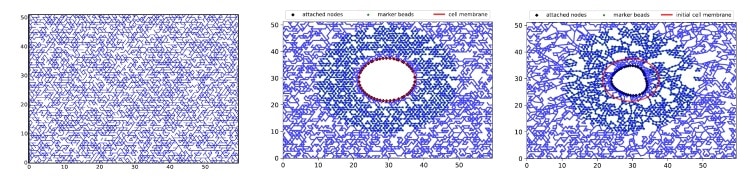
In this study, the authors employed a lattice-based mechanical model that is based on a network of repeated polygonal motifs, such as triangles. This 2D model is able to mimic the properties of the cellular environment (such as the nonlinear elastic response of fibres), has similar properties to 3D models and offers a high computational efficiency. In this model, simulations consisted of inserting a round cell into the lattice (triangle network) and imposing the interactions between them. Next, by employing validated equations that govern the model, the researchers used the observed deformations in the lattice to calculate the forces generated by the cell.
Lattice-based ECM model
However, this is a complex inverse problem, even if we know the equations exactly, and hence some limitations appear during the determination of the desired parameters. For example, poor resolution (or distance between intersections receiving different amounts of force) can lead to inaccuracies.
In general, we can never know the exact equations for the actual system. For example, the model assumes that all the fibres of the lattice have similar properties (i.e., stiffness). However, this is not representative of the extracellular environment, which is comprised of fibres with different sizes and stiffness values. Another important limitation is that we must know the exact fibre geometry to determine the local mechanical properties for the inversion; typically, all we know is the macroscopic response, which is not sensitive to heterogeneity and microscopic structures. This could lead to high inaccuracies in the predictions.
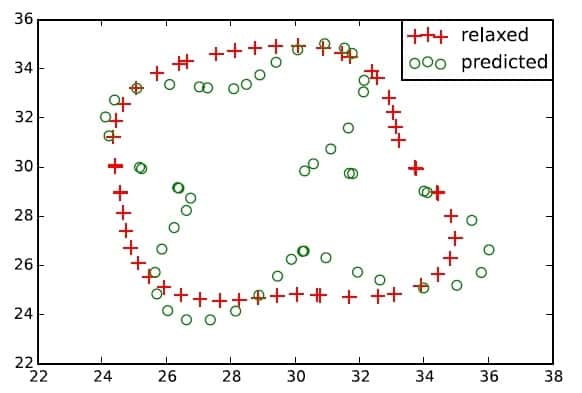
The prediction and the initial shape of the cell
To overcome these hindrances, the authors propose to combine the standard approach, which tries to measure the traction forces from the lattice deformation, with another that also measures the mechanical responses of determined local beads (single points of the lattice). This approach would allow a more precise reconstruction of a specific piece of extracellular environment, and therefore, do a much better job in calculating the forces exerted on it. This challenging task will be part of the authors’ future work.