

Sorting T-cells using biomolecular tension

T-cells, which recognize pathogens such as viruses and bacteria, play a crucial role in the immune system. The affinity (or stickiness) with which T-cells bind to pathogen-based biomolecules determines how effective they will be in mounting an immune response.

Some emerging cancer treatments employ T-cells trained to recognize cancer cells and, for such therapies, the ability to sort T-cells based on affinity could potentially improve clinical outcomes. Unfortunately, existing techniques for testing affinity are low-throughput and not suitable for clinical use. Now, a team of researchers at Massachusetts Institute of Technologyhas used microfluidic technology to take the first step towards high-throughput affinity-based T-cell sorting (Biomicrofluidics11 064103).

As T-cells move throughout the body, they scan for foreign invaders using a biomolecular sensor called the T-cell receptor (TCR). The T-cell has TCRs on its surface, and as the T-cell crawls, these TCRs stick to pMHCs, signalling molecules that can indicate the presence of pathogens. Some TCR-pMHC bonds are stronger than others, and if the two bind with sufficient affinity then the T-cell will initiate an immune response.

To test the affinity of an individual TCR-pMHC pair, the T-cell physically pulls on the TCR to try to break the two apart. The longer the TCR-pMHC pair can stay bonded under tension, the more likely the T-cell is to initiate an immune response. Single-molecule testing techniques can mimic this mechanical test by applying tension to a single TCR-pMHC bond, but such approaches can only test one cell every few minutes. That is far too slow to sort through the millions of cells needed for T-cell-based therapies. As such, the team, led by Scott Manalis, is exploring new approaches for increasing throughput by using microfluidics.

Microfluidics uses micrometre-scale fluid-flow channels for applications where very small volumes of liquid must be moved around (for example, small-volume chemistry or single-cell manipulation). The technology is often used in conjunction with a microscope to sort cells based on visible cues such as size, shape and colour. In this study, the team used a clever trick to estimate the strength of TCR-pMHC interactions in single cells flowing through a microfluidic device.

Manalis and colleagues designed a long, zig-zagging “serpentine” microfluidic channel through which they flow individual T-cells. They also embedded pMHC-coated beads in the channel. As the T-cells move through the channel, they sometimes brush up against the pMHC-coated beads. The T-cells’ TCRs then interact with the pMHC on the beads.

Importantly, the force of fluid flow is transmitted to the TCR-pMHC bonds, mimicking the mechanical test used naturally by T-cells and ultimately leading to bond rupture. The T-cells continue to flow through the channel, but their flow velocity decreases with increased affinity of TCR-pMHC interactions. The researchers measured this reduction in flow velocity using a standard microscope, observing a significant reduction compared with T-cells flowing past non-pMHC-coated beads.

By using a microfluidic device to mimic the mechanical biomolecular test used by T-cells, the team observed a modest increase in testing throughput, to 4-5 cells per minute. “Our future efforts will be geared towards further increasing throughput,” says first-author Max Stockslager. He noted that unlike previous techniques, this sorting method is scalable as several microfluidic channels can be imaged at once. Looking forward, the researchers also hope to translate this technique into a clinical tool for improving T-cell-based therapies.
2017 in sights and sounds

It’s fair to say, 2017 has been another colourful year online, where visual memes continue to stir strong emotions against increasingly divisive political backdrops. Science is not some remote activity completely detached from society, so our videos and podcasts this year reflect the increasingly politicized nature of science. But don’t worry, it’s not all a complete misery-fest. We also celebrate science’s unwaning ability to evoke awe and wonder, as well as profiling some of the next generation of scientists in the US.

How politicians misuse and mangle science

How politicians misuse and mangle science

At the start of 2017 we relaunched our monthly podcast by bringing in a new regular host. Andrew Glester is a science communicator and produces his own popular-science podcast The Cosmic Shed. In the June episode of the Physics World podcast, Glester spoke with Dave Levitan, author of the book Not a Scientist: How Politicians Mistake, Misrepresent, and Utterly Mangle Science. Levitan grapples with the populist politics that rejects the claims of specialists and pitches itself against what it perceives as the intellectual and political elite. The podcast features scientists and commentators from both sides of the Atlantic.

Marching for science

On Saturday 22 April thousands of people took to the streets of Washington, DC to voice their support for science. Endorsed by more than 200 scientific organizations including the American Physical Society, the “March for Science” sought to promote the value of science – and scientists – to society. Physicists were among those marching and they explain their reasons in this video report from the day, which also features some of the most memorable outfits and signs. On the same day, there were there were almost 600 sister events across the globe, including a rally in Bristol where Physics World is produced.

How science gets women wrong

How science gets women wrong

Those who have already listened to the December episode of the Physics World podcast will know that our book of the year 2017 award has gone to Angela Saini for Inferior. The much-discussed thesis re-examines some of the science underpinning long-standing gender stereotypes. Saini, a UK-based science journalist, also shines a light on some of the contemporary research revealing that gender differences are not as straightforward as we might think. In our September podcast, Glester discussed the issues with Saini and travels to Birmingham for the International Conference on Women in Physics 2017.

Human organs on a chip

This year also saw the last films from our “Faces of Physics” series. This collection of short films profiles the lives of people working in physics, exploring their motivations and the impacts of their work. The concluding film in the 5-part series features Samira Musah, a researcher with an intriguing goal – to recreate a human kidney on a chip. A bioscientist by training, Musah is now part of an interdisciplinary team of researchers at the Wyss Institute for Biologically Inspired Engineering in Boston. Human Organs on Chips takes you inside the lab to find out more about this futuristic technology, which could lead to personalized drug development. You can find out more about the Wyss Institute’s philosophy and spirit of enterprise in this Q&A with its founding director Don Inger, taken from our 2017 special report on physics in the US.

Exploring the cosmos with gravitational waves

Exploring the cosmos with gravitational waves

Having pretty much broken the internet last year with the announcement of the first ever detection of gravitational waves, LIGO researchers refused to lay low 2017. On 3 October, LIGO pioneers Rainer Weiss, Barry Barish and Kip Thorne were awarded the 2017 Nobel Prize for Physics. Less than two weeks later, astronomers gathered at the Royal Society for the announcement of arguably the most significant breakthrough of all. A so-called “kilonova” – the merger of two neutron stars – had been detected by the LIGO–Virgo collaboration as well as being observed by dozens of other telescopes, across the electromagnetic spectrum. These combined observations represent the first example of “multimessenger astronomy” involving gravitational waves, opening up a new way of looking at the heavens. In the November podcast, Glester reported from the Royal Society meeting met a range of researchers who provide a broad background to this burgeoning field. For a more in-depth look at the significance of these latest discoveries, take a look at Multimessenger Astronomy by Imre Bartos and Marek Kowalski, a free-to-read ebook from the Physics World Discovery series.

Cassini’s Grand Finale

Since entering orbit around Saturn in 2004, NASA’s Cassini mission has transformed our understanding of the famous ringed planet and its moons. But on 15 September this year the mission came to an abrupt ending when the spacecraft plunged into Saturn’s atmosphere, burning up on entry. This death dive marked the end of Cassini’s so-called “Grand Finale” tour, which saw it take 22 plunges into the space between Saturn and its rings between April and September. This video provided a guide to the Cassini’s dramatic swansong while reflecting on the mission’s key achievements. To learn more about Cassini’s Grand Finale tour, check out this article from the September 2017 issue of Physics World, written by mission scientist Joshua Colwell. Colwell has also written an illustrated ebook, which documents the key discoveries of Cassini’s 13-year mission.

Rising stars of US science communication

Finally, in November we published interviews with 10 early-career scientists based in the US, who discuss their career ambitions and the challenges they face in achieving those dreams. These scientists were invited delegates at ComSciCon 2017, a national workshop for promising science communicators. This interview is with Chani Nava, an astrophysics PhD student who has just finished her first year at Harvard University. Having originally started an undergraduate degree in medicine, Chani switched to a physics programme after coming to understand all the career opportunities that would be open to her. You can see all the other interviews on our multimedia pages.

So the curtain draws on another lively year of audiovisual journalism. Make sure you return in 2018 when we will be pressing the green button on our new look website, which will be packed with thought-provoking podcasts and videos. Look out early in the year for a new video series exploring global environmental challenges and innovative solutions. For now though, that’s a wrap.

Integrated circuits could make quantum computers scalable

Researchers at TU Delft and University of New South Wales have designed a scalable quantum computing architecture based on widely used complementary metal–oxide–semiconductor (CMOS) manufacturing techniques. The approach encodes information in the spins of individual electrons confined in quantum dots, and could allow the development of large-scale computers incorporating millions of qubits.

Computing milestone

For now, the state of the art in quantum computing is represented by devices with a few dozen qubits: as of November 2017, the 50-qubit, superconductor-based IBM Q is the record holder. Systems of this size are about as complex as can be simulated using a classical computer, so the field has reached an important milestone. But although quantum computers at this scale do have their uses, individual devices will need to harness hundreds, thousands, or even millions of qubits before they really come into their own.

No technology epitomizes the concept of scalability like silicon-based integrated circuits. So reliably and profoundly has this field advanced over the last half-century, that Moore’s Law – essentially just an observation about the regularity of increases in available computing power – has become firmly established in consumer culture. No wonder then that researchers are hoping that the same manufacturing process that has underpinned this growth for so long might do the same for quantum computers.

Small but perfectly formed

Writing in Nature Communications, Menno Veldhorst and colleagues describe how cutting-edge CMOS processes are approaching the point at which silicon microelectronic components can be made small enough to be integrated with quantum-dot spin qubits. The architecture designed by Veldhorst and his team is based on a silicon qubit layer enriched with silicon-28. Above this, and separated by a silica interconnect layer, the classical control and readout circuits would be patterned in isotopically normal silicon. Working at a temperature below 1 K, qubit operations would be controlled by electron spin resonance, coupling by exchange interactions between the confined electrons, and measurement by radiofrequency dispersive readout.

Using minimum feature sizes that are achievable now or anticipated in the near term, the researchers propose a circuit geometry that would result in individual 2D modules of 480 qubits each. Thousands of these modules could be combined, producing a computer containing millions of interacting qubits.

Rectal muscle recordings could treat overactive bladders

Abnormalities with the nervous system can cause an overactive urinary sphincter, leading to urinary incontinence. Researchers from University College London (UCL) and Nephro-Urology Clinical Trials (NUCT) Ltd have designed an ano-rectal surface electromyography (sEMG) probe to indirectly monitor muscle activity of the external urethral sphincter. The estimated amplitude of this muscle activity could be used as a threshold to initiate trans-rectal stimulation to treat overactive bladders (Physiol. Meas. 38L17).

Research suggests that an overactive urethral sphincter muscle could be identified by monitoring the activity of the external anal sphincter (EAS) muscle. UCL's Arsam Shiraz, under the leadership of Andreas Demosthenous, has worked with a group of researchers to determine a feasible sEMG probe design to detect such signals. The researchers manufactured four probes with a diameter of 18 mm, and with electrode configurations that varied in the number of electrodes, their size and spacing.

Proof of concept
To attain an acceptable design for an intra-anal sEMG probe, the team tested the four probes on a healthy volunteer by inserting each probe through the anal orifice. The individual was required to contract their EAS muscle three times, lasting 10 seconds each time.

The researchers used correlations between the time of EAS contractions and the sEMG traces to determine a viable in situ probe design. In some probes, they observed poor quality signals and odd findings - such as moments of silence during EAS contractions - which they assumed were related to the large electrode sizes, unstable electrode-tissue contact and the placement of the reference electrode. However, they successfully designed one probe - probe C - which produced the signal that was most correlated with EAS muscular activity.

The researchers had specific design constraints when developing the prototype, such as patient comfort due to the long periods of time that the probe would be inserted and maintaining good contact with the ano-rectum. The final prototype was based on design C with electrode dimensions of 3 mm wide and 1 cm long, and an electrode spacing of 5 mm.

Potential future applications of the probe include the embedding of stimulator electrodes to allow nerve stimulation for the treatment of overactive bladders. By recording intra-anally for a period of time, the EAS sEMG signal could provide a trigger for stimulation by the electrodes.

‘Water cloak’ uses electromagnetic waves to eliminate turbulence

Fuel-efficient ships that produce no wakes could soon be a reality thanks to computer simulations of “water cloaks” done by two researchers in the US. Yaroslav Urzhumov and Dean Culver of Duke University have shown that ions present in ocean water can be accelerated by electromagnetic waves in such a way that any turbulence created by sea-going vessels is cancelled out. Their work offers new opportunities for creating ships with greater propulsion efficiency – and could also be used to make vessels that are harder to detect.

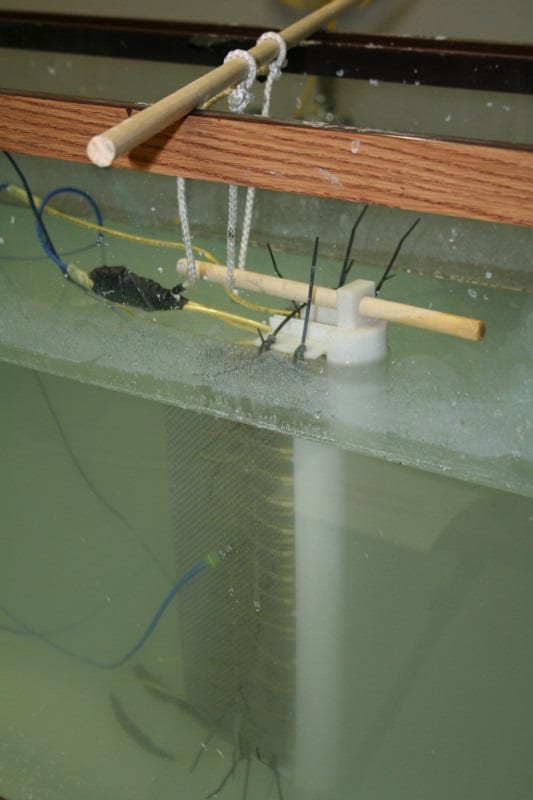
Photograph of a rough prototype of the proposed water cloaking device

“This cloaking idea opens a new dimension to create forces around an underwater vessel or object, which is absolutely required to achieve full wake cancellation,” says Urzhumov.

Guiding waves

Initial ideas for a water cloak were based on developing a specially designed metamaterial to coat the hulls of ships. Metamaterials are more common in optics and acoustics and comprise structures that can bend light or sound waves in ways not possible with conventional materials. In 2011, Urzhumov and colleagues hoped to develop a porous material interspersed with a complex network of miniscule pumps, to act as a metamaterial for guiding water waves. It was hoped that the system could cancel-out any turbulence caused by a moving vessel.

Urzhmov realized there were problems with this approach, arising from shear forces in water. When water is disturbed by an object, intermolecular forces tend to cause more water to be dragged along and these shear forces could not realistically be eliminated by their metamaterial. The team also was not clear on how it would create the pumps. They proposed several designs, but could not think of a way to implement them throughout a porous structure.

Pushing ions out of the way

Now, Urzhumov and Culver have devised a new method of guiding water waves, this time exploiting magnetohydrodynamic forces. This involves the motion of charged particles in a conducting fluid when subjected to electromagnetic fields. The field induces an electric current in the fluid, polarizing the charged particles. In turn, the polarized particles change the magnetic field, which generates a force on the fluid as a whole.

Seawater contains an abundance of ions including sodium, potassium and magnesium, and can therefore be subjected to magnetohydrodynamic forces. In Urzhumov and Culver’s new approach, electromagnetic fields would be used to accelerate water in the direction it would travel under normal turbulence conditions – essentially "pushing it out of the way" of a moving ship. As the vessel passes through the accelerated fluid, any movements due to turbulent and shear forces are cancelled out. The water around the ship appears to remain completely still relative to the surrounding environment, thus eliminating the wake and acting as a functioning water cloak.

Testing with simulations

Urzhumov and Culver used computer simulations to show how the cloak could be implemented practically. By carefully selecting the direction and strength of electromagnetic fields, the simulations showed that turbulence could be eliminated throughout a vessel’s journey. The only variation needed in the field would be to account for how turbulent forces increase with the speed of the vessel. They say that a simple system could be designed to increase the power of the electromagnetic fields with speed.

“If you don’t have to adjust the distribution of forces, you don’t need any electronic switches or other means of dynamic control”, says Urzhumov. “You can set the structure with a specific configuration and simply crank up the current as the object speeds up.”

There is still some way to go before water cloaks become a reality, but their applications are now looking increasingly realistic. The technology would lead to a significant increase in propulsion efficiency for ocean-going vessels. Eliminated turbulence could be exploited by warships to avoid detection from the noise associated with a wake, and could also be used to reduce damage to marine ecosystems. There are also possibilities outside of the ocean. Urzhumov believes the technology could be adapted in the future for use as ion propulsion systems in spacecraft, and for achieving much-desired increases in efficiency for thermonuclear fusion reactions. “I believe these ideas are going to flourish in several of these fields,” Urzhumov concludes. “It is a very exciting time.”

The duo has built a "rough prototype" of the cloak and is testing it in a small tank of sea water (see figure). The research is described in Physical Review E.

Controversial Italian neutrino experiment gains support online

More than 40,000 people have signed an online petition defending a controversial neutrino experiment that is due to start operating next year at the Gran Sasso National Laboratory in Abruzzo, central Italy. The Short Distance Neutrino Oscillations with Borexino Experiment (SOX) is opposed by environmentalists and local residents who fear its source of highly radioactive cerium-144 could contaminate water supplies in the event of an accident. But petitioners believe those fears are overblown and are calling on the president of Abruzzo’s regional government to confirm the experiment’s go-ahead.

That appeal follows a unanimous vote by a regional commission in November to stop the experiment “immediately and definitively”. Meanwhile, a collective of environmental pressure groups known as Forum H2O is to request that the central government revoke the authorization for the experiment that it gave the National Institute for Nuclear Physics (INFN) in February 2016. Forum H2O argues that the INFN failed to tell the relevant ministries that the lab – located within an aquifer inside the Gran Sasso mountain – contains what is effectively a well that feeds one of the region’s main aqueducts.

SOX is designed to provide an intense, laboratory-based source of neutrinos for the Borexino detector, a 17 m-high stainless steel ball containing about 300 tonnes of liquid scintillator that has been used at Gran Sasso over the past 10 years to study neutrinos from the Sun. The idea is that a wave-like distribution of detections throughout the sphere would indicate that ordinary neutrinos from the source are “oscillating” into sterile neutrinos, which are predicted by some extensions of the Standard Model of particle physics but have never been unambiguously observed. SOX’s radioactive source would consist of about 40 g of cerium-144. Currently it is not clear whether the source can actually be built, since the company contracted to do so – Russia’s PA Mayak – has said it is finding it difficult to achieve the desired radioactivity.

Steel and tungsten container

If the cerium-144 can be produced, it would be contained within 10 kg of cerium-oxide powder and sealed inside a double stainless-steel capsule. That would be surrounded by a tungsten cylinder with 19 cm-thick walls and placed in a pit several metres beneath Borexino. The cerium would undergo 5.5 × 10¹⁵ beta decays per second (5.5 PBq), and in the process emit intense gamma radiation. According to SOX spokesperson Marco Pallavicini of the University of Genoa, the shielding – which allows the neutrinos from the beta decays to pass through – would mean people handling the source receive a dose about equal to that absorbed on a return transatlantic flight.

Critics fear, however, that the shielding might be opened, either maliciously or accidentally, and that the powder could then enter the water supply. Pallavicini says these concerns are unfounded, explaining that computer simulations show that the tungsten cylinder could not break, even if it fell from a significant height. As to deliberate interference, he says that the cylinder would be extremely difficult to open since it has a cover weighing several hundred kilograms. “For the possibility of a terrorist attack,” he adds, “the Italian prefecture and police have been informed and I assume will take the appropriate measures.”

Augusto De Sanctis, president of the non-profit organization Abruzzo Ornithological Station, argues that SOX would be illegal because it would contravene a 2006 law forbidding the storage of dangerous or radioactive substances within 200 m of a source of drinking water. Pallavicini admits that he does not know how far SOX would be from the well, but insists that the distance is irrelevant. Because SOX would operate for only 18 months, he maintains it would not involve the permanent storage of radioactive material.

Practice run

Controversy over SOX flared up in early October after Forum H2O and a local online newspaper received an anonymous tip-off that an unannounced practice run for the delivery of the radioactive material – involving an empty cylinder but still requiring a police escort – would be held within a few days. Pallavicini says that the reaction to the trial run “got me mad because they accused us of wanting to hide the experiment”, whereas, he maintains, “we didn’t say anything because it wasn’t very interesting”. But De Sanctis says this was the first time that anyone had heard about SOX, arguing that plans for the experiment should have been made public once the INFN had requested authorization in 2014.

The lab came under fire in 2003 over questions of public safety when prosecutors sealed off part of the lab for several months after 50 l of pseudocumene were accidentally released into the lab’s drains. And in August 2016, measurable but not dangerous quantities of dichloromethane were found in the lab’s well.

De Sanctis says that he is “a supporter of scientific research” and that there are dozens of experiments in the lab that he and his fellow campaigners “are proud of and which don’t pose a risk”. But he believes it is a “gamble” to house SOX – as well as Borexino and the Large Volume Detector, which contains 1000 tonnes of white spirit – underground within a huge aquifer in what is a highly seismic area. “Research has its limits,” he says.

Troubled waters

Pallavicini says that the huge response to the petition makes him “reasonably optimistic that in the end we will come through these troubled waters”. He notes that formally the experiment does not need a green light from the regional government since it has already been authorized from Rome. But he says he has no intention of taking any legal action if the regional government is opposed. “I am a physicist,” he says. “I don’t want to do the experiment against the will of the people in Abruzzo.”

Random walk to quantum computing

The Google quantum hardware lab in Santa Barbara in the US, that’s where I work. We’re trying to tap into a potentially vast natural resource for computing, by harnessing quantum mechanics – something that has never been done before. Success means pushing the computational boundaries of mankind, and the new techniques and materials we develop in achieving this goal will be added benefits. But the path that brought me here wasn’t an obvious one.

When I was close to graduating from high school, I visited several universities and departments to decide what degree to pick. I wanted to study a science, but there are many disciplines, all of which looked exciting – I couldn’t make up my mind. Then it struck me. If you turn off the electricity, there’s isn’t much computer science, aerospace engineering doesn’t apply to a vacuum, and maritime engineering doesn’t help you if you find yourself in a desert. Yet, physics will always be there.

In the end I decided to study physics at the Delft University of Technology in the Netherlands, so that I could remain close to my family. Their physics curriculum takes five years – a good introductory programme is followed by coursework, a small project halfway through, and ends on a high note with a full year in a research group.

The quantum and solid-state physics courses really took off in my third year, and I disliked them. I got bored because of the courses did not got much into the how and why of the science, and the focus was on endless crystal lattices. I liked other disciplines in physics and was good at maths. But at the end of the third year, I had a sudden change of heart – my love for solid-state physics blossomed when I got the chance to work in Teun Klapwijk’s group at Delft, on research related to astronomical instrumentation – detectors to be precise.

The topic was “bolometric mixers”: you take a superconducting wire and bias it with a current. A little added starlight will then heat up the wire, which creates a measurable resistance. The idea was to increase the detector’s (i.e. the mixer’s) bandwidth by engineering the electron diffusivity. For my final year I came back to the same group to dive deeper into this topic. I was amazed that understanding the concept of how electrons pair would allow you to build a detector to learn about the universe.

Unsurprisingly, my PhD started in the same group as well, on subject of “microwave kinetic inductance detectors”. The premise was simple: with a superconducting resonant circuit, light from faraway planets, stars, or even the Big Bang itself, can be absorbed – this light breaks up paired electrons, leading to a measurable shift in frequency. Arraying such resonators provides a path to building large-scale, far-infrared cameras. I learnt a lot about microwave engineering, system design and the low-temperature physics that goes on in superconducting systems – invaluable for my next endeavour.

After my PhD, I wanted to increase my intellectual and geographical radius, and so I moved to the US and took up a postdoctoral scholarship in John Martinis’s group at the University of California, Santa Barbara, to work on superconducting qubits. That was in 2010, when such qubits had significant issues related to noise, loss and the parasitic detection of far-infrared radiation – all topics that I had fortunately covered during my PhD. Moreover, quantum-computing research made some big promises but had been going on for well over a decade, so I decided I wanted to see what it was all about for myself.

The key challenge in building qubits is increasing the coherence time and keeping them isolated, while simultaneously connecting them to other qubits and control lines. This is a tough balancing act. Coherence is also affected by many varying factors, some of which are unknown. By combining several innovations, including a redesigned qubit, a quiet sample environment, and novel materials research, we achieved coherence times that were 1000× longer than the qubit gate operation time, in a coupled system. After figuring this out, the demonstrations of record gate fidelities, error correction, and quantum simulations of chemistry and adiabatic evolutions followed suit. We knew we had laid the foundations for something bigger.

In an unprecedented move, our Santa Barbara team joined Google to form the new quantum hardware lab in 2014, maintaining a presence at the university while setting up a new lab at the company. The combination of being dropped from ongoing funding, writing a research paper and interviewing for a new role at Google was a little hectic. However, joining Google introduced a new level of professionalism, secured long-term funding, and allowed for retaining skilled people, as many academic positions are temporary. Moreover, thanks to the large amount of support within Google for materials analysis, clean software practices and electronics development, our project was able to move along faster. For me, the largest change is that the focus has shifted from building quantum systems for academic interests to developing them for applications. The day-to-day activities haven’t changed much: running experiments, analysing data, iterating designs and writing software. But I now have the freedom to set out quantitative metrics to achieve, and dive into the fundamental issues in qubit coherence and scaling, leaning on the physics training I’ve obtained over the years. So what is the best path to join quantum-computing efforts today? Looking back, while joining Google was obviously a very distinct event, the foundations were laid earlier, when I realized the link between mesoscopic physics and astronomy. Research and development are not separate processes. I’ve had the privilege of working with the best in the field, learning from project investigators, guiding bright students, collaborating with external groups, and now working with a great team at Google. Even though my path here was an unusual one, I can now make a difference, because quantum computing is a nascent field that lies at the crossroads of many disciplines.

The grand tour

The first time I came across the Voyager mission, I must have been six or seven years old, and was poring over an astronomy encyclopaedia. I was amazed to read that a mission launched a full decade before I was born was still out among the stars, and that it bore music and messages from humanity that aliens may one day listen to. From those early days, my obsession with the Voyager mission flourished. Suffice to say, I did not expect any real revelations when it came to either the science or the cultural history of Voyager from The Farthest: 12 Billion Miles and Counting – the latest documentary film about this one-of-a-kind human endeavour. What I expected was a beautifully made film with some exceptional graphics that would tell the familiar tale of Voyager to me, which the documentary most definitely delivered. But I was pleasantly surprised to find that it also revealed several new-to-me and amazing facts, as told by those most closely associated with Voyager and its scientific discoveries.

Written and directed by Emer Reynolds, The Farthest is a feature-length documentary that brings together 25 original and current mission scientists, engineers and other Voyager team members. Using their tales and testimony, the film weaves together the enchanting, comprehensive and ultimately moving story of this farthest-travelled of space missions. Synonymous with the Voyager mission is the Golden Record – the 12-inch gold-plated copper phonograph, put together by celebrated astronomer Carl Sagan and a team of scientists, artists and musicians. It contains music, pictures and greetings from across our planet, in case either probe encounters any extraterrestrial life – and The Farthest also explains how this calling card to the universe was conceived and executed.

Launched in 1977 from Cape Canaveral in Florida, Voyager 1 and Voyager 2 were built to delve into our planetary neighbourhood and get a closer look at Jupiter and Saturn. The primary mission was swiftly extended, with Voyager 2 continuing on to explore Uranus and Neptune (to date, it is the only spacecraft to have visited these planets). Voyager 1, meanwhile, began to make the long journey towards interstellar space (which it officially reached on 25 August 2012). Indeed, the mission was extended three times and is still ongoing, as we remain in contact with both probes. As part of what is now known as the Voyager Interstellar Mission, the twin spacecraft are exploring the boundary of the “helio­pause” – where the influence of the Sun’s magnetic field ends.

The Golden Record (left) was attached to both Voyager craft before they were launched in 1977 (top right). Voyager 2 flew past Uranus in 1986 (bottom right) – to date the only spacecraft to have visited the planet.

Early on in the film, Voyager’s project manager John Casani describes just how crucial and rare the planetary alignment was that allowed both Voyager craft to use “gravity assist” to visit the outer gas giants of our solar system, exploiting Jupiter’s orbital energy to slingshot further out into space. This specific – and fortuitous – planetary alignment only occurs once every 175 years. The film puts that into context by pointing out that the previous time this happened, we were still exploring our planet using wooden sailing ships, and the US president was Thomas Jefferson. But one of the most amazing facts The Farthest reveals is that, thanks to the slingshot, the Voyager probes actually slowed Jupiter’s orbit by about 30 cm per trillion years. The idea that something built by humans had a very real and lasting impact on a celestial body as powerful as Jupiter is a wonderful thought.

My only two tiny criticisms of the film are that often, you do not know who is speaking, as people’s names and titles only pop up at random intervals. It is also a bit annoying that the main story of the Voyager mission is interspersed with the (largely separate) story of the Golden Record – how it was made, what it contains and who was involved. While this is also interesting stuff, these cuts most often happen at an exciting juncture in the Voyager tale – just as the mission is approaching Neptune, say, or when it seems like something has gone wrong. But maybe this is a clever ruse to keep the viewer entranced and leave them at the edge of their seat to see how it all plays out.

Certain moments are indescribably touching, such as when members of the Voyager team recall how they were looking at pictures of Uranus when the Challenger tragedy occurred. They watched the explosion over and over again, but still had to keep on taking their own data.

Another touching moment is when image scientist Candice Hansen describes exactly how she felt when she first set eyes on Earth in the now-legendary “Pale Blue Dot” picture, the most amazing “family portrait” of our solar system, taken by Voyager 1 on 14 February 1990.

With its powerful imagery, glossy VFX scenes and balanced commentary from the men and women who turned the dream of an interstellar mission into a reality, The Farthest is a celebration of humanity at its best. I highly recommend you watch this film, especially if you need something uplifting in these gloomy times. The mere thought that these human-made machines will continue to boldly go, for possibly the next billion years, where no human has gone before, is to me both comforting and tremendous.

  • Dir. Emer Reynolds The Farthest: 12 Billion Miles and Counting 2017 Abramorama 120 min £8.99 DVD

Liquid biopsies can advance cancer treatment

A liquid biopsy simply involves using a patient's blood from a routine blood draw procedure to diagnose cancer. Although extremely promising as a minimally invasive method to track cancer in patients, the approach has yet to be validated. Researchers at the Cancer Center of Northwestern Universityand Thomas Jefferson University Hospital have retrospectively studied medical records of 91 patients with advanced metastatic breast cancer to demonstrate liquid biopsy as an effective prognostic tool (Clin. Cancer Res. doi: 10.1158/1078-0432.CCR-17-2092).

As a tumour grows, it sheds cellular and molecular material that enters the blood circulation. Cancer cells that enter the blood are called circulating tumour cells (CTCs), whereas DNA molecules are referred to as circulating tumour DNA (ctDNA). The research team evaluated increases in CTCs, ctDNA levels, and the number of genetic mutations found in the circulating DNA over a period of three years.

Cancer-related gene mutations

Cancer diagnostics company Guardant Health carried out the blood analysis using Guardant360, a commercially available test that examines more than 50 genes associated with solid tumours. These cancer-related genes are reported in the Catalogue of Somatic Mutations In Cancer (COSMIC), a comprehensive database of cancer-related mutations. In this study, patients' ctDNA harboured three mutations, on average. The most frequent mutations were found in the cancer-related genes TP53PIK3CA and ERBB2.

By analysing blood during the first and second years, the research team established threshold levels that could be used as prognostic factors in metastatic breast cancer. As tumour burden increased in patients, not only did the CTCs and ctDNA levels rise, but the number of mutations also rose. The researchers concluded that CTC levels greater than five cells per 7.5 ml of blood, ctDNA greater than 0.5%, and a number of mutations greater than two could be used as prognostic indicators to determine advanced tumour burden in patients.

Summary of prognostic thresholds found in this study

This prognostic classification is critical in enabling precision medicine, which tailors treatment plans for each individual patient. Such an approach is strongly desirable because genetic mutations related to each individual's cancer can vary greatly from patient to patient, which leads to variable success rates with systemic treatments. A "one-size-fits-all" does not work for treating all patients. Often, approved targeted therapies are available to use on patients with specific cancer-related mutations. However, if the genetic makeup of the patient's cancer is unknown, such therapies may not be recommended.

The researchers demonstrated that a comprehensive liquid biopsy analysis provides a useful prognostic tool for assessing tumour burden and genetic features of cancer. These assessments can enable physicians to tailor treatment plans based on the individual needs of the patient.

With minimal invasiveness, the liquid biopsy can pinpoint genetic mutations to target with drugs, monitor response to drugs, and evaluate the benefit of new drugs during the entire course of a patient's treatment plan. In fact, the authors note that several patients in the study were initiated on targeted therapy based on results of their ctDNA tests.

New constellations, happy birthday Kristian Birkeland, ‘There once was a chemist from Bath…’

By Hamish Johnston

Astronomers at the University of Birmingham have dreamt-up a set of modern constellations in a bid to inspire young people to take an interest in the cosmos. The constellations are related to eight admirable people including J K Rowling, Usain Bolt, Malala Yousafzai, David Attenborough, Mo Farah and Michael Bond. But my favourite is the tennis racquet shaped constellation Serena, named after Serena Williams.

Elsewhere in the heavens, Wednesday marked the 150th birthday of Kristian Birkeland, the Norwegian scientist who first explained the physics of the Northern Lights. After several expeditions to the Arctic to study the lights, Birkeland built a model of the Earth and its magnetic field in the lab to verify his theory. He died in 1917 and his ideas we ignored and even ridiculed until 1960s, when satellite measurements confirmed his description of the outer atmosphere. You can read more about Birkeland in Aurora: In Search of the Northern Lights by plasma physicist Melanie Windridge.

Forget about dancing your PhD, the latest trend in artistic expression is to compose a Limerick based on your research topic – at least at the University of Bath’s Centre for Sustainable Chemical Technologies. Students have been composing poems and uploading them to twitter. Some are very clever and you can enjoy reading them all at #PhDlimerick.

Copyright © 2026 by IOP Publishing Ltd and individual contributors