Gravitational waves hit the headlines in February last year when the LIGO collaboration announced it had detected them directly for the first time using a pair of huge laser interferometers in the US. With a further five sightings reported since then by LIGO and its European counterpart Virgo, scientists have begun to open what they call a new window on the universe. Now, keen to open that window as wide as possible, several groups have proposed sending atomic interferometers into space to observe gravitational waves that are difficult to intercept on the ground.
Gravitational waves are ripples in space–time that create tiny periodic expansions and contractions of space along orthogonal axes as they propagate forward. And, like any waves, they come in a range of frequencies. LIGO, which stands for the Laser Interferometer Gravitational-wave Observatory, detects them by monitoring a change in the relative phase of two perpendicular laser beams. However, at frequencies below about 10 Hz, this signal tends to be drowned out by terrestrial sources of noise, such as seismic waves.
Free-floating masses
To avoid such interference and detect low-frequency waves, physicists are eager to launch interferometers into the quiet of space. The €1.5bn Laser Interferometer Space Antenna (LISA) would consist of three spacecraft positioned millions of kilometres apart in a triangular formation, and would detect gravitational waves by monitoring the interference between laser beams bounced back and forth off free-floating test masses inside each spacecraft. First proposed about 25 years ago, the project has suffered a series of funding problems and was only officially inserted into the European Space Agency’s science programme in June this year, following the successful completion of its predecessor LISA Pathfinder. Its launch is planned for 2034.
“Quantum sensors might allow a reduction of costs, complexity, risks and permit an increased range of observation,”
Guglielmo Tino, University of Florence
According to Guglielmo Tino of the University of Florence in Italy, however, a mission based on the interference of matter waves could potentially be cheaper than one requiring laser interference. That is because while LISA needs at least three spacecraft to carry out multiple measurements of any passing gravitational wave – otherwise an apparent signal might simply be due to random fluctuations in laser frequency – an atomic interferometer could get away with two. “Quantum sensors might allow a reduction of costs, complexity, risks and permit an increased range of observation,” says Tino.
Earlier this month, physicists at Stanford University and the University of California Berkeley outlined plans for the Mid-band Atomic Gravitational Wave Interferometric Sensor (MAGIS). It would consist of two satellites positioned about 40,000 km apart in orbit around the Earth, each of which would contain an ensemble of ultracold strontium atoms brought into and out of superposition by a laser fired between the satellites. Any passing gravitational wave would change the laser’s flight time, resulting in different relative phase shifts between the two interferometer arms in each spacecraft.
Speculative cosmological sources
In effect, says Stanford’s Mark Kasevich, the interferometers would serve as atomic clocks while the laser beam would start and stop those clocks at intervals that depend on its passage through space–time. Kasevich and colleagues say that MAGIS could achieve “scientifically interesting” sensitivities to gravitational waves in a frequency band extending from about 30 mHz to 10 Hz, putting it between the ranges available to LISA and LIGO. At lower frequencies it could observe the merger of white dwarfs, while at the higher end of the spectrum, they say, it might see “more speculative cosmological sources” such as inflation. In addition, it could detect some sources, such as merging black holes or neutron stars, before LIGO does, and as such, allow astronomers operating conventional electromagnetic telescopes to point their devices to the relevant patch of sky ahead of time.
MAGIS is somewhat like a proposal put forward last year by a collaboration at the JILA research institute in Colorado and Harvard University, which features two satellites sharing a single laser link. However, whereas that mission would trap its atoms using lasers, in MAGIS the atom clouds would float freely. That would isolate the atomic clocks from any spacecraft vibration, Kasevich explains.
Meanwhile, a group at the Wuhan Institute of Physics and Mathematics in China has just unveiled an even more ambitious proposal. Called the Atom Interferometric Gravitational-wave Space Observatory, it would use atoms to detect gravitational waves directly rather than to measure the waves’ effect on a laser beam. This would involve three satellites splitting, deflecting and recombining a beam of atoms to create a single interferometer sensitive to a distortion of space–time known as the Sagnac effect that would be induced by gravitational waves.
Smaller size, lower cost
Group member the Dongfeng Gao explains that the observatory could be much smaller than other space-based interferometers – its envisaged length being just 10 km – since the matter waves would have a far shorter wavelength than light. Hopefully, he says, that would lead to a “cut-down in relevant technological requirements and in expense”.
Shimon Kolkowitz of the JILA/ Harvard group praises the “exciting” new proposals, but warns that they will need further R&D on the ground before they can be made “space-ready”. Indeed, Kasevich has not even costed his group’s mission, although he reckons that the price tag would “probably be greater than $1bn”. He says that it is “hard to know how far the technology can be pushed until you start to build the apparatus”.
A porpoise’s forehead acts like a ‘metamaterial’ to create the directional sound beam used by the marine mammals to detect and track prey, claim researchers in the US and China. The acoustics experts and biologists also found that the animals can adjust the acoustic properties of their foreheads to control the width of the beam. They believe that the structure of the porpoise forehead could inspire the development of new materials to control sound, with applications in underwater sonar and ultrasonic imaging.
Porpoises are toothed whales that use directional acoustic waves as a sonar system to hunt. When first searching for prey they use a narrow beam of sound to scan the water. But as they close in on a target they dramatically increase the width of the beam, to keep it in their field of view.
Scientists have struggled to understand how porpoises produce, and control, this directional echolocation beam. Porpoises produce the sounds, or ‘clicks’, by forcing air through a structure in their blowhole called the phonic lips. But this sound source is smaller than the wavelength of the sound it produces, which should, in theory, make the acoustic beam hard to control. And the phonic lips emit sound in all directions, not just forwards.
Sound velocity
To investigate these issues, Wenwu Cao, at Pennsylvania State University, and colleagues took computed tomography (CT) scans of a dead, finless porpoise (Neophocaena phocaenoides) and used ultrasound to measure the sound velocity of the different tissues in its head. They combined this information with field recordings of porpoise clicks and built a mathematical model to simulate sonar emission and beam control.
They found that air sacs in the head and the porpoise’s skull and melon – a tissue bulge on the forehead – all work together to direct the sound. When they included an omnidirectional sound source in their model of the porpoise forehead, a sharp beam of sound was formed with an angular width of 13°. “The forehead structure forms a specially designed passage for the produced wave signal and forces the beam to go forward,” Cao told Physics World.
The air sacs have the lowest sound velocity and the skull has the highest, but they both work as sound reflectors guiding the sound forwards. The melon comprises a low-velocity core enclosed in high-velocity connective tissues. These different acoustic properties achieve the focussing effect.
Acoustic lens
Further modelling showed that changing the shape of the melon and air sacs, by compressing the soft tissues of the forehead, increased the width of the beam to almost 20°. In effect, the melon acts as an acoustic lens that can be adjusted by the porpoise’s facial muscles. And porpoises have been observed doing just that.
A previous study of harbour porpoises found that as they approach prey the width of their echolocation beam changes from 9° to 15°. Further video and magnetic resonance imaging showed that during this period the porpoise’s melon rapidly changes shape, controlled by a network of facial muscles.
By compressing the forehead, the beam can be widened, so that the fish is always on the sonar screen,”
Wenwu Cao, Pennsylvania State University
The initial narrow beam allows porpoises to locate distant fish, but because the field of view is narrow, the fish may move out of sight when they close in, Cao explains. “By compressing the forehead, the beam can be widened, so that the fish is always on the sonar screen.”
Cao says that although it has not been observed, it is reasonable to speculate that other cetaceans – whales, dolphins and porpoises – “may use the same principle to control their acoustic beam since their biosonar systems are similar”.
Ultrasound expert Bruce Drinkwater at the University of Bristol, told Physics World: “They show convincingly that the acoustic properties of the melon cause the sound to be focused into a well-directed beam. It is fascinating to see that evolution has come up with a solution that is quite complex and unlike anything humans have “invented” – the precise shape of the melon is important, as is the distribution of speed of sound.”
“The idea of a sonar system that manipulates sound by deforming an engineered melon is a nice one,” adds Drinkwater. Currently, beam control for underwater sound is achieved using complex and expensive programmable arrays of speakers, he explains. A porpoise-like solution that used a single source of sound and a “melon” could be cheaper. “Change the shape of the melon and the beam is moved or focused.”
The research will be described in Physical Review Applied and an abstract is available.
Biomaterial investigators know that the mechanical stretching of a scaffold containing cells modifies the cells’ behaviour. This effect is being studied and used by research groups worldwide to optimize the fabrication of collagen scaffolds – biomaterial constructs based on collagen that can carry cells and be implanted in the body.
Diego Mantovani and his group at Laval University (LBB) are well aware of this issue and are aiming some of their research in this direction. In a recently published article, they explore the idea of identifying the correct “work out” or stretching that cells in 3D collagen scaffolds must follow to optimize their effect on the collagen. Their results show that an incremental frequency of strain can improve the properties of the scaffold in which the cells are growing (ACS Biomater. Sci. Eng. doi: 10.1021/acsbiomaterials.7b00395).
Making the cells fabricate the scaffold
At the recent Advanced Materials for Biomedical Applicationsconference in Ghent, Mantovani gave a fascinating talk about the collagen tubular constructs that his team is producing for vascular tissue engineering. However, the fibrillary arrangement of collagen scaffolds is not being carried out by the researchers directly, but by the cells themselves.
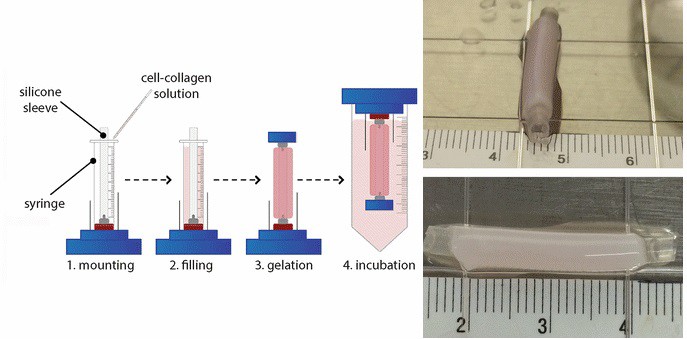
Cells in a collagen–gel solution are doing the work of remodelling the extracellular matrix protein produced by themselves, together with the exogenous collagen provided by researchers. All this happens during one to two weeks maturation inside a custom-designed bioreactor, a closed system that allows the growth of cells in the desired conditions.
These systems allow the induction of a symphony of stimuli – including stretching of the material that the cells grow on, or the flow of liquid – which are detected by the cellular sensors and modify their metabolism. One of the effects that these stimuli have on the cells is to motivate them to alter the material architecture and to improve mechanical properties, as shown in an earlier publication (Ann. Biomed. Eng.45 1496).
Bioreactor to produce tubular scaffolds
Are in vitro and in vivo mechanical stimuli similar?
There are still many conditions to optimize but, if we focus purely on the mechanical stimuli, we can ask: Is a constant mechanical stimulation representative of or relevant to what actually happens in the native blood vessels? Are we making the cells “work out” correctly?
A strain with incremental frequency is indeed more representative of what occurs in the blood vessels in vivo than a constant strain. In addition, it might provide new insights as to how mechanical strain affects cell behaviour in a 3D environment in vitro. To compare and understand the behaviour of the cells under the different conditions, the researchers monitored their shape, orientation and expression, and studied the mechanical properties of the scaffolds.
A gradual increase improves remodelling
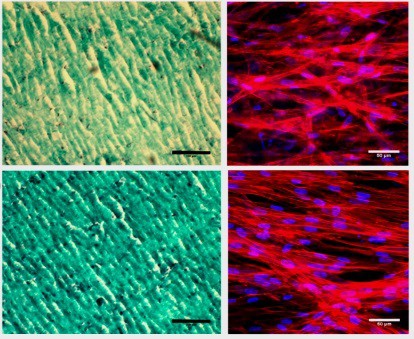
As expected, cells showed different behaviour under the different conditions. The gradual increasing strain promoted a higher alignment of cells and their nuclei when compared with the other conditions. Moreover, it even improved the remodelling of collagen, showing a more compact and aligned structure. Importantly, this alignment occurred in the direction of the strain, as seen in native blood vessels.
However, even though the cells improved the remodelling of the tissue under strain, the expression of proteins related to tissue remodelling was higher in the static control. This fact, together with similar observations reported in other articles, could be accounted for by the “desensitization of the cells over time to cyclic mechanical stimulus” since “no remodelling is seen in the human vasculature unless changes in mechanical cues or injuries are sensed”, the authors suggest. Furthermore, the cells under gradual strain within the scaffold exhibited improved mechanical properties, providing closer characteristics to those observed in the native blood vessels.
Cell containing collagen scaffolds
The study demonstrates that the use of an incremental frequency in the strain strengthens the resemblance between native blood vessels and in vitro developed scaffolds, reducing the gap between them.
Although this provides some answers to current models in vitro, it nonetheless poses more questions: Would we expect the same outcome by incrementing the intensity of the strain? Would there be a synergic effect between the intensity and the frequency? Could we observe similar behaviour when combining with the stimulus of the flow?
While these questions remain unanswered, Mantovani and his group at LBB will be making cells “work out” to provide future answers.
In the depths of the Mediterranean Sea, far from the bright clear blue sky, lies a hidden treasure. It’s not a shipwreck or a pirate’s hoard, a lost artefact or a water-carved sculpture. In fact, at first glance it simply looks like some very organized and oddly stationary bubbles. But these aren’t just trapped pockets of air. They are glass spheres connected by lines of cables, rooted to the sea floor. Swaying slightly with the currents, this odd array is completely alien to the beautiful ocean environment.
Rather than being an art installation seen only by sea creatures and submarines, the unexpected sculpture is a neutrino detector, known as ANTARES (Astronomy with a Neutrino Telescope and Abyss environment RESearch). Tiny and chargeless, neutrinos can be produced artificially in nuclear reactors or created when cosmic rays (protons or heavier nuclei) hit the atmosphere. But physicists at ANTARES are more interested in neutrinos from much further afield, such as remote galaxies. In that case, they are produced when cosmic rays get accelerated and collide with the dense ambient medium.
Unlike charged particles, neutrinos are not deflected by the magnetic fields that permeate the universe; in addition, they interact so weakly with matter that they can travel huge distances across space without being absorbed or scattered. Detecting such neutrinos and retracing their paths therefore allows the cosmic sources to be pinpointed. These subatomic particles are, however, even harder to detect than those made on Earth because they are so few in number.
The only identified sources of cosmic neutrinos are the Sun and the supernova SN1987A Both were confirmed in the 1980s using, among others, Japan’s Kamiokande detector, which contained 3000 tonnes of ultrapure water in a lab 1000 m below ground. But astrophysicists anticipate much more from the neutrino sky, especially at energies above 1012 eV (TeV) , which is why they have turned to the oceans. Unlike detectors such as Kamiokande, or its even bigger successor Super-Kamiokande, using the ocean means there’s no need to dig vast underground complexes and no limit to how big the detectors can be.
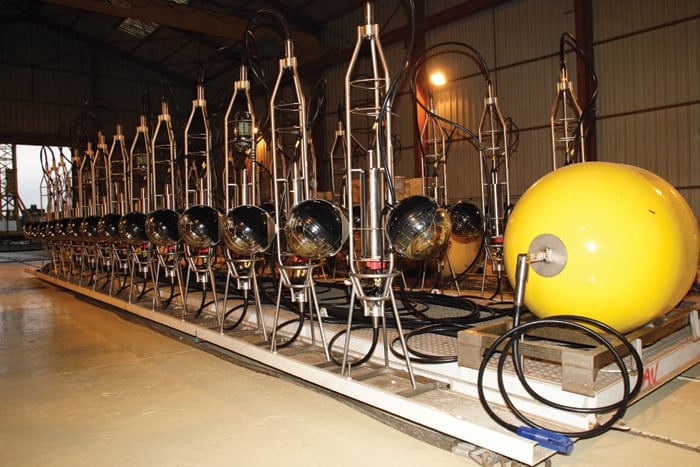
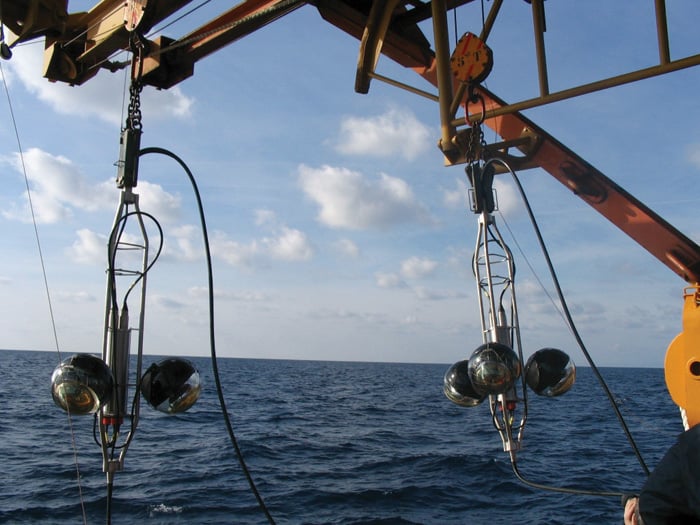
Destined for the depths: a single line of ANTARES before deployment. (Courtesy: L Fabre/CEA)
One beauty of the ocean’s waters is that they serve as a natural shield against the background charged particles (mainly muons) created from cosmic rays interacting in the atmosphere. To further reduce this contamination, neutrino telescopes also concentrate their observations on upward-going neutrinos that have passed through the Earth. These telescopes, in other words, observe the sky on the other side of the Earth, using the planet as a giant particle “filter” that lets only neutrinos through.
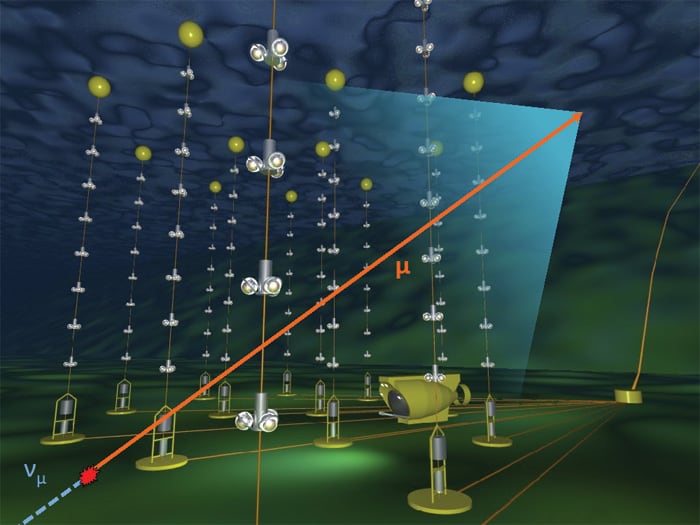
1 Blue light Charged particles (here, a muon) produced in a neutrino–nucleus interaction travel faster than the speed of light in water. This property leads to the emission of a cone of blue light around the muons’ direction of propagation that can be detected by photomultipliers installed in a dark, transparent environment. The depicted detector is ANTARES: each of the 12 detection lines supports 25 titanium frames holding a triplet of photomultipliers looking 45° downwards. The lines are connected to a main junction box through interlink cables plugged with a submarine vehicle. The junction box communicates with the shore station through a 40 km-long electro-optical cable laid on the seabed. (Courtesy: F Montanet, CNRS/IN2P3 and UJF for Antares)
But the ocean’s main appeal for physicists is the water itself, which transforms the sea into a giant telescope. In particular, it detects the “Cherenkov light” produced by charged particles that are created when a neutrino interacts with an atom’s nucleus. Moving faster than the speed of light in water, these particles create a cone of blue light at a well-defined angle with respect to the particle’s direction of travel (figure 1) – a process similar to the creation of sound shock waves. In a dark, transparent environment this Cherenkov light can be detected by photomultipliers and then used to reconstruct the energy and incoming direction of the parent neutrino. While both Kamiokande and Super-Kamiokande rely upon this principle, their water tanks are not big enough to detect the extremely faint flux of cosmic neutrinos. The ocean, however, does not have that limitation.
Looking through the Earth
The far-fetched idea of sticking a neutrino detector at the bottom of the sea was first proposed in 1960 by Soviet physicist Moisey Markov, but it was not until the 1970s that the US began work on the first submarine neutrino telescope off the coast of Hawaii – the Deep Underwater Muon and Neutrino Detector (DUMAND). As it was in the northern hemisphere, the detector was designed to find neutrinos from the southern sky, on the opposite side of the planet. In that direction is the inner region of our galaxy, which is known to host a supermassive black hole and plethora of other particle acceleration sites that could be producing cosmic neutrinos.
DUMAND’s planned set-up – and deep-sea detectors installed since – included an array of vertical cables, several hundred metres in height. Also known as “lines”, they were to be anchored into the sea floor at a depth of 4800 m and held in place vertically by immersed buoys. These lines would support clusters of photomultipliers protected from the ocean pressure in centimetre-thick glass spheres about half a metre in diameter. This array was to be connected to the coast through a long electro-optical cable, powering the detector and providing optical-fibre support for data transmission.
But the technological challenges were tremendous and DUMAND was never completed. Working underwater means dealing with high pressure, corrosion and leaky connectors – and you can’t just dive down to do repairs. From 1982 until 1987, some 14 R&D operations at sea were required before the first autonomous-prototype line managed to detect atmospheric muon trajectories, validating the Cherenkov-based detection principle and triggering the installation of the main cable. In December 1993 the first line was connected, but a pressure vessel leak occurred a few hours later, eventually generating a short circuit and causing communication with the installed apparatus to be lost.
Destined for the depths: sections of an ANTARES line being lowered into the sea. (Courtesy: L Fabre/CEA)
That same year also saw scientists begin installing a telescope in Lake Baikal, Siberia – the world’s deepest lake and largest body of fresh water, reaching depths of about 1600 m. The lake gets covered in winter with a thick layer of ice, which made it easier to install the detector because it could carry the weight of heavy instruments without cracking, and an eight-line detector with 192 photomultipliers was quickly deployed. However, the lake water, despite being among the purest in the world, was not ideal for detecting neutrinos because it absorbs light more than ice or sea water. The detection lines therefore had to be placed relatively close to each other, restricting the detection volume to a modest ~5 Mt (equivalent to 0.005 km3).
Back in the US, the DUMAND project was stopped in 1995 due to a lack of funding, and activities were redirected to the installation of a similar detector in the Antarctic ice: the Antarctic Muon And Neutrino Detector Array (AMANDA). As with Lake Baikal in winter, the solid ice made life easier by allowing researchers to drill holes into the ice using hot water, without any need for a ship. The simplified construction partly compensated for performance losses caused by the less favourable optics of ice compared to seawater and the fact the detector was in the southern hemisphere so did not have the Milky Way’s centre in its field of view.
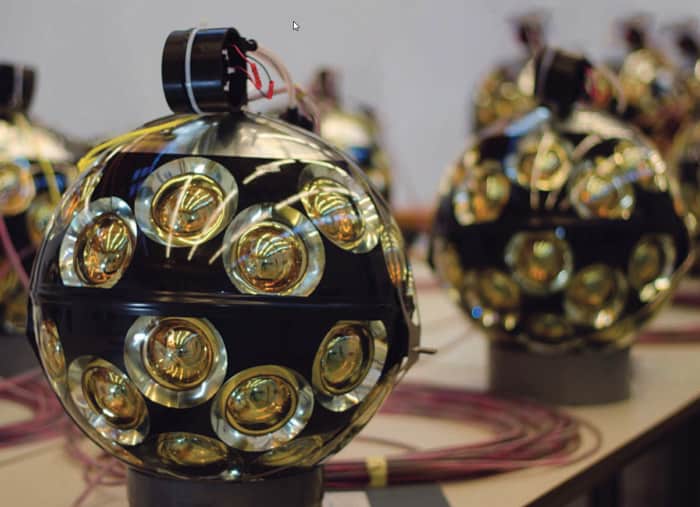
Destined for the depths: KM3NeT’s photomultiplier spheres in the lab. (Courtesy: CEA Ir fu)
AMANDA stopped operating in 2004 and was upgraded to the famous IceCube Neutrino Observatory. In 2013 this 1 km3-sized detector identified cosmic neutrinos from the depths of space, for which it won Physics World’s Breakthrough of the Year Award in 2013. But the origin of IceCube’s cosmic signal remains unknown. Researchers have been unable to identify the sources because they have limited statistics and directional reconstruction power. The latter limitation is partly due to the important diffusion of light in ice, which degrades IceCube’s angular resolution – a crucial parameter for astronomy.
The lure of the Mediterranean
So we return to warmer climates and ANTARES. After the failure of DUMAND, Europe had taken up the torch of submarine neutrino telescopes, concentrating on the Mediterranean Sea because it lies in the northern hemisphere and offers deep-sea sites relatively close to on-shore facilities. After several site surveys and prototype developments in Greece, Italy and France, the ANTARES project began in 1996 off the coast of Toulon, France.
But success was not immediate, with dozens of autonomous tests having to be carried out to understand the environmental conditions. The researchers needed to know everything from how marine currents bend the detection lines and how salinity affects the speed of sound in water (vital for calibration), to how bioluminescence would affect the photomultipliers, and whether biofouling could potentially soil the detection modules. Some brave physicists even occasionally had the privilege of diving to depths of almost 2500 m on board the Nautile – a manned submarine of the French research institute Ifremer that also served for the exploration of the wreck of the Titanic. Among their missions, these researchers had to electro-optically connect the main cable and perform visual inspections of the area. Their adventures even led to some surprises, such as the discovery of an old cannon found lying near the detector.
The first detection line was installed in 2006 and ANTARES was completed in 2008 with 12 detection lines, each featuring 75 photomultiplier spheres along their 450 m and anchored at a depth of 2500 m. ANTARES has so far observed more than 10,000 neutrino events with energies ranging from 100 GeV to several hundreds of TeV. These detected events are compatible with the predicted neutrinos created by the interaction of cosmic rays in the atmosphere, but presumably hide a handful of cosmic neutrinos.
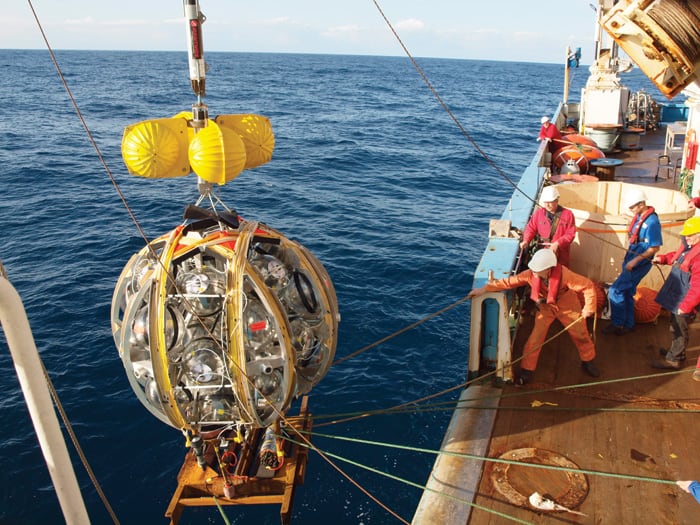
Destined for the depths: a KM3NeT line frame being deploying into the ocean. (Courtesy: CEA Ir fu)
ANTARES, with its unmatched pointing power and good coverage of the central region of our galaxy, is providing important results and complementary information to IceCube. It is also part of an ambitious “multimessenger” programme that seeks to correlate the neutrino events with other cosmic probes, including photons (from radio to gamma rays) and even the recently detected gravitational waves. Despite these efforts, and the presence of a slight excess of events in ANTARES data that could correspond to a cosmic signal, no attempts have succeeded in identifying a neutrino source so far. Confirmation can only come from an even larger detector: the Cubic Kilometre Neutrino Telescope (KM3NeT), which will be the successor of ANTARES.
The next generation: KM3NeT
Construction of KM3NeT began in 2015, with 240 scientists in 15 different countries embarking on the latest deep-sea adventure. And it will be massive. On completion in the early 2020s it will have 345 detection lines distributed across two sites in the Mediterranean Sea: one near Toulon, close by ANTARES, and a second one off the coast of Capo Passero in Sicily, Italy, creating a telescope with a detection volume of more than 1 km3. Subject to future funding, there may also be a third site off the coast of Pylos, Greece.
While neutrino detection in KM3NeT will still be reliant on the Cherenkov principle, the new project features significant technological improvements based on the decade-long experience of ANTARES and the other prototypes. In particular, 31 small photomultipliers – instead of a single, larger one – will be housed in each glass sphere offering several advantages in terms of photon-detection efficiency, photon counting and directionality – all of which are crucial ingredients for the reconstruction of the incoming neutrino energy and arrival direction.
The deployment procedure has also been redesigned: the full detection line is coiled into a spherical frame and attached to a line anchor, which in turn is equipped with an acoustic receiver. Researchers can acoustically monitor the descent of the detection unit from a surface vessel, allowing lines to be positioned to within 1 m. And there’s no need any more for courageous divers as the anchor is connected to the seabed network by a submarine vehicle remotely operated from the boat. Once the connection is verified onshore, an acoustic signal triggers the unfurling of the unit. The compact line frames also mean several lines can be deployed during a single cruise, saving time and money.
Although both detection sites will be based on the same technology, the two will pursue different physics goals. In Toulon, the emphasis will be on studying atmospheric neutrino properties in the GeV energy range, with a dense detector named Oscillation Research with Cosmics in the Abyss (ORCA). In Sicily, a larger and sparser detector called Astrophysics Research with Cosmics in the Abyss (ARCA) will focus on the study of astrophysical sources with energies ranging from TeV to PeV. At each site, the first lines of the arrays have been installed and the first background events have been observed.
Physicists working on the construction of KM3NeT are eager to share their data and provide new opportunities for earth and sea sciences through their cabled infrastructure. From oceanography to geophysics and from marine biology to climatology, the full scientific potential of deep-sea neutrino observatories is still to be explored. As a partner of the European Multidisciplinary Seafloor and water column Observatory facility, KM3NeT will help scientists understand the complex interaction between the geosphere, the biosphere and the hydrosphere, while continuing to hunt for cosmic neutrinos (see box below). So come 2020, there will be many more orderly glass bubbles confusing the fish while probing the depths to look afar.
A multidisciplinary observatory of the sea
A down-to-Earth glow: pairing ANTARES with mooring lines such as LION provides valuable environmental information. (Courtesy: Mathilde Destelle, www.mathildedestelle.com)
It is essential to calibrate and monitor the response of any undersea neutrino detector by measuring environmental parameters such as the optical properties of water, sea currents, bioluminescence and acoustic noise. This is why deep-sea neutrino telescopes not only scrutinize the cosmos from the abyss, but also contribute to more down-to-Earth research. Thanks to their permanent connection with an on-shore lab, facilities such as ANTARES and KM3NeT are providing new and valuable data for oceanographers, geophysicists and biologists, who usually rely on autonomous stations with limited data storage capacity. The long-term and real-time monitoring of deep-sea parameters, such as temperature, pressure, salinity and oxygen and carbon-dioxide content, will allow a better understanding of the marine environment and ecosystems, and of the impact of climate change on the oceans. The deployment of a seismometer and pressure gauges on the site will also contribute to the monitoring and early warning of seismic hazards such as earthquakes and tsunamis. Even the neutrinos registered by KM3NeT, having traversed the whole Earth, can be exploited by geophysicists to obtain indirect information on the composition of the innermost regions of the planet, complementing insights inferred from seismic waves.
The telescopes’ photomultipliers are also sensitive to the continuous background of bioluminescent light emitted by micro-organisms. Although physicists view this light as noise, to marine biologists it’s a valuable signal. One study, for example, combined data obtained by ANTARES and two independent mooring lines also located in the north-west Mediterranean Sea. Looking for correlations between temperature, current velocity and optical activity, the study has led to a better understanding of the link between bioluminescence and the mechanisms of deep-water formation: cold winters densify the surface waters that sink into the abyss by gravity, bringing oxygen and triggering a firework of bioluminescence around ANTARES.
Other discoveries have come from prototype hydrophone arrays in both ANTARES and the Italian neutrino telescope prototype NEMO. These arrays are primarily meant to study the possibility of enhancing the detection of highly energetic neutrinos by listening to their associated sound wave. But they also turn out to be a non-invasive way of monitoring the presence and activities of dolphins and other sea mammals by detecting their acoustic emissions, which can propagate for tens of kilometres in seawater. These range from ultrasonar echolocation “clicks” to frequency-modulated whistles used for social communication. Tracking these signals has even ended up revealing the continuous presence at great depths in the Mediterranean of a population of sperm whales much larger than previously inferred from sound recordings conducted close to the surface. Such studies are invaluable for marine biologists to study how dolphins move, feed, capture prey, communicate and mate.
Heisenberg: the Uncertainty Principle, written by Simon Stephens, is currently showing at Wyndham’s Theatre in London until 6 January 2018. It stars Anne-Marie Duff as Georgie and Kenneth Cranham as Alex and tells the tale of their chance meeting at a crowded train station and their ensuing relationship, which changes both their lives forever.
How did you first come across Werner Heisenberg’s uncertainty principle and what made you base your play on it?
The idea of the uncertainty principle is something that I came across in a conversation with a very good friend of mine, a computer scientist called Jon Sedmak, who is a significant figure in American computer engineering. He worked with Dell and Apple in the 1990s, and he’s key to the team that invented the notebook computer. In recent years he has become a big champion of British theatre and we’ve become friends. In fact, we met because there was a reference to Paul Dirac in my play Punk Rock. Jon was very excited that a playwright was referencing Dirac, so he took me out for lunch. We now meet every time he’s in London and we have lengthy conversations, during which he’ll go on an aria for 10 minutes about some scientific thought he’s had that astonishes me completely.
One of the many things that Jon said that blew my mind was his very simple definition of the uncertainty principle. This notion, as much as I understood it, means that observation and prediction render each other impossible, such that the precise observation of the whereabouts of a given particle means that the prediction of its momentum is impossible, or that a precise measurement of the momentum renders the actual observation of the particle impossible. I thought this was thrilling, not because I understand anything about physics, but because it struck me that was what life was like. If you watch people, if you know and study and think about people, the people you know best are the people who are most likely to do something or go somewhere that will completely take you by surprise. And if you have an understanding of where somebody’s going or what they’re about to do, it probably means you’re not looking at them properly. I was so excited by that, the way in which the scientific principle works as a metaphor for human behaviour, that I built the play around it.
Have you always had an interest in quantum mechanics or science in general?
I’m 46 and I come from a time when the delineation between sciences and the arts was really binary. Growing up, I defined myself as definitely into the arts, definitely into literature, definitely into music, and definitely not into maths or science. It’s a ludicrous position to take, but one I took very vehemently. It’s only through my son Oscar, who has just gone to the University of Oxford to study maths, and through my friendship with people like Jon Sedmak that I’ve come to realize that science and mathematics are as creative and vital and exciting as any kind of music I’ve grown up listening to or films I saw or plays I read or novels I read or any of that.
So did you research Heisenberg’s uncertainty principle any more than those conversations with your friend?
No, I really didn’t, which on the one hand is shaming, and on the other hand is shaming! We had a friend of the director, a scientist, come in to talk to the cast on the first day of rehearsal, and he tried to explain to us some of the implications of the thinking. I think there’s something very interesting about the emotional consequences of quantum thinking…I find, weirdly, there’s something reassuring about it. It is good to be able to accept uncertainty, unpredictability, chaos, as being a fundamental element of what it is to be alive. We don’t know what’s going to happen. We have an impulse to try to impose a narrative on the chaotic. But if we can live without doing that, if we can accept the chaotic, if we can accept the wildly unpredictable, then maybe we’ll live with a certain level of grace, and that’s a good thing, isn’t it?
Is Heisenberg the most scientifically themed script you have written?
I’d be really loathe to say that it has a scientific theme. But just as a human being, my relationship with my son Oscar has been so illuminating, especially as he became increasingly excited by pure mathematics. The notion that the scientific terrain excited and inspired somebody who was so important to me made me reconsider that world. And that reconsideration is actually found in lots of the plays that I’ve written since he’s become a cognitive adult. There’s a quiet nod to it in my stage adaptation of The Curious Incident of the Dog in the Night-Time. It’s not that I’ve written other plays inspired by scientific theories, but I’ve re-accommodated scientific thinking into my thinking.
One of the things Oscar always says to me is that the essence of science for him isn’t necessarily the rudiments of the history of scientific thought, so much as the essence of scientific approach. The idea that things can be tested and proven, and the Galilean notion that we assume things not to be the case until we test and test and test them, until we’re forced to conclude that they are the case. And that type of scientific thinking, that quite secular scientific thinking, has been something that has inspired and galvanized me as an artist.
What do you feel about the perceived boundary between arts and sciences today?
I don’t spend enough time with teenagers now to know whether it’s still as paralysing a concept as it was when I was a kid. All I can say from my own experience is that when I started to get my head around characters like Dirac or Heisenberg, when I found out about how radical their thinking was, it reminded me of the kind of radicalism of the great artists and great musicians that I grew up with. There was something as beautifully punk about Heisenberg as anything Lou Reed or Iggy Pop ever did. They might have done it differently, but the ferocity of their intellectual thinking in defiance of all received wisdom is common to them all.
The function of the artist is to be a great truth-teller, even when it defies convention, and that’s what the great scientists do as well as the great artists. They ought to be mutually dependent upon one another. How we do that is through our teachers, through the way we talk about science, through the way we talk about arts. I think it’s happening more now. I think there are more and more artists who are excited by scientists. And the scientists I’ve spent time with, they’re much more excited about the unprovable, and that seems to me to be completely the terrain of the arts, as well. I was sceptical about maths and science when I was a kid, because I thought there was a wrong answer. But the more I’ve come to learn about science, the more I’ve realized that it’s a constant, evolving, communal exploration and experiment. And to me, that is exactly like making art.
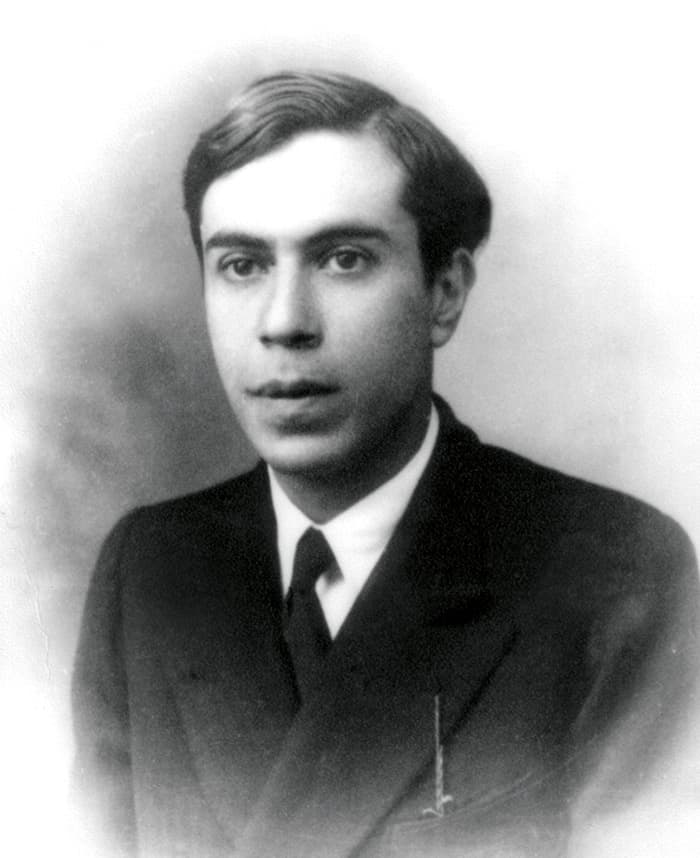
There are many hypotheses regarding the mysterious disappearance of the Italian physicist Ettore Majorana in March 1938 aged just 32 while on a boat trip from Sicily to Naples. Was he depressed and committed suicide? Did he become a spy, join a monastery or relocate to Latin America? Yet there is one other possible explanation behind his disappearance, which is that Majorana’s sexuality may have played a role.
In the 2013 book Ettore Majorana, lo scomparso e la decisione irrevocabile, Stefano Roncoroni, who was a great nephew of Majorana, writes that family lore supports this view. It is also backed by evidence that police searched for Majorana in parts of Naples typically associated with men who engaged in sex with men.
I have no incontrovertible evidence to support or refute these claims, but as a gay man and a physicist myself, this suggestion felt like hearing the first whispers of a painfully revealing family secret. Finding out that Majorana may have tried to navigate the myriad of barriers maintained by families, institutions, colleagues and society, while hiding his sexuality, elicits a combined sense of awe and deep sadness.
Even if this assertion is highly speculative, other gay scientists have suffered similar troubles. The computer scientist Alan Turing, for example, was sentenced to chemical castration despite his major contributions in the Second World War. Then there was the Prussian naturalist Alexander von Humboldt, whose love life remains a secret despite accounts that he left most of his estate to his valet and purported lover.
Out gay men and lesbians – as well as trans and gender non-conforming people – remain rare in physics, as are women and people from minorities who have been subjected to systematic racial discrimination. Indeed, some of us inhabit multiple excluded identities and if we share anything, it is a common loss of history. We mourn those who could have contributed to science but were either unable to navigate the pitfalls or unwilling to achieve the level of “self-erasure” that could have made them more “acceptable” to the scientific community.
Many of the factors that cause such people to feel excluded are attributes of the broader society in which physics is embedded. These include inequitable access to education, the risk of ostracism from unsupportive families and the weight of discrimination harming one’s mental health. Even so, the physics community must examine how to eliminate or mitigate these barriers or, at the very least, support those who must surmount them. To not engage in this work is to impoverish our field.
While the situation has improved in recent years, exclusion still persists. We live in a time when it is common in physics to deny that there are such barriers. The dominant paradigm that I and many others sense in our profession is: “I don’t want to hear about your personal life, your gender, your race; let’s just stick to physics.” Trans, gay, lesbian and bisexual people are familiar with this rhetorical device – it is “the closet” that creates a maze of awkwardness and concealment.
In a study undertaken by the American Physical Society in 2016, which I chaired, we surveyed and interviewed LGBT physicists about their experiences in their learning and work environments. The study found that isolation and closeted behaviour remain common in physics, with high levels of harassment leading many to consider leaving the field. Even in environments that might otherwise seem supportive, LGBT physicists often choose closeted behaviour for fear of the repercussions of being open, which they find hard to gauge. Many respondents also reported not knowing who around them may be supportive, knowledge that could have helped them to feel comfortable in their university or workplace.
Physics also has a pervasive gender problem. From our surveys and interviews, we heard that discrimination is disproportionately borne by women and those who self-identify as gender non-conforming. Transgender physicists face the most toxic environments, having to deal with, for example, harassment, exclusion from career-enhancing opportunities and mis-gendering – being routinely referred to by the gender and/or name with which they do not identify.
But some of the worst workplace environments are faced by LGBT physicists subject to racial discrimination, who have to deal with an attitude of assumed incompetence that is both demoralizing and demeaning. They reported being uncertain which aspect of their identity makes colleagues so dismissive. Blindness of those around them to broader societal injustices faced by minority communities undermines their sense of collegiality with other physicists.
When our report was published, some online comments exhibited negative stereotyping and closeting behaviour by contributors who claimed to be physicists, inadvertently paying testament to the need for the report. Physics can do better. Working on a committee of physicists from a spectrum of sexual identities and gender expressions was an inspiration for all involved. Particularly notable was the strong leadership of trans women, who have served as a grassroots vanguard working on these issues.
While we were working on the report, Science published an interview with MacArthur fellow and astrophysicist Nergis Mavalvala from the Massachusetts Institute of Technology in which she proudly noted her existence as an “out, queer person of colour”. This interview was a tonic for those of us on the committee who had heard so many negative, first-hand accounts. Humanizing the queer physicist doing physics is essential if we are to inspire future generations not to be relegated to the physics closet.
The start-up company Quantum Circuits Inc (QCI) has attracted $18m in first-round financing. The firm is based in New Haven, Connecticut and was founded in 2015 by Michel Deverot, Luigi Frunzio and Robert Schoelkopf – all physicists at Yale University – who pioneered the transmon superconducting quantum bit and associated circuitry and quantum algorithms.
QCI aims to develop universal quantum computers that can be used to solve a wide range of problems. The firm says that early applications could include drug design, improving chemical processes, finance and machine learning.
Now hiring
The firm currently has seven employees in management, scientific and engineering roles. Some of the new money will be used to hire engineers and software designers to transform QCI’s prototype quantum technology into practical hardware and algorithms.
Schoelkopf will take a leave of absence from Yale starting in January 2018 to become chief executive officer of QCI. “We are at a tipping point in quantum technology where we understand how to build machines to tackle problems that are otherwise uncomputable,” he says.
Fix your eyes on the upper-right portion of the above video and pay particular attention about seven seconds into the footage. You will see a fireball falling through Earth’s atmosphere. The video was taken from the International Space Station by the Italian astronaut and prolific photographer Paolo Nespoli.
Was the fireball a piece of space junk, or perhaps a tiny piece of asteroid? And how fast was it moving? For an analysis of what Nespoli may have seen, go to: “The backstory: Paolo spots a meteoroid from the ISS”. There you will also find a fantastic gallery of photographs taken by Nespoli.
Winning a Nobel prize is a sure-fire way of getting people to listen to you. While some laureates have been known to espouse some rather loopy ideas, most speak with humility and grace – and try to use their platform to make the world a better place.
It’s definitely the latter for two of this year’s newly-minted physics laureates, Kip Thorne and Barry Barish. Thorne tells the Los Angeles Times that he would rather share his Nobel prize with the entire LIGO collaboration, something that he has suggested unsuccessfully to the Nobel Foundation. Thorne also laments that the American people seem to have lost their enthusiasm for science and technology and tells the Times that he is currently working on a volume of poetry.
Meanwhile over at Symmetry, Barish explains how the relationship between physics and technology has changed in his lifetime. Gone are the days when physicists were at the forefront of technological development, which he argues is now the domain of industry. “I think we need to become really aware and understand the developments of technology and how to apply those to the most basic physics questions that we have and do it in a forward-looking way,” says Barish.
The US National Science Foundation (NSF) has announced that it will continue to support the Arecibo Observatory in Puerto Rico, which was hit by a hurricane on 20 September. In a statement, the NSF says that it will keep the radio telescope working, but will reduce annual funding for the observatory from $8m to $2m within the next five years. The US-government agency is now looking for another partner to take on the bulk of Arecibo’s funding.
New facilities
The decision to reduce funding in Arecibo comes as the NSF faces tight budget constraints, related to the construction of new facilities, such as the Large Synoptic Survey Telescope that is being built in Chile.
“This plan will allow important research to continue, while accommodating the agency’s budgetary constraints and its core mission to support cutting-edge science and education,” says a statement from the NSF.
Built in the 1960s, Arecibo is a 305 m-diameter antenna that is built into a natural sinkhole in Puerto Rico’s limestone landscape. It is one of the world’s largest radio telescopes and astronomers have used Arecibo to discover the first binary pulsar and the first extrasolar planets.
Results from an experiment designed to test the limits of charge–parity (CP) symmetry have been used to restrict the possible mass range of a candidate dark-matter particle. Writing in Physical Review X, researchers with the international Neutron Electric Dipole Moment (nEDM) collaboration report that the absence of oscillations in the electric dipole moment of ultracold neutrons and mercury-199 atoms rules out axion-like dark-matter particles with masses between 10-24 and 10-17 eV.
Axions were first proposed to explain the lack of CP symmetry-breaking in strong-force interactions, although they have not yet been observed. Their existence could also account for some proportion of dark matter, which is the invisible mass component of the universe.
Evidence for CP symmetry-breaking was the goal of the nEDM group’s experiments at the Paul Scherrer Institute in Switzerland. Their apparatus was designed to detect signs of a finite electric dipole moment (EDM) in the spin precession of neutrons and mercury nuclei. The researchers realized, however, that the same data might also reveal the presence of axions.
Suffused with axions
The small mass predicted for axions means that they must permeate the galaxy if they are to contribute significantly to the universe’s dark matter. Interactions between this axion field and gluons and nucleons should produce oscillations in the EDM of the neutrons and atoms in the experiment. No such effect was detected; nor was there any sign of the axion “wind” caused by the solar system’s passage through the galaxy’s dark matter halo.
As a result, the researchers were able to put limits on the axion–gluon coupling strength, and to exclude a wide range of masses for the particle. Longer and more sensitive measurements in the future should make even lighter axion masses accessible to observation.