

When will Japan get its next physics Nobel prize?

By Matin Durrani in Osaka, Japan

Hikaru Kawamura, president of the Physical Society of Japan (JPS), handed me a brochure as we sat down in his office on the fifth floor of the Department of Earth and Space Science at Osaka University. Inside it were photographs of the 13 Japanese physicists who have won the Nobel Prize for Physics.

It’s an impressive list of people, starting with Hideki Yukawa, who won the 1949 prize for his theory of the nuclear force, and going all the way up to Takaaki Kajita who shared the 2015 prize for detecting atmospheric neutrino oscillations at the Super-Kamiokande underground lab. (They’re all men, of course, but that’s another story.)

However, Kawamura admitted to me during our 90-minute discussion, that he is “not optimistic” that Japan will be as prolific in terms of Nobel prizes in the future. Most Nobel laureates usually (though admittedly not always) win their awards for work done 20-30 years ago. So with Japanese physics these days being, as Kawamura puts it, “not so popular as it used to be”, how long will Japan have to wait for its next physics Nobel prize?

When he was a kid, in contrast, physics was all the rage. Kawamura, 63, grew up on a remote Japanese island and, back then, people in Japan saw scientific research as a way for the country to rebuild and revitalize itself after the devastation of the Second World War. Indeed, Kawamura told me how one of his school teachers “used to talk about Yukawa like he was a god”.

These days, Kawamura is worried about the declining output of Japanese physics and falling numbers of people doing PhDs in the subject. He is also concerned about the government cutting back on funds for “unconstrained” research at the expense of projects earmarked for specific targets. “There is a general concern in the community for fundamental science in future,” he warned.

That said, Japanese physics is pretty strong overall, with Kawamura pointing to plenty of areas where Japan is world-leading, such as elementary particle physics, solid-state physics, astronomy and creating new materials. But if Japan wants to continue to be a global leader in science, I feel it’s got to be up to societies like the JPS to make the case to government for continued financial investment in basic research.

Because without healthy funding, where will the Japanese Nobel-prize-winning physicists of the future come from?
Riding around KAGRA

By Michael Banks in Kamioka, Japan

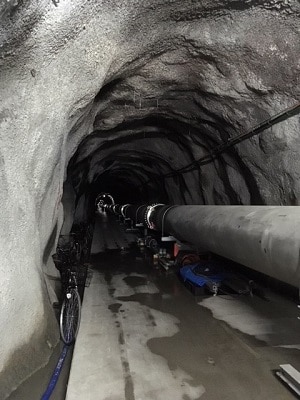
Of all the places I have been, I can’t remember being asked to ride a bicycle for 3 km down a dimly lit tunnel that had water dripping – sometimes pouring – from the ceiling.

But that’s what happened today when I visited the KAGRA gravitational-wave observatory in northern Japan.

Rising bright and early – a common occurrence this week thanks to jet lag – I took the Shinkansen from Tokyo to Toyama.

Around an hour south of Toyama is the small village of Kamioka that is home to KAGRA as well as the nearby SuperKamiokande neutrino observatory.

Kamioka certainly feels remote being in a valley surrounded by mountains on all sides. Indeed, at this time of year the views are spectacular as the leaves on the trees on the slopes of the mountain turn a mixture of red, brown and yellow.

I was shown around KAGRA by Shinji Miyoki from the Institute for Cosmic Ray Research at the University of Tokyo.

I jumped in his car and we drove to the entrance of a 500 m-long tunnel in the side of a mountain. It all felt slightly low key given that this will soon be home to one of the world’s most advanced gravitational-wave observatories.

Construction of KAGRA began in 2010 and is set to be complete in March 2019. It is a huge interferometer in which a 2 W laser beam is split down two 3 km-long arms. The beams are reflected multiple times between mirrors suspended at the ends of each arm and then combined at a detector. A gravitational wave is a ripple in space–time and when it passes through an interferometer, it can change the distances between the mirrors. This is detected as a change in how the laser light interferes at the detector.

While the advanced Laser Interferometer Gravitational-wave Observatory (aLIGO) in the US already detected gravitational waves for the first time in 2015, that hasn’t stopped Japan forging ahead with their own observatory.

Indeed, the Japanese design has some key differences. One is that the mirrors -a single-crystal of sapphire weighing 23 kg – are cooled to around 10 K to reduce thermal noise. The second is that the facility is built some 200 m underground to help reduce seismic noise.

Yet despite these advantages both aLIGO and KAGRA will still have similar sensitivity, thanks in part to LIGO’s greater size with 4 km-long arms.

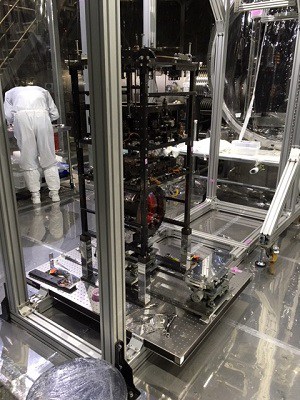
Currently, engineers at KAGRA are testing the sapphire mirrors that will be placed at each end of KAGRA’s arms and  during the tour, Miyoki asked whether I would like to see a mirror.

However, I didn’t quite realise what that would involve. As KAGRA is still very much under construction, getting there involved traversing beampipes, both ducking under and even walking on.

That was then followed by a 3 km cycle to the end of the arm. While the ride made me appreciate how big this facility is, it would have been a more pleasant experience if I was trying to not to get drenched or worse fall off the bike.

Yet I survived and managed to catch a glimpse of the mirror before it is soon placed in the cryostat.

Once above ground, I asked Miyoki whether Japanese researchers are disappointed to have missed the party when it came to the first detection of gravitational waves. “We were incredibly pleased for LIGO,” says Miyoki. “It makes it exciting for the future.”

Exploring the cosmos with gravitational waves

To say the past couple of years have been a whirlwind for scientists engaged in gravitational-wave research would something of a cosmic understatement. After detecting its first gravitational waves in 2015, the LIGO experiment in the US went on to announce three more detections, all of them from the merger of two black holes. One of these was also detected by the Virgo experiment in Italy. This October Rainer Weiss, Barry Barish and Kip Thorne shared the shared the Nobel Prize for Physics for their pioneering contributions to the field and to the LIGO detector itself.

Less than two weeks after the Nobel announcement, astronomers gathered at the Royal Society for the announcement of arguably the most significant breakthrough of all. The merger of two neutron stars was observed by the LIGO–Virgo collaboration, while gamma rays from the same event were picked up by the Fermi Gamma-ray Space Telescope. This prompted the global astronomical community to point up to 70 different telescopes and detectors around the world, and in space, at the origin of the signals in a distant galaxy – building a detailed picture of the collision and its aftermath.

Glester was at that latest announcement at the Royal Society to soak up the atmosphere and learn all about multimessenger astronomy. Among the people he met was the Astronomer Royal Martin Rees, whose CV also includes terms as president of the Royal Society and the Royal Astronomical Society. Rees hails the latest result as “sociologically very important” because it demonstrates international collaboration between teams of scientists and engineers to achieve measurements of phenomenal precision. “It illustrates how astronomy is a very broadly based international and multi-technique subject,” he says.

As the editor of physicsworld.com, Hamish Johnston, pointed out shortly after the Nobel prize announcement, we should not forget that for millennia, humans could only see visible light from the cosmos. It is only during the last century that we have been able to view the universe across much more of the electromagnetic spectrum – as well as through the arrival of high-energy particles such as cosmic rays and neutrinos. Adding gravitational waves to the mix now brings a new way of seeing the heavens that could reveal astronomical events that had been beyond the view – and even beyond the imagination – of astrophysicists.

For a more in-depth look at the significance of these latest discoveries, take a look at Multimessenger Astronomy by Imre Bartos of the University of Florida and Marek Kowalski of Humboldt University and DESY. Part of the Physics World Discovery series, this free-to-read ebook explores the scientific questions surrounding these new messengers and the detectors and observational techniques used to study them. It also provides an overview of current and future directions in the field.

  • Neutron-star collision artwork courtesy of the University of Warwick and Mark Garlick

Lasers go to the dark side

A newly designed compact tunable laser has demonstrated high-quality emission while boasting subwavelength thickness. When the gain medium is excited, the lasing energy is stored in a surface-bound cavity mode (dark-mode), as opposed to the traditional un-bound, radiating mode. Here, the strong, tightly confined light can be used in sensing applications. Alternatively, the light can be coupled to either free-space or surface modes by adjusting the position of small scattering elements on the surface that behave as an electromagnetic metasurface, coupling the dark-mode lasing state to radiation.

A lab-on-a-chip is the ultimate goal for many researchers, and one important component is a small but efficient laser. Many attempts at creating such a device have been made, and include the use of photonic crystals, ring resonators and plasmonic arrays. However, all of these suffer from either wavelength-limited miniaturization, or high material losses and low quality (Q-) factors. In all cases, radiation damping lowers the Q-factor considerably.

A team of researchers at the Institute of Electronic Structure and Laser, Heraklion, Greece and Ames Laboratory and Department of Physics and Astronomy, Iowa, USA, have found a way around these problems. They create a linear grating of silver strips, where the space between the strips is filled by a high-index dielectric with a gain medium embedded in it. This periodically modulated thin dielectric film supports resonant, dark-bound states. The spacing of the grating is carefully chosen to match the emission band of the gain medium, and to provide the highest Q-factor. This structure is much thinner than the emission wavelength, and does not suffer so much from material damping as it is made of mostly dielectric, not metal.

When the gain medium is pumped by an external light source, the energy accumulates in the gain medium and lasing, i.e., stimulated emission, occurs directly in the dark bound state of the laser. By definition this mode does not radiate to free space, eliminating radiative losses. Then, by including small non-resonant scatterers on the surface of the grating, which collectively act as an electromagnetic metasurface, the energy in the dark mode is scattered to free space in the form of a wave, creating the optical laser beam output. This approach separates the conceptual constituents of lasing action, cavity resonance and out-coupling to the emitted laser-radiation from one another, and allows the researchers to independently optimize the individual components.

Using this concept, first proposed in an earlier paper, the team, led by Costas Soukoulis, took full advantage of the exotic capabilities of metasurfaces (wavelength-scale periodic arrays that manipulate electromagnetic fields) to affect the shape and properties of the emitted laser beam. They fully characterized possible geometries for the laser through extensive simulations. For example, changing the position of the scatterer between the two silver strips allows control of the Q-factor, lasing threshold, directionality and loss channel (whether the energy is radiated away or stored and eventually lost to Joule heating).

The next challenge the researchers will focus on is the fabrication and experimental realization of such a device. The researchers have already outlined some of the fabrication issues that may be faced, along with potential solutions. For example, the effects of radiative and dissipative loss can be balanced by appropriate adjustments to the geometry. Some simplified geometries are explored, taking into account the presence of a substrate and the possibility of layer-by-layer fabrication.

More information can be found in the research paper here, published in Physical Review B.

Superfluid helium could reveal lightweight WIMPs

A new detector sensitive to low-mass dark matter particles too light for current experiments to see has been proposed by physicists in the US. Built around a bath of superfluid helium-4, the device would use field ionization to spot single helium ions ejected from the superfluid’s surface by colliding weakly interacting massive particles (WIMPs).

The existence of dark matter has been inferred from unexpectedly high stellar and galactic velocities since the early 20th century, and recent observations of gravitational waves have only strengthened the case by ruling out some competing modified-gravity models. Despite the efforts of dozens of experimental collaborations worldwide, dark matter particles have not been detected directly. However, WIMPs are still the dark matter candidate favoured by most physicists.

Unexplored regions

Dark matter surveys conducted until now have focused largely on high-mass particles, and are relatively insensitive to candidates lighter than 10 GeV/c2, or about ten times the mass of the proton. Some recent theories have proposed WIMPs with masses below this threshold, so with a view to filling this observational gap, Humphrey Maris, George Seidel and Derek Stein at Brown University conceived a detector model that could extend the lower mass limit by three or four orders of magnitude.

The team decided on 4He for the detector mass since it receives more energy per collision than heavier targets, and the low internal radioactivity minimizes false positive results. When dark matter particles interact with the target, recoiling helium atoms are expected to trigger phonons and rotons – quasiparticle excitations – which, in superfluid 4He, can propagate without scattering. When these excitations reach the surface of the superfluid, helium atoms are expelled by quantum evaporation.

A similar technique was developed a decade ago by Maris, Seidel and colleagues at Brown University for the HERON neutrino detector. In that experiment, evaporated helium atoms were deposited on a silicon wafer calorimeter suspended above the superfluid, causing a measurable increase in temperature. “This worked fine if a large amount of energy was deposited in the liquid thereby producing many rotons and many atoms,” explains Maris. “But the method was inadequate for the detection of the small number of atoms that would be evaporated if the energy deposit was by a dark matter particle with, for example, a mass of 1 MeV.”

Single-atom sensitivity

The novelty of the new approach lies in the device’s sensitivity to individual atoms. This makes the minimum detectable transferable kinetic energy (the energy imparted to a helium nucleus by a dark matter collision) equal to the binding energy of a helium atom to the liquid. Since no existing large-area calorimeter could be sensitive to such tiny energies, individual helium atoms ejected at low speed can only be detected if they are first accelerated significantly.

The trick proposed by the team at Brown University is to have evaporated atoms pass near to arrays of positively charged, sharp metal tips. Strong local electric fields ionize the helium, and the resulting positive ions are accelerated toward a cathode at energies within the range detectable by current calorimeters.

“The addition of the field ionization opens up the possibility of detecting energy deposits into the helium that are smaller by a factor of about 10,000 than in the previous work that we did. This will make it possible to detect dark matter in a mass range far below what has been previously achieved,” Maris told physicsworld.com. Assuming the Standard Halo Model of dark matter distribution – in which the galaxy is permeated uniformly by WIMPs of a single type, and the local galactic escape velocity is the maximum particle speed allowed – the researchers expect such single-atom sensitivity to translate to a detectable dark matter particle mass of 0.6 MeV/c2, or less than a thousandth the mass of a proton.

A modified scheme that could achieve even greater sensitivity has also been presented by the group. Instead of employing bulk helium as the detector mass, a solid crystalline target could be used, which would also be susceptible to phonons initiated by colliding WIMPs. A helium film coating the crystal would exhibit the same excitation-induced quantum evaporation effect but with a lower phonon energy threshold. By lining an ultrapure target crystal with a few monolayers of caesium (to which 4He binds especially weakly), an atomically thin film of helium could further lower the WIMP mass sensitivity by orders of magnitude.

Full details of the research are reported in Physical Review Letters.

Targeted therapies tackle resistant tumours

By studying breast cancer tumours in mice, Erkki Ruoslahtiand an international team of scientists have discovered important characteristics of non-responsive tumours that can help restore the targeting and therapeutic effectiveness of a nanoparticle-based cancer treatment.

Previously, the team discovered that this treatment was highly effective at disrupting blood vessels in breast cancer and glioblastoma models. However, tests on mice demonstrated that certain tumours were evasive and resistant to the therapy.

In their latest paper, the scientists compared differences in the vasculature (blood vessel make-up) of the tumours to understand this change in responsiveness. They identified a peptide that may make it possible to specifically target the treatment-resistant tumours (J. Controlled Release 268 49).

Nanoworms disrupt tumour vessels

Previous work by the California-based research team showed that functionalized iron-oxide nanoparticles are potent tumour disrupting agents. The particles, nicknamed nanoworms (NWs) due to their shape, consist of two peptides (the homing peptide GGKRK and D(KLAKLAK)2) that respectively target and disrupt the mitochondria of tumour cells. The peptides are displayed on the surface of NWs in large numbers (because the NWs are aggregates of many nanoparticles), which increases their activity.

By looking at responsive mouse tumours under a microscope, the researchers saw that NWs reduced blood vessels in these tumours by 75%. Most of the blood vessels in tumours that responded to treatment also stained positively for lectin (a membrane protein used to detect vessels with blood flow) and CD31 (an antibody used as a general blood vessel marker). However, resistant tumours showed a unique feature: many blood vessels were lectin-positive, but CD31-negative.

Further microscopic investigation indicated that some of the vessels in these tumours might be from human tumour cells, as opposed to the host mouse. However, the scientists found that NW accumulation in non-responsive tumour cells was greatly decreased, even though the homing peptide’s receptor was still expressed at the same level. This finding indicates that an alteration in both CD31-positive and CD31-negative blood vessels has occurred, limiting the homing ability of the nanosystem.

Screening resistant tumours

Since the tumours that are resistant to the NW homing treatment have altered blood vessels, the researchers hypothesized that a different homing peptide (not GGKRK) could restore NW treatment effectiveness.

After screening a phage-displayed peptide library in mice, and sequencing the peptides recovered from non-responsive tumours, the research team saw a high frequency of the RGD peptide, which is used in many different therapies to home in on tumours. This peptide targets integrins, specifically the αvβ3 integrin. As expected, the non-responsive tumours showed higher expression of the β3 integrin subunit than responsive tumours and had elevated expression of β3 mRNA.

Ruoslahti’s team showed that multiple pathways affect a tumour’s ability to resist the vasculature-disrupting NW therapy. Their results also suggest that by using combination therapies, for example NWs functionalized with both GGKRK and RGD peptides, scientists may be able to prevent the development of non-responsive tumours.

Finally, this approach, in which the molecular and cellular basis of resistance in non-responsive tumours was explored, could be applicable to the study of other cancers as well.

Neutrino detector could see radioactive potassium deep within the Earth

A new way of studying radioactive processes deep inside the Earth has been proposed by an international group of physicists. They want to use a next-generation dark matter detector called a gas-filled time projection chamber to detect geoneutrinos produced deep underground by the radioactive decay of potassium – something that existing detectors cannot do.

Rock samples from deep inside Earth’s crust suggest that much of the planet’s internal heat comes from the radioactive decay of unstable isotopes of uranium, thorium, and potassium. These processes give-off neutrinos called geoneutrinos, which travel easily through the Earth and emerge from its surface.

Geoneutrinos from thorium and uranium decay were detected in 2005 by the KamLAND experiment in Japan and in 2010 by Borexino in Italy. The measurements suggested that the decay of these two materials accounts for about half of Earth’s internal heat. But those and other existing detectors cannot see neutrinos from potassium decay. “The neutrinos are too low in energy,” explains Jocelyn Monroe of Royal Holloway, University of London.

Ionized molecules

Monroe and her colleagues, Michael Leyton of Institut de Física d’Altes Energies in Spain and Stephen Dye of the University of Hawaii, predict that a new type of detector, filled with tetrafluoromethane gas, should see the potassium neutrinos. When a neutrino collides with a gas molecule in the detector, the molecule becomes ionized. An electric field within the detector moves the ion towards another part of the detector that produces an amplified light signal.

To see potassium-produced neutrinos, the detector would need to be about 200–500 m3, contain 10 tonnes of gas, and collect data for 5–10 years, says Monroe. They calculated this in part by modelling the neutrino flux through the detector–solar neutrinos, neutrinos produced in nuclear reactors, and geoneutrinos – for three different detector locations. They considered the Kamioka Observatory in Japan, the Gran Sasso experiment in Italy, and SNOLab in Canada.

The detector is based on a prototype dark matter detector that Monroe’s group has been developing for several years. The gas-filled time projection chamber can measure both the energy and direction of an incoming particle, so it can determine if an incoming particle is coming from overhead or from inside Earth. Current dark matter detectors cannot determine the direction of a particle, which means that their data have much higher levels of noise.

Potent greenhouse gas

However, it will take much more planning and engineering to actually carry out the experiment. “The [proposal] has promise,” says William McDonough of the University of Maryland, adding “[but] the devil is in the details”. He cautions against the use of tetrafluoromethane gas, which is a potent greenhouse gas. If the detector leaks, it could cause severe environmental damage, he explains.

The deployment of such a detector is also contingent on the discovery of dark matter, says Monroe. “If dark matter hasn’t been seen 10 years from now, it’s probably going to be a hard sell to build a detector at this scale for geophysics or for particle astrophysics,” she says.

So, at the moment, it’s unclear if such a detector will ever be deployed. But making ambitious proposals is necessary for procuring funding for expensive particle physics experiments, says Giorgio Gratta of Stanford University. “It’s kind of a long process, and it definitely requires [proposals] like this one that don’t have real data,” Gratta says. “It’s useful that the community at large is reminded that the technology exists, in principle.”

The proposal is described in Nature Communications.

Fractured, watery core key to Enceladus’s long-lived ocean

Tidal heating could power Saturn’s moon Enceladus for tens of millions to billions of years if its core is porous and unconsolidated, a new model suggests. The conclusion is based on 3D simulations of tidal friction and heat transport, in which energy is transmitted from the core to the ice shell by advection. As well as accounting for the unexpectedly high heat flux in Enceladus, the model also explains differences in ice thickness between the poles and the equator, and the presence of hydrothermal products in the moon’s water plumes.

Surprisingly warm

Evidence for liquid water under the frozen surface of Enceladus began to mount after the Cassini spacecraft’s first flybys of the remarkable moon in 2005. Further observations suggested that a global ocean separates the moon’s rocky core from its icy shell, but radioactive decay and tidal heating seemed insufficient to explain its persistence.

Writing in Nature Astronomy, Gaël Choblet of the Laboratoire de Planétologie et Géodynamique in Nantes and collaborators in France, USA, the Czech Republic and Germany, have shown that orbital interactions with another of Saturn’s moons, Dione, could generate enough tidal friction within Enceladus to sustain the ocean, but only if the porosity and permeability of the moon’s core fall within certain ranges. Although the body’s small size has made its anomalous warmth difficult to explain until now, it also means that such porosity could have been present in the core since the moon’s formation.

Thin ice

For some combinations of parameters, the group’s simulations predicted polar upwellings of water warmed in the core, where rock and hot water can interact, and corresponding downward flows of cooler water elsewhere. This result is consistent with observations suggesting that the ice is significantly thinner at the poles than at the equator, but it does not explain the asymmetry between the south pole, where the characteristic “tiger stripes” jet plumes of water, and the north pole, which is ancient and inactive. Choblet and colleagues suggest that a small discrepancy in ice behaviour between the poles could have been amplified over time by the concentration of tidal friction in fractures at the south pole.

Reforming Japanese science

By Michael Banks in Tokyo, Japan

Following this morning’s talk at the Tokyo Institute of Technology (as well as a mock earthquake evacuation drill that took place just afterwards), I took the opportunity to visit the Earth-Life Science Institute (ELSI), which is located in a neighbouring building at Tokyo Tech.

Like the Kavli Institute for the Physics and Mathematics of the Universe (IPMU), which I visited yesterday, ELSI is part of the World Premier International Research Center Initiative (WPI).

ELSI began in 2012 and has funding for 10 years from the WPI. There are around 100 people working there, the majority of whom are from outside Japan. Its main aim is to understand how life began on Earth and how that can be applied to the search for life on other planets. It covers a range of disciplines from astrophysics to microbiology.

I sat down with John Hernlund, ELSI’s vice director, and Shawn McGlynn, a principal investigator at the institute. Both are from the US, and Hernlund joined in 2013, becoming the first permanent foreign researcher to work at Tokyo Tech.

Hernlund, who works in astrobiology, notes that one of the fun aspects of working at the institute – apart from the science – is changing how things are done. For example, when the institute was founded it went on a big recruitment drive by placing advertisements in the media. But Hernlund and colleagues quickly discovered that there was no process at the university to do this – it wasn’t how universities in Japan traditionally brought people in.

This resulted in staff members dipping into their own pockets to pay for the advertisements. They eventually got reimbursed, but it took nearly a year to sort it all out and put in place a system should anyone at the university want to follow suit. “This is why reform is so important,” says Hernlund, adding that he hopes such changes will “propagate outside ELSI”.

Given the institute’s funding is guaranteed for only another five years, ELSI is now trying to diversify its income to guarantee its future. Hernlund notes the temptation to even turn away from the WPI programme itself to help the institute become self-sustaining and have more flexibility than it would do if it stayed in the system. One avenue being explored to do this is attracting more private funding.

After visiting ELSI and IPMU it is apparent that these two institutes feel very different from a traditional Japanese physics department. Bringing in foreign researchers – a mandate of the WPI programme – is certainly shaking up the academic system in Japan. It will be interesting to see how much further those reforms go.

How to get your paper noticed

By Matin Durrani in Tokyo, Japan

For physicists, doing research is only the start of the game. With thousands of papers published each year, how do you make sure your latest work stands out from the crowd?

If you’re an established academic, your peers will already know who you are and, provided you can continue getting your papers published in the top journals, your career will carry on hitting the high notes . But if you’re less experienced in the research game, then a good dose of publicity in the mainstream media can give you a great head start – and thankfully the online world can help hugely.

That was the message of a seminar “Science communication in the digital age” given today at Tokyo Institute of Technology by me and my IOP Publishing colleagues Michael Banks (Physics World news editor) and Elaine Tham (associate director for Asia-Pacific). Attended by about 40 students, science communicators and university administrators, the seminar was opened by the president of Tokyo Tech Yoshinao Mishima.

One traditional measure of how well your paper is doing is to note how many times it’s been cited in the reference lists of other papers. But as Elaine pointed out, the digital world offers much more than conventional citation counts. One particularly useful service, now available on all IOP Publishing papers, is Altmetrics.

It captures, in real time, how often a paper has been mentioned by news outlets, policy documents, blogs and other social networks, as well as by other scholarly and non-scholarly sources. By checking your Altmetrics score, which is listed next to the online version of the paper, you can find out what impact your work is having in the wider world.

That’s all very well, I hear you say, but how do you get your work noticed in the first place? There’s no magic solution, of course, but Michael and I offered delegates at Tokyo Tech some top tips for how to get your work spotted and picked up.

Some things are obvious and require little effort: writing about your research on a personal or group website; talking to friends and colleagues; or sending a copy of your paper to those in your field. Others need a bit more work, such as setting up a blog, press-releasing your research, contacting science journalists with story ideas, or creating a short “video abstract” about your paper.

But if you can’t be bothered with any of that, why not just get active on social media? A great photo with a link to your paper can work wonders, especially on Twitter, which academics just love. And best of all it’s free, so you’ve really no excuse.

Copyright © 2026 by IOP Publishing Ltd and individual contributors