Suitcases packed, Matin Durrani and I will be travelling to Japan over the weekend for a week-long road trip that will see us heading to Tokyo, Osaka, Kyoto and Kamioka.
It’s a busy schedule that includes meeting with senior policy-makers and visiting a number of high-profile institutes.
The main purpose of our visit is to gather material for a special report on Japan that will be published in February 2018 (for this year’s reports on China and the US see here and here).
For those wanting to add a physics twist to your season’s greetings, you now can thanks to Germany’s Federal Ministry of Finance. It has announced two new stamps that will go on sale in the country on 7 December. A €0.40 stamp will feature the European Space Agency’s Gaia satellite and will be the first German stamp to include a metallic coating. Gaia was launched in 2013 to measure the positions and distances of astronomical objects, including stars, planets as well as comets. The ministry also announced a €0.70 stamp that depicts the gravitational waves that emerge from the collision of two black holes. The simulation was made by researchers at the Albert Einstein Institute (AEI) in Potsdam, Germany. “The ministry did not announce whether letters equipped with the new gravitational-wave stamp will be transported at the speed of light,” states an AEI press release.
LEGO in space: the “Women of NASA” set. (Courtesy: LEGO)
Are you looking for a NASA-themed present for someone who is crazy about space? We can recommend LEGO’s “Women of Nasa” building kit, which features minifigures of four women who have made major contributions to the agency. These include NASA executive and “Mother of Hubble” Nancy Roman, who pioneered space astronomy; and the computer scientist Margaret Hamilton, who led the development of the on-board flight software for NASA’s Apollo Moon missions. Also in the kit are the astronauts Sally Ride, who was the first American woman in space and Mae Jemison, the first African-American woman in space.
Physicist baker: James Hoyland on The Great Canadian Baking Show. (Courtesy: CBC)
Earlier this year Physics World visited the physicist Nathan Myrvold at his “cooking lab” in Seattle and learned just about everything one would ever want to know about “The physics of bread”. Elsewhere in the Pacific Northwest, the Vancouver-based physicist James Hoyland is competing on The Great Canadian Baking Show, which premiered Wednesday on CBC. Originally from Darlington in north-east England, Hoyland told the Metro newspaper, “I’m still an experimental person – there’s physics and chemistry as well. People say cooking is art but baking is science. There’s some truth to it, but there’s still art involved. It’s more like engineering.”
Flexible electronics, microfluidics and other cutting-edge engineering applications utilize two-dimensional (2D) metal oxides. These oxide layers are thin yet powerful sheets that combine the useful bulk electronic properties of the oxide with the high surface area activity of nanomaterials. While 2D metal oxides are incredibly useful, their synthesis is inherently difficult and costly. Ali Zavabeti and co-workers at the Royal Melbourne Institute of Technology in Australia hope to reduce these synthetic costs with their room-temperature liquid metal synthesis procedure while also providing access to new 2D oxides that could not be produced before. By utilizing different gallium alloys as solvents, Zavabeti and his fellow researchers demonstrate a low-cost and scalable procedure that yields isolated atomically thin 2D metal oxides.
Their varied electronic properties and potentially large surface area to volume ratio make two-dimensional metal oxides ideal candidates for usage within flexible electronics. Ideally, researchers would maximize this surface area to volume ratio by creating ultra-thin 2D samples. Zavabeti et al. accomplish this via a novel liquid metal synthesis.
The group demonstrates the usefulness of their procedure by creating an ultra-thin dielectric composed of HfO2 and characterizing its electronic properties. The dielectric device boasted a break-down electric field value three orders of magnitude higher than that of the traditionally prepared HfO2 device. Additionally, the device’s dielectric constant and bandgap are on par with bulk HfO2.
Using metals as solvents
Zavabeti and co-workers prepared this highly functional metal oxide using a new exfoliation technique. They prepared melts of the target precursor, e.g. Hf, Al, or Gd, and solvent galinstan – a non-toxic metal alloy containing gallium, indium, and tin. Exposing a droplet of the melt to air then allows oxidation. Finally, they isolated the formed metal oxide, e.g. HfO2, Al2O3, or GdO2, by briefly touching a substrate to the droplet.
Analysis via high-resolution transmission electron microscopy (HR-TEM) revealed pure metal oxide layers approximately 0.5 to 1 nm thick. Traditional deposition techniques (e.g. chemical vapour), produce samples with a minimum thickness of approximately 5 nm. In addition, atomic force microscopy (AFM) analysis showed a uniform surface lacking property-damaging pinholes.
This liquid metal synthetic technique relies on the self-limiting atomically thin oxide film displayed by most metals and alloys at room temperature. Thermodynamics dictate that the oxide that yields the greatest reduction in Gibbs free energy will dominate the surface. By analysing the Gibbs free energy of individual metals, the researchers determined which combination of alloy solvent and liquid metal will produce the target metal oxide.
The researchers also describe a liquid suspension technique where they bubbled air through the metal melt. The target metal oxides form in this bubble and are suspended in water. They believe these two synthetic methods will allow other previously unattainable metal oxides to be formed and characterized, many of which “are of exceptional importance because of their various electronic, magnetic, optical, and catalytic properties.”
The first continuous-wave, solid-state maser to operate at room temperature has been created by researchers in the UK. The diamond-based device could lead to the development of ultra-sensitive microwave amplifiers that need no cryogenic cooling. Such devices could have a wide range of applications including security scanning and medical imaging.
A maser is essentially a microwave version of the laser. It preceded the laser and was also crucial to its development. While the laser has revolutionized technology from telecommunications to industrial cutting, however, the demanding operating conditions of masers has limited their practical use.
The original masers – invented in 1958 – were based on microwave transitions in atoms or molecules in a vacuum chamber. The vacuum requirement makes these devices bulky, and their power is very low. In 1960, a significant advance came with the development of the solid-state maser, which used a crystal of cryogenically cooled ruby as the cavity. Although masers have been useful in radio telescopes and atomic clocks, the need to run at very low temperatures makes them impractical for use in everyday technology such as airport body scanners.
Too hot to handle
In 2012, Mark Oxborrow of the National Physical Laboratory and Jonathan Breeze and Neil Alford of Imperial College London devised a new maser scheme in which a soft polymer – p-terphenyl doped with pentacene – was pumped with an optical laser. This could operate at room temperature, but there was a problem: their device worked only in the pulsed regime, whereas many maser applications such as microwave detectors require continuous-wave operation. Moreover, p-terphenyl is a very poor thermal conductor which would limit its ability to dissipate the heat inevitably generated by non-radiative decay processes and its melting point is only 230 °C. Therefore, even if an organic maser could operate continuously, such operation might rapidly destroy the device.
Now Breeze, Alford and colleagues at Imperial College have implemented a similar scheme in a maser cavity made from synthetic diamond impregnated with negatively charged nitrogen-vacancy (NV–) centres. Diamond is an ideal medium because it has the highest recorded thermal conductivity of any material.
Laser pumping drives electrons into an excited state that rapidly decays to one of three spin sublevels of the electronic ground state. By applying a moderate magnetic field to the NV– centres, the researchers manipulated the sub-levels’ energies such that the state into which the electron most commonly decayed was above another sub-level. This allowed the laser pumping to create a population inversion between the bottom two sub-levels and therefore maser emission. The energy difference between the two sub-levels, and thus the maser frequency, could be tuned by the magnetic field. The system’s stability allowed the researchers to operate their maser continuously for up to 10 hours with no degradation in its output.
Challenges overcome
The researchers are unable to speak to Physics World about its work because it has been submitted to a journal with an embargo policy. However, Pauli Kehayias of Harvard University in the US is enthusiastic about the research. “As a PhD student I was excited about the precursor work to this,” he says, “I thought about whether an NV diamond maser was possible, but was discouraged after realizing the technical challenge and other disadvantages. I’m pleased to see that an NV diamond maser actually works!”
The maser is described in a preprint on the arXiv server.
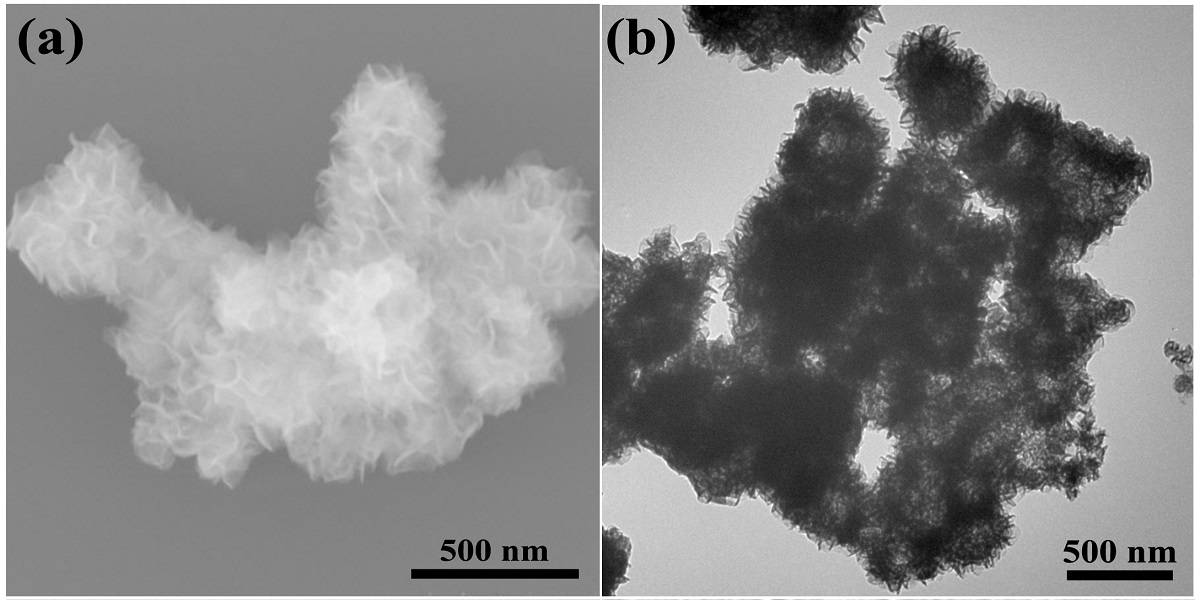
Flower power: A one-pot production produces submicron flower-like structures with high photocatalytic activity for water splitting to produce hydrogen. Credit: ChemSusChem
A one-pot production method is used to create submicron flower-like structures that display high photocatalytic activity, specifically for water splitting to produce hydrogen. This work is a collaboration between Singaporean and Chinese institutions, and represents the forefront of visible light-driven hydrogen evolution research that is both effective and environmental. The nanostructures do not contain precious metals and so could provide a path toward cost-effective and environmentally friendly energy conversion.
Finding ways to effectively utilize the vast quantities of sunlight that impart energy to our planet remains the greatest challenge for many alternate energy visionaries. Among them is Wee-Jun Ong who is at the forefront of research into photocatalysis. As part of a publication showcasing promising new methods for solar energy conversion, Ong has stated that “accomplishing solar-to-energy conversion will, in turn, lead to the development of a sustainable, green, and renewable future without environmental detriment. All of us need to do our roles to make this world better.”
Lead author Deqian Zeng and colleagues including Ong combine both sunlight and water to create hydrogen, making use of naturally abundant resources, a factor that is key in providing a sustainable future for us all. This hydrogen can be used as a clean fuel source, but arguably more important is the alluring potential that has been unearthed in using hierarchical nanostructures for potential application to a wide variety of energy storage and conversion applications.
Less precious more efficient
Zeng et al. present an attractive alternative to current water-splitting processes, which rely heavily on precious metals. The use of precious, or noble, metals is not ideal as the metals are just that: precious as they are in limited supply, and therefore expensive both in terms of monetary cost and the environmental impact in mining them. By combining ZnIn2S4and MoSe2 heterostructures, the researchers have developed novel photocatalysts from abundant materials with highly desirable properties including non-toxicity, high chemical stability and superb catalytic activity.
The properties are particularly impressive considering that the production method is much quicker and much simpler than competing processes: a reaction duration of just one hour makes use of a solution-phase hybridization approach that needs only a single pot to fabricate. This is a marked improvement compared with alternate methods that traditionally involve complex, multi-step reactions over the course of days.
Nanoflowers for photocatalysis
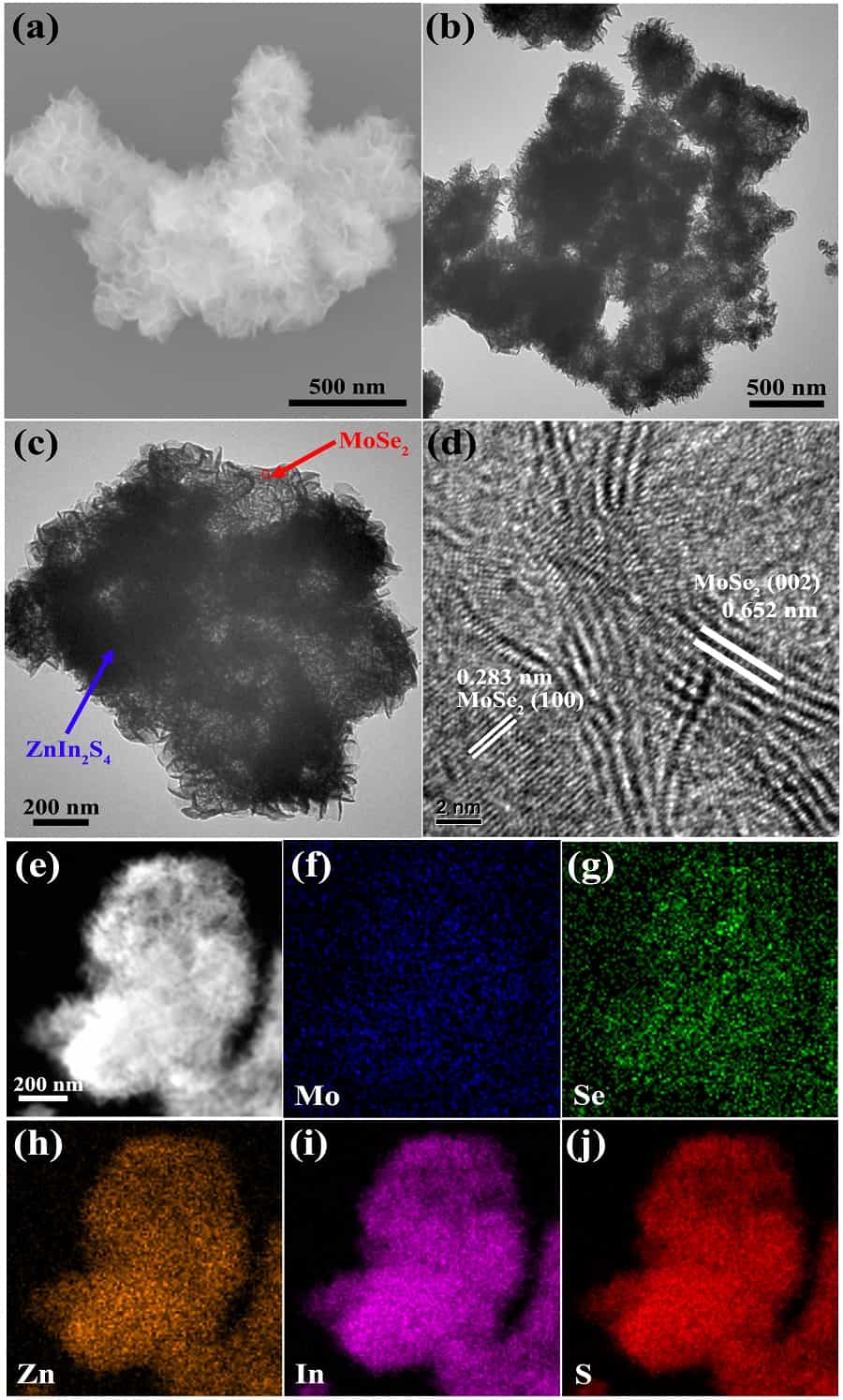
To elucidate the role of nanostructures in producing a highly efficient photocatalyst, a range of state-of-the-art techniques such as X-ray diffraction, electron microscopy and energy-dispersive X-ray (EDX) mapping were employed. EDX is an incredibly useful spectroscopic tool that enables elemental analysis down to the nanometre length scale, and in this instance it shows the coexistence of Zn, In, S, Mo and Se in the hybrid system (see image). Further morphological insights from the remaining characterization techniques delve into how the structure gives rise to high chemical reactivity.
Ong explains that “importantly, the MoSe2 nanonetworks have multiple pores and are in favour of the direct light absorption of ZnIn2S4, even though the ZnIn2S4 is hybridized with MoSe2. The ZnIn2S4/2%MoSe2 photocatalyst displays a dramatically high noble-metal-free hydrogen generation rate of 2228 μ mol g–1 h<sup–1 sup=””>with a high apparent quantum yield of 21.39% at 420 nm.”</sup–1>
This system signifies a massive enhancement in the production of hydrogen, weighing in at more than two times larger than similar systems. The apparent quantum yield is a measure of how many reactive electrons are produced depending on the amount of incident light (at a 420 nm wavelength in this instance, which corresponds to violet light); in the world of photocatalysis, 21% is a very impressive figure.
To the future and beyond
Wee-Jun Ong, corresponding author for this research
To fully investigate the mechanisms and applications of this material, various photoelectrochemical tests were carried out, with promising performances, demonstrating that this system can be used as a basis for future commercialization. However, the work does not stop there, and as Ong reveals to nanotechweb.org, “besides water splitting, my research direction is now gearing toward diverse types of energy conversion, including photocatalytic, photothermal, photoelectrochemical and electrochemical CO2 reduction and N2 fixation.” So watch this space for even more future energy solutions.
Full details of the research are reported in ChemSusChem DOI: 10.1002/cssc.201701345, published as a contribution to the Special Issue “Artificial Photosynthesis for Sustainable Fuels” invited by the editor-in-chief.
A large void hidden deep within Khufu’s Pyramid at Giza in Egypt has been discovered by a team of physicists. The first-ever image of the mysterious structure was taken using muons that shower down on Earth after being created when cosmic rays collide with the atmosphere.
The measurements were done by the ScanPyramids collaboration that includes researchers from Egypt, Japan and France. The team used three different muon-imaging techniques to study the pyramid, which was built in about 2500 BCE and is also known as the Great Pyramid and the Pyramid of Cheops.
Unexpected muons
Called muography, the technique is similar to radiography using X-rays. Dense materials such as stone tend to absorb muons, which travel relatively unhindered through the air. If more muons than expected reach a detector within the pyramid, it means that they must have passed through an air-filled void on their way.
In 2016 chemical-emulsion muon detectors developed at Nagoya University in Japan were deployed in the Queen’s Chamber, which is the lowest known chamber within the pyramid (see figure). Much like photographic film, the emulsion undergoes a chemical reaction when exposed to muons. This leaves permanent 3D tracks in the detector that tell the researchers the directions from which the particles came.
As well as detecting known voids such as the King’s Chamber, the emulsion detectors provided the first evidence for a previously-unknown large void about 30 m in length. “We knew we had found something very big and important,” says Mehdi Tayoubi of the Heritage Innovation Preservation Institute and Dassault Systèmes – both in Paris.
To verify the existence of the void, scientists from the KEK particle physics lab in Japan installed hodoscopes at a separate location within the Queen’s Chamber. These comprise layers of plastic scintillator, which measure muon trajectories. Outside the pyramid, physicists from France’s nuclear research agency CEA monitored the muon flux through the pyramid using micromegas detectors. These were arranged in muon “telescopes”, which are also able to measure muon trajectories.
We knew we had found something very big and important
Mehdi Tayoubi, Heritage Innovation Preservation Institute
Computer reconstruction
Using what are essentially three different 2D images taken from three different angles, the team could locate the void in 3D. A computer reconstruction based on analysis of the data suggests that it is similar to the Grand Gallery of the pyramid – which is an inclined passageway about 2 m wide, 8 m high and about 47 m long. The new void is between 50 and 70 m above ground level, which puts it above the Grand Gallery. The void is at about the same level as a series chambers that are above the King’s Chamber – which lies near the centre of the pyramid. Tayoubi says that it is not clear whether the void is a single chamber or multiple chambers, or whether it is horizontal or inclined.
“The void is not predicted by any theory about the pyramid,” says Tayoubi. He hopes that experts in ancient Egyptian architecture will be able to provide further information that could then be combined with the muon data in computer simulations in to determine what the void could be.
Very difficult to reach
He says that the location of the void would make it very difficult to reach by drilling and adds: “Our mission is non-destructive by design.” However, he points out that the Nagoya team has also found a corridor-like structure near the surface of the pyramid that could provide a route to the newly discovered void.
This is not the first time that muons have been used to study the interior of pyramids. In the 1960s the American physicist and future Nobel laureate, Luis Alvarez, placed a muon detector in a chamber in the nearby Pyramid of Khafre. He showed that there are no other large chambers in that pyramid.
More recently, Arturo Menchaca of the National Autonomous University of Mexico placed a detector inside the Pyramid of the Sun at Teotihuacan near Mexico City. Physics World‘s James Dacey and Matin Durrani visited the experiment in 2015, where they recorded the podcast “Inside the particle pyramid“. Dacey recounts how the intrepid pair crawled into the interior of the pyramid in “Particle-physics lab beneath a Mexican pyramid“.
Elsewhere in Mexico, a team including Menchaca is trying to image the interior of a volcano using muons. See “Monitoring a smoking giant“.
In the deep, dark depths of the ocean, where chimneys spout hot black clouds of particles, there is life. Scientists are currently exploring the sea floor of the eastern Pacific Ocean using the research ship Nautilus, aided by its two hardy assistants Argus and Hercules – remotely operated vehicles. Gaining a better understanding of these harsh environments offers clues about whether life could survive on other worlds, and could inform future missions to Jupiter’s watery moon Europa. This video introduces the aims and the technology of the Nautilus mission, including video footage of the alien landscape that lies beneath the waves.
Find out more about the Nautilus mission in November’s Physics World, a special issue about the challenges for physicists working below the waterline. The issue includes an article by astronomer and science communicator Jon Willis about his time spent on the Nautilus ship earlier this year. Physics World managing editor Matin Durrani introduces our “Under the sea” special issue and explains how you can access it in this article published yesterday.
Nanoarchitectures reveal the inner workings of a new breed of photocatalysts
Finding ways to effectively utilise the vast quantities of sunlight that impart energy to our planet remains the greatest challenge for many alternate energy visionaries. Among them is Wee-Jun Ong who is at the forefront of research into photocatalysis. As part of a publication showcasing promising new methods for solar energy conversion, Ong has stated that “accomplishing solar-to-energy conversion will, in turn, lead to the development of a sustainable, green, and renewable future without environmental detriment. All of us need to do our roles to make this world better.”
Reporting in ChemSusChem Ong and colleagues show that submicron flower-like structures created by a one-pot production method have high photocatalytic activity, specifically for water splitting to produce hydrogen. The work, a collaboration between Singaporean and Chinese institutions, represents the forefront of visible light-driven hydrogen evolution research that is both effective and environmental. The nanostructures do not contain precious metals and so could provide a path toward cost-effective and environmentally friendly energy conversion.
In combining both sunlight and water to create hydrogen, lead author Deqian Zeng and colleagues including Ong make use of naturally abundant resources, a factor that is key in providing a sustainable future for us all. This hydrogen can be used as a clean fuel source, but arguably more important is the alluring potential that has been unearthed in using hierarchical nanostructures for potential application to a wide variety of energy storage and conversion applications.
Less precious, more efficient
Zeng et al. present an attractive alternative to current water-splitting processes, which rely heavily on precious metals. The use of precious, or noble, metals is not ideal as the metals are just that: precious as they are in limited supply, and therefore expensive both in terms of monetary cost and the environmental impact in mining them. By combining ZnIn2S4 and MoSe2 heterostructures, the researchers have developed novel photocatalysts from abundant materials with highly desirable properties including non-toxicity, high chemical stability and superb catalytic activity.
The properties are particularly impressive considering that the production method is much quicker and much simpler than competing processes: a reaction duration of just one hour makes use of a solution-phase hybridization approach that needs only a single pot to fabricate. This is a marked improvement compared with alternate methods that traditionally involve complex, multi-step reactions over the course of days.
Nanoflowers for photocatalysis
Wee-Jun Ong, corresponding author for this research
To elucidate the role of nanostructures in producing a highly efficient photocatalyst, a range of state-of-the-art techniques such as X-ray diffraction, electron microscopy and energy-dispersive X-ray (EDX) mapping were employed. EDX is an incredibly useful spectroscopic tool that enables elemental analysis down to the nanometre length scale, and in this instance it shows the coexistence of Zn, In, S, Mo and Se in the hybrid system (see image attached to article). Further morphological insights from the remaining characterisation techniques delve into how the structure gives rise to high chemical reactivity.
Ong explains that “importantly, the MoSe2 nanonetworks have multiple pores and are in favour of the direct light absorption of ZnIn2S4, even though the ZnIn2S4 is hybridised with MoSe2. The ZnIn2S4/2%MoSe2 photocatalyst displays a dramatically high noble-metal-free hydrogen generation rate of 2228.
This system signifies a massive enhancement in the production of hydrogen, weighing in at over two times larger than similar systems. The apparent quantum yield is a measure of how many reactive electrons are produced depending on the amount of incident light (at a 420 nm wavelength in this instance, which corresponds to violet light); in the world of photocatalysis, 21% is a very impressive figure.
To the future and beyond
To fully investigate the mechanisms and applications of this material, various photoelectrochemical tests were carried out, with promising performances demonstrating that this system can be used as a basis for future commercialisation. However, the work does not stop there, and as Ong reveals to Physics World, “besides water splitting, my research direction is now gearing toward diverse types of energy conversion, including photocatalytic, photothermal, photoelectrochemical and electrochemical CO2 reduction and N2 fixation.” So watch this space for even more future energy solutions.
Full details of the research are reported in ChemSusChem, published as an invited contribution to a Special Issue of the journal ChemSusChem, Artificial Photosynthesis for Sustainable Fuels by the Editor-In-Chief. DOI: 10.1002/cssc.201701345
Wahib Al-Qubatee of Wageningen University and colleagues worked in the Tihama Coastal Plain, a region bordering the Red Sea in the west of Yemen. Hydrogeological data collection has been inconsistent here despite extensive irrigation improvements upstream in Wadi Zabid and Wadi Rima in the 1970s. Local stakeholders hold a significant pool of knowledge because the irrigation systems implemented require their active participation. The people are driven by the Islamic consultation concept of “shura”, which encourages them to share knowledge and cooperate, with specialists as well as within their community.
The Tihama Coastal Plain was once highly fertile agricultural land fed by water from the western slopes of the Yemen Highlands. But upstream dams and reduced rainfall have led to a shortage of both surface and groundwater, which is causing desertification.
The Yemen Highlands receive around 550 mm rainfall per year, which flows to the midstream regions of Wadi Zabid and Wadi Rima. The coast receives just 100 mm of rain each year so coastal townships such as Al-Mujaylis are heavily reliant on groundwater.
Al-Qubatee and colleagues found from interviews that 50 to 60 years ago the groundwater in Al-Mujaylis was around 0.5 m below the surface. By 2013 it was at a depth of 13 m, showing that the groundwater is being used unsustainably. There have been changes to well and pumping technology during this time, encouraged by diesel subsidies introduced by the government to support agriculture. Local people thought the drop in the water table was due to a lack of rainfall, water harvesting structures and dams in Wadi Zabid and Wadi Rima, inefficient irrigation and increased abstraction.
Using timelines the team was able to date groundwater changes by connecting them to historical events. People tended to agree that after 1985, groundwater levels and land devoted to agriculture dropped, whereas desertification and emigration increased. Following 2000, rainfall decreased, creating further pressure on the groundwater, agricultural land again decreased and crop yield also fell. Desertification became increasingly widespread.
Around this time about 60% of the population left Al-Mujaylis. The community reported that emigration was due to a decrease in crop yield exacerbating poverty. A local teacher thought that 85% of the Al-Mujaylis population live in extreme economic poverty. When groundwater was close to the ground surface, little irrigation was required. However, under current conditions watering crops is unaffordable for most: drilling and pumps may cost up to $8400. Water shortage, encroachment of sand dunes and the spread of Prosopis juliflora, a highly competitive invasive shrub, are the result.
The researchers noted that the best technique for this project was a balance between a top-down, specialist-led approach and a bottom-up method involving stakeholders. Al-Qubatee said that with this approach the researchers “benefit from the implicit knowledge of the community and get the technical expertise of governmental institutions in order to facilitate decision-making and the implementation process”. The team was pleased with the effectiveness of PRA for obtaining historical information from local people. The technique also provides an opportunity for education and for finding solutions that local stakeholders agree with.
Microscopic objects and organisms can reveal a great deal about our world, and with today’s technology, you can even turn your mobile phone into a microscope. Of course, a phone-based microscope could never compare to a specialized laboratory microscope, right? Or perhaps it could.
A team of researchers at the University of California, Los Angeles, led by Aydogan Ozcan, specializes in techniques for imaging tiny objects outside of the research lab. In a recent report appearing online in Light: Science and Applications, the team used machine learning to extract phase information – which has many uses, including visualizing transparent objects and measuring object thicknesses – from images of complex biological samples taken with a hand-held portable camera. Thanks to their deep neural network algorithm, the team was able to reduce both the computing time and the number of images needed to perform biomedical imaging of patient samples (Light Sci. Appl. 7 e17141).
The researchers used a lens-free imaging device equipped with a camera similar to the one on a mobile phone (more details on lens-free imaging can be found in a recent Physics Todayfeature co-authored by Ozcan). In an unorthodox approach, they place the sample directly in front of the camera and shine light through it onto the camera using a simple LED. The light is distorted (scattered and phase-shifted) as it passes through the sample. The camera then captures the light, distortions and all, creating a hologram. The hologram is then processed computationally to reconstruct an image of the sample, exactly as it is would be seen through more expensive and bulky benchtop microscopes.
A major challenge in this form of imaging is recovery of phase information. When light waves hit a camera’s detector, they contain both phase and intensity information, but the phase information is lost because optical cameras only detect intensity. “Phase information is particularly important for transparent objects that are hard to see – like unstained tissue samples,” says Ozcan.
Several computational techniques for recovering phase-information from intensity images have been invented, but they suffer from the need to acquire multiple images and relatively long computation times. If you have a moving sample or need quick readouts – for tracking the swimming of sperm cells, for example – these long imaging and processing times can be problematic.
A key benefit of machine learning is the ability to solve complex problems without having a complete understanding of the physical processes underlying the data. “Remarkably, this deep learning-based phase recovery and holographic image reconstruction approach has been achieved without any modelling of light-matter interaction or wave interference,” the team writes. By training the machine-learning algorithm with a large dataset of images in which the correct phase was known, the team taught a neural network to reliably reconstruct images of biological samples, such as tissue sections used in pathology, for example.
Using their algorithm, the researchers were able to reconstruct images of blood cells, Pap smears and breast cancer tissue slices. Notably, the team found that the machine learning algorithm only needed one image to reconstruct the phase information of the specimen at a quality comparable to that achieved with two to three images using the former state-of-the-art technique. In addition, the computation time was cut in half, and the algorithm could even handle out-of-focus images far better.
By requiring less sophisticated imaging and computing hardware, these advances enable the potential development of more affordable portable imaging devices. In a presentation at Biodetection and Biosensors 2017, Ozcan noted that camera pixel-count is increasing exponentially over-time in a manner similar to Moore’s law. Computational advances such as this one are critical to ensuring that today’s rapidly improving hardware can be fully exploited, and this work demonstrates that machine learning has a huge potential to impact this field.
“We have a line of exciting ongoing projects that use deep learning approaches for advancing imaging and sensing science,” concludes Ozcan.