Making space

In a column last year I wrote about a book by the historian of science Jimena Canales (January 2016 p19). Entitled The Physicist and the Philosopher: Einstein, Bergson, and the Debate That Changed Our Understanding of Time, her book describes an encounter that took place in 1922 between Albert Einstein and the French philosopher Henri Bergson. The book was notable for dramatizing the gap between Einstein’s approach to “objective time” as quantitative and measurable, and Bergson’s notion of “experienced time” as a flux in which past, present and future are knitted together.

A century later, the gap in our thinking of time persists. But a similar gap also exists in notions of space, even if that divergence has never crystallized into a specific encounter as it did between Einstein and Bergson over time. Physicists are apt to explain the everyday experience of space as a smooth, 3D arena in which things always have definite positions as an illusion – a by-product of the limited sensory faculties of humans. As the German mathematician Hermann Minkowski proclaimed in 1908, “space by itself, and time by itself, are doomed to fade away into mere shadows”, for only 4D space–time can preserve “an independent reality”. In quantum mechanics, moreover, the uncertainty principle forbids things from having definite locations.

In more speculative theories, space is more complicated. Some versions of quantum-field theory picture a fluctuating space–time foam. In loop quantum gravity, meanwhile, space is quantized, with its patches unable to become infinitely small. As for string theorists, they insist on 10, 11 or 26 dimensions, with the extra ones closed or “compactified” so they are unseen even in current scientific experiments. The Columbia University theorist Brian Greene’s 2011 book The Hidden Reality: Parallel Universes and the Deep Laws of the Cosmos discusses no less than nine types of alternate universes.

Philosophers, by contrast, tend not to consider the ordinary experience of space illusory. They are more interested in features that make such experience possible – features that are not incidental or subjective but belong to the full reality of spatial experience. As the French philosopher Maurice Merleau-Ponty wrote in his 1945 book Phenomenology of Perception, these aspects are like “the darkness needed in the theatre to show up the performance”.

Philosophers, for instance, distinguish between “allocentric”, “perceptual” and “bodily” space. Allocentric space is an objective space in which locations and orientations can be defined – with a GPS, say – without reference to an observer’s location. Perceptual or “egocentric” space was identified in the 18th century by the German philosopher Immanuel Kant. It is based on the spatial orientation provided by an observer’s body – up and down, right and left, front and back – without which it would be impossible to locate something in allocentric space even with a compass or GPS device.

As for bodily or “proprioceptive” space, it was described by 20th-century philosophers (including Merleau-Ponty) as an awareness of the presence of your own body and its ability to move. It is the sense you have of your head and hands as you hold this magazine – or as you operate the phone or tablet you’re reading it on. Bodily space is the non-mathematical sense called upon in walking, playing and operating objects such as a GPS or a compass.

Ambitious disciplines

Given the gap between the physical and philosophical approaches to space, you might wonder why we don’t just assume that physicists and philosophers investigate different things: space and place, say, or Space and space.

That won’t work, because physics and philosophy are both ambitious disciplines; each aims to describe the world, not just a particular slice of it. As the physicist John Bell wrote: “To restrict quantum mechanics to be exclusively about piddling laboratory operations is to betray the great enterprise. A serious formulation will not exclude the big world outside the laboratory.”

That big world includes human experiences. The German philosopher Edmund Husserl, for example, denounced the “scientific fanaticism” of those who think they are studying the world when they rely on only what shows up in laboratories. Philosophy’s task, as Husserl saw it, is to investigate the basic features of all human activities, including science, and the experiences that make them possible. Both physicists and philosophers, then, insist that they are the ones talking about “Space” rather than “space” and grasp their relation.

What most divides physicists and philosophers on the issue of space seems to boil down to their answers to the question of whether consciousness is a fundamental feature of the world. Physicists begin with the assumption that what they study precedes and is independent of interactions with observers. Philosophers – or at least those who follow Husserl’s general starting point – begin with and never fully leave behind experiences of connections between humans and the world. That makes it hopeless either to try to reduce one starting point to the other, or to develop some larger conception of space to encompass both in an artificial compromise.

The critical point

Let’s adapt Bell’s image of the lab and the “big world”. Space that’s investigated in the lab – where there are trained staff, special assumptions, advanced equipment and controlled conditions – looks the way scientists find it to be, and it also can be used to describe much of what’s on the outside. Yet humans are born into and inhabit that “big world” first, and rely on the practical experience of space that philosophers address. That space is also found inside the lab, where scientists practically handle equipment and make measurements using perceptual and bodily space.

What’s in the lab is also in the big world, and what’s in the big world is also in the lab. Recognizing this multidimensionality makes space capacious enough for both physicists and philosophers alike.
Serving the public

It is hard to read the news these days without a degree of trepidation over the future of enlightened democracy. With the rise of Donald Trump in the US, the increase of right-wing parties around the globe as well as the general decline of rational and civil discourse, we need everyone to stand up for rational and fact-based debate. In the US, budget cuts and conservative ideology threaten to undo the progress that decades of scientific research has made in the quality of life and standard of living that we currently enjoy.

Scientific and technical competence is our best defence against these threats, especially from individuals with a scientific background who are willing to serve in elected office. For this reason, I often tell researchers my own story, so that other scientists might consider spending part of their career in public service.

When I was 19, my brother and I started a company in our parents’ basement that now makes most of the stage lighting equipment in the US. I then returned to my first love and entered graduate school at Harvard to study physics. My PhD thesis involved searching for proton decay through the construction, instrumentation and data analysis of the Irvine–Michigan–Brookhaven detector that was located at Fairport mine on the shore of Lake Erie. Although our experiment did not discover proton decay, it scored a significant unanticipated success when it was one of three experiments to observe the burst of neutrinos from SN1987a.

After receiving my PhD in 1983, I spent the next 23 years at Fermi National Accelerator Laboratory in Illinois. I spent the first decade designing, building and analysing data from giant particle detectors. I was a member of the team that discovered the top quark – the heaviest known form of matter, and quite possibly the heaviest particle that will ever be discovered. So when we had the Congressional reception celebrating the discovery of the Higgs boson in 2012, I had the honour of congratulating many of my former colleagues for discovering the second heaviest form of matter.

I spent my second decade at Fermilab designing and building particle accelerators such as the Fermilab Antiproton Recycler Ring, which was used to greatly increase the number of collisions and keep the physics programme at Fermilab’s Tevatron competitive until the end of its lifetime. With a large team of collaborators, I also helped design and build prototype elements of future, large hadron colliders.

Tackling technical issues

Why did I decide to enter the US Congress? My quick answer is that I tragically fell prey to my family’s recessive gene for adult-onset political activism. My parents met on Capitol Hill in the 1950s when my mother worked for US senator Paul Douglas. Like me, my father was trained as a scientist, and during the Second World War he designed fire-control computers for the navy. During his service, he started receiving reports on how many people were killed each week by the equipment his team built. He became very unhappy at the idea of his scientific skills being used that way. When he came back from the war, he became a civil-rights lawyer and wrote much of the enforcement language behind the Civil Rights Act of 1964.

After he passed away, I began to read his papers, and they prompted me to begin contemplating a question that science cannot really answer: what fraction of your life should you spend in service of your fellow citizens? That is why I decided to run for Congress in the special election to replace Dennis Hastert, former speaker of the US House, in 2008. On the campaign trail I learned that there is a long list of neurons that you have to deaden to convert a scientist’s brain into a politician’s. When you speak with voters, you must lead with conclusions rather than complex analysis of underlying evidence – something that is very unnatural to a scientist.

As a sitting member of Congress, I have been able to lead on important technical issues. On the science, space and technology committee, I have helped bring issues to the committee’s attention that require us to act. For example, the CRISPR/Cas9 gene-editing technology discovered in 2012 raises the prospect for cures for diseases such as sickle-cell anaemia, but also has the potential to disrupt society. At my urging, the science committee held a hearing on this topic, and I have been told that it was one of the best attended in the committee’s history.

As the only PhD physicist in Congress, my background became important during the debate of the Iran nuclear deal. During this time, I had more than a dozen classified briefings, many of them individual briefings by the technical experts at the Departments of Energy, State and Treasury, and the intelligence agencies. Because of the technical complexity of the agreement, members of both parties would routinely ask my opinion on aspects of the proposed agreement. Ultimately, my support was based on verification and science, not trust of the Iranian regime.

Defending the science budgets during the annual appropriation cycle is an ongoing challenge. Many members of Congress make the mistake of seeing science as an enterprise that can be stopped and restarted at will – like road construction or equipment purchases. They do not appreciate the damage that can be done to a scientific enterprise in a single budget cycle, where projects and careers that take decades to build can be irreversibly destroyed in a single fiscal year.

In the US and across the world, we need people with strong scientific backgrounds in all levels of government and politics. We need scientists and engineers on our school boards and city councils just as much as we need them in Washington. I hope anyone who reads this will take the time to consider spending a fraction of their life in service to their fellow citizen.

Prize-winning astronomy image, the ultimate cost of Cassini, amazing facts about lasers

By Hamish Johnston and Michael Banks

Hats off to the Russian photographer Artem Mironov, who has beaten thousands of amateur and professional photographers from around the world to win the 2017 Insight Astronomy Photographer of the Year. The award is in its ninth year and is run by the Royal Observatory Greenwich together with Insight Investment and BBC Sky at Night magazine. Mironox’s image, which was taken over three nights from a farm in Namibia, is of the swirling dust and gas clouds in the Rho Ophiuchi Cloud Complex. The object is situated approximately 400 light years away from Earth and is home to a cluster of more than 300 protostars. As well as winning the £10,000 top prize, Mironov’s image will be on display along with other selected pictures at an exhibition at the Royal Observatory that will run until 28 June 2018. The competition received over 3800 entries from over 90 countries.

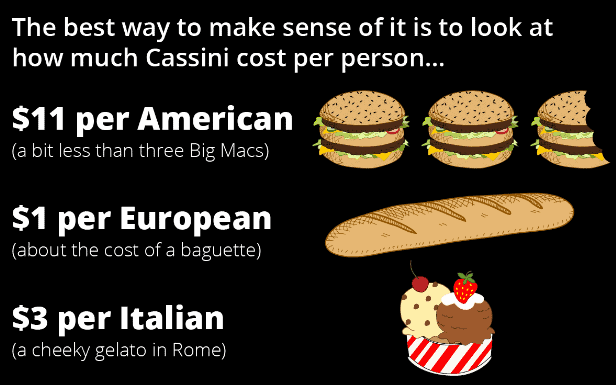
It was a bittersweet week for scientists working on Cassini who watched their beloved spacecraft plunge into Saturn earlier today. This marked the end of an incredible 20-year mission that changed the way we look at the ringed planet – and also how we think about where life might exist beyond Earth. Above is a detail from an infographic that describes how much the mission cost, and what we got in return. You can view the entire infographic at Scienceogram UK. Cassini looks like a bargain to me.

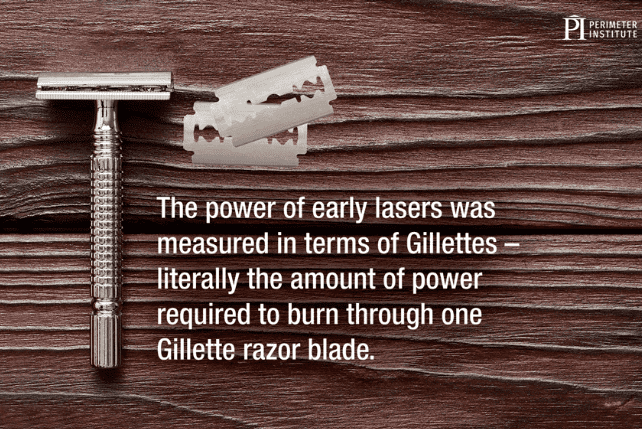
Close shave: a razor-sharp unit for power. (Courtesy: Perimeter Institute for Theoretical Physics)

“It was 60 years ago this week that a young Columbia University grad student named Gordon Gould jotted some sketches in his notebook of a proposed light-emitting device, then had his sketches notarized at a candy store in the Bronx.” That’s according to the Perimeter Institute for Theoretical Physics, which has put out a lovely deck of cards full of amazing facts about lasers. My favourite is the Gillette unit illustrated above.

Heroic Cassini makes the ultimate sacrifice

After two decades in space, the Cassini mission will come to a dramatic end today (15 September) as the craft is deliberately hurled into Saturn’s atmosphere, where it will burn up on entry. According to mission scientists, Cassini will continue to collect valuable scientific data throughout this final act, from which we could learn about the planet’s atmosphere. This finale will also avoid the unlikely event that Cassini crashes into one of Saturn’s moons in the future – Titan and Enceladus could both contain habitable environments that could be contaminated by the wreckage.

“We’ve all known this day was coming for a long time, but it seems strangely unreal at the moment,” says mission scientist Joshua Colwell. “There’s a community of people associated with this mission that will gradually dissolve, so it’s a sad day for me, but also one to marvel at the voyage and what we’ve learned and still have to learn from the observations sent back by this robot explorer that has been reliable to the end.”

Having launched in October 1997, the US–European mission entered orbit around Saturn in 2004. One of its crucial early milestones was to deliver the European Space Agency’s Huygens probe to Saturn’s moon Titan – the only landing ever made on a body in the outer solar system. Data transmitted back to Earth from the Cassini–Huygens mission over the past 13 years has transformed our understanding of Saturn and its moons.

So long, and thanks for all the data

Since its launch, the craft has travelled eight billion kilometres, completed 162 targeted fly-bys of Saturn’s moons, and captured almost half a million images. Among its achievements are the discovery of liquid-methane seas on Titan, and the discovery of geysers on the surface of Enceladus, which indicate that liquid water is reaching the moon’s surface due to hydrothermal activity. To date, nearly 4000 papers have been published involving data from the Cassini–Huygens mission.

With the spacecraft now running low on fuel, mission scientists decided to embark Cassini on one final sacrificial mission. Its so-called Grand Finale began in the final few days of April this year, when it embarked on a five-month series of plunges into the space between Saturn and its rings. These daring dives could provide vital information about the nature and origin of the rings.

Writing in a feature article for the September issue of Physics World, Colwell puts this opportunity in its historical significance: “Saturn’s interior may still be hidden from view, but astronomers have been gazing at its rings – one of the most striking features in our solar system – since the 1600s, and it has long been an embarrassment to me that I’m unable to answer two basic questions about them: how old are they and where did they come from?”

Performing until the fiery end

At around midday UTC today the 212 kg craft will plummet into Saturn’s atmosphere, burning up like a meteor. Connection will be lost shortly before as friction will make it impossible for the spacecraft to maintain a connection with the Earth. Data collected in these death throes from the craft’s mass spectrometer could reveal vital information about the composition of Saturn’s atmosphere.

Colwell says that he will be spending the day in Pasadena with members of his team, which worked on Cassini’s Ultraviolet Imaging Spectrograph. “It’s an unfortunate bit of celestial timing that we lose the spacecraft at about five in the morning here in Pasadena. What a way to start the day!” he says.

Colwell is now turning his attention to developing a CubeSat mission to perform experiments in Earth orbit to study collisions in planetary rings and in the protoplanetary disc. Meanwhile, many Cassini mission scientists are expected to join the ranks of the Europa Clipper mission. This NASA mission planned for launch in the 2020s will make multiple fly-bys of Jupiter’s ocean moon to investigate its possible habitability, using lessons learned from the way Cassini has explored Saturn.

Microfluidic chip unveils metastasis mechanisms

Cancerous tumours can spread and infiltrate other tissues through blood vessels. This metastasis is driven by biochemical signals and a physical interaction with blood vessel endothelium. A critical step in this process is the invasion of the extracellular matrix (ECM) by cancer cells.

The ECM is a network of proteins, polysaccharides and growth factors that provide a platform for cell migration and act as supporting glue between cells. As of now, investigation of cancer metastasis through the ECM is held back by the lack of an effective model to study the physical interaction between cancerous and vascular cells, as well as by poor image resolution offered by current models, which do not allow quantification of the invasion process.

Microfluidic chip

Researchers from Boston University have now developed a microfluidic platform for modelling the infiltration of cancer cells into the ECM (Biofabrication 9 045001). This model exhibits cell migration without the use of biochemical gradients, while enabling imaging of cell–cell and cell–matrix interactions. The group used collagen hydrogels to model the ECM and monitored the migration and invasion of breast cancer cells. They established that incorporating endothelial cells into the model significantly boosted the rate of cancer cell invasion to the ECM, without the need for biochemical gradients to draw the cells across.

3D-design

Lead author Laura Blaha and colleagues used microfabrication techniques to create polydimethylsiloxane (PDMS) microfluidic chips with specific dimensions. These dimensions create a surface tension that restricts fluid flow between compartments, but allows cells to migrate and interact with the other cellular compartments.

Importantly, the thickness of the chip facilitated imaging of cells and their interactions. This is a big advantage over models commonly used to investigate tumour migration, which use transwell chamber devices, limiting the quality of images and the ability to draw effective conclusions from studies.

The platform enables staining of specific ECM and cell-cell interaction markers. Due to the chip’s straight, parallel channel design, protein staining protocols like the one described in the study can be completed with ease. This allowed the group to establish the production of ECM proteins from endothelial cells within the model.

Future applications

The authors predict that this model could be used in future experiments to probe the specific membrane proteins that enable the invasion of cancer cells to the ECM. A similar microfluidic model could also be used to model cell-cell and cell-matrix interactions for multiple diseases. The correct use of this microfluidic model might potentially lead to therapies for various diseases, including many different metastatic cancers.

Why is quantum physics so hard to write about?

By Hamish Johnston

Why is quantum physics so hard to write about?

That was the theme of George Musser’s keynote talk at a seminar for science communicators held this week at the University of Leeds. Musser – who has written extensively on topics such as quantum entanglement and string theory – gave several reasons and here are a few that stuck in my mind.

One reason is that reaching an understanding of what you are writing about can be very time consuming. I have been writing about quantum mechanics for over a decade, I couldn’t agree more. Even covering a small piece of research often involves taking several steps backwards and reviewing the fundamentals of quantum theory.

A question I face on Physics World is should I share this background information with the reader, or assume that they already have the required knowledge? I tend to go for the former because the background to an exciting piece of research is often as interesting as the breakthrough itself. And there’s also the old maxim that physicists love to be told what they already know!

Musser also pointed out is that research papers on quantum mechanics can be very confusing. I agree to a point. I can certainly think of two high-profile general science journals that are prone to publishing papers on quantum physics that can be incomprehensible. However, I do think that papers in leading physics journals tend to be much more accessible – at least to physicists. But feel free to take this with a grain of salt, because I do work for a physics journal publisher.

Musser also says that interacting with quantum researchers should be a two-way process, rather than the journalist simply asking questions and recording the answers. Although such interactions take time, I think this is very good advice.

It’s very likely that the first answer you get to a question will be incomprehensible. This is not a reflection of the intellectual ability of the journalist, nor a slight on the physicist’s ability to explain their work. It’s just that difficult concepts are rarely understood the first time around.

Musser’s advice – against good journalistic practice, he points out – is to move things forward by prompting the interviewee with your own interpretation of the quantum physics in question. Ultimately it is your interpretation that you will be presenting to your readers, so why not get a sanity check? If you are worried about bias creeping into your article, you can always get a second opinion from another quantum expert.

And when it comes to experts, who should you trust? Does the proponent of a new and controversial theory express some doubt about their idea? If so, that’s someone you can believe in, says Musser, adding that having no doubt is a very bad sign. Indeed, Musser points out that most new ideas in physics tend to be wrong, that’s just how science works.

In the footsteps of Cecil Powell

By  Matin Durrani

I spent yesterday at the University of Bristol, where a meeting was held to celebrate the 70th anniversary of the discovery of the pion in 1947.

The particle was spotted by Cecil Powell, who joined the university’s physics department in 1928 and went on to win the 1950 Nobel Prize for Physics for his efforts.

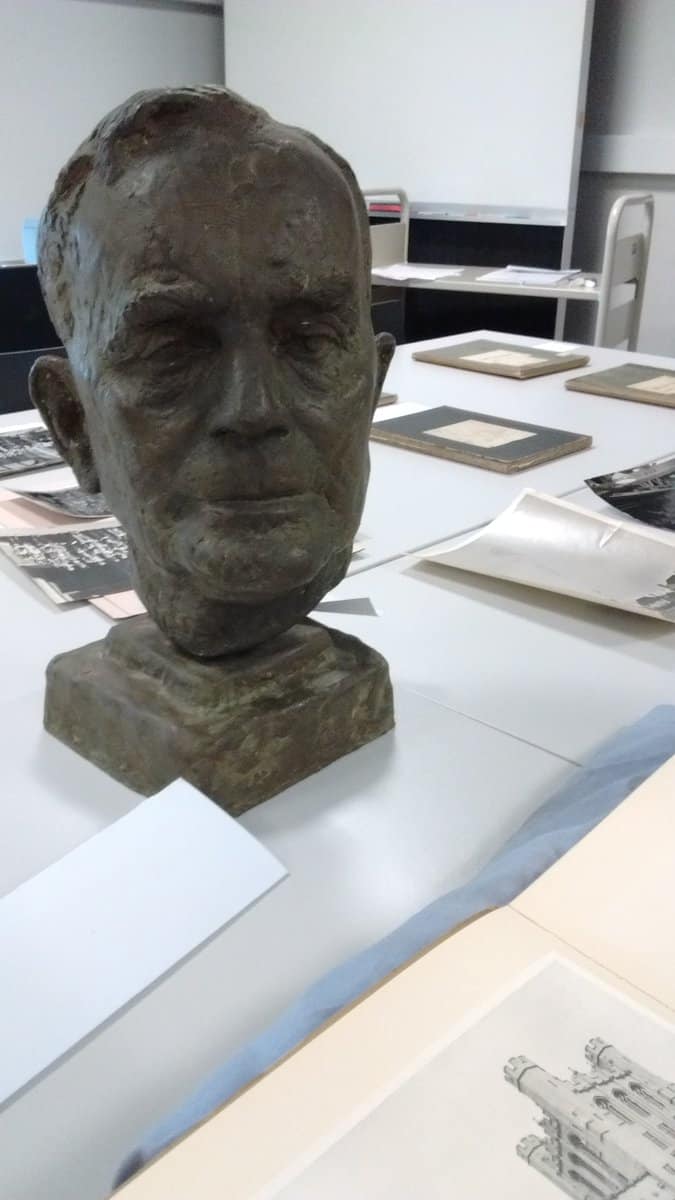
a bust of Cecil Powell

At the time, the pion was thought to be the carrier of the strong nuclear force, which binds protons and neutrons in the nucleus, though we now know it is one of a family of strongly interacting mesons.

As we heard yesterday from introductory speaker Brian Pollard, Powell found evidence for the pion using a series of ingenious (and literally breathtaking) experiments that involved him taking specially manufactured photographic plates to high altitudes up the Pic-du-Midi mountain in the Pyrenees.

Like other charged particles, mesons (produced by cosmic rays hitting the atmosphere) scatter from electrons and nuclei in the photographic emulsion, leaving distinctive tracks in the processed emulsion plates.

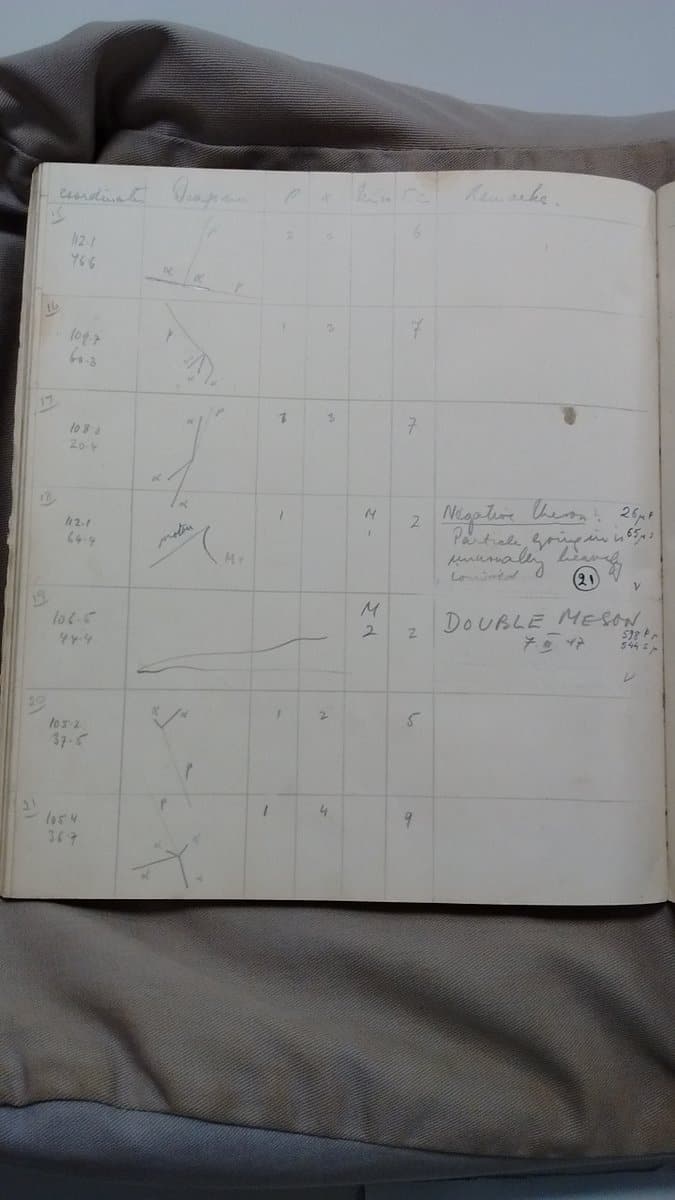
On 7 March 1947, one of Powell’s assistants (known as “scanners”) identified an event that showed one slow-moving meson stopping and then emitting a second meson. The following day another was seen, indicating that in both cases a heavier, primary meson had decayed into a secondary, lighter meson and a neutral particle.

Powell was the intellectual and practical driving force behind the experiment, but it was fascinating for me during the lunch break to visit the University of Bristol’s arts and social sciences library, where a small exhibition related to Powell’s work was on display.

There, among the bust of Powell and photos of him receiving his Nobel prize in Stockholm, was the very notebook containing details of that first event on 8 March.

The book was the property of Miss Marietta Kurz, one of the scanners who would pore over photographic plates and bring potentially interesting events to the attention of physicists in Powell’s group.

Kurz, like the other scanners, wast not a trained scientist, but to look at her book one wonders where her undoubted experimental skills would have taken her had she benefited from physics training.

As I was examining her notebook, a small party of four other delegates entered the room, including Pollard as well as the physicist and writer Frank Close, who is currently writing a book on one of Powell’s colleagues – Klaus Fuchs, who was later unveiled as a Soviet spy.

The other two visitors turned out to be none other than Powell’s daughters Jane Panahy and Annie Hatt, who spoke to me with obvious fondness about their father.

Both women also recalled their father winning his Nobel prize and how they had to stay at home in December 1950 when he went to pick up his award – the rules stating that each winner could invite just two guests (Powell took his wife and sister).

It was a poignant moment, especially when his daughters spoke of the sadness they had felt when their father died after suffering a heart attack while out walking in the hills above Lake Como in Italy. Powell died eight days after his retirement, aged just 65.

Does self-interacting dark matter explain galactic diversity?

A new computer simulation by physicists in the US suggests that interactions between dark matter particles can explain why galaxies with similar masses can have different rotation curves.

The cold dark matter (CDM) model assumes that dark-matter particles interact with each other very weakly. When combined with a cosmological constant (Λ) that describes the expansion of the universe, the ΛCDM model is very good at explaining the large-scale structure of the universe. However, CDM is not very good at predicting the distribution of mass within individual galaxies once they have formed.

Stronger interactions

In 2000 David Spergel and Paul Steinhardt at Princeton University argued that this shortcoming could be eliminated if dark-matter particles interacted more strongly with each other. This has since been dubbed the self-interacting dark matter (SIDM) model.

Now, Hai-Bo Yu at the University of California Riverside, Monoj Kaplinghat at the University of California Irvine have shown that SIDM can explain the observed diversity of mass distributions in some galaxies.

Astronomers usually describe the mass distribution of a galaxy in terms of a rotation curve. This is a plot of the rotational velocities of a galaxy’s stars as a function of their distance from the centre of the galaxy. Because the galaxy is mostly held together by the gravitational glue of dark matter, the rotation curve reveals the location of the otherwise invisible dark-matter halo that envelops the galaxy. What has puzzled astronomers is that galaxies of similar mass can have significantly different rotation curves – something that is not predicted by CDM.

Formation history

Yu, Kaplinghat and colleagues created a computer model that calculates the rotation curve of a galaxy of a certain mass containing both dark and visible matter. SIDM is used to describe dark-matter in the central region of the dark-matter halo, where collisions between dark-matter particles are more likely to occur. CDM is used to model dark-matter interactions in the outer region of the halo, and the effect of visible matter on the structure of the galaxy is also included. In addition, the history of the formation of the dark-matter halo is factored into the model.

The team used their model to calculate the rotation curves of galaxies with parameters similar to that of 30 galaxies that are well-known to astronomers. Writing in Physical Review Letters, the team says that they were able to reproduce the diversity of rotation curves describing the 30 galaxies. This allowed them to conclude that SIDM could be a contributing factor to the observed diversity of rotation curves.

Dichalcogenides offer atomically thin alternatives to silicon

By carefully controlling oxygen exposure during fabrication, scientists at Stanford University have created field-effect transistors (FETs) out of two-dimensional semiconductors. The transistors are atomically thin and benefit from “native” high-k dielectrics, which can enable low-defect interfaces and low-power operation. The researchers believe that such devices could help overcome current limitations imposed by power dissipation in modern electronics.

Silicon has maintained a strong hold on integrated electronics for more than five decades. This material’s moderate band gap minimizes leakage currents and provides the ability to switch transistors “off”, minimizing power consumption. Silicon also readily accepts dopants to form p-n junctions, enabling the creation of solar cells and complex circuits. In addition, unlike many other semiconductors, silicon benefits from the existence of silicon dioxide (SiO2), a robust and native insulator, allowing for good electrical isolation between silicon components.

Despite the factors in silicon’s favour, incremental improvements in processor performance are becoming harder to come by. Historically, transistor density has grown exponentially, bringing with it increased computing power. However, as transistor dimensions have entered the nanoscale regime, quantum effects such as tunnelling have begun to dominate the total power consumption. In the past decade, performance improvements have been driven less by Moore’s law and more by design innovations including the use of strain and the replacement of traditional silicon dioxide with high-k dielectrics like hafnium oxide (HfO2).

Beyond silicon

Now, Michal Mleczko, Eric Pop and colleagues at Stanford University have fabricated field-effect transistors based on hafnium and zirconium diselenides (HfSe2 and ZrSe2) – semiconductor materials formed from “two-dimensional” crystal layers three atoms thick. These materials exhibit band gaps comparable to that of silicon even at single-layer thicknesses, enabling the design of atomically thin electronics.

Inspired by the need for native insulators in good semiconductors, the Stanford researchers looked for the formation of HfO2 and zirconium oxide (ZrO2), which would fulfil the role played by SiO2 in silicon-based miroelectronics. Transmission electron microscopy (TEM) images taken by the researchers showed that HfSe2 and ZrSe2 readily form such native oxides when exposed to oxygen. Furthermore, the oxides are the same high-k dielectrics that have been painstakingly implemented in silicon electronics for the past decade. The use of naturally forming oxide produces interfaces between the semiconductor and the insulating layer that have low defect density.

The researchers prepared transistors using the native oxides (HfO2, ZrO2) or a non-native insulator (aluminium oxide, Al2O3), which was deposited separately. To directly compare the performance of the transistors, the current was measured as a function of gate voltage, illustrating how otherwise identical devices behave. These measurements revealed that the devices with high-k dielectrics exhibited much lower defect densities at the semiconductor–dielectric interface.

A significant challenge moving forward comes from the tendency of these two semiconductor materials to form oxides too readily, as this happens spontaneously in the presence of ambient oxygen. Furthermore, oxygen atoms diffuse through the oxide crystal lattice, meaning that the oxide growth is not self-limiting. The need to prevent inadvertent exposure to oxygen in the ambient environment posed a big hurdle during device fabrication: devices and samples had to be kept in nitrogen gas or under vacuum to inhibit unintentional excess oxide formation. Left unchecked, the oxidation process could consume the entire semiconductor sample, akin to the rusting of a metal.

Full details of the research are reported in Science Advances 10.1126/sciadv.1700481.

Behind the scenes of peer review

By James Dacey

This week is Peer Review Week 2017, a global celebration of the essential role that peer review plays in maintaining scientific quality. The theme of this year’s event is “transparency in review”, exploring how individuals and organizations could be more open at all stages of the scientific process.

Physics World is published by IOP Publishing and I’ve been part of a crack team assembled to take people behind the scenes of our peer-review processes. As the man with a camera, my job was to create a series of videos with my colleagues in the publishing department who deal with peer review on a daily basis.

First up, we have a video message from Marc Gillet, our associate director of publishing operations, introducing our plans for the week (see above). Marc is joined by a selection of staff revealing the role they play in the peer-review process – drawing inspiration from Bob Dylan’s famous flashcard skit for Subterranean Homesick Blues.

(more…)

Copyright © 2026 by IOP Publishing Ltd and individual contributors