

Shape-shifting soft projectiles travel faster

Liquid droplets or soft solid objects can be catapulted with more than twice the energy of rigid projectiles, according to physicists in France. They say that this “super propulsion” relies on additional momentum provided by the stretching and compression of deformation and could have practical applications in areas ranging from ballistics to bioengineering.

The effect involves superhydrophobic surfaces, which, like lotus leaves, are very hard to wet. Previously, scientists had shown that liquid droplets can bounce off these surfaces just like elastic balls, and now Franck Celestini of the University of Côte d’Azur in Nice and colleagues have demonstrated that these surfaces can be used to make very effective catapults.

The catapult in their case was a tiny upright spring with one end anchored to the ground and the other supporting a metal plate. Initially compressed and held at rest by an electromagnet, the spring undergoes harmonic motion when released – rising and falling over a distance of just a few millimetres but with an acceleration up to 10 times that of Earth’s gravity.

Up, up and away

Had the researchers simply placed small rigid objects on the plate, the outcome would have been straightforward. Each object would be pushed upwards until the plate reaches its maximum velocity and then starts decelerating, which occurs halfway through the spring’s expansion. At that point, the object – continuing to move upwards with the plate’s peak velocity – would be ejected by the catapult.

Instead the team covered the plate with a superhydrophobic polymer and then placed droplets of water on top of that. In this case the upward acceleration of the plate spreads the drop outwards, compressing it in the vertical direction. This slows down its centre of mass compared with the plate – so tending to delay the drop’s moment of ejection.

However, the horizontal spreading does not go on indefinitely. At a certain point, surface tension causes the drop to reassume its normal spherical shape, before overshooting and then expanding along the vertical axis. This vertical expansion gives the drop additional vertical velocity, which means that when it does fly off the plate its speed is greater than it would otherwise be.

Quick oscillation

Celestini and colleagues did their experiment using a range of spring stiffnesses and drop sizes, which varied the frequency of both the catapult’s up and down motion and the drops’ compression and expansion. As they report in Physical Review Letters, they found that drops got the biggest boost when oscillating about three times as fast as the spring did – the ejection speed and kinetic energy being, respectively, about 1.5 and 2.5 times greater than those of a rigid object.

Repeating the exercise but replacing the droplets with elastic balls made from a water-absorbing polymer, the researchers obtained essentially the same result: a kinetic-energy gain of some 250% at a frequency ratio of around 3. As such, they say that they “clearly demonstrate the generality of the phenomenon”, adding that it differs from classical resonant phenomena in that driven harmonic and parametric oscillators exhibit frequency ratios of 1 and 2, respectively. They suggest the effect be viewed as a “one-shot resonance”.

The group found it could model the projectiles’ deformation using a simple wave equation based on Hooke’s law. Although unable to derive the optimum frequency ratio analytically, the researchers did do so numerically by assuming three basic boundary conditions and then calculating the ejection time and kinetic-energy boost for a variety of ratios. This procedure yielded a value – 3.4 – close to that obtained experimentally.

Significant contribution

That value, explains Celestini, allows a projectile to be propelled upwards with a significant contribution from both the catapult and the object’s centre of mass. If the frequency ratio is too small then the object only starts to push itself up once the plate has reached maximum height (and, with it, zero velocity). But if the ratio is too high – in other words, the object is close to being rigid – then the object’s own oscillations become insignificant.

Jonathan Boreyko of Virginia Tech in the US praises the French group for its “exciting discovery”, arguing that the find could lead to a number of practical applications. Among those, he suggests, are being able to sort drops by size or elasticity – given the specific spring oscillation frequency that would boost their speed in each case. Another possibility, he says, would be transporting droplets in three-dimensional lab-on-a-chip systems.

Celestini also believes the work could have military applications. He reckons that the results might lead to “a new efficient catapult for launching aircraft”, but says he cannot provide details on such a system for the moment.

Mechanism could stop deadly spiral waves in the heart

A mechanism that could break up potentially deadly spiral waves in heart tissue has been identified in simulations done by a team led by Sasha Panfilov at Ghent University in Belgium. Spiral waves can cause irregular heartbeats (arrhythmias) and the team says that the newly discovered mechanism could help stop this potentially deadly condition.

The heart is a mechanical pump that is governed by electrical activity. Researchers also know that the mechanical deformation of the heart by external forces can affect its normal operation – a process called mechano-electrical feedback (MEF). Physical impacts to the chest are known to both cause and correct arrhythmias, for example, and impacts can even cause death.

Colliding waves

The team simulated MEF using a 2D computer model of the electrical and mechanical properties of heart tissue. Spiral waves were initiated in the simulation and then the system was subjected to simulated mechanical pulses of varying duration and strength. Under some circumstances the pulse causes a spiral wave-front to collide with the preceding wave-back. In some cases, this causes the spiral wave to dissipate.

Writing in Physical Review Letters, the team says that its predictions could be tested experimentally in systems including excised heart tissue, cell cultures and living hearts.

Microfluidic interface enables neurovascular interactions

Neurovascular cell interactions within the brain are critical to controlling cerebral blood flow and regulating which compounds and proteins can cross the blood-brain barrier (BBB). When these neural and vascular cells run into damage or dysfunction it can lead to the cognitive decline observed in vascular dementia. Research groups have strived to replicate neurovascular interactions in vitro to analyse the underlying mechanisms of dementia. Progress of such research, however, has been hindered by difficulties in modelling the interaction between different cell types or ensuring that the correct nutrients reach the appropriate cell types.

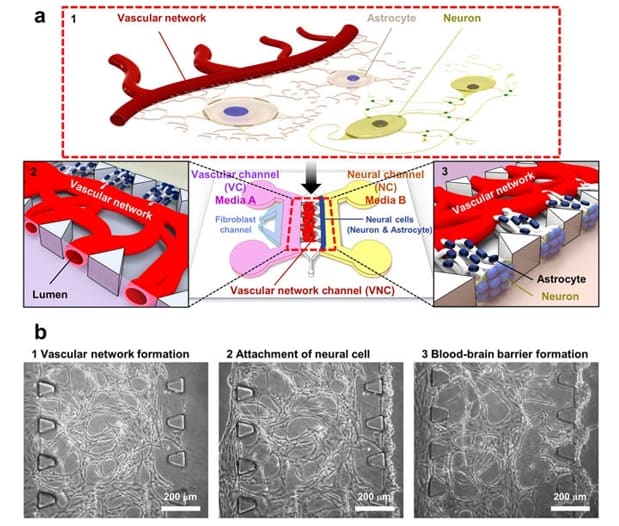
Researchers from Seoul National University in South Korea have developed a microfluidic neurovascular-unit-on-a-chip that enables both an interactive interface between neural and vascular cell compartments, whilst also separating key nutrients to the appropriate cell compartments. The developed model enabled BBB formation in the central portion of the chip, with vascular and neural interactions being enabled by the specific chip dimensions (Scientific Reports 7 8083).

Noo Li Jeon and team produced the microfluidic device using photolithography and soft lithography techniques. This allowed for remarkable definition and resolution, which enabled the separation of fluids for neurovascular interaction. The model was produced by creating a negative “master” mould from plastic (SU-8), from which multiple silicon wafers (polydimethylsiloxane (PDMS)) with the specific detailing required were produced. The researchers encapsulated the cells within a fibrin hydrogel before seeding them on the chip. This provided a 3D architecture for cells, which is much more physiologically relevant than a planar 2D material. This hydrogel allowed cells to bind to and migrate through the 3D porous network of the hydrogel and enabled the flow of nutrients and growth factors to all regions of the chip.

The microfluidic neurovascular unit

The researchers showed that injecting neural and vascular media into their respective components promoted cell growth and interaction compared with that seen when the cell media were mixed together. The separation of media compartments also displayed a positive effect on synaptic connections between neurons, in the form of increased expression of a synapse-associated protein. This established an improved synaptic development in neurons cultured with neuron-specific medium in the neural compartment.

The authors have suggested that this microfluidic BBB model can be used to screen drugs for BBB permeability in neurodegenerative diseases, whilst also reducing the number of animals used for research. By using cells from vascular diseases like vascular dementia, the model could be employed to dissect the specific cell-cell interactions that affect pathology. The authors also state that the model is incomplete as far as a full “neurovascular unit” is concerned, as it can only model the interaction between endothelial cells and astrocytes. Further introduction of the missing cell types within this interactive platform would provide a useful tool for more effective BBB and neurovascular research.

Angela Saini discusses her book Inferior  

Angela Saini in conversation with Andrew Glester

“Writing the book has made me question my own feelings about the world.” That is the stark conclusion of science journalist Angela Saini, referring to her recent publication Inferior: How Science Got Women Wrong and the New Research That’s Rewriting the Story.

Saini’s book re-examines some of the science underpinning long-standing gender stereotypes, which often portray men and women to have fundamentally different bodies and minds. Over the years, these preconceptions have become hard-wired into a common wisdom that men and women should have different expectations of what they can hope to achieve in life. But, as Saini finds out, the science behind these stereotypes is often far from clear-cut.

Saini has been in conversation with science communicator Andrew Glester who is currently producing the Physics World September podcast about the challenges facing women in science. “I honestly did think underneath that there were some fundamental differences in the way men and women think,” admits Saini. “But to learn that actually there probably aren’t very great differences has been a real surprise to me. It has forced me to question the way I treat people.” Saini’s reading of the literature is that physical and psychological variation is far more significant within the sexes than it is between them.

Cover of Inferior by Angela Sain

One of Saini’s key points is that scientific studies of gender always need to be viewed within their cultural context. For example, she speaks about the book Sex Antagonism published at the start of the 20th century by respected British biologist Walter Heape. At a time when women were campaigning for the vote, Heape presented a “scientific” argument that women were wasting their reproductive energies by championing such a campaign. This, says Saini, is a classic example of an eminent scientist applying their undoubtable scientific knowledge to support a subjective cause.

As well as examining historical claims, Saini also introduces some of the modern research that is challenging some of the long-held assumptions. She strongly advises that people check out the work of Sarah Blaffer Hrdy, a US anthropologist and primatologist, whose work reassesses the evolutionary role of older women in societies.

An extended interview with Saini will feature in Physics World’s September podcast, which will be published on this site within the next week. You can also read a review of Saini’s book by Imperial College London physicist Jess Wade.

Laser-spectroscopy pioneer Nicolaas Bloembergen dies at 97

Nicolaas Bloembergen, the Dutch–American physicist who shared the 1981 Nobel Prize for Physics, has died at the age of 97. Bloembergen died on 5 September following complications arising from a heart attack.

Born in Dordrecht, the Netherlands, on 11 March 1920, Bloembergen studied physics at the University of Utrecht. He graduated in 1943 with a Phil. Drs degree – equivalent to an MSc – just before the occupying German forces closed the university during the Second World War.

Although he was not Jewish, Bloembergen spent two years in hiding from the Nazis. He later told the Nobel Foundation that during this time he ate tulip bulbs to fill his stomach and read the Dutch physicist Hendrik Kramers's book Quantum Theorie des Elektrons und der Strahlung by the light of a storm lamp that needed cleaning every 20 minutes.

In 1945 Bloembergen moved to Harvard University. Two years later he returned to the Netherlands to the University of Leiden, where he was awarded a PhD in physics in 1948 for his work on nuclear magnetic resonance. In 1949 he went back to Harvard, where he remained for the rest of his career.

In the 1960s Bloembergen began to develop the theory of nonlinear optics in which photons interact with each other through some mediating material, such as transparent crystal. A common nonlinear optical phenomenon is "four-wave mixing" where three waves are sent into a nonlinear medium and the exchange of energy and momentum between the waves results in the production of a fourth wave. This method made it possible to generate laser light in both the infrared and the ultraviolet, extending the range of wavelengths that could be used for laser spectroscopy.

Bloembergen shared half of the 1981 Nobel Prize for Physics with Stanford University physicist Arthur Schawlow "for the development of laser spectroscopy". The other half went to Kai Siegbahn from Uppsala University in Sweden for his work on high-resolution electron spectroscopy. In 1991 he served as president of the American Physical Society.

Electrons heat up in first observation of spin Nernst effect

In this diagram the upper-left end of the platinum film (shown in light blue) is hotter than the lower-right end. This causes electrons to flow from hot to cold. The spin Nernst effect is shown as spin-down electrons (yellow arrows) and spin-up electrons (green arrows) moving to opposite edges of the film. (Courtesy: S Meyer et al / Nature Materials)

Sharp turn: how the spin Nernst effect works

Spin separation caused by the thermal flow of electrons has been observed by an international team of physicists. Called the "spin Nernst effect", the phenomenon involves the separation of spin-up and spin-down electrons without the application of a magnetic field. The research could help with the development of new technologies including spintronics – circuits that store and process information using spins – and devices that convert heat into usable electrical energy.

The spin Nernst effect is the thermal version of the spin Hall effect, which occurs when electrical currents flow through thin strips made of certain materials. Spin-up electrons will migrate towards one edge of the strip and spin-down electrons towards the opposite edge of the strip. This is the result of the spin–orbit interaction between the intrinsic spin of the electron and the magnetic field created by its motion relative to the ions that make up the material.

Hard to measure

A temperature gradient along the length of a material can also drive the flow of electrons – and under the right conditions this should result in a similar separation of spins. However, the spin Nernst effect has proven difficult to differentiate from other thermal effects in a material.

Now Sebastian Gönnenwein at the Technical University of Munich and colleagues in Germany, the Netherlands and Japan have observed the spin Nernst effect in a thin strip of platinum.

Their platinum strip was about 3 mm long, 250 μm wide and 4 nm thick. The strip was created on a thicker piece of yttrium iron garnet (YIG), which is a ferromagnetic material. One end of the strip was heated to create an 18 K temperature gradient along the length of the strip. This created an electrical voltage of about 66 μV along the strip, causing an electron current to flow.

Controlling interface

The challenge for Goennenwein and colleagues was how to isolate the spin accumulation associated with the spin Nernst effect from the other thermoelectric effects that occur in their sample. Their solution involves varying the magnetization of the YIG so that under certain configurations, spins can flow across the interface with the platinum. Under other configurations, however, the flow of spins is much lower. This allowed them to observe the effect of the spin Nernst effect on the electrical currents that flow in the platinum film and confirm that the effect was occurring in their sample.

The research is described in Nature Materials.

Clay-based bioink enhances 3D cell bioprinting

Clay is not the first material that comes to mind when thinking of a next-generation biomaterial for tissue engineering. However, researchers at the University of Southampton and the Technische Universitat Dresden have used Laponite, a synthetic nanosilicate clay, to 3D print human mesenchymal stem cells (Biofabrication 9 034103).

The team developed a new bioink, a material that contains cells, by combining Laponite with alginate and methylcellulose. The Laponite improved the printability of the bioink due to the shear thinning properties of the clay, whilst allowing high cell viability and maintaining scaffold shape for up to 21 days. Furthermore, Laponite has potential as a drug delivery agent, demonstrating sustained release of two model proteins included in the bioink.

"The inclusion of Laponite into bioinks enables development of new compositions due to the interesting interaction capability of Laponite with polymeric hydrogels," explained corresponding author Richard Oreffo from the University of Southampton.

Improved printability

A major issue in 3D bioprinting is the ability to print materials that maintain their shape after deposition, whilst still enabling appropriate cell survival and maintenance of functionality. Bioink properties such as viscosity and the gelation process can be tuned to improve the printing process and final structure.

In this work, the researchers used Laponite, which is employed in the cosmetics industry as a thickener or filler, to improve the properties of their bioink. The clay consists of disc-shaped particles, 25 nm in diameter and 1 nm thick, which can self-assemble into a gel due to electrostatic interactions between the clay nanoparticles' negatively charged face and positively charged rim.

One of the key advantages of Laponite is the shear thinning properties that it imparts. Shear thinning is the ability of a material to temporarily decrease its viscosity when a stress is applied. Tomato ketchup, for example, exhibits shear thinning and only flows or squirts when a force is applied. By including Laponite, a higher viscosity bioink can be used that maintains its shape after being extruded.

Bioprinting scaffolds

The researchers created scaffolds (the structures that provide support for cell growth) using an extrusion-based process, 3D plotting, which allows printing at low temperatures and physiological conditions. They prepared a variety of bioink blends to determine the optimal composition for printability and promoting shape fidelity of the scaffold. A 3-3-3% blend of Laponite, alginate and methylcellulose was determined to be optimal for extrusion and scaffold shape.

After extrusion, they incubated the scaffolds with calcium chloride to allow crosslinking (gelling) of the alginate, which partially solidifies the scaffold. The scaffolds maintained their shape even after 21 days of incubation in cell culture conditions, although the mechanical properties altered, transitioning from flexible and tough to soft.

The researchers encapsulated immortalized mesenchymal stem cells within the bioink and showed that the printing process and inclusion of Laponite allowed high cell viability, 70–75%, even after 21 days of culture. Laponite actually had a positive impact on cell viability, with the bioinks without Laponite exhibiting reduced cell viability. The authors are currently working towards the inclusion of Laponite as a hydrogel system in combination with biomaterials that currently have limited printability, shape stability, and biocompatibility.

Drug delivery

Finally, the researchers demonstrated the use of Laponite as a drug delivery agent that allows the sustained release of two model proteins, bovine serum albumin (BSA) and vascular endothelial growth factor (VEGF), included in the bioink. They compared the release profile of these proteins in scaffold with and without Laponite.

Whilst non-Laponite scaffolds displayed a high initial burst of protein release, the Laponite-based scaffolds showed a sustained release profile. The authors suggest that Laponite provides electrostatic interactions that can bind proteins. This ability opens the door for long-term release of drugs and proteins that can promote specific cell behaviour and could be an important step in the field of bioprinting.

"The bioink consisting of Laponite, alginate and methylcellulose showed advanced printing properties and a positive cell survival rate," said Oreffo. "Our next steps will focus on enhancing the cellular response within these printed constructs, either by subsequent preservation of the crosslinked state of the scaffolds or by usage of the attractive growth factor binding capabilities of the bioink with proteins that enhance cell responses."

A guide to Cassini’s Grand Finale

Since entering orbit around Saturn in 2004, NASA’s Cassini mission has transformed our understanding of the famous ringed planet and its moons. But on 15 September the mission will come to an abrupt ending when the spacecraft plunges into Saturn’s atmosphere, burning up on entry. This death dive will mark the end of Cassini’s so-called “Grand Finale” tour, which has seen it take 22 plunges into the space between Saturn and its rings since April. These daring dives could provide vital information about the nature and origin of the rings. Check out our animated guide to Cassini’s Grand Finale tour, which explains why scientists decided to end the mission in such a dramatic fashion.

To learn more about the Cassini Grand Finale tour, check out this article from the September 2017 issue of Physics World, written by mission scientist Joshua Colwell. Colwell has also written an illustrated ebook, which documents the key discoveries of Cassini’s 13-year mission.

Book of Sol

As human beings, we have long been looking up at the big, warm ball of fire in sky, which sustains most life on our planet. Indeed, some of the earliest observational experiments involved the Sun or sunlight, so it’s no surprise that there is a long, documented history of solar research, as early scientists tried to determine what the Sun was made of, its age and even why it shines so bright. In the simply named book The Sun, authors Leon Golub and Jay M Pasachoff detail much of what we do and don’t know about our parent star, complete with 99 pictures to help tell the tale.

In an attempt to cover centuries of solar studies, the book is divided into eight chapters that cover the different parts of the Sun, ranging from sunspots and its spectrum, to the corona and prominences. Particularly fascinating is the chapter on “looking inside the Sun”. Golub and Pasachoff detail how seismology played a key role in helping us understand the interior of both the Earth and the Sun. They explain how a technique known as difference imaging was developed in the 1960s that helped us draw the first maps of the solar interior, showing its vibrational modes, and how it ultimately emerged that the solar surface rings like a bell.

The book also includes appendices that provide instructions on how to safely observe the Sun and eclipses. While the book is a good resource on all things solar, its pace is rather plodding and the very many references and historical accounts can make for somewhat tedious reading. While it was not the authors’ aim, The Sun is more of a reference book with pretty pictures than a general science book.

  • Leon Golub and Jay M Pasachoff The Sun 2017 Reaktion Books £19.99hb 224pp

Single photons pinpoint objects inside living tissue

Scientists in the UK have developed a new technique that uses light to locate objects deep within biological tissue and which could help physicians better diagnose lung diseases. Implemented without bulky equipment and in the glare of fluorescent lighting, the technique involves precisely measuring how long it takes single photons to leave the body after being sent down a fibre-optic extension of an endoscope.

The research has been carried out as part of the Proteus project, in which more than 40 scientists from three different universities – Edinburgh, Bath and Heriot-Watt – are working together to better observe bacteria in lungs. Doctors look inside lungs using endoscopes – long narrow tubes that they insert into the lung's airways and which they guide using a lensed camera built into the device. However, as Michael Tanner of Heriot-Watt explains, endoscopes are usually more than a centimetre in diameter, which means they cannot get through the smaller airways and into the inner lung where bacteria grow rapidly.

Getting access to this area involves pushing millimetre-diameter bundles of optical fibres down the centre of the endoscope and then out of the far end. But even though these fibres can take images of the inner lung, there is no way to gauge exactly where they end up and therefore where the imaged bacteria are. As Tanner puts it, medics rely either on "expert practice or pot luck".

Multiple scattering

The solution devised by Tanner and colleagues is in principle very straightforward. It involves simply sending additional pulses of light down the fibre and then observing where they leave the body. Light is heavily absorbed when passing through biological tissue, while the photons that do make it out are usually scattered many times, meaning they lose much of the information about their point of origin. But there is a small chance that even over long distances any given photon will pass straight through with very little scattering.

Because these essentially "ballistic" photons travel in a straight line they not only reveal where they come from – the fibre tip – but they also emerge from the body ahead of all the other photons. So the trick in establishing the tip's location is to time the arrival of the photons so precisely that the ballistic ones can be isolated from the rest.

To implement their scheme, Tanner and co-workers sent a series of very short near-infrared laser pulses (pulse frequency: 80 MHz) through a length of fibre-optic cable inserted into a range of biological samples. They captured the emerging light using an array of single-photon detectors having a temporal resolution of around a tenth of a nanosecond. And they chose the light's wavelength – 785 nm – to both limit absorption and distinguish the very weak signal from hospital fluorescent lighting, which has a number of well-defined spectral peaks in the visible range.

Early arrivals

Because each laser pulse results in very few ballistic photons leaving the tissue, the researchers had to build up histograms from multiple pulses to establish exactly which detectors had snared the earliest arriving particles (and therefore where the fibre tip was). Using exposure times of up to 17 s, they had no problem doing this when burying the fibre tip inside a ventilated sheep's lung or behind a human hand. But they could only gather limited statistics when placing it underneath a 25 cm-thick human torso, and to pin down the fibre-tip location in this case they had to turn down the background lighting.

One snag with the latest work was the inability to independently confirm the location of the fibre tip. Although the researchers tied down the ballistic photons to just one or two possible pixels – equating to a spatial resolution of about a centimetre – Tanner says it is conceivable, although unlikely, that the photons had, for example, bounced off an air pocket and were therefore not travelling direct from the tip. To remove any doubts, in future they plan to use tissue phantoms that can be dissected after use to reveal the true location of the tip.

The group also aims to reduce the exposure time to a second or less, even for thick samples. This would allow the fibre tips to be located in real time – so enabling a clinician to overlay that position on, say, an X-ray image of a lung. Doing so, explains Tanner, could involve adding optics to fibre tips or upping the density of detector elements. As he points out, laser power, and therefore signal strength, is limited by safety considerations.

Key-hole surgery

Ultimately, adds Tanner, the group hopes to apply the new technology more broadly. Being relatively simple and compact – the prototype camera sitting in a box about the size of a biscuit tin and mounted on a tripod – he reckons that the technology could in principle be applied to all medical procedures in which instruments are inserted into the body, such as key-hole surgery and interventions requiring catheters. "Sometimes medics aren't sure whether a catheter has gone the right way up a vessel and so need to use X-rays, which may cause delay," he says. "Real-time imaging would be very useful."

Hervé Rigneault, a physicist at the Institut Fresnel in France, points out that the latest technique is not the only one that could be used to probe deep into the lung. Among the alternatives, he says, is photo-acoustics, which creates biomedical images from sound waves generated by laser heating. "But," he adds, "this is a nice piece of work that brings another possible imaging modality."

The research is described in Biomedical Optics Express.

Copyright © 2026 by IOP Publishing Ltd and individual contributors