Single imaging score correlates brain changes to cognitive decline

Researchers from multiple groups in the UK, headed up at St George’s University of London, have developed a single score MR imaging methodology for correlating cerebral small vessel disease (SVD) damage to cognitive decline (NeuroImage: Clinical 16 330).

The developed methodology utilizes a diffusion tensor image segmentation (DSEG) technique, combining several MRI-detectable SVD markers to produce a sensitive singular score for disease severity and brain damage. This enables monitoring of alterations in brain microstructure over time via a single angular measure – DSEG θ.

DSEG images of SVD patients over three time points

Diffusion tensor imaging is an MRI based technique that has been increasingly utilized for neuroimaging, due to its ability to image brain tissue damage. It uses the diffusion of water molecules in the brain to generate contrast and noninvasively image volumes within the brain. This technique may enable earlier and more efficient diagnosis of SVD, with better monitoring of disease progression in affected patients. This disease alters the microvasculature of the brain, resulting in a reduced cerebral blood flow to brain tissue. The reduction in cerebral blood flow causes the cognitive decline that is commonplace in SVD.

The use of DSEG markers allowed the study authors to accurately monitor changes in brain structure that correlated with cognitive testing in 98 SVD patients (aged 43–89) over a three-year period. DSEG measurements have been made previously to monitor tumour growth, but this is the first time that the methodology has been used to monitor sensitive and gradual changes in brain matter. Common imaging techniques for diagnosing and monitoring SVD only utilize a single marker, which does not always correlate strongly with disease progression and cognitive decline. The DSEG technique acquires scores by comparing SVD patients’ brain scans with those of age-matched healthy controls. This process accurately depicts microstructure changes within the brain.

The DSEG technique enables imaging of grey matter, white matter, cerebrospinal fluid and white matter hypersensitivities, which when combined to create a DSEG θ angular score can quantify brain damage effectively. The authors note that a limitation of this study is the lack of consideration for the spatial location of SVD related pathology.

Future studies could delve into the relationship between the spatial configuration of brain damage caused by SVD and the progression of cognitive decline. This imaging technique and implementation of a singular score denoting structural brain changes could be used for a range of neurodegenerative diseases – such as vascular dementia and Alzheimer’s disease – with great promise for advancing knowledge in this research area.

The sounds of Saturn, dancing particles, distracted funding agency


By Hamish Johnston

Astronomy can be a highly visual science and therefore developing ways of sharing data with visually impaired colleagues – and the public – is an important challenge. Sound offers one way forward, as astrophysicist Wanda Diaz Merced explains in “The sounds of science”. Now, fellow astrophysicists Matt Russo and Dan Tamayo at the University of Toronto have converted the motions of the rings and moons of Saturn into two musical compositions. You can listen to a composition based on the orbital frequencies of moons and rings by playing the video above. The second piece is called “Resonances of Janus translated into music”.

(more…)

The September 2017 issue of Physics World magazine is now out

PWSep17cover-200By Matin Durrani

Some of the daily challenges facing women in physics are tackled in the latest issue of Physics World magazine, which is now out.

As well as a round-up from the recent International Conference on Women in Physics, which took place in Birmingham, UK, there’s a fascinating feature about the life of Jocelyn Bell Burnell. She discovered pulsars 50 years ago next month and became the first female president of the Institute of Physics, which publishes Physics World.

As Bell Burnell points out, “Fix the women!” is often seen as the solution to why women progress more slowly in physics than men. In fact, she argues, larger problems – notably institutional bias and poor policies – are to blame.

Don’t miss either our cover feature on the stunning images Cassini has been beaming back over the last few months before it plunges into Saturn on 15 September. We’ve also got a great Lateral Thoughts article by Daniel Whiteson, illustrated by PHD Comics artist Jorge Cham. Plus, find out how groups of cells move, communicate and organize themselves in networks.

Remember that if you’re a member of the Institute of Physics, you can read Physics World magazine every month via our digital apps for iOS, Android and Web browsers.

(more…)

European X-ray facility officially opens

The €1.22bn European X-ray Free Electron Laser (E-XFEL) in the Hamburg region of Germany has been inaugurated at a ceremony held today at the lab. The opening was attended by several officials including Germany’s research minister Johanna Wanka and the mayor of Hamburg, Olaf Scholz.

The 3.4 km-long E-XFEL uses a superconducting linear accelerator to accelerate electrons before passing them through an “undulator” where they produce coherent X-ray beams 27,000 times per second and with a luminance a billion times higher than that of the best conventional X-ray sources. Each pulse will last less than 100 fs (10–13 s), allowing researchers to create movies of chemical reactions and decipher the molecular composition of viruses and cells.

Two instruments

Experiments will begin in mid-September for two months and on two instruments: one called Femtosecond X-Ray Experiments and the other Single Particles, Clusters, and Biomolecules and Serial Femtosecond Crystallography.

The E-XFEL has 11 international partners: Denmark, France, Germany, Hungary, Italy, Poland, Russia, Slovakia, Spain, Sweden and Switzerland. The UK is in the process of joining.

A century ago Einstein sparked the notion of the laser

By Philip Ball 

I just got back from having my broken wrist X-rayed (it’s doing fine, thanks), and noticed that a laser beam was used to position and align the X-ray source. Hardly the most sophisticated use of these optical devices, it’s true, but a little reminder that there’s probably hardly a day goes by in the life of an average urbanite without the laser’s beam of coherent photons impinging on it. From supermarket barcode scanning to broadband fibre-optic telecommunications, lasers are everywhere.

The fundamental idea behind this mainstay of modern life was published one hundred years ago by Albert Einstein. But blink and you’ll miss it in his seminal paper, “The quantum theory of radiation”, published in German in Physikalische Zeitschrift 18 121 (English translation here). Einstein is trying to work out what Max Planck’s “quantum hypothesis” – that the energy of an oscillator must take discrete values equal to some integer multiple of the oscillation frequency times a constant h – implies for the way light interacts with matter.

Einstein himself had shocked many physicists (including Planck) by proposing in 1905 that we regard Planck’s formula as a physical fact, not just a mathematical trick that avoids the complications of a classical energy continuum. What’s more, Einstein said, this quantization of energy applies not only to the “oscillators” (in essence, the vibrating atoms) that cause “black-body” radiation from a warm object; it applies also to the electromagnetic oscillations of light itself, chopping up a ray into discrete energy packets called photons.

That was the start of the “quantum revolution” that overturned classical physics at the scale of atoms and molecules. We now know that classical laws are not an alternative to quantum laws, kicking in at everyday scales, but are a consequence of them. But in 1917 the implications, and indeed the meaning, of quantization were still unclear. There was no formalism for doing quantum mechanics – Erwin Schrödinger did not write down his iconic equation until seven years later – and so, to address the problem of matter–light interaction, Einstein had to make do with ad hoc methods.

They were clear enough. Planck’s oscillators can emit a photon of the allowed frequency spontaneously and at random with a certain rate, in much the same way as a radioactive atom decays. And the oscillator can also absorb a photon from the ambient radiation field with a different rate. Einstein wrote the simple differential equations for these processes. But he realized that photon emission can also be stimulated by that radiation field. He went on to work out the equilibrium state between these processes of spontaneous absorption and emission, and stimulated emission, and derived Planck’s radiation law.

The implication was that, if one arranges for a large number of atoms to be in identical excited states, a stray photon of the right energy can stimulate one atom to emit another photon, which stimulates another… and all the atoms release their excess energy in a sudden cascade. What’s more, the photon released by stimulated emission will be in phase – coherent – with the one that stimulated it, and so all the light produced in the cascade will be coherent.

In 1955 American physicist Charles Townes of Columbia University in New York, an expert in molecular spectroscopy, and his co-workers showed how stimulated emission could be used to make a device for generating or amplifying microwaves, which they called a maser (microwave amplified stimulated emission of radiation). Three years later Townes and Arthur Schawlow explained how to extend the idea to visible and infrared frequencies to make an “optical maser” – in effect, the laser.

They proposed using ordinary (incoherent) light to pump atoms into an excited state, setting up the “population inversion” in which the atoms are primed to return to their ground state by emitting photons. And their design used an optical cavity – basically two mirrors between which photons would bounce – to trap the emitted photons while they stimulated more emission. The device, they explained, would generate “extremely monochromatic [single-wavelength] and coherent light”. Theodore Maiman of the Hughes Research Laboratories in Malibu, California, described such a device, using a ruby crystal (already used for masers) as the lasing medium, in 1960.

Myth has it that the laser was first dismissed as a “solution looking for a problem”. But its potential was never in much doubt, especially when the first compact semiconductor laser was produced at the General Electric Laboratories in 1962, making the devices more easily integrated with electronics. All the same, they got up to some tricks. In 1969 a laser was bounced off a reflector on the Moon put there by Apollo astronauts. Schawlow even made an edible laser out of gelatin for a joke; more recently they’ve been made from silk, offering the prospect of cheap, flexible biodegradable optoelectronics, and potentially taking lasers to new frontiers.

There’s no evidence that Einstein had any inkling in 1917 of the implications of his work for making a beam of coherent light, let alone the extraordinary array of uses that might have. But that just goes to show once again how practically and unexpectedly fruitful ideas in fundamental science can be.

Tales of India’s rocketeers

The Indian Space Research Organisation (ISRO) has had a string of photogenic successes of late, following a relatively subdued decade of building, testing and marketing. From launching new rockets and building improved communication, weather-monitoring and resource-tracking satellites, to developing ambitious space science missions, the organization has demonstrated its ability to produce results using a shoestring budget. But viewing these successes as demarcating a distinct period of ISRO operations might be misguided because, arguably, they are the result of an invisible transition that took place in the mid-1990s.

In 1994 astrophysicist and space scientist Krishnaswamy Kasturirangan took over the leadership of ISRO from then chairman Udupi Ramachandra Rao (who died in July), ending a 30-year period during which the institute was led by visionaries rather than shrewd managers, as it has been since. This isn’t criticism: with the recent political and economic climates in India being what they are, good managers are crucial to sustain a costly and budding space programme. Yet, there has been a discernible shift in the choice of aspirations and the selection of priorities.

The pioneer of the early days and the “father” of India’s space programme was Vikram Sarabhai, who laid the foundations for space research in the country. He convinced the Indian government in the 1960s to fund the programme and helped set up its first facilities. He also persuaded the best Indian space scientists and engineers to move back to India from their cosy jobs in the West, as well as charting the trajectory and purposes of the programme itself. R Aravamudan, one of Sarabhai’s first colleagues in these endeavours, and his wife Gita, an author and a journalist, recount these years in their book, ISRO: a Personal History, with charming fondness and clarity.

The book has large overlaps with Rao’s India’s Rise as a Space Power (2014). But an important difference is that the Aravamudans offer a more emotional perspective on the history of ISRO – the book is a collection of memories, in contrast with Rao’s retelling through the lens of India’s strategic aspirations. In this sense, the Aravamudans’ book is a more important addition to the popular literature available on the Indian space programme.

Having been close to Sarabhai as his principal telemetry man, R Aravamudan enjoyed a ringside view of almost everything that happened at ISRO. As a result, there are many passages in the book that go beyond just the facts, instead delving into the people behind each project, their feelings and interpersonal relationships.

The early days of the country’s space efforts were centred around the Mary Magdalene Church in Thumba – a suburb of Thiruvananthapuram, the capital of Kerala – where the first sounding rockets were launched in 1963. The church was located next to a small “spaceport”; its halls often housed makeshift workshops and the offices of scientists and engineers at work. Some of the first Nike-Apache engines for the sounding rockets were assembled by Aravamudan and Abdul Kalam – who would later become the 11th president of India – on the floor in front of the altar. Over time, with help from American and Japanese scientists, Sarabhai and his colleagues became fluent in more sophisticated areas of spaceflight, including fabrication, propellants, atmospheric physics, space science and satellite development. By 1967 three other R&D facilities had been set up. Three years later, a full-fledged spaceport was being established in Sriharikota, Andhra Pradesh.

On 30 December 1971, however, Sarabhai died, plunging the organization into despair. This is one of the more memorable parts of the book, which describes the deep and unshakeable sense of helplessness that descended upon the organization, with its members realizing that they were now on their own. Aravamudan recalls how a conflict with Thumba’s fisherpeople escalated around the same time, leading to a police firing and the death of a fisherman. “A case had been lodged and a judicial enquiry ordered which dragged on for many months. More importantly, various politicians who had been waiting like hawks in the wings began circling in. So far our little rocket station had functioned without political interference. In a way, this was a coming of age for the organization. Things were never the same again.”

The subsequent reorganization sparked a new period of growth that saw India take giant strides in launching communication and weather-monitoring satellites. ISRO also embarked upon Sarabhai’s resolution to build rockets that would be able to take any Indian satellite into orbit. For many of ISRO’s senior members, this phase was almost spiritual, as it required carrying forward the can-do attitude that their previous boss had inculcated in them more than anything else. In the 29 years from 1972, ISRO built its Satellite Launch Vehicle (SLV) and Augmented SLV, kickstarted its cryogenic engines development programme, built the Polar SLV and launched the first Geosynchronous SLV. Apart from the GSLV Mk III, which launched on 5 June this year, the first flights of all other rockets failed, frustrating the minds behind them, but leaving those people more determined than ever to achieve their goals. The Aravamudans’ book is the story of these people.

Its language is lucid and simple, and its succession of vignettes quite insightful and entertaining, especially for those interested in the backstage scenes. In one instance, the book describes what it was like to travel from the “humid pressure cooker climes of French Guiana”, where the INSAT-2C satellite was launched by the French, to the “temperate Bangalore winter” and the “bone-chilling cold” of Kazakhstan, just in time for the Russians’ launch of the IRS-1C satellite. Peeks behind the scenes like this have become harder to come by, as ISRO has become more closed off, and its researchers even more disinclined to talk freely about their lives and work. While this is sad, it is not surprising: many scientists in India don’t think public engagement is an important part of their work. On the other hand, the Aravamudans’ book – like Rao’s – steers clear of the politics surrounding the Indian space programme, as if unmindful of the broader circumstances impinging on ISRO’s place in the Indian growth story. Some blame for this can be laid at Sarabhai’s doorstep – although the layer of political insulation he provided had been more helpful than not, the leaders who followed Sarabhai seem to have emulated him fully, even though the times have changed.

Indeed, since the 1990s national and strategic needs have hemmed in ISRO’s priorities and left its leaders without the room to chart their own, broader course. Nothing exemplifies this more than the fact that ISRO has become more about rocketry than anything else. It is not clear if this is a phase that will pass once we can be completely self-sufficient in terms of launch capabilities, but for as long as it persists, it will be at the expense of the sort of experimentation and dreaming that Sarabhai’s, and Aravamudan’s, era championed.

  • 2017 Harper Collins 256pp £9.99pb

Spin Hall effect is measured directly using light

Physicists in Switzerland and Sweden say they are the first to use an optical technique to make direct measurements of the spin accumulation associated with the spin Hall effect.

When an electrical current passes through a thin strip made of certain materials, spin-up electrons tend to accumulate at one edge of the strip and spin-down electrons at the opposite edge of the strip. Called the spin Hall effect, it is the result of the spin–orbit interaction between the intrinsic spin of the electron and the magnetic field created by its relative motion to the ions that make up the material.

This spin accumulation at the edges is usually measured indirectly by placing a magnetic material next to the strip – but this can have detrimental effects on the measurement.

Polarization rotation

Now, Pietro Gambardella and colleagues at ETH Zürich and Uppsala University have used an established technique called magneto-optical Kerr microscopy to make direct measurements of the accumulated spin. This involves shining a laser on metallic strips and measuring the rotation of the polarization of the reflected light. The magnitude and direction of this Kerr rotation is proportional to the spin polarization where the reflection occurs.

Measurements on thin films of platinum and tungsten confirmed that spin accumulation occurs in both materials. The team was also able to show that the spin diffusion length in the platinum film was about 11 nm, which is significantly larger than that measured for a platinum film that is adjacent to a magnetic material.

Writing in Physical Review Letters, the researchers say that the optical technique could be further developed to study the spin dynamics of materials with strong spin–orbit interactions.

Unusual electron behaviour seen in antiferromagnetic crystal

An unusual type of collective motion among electrons has been spotted by physicists in Germany and the US. Called electronic nematicity, the effect is seen when an antiferromagnetic crystal is exposed to high magnetic fields. The researchers say that their work could help disentangle the phenomenon from that of superconductivity and in doing so contribute to the search for new high-temperature superconductors.

Ever since high-temperature superconductivity was discovered in 1986, physicists have been searching for materials with ever higher superconducting transition temperatures. Their quest, however, has been hampered by the absence of a unifying theory to describe the phenomenon. In conventional superconductors, the Bardeen–Cooper–Schrieffer theory tells us that electrons moving through a crystal lattice can undergo a collective motion mediated by lattice vibrations. This causes electrons to link up into pairs and form a superconducting state in which current flows without resistance. But that mechanism cannot explain the behaviour of high-temperature superconductors (HTSs).

One major impediment in the development of a suitable theory, according to Toni Helm of the Max-Planck Institute for Chemical Physics of Solids in Dresden, has been the inability to properly isolate superconductivity from other collective phenomena in HTS materials. One such phenomenon is electronic nematicity, which, like the alignment of molecules in a nematic liquid crystal, involves most electrons in a metallic conductor favouring a certain direction of flow over another one. Since the flow in normal metals usually does not have such preferences, and therefore obeys the symmetries of the surrounding material, electronic nematicity is said to “break” the symmetry of flow.

Symmetry breaking

Helm is part of a collaboration of physicists at the Max-Planck Institute and a number of institutes in the US, under the leadership of Dresden colleague Philip Moll. The team used a microscopic device that was machined from an extremely pure single-crystal sample of layered cerium, rhodium and indium (CeRhIn5) – a superconductor – grown at the Los Alamos National Laboratory in New Mexico. The researchers placed their crystal in the static magnetic field of the DC Field Facility at the National High Magnetic Field Laboratory in Florida and found that it underwent symmetry breaking at magnetic fields around 30 T. They then transferred the sample to the even higher fields available in the lab’s Pulsed Field Facility and observed the nematicity to disappear above about 50 T.

The team is not the first to see electronic nematicity and superconductivity in the same material because the combination has been observed in HTS compounds based on iron and copper. What is new is the ability to create the two states independently of one another. The researchers were able to tune the CeRhIn5 into and out of a superconducting state by applying or releasing pressure, while at the same time tuning the magnetic field to induce nematicity. Doing so, they have begun to construct a magnetic field versus pressure phase diagram for the material.

An important goal, explains Helm, is to establish whether nematicity and superconductivity are co-operative, competitive or independent phenomena. The group has not got to that point yet but has uncovered an intriguing effect. The researchers have found that if they tilt the orientation of the magnetic field then they can control the preferred direction of the electron flow. “The really interesting thing for physicists is that this new state of matter seems to be completely decoupled from the crystal,” he says.

High pressure

The next step is to fill in the phase diagram by varying pressure and magnetic field at the same time. Helm points out that CeRhIn5 only superconducts below 2.2 K and that it needs a very high pressure – more than 10 kbar – to do so, but he says that their work can nevertheless provide a model to better understand materials that superconduct, or potentially superconduct, more readily. “We have the knob to tune both nematicity and superconductivity, and play with these states to see how they interact with one another,” he says. “This makes our work unique.”

The research is published in Nature.

Ultrasound triggers pain relief

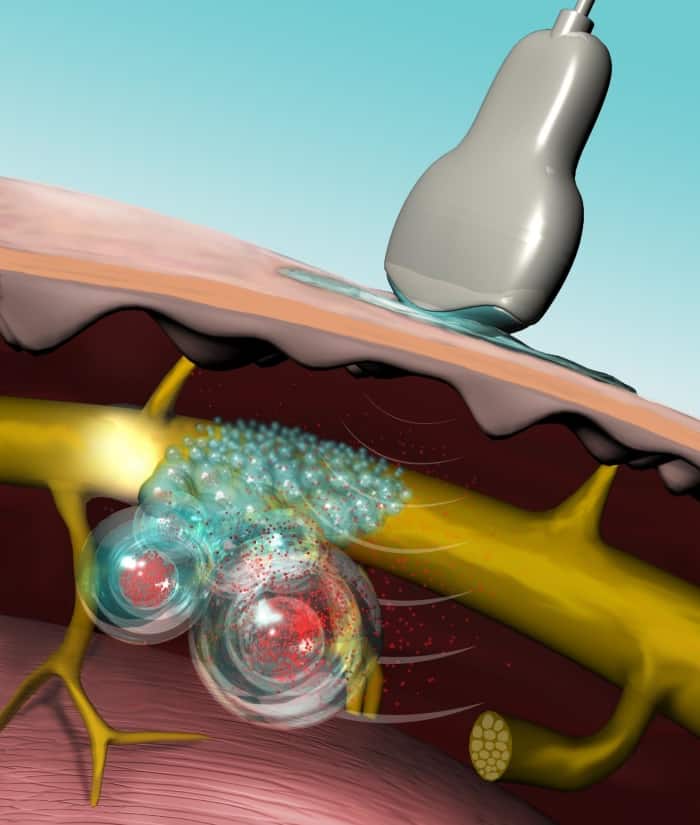
Ultrasound can be used to release nerve-blocking agents contained in liposomes and relieve patients from pain. This would be an alternative to opioids and open up the possibility of a safer, on-demand and personalized management of pain.

A departure from opioids

Opioids are frequently prescribed to patients in an attempt to relieve disease- or surgery-related pain. But such drugs carry a high-risk of addiction and overdose that can potentially lead to death. This became a cause of concern over the past decade as official figures revealed an increase in deaths by pain-reliever overdose in America of more than 400% in women and 237% in men between 1999 and 2010.

In response to this problem, researchers from Boston, Madrid and Hong-Kong teamed up to create a safer substitute that would provide instant pain relief at specific locations. They designed a system that uses engineered liposomes containing an anaesthetic agent, and whose outer shell is triggered by ultrasound to burst the liposome open and release its cargo. This strategy provides local anaesthesia where needed (Nature Biomedical Engineering 1 644).

A sono-sensitive drug-delivery system

Ultrasound has been investigated to direct diverse organic vehicles to specific locations. For example, microbubble-induced opening of the blood-brain barrier has reached the human trial stage. The non-invasive and non-ionizing nature of ultrasound makes it a suitable energy source to direct these vehicles, but it is its extended depth of penetration that makes ultrasound the trigger of choice over other techniques such as near-infrared light.

Ultrasound interacts PPIX with to burst the liposome

Of all the existing vehicles, liposomes – spherical vesicles with a lipid bilayer shell – were preferred due to their customizable potential and ability to carry tetrodotoxin (TTX), a molecule administered in clinical trials to attenuate cancer pain. FDA-approved protoporphyrin IX (PPIX) was encapsulated between the two layers of the liposome and used as a sonosensitizer to trigger the release of the anaesthetic under the action of the ultrasound energy. The team investigated various combinations of frequencies, intensity, duration and duty cycle of insonation to ensure maximum efficiency in the release of TTX.

Experiments in rats

The researchers conducted experiments in rats to validate the need for PPIX and verify whether TTX was responsible for nerve blockade – the phenomenon responsible for anaesthesia. They injected liposomes directly in the nerve and sonicated, while assessing the status of the nerve by timing how long the rat could stay on a hot plate. The results validated their hypotheses and the group observed that the duration and intensity of anaesthesia were dependent upon the duration and intensity of the ultrasound beam.

After one injection, a 10-minute insonation led to 34 hr of nerve blockade; subsequent insonations with no reinjection of liposomes led to around 1 hr of additional nerve blockade. This result paves the way for personalized narcotic-free pain management. The technique also proved to be safe, as all 20 animals used in the experiments with TTX and PPIX survived.

The future of pain management?

These results are very promising. The fact that the degree of nerve blockade is controlled by the ultrasound duration and intensity allows for customizable pain management. Patients could receive an injection at the hospital and relieve their pain themselves at home, whenever they need, using a small portable ultrasound device. This could potentially help combat opioid addiction, reduce the overall duration of hospitalization and hence alleviate bed blocking.

The quest to create metallic hydrogen

By Michael Banks

A team led by Isaac Silvera at Harvard University hit the headlines earlier this year when it claimed to have been the first to create metallic hydrogen. Silvera, who will be giving an invited talk about metallic hydrogen at the Chinese Physical Society meeting at Sichuan University (7–9 September), outlines the challenges in working with the material and what future applications it may have. The event is co-sponsored by the Institute of Physics, which publishes Physics World.

What is metallic hydrogen?

Metallic hydrogen is a metal that is made entirely of hydrogen atoms. On Earth, hydrogen exists naturally as a gas. When cooled to 20.3 K it liquefies and at 14 K becomes a molecular solid. In 1935 Eugene Wigner and Hillard Huntington at Princeton University theorized that a molecular hydrogen lattice will dissociate to an atomic hydrogen lattice at pressures of 25 GPa, allowing electrons to flow freely through it, therefore creating metallic hydrogen. Modern calculations, however, predict that you need pressures of around 400–500 GPa to create it.

Physicists have spent decades trying to make it, so what allowed it to be done now?

At low temperatures, enormous pressures – until recently, around 350 GPa – have been achieved in diamond anvil cells (DACs). In DACs, the hydrogen is in a hole or cavity in a metallic gasket that is pressed between two diamond anvils. We developed techniques to achieve even higher pressures – touching 500 GPa. It was not a new method, but recognizing that certain existing procedures resulted in the diamonds failing and therefore limiting the pressure. To reach higher pressures required, for example, preventing the diffusion of hydrogen into the diamonds, which makes them brittle, as well as assuring the perfect alignment of the DACs during pressurization.

What are the challenges when working with metallic hydrogen?

The main challenge is creating the enormous pressures that are required. In DACs, the highest pressures are achieved with a small culet. The culet is the flat-polished part on the tip of a brilliant-cut diamond. At the highest pressures, we use culet flats around 20–30 µm in diameter with a hydrogen sample size of about 10 µm in diameter and 1 µm thick. While the sample is in a cryostat, this requires careful study using microscopes that creates certain optical challenges. Furthermore, the hydrogen sample is between two diamond anvils, and to study the sample, radiation must pass through those diamonds. The diamonds have a region in the visible and infrared where they are transparent, but block out light in the ultra violet, which limits studying them in this region of the spectrum.

Why is there still some scepticism that metallic hydrogen has been created in the lab?

Several groups around the world are working on this challenge. Yet they are continuing to use the same old techniques and achieving the same pressures. Thus, criticisms have been mainly aimed at our methods to determine the pressure. Conventional techniques to determine the pressure use Raman scattering in the highly stressed region of the diamond anvil. But it is known that illuminating stressed diamonds with lasers can lead to them failing. We avoided using this method until we achieved and determined that the hydrogen was metallic by measuring its reflectance. We then used a low-laser power of around 20 mW to measure the pressure with Raman scattering and succeeded.

How long can you isolate a sample for?

Interestingly, we maintained the metallic hydrogen in our cryostat for about three months before again attempting to measure pressure by illuminating it with a laser. We used 1/20th of the laser intensity – 0.5 mW – and the diamonds immediately failed. We believe that the highly stressed diamonds relax by creating defects in their lattice and these defects interact with the light.

What possible uses could metallic hydrogen have?

Metallic hydrogen may be a room-temperature superconductor. It may also be metastable – that is, it may remain metallic hydrogen even when the pressure is lifted. If so, and if it is a room-temperature superconductor, it would be revolutionary. Theoretically, it is also the most powerful rocket propellant known to man, and if metastable and could be produced in large quantities, it would transform rocketry.

What are you currently working on?

We are repeating our first experiment to make metallic hydrogen and measure its reflectance. We then plan to measure its electrical conductivity to determine if it is a room-temperature superconductor. We will also aim to test if it is metastable as well as study isotope effects, such as the metallization of deuterium.

  • A feature about the quest for metallic hydrogen will appear in the October 2017 issue of Physics World. The APS–CPS–IOP Joint International Session on Materials and Physics Under Extreme Conditions takes place on 9 September at the CPS Fall Meeting.
Copyright © 2026 by IOP Publishing Ltd and individual contributors