New research predicts that North Atlantic hurricane activity will reduce over the next decade and a half, due to the El Nino Southern Oscillation (ENSO) and changes in North Atlantic sea surface temperature. The open ocean is expected to experience the largest decrease, with approximately four fewer tropical cyclones per decade.
Woosuk Choi from Seoul National University in Korea and colleagues used a track-pattern-based tropical cyclone model to examine the role of natural variability and anthropogenic forcing on climate in the near-future – the next one or two decades.
A predicted increase in the frequency of El Niño episodes provides unfavourable conditions for tropical cyclone formation – for example, enhanced vertical wind shear erodes the vertical structure that the storms need to maintain in order to develop. In the North Atlantic, the study shows, the cooling effects of natural variability dominate those of anthropogenic warming. This results in a cooling of the North Atlantic sea surface, which will also suppress tropical cyclone formation.
Many studies focus on cyclone genesis frequency or maximum intensity. But when considering impact, the location of the tracks is most important, as it relates to landfall. Choi and colleagues from the University of California, US, and City University of Hong Kong used a model that divides tropical cyclone tracks into four patterns. They based predictions for each pattern on climate projections from the Climate Forecast System version 2 (CFSv2) in the Coupled Model Intercomparison Project (CMIP), and compared tropical cyclone activity between 2002–2015 and 2016–2030.
Predicting cyclone activity in the near-future is complicated by uncertainties from both internal variability (natural oscillations) and external forcings such as greenhouse gases. The timescale lies between short-term predictions and long-term climate change, where in each case only one of the uncertainties dominates. Predictions in the near-future, however, are vitally important for planning mitigation strategies for extreme weather such as hurricanes.
The UK government wants to agree a “far-reaching” science and innovation agreement with the European Union (EU) after the country leaves the bloc in 2019. In a “position paper” on science and innovation published today, the UK government states that science will be an important part of the UK’s future partnership with the EU, adding that it hopes to have a “full and open discussion” with the EU about a future collaboration.
The 16 page document says that the UK wants Europe to maintain its world-leading role in science and innovation, and will continue playing its part. “It is the UK’s ambition to build on its unique relationship with the EU to ensure that together we remain at the forefront of collective endeavours to better understand, and make better, the world in which we live,” the paper states.
On the Horizon
The biggest funding initiative in the EU is the €80bn Horizon 2020 programme, which runs from 2014 to 2020. The UK government has already stated that it will underwrite bids for Horizon 2020 projects submitted while the UK is a member of the EU. “The UK will work with the [European Commission] to ensure payments when funds are awarded, and Horizon 2020 participants should continue to collaborate as normal,” the paper states. Yet when it comes to Framework Nine – Horizon 2020’s successor – the document only says that future association “will be discussed”.
Another area of concern among researchers is the UK’s participation in the European Atomic Energy Community (Euratom). However, the paper only states that the UK will seek to “build on its extensive history of working with EU partners on nuclear research”, adding that “there is precedent for third-party involvement [via Euratom] in fusion research”.
Indeed, the Joint European Torus (JET) at the Culham Centre for Fusion Energy in Oxfordshire, is largely funded by Euratom. A contract to extend Euratom’s involvement in JET from 2018 to 2020 is still pending, and the document reiterates that if that goes ahead the UK government will underwrite its share of JET contract costs after it leaves the EU.
More to be done
While some have welcomed further clarity on the government’s position, some are concerned about the lack of details. “The document says many positive things,” notes John Womersley, director general of the European Spallation Source. “Aspiration of an ambitious science agreement between Britain and the EU is absolutely correct, but the paper is so lacking [in] implementation details that it will probably disappoint most of the science community rather than reassure.”
That view is backed up by Sarah Main, executive director of the Campaign for Science & Engineering, who says that the UK government needs to start making “firm commitments” on migration, regulation and scientific funding.
“It is welcome that the government are indicating that all options are on the table for continued scientific collaboration, including the potential for a bespoke agreement as an associated country,” she adds. “This softer approach to mutually beneficial arrangements beyond Brexit is made possible because of the high regard in which UK science is held and its strong research networks across Europe.”
With about 15% of the world’s electricity used for cooling, making air-conditioning systems more efficient could go a long way to ease future energy demand. A group of scientists in sunny California reckons it can do just that via “radiative cooling” – a process requiring essentially no external source of power that transmits unwanted heat into the cold of outer space via infrared emission. The researchers have shown that a device able to reflect almost all incoming radiation from the Sun while simultaneously emitting in the infrared could reduce electricity consumption from air conditioners by at least a fifth.
Objects emit electromagnetic radiation with a spectrum that peaks at a particular wavelength depending on the object’s temperature. Radiative cooling exploits the fact that the peak at room temperature lies in a narrow range of infrared wavelengths (8–13 μm) that pass through the Earth’s atmosphere with relatively little absorption. This allows an object placed outside with a clear view of the heavens to lose a significant fraction of its thermal energy to outer space, which, having a temperature of just 3 K, serves as an enormous heat sink.
This principle has been exploited for many years to cool buildings and other objects when it is dark. Objects are simply covered by a suitable layer of thermal insulation to ensure that the energy they emit into space is not counter-balanced by convection and conduction that would normally keep them in thermal equilibrium. In this way, they can be cooled by as much as 15° below ambient temperatures.
Hot stuff
Doing the same thing during the day, however – when cooling is most needed – has proved much harder. Most materials that readily emit radiation are also good absorbers of sunlight and the heat they lose to outer space tends to be heavily outweighed by the energy they absorb from the Sun. The trick is to find a material that is a good solar reflector but can also emit in the infrared. Metals such as silver, for example, meet the former condition but not the latter.
Three years ago, Shanhui Fan and colleagues at Stanford University showed it is in fact possible to have your cake and eat it. They developed a material just 1.8 μm thick, made from seven layers of silicon dioxide and hafnium oxide laid on top of sliver, which reflected 97% of the sunlight striking it while at the same time emitting the relevant portion of the infrared spectrum. By insulating the film using polyethylene, wood and air, and placing it on a roof in Stanford on a sunny winter’s day, the researchers found they could cool it to nearly 5° below the ambient temperature.
However, Fan says, developing the device itself is only part of the challenge. If the device is to be used to cool buildings, he points out that a mechanism is needed to “deliver the coldness from outside to inside”. Because many modern buildings are very well insulated, he says that simply cooling their roof will not do much to lower their internal temperature.
Cooling water
In the latest research, he and his colleagues instead exploit the fact that many buildings already contain air-conditioning systems. The idea, he explains, is to radiatively cool the water that is used in some large air conditioners to lower the temperature of the refrigerant condenser. To test the idea, Fan and co-workers swapped the silicon dioxide and hafnium oxide of their earlier device with an extruded copolymer – which has similar photonic properties but is easier to scale up – and then added a heat exchanger and an insulating enclosure to create a number of “cooling panels”, each around a third of a metre squared.
Returning to their Stanford rooftop, the researchers connected three of the panels together and pumped water through the heat exchangers. They found that for air temperatures of up to about 30°, they could cool the flowing water by between 3–5° – the upper end of the range, they say, equalling about 70 W of cooling power for every square metre of panel. Afterwards, they plugged those numbers into a model that simulated the air-conditioning system of a two-storey office building in hot and dry Las Vegas and calculated that the panels could reduce electrical consumption by 21%.
Fan and colleagues are not the only ones working on daytime radiative cooling. Earlier this year, a group at the University of Colorado Boulder reported an average cooling power of 110 W/m2 from a silver-backed polymer film containing silicon-dioxide balls made using a roll-to-roll process. But Colorado team member Xiaobo Yin praises the Stanford group for its “exciting progress” with the water-based demonstration, agreeing that the technology “can potentially be integrated with building air conditioning systems”.
“Good option”
According to Eli Yablonovitch at the University of California, Berkeley, radiative cooling could be competitive with solar energy. He explains that solar panels have a higher power density but only contribute energy for about a quarter of each day, whereas radiative devices could cool water continuously. For hot dry climates, he says, that could make them “a good option” as an energy-saving technology.
Fan acknowledges that his group must still overcome a number of hurdles before its devices can enter the market, including proving their reliability. But he and his two co-authors – Eli Goldstein and Aaswath Raman – have nevertheless set up a company known as Skycool Systems to commercialise the technology. As regards price, Raman is bullish, claiming that the devices will recover their costs in terms of lower electricity bills within “several years” of switching on.
Astronomers in Japan say they have the best evidence yet that intermediate-mass black holes (IMBHs) exist – and what’s more, there could be one in the Milky Way. Weighing in at 100,000 solar masses, the object is on the heavy side for a IMBH and could have been created in a dwarf galaxy that then merged with the Milky Way.
There is very good evidence that supermassive black holes (SMBHs) dominate the centres of many galaxies. These behemoths have masses equivalent to 100,000 to billions of Suns and their huge gravitational fields can drive spectacular emissions of radiation. At the other end of the mass scale, there is also strong evidence for the existence of “stellar mass” black holes (several to tens of solar masses) from indirect astronomical observations and the detection of the gravitational waves that are given off when pairs of black holes merge.
Coalescing IMBHs
What is not understood, however, is how SMBHs come into being. One possibility is that IMBHs are first formed when a young compact cluster of stars undergoes a gravitational collapse. Then, a number of these IMBHs coalesce at the centre of a galaxy to form a SMBH. While astronomers have identified many objects that could be IMBHs, none of these sightings are accepted as being definitive.
Now, Tomoharu Oka and colleagues at Keio University have studied a “peculiar molecular cloud” located near the centre of the Milky Way and concluded that it harbours a black hole weighing in at about 100,000 solar masses – putting it at the more massive end of the IMBH classification.
Unusual velocities
Dubbed CO-0.40-0.22, the cloud is peculiar because of the unusual distribution of the velocities of its constituent molecules. This, say Oka and colleagues, is best explained by the presence of a IMBH near the centre of the cloud that is giving the molecules a “gravitational kick”.
Writing in Nature Astronomy, the team says that the presence of a IMBH is backed up by observations of a compact region of dense gas near the centre of the cloud. Within this compact region is a point-like source of radio emissions, which could be created by gas accelerated by an IMBH.
What is not clear, however, is how the IMBH could have formed. Current theory suggests that a 100,000 solar-mass black hole is more likely to form in a nearby dwarf galaxy – rather than in a star cluster within the Milky Way. As a result, the IMBH could have formed outside the Milky Way and was then incorporated into our galaxy along with its parent dwarf galaxy. Indeed, the team points out that there is evidence that such a merger occurred about 200 million years ago.
Volcanic ballistics are fragments of lava and rock – ranging in size from a few centimetres to tens of metres in diameter – expelled by explosive eruptions at temperatures reaching over 1000 °C. Hurtling through the air at speeds reaching hundreds of metres per second, they travel in parabolic arcs and are capable of striking ground up to 10 km from the volcano that launched them. Despite presenting a significant hazard to people and infrastructure, vulnerability assessments for these ballistics – from which risk-management strategies can be developed – are lacking.
In a new study, however, Tom Wilson and colleagues at the University of Canterbury in New Zealand and the Mount Fuji Research Institute in Japan, simulated the impact of volcanic projectiles by using a pneumatic cannon to fire real volcanic rocks into sections of wall and roof claddings. This is the first ballistics study to use rocks of realistic sizes and weights to simulate volcanic bombs, rather than – for example – putty-based projectiles. Four commonly used cladding types were tested – sheet metal, timber planks, timber weatherboard and reinforced concrete – each of which were mounted to a timber frame. Various impact velocities, masses and angles were used to find the threshold of different damage severities. Each impact was recorded, from which the ballistic velocity, impact trajectory and path of resulting shrapnel was measured.
Real-life events
The team compared this data with measurements they took of ballistic impacts to real-life buildings following the recent eruptions of Japan’s Mount Ontake and Mount Usu, along with similar data already recorded from other volcanoes across the globe, looking for similarities in damage patterns.
From all their results, the researchers developed models of building vulnerability to a ballistic strike from a volcanic eruption. They found that concrete was the most impact resistant material, and that the more oblique the impact, the less damage it caused – although oblique impactors, and the building shrapnel they create, tended to ricochet further off the cladding. In addition, buildings can offer enhanced impact resistance when volcanic bombs strike them in areas directly supported by their frame structure.
Seeking shelter
The team concludes that the ideal place to shelter in would be the far side of a building with a reinforced concrete roof, dense framing structure, multiple floors, and a secondary interior layer – and could be enhanced by piling up furniture, mattresses, etc, to add more layers of shielding – although, overall, any structure is safer than none.
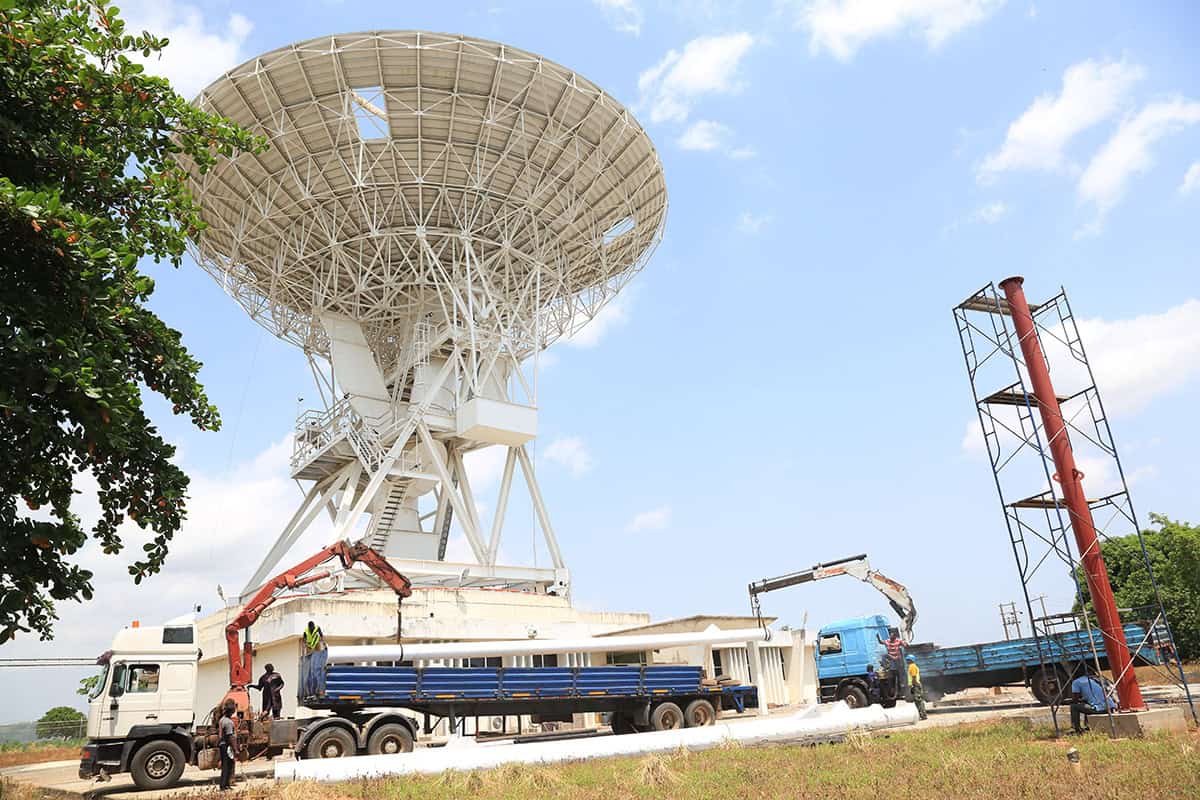
A careful crawl is the only safe way to negotiate the last few kilometres of potholed road leading up to the old telecommunications satellite dish in Kuntunse, Ghana. In the distance the 32 m dish towers over fields of maize, banana and cassava. From afar it looks derelict, like a technological relic. But under the grime, the dish is getting a second life as Ghana’s first ever astronomical telescope, under the leadership of Bernard Asabere, the telescope’s director and Ghana’s first homegrown space scientist. “When building this thing, we weren’t even 100% sure that we would succeed,” he admits. There are still a bunch of technical snafus to be resolved before they get useful data from observations, but the “first light” data collected earlier this year show promise.
In the 1980s and 1990s this dish linked Ghana with the rest of the world. But as undersea cables took over Africa’s telecommunications traffic, this and other such giant satellite dishes became obsolete. That is, until a group of South African astronomers, eager to build observing capacity on the rest of the continent, took an interest in the hulking behemoths. It was Michael Gaylard, the former director of the Hartebeesthoek Radio Astronomy Observatory, who first came up with the idea of retrofitting disused African satellite dishes as telescopes. He used Google Maps to scour the continent for such things, and Kuntunse was one of the sites he identified. It is the only one up and running so far, and was formally launched last month.
Reuse, recycle Ghana’s first astronomical telescope has been repurposed from an obsolete satellite dish. (Courtesy: SKA SA)
Three more are in the works in Zambia, Madagascar and Kenya. The long-term plan is to hook these up with new telescopes in Namibia and Botswana, as well as existing facilities in South Africa, to form the African Very Long Baseline Interferometry (VLBI) Network. Ghana’s location just north of the equator means it can view the entire plane of the Milky Way galaxy, thus filling a gap in global VLBI observations. Kuntunse could also become one of the receiving stations of the Square Kilometre Array (SKA), and will also play an important role in training African astronomers to be ready to spring to work when the entirety of the SKA network comes online in a few years’ time. All that is some way off, explains Asabere, as the Kuntunse telescope’s current motor can’t keep up with the VLBI observations made by more advanced telescopes further north, so that needs to be upgraded.
Crooked journey
Asabere’s path to astronomy was a crooked one – and as bumpy as the one leading to his telescope. As a boy growing up, he remembers seeing the dish when travelling between his home village of Aduamoa and Accra, the capital. But the thought that he would one day work there never crossed his mind. He studied physics at the Kwame Nkrumah University of Science and Technology in Kumasi, near his home. After graduating, he taught physics at a girl’s school for six years – there were few other job prospects for physics graduates in Ghana at the time. In 2006 he moved to Gothenburg, Sweden, to study for a Master’s degree in engineering at Chalmers University of Technology. There was an astronomy course in the curriculum. “I did it because I had to,” he recalls with a shrug. After all, what would a Ghanaian do with astronomy?
After graduating, he taught physics – there were few other job prospects for physics graduates in Ghana at the time
Quite a lot, as it turned out. In 2010, after completing his Master’s, Asabere was headhunted by representatives of South Africa’s SKA project. It envisaged using antennas dotted around the continent, but for this it needed African astronomers. Asabere completed his PhD at the University of Johannesburg between 2011 and 2015, during which time he travelled intermittently to Kuntunse. It took the Ghanaian government several years longer than expected to give the Kuntunse telescope project its full support, including an agreement to help maintain the facility. But by the time Asabere moved back to Ghana permanently in December 2015 all the agreements were in place and work had started on the refurbishment.
Asabere relishes the small victories. The first time the dish moved at all, after 30 years fixed on the zenith, it caused a stir in the surrounding community. “Most often they were just curious about what we were doing,” says Asabere. The renovation of the telescope has brought much-needed employment to the area, and business is booming at Kuntunse’s only hotel. However, electromagnetic signals from dwellings built on the surrounding land might interfere with observations, and a solution has yet to be found.
Today, Asabere’s day-to-day work includes testing the telescope’s technical capabilities, supervising engineering and maintenance work, leading outreach projects (he visits schools and colleges to talk to students about careers in astronomy), and helping train the telescope’s future staff. At the moment there are two Ghanaians studying for PhDs and five Ghanaians studying for Master’s degrees as part of the SKA’s Africa-wide astronomy training programmes. Asabere has also had plenty of opportunity to train his “soft skills” in his negotiations with Ghanaian decision-makers about the way forward for the observatory and astronomy in general in the country.
The main drawback, he says, is the persistent lack of financial commitment from the Ghanaian government. “That’s a bit of a headache. Most of the local stakeholders and policy-makers on the project are non-astronomers with little interest in the field, so most of their actions are directly and indirectly not in favour of the project.” However, this irritating state of affairs is more than made up for by the things he values about his job: the opportunity to practise his profession on his home soil – at last – and the chance to raise awareness about astronomy, especially among young people who, like him, are unaware of the opportunities that await them out in the world. He tells them that their every conceivable dream is achievable with the right resources, time and commitment: “I encourage them to go for it irrespective of how unrealistic it might seem to them today.”
There are many ways to blend science and theatre. An episode of discovery perhaps, like Albert Einstein’s discovery of relativity theory as told in the recent television series, Genius; merging politics, science and world events, as in Michael Frayn’s Copenhagen; or using science as the backdrop to the plot, which is the case in Lucy Kirkwood’s Mosquitoes. What is paramount to such projects is to avoid bombarding the audience with science lectures. The science should emerge from conversation and this is no easy task. Mosquitoes is a superbly acted and complex play about the clash of human emotions, but in some ways, the science of the Higgs boson and the Large Hadron Collider (LHC) at CERN is irrelevant to the plot and could almost be left out.
The story turns on a confrontation (collision, get it?) between two sisters as opposite as night and day. One, Jenny – played by Olivia Colman – who lives in Luton and sells medical insurance, is utterly daffy, curses like a trooper and drinks like one too, but has a heart of gold. The other, Alice – played by Olivia Williams – is an austere scientist at the LHC. Her passion is to find the Higgs boson. Science is her life and her character all too frequently seems like a stereotype.
Alice is often caught up in conflict with Jenny and her mother, or is distracted by her work. She especially seems to ignore the needs of her uncommunicative teenage son, Luke (Joseph Quinn), who is sunk into the depths of unhappiness and boredom over life in Geneva. Poking fun at Switzerland’s boredom peppers the play. Luke is socially awkward and spends a lot of time sitting in front of his computer. He wants to leave the country, or at least switch schools, but his mother is too involved in her work to help him out. Alice’s husband disappeared some years ago and she still pines for him.
The play opens in Luton with Alice visiting Jenny who is pregnant. A year passes and Jenny is now visiting Alice in Geneva, with their mother in tow. It soon emerges that Jenny’s baby was not vaccinated, because she was taken in by the scare about the MMR vaccine. Although Jenny is visiting her sister for some rest and sympathy, deep down she blames Alice, who is after all a scientist, for not telling her that she must have the vaccine. Their mother, Karen (Amanda Boxer), was a major theoretical physicist at the University of Cambridge. She claims that her great discovery – concerning liquid helium, which turned out to be of importance to the LHC, she emphasizes – was appropriated by her now deceased husband who won a Nobel Prize; being a woman she was ignored. She is on the cusp of dementia but still the feisty mother of two warring sisters. She abuses Jenny, who takes daily care of her, and calls her stupid and irresponsible, while lauding the scientist Alice.
Then there is a character, or presence, who strides around the stage in a white coat (Paul Hilton) – to designate that he is a scientist – and delivers animated lectures on the universe and the meaning of life. His lectures are full of shock and awe, about particles colliding in the LHC and what the results might be. Thunder, lightning, and ear-splitting noise bombard the audience. Who this character is supposed to be is not clear. At first I thought he was some sort of apparition of Alice’s husband, but according to the text of the play, he is also a manifestation of the Higgs boson.
Kirkwood introduces, and then drops, the big theme of scientists “inventing” hypotheses in order to explain certain unknown phenomena – such as why certain elementary particles have mass, having been born with none. For this purpose a field was hypothesized that, metaphorically, has the consistency of molasses – by slogging their way through it these particles generate their masses. Peter Higgs, among others, elucidated this field further by taking into account the fact that in quantum physics every field has a particle associated with it. The electromagnetic field, for example, is associated with the light quantum. Higgs theoretically predicted the Higgs boson, which was substantiated at the LHC, thereby proving the existence of the mass-generating field – now called the Higgs field. Scientists favour hypotheses like these because of their enormous explanatory powers. With all the pyrotechnics in the physics lectures, it’s too bad this didn’t find a more concrete place in the production, which would have further cemented its links with physics. Jenny’s response, by the way, to these momentous proceedings is to ask why scientists couldn’t have invented something to save her marriage.
What of the enigmatic title Mosquitoes? Kirkwood offers two hints. Karen, in a throwaway line, compares the head-on collisions of protons in the LHC to “the forces of two mosquitoes, flying into each other”. The point of this often-used metaphor is that the energy possessed by a moving mosquito happens to be about 1 TeV, while the LHC can accelerate protons to 7 TeV. Among the differences between a mosquito buzzing around and bothering us, and a proton zipping through the LHC, is that the proton is travelling near the speed of light. Equally crucial is the fact that in a proton, a huge amount of energy is squeezed into a volume a million million times smaller than a mosquito, meaning that a collision between two protons is much more spectacular than two mosquitoes. Might there have been some theatrical magic Kirkwood could have spun here?
The other place where mosquitoes enter, and then just as abruptly disappear, is when Alice’s boyfriend Henri (Yoli Fuller) reveals that he too is a scientist, who works for the World Health Organization and is looking at ways to eliminate the mosquito responsible for malaria. Perhaps Kirkwood means mosquitoes to be omens of doom. Protons smashing into each other in the LHC might produce some havoc that could destroy our planet and maybe our universe; and real mosquitoes can cause deadly malaria.
In essence, Kirkwood attempts to touch all bases, which is unnecessary. But I highly recommend Mosquitoes for its emotional depths, spellbinding acting and occasional dazzling physics lectures.
Writer: Lucy Kirkwood, Director: Rufus Norris
Showing at the National Theatre’s Dorfman Stage, London, until 28 September
After spending more than 13 years as an artificial moon of the most famous ringed planet, NASA’s Cassini spacecraft will plunge into Saturn’s atmosphere on 15 September. One month shy of 20 years in space, its mission will finally be complete. Unlike some planetary missions that have ended with gradually diminishing capabilities, however, Cassini will have been returning some of its most spectacular and unique data right up to its sudden and dramatic demise.
That is because, since April this year, the spacecraft has been flying closer to Saturn than ever before, for the first time passing in-between the rings and the planet in 22 unprecedented orbits. With 11 of Cassini’s 12 instruments still operating, its “Grand Finale” tour has not only been providing the highest-ever-resolution images of Saturn’s atmosphere, rings and moons, but its snug orbits have also been enabling an entirely new scientific investigation of the planet’s interior.
The story so far
The Cassini orbiter was launched on 15 October 1997, along with the European Space Agency’s Huygens lander, which it was to deposit on Saturn’s moon Titan. Arriving in 2004, Cassini’s initial mission at Saturn was planned to last for just four years, but the rapid pace of discoveries led to two extensions of the mission. First there was the two-year Equinox mission from 2008 to 2010 and then the Solstice mission, which takes Cassini to its final orbit.
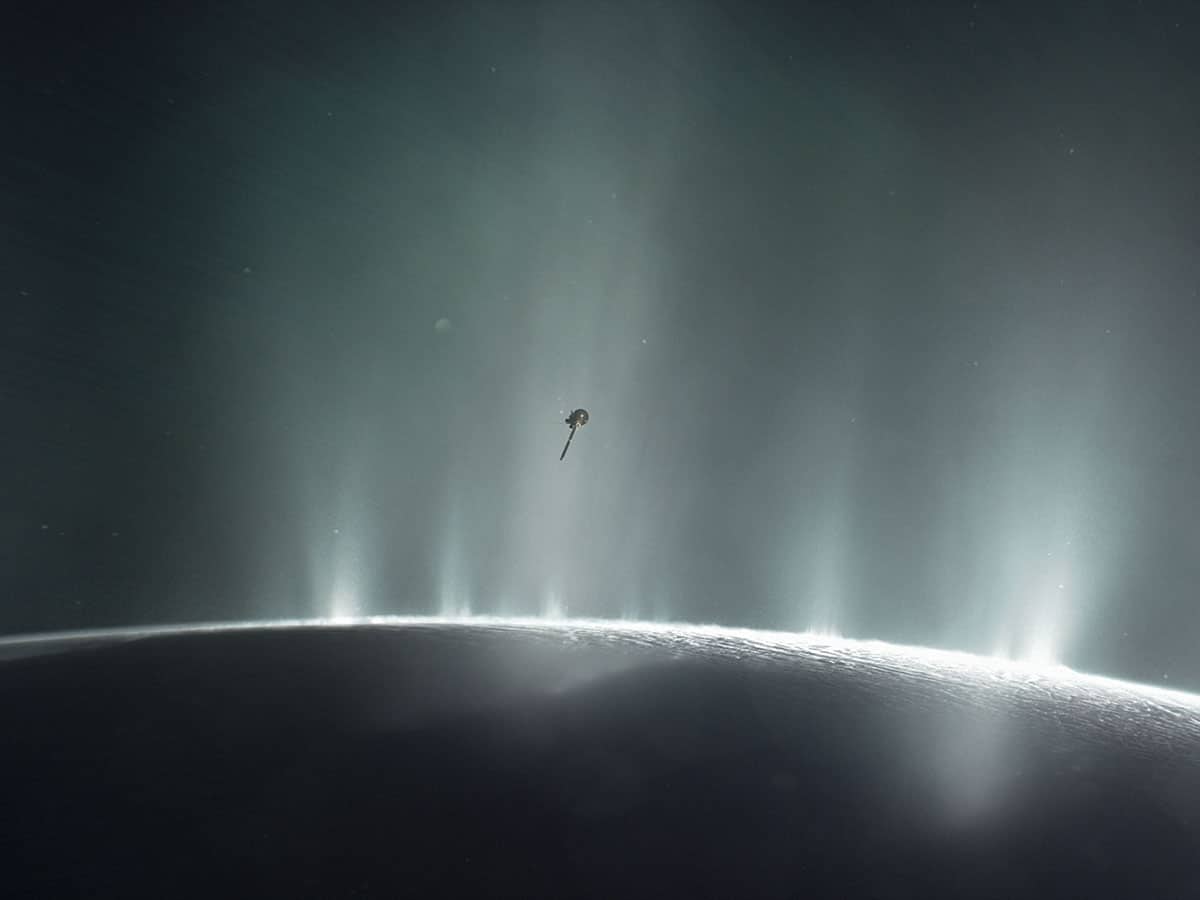
Cassini’s tour of the Saturn system has revealed surprising and dynamic features at every turn. Its largest moon Titan has lakes confined to the polar regions. Enceladus, another moon, was discovered to have active geysers of water vapour and ice spewing from its south pole with unknown variability. The rings, meanwhile, revealed moonlets embedded within them, some apparently breaking apart before our eyes, producing clouds of dust that spiralled around the planet.
An additional feature of the rings is that they cast an enormous shadow on the atmosphere, which moves across the planet over the course of a Saturn year – equivalent to 29 Earth years. During the Equinox mission, however, the Sun was directly above Saturn’s equator, which is also the plane of the rings. This allowed Cassini to observe Saturn’s atmosphere with virtually no ring shadow, and to observe the slight shadow cast by the rings. Rather than being entirely flat, the ring shadow revealed out-of-plane features, including a periodic ripple across the innermost D ring, which, in 2011, Cassini scientist Matt Hedman and colleagues attributed to the impact of cometary debris with the ring in 1983. The rings really are changing before our eyes.
What lies beneath
A gas giant, Saturn’s thick and opaque atmosphere shrouds what lies beneath, keeping the structure and composition of its interior the planet’s biggest remaining mystery. This question is not only interesting in itself, but also because much of what sculpts the rest of the Saturn system is determined by events inside the planet.
The most widely accepted model of Saturn’s formation is that a solid core of ice and rock accreted from smaller planetesimals, in much the same way that the terrestrial planets such as Earth formed. In this “core accretion” model, the solid core provided the gravitational nucleus that allowed the planet to capture most of its mass from the gas in the protoplanetary nebula. But whether that core is one tenth or one quarter the mass of the planet is unknown. The structure of the outer parts of Saturn’s interior, a mixture of hydrogen and helium, is also poorly understood.
What we do know so far about Saturn’s interior has been pieced together from lots of different lines of evidence, with theoretical and laboratory-based models complementing Cassini’s observations. These include bright auroras and coloured moons, both of which are caused by belts of charged particles shaped by a magnetic field generated somewhere in Saturn’s interior. Cassini has also detected waves in the rings that are produced by resonances with moving mass anomalies in the planet’s interior, pointing to an interior that is both lumpy and dynamic.
Ocean world: geysers of water vapour and ice grains erupting from the south polar region of Enceladus. (Courtesy: NASA/JPL-Caltech/Space Science Institute)
Even something as apparently straightforward as knowing the rotation rate of the planet’s interior proves complicated for Saturn. Radio waves emitted by Jupiter, in contrast, are thought to tightly correlate with the rotation of the bulk interior of the planet. The comparable radiation from Saturn, though, has multiple components and has changed over the years. So just what is going on inside this planet?
New and unique data
From May through to September this year, Cassini has been flying closer to Saturn than ever before. Passing just 1628 km above Saturn’s cloud-tops, Cassini’s proximity has enabled a series of first-time measurements that will tell us more about the interior of the planet.
First, we are getting a more highly resolved view of Saturn’s magnetic field. Seen from a great distance, its magnetic field looks like that of a simple bar magnet, but as Cassini gets close to the source of that magnetic field, we have found it deviates from a perfect dipole. Those deviations, measured during the Grand Finale orbits, are giving us a more highly resolved view of Saturn’s magnetic field, providing us with clues to the processes inside the planet that are producing it. Saturn’s magnetic field can be measured both directly using magnetometers on Cassini, and indirectly by using Cassini to measure the radio waves produced by charged particles that are guided by Saturn’s magnetic field.
Cassini is also measuring the distribution of material in Saturn’s interior. From a long way off, the mass of Saturn and even its moons and rings can be lumped together and approximated by a single point. But because it has a density less than water and rotates so fast (one day is about 10.5 hours), Saturn is highly flattened and the distribution of material in its interior is uneven. And the closer one gets to Saturn, the more these differences from a spherically symmetric planet come into play.
To measure the gravitational field of Saturn, we take advantage of the fact that Cassini is actually falling around the planet, and during six of the 22 close orbits, known as the “gravity passes”, it makes no manoeuvres at all. The spacecraft’s speed is therefore entirely determined by the gravitational pulls of Saturn, its moons and its rings, and at close distances, the lumpiness of Saturn’s interior produces measurable changes in its velocity.
Cassini transmits data to us via a radio signal, which is tracked by large radio telescopes on Earth that are part of the Deep Space Network. By precisely measuring the Doppler shift in the radio signal as Cassini’s speed relative to the Earth changes, the speed of the spacecraft can be determined to a precision of just 17 µm/s, which is an impressive feat considering that Cassini’s top speed relative to Saturn is more than 34 km/s. These data can then be used to reconstruct the distribution of mass in the planet, and, crucially, to determine the mass of the rings distinct from the mass of the planet.
To get all of this correct requires extraordinary care. As team leader of Cassini’s Radio Science Subsystem Richard French explains, “In an early solution for the gravity field of Saturn, an error in the position of a Deep Space Network station of only 10 cm due to plate tectonics on the Earth resulted in a physically implausible solution for the gravity field.”
Riddles of the rings
Saturn’s interior may still be hidden from view, but astronomers have been gazing at its rings – one of the most striking features in our solar system – since the 1600s, and it has long been an embarrassment to me that I’m unable to answer two basic questions about them: how old are they and where did they come from?
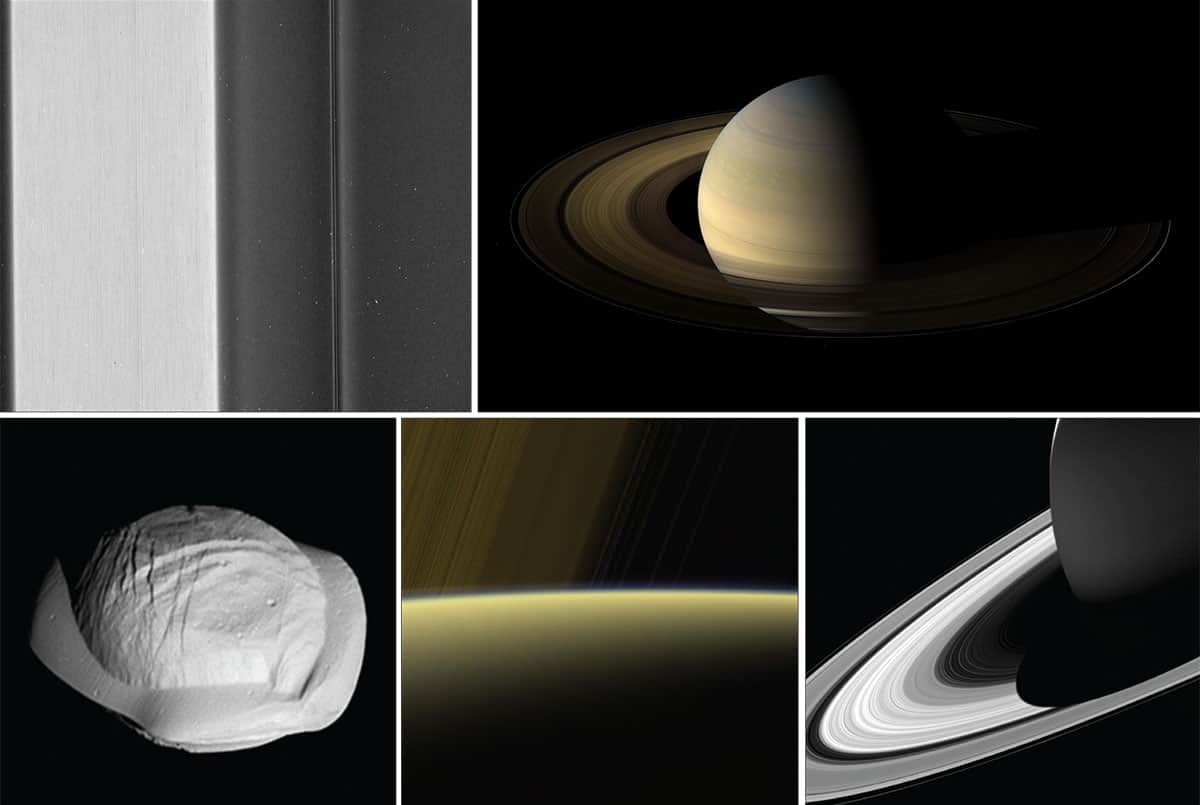
Closer look: Cassini’s recent images include (clockwise from top left): close-up of Saturn’s C ring – in the darker region, tiny waves can be seen, some of which are caused by interactions with Saturn’s interior; mosaic of Saturn’s spring equinox; projection of Saturn’s shadow on the rings at its shortest, in May; Saturn’s horizon visible as a thin, detached haze; the tiny moon Pan, which orbits within the A ring, has a complicated shape sculpted by accretion of ring material along its equator. (Courtesy: NASA/JPL-Caltech/Space Science Institute)
Before the Voyager fly-bys of Saturn in the early 1980s, it was thought that the rings were as old as the planet itself, being the leftover debris from the formation of the planet, much as asteroids and comets are leftovers circling the Sun. The idea was that ring particles are too close to Saturn to coalesce into moons the way the more distant leftover material did. Instead they are consigned to circle the planet in a crowd, jostling ever-so-gently with each other every few hours, never accumulating to form more than a large, temporary snowdrift of material. But when the Voyagers showed that there is structure in the rings that would be hard to maintain for the 4.5-billion-year age of the solar system, this old-rings theory no longer made sense and, instead, the once-radical idea of a recent origin for the rings was explored.
Cassini’s detailed exploration of the system has provided even more evidence for a young ring system. From measurements of the reflectance of the rings at different wavelengths we have known for decades that the rings are primarily water ice. Indeed, their surfaces indicate a composition of roughly 99% water ice. The puzzle is that the rings are like a giant bulls-eye in space for all the tiny bits of debris moving through the solar system – micrometeoroids shed from comets and collisions among comets and asteroids – to hit. Those particles, smaller than a millimetre, should darken the ring particles when they hit them, not unlike when freshly fallen snow on the Earth turns black from dirt and pollution.
To determine the age of Saturn’s rings we can therefore figure out how long it would take them to reach their current state of 1% non-ice “pollution” from interplanetary debris, assuming they started as pure water ice. To work this out, two things must be known: the rate of dirt hitting the rings, and the degree to which this dirt gets buried in the interior of the ring particles.
Cassini’s Cosmic Dust Analyzer has already allowed us to figure out the incidence of dirt landing on the rings. After painstakingly analysing more than 10 years of data in which the impacts from interplanetary dust particles were sifted out of the much more numerous impacts by icy grains in Saturn’s E ring, scientists working on this instrument determined that the rate of in-falling material would darken the surfaces of Saturn’s ring particles from an initial pure ice state to their current brightness in just about 100 million years.
As for the degree to which the dirt gets buried in the rings, finding out the mass of the rings would help to answer this, as massive rings provide a greater reservoir in which to bury the dirt. Massive rings are also harder to explain with models of a recent origin that require either the break-up of a moon or the tidal capture and disruption of a passing cometary body. Less-massive rings, on the other hand, make it harder to explain the brightness of the rings if they are as old as the solar system, and are a bit easier to explain with recent origin models. Current estimates of the ring mass vary by about a factor of 10. The Grand Finale orbits may put the nail in the coffin for ancient rings, or they may reopen the question.
Final goodbye
I will be in Pasadena early in the morning on 15 September, gathered together with many of the Cassini extended family, to witness the final disappearance of the radio signal from Cassini. After plunging into the atmosphere, and shortly before burning up as a meteor, friction will make it impossible for the spacecraft to maintain a radio connection with the Earth. The disappearance of that final radio signal will be witnessed live by thousands of people who have worked on the project, some, like me, for more than 25 years.
I cannot know what emotions I will feel because it is an unprecedented event for me, but it will be a kind of death. I have worked on Cassini for my entire professional life. After the mission, the family will disperse and the clans will not assemble again. However, as we say goodbye to our robotic friend who has tirelessly explored the vast Saturn system, faithfully executing tens of thousands of observations, we will look forward to answering the many scientific questions that Cassini will leave behind as its legacy, long after it has become part of Saturn.
Quirks and clans of the Cassini family
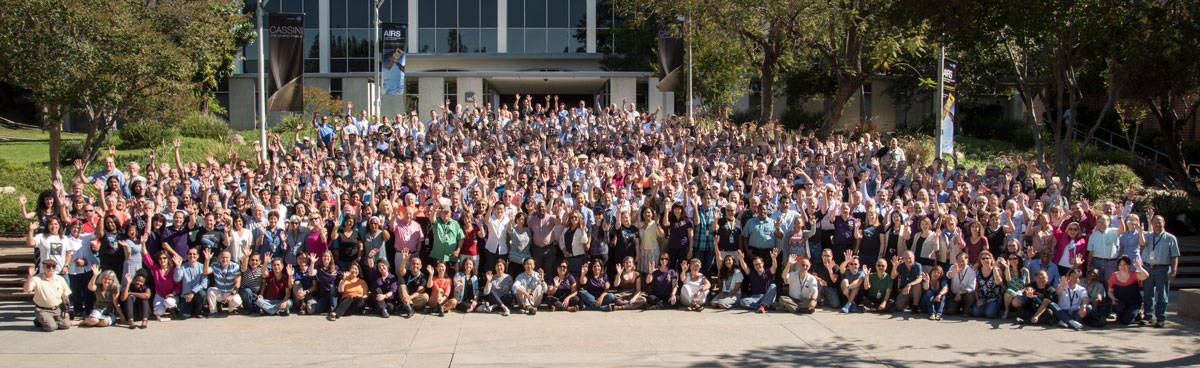
Wave goodbye: the Cassini team old and new posed together in June. (Courtesy: NASA/JPL-Caltech)
I started working on Cassini in 1990 as a fresh postdoc for my dissertation adviser, Larry Esposito, who had just been selected to provide the Ultraviolet Imaging Spectrograph for the mission. Over the course of the next 27 years I’ve been part of a large extended family of Cassini scientists and engineers. We wrestled with a changing spacecraft design and then years of work to refine the trajectory or “tour” of the Saturn system that the spacecraft would follow.
This extended family had lots of clans: the rings clan, the Titan clan, the imaging team clan and so on. Each clan had regular meetings. For years I had a weekly telecon meeting of the Rings Target Working Team (invariably referred to as the “rings twit”) where we would debate various observation proposals to arrive at an optimized timeline of observations down to the minute. We had a close and friendly working relationship on the phone, and then every six months or so there would be face-to-face meetings of cross-sections of these clans. I would often know people by their voice and had extensive discussions with them, despite never having met them face-to-face.
The project seemed to be enamoured of complex Excel spreadsheets to score various proposals (for example, which tour to fly) with a green–yellow–red colour-coding scheme. One clan (say Titan), might score a tour with lots of green, while Rings would show a red-and-yellow spreadsheet for that same tour. Sometimes we would close our eyes and find those endless boxes of red, green and yellow burned onto our retinas. There was a certain culture that grew organically over the course of the mission. We all knew our Cassini lingo of twits, revs (revolutions, or orbits, of Cassini around Saturn), RBOT (a computer program that checked that a planned “sequence” of activities wouldn’t leave the reaction wheels spinning in a dangerous state), PDT (the Pointing Design Tool used to create files to generate commands to transmit to Cassini to tell it where to look) and many more.
As the mission wore on, we grew older, new people joined the project, some moved on and, sadly, some died. Some milestones have already passed. There will never be another rings twit telecon, nor will there ever be another satellite fly-by, radar observation of Titan or project meeting at ESA’s ESTEC (European Space Research Technology Centre). After 15 September, we will never get another notice of new data downloaded from Cassini – something that has occurred with remarkable reliability for more than a dozen years. I’ll cross paths with my Cassini colleagues not at team meetings or project science meetings, but at larger international science conferences, if at all. Shared science questions will continue to bind some of us together, but with the spacecraft gone, some connections will fade away. And I will miss them.
A new type of optical quantum memory that could be integrated with other components on a chip has been unveiled by physicists in the US. The device overcomes an important challenge facing researchers trying to make quantum computers based on light – how to efficiently capture a photon within a sub-micron-sized structure.
From sending messages that could never be bugged to linking together quantum computers in a “quantum Internet”, the ability to exchange quantum information may be vital to the future of technology. This will not be possible, however, without quantum memories to store quantum states and release them when needed.
In the Internet of today, information is sent between computers through a distributed series of nodes called routers. “Packets [of information] are maybe stored for some time and then they are sent,” says Andrei Faraon of the California Institute of Technology, “There is some control over the timing of the packet.” An optical network that uses photons to carry quantum information would require analogous nodes to store not strings of ones and zeroes (bits) but the full quantum states of individual photons (quantum bits or qubits).
There are currently several different quantum memories under development – some storing qubits as collective excitations in ensembles of atoms, others using solid-state crystals. Among the second group, crystals doped with ions of rare-earth metals have proved successful because rare-earth ions have sharp, stable electronic transitions that can couple to photons and preserve their quantum states. However, absorbing a photon generally requires millimetre- to centimetre-thicknesses of material, making quantum memories rather large.
Enhanced interaction
Now, Faraon and colleagues produced a resonant optical cavity just 0.056 μm3 in volume in neodymium-doped yttrium orthovanadate – which is a crystalline material used in solid-state lasers. The interaction between single photons and matter is strongly enhanced in the cavity, explains Faraon: “The photons are captured by the atoms in a much smaller volume. That is what allowed us to make a much smaller device.”
After cooling the cavity to 480 mK, the team couples it to an optical fibre fed by a laser. When a series of light-pulse pairs is injected into the cavity, the researchers return about 75 ns later. The fidelity of the memory (the proportion of retrieved photons that are in the correct quantum state) is 96.8%. This is on par with state-of-the-art quantum memories of this type. However, the efficiency of the memory (the proportion of photons retrieved at all) was only 2.5%. “We show a clear path towards how this efficiency can be improved,” says Faraon.
To control the time at which stored pulses are released, the researchers apply a second set of laser pulses that are slightly off resonance from the cavity frequency. These pulses compress the spacing of energy levels in the cavity through the Stark effect. The researchers found that this causes a slight delay in the timing of the photon’s release. As they increase the intensity of these “Stark pulses” the delay increases to a maximum of about 10 ns.
Faster preparation
Aside from the possible savings in materials and space, the nanophotonic memory has several advantages over its bulk counterparts. For example, before the cavity can accept a photon, the neodymium spins must be polarized using repeated laser pulses. “These preparation steps are significantly faster in the cavity [than in the bulk system],” says Faraon.
Margherita Mazzera of the Institute of Photonic Sciences in Barcelona describes the work as “significant”, adding: “There are several new aspects, but the most important is that it’s the first time that memory capacity has been demonstrated at the single photon level in a nanophotonic rare-earth system.”
She cautions, however, that drastic increases in both the efficiency (to around 90%) and the storage time, as well as the introduction of on-demand release of the photon are required before the system can be function as a practical quantum memory. The usual protocol to achieve on-demand read-out, she says, is “a very difficult step” that the researchers have yet to demonstrate. She describes the use of Stark pulses to delay the photon release as “an intermediate solution”.
Fundamental science
Nicolas Gisin of the University of Geneva says the work is “significant but also quite specialized”, and agrees that much work remains before the device can form a useful quantum memory. In his view, however, the emission delay due to the Stark effect is the most important feature of the work in terms of fundamental science. “I find it fascinating to stop a photon and decide when it comes back, and have it come back with all it’s quantum properties intact.”
The ¥2.2bn ($330m) China Spallation Neutron Source (CSNS) has produced its first neutrons. The facility is the fourth spallation neutron source to be built in the world. When it opens to users in 2018, the CSNS will have a wide range of applications in areas such as materials science, life sciences, physics, chemical industry and energy.
Neutron bunches
The neutron source is located some 30 km south-east of Dongguan and is one of the largest scientific facilities in China. Construction began in 2012 and the CSNS features a 200 m-long 80 MeV linear accelerator that feeds protons into a 1.6 GeV 238 m circumference synchrotron. In July 2017, the facility managed to accelerate a proton beam to 1.6 GeV for the first time. The protons are then fired into a solid tungsten target that will produce a 100 kW beam of neutrons with 25 bunches of particles released every second.
The facility has room for a total of 20 instruments. The CSNS will initially contain three instruments – a powder diffractometer, a small-angle neutron-scattering instrument and a reflectometer. Two more instruments are in the pipeline including a high-pressure powder diffractometer and an engineering diffractometer, which is being built in collaboration with the ISIS Neutron and Muon Source in Oxfordshire, UK.