

Alzheimer’s patients exhibit altered gut microbial composition

Researchers from the University of Wisconsin-Madison, along with colleagues from Sweden and the UK, have analysed, for the first time, the bacterial genome composition (microbiome) of the gut of individuals diagnosed with Alzheimer’s disease (AD). The authors reported a decrease in microbial diversity and a difference in bacterial composition for individuals with AD, compared with healthy subjects. This difference in composition correlated with the extent of AD pathology and reflected a functional alteration of AD-associated bacteria. These findings hint to the potential of developing therapies to target gut bacteria (Sci. Rep. 7 13537).

The last decade has seen an exponential increase in the number of publications that associate a gut microbial alteration – known as “dysbiosis” – with diseases such as obesity, diabetes, irritable bowel syndrome and Parkinson’s disease.

AD is a neurodegenerative disease characterized by the accumulation of amyloid-β plaques and neurofibrillary tangles (aggregates of hyperphosphorylated tau protein) in the brain and is estimated to affect 46 million people worldwide (World Alzheimer Report 2015). Despite a wealth of research, there isn’t a complete understanding of the mechanisms behind the onset and development of this disease.

The gut microbiome in AD
The “microbiome” refers to the collection of genetic material from a community of microorganisms. Recent studies, using AD mouse models, reported that changes in gut microbiome influenced the accumulation of amyloid-β (see, for example, Sci. Rep. 6 30028 and Sci. Rep. 7 41802).
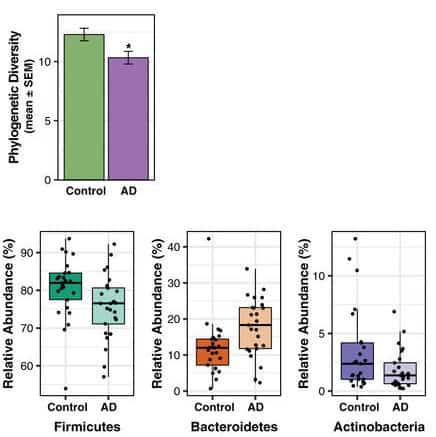
Gut microbiome composition in individuals with AD and healthy controls

To fully characterize the gut microbiome of individuals with AD, the authors performed bacterial gene sequencing on faecal samples collected from 50 participants matched for age, sex, diabetes and weight: 25 with diagnosed AD and 25 healthy controls. Participants with AD displayed a less rich gut microbiome and, in particular, they showed a decrease in abundance of Firmicutes and Actinobacteria, and an increase in Bacteroidetes, compared with the healthy participants.

The gut-brain axis
The authors suggested that the observed dysbiosis supports the hypothesis that gut microbiome alterations may promote AD pathology via the activation of the immune system and the development of insulin resistance. They proposed that, since Actinobacteria have anti-inflammatory properties and Bacteriodetes trigger pro-inflammatory responses, the opposing changes in abundance of these bacteria can stimulate inflammation. Additionally, they cite previous research that linked a decrease in Firmicutes abundance to diabetes incidence and the latter to an increase in amyloid-β accumulation.

To further support this hypothesis, the authors studied the relationship between the levels of AD biomarkers (biological molecules used as pathology indicators) measured from cerebrospinal fluid and the gut bacterial abundances of AD participants – and found them to be correlated. This result linked a more pronounced dysbiosis to a greater AD pathology.

This work adds to the growing evidence of a bidirectional interaction between the digestive tract and the brain via the nervous, endocrine and immune systems – the gut-brain axis. Future research to study the influence of gut microbiome in brain activity and progression of a disease, such as AD, may lead to the development of new targeted therapies.
A matter of time

What is time? This is not an easy question for a physicist, or anyone else for that matter, to answer. In Why Time Flies: a Mostly Scientific Investigation, the New Yorker writer Alan Burdick tries to address this question by examining the science of how humans and other living organisms perceive the passage of time. In our everyday lives, our relationship with time is driven by two things – the daily cycle of darkness and light, and our own internal circadian rhythm. Burdick begins his exploration by delving into the latest research into circadian rhythms in humans, plants and animals, which coincidentally was the subject of this year’s Nobel Prize for Physiology or Medicine. He wonders whether the origins of our internal clock come from ancient organisms’ needs to prepare themselves for the dawn, which would bring the daily onslaught of DNA-damaging solar radiation. He points out that humans are not the only organisms that understand the concept of time wasting. A wide range of animals from rats to fish are able to spend their time wisely by learning the shortest way to complete a task. We may never know how a fish measures time, but until the previous century humans defined days, months and years by how objects move across the heavens. Burdick describes how in the 17th century, seafaring nations invested in astronomical facilities like the Royal Observatory at Greenwich to improve navigation on the open seas by charting the motions of the stars. By the 19th century, however, astronomers were becoming aware that different people will perceive the motion of stars in different ways – something they called “human equation”. While this discovery was bad news for those wanting more accurate astronomical measurements, it was a boon for physiologists studying how humans perceive events and react to them. Burdick explains that our best measure of time – co-ordinated universal time (UTC) – is a running average of the time kept by a collection of atomic clocks worldwide. The best clocks in this group undergo a process called “steering”, whereby their accuracy is refined regularly by comparing them to UTC. So, it is true that time does not stand still, at least in terms of how we define it today.

How to build a planet

It is a difficult project to tackle, in a book – the subject of exoplanets – as it is one of the fastest-moving branches of planetary science. Frequent news stories cite the discovery of new “habitable planets” and this popular topic of discussion has captured the attention of both the media and the public alike. It feels as though we are a breath away from finally discovering a second Earth somewhere out there in the cosmos. In The Planet Factory, Elizabeth Tasker, an astrophysicist at Japan’s JAXA space agency, has bravely taken on the role of navigator for this incredible journey of planetary discovery, and the book does not disappoint.

Early on, Tasker acknowledges and addresses an important fact head-on – that even at the time of writing the number of confirmed planets is changing and that at no point should this book be taken as the complete knowledge or whole story of the search. Indeed, since its publication many exciting exoplanetary candidates have been discovered and made the headlines, but science is a fluid pursuit and our knowledge is ever-changing, with each bit of new research building upon the last. This book will never be up to date; no popular-science book ever is. However, the information contained within its pages is still invaluable and incredibly interesting.

The Planet Factory is helpfully broken into three parts, so if you feel you are fully up to date with how our planetary system came to be, you could skip ahead to part two to get into the juicy exoplanet hunt. But I wouldn’t encourage this as you will miss out on some interesting stories and history woven into the science. To set the scene we are taken back to the birth of the solar system and told the story of how the planets formed along with the Sun, from a whirling disc of gas and dust. Gravity and heat from the young Sun eliminated nearby gas, to enable the inner small and rocky planets to form. Further out, gas and ice remained, resulting in the giant planets with thick atmospheres.

Our solar system – four small, rocky inner planets and four immense, gassy outer planets – became the blueprint for planetary families and gave astronomers confidence in their explanations… that is until the myriad of exoplanetary observations destroyed it. With tales from the Apollo missions, the Moon landings, catch-a-comet exploits and anecdotes from the personal experiences of scientists, there feels (in parts) to be slightly more emphasis on the stories around the science than the facts that are being conveyed. This could perhaps be the only criticism of the book. For someone who knows the field well, this is an incredibly interesting part of the history being told; however, for someone new to the topic it may slightly obscure the main take-home information. This is very much down to reader preference however, and does not in any way detract from a brilliantly written first section.

Part two is where we get into some fascinating exoplanets. Tasker introduces the reader to the “super Earths” such as 55 Cancri e and “hot Jupiters” such as WASP-17b and uses these stellar systems to continue the discussion of how the worlds in our solar system came to be arranged. We also learn about the measurements we can glean from distant exoplanets, such as size and density, and what this can imply about their compositions.

As is often the case with measurements such as these, what we think we know and understand from the data can be interpreted in multiple ways. For example, the radii vs mass observations of exoplanets such as 55 Cancri e implied it was too small to be a purely gas world but too large to be a rocky one. This exoplanet could therefore be a hybrid world of rock and atmosphere, a carbon-rich world with a diamond mantle, a silicon-rich world covered in seas of supercritical fluids or even a world swimming in magma. The more we learn about exoplanets, the more questions we have, and this section does well to try and answer some of them. Plus, it charmingly reminds us that the scientists involved also don’t know the answers just yet, but that is part of their enjoyment of the exploration process.

Finally, in the last section we learn about “Goldilocks worlds” and as Tasker eloquently describes, “our insatiable thirst to find habitable planets”. After earlier discoveries of Jupiter-sized worlds squished close to their stars, planets comparable in size to the Earth are starting to be found, giving us genuine hope that a world like ours isn’t alone. Tasker then delves deep into what makes the Earth habitable and the relationships between stars, planets and moons that can influence the potential for a planetary body to host life. She explains in detail many of the exoplanets currently found and their potential habitability.

In particular, we learn about the red dwarf star Gliese 581, which was once thought to have a family of six planets orbiting it, with two of those – Gliese 581g and d – inside its temperate or Goldilocks zone. The existences of Gliese 581f and g were called into question a few weeks after their discovery, with the non-existence of Gliese 581f accepted. However, after unusual magnetic activity was observed on the stars’ surface in 2014, it was realized that this created a wobble that mimicked that of the influence of a planet. When these data were considered, we suddenly lost Gliese 581g and to top it off, Gliese 581d was erased too. Through this case study and nicely explained process of scientific exploration, Tasker wonderfully highlights how difficult the hunt for planets is without coming across as pessimistic.

Overall, I would highly recommend this book. Tasker has a lovely way of writing that makes the story easy to follow while addressing some rather technical details. Aimed primarily at an undergraduate level and for anyone wanting to learn more about exoplanet research, this book is a thorough guide into what way these hard-to-find worlds are opening our eyes to the cosmic possibilities for life, and especially how our own planet and solar system family came to be.

  • Elizabeth Tasker The Planet Factory: Exoplanets and the Search for a Second Earth 2017 Bloomsbury Sigma 336pp £16.99hb

Qubits transferred between atomic gas and a crystal

Quantum information has been transferred between a cold atomic gas and a solid crystal using photons. The work was done by Nicolas Maring and colleagues at the Institute of Photonic Sciences and the Barcelona Institute of Science and Technology and could lead to significant advances in quantum computing and even the creation of a “quantum internet”.

An important challenge in building a quantum computer is how to transfer quantum bits (qubits) of information between the “quantum nodes” of a system. These nodes can consist of a variety of different types of matter, including cold atomic gases and solid crystals doped with impurities. If two nodes are the same, it is relatively straightforward to transfer qubits – in the form of single photons, for example. In this process, one node emits a qubit-encoded photon that is then absorbed by another node.

“It’s like having nodes speaking in two different languages,”
Nicolas Maring, Institute of Photonic Sciences

In practical quantum communication systems, it is often better to use different types of quantum nodes to perform different functions. This is because some nodes are better than others at doing certain tasks. Cold atomic gases can easily produce qubit-encoded photons, for example, while doped solids can store quantum information over relatively long periods of time. However, different types of nodes will usually emit and process photons at different wavelengths and bandwidths, making qubit transfer between nodes more difficult.

“It’s like having nodes speaking in two different languages,” explains Maring. “In order for them to communicate, it is necessary to convert the single photon’s properties so it can efficiently transfer all the information between these different nodes.”

Laser-cooled atoms

In the ICFO study, a “hybrid” quantum network link between two different quantum nodes in separate labs was established for the first time. The first node, a gas of laser-cooled rubidium atoms, produced a qubit-encoded photon with a wavelength of 780 nm. The photon’s wavelength was then converted to 1552 nm, and coupled to a commonly-used optical telecommunication fibre, to be carried into the next lab.

After passing through the fibre, the photon was converted again to a wavelength of 606 nm. This enabled its quantum information to be processed by a second quantum node, which was composed of a crystal doped with praseodymium ions. This node could store qubits for 2.5 μs while retaining most of the original quantum information.

The research could prove to be a significant step towards the creation of quantum networks that take advantage of the different processing and storage capabilities of different quantum nodes. In the future, the ICFO scientists hope that larger scale, more complex hybrid networks will be built, made from many different nodes and links between them.

Huge variety

“Much like the modern-day Internet connects a huge variety of very different devices, the future quantum internet will necessarily have to connect many different quantum information processing devices that each have their own advantages and application areas”, Alexey Gorshkov of the University of Maryland tells Physics World. “This work from the ICFO is a significant step in the direction of creating such a quantum internet”.

The research is described in Nature.

  • There is much more about new technologies for quantum information in the Physics World Discovery book How to Build a Quantum Computer, which is free to read

Underneath the alien rain

Celebrated cosmologist Carl Sagan once wrote “We are star stuff which has taken its destiny into its own hands.” Sagan was of course right, but it turns out that our whole planet is blanketed in stardust. These tiny pieces of extraterrestrial rock, known as “micrometeorites”, are made up of some of the most ancient minerals in our celestial neighbourhood and existed before the planets, or even possibly the Sun formed – meaning they originate from the planetary nebula that our entire solar system was made from. Amazingly, some 100 tonnes of cosmic dust rain down on Earth every day. For more than a century it was believed these alien invaders could be reliably found only in untouched areas of the globe such as the ocean floor, prehistoric sediments or Antarctica. The main reason why it was thought impossible to find them in urban regions was not because they aren’t there, but because of contamination from terrestrial and man-made sources. But Norwegian artist Jon Larsen was convinced that he could find stardust in the most mundane of locations – from the rain gutters lining a road to the roof of your house. In 2010 he began a systematic search of dust samples in populated areas, often focusing on rooftops, and has amassed a collection of more than 40 000 individual objects. To definitely identify the celestial orbs in the mix, Larsen developed a microphotography technique to sort the micrometeorites from the rest. His book In Search of Stardust: Amazing Micrometeorites and Their Terrestrial Imposters is a glossy coffee-table affair containing more than 1500 images – using both high-resolution colour microscopy and scanning electron microscopy. These are truly the USP of this book, showing the strange and ethereal alien rocks, but also the sizeable collection of earthly pretenders – tiny rocky or glassy spheres and dumbbells formed by everything from old steam trains and fireworks to remnants of the industrial revolution and even asphalt. While the book claims to teach the reader how they can hunt down these particles themselves, the details of just how to do that are few and unclear. In Search of Stardust is a visual extravaganza though, and will undoubtedly wow you. I’m just not sure if it will have you scrambling over your roof collecting dust.

A little learning is a dangerous thing

Swipe. Scroll. Tap. Swipe. Tap. Tap. Swipe. Scroll.

You haven’t got time to read a long in-depth book review now have you? What you want is the core message served up in an easy-to-digest form; there’s so much other news and information out there, why the heck should you care about some long-winded analysis that doesn’t get to the point as quickly as possible? After all, as Einstein said, “everything should be made as simple as possible, but not simpler”. Never mind that there is no record of him saying that… let’s leave factual accuracy to one side for the sake of a compelling message.

One paragraph in and this reviewer still hasn’t condensed down the content of this book into a simple memorable soundbite or meme? Tsk. That’s no way to build an audience. If you’re still with me, then thank you for your immense patience, and let me finally cut to the chase. Here’s my three-word synopsis of this review: Buy this book. Need some slightly more detailed advice? Buy Tom Nichols’ The Death of Expertise. And read it. Regularly. Indeed, I would go as far as saying the book should be required reading for every physicist, at every level: from A-level student to assistant professor to Nobel laureate. It should also be on the reading list of every teacher and academic, regardless of their discipline.

Subtitled “The Campaign Against Established Knowledge and Why it Matters”, Nichols’ book was published earlier this year and is an exceptionally timely, carefully reasoned and impassioned analysis of just why, as he puts it in the introduction,

“…we’re proud of not knowing things. Americans have reached a point where ignorance, especially of anything related to public policy, is an actual virtue. To reject the advice of experts is to assert autonomy, a way for Americans to insulate their increasingly fragile egos from ever being told they’re wrong about anything.”

Much as it would be convenient for those of us here on the other side of the pond to lay all the blame at the feet of our American cousins, the antipathy to expertise to which Nichols refers is a global, not national, phenomenon. Take a look, ever so briefly, at the comments section of just about any YouTube video or, more broadly, any online forum, and you’ll see that the special blend of ignorance and arrogance to which Nichols refers is not just commonplace online, it’s entirely the norm.

Nichols presents a sharp and thoroughly readable analysis of how we’ve ended up in a world where expertise and knowledge have been devalued (both online and offline) to the extent that “academic” is now a dirty word. The world has Google, after all. What more does anyone need? Remember that those boffins are just shills for corporate interests/the global elite/cultural Marxists/the Bilderberg group/the New World Order/the Illuminati (delete – or, indeed, extend – to taste). There are now countless pundits online, with millions of subscribers and followers, who can tell us exactly what we want to hear. Unlike those professors in their dreaming ivory towers, our YouTubers will tell us what we need to know in honest-to-goodness, plain-speaking everyday language; none of that highfalutin intellectual PC nonsense. And YouTube means that we don’t even have to read for ourselves.

In six tightly focused and absorbing chapters, book-ended by a brief introduction and conclusion, Nichols describes the key ingredients in the development of this embrace of ignorance, focusing in particular on the central role of social media. He covers conspiracy theories, the evolution of news programming to pure entertainment, the transformation of higher education into a market-driven, consumer-directed product, and the dumbing down that’s paradoxically been engendered by unlimited access to virtually unlimited information.

Not only does Nichols map out the landscape, he compellingly joins up the dots. He demonstrates how the ready availability of information has convinced the folks on the virtual Clapham omnibus that they are on a similar intellectual footing to experts of all stripes.

The academic solution to this (and every) problem is to burst into our age-old mantra of “education, education, education”. Wrong, wrong, wrong. The call for education as a universal panacea is a breathtakingly naïve position to adopt in the face of the wilful ignorance described in The Death of Expertise. First, it depends on just what we mean by education. Nichols explains how Google searching alone can “actually make people dumber than if they never engaged a subject at all. The very act of searching for information makes people think they’ve learned something, when in fact they’re more likely to be immersed in yet more data they do not understand”.

This behaviour is compounded and exacerbated by the much more difficult issue of ideological bias. A key example of this is the extent to which US citizens accept or deny the evidence for climate change – it critically depends not on their educational attainment (or social demographic indicators such as household income) but on their voting preferences. Vote Republican and there is a much stronger probability that you’re also going to be deeply sceptical about climate-change data. This is not something that can be fixed by more education, because these are often well-educated people to begin with. Ideology trumps education. So just how do we go about starting to fix this cult of ignorance (which is also almost invariably connected to a cult of personality)? You’ll get no easy answers in this review, I’m afraid; this is Physics World, not a TED talk, after all. Nichols provides some messages of hope (interspersed with those of despair) in his final chapters but you’ll have to buy the book to read what he has to say.

So, to conclude, with a suitably Tweetable and social-media-friendly summary of the review – buy this book. And read it. Regularly.

  • Tom Nichols The Death of Expertise: the Campaign Against Established Knowledge and Why it Matters 2017 Oxford University Press 272pp £16.99hb

Kepler and Newton help solve mystery of how some algae swim

The complicated 3D swimming motion of some types of algae has been reconstructed from 2D images. The work was done by a team of biophysicists in Italy and Germany, who say that their results suggest a “universal law” of motion for flagella propulsion. This, they claim, could be useful for the development of bio-inspired robots, particularly with medical applications.

Many swimming microorganisms propel themselves with whip-like structures called flagella. Most propulsion strategies involve planar and helical beating patterns, which are well studied. However, euglenids – a group of algae mainly found in freshwater – have a single anterior flagellum that moves in a fast spinning motion that deviates from these commonly-seen patterns. The movement is often described as a “spinning lasso” or “figure eight”, but as its complex 3D trajectory makes it difficult to study.

Now, Antonio DeSimone DeSimone at the International School for Advanced Studies in Trieste, Italy, and colleagues have used 2D images of specimens of the 50 μm long euglenid, Euglena gracilis to create 3D reconstructions of the beating flagellum’s path and the motion of the organism.

Filling a gap

“The direct observation techniques available today do not allow us to see the moving body in the third dimension with sufficient spatial and temporal detail,” explains DeSimone. “Our technique, which can be generalized to all flagellated organisms, and therefore useful for studying other species, fills this gap.”

Using a high-speed video camera, the researchers took standard 2D microscopy images at a high frame rate and combined these with a mathematical model based around some simple assumptions on the physics governing the propulsion system. In particular, the low Reynolds number hydrodynamics of the system puts limits on the possible trajectories and rotations of the algae.

The team says that its approach is like that used centuries ago by Johannes Kepler and Isaac Newton to identify the orbits of solar system planets around the Sun. The planets can appear to follow complicated and mysterious paths. But once it is understood that the planets are all orbiting the Sun it is possible to calculate and explain their movements.

“It’s a bit like knowing that the Earth revolves around an axis as it makes its orbit, and having a sequence of two-dimensional images – many disks – of the planet, just as it appears if seen from the Sun. By mounting the images in the correct orientations, you can reconstruct the 3D map of the Earth,” explains DeSimone.

Reference axes

Likewise, once reference axes for the movement of the euglenid are identified, it is possible to create a 3D reconstruction of the movement of the body and the shapes of the beating flagellum, from a set of 2D images.

Although the flagellum of the alga is attached to the front of the organism the researchers say that its movement cannot be adequately summarized as a backward beating to push the cell forward. They explain that the flagellum beats laterally, spanning a complex sequence of non-planar shapes and that no obvious symmetries can be exploited to guess the way the body moves. They add that the motion involves spiralling trajectories coupled to body rotations (see video).

The researchers say that their results fit with experimental observation and suggest that all flagellated microorganisms move with helical trajectories when they beat their flagellum periodically in time. This, they say, suggests a “universal law” of motion for flagella propulsion.

Tiny robots

The researchers say that understanding how flagellated organisms move could help with the development of tiny bio-inspired robots. “For years, many laboratories in the world have been studying how to exploit the way biological organisms move and apply it to technology. Small organisms such as eugenids are particularly interesting for medical applications, for example,” DeSimone says.

The research is described in the Proceedings of the National Academies of Sciences.

Towards a vaccine for Alzheimer’s disease

Researchers at Cinvestav in Mexico have produced a promising vaccine candidate against Alzheimer’s disease by targeting the amyloid-beta (Aβ) peptide. The vaccine, created by a team led by Miguel Angel Gómez Lin, used an Aβ epitope – a molecule-specific receptor – that is known to be present in the full-length amyloid-beta peptide, as well as in its truncated version, which is often found in the brains of Alzheimer’s patients. After immunization, Aβ-specific antibodies from the mice were isolated and found to effectively bind to amyloid plaques in both mice and human brains (Inflammopharmacol doi: 10.1007/s10787-017-0408-2).

Designing the best vaccine
Virus-like particles (VLPs) are an exciting approach to vaccines because of their natural immunogenic properties. They also have an improved safety profile compared with vaccines based on live or attenuated virus. VLPs self-assemble from many copies of a protein and can present antigens on their surface at high density. Lim’s team decided to use the HPV (human-papilloma virus) VLP: a well-characterized platform that is able to support the genetic insertion of foreign epitopes.

After constructing three-dimensional molecular models of the assembled VLP (formed from 72 pentameric HPV protein shells), the researchers found two promising areas to insert their Aβ epitope. Choosing the place for genetic insertion on a VLP is not trivial since the inserted epitope needs to both face the outside of the nanocage to facilitate binding and not interfere with VLP formation.

The team chose the epitope inserted in the VLP (epitope Aβ 11-28) because it is present in both full-length amyloid-beta peptide and in the truncated/modified versions of peptides that are pathogenic. Although there are different proposed mechanisms of Alzheimer’s disease, the amyloid peptide is hypothesized to cause toxicity in the brain by forming large, insoluble plaques between neurons.

A promising proof-of-principle
After producing the VLP vaccine in plants, the researchers assessed the vaccine by immunizing mice. They tested samples from the mice for the presence of anti-amyloid-β antibodies at the end of a 10-week immunization period.

The results speak for themselves: not only did the mice serum contain antibodies that were able to recognize both the full-length and truncated amyloid peptide, but the antibodies were also able to bind to amyloid plaques in Alzheimer’s disease brain samples from mice and humans.

Taken together, these results are an important step towards creating an immunogenic therapy for Alzheimer’s disease. The VLP-based vaccine developed by the Mexico-based research centre was not only safe and easy to produce, but also showed good immunogenicity and the ability to target different amyloid peptides and amyloid aggregates.

Although no vaccine against Alzheimer’s exists yet, research results like this hopefully bring us one step closer.

Star Wars fact or fiction, Wikipedia editor in space, stellarator tour

By Hamish Johnston

What is it about Star Wars that captivates the imaginations of physicists? Earlier this week Carsten Welsch, who is head of physics at the University of Liverpool and head of communication for the nearby Cockcroft Institute, gave a presentation called “Physics of Star Wars” to an audience of hundreds of secondary school children, undergraduate and PhD students and university staff.

“I selected iconic scenes from the movies that everybody will immediately recognize, and used real-world physics to explain what is possible and what is fiction,” says Welsch. “For example, a lightsaber, as shown in the film, wouldn’t be possible according to the laws of physics, but there are many exciting applications that are possible, such as laser knives for high-precision surgery controlled by robot arms and adaptive manufacturing using lasers for creating complex structures in metals.”

You can watch a video of R2D2 negotiating a maze at the event here.

Staying in space, a few weeks ago we mentioned Italian astronaut Paolo Nespoli and the video he took of a fireball falling through Earth’s atmosphere. Nespoli is still up on the International Space Station and this week he has become the first person to contribute to Wikipedia from space. He recorded two audio messages, one in English and one in Italian, describing his exploits in space and uploaded them to the online encyclopaedia. You can listen to the English message here.

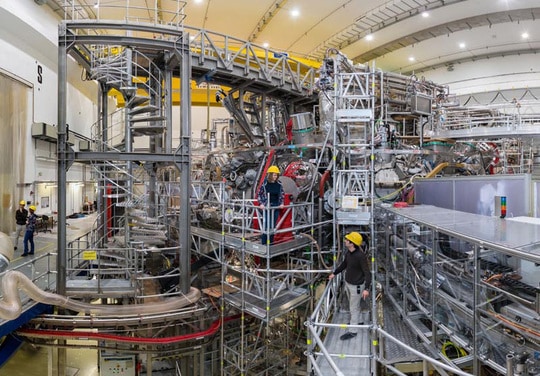
Finally, back here on Earth you can take a virtual tour of a research facility that recreates conditions in the Sun – the Wendelstein 7-X stellarator fusion research device at Greifswald, Germany. You can view a 360° panorama of the stellarator and also take an annotated tour of the facility.

A day in the life

When I was 10, I asked my mother if I could take my toy wheelbarrow full of assorted toys from home to school. We had been studying simple machines in our “general science” class, and I saw examples of them everywhere I looked: several of the toys I grew up with were perfect for understanding concepts I was encountering in a formal way for the first time. Now, unless you are a particularly enthusiastic 10-year-old, even the most avid physics enthusiast does not necessarily awaken each morning and turn their mind to the various physical processes they will encounter over the course of their day. Yet this is precisely the sort of journey that author James Kakalios takes us on in his book The Physics of Everyday Things.

Kakalios talks directly to you, the reader, as he puts you in the shoes of an imagined North-American protagonist going through a typical day. The narrative device – a second-person story constrained to a single day – serves the author well in delivering an enjoyable introduction to the laws of physics, using technology and experiences the reader might be familiar with. Your day (and the book) begins with the morning alarm, and Kakalios uses the subject of timekeeping to segue into a deeper conversation about frequencies and electricity generation. The stage is set, and the reader knows what to expect through the rest of the book.

Using examples of everyday technology, from toasters to aeroplanes, Kakalios introduces the reader to concepts such as energy conversion and conservation laws, as well as the physics principles behind aviation and medical devices, with occasional nods to chemical processes, which slightly expands the title and scope of the book. He also uses helpful analogies to tie macro phenomena with micro ones. I particularly enjoyed the way Kakalios used traffic jams to explain the behaviour of molecules in gases and liquids. He then used these molecules to explain why traffic flows the way it does: a lower density of vehicles on the road is akin to a very dilute gas, Kakalios points out, while at higher densities the flow of traffic resembles collective phenomena such as waves on the sea. When he remarks, “Physics says that traffic would be forever smooth and easy, if only we could get rid of drivers,” you might find yourself nodding in agreement, awaiting the day self-driving cars will rescue us from bumper-to-bumper commutes.

The writing is clear and inviting, allowing you to immerse yourself in the world created by the author. The text alternates between narration and exposition without distracting interruptions, though sometimes it can read a little like a textbook. And even though the book is US-centric it is not jarringly so; readers from elsewhere in the world will not struggle to identify with the book’s protagonist. The more you read, the more you are drawn into the world Kakalios paints, and you begin to ask yourself what concepts of physics he has chosen not to discuss with you in a particular context.

Kakalios does a commendable job of recognizing the ways in which physics manifests itself in seemingly mundane objects and injects his own enthusiasm for the subject into his writing. And even when he addresses subject matter that appears to be well-trodden territory, he is able to bring a fresh perspective, as he does when discussing the hypothetical of our favourite and familiar frictionless pendulum, and how it relates to the production of electromagnetic waves. But beyond such idealized examples, much of what might seem mundane today certainly felt like science fiction not too long ago. So Kakalios allows himself the indulgence of addressing both the “why” and the “why not” of speculative science fiction through the lens of the DeLorean time machine of the Back to the Future movies.

The book draws to a close as your day does, and all talk of cycles in nature manifests itself in the protagonist returning to the clock, to set an alarm for the next day. Although I did not have access 20 years ago to a lot of the technology discussed in this book, 10-year-old me would have pored over every little detail in the book and dug up the corresponding entries in an encyclopaedia. This is something to bear in mind: this book strikes a good balance between covering the basics and delving into detailed descriptions, but is by no means comprehensive and is certainly not meant to replace formal textbooks on the subject.

The Physics of Everyday Things is a welcome addition to any bookshelf: the engaging writing style is perfect for the casual physics enthusiast and the examples discussed will prove valuable to those who discuss physics with non-specialists. Perhaps we could all benefit from giving a little thought to the wonderful world of physics that surrounds us and look for everyday instances that evoke that sense of wonder.

  • James Kakalios The Physics of Everyday Things: the Extraordinary Science Behind an Ordinary Day 2017 Crown Publishing Group 256pp £19.82hb
Copyright © 2026 by IOP Publishing Ltd and individual contributors