Transformation optics has already had a huge impact on the design of cloaking devices that can make objects appear invisible. The technique lets us relate the solution of two, in principle, very different electromagnetic problems by defining a relation between the sets of coordinates of the problems. Now reporting in Science, John Pendry’s group has shown that a whole spatial dimension can be transformed into a set of singular points while maintaining the original response of the system.
Pendry and his group showed that a simple grating with sharp edges can exactly reproduce the response of an infinite periodically layered metal-dielectric stack. This result means that the continuum of modes of the 3D structure are directly mapped into the 2D metasurface. When these modes are excited by a plane wave, the energy is directed by the surface to these singular points where the sharp edge confines the energy, which is converted into heat. By doing this, the amplitude of the reflected wave is reduced, making the object less visible for the observer. The importance of the band-width of operation is that the object will remain dark even when illuminated with white light, in contrast to previous designs which would reflect several colours of the spectrum.
The coordinate transformations in transformation optics are generally introduced into Maxwell’s equations as a change in the material parameters. However, this effect on the materials can be avoided using the so-called conformal transformations (which are those that conserve angles at every point of space). The development of these techniques had a huge impact on the design of the first cloaking devices.
From transformation optics to broadband single-layer absorbers
The authors go even further and propose a flat absorber based on the principle they lay out. Thanks to the properties of graphene, one can precisely control the conductivity by attracting electrons to certain regions of the surface, simply using electrodes. This change in conductivity makes the layer behave as a grating, which can be designed to present singular points (at which the conductivity is set to zero). The simulated results show an absorption level around 50% with a bandwidth of more than 10 THz, even in the presence of losses. This is due to the fact that the mode on the surface contains components of a continuum of wavelengths, and can be therefore excited by any wave within that spectrum. We now just need to wait for someone to verify this experimentally, would you like to try?
The magnetic moment of the proton has been measured to a precision of 0.3 parts per billion by physicists in Germany. This is factor of 11 improvement on the previous most precise measurement, and means that the magnetic moment of the proton is now known to greater precision than that of the antiproton.
The measurement was made by an international team led by Georg Schneider of the Johannes Gutenberg University of Mainz in Germany and the RIKEN Ulmer Fundamental Symmetries Laboratory in Japan. Working in Mainz, the team used a “double trap” technique to make their measurement and found the proton magnetic moment to be 2.79284734462(82) nuclear magnetons.
Equal and opposite
Schneider and several of his colleagues are also part of a team working on the BASE antiproton experiment at CERN. In October, the CERN team announced that it had used a related trapping technique to measure the magnetic moment of the antiproton, and found it to be −2.7928473441(42) nuclear magnetons. These values are equal and opposite to within experimental uncertainties, just as predicted by the Standard Model of particle physics.
The team now aims to improve the double-trap technique so that even more precise measurements can be made. They also plan to implement the double-trap technique at CERN, so it can be used on antiprotons.
Matter versus antimatter
One important goal of the team’s research is to look for tiny discrepancies between matter and antimatter. If physicists discover that magnetic moments of the proton and antiproton are indeed different in magnitude, it could point to physics beyond the Standard Model and explain, for example, why there is much more matter than antimatter in the universe.
The first detailed, convincing evidence that lightning strikes can lead to the synthesis of radioactive isotopes in the atmosphere has been unveiled by physicists in Japan. The research, which was initially financed by crowdfunding, follows several previous, inconclusive observations and confirms a theoretical prediction that gamma rays produced during lightning strikes can stimulate a variety of nuclear reactions, releasing neutrons and positrons into the atmosphere.
Gamma rays can be produced by lightning strikes when relativistic electrons, accelerated by strong electric fields, lose energy in collisions with air molecules. Dubbed gamma-ray flashes, these events are usually directed up towards outer space. Indeed, the first detections of gamma rays from lightning were made by satellites. However, scientists have recently discovered that, on rare occasions, the gamma rays can instead shoot down at Earth. Several research groups have detected neutrons or positrons in the atmosphere in the aftermath of lightning strikes. Theoretical models have associated these with the gamma ray-induced production and subsequent decay of radioactive nuclei such as nitrogen-13 and oxygen-15. However, no conclusive evidence had previously been found to confirm this.
Teruaki Enoto of Kyoto University in Japan and colleagues have been operating radiation detectors at Japan’s Kashiwazaki-Kariwa nuclear power station since 2006 in an effort to detect gamma ray emissions from the heavy, low thunderclouds that are common to the region. On 6 February they got lucky: their four detectors recorded powerful discharges from two simultaneous lightning strikes less that 2 km away. In the immediate aftermath of the strikes, the researchers detected a gamma-ray “afterglow” lasting a few hundred milliseconds. They attribute this to gamma-ray photons generated in the initial lightning strike having knocked neutrons out of stable atoms in the air such as nitrogen-14. Some of these neutrons were then captured by other nuclei, they conclude, producing excited states, which subsequently decayed – explaining the delayed gamma-ray photons of the afterglow. This conclusion is supported by research reported last month in Geophysical Research Letters, which shows unambiguous direct detection of neutrons from a downward gamma-ray flash.
After the afterglow
After the initial afterglow had died away, the researchers detected a second signal in detectors downwind of the lightning strikes that emerged slowly and peaked after about 1 min. Tellingly, this signal showed a strong peak at an energy of 0.51 MeV – almost exactly the energy of gamma rays produced by electron-positron annihilation. The researchers concluded, therefore, that this signal was the result of the inverse beta decay of the radioactive nuclei that had been produced when the gamma-ray photons had knocked neutrons out of stable atoms. Nitrogen-13, for example, decays to stable carbon-13 by emitting a positron with a half-life of 10 min.
Diagram showing how lightning creates radioactive isotopes (Courtesy: University of Kyoto)
When the researchers studied the direction and speed of the wind on the day of the lightning strikes, they found that the time taken for this second signal to peak coincided with the time it would have taken for air around the lightning strikes to blow over the detectors. “Our discovery is the first time that neutrons and positrons have both been detected simultaneously from the same event with enough subsequent interpretation of both signals,” says Enoto. “We interpreted the dataset very carefully and our results cannot be interpreted other ways.”
Joseph Dwyer of the University of New Hampshire in the US, who was not involved in the Kashiwazaki-Kariwa study but is a co-author on the Geophysical Research Letters paper, says that the new research fills in a crucial piece of the puzzle. “We’ve seen the gamma rays, we’ve seen the neutrons, we should be seeing these radioactive decays, and that’s what they’ve seen,” he says. “This paper is throwing in the missing part of the painting…If we never saw these radioactive by-products it would be a big problem for our current understanding.”
Much to be done
Nevertheless, he says, there is still much work to be done: “There’s a lot of things about thunderstorms and lightning we really don’t understand, but in the mix we know that sometimes thunderstorms make these powerful bursts of gamma rays. We know it’s somehow related to lightning and the strong electric fields, so it’s telling us something really interesting is going on at the time, but we’re not certain about exactly what’s happening.”
The James Webb Space Telescope (JWST) has completed its final round of cryogenic testing at NASA’s Johnson Space Center in Houston, Texas. On 10 July the spacecraft’s optical telescope and integrated science instrument module were sealed in Chamber A, which is a huge cylindrical vacuum chamber that is 27 m tall and 17 m in diameter. There, it was cooled to temperatures as low as 11 K, using cold helium gas and then put through a three-month testing programme to ensure that the JWST will function in a cold and airless environment similar to space.
One of the tests involved ensuring that the telescopes 18 primary, gold-coated mirror segments continue to act as single mirror when cooled. Engineers also ensured that the telescope optics and instrument module can function together under extreme conditions.
Weathering the storm
Before the tests could begin, it took a week to remove most of the air from the chamber and a month to cool the instruments to the required temperature for testing. The programme of tests coincided with Hurricane Harvey, which dropped more than one metre of rain on parts of Houston. Despite the difficult conditions during the storm, the team managed to safeguard that the testing was not interrupted.
The instrument module and optics will now be shipped to Northrop Grumman Aerospace Systems in Los Angeles, where it will be integrated into the JWST spacecraft. Once this is complete, the spacecraft will be subject to a final round of “observatory-level testing” before being launched in the spring of 2019.
The JWST programme is led by NASA and involves the European Space Agency and the Canadian Space Agency.
Additive manufacturing, otherwise referred to as 3D printing, enables rapid and precise fabrication of multilayer and complex structures. The technique has been utilized in the field of biofabrication to manufacture tissues and organs for transplantation, therapies and disease modelling.
One of the key issues for biofabrication is developing a biomaterial that can provide a suitable environment for encapsulated cells, yet also have the properties of a printable biomaterial (bioink). A multinational research team has designed a set of physical and functional characteristics that can be applied to prospective bioinks to predict their printability and biological compatibility (Biofabrication9044107).
Rheological properties
Rheology, the science of flow, is crucial to well-defined bioprinting, with bioink flow and gelation enabling printing and formation of a solid structure. The research team, headed up at Julius-Maximilians-Universitat Wurzburg, initially assessed bioink printability visually, for printing of defined fibres, rather than loose droplets, and its capability to be stacked into distinct layers.
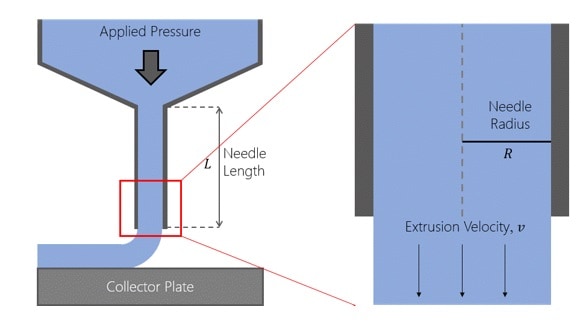
Extrusion printer mechanism
Next, they assessed the physical (also known as rheological) properties, which dictate bioink flow, shear thinning properties and speed of post-printing gelation. These data were collated by the authors to produce a “printing window”, in which printing pressure and other factors are optimal for bioprinting.
Cell health
An equally important characteristic for a bioink is the biological health of cells once encapsulated within the biomaterial. The researchers established this by measuring healthy cells versus dead cells, to determine how suitable the bioink is for housing cells post-printing.
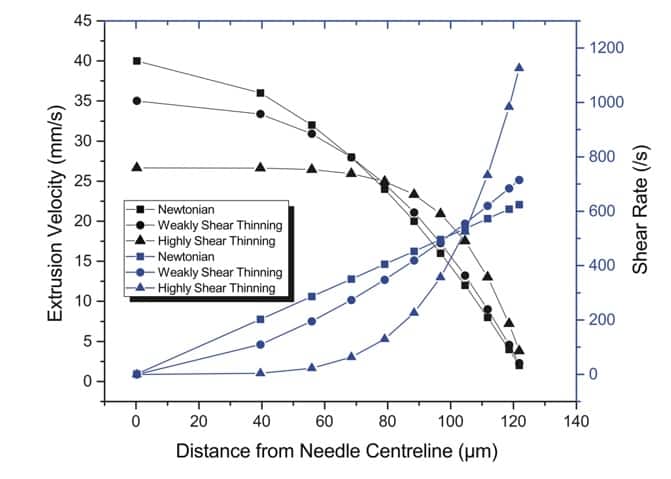
It is also important to ensure that the printing process does not put too much physical stress on cells. The researchers established that cells on the outer region of a printed fibre exhibited higher rates of cell death, due to the higher levels of shear stress experienced during the printing process.
Theoretical extrusion velocities profiles for different materials
Bioinks checklist
The bioink screening established by the authors allows for the validation of a material for printing of a 3D tissue or organ construct. Implementation of such screens can speed up the process of selecting a suitable bioink for a chosen application, although further optimization may be needed to ensure that a bioink enables certain physiological functions; for example, the formation of blood vessels (vascularization) or growth of new synapses (neurogenesis) in brain tissue.
Overall, the introduction of these screening processes can lead to the implementation of a printing window that will accelerate the development of bioinks and bioprinting across the field of biofabrication. This will hopefully lead to exciting developments in the biofabrication of tissues and organs for disease modelling, therapies and transplantation.
Carl Kempf’s new short-form Physics World Discovery ebook is free to read
By Matin Durrani
For centuries, astronomers looking up at the heavens through a telescope had a problem on their hands – the quality of their images depended on the strength and direction of the wind in the air. Trouble is, the Earth’s atmosphere isn’t uniform because its density – and thus its refractive index – varies from point to point as the wind blows. Result: distorted images.
In 1953, however, astronomer Horace Babcock proposed a clever solution, which was to bounce incoming light off a device that can rapidly correct for changes in optical path-length, which flattens the wave-front and so counteracts the effects of aberration. Any remaining wave-front errors are measured after the correction, before a feedback control loop uses the measurement to continuously adjust the corrections applied to the wave-front.
That was the principle behind “adaptive-optics” technology, which has since gone on to become a routine and invaluable part of astronomy. Turns out, however, that the same principles can be used in microscopy too, leading to many applications of adaptive optics in medicine and biology too, as I’ve discovered by commissioning and editing a new short-form Physics World Discovery ebook by Carl Kempf.
Kempf is a senior systems engineer at the California-based firm Iris AO, Inc, which is heavily into adaptive-optics technology, having worked on sensing, actuation, and control systems for high-precision devices for more than 30 years. I’m pleased to say that Kempf’s short ebook, Adaptive Optics in Biology, is now available for you to read free in EPUB, Kindle and PDF format via this link.
To give you some more idea of what the book is about and his career to date, I put some questions to Kempf, which you can read below. Don’t forget either that there are plenty of other books in the Physics World Discovery series, ranging from multimessenger astronomy to quantitative finance.
Adaptive thinking: Carl Kempf from Iris AO.
1. Carl, can you tell us about how you ended up working for Iris AO?
My background is in control systems, and adaptive optics is an interesting area that a lot of traditional control engineers overlook. When the chance to build the controller for the Iris adaptive-optic mirror came along, I couldn’t resist.
2. What does the firm mostly do and what’s your role there?
The company’s core product is a family of deformable mirrors build using techniques from micro-electromechanical systems (MEMS). Unlike most other mirrors, the devices have an optical surface that is an array of individual hexagonal segments. This offers some significant advantages, but requires a little bit of sophistication in the controller design. We also build some closed-loop systems our customers can use in simple applications or use a starting point for their own development of more sophisticated systems. My role is to oversee the development of the electronics and software that our customers use.
3. Why do you find adaptive optics such an exciting technology?
First, it is just such a simple but clever idea. As an engineer, I appreciate that. Second, to see an image sharpen up dramatically when the adaptive-optics controller is turned never gets old. It is just a neat thing to see.
4. What’s been your favourite application of it so far?
Probably retinal imaging. Being able to see details like blood flow in real time is fascinating. There is so much complex biology at work in the eye it is really pretty amazing to me, particularly coming from an engineering background. Knowing that the technology we build enables this is rewarding. Another aspect is that researchers often image themselves when first testing out a system, just because we are readily available. Taking these hi-tech “selfies” is fun.
5. Why would you encourage other scientists to take an interest in the field?
Adaptive optics is basic enabling technology that is going to be present in all the highest performance optical imaging systems regardless of whether it is astronomy, biology, or other fields. A basic knowledge of what adaptive optics is and how it works is useful to a scientist, particularly if they are lucky enough to get some time on an adaptive-optic-equipped system.
Gravitational waves hit the headlines in February last year when the LIGO collaboration announced it had detected them directly for the first time using a pair of huge laser interferometers in the US. With a further five sightings reported since then by LIGO and its European counterpart Virgo, scientists have begun to open what they call a new window on the universe. Now, keen to open that window as wide as possible, several groups have proposed sending atomic interferometers into space to observe gravitational waves that are difficult to intercept on the ground.
Gravitational waves are ripples in space–time that create tiny periodic expansions and contractions of space along orthogonal axes as they propagate forward. And, like any waves, they come in a range of frequencies. LIGO, which stands for the Laser Interferometer Gravitational-wave Observatory, detects them by monitoring a change in the relative phase of two perpendicular laser beams. However, at frequencies below about 10 Hz, this signal tends to be drowned out by terrestrial sources of noise, such as seismic waves.
Free-floating masses
To avoid such interference and detect low-frequency waves, physicists are eager to launch interferometers into the quiet of space. The €1.5bn Laser Interferometer Space Antenna (LISA) would consist of three spacecraft positioned millions of kilometres apart in a triangular formation, and would detect gravitational waves by monitoring the interference between laser beams bounced back and forth off free-floating test masses inside each spacecraft. First proposed about 25 years ago, the project has suffered a series of funding problems and was only officially inserted into the European Space Agency’s science programme in June this year, following the successful completion of its predecessor LISA Pathfinder. Its launch is planned for 2034.
“Quantum sensors might allow a reduction of costs, complexity, risks and permit an increased range of observation,”
Guglielmo Tino, University of Florence
According to Guglielmo Tino of the University of Florence in Italy, however, a mission based on the interference of matter waves could potentially be cheaper than one requiring laser interference. That is because while LISA needs at least three spacecraft to carry out multiple measurements of any passing gravitational wave – otherwise an apparent signal might simply be due to random fluctuations in laser frequency – an atomic interferometer could get away with two. “Quantum sensors might allow a reduction of costs, complexity, risks and permit an increased range of observation,” says Tino.
Earlier this month, physicists at Stanford University and the University of California Berkeley outlined plans for the Mid-band Atomic Gravitational Wave Interferometric Sensor (MAGIS). It would consist of two satellites positioned about 40,000 km apart in orbit around the Earth, each of which would contain an ensemble of ultracold strontium atoms brought into and out of superposition by a laser fired between the satellites. Any passing gravitational wave would change the laser’s flight time, resulting in different relative phase shifts between the two interferometer arms in each spacecraft.
Speculative cosmological sources
In effect, says Stanford’s Mark Kasevich, the interferometers would serve as atomic clocks while the laser beam would start and stop those clocks at intervals that depend on its passage through space–time. Kasevich and colleagues say that MAGIS could achieve “scientifically interesting” sensitivities to gravitational waves in a frequency band extending from about 30 mHz to 10 Hz, putting it between the ranges available to LISA and LIGO. At lower frequencies it could observe the merger of white dwarfs, while at the higher end of the spectrum, they say, it might see “more speculative cosmological sources” such as inflation. In addition, it could detect some sources, such as merging black holes or neutron stars, before LIGO does, and as such, allow astronomers operating conventional electromagnetic telescopes to point their devices to the relevant patch of sky ahead of time.
MAGIS is somewhat like a proposal put forward last year by a collaboration at the JILA research institute in Colorado and Harvard University, which features two satellites sharing a single laser link. However, whereas that mission would trap its atoms using lasers, in MAGIS the atom clouds would float freely. That would isolate the atomic clocks from any spacecraft vibration, Kasevich explains.
Meanwhile, a group at the Wuhan Institute of Physics and Mathematics in China has just unveiled an even more ambitious proposal. Called the Atom Interferometric Gravitational-wave Space Observatory, it would use atoms to detect gravitational waves directly rather than to measure the waves’ effect on a laser beam. This would involve three satellites splitting, deflecting and recombining a beam of atoms to create a single interferometer sensitive to a distortion of space–time known as the Sagnac effect that would be induced by gravitational waves.
Smaller size, lower cost
Group member the Dongfeng Gao explains that the observatory could be much smaller than other space-based interferometers – its envisaged length being just 10 km – since the matter waves would have a far shorter wavelength than light. Hopefully, he says, that would lead to a “cut-down in relevant technological requirements and in expense”.
Shimon Kolkowitz of the JILA/ Harvard group praises the “exciting” new proposals, but warns that they will need further R&D on the ground before they can be made “space-ready”. Indeed, Kasevich has not even costed his group’s mission, although he reckons that the price tag would “probably be greater than $1bn”. He says that it is “hard to know how far the technology can be pushed until you start to build the apparatus”.
A porpoise’s forehead acts like a ‘metamaterial’ to create the directional sound beam used by the marine mammals to detect and track prey, claim researchers in the US and China. The acoustics experts and biologists also found that the animals can adjust the acoustic properties of their foreheads to control the width of the beam. They believe that the structure of the porpoise forehead could inspire the development of new materials to control sound, with applications in underwater sonar and ultrasonic imaging.
Porpoises are toothed whales that use directional acoustic waves as a sonar system to hunt. When first searching for prey they use a narrow beam of sound to scan the water. But as they close in on a target they dramatically increase the width of the beam, to keep it in their field of view.
Scientists have struggled to understand how porpoises produce, and control, this directional echolocation beam. Porpoises produce the sounds, or ‘clicks’, by forcing air through a structure in their blowhole called the phonic lips. But this sound source is smaller than the wavelength of the sound it produces, which should, in theory, make the acoustic beam hard to control. And the phonic lips emit sound in all directions, not just forwards.
Sound velocity
To investigate these issues, Wenwu Cao, at Pennsylvania State University, and colleagues took computed tomography (CT) scans of a dead, finless porpoise (Neophocaena phocaenoides) and used ultrasound to measure the sound velocity of the different tissues in its head. They combined this information with field recordings of porpoise clicks and built a mathematical model to simulate sonar emission and beam control.
They found that air sacs in the head and the porpoise’s skull and melon – a tissue bulge on the forehead – all work together to direct the sound. When they included an omnidirectional sound source in their model of the porpoise forehead, a sharp beam of sound was formed with an angular width of 13°. “The forehead structure forms a specially designed passage for the produced wave signal and forces the beam to go forward,” Cao told Physics World.
The air sacs have the lowest sound velocity and the skull has the highest, but they both work as sound reflectors guiding the sound forwards. The melon comprises a low-velocity core enclosed in high-velocity connective tissues. These different acoustic properties achieve the focussing effect.
Acoustic lens
Further modelling showed that changing the shape of the melon and air sacs, by compressing the soft tissues of the forehead, increased the width of the beam to almost 20°. In effect, the melon acts as an acoustic lens that can be adjusted by the porpoise’s facial muscles. And porpoises have been observed doing just that.
A previous study of harbour porpoises found that as they approach prey the width of their echolocation beam changes from 9° to 15°. Further video and magnetic resonance imaging showed that during this period the porpoise’s melon rapidly changes shape, controlled by a network of facial muscles.
By compressing the forehead, the beam can be widened, so that the fish is always on the sonar screen,”
Wenwu Cao, Pennsylvania State University
The initial narrow beam allows porpoises to locate distant fish, but because the field of view is narrow, the fish may move out of sight when they close in, Cao explains. “By compressing the forehead, the beam can be widened, so that the fish is always on the sonar screen.”
Cao says that although it has not been observed, it is reasonable to speculate that other cetaceans – whales, dolphins and porpoises – “may use the same principle to control their acoustic beam since their biosonar systems are similar”.
Ultrasound expert Bruce Drinkwater at the University of Bristol, told Physics World: “They show convincingly that the acoustic properties of the melon cause the sound to be focused into a well-directed beam. It is fascinating to see that evolution has come up with a solution that is quite complex and unlike anything humans have “invented” – the precise shape of the melon is important, as is the distribution of speed of sound.”
“The idea of a sonar system that manipulates sound by deforming an engineered melon is a nice one,” adds Drinkwater. Currently, beam control for underwater sound is achieved using complex and expensive programmable arrays of speakers, he explains. A porpoise-like solution that used a single source of sound and a “melon” could be cheaper. “Change the shape of the melon and the beam is moved or focused.”
The research will be described in Physical Review Applied and an abstract is available.
Biomaterial investigators know that the mechanical stretching of a scaffold containing cells modifies the cells’ behaviour. This effect is being studied and used by research groups worldwide to optimize the fabrication of collagen scaffolds – biomaterial constructs based on collagen that can carry cells and be implanted in the body.
Diego Mantovani and his group at Laval University (LBB) are well aware of this issue and are aiming some of their research in this direction. In a recently published article, they explore the idea of identifying the correct “work out” or stretching that cells in 3D collagen scaffolds must follow to optimize their effect on the collagen. Their results show that an incremental frequency of strain can improve the properties of the scaffold in which the cells are growing (ACS Biomater. Sci. Eng. doi: 10.1021/acsbiomaterials.7b00395).
Making the cells fabricate the scaffold
At the recent Advanced Materials for Biomedical Applicationsconference in Ghent, Mantovani gave a fascinating talk about the collagen tubular constructs that his team is producing for vascular tissue engineering. However, the fibrillary arrangement of collagen scaffolds is not being carried out by the researchers directly, but by the cells themselves.
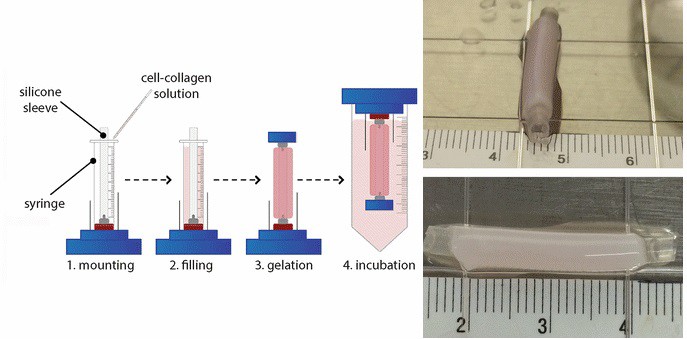
Cells in a collagen–gel solution are doing the work of remodelling the extracellular matrix protein produced by themselves, together with the exogenous collagen provided by researchers. All this happens during one to two weeks maturation inside a custom-designed bioreactor, a closed system that allows the growth of cells in the desired conditions.
These systems allow the induction of a symphony of stimuli – including stretching of the material that the cells grow on, or the flow of liquid – which are detected by the cellular sensors and modify their metabolism. One of the effects that these stimuli have on the cells is to motivate them to alter the material architecture and to improve mechanical properties, as shown in an earlier publication (Ann. Biomed. Eng.45 1496).
Bioreactor to produce tubular scaffolds
Are in vitro and in vivo mechanical stimuli similar?
There are still many conditions to optimize but, if we focus purely on the mechanical stimuli, we can ask: Is a constant mechanical stimulation representative of or relevant to what actually happens in the native blood vessels? Are we making the cells “work out” correctly?
A strain with incremental frequency is indeed more representative of what occurs in the blood vessels in vivo than a constant strain. In addition, it might provide new insights as to how mechanical strain affects cell behaviour in a 3D environment in vitro. To compare and understand the behaviour of the cells under the different conditions, the researchers monitored their shape, orientation and expression, and studied the mechanical properties of the scaffolds.
A gradual increase improves remodelling
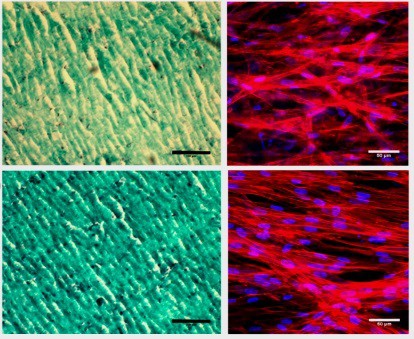
As expected, cells showed different behaviour under the different conditions. The gradual increasing strain promoted a higher alignment of cells and their nuclei when compared with the other conditions. Moreover, it even improved the remodelling of collagen, showing a more compact and aligned structure. Importantly, this alignment occurred in the direction of the strain, as seen in native blood vessels.
However, even though the cells improved the remodelling of the tissue under strain, the expression of proteins related to tissue remodelling was higher in the static control. This fact, together with similar observations reported in other articles, could be accounted for by the “desensitization of the cells over time to cyclic mechanical stimulus” since “no remodelling is seen in the human vasculature unless changes in mechanical cues or injuries are sensed”, the authors suggest. Furthermore, the cells under gradual strain within the scaffold exhibited improved mechanical properties, providing closer characteristics to those observed in the native blood vessels.
Cell containing collagen scaffolds
The study demonstrates that the use of an incremental frequency in the strain strengthens the resemblance between native blood vessels and in vitro developed scaffolds, reducing the gap between them.
Although this provides some answers to current models in vitro, it nonetheless poses more questions: Would we expect the same outcome by incrementing the intensity of the strain? Would there be a synergic effect between the intensity and the frequency? Could we observe similar behaviour when combining with the stimulus of the flow?
While these questions remain unanswered, Mantovani and his group at LBB will be making cells “work out” to provide future answers.
In the depths of the Mediterranean Sea, far from the bright clear blue sky, lies a hidden treasure. It’s not a shipwreck or a pirate’s hoard, a lost artefact or a water-carved sculpture. In fact, at first glance it simply looks like some very organized and oddly stationary bubbles. But these aren’t just trapped pockets of air. They are glass spheres connected by lines of cables, rooted to the sea floor. Swaying slightly with the currents, this odd array is completely alien to the beautiful ocean environment.
Rather than being an art installation seen only by sea creatures and submarines, the unexpected sculpture is a neutrino detector, known as ANTARES (Astronomy with a Neutrino Telescope and Abyss environment RESearch). Tiny and chargeless, neutrinos can be produced artificially in nuclear reactors or created when cosmic rays (protons or heavier nuclei) hit the atmosphere. But physicists at ANTARES are more interested in neutrinos from much further afield, such as remote galaxies. In that case, they are produced when cosmic rays get accelerated and collide with the dense ambient medium.
Unlike charged particles, neutrinos are not deflected by the magnetic fields that permeate the universe; in addition, they interact so weakly with matter that they can travel huge distances across space without being absorbed or scattered. Detecting such neutrinos and retracing their paths therefore allows the cosmic sources to be pinpointed. These subatomic particles are, however, even harder to detect than those made on Earth because they are so few in number.
The only identified sources of cosmic neutrinos are the Sun and the supernova SN1987A Both were confirmed in the 1980s using, among others, Japan’s Kamiokande detector, which contained 3000 tonnes of ultrapure water in a lab 1000 m below ground. But astrophysicists anticipate much more from the neutrino sky, especially at energies above 1012 eV (TeV) , which is why they have turned to the oceans. Unlike detectors such as Kamiokande, or its even bigger successor Super-Kamiokande, using the ocean means there’s no need to dig vast underground complexes and no limit to how big the detectors can be.
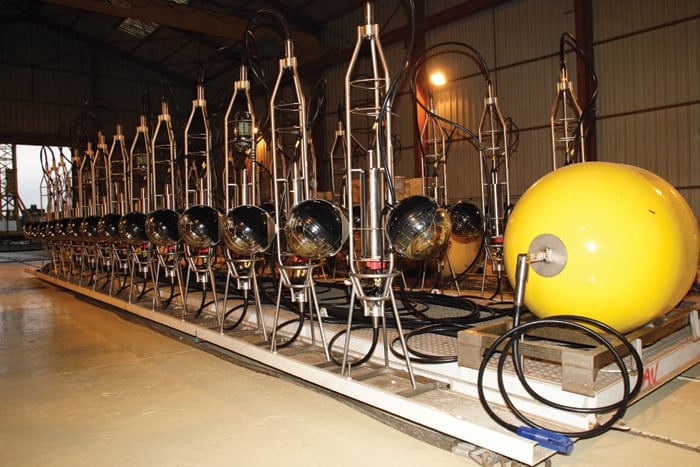
Destined for the depths: a single line of ANTARES before deployment. (Courtesy: L Fabre/CEA)
One beauty of the ocean’s waters is that they serve as a natural shield against the background charged particles (mainly muons) created from cosmic rays interacting in the atmosphere. To further reduce this contamination, neutrino telescopes also concentrate their observations on upward-going neutrinos that have passed through the Earth. These telescopes, in other words, observe the sky on the other side of the Earth, using the planet as a giant particle “filter” that lets only neutrinos through.
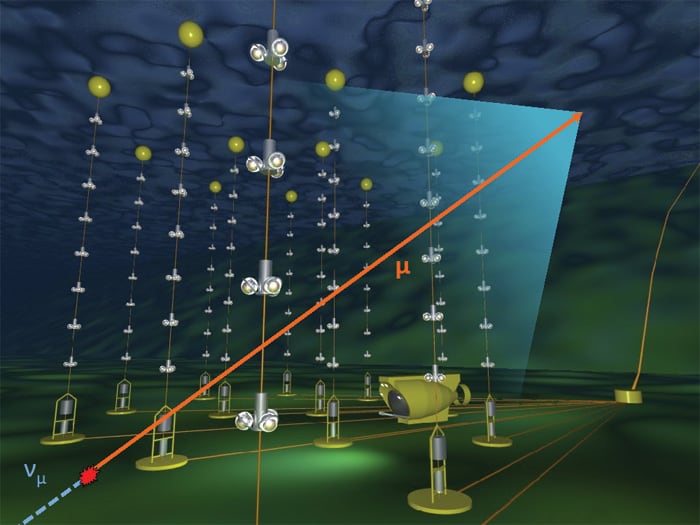
1 Blue light Charged particles (here, a muon) produced in a neutrino–nucleus interaction travel faster than the speed of light in water. This property leads to the emission of a cone of blue light around the muons’ direction of propagation that can be detected by photomultipliers installed in a dark, transparent environment. The depicted detector is ANTARES: each of the 12 detection lines supports 25 titanium frames holding a triplet of photomultipliers looking 45° downwards. The lines are connected to a main junction box through interlink cables plugged with a submarine vehicle. The junction box communicates with the shore station through a 40 km-long electro-optical cable laid on the seabed. (Courtesy: F Montanet, CNRS/IN2P3 and UJF for Antares)
But the ocean’s main appeal for physicists is the water itself, which transforms the sea into a giant telescope. In particular, it detects the “Cherenkov light” produced by charged particles that are created when a neutrino interacts with an atom’s nucleus. Moving faster than the speed of light in water, these particles create a cone of blue light at a well-defined angle with respect to the particle’s direction of travel (figure 1) – a process similar to the creation of sound shock waves. In a dark, transparent environment this Cherenkov light can be detected by photomultipliers and then used to reconstruct the energy and incoming direction of the parent neutrino. While both Kamiokande and Super-Kamiokande rely upon this principle, their water tanks are not big enough to detect the extremely faint flux of cosmic neutrinos. The ocean, however, does not have that limitation.
Looking through the Earth
The far-fetched idea of sticking a neutrino detector at the bottom of the sea was first proposed in 1960 by Soviet physicist Moisey Markov, but it was not until the 1970s that the US began work on the first submarine neutrino telescope off the coast of Hawaii – the Deep Underwater Muon and Neutrino Detector (DUMAND). As it was in the northern hemisphere, the detector was designed to find neutrinos from the southern sky, on the opposite side of the planet. In that direction is the inner region of our galaxy, which is known to host a supermassive black hole and plethora of other particle acceleration sites that could be producing cosmic neutrinos.
DUMAND’s planned set-up – and deep-sea detectors installed since – included an array of vertical cables, several hundred metres in height. Also known as “lines”, they were to be anchored into the sea floor at a depth of 4800 m and held in place vertically by immersed buoys. These lines would support clusters of photomultipliers protected from the ocean pressure in centimetre-thick glass spheres about half a metre in diameter. This array was to be connected to the coast through a long electro-optical cable, powering the detector and providing optical-fibre support for data transmission.
But the technological challenges were tremendous and DUMAND was never completed. Working underwater means dealing with high pressure, corrosion and leaky connectors – and you can’t just dive down to do repairs. From 1982 until 1987, some 14 R&D operations at sea were required before the first autonomous-prototype line managed to detect atmospheric muon trajectories, validating the Cherenkov-based detection principle and triggering the installation of the main cable. In December 1993 the first line was connected, but a pressure vessel leak occurred a few hours later, eventually generating a short circuit and causing communication with the installed apparatus to be lost.
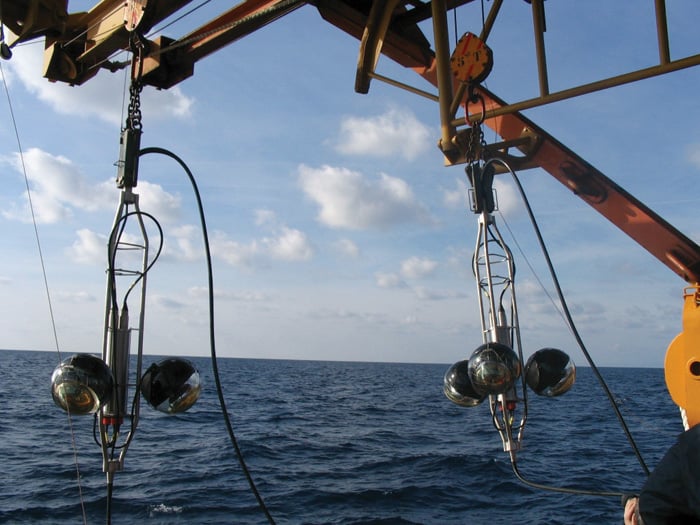
Destined for the depths: sections of an ANTARES line being lowered into the sea. (Courtesy: L Fabre/CEA)
That same year also saw scientists begin installing a telescope in Lake Baikal, Siberia – the world’s deepest lake and largest body of fresh water, reaching depths of about 1600 m. The lake gets covered in winter with a thick layer of ice, which made it easier to install the detector because it could carry the weight of heavy instruments without cracking, and an eight-line detector with 192 photomultipliers was quickly deployed. However, the lake water, despite being among the purest in the world, was not ideal for detecting neutrinos because it absorbs light more than ice or sea water. The detection lines therefore had to be placed relatively close to each other, restricting the detection volume to a modest ~5 Mt (equivalent to 0.005 km3).
Back in the US, the DUMAND project was stopped in 1995 due to a lack of funding, and activities were redirected to the installation of a similar detector in the Antarctic ice: the Antarctic Muon And Neutrino Detector Array (AMANDA). As with Lake Baikal in winter, the solid ice made life easier by allowing researchers to drill holes into the ice using hot water, without any need for a ship. The simplified construction partly compensated for performance losses caused by the less favourable optics of ice compared to seawater and the fact the detector was in the southern hemisphere so did not have the Milky Way’s centre in its field of view.
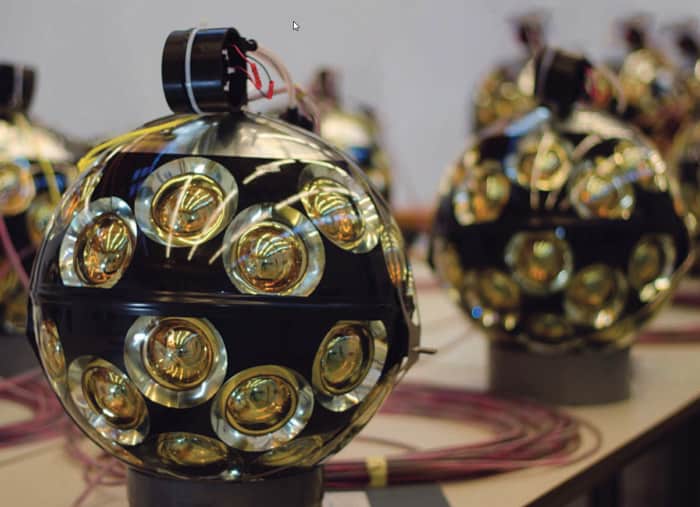
Destined for the depths: KM3NeT’s photomultiplier spheres in the lab. (Courtesy: CEA Ir fu)
AMANDA stopped operating in 2004 and was upgraded to the famous IceCube Neutrino Observatory. In 2013 this 1 km3-sized detector identified cosmic neutrinos from the depths of space, for which it won Physics World’s Breakthrough of the Year Award in 2013. But the origin of IceCube’s cosmic signal remains unknown. Researchers have been unable to identify the sources because they have limited statistics and directional reconstruction power. The latter limitation is partly due to the important diffusion of light in ice, which degrades IceCube’s angular resolution – a crucial parameter for astronomy.
The lure of the Mediterranean
So we return to warmer climates and ANTARES. After the failure of DUMAND, Europe had taken up the torch of submarine neutrino telescopes, concentrating on the Mediterranean Sea because it lies in the northern hemisphere and offers deep-sea sites relatively close to on-shore facilities. After several site surveys and prototype developments in Greece, Italy and France, the ANTARES project began in 1996 off the coast of Toulon, France.
But success was not immediate, with dozens of autonomous tests having to be carried out to understand the environmental conditions. The researchers needed to know everything from how marine currents bend the detection lines and how salinity affects the speed of sound in water (vital for calibration), to how bioluminescence would affect the photomultipliers, and whether biofouling could potentially soil the detection modules. Some brave physicists even occasionally had the privilege of diving to depths of almost 2500 m on board the Nautile – a manned submarine of the French research institute Ifremer that also served for the exploration of the wreck of the Titanic. Among their missions, these researchers had to electro-optically connect the main cable and perform visual inspections of the area. Their adventures even led to some surprises, such as the discovery of an old cannon found lying near the detector.
The first detection line was installed in 2006 and ANTARES was completed in 2008 with 12 detection lines, each featuring 75 photomultiplier spheres along their 450 m and anchored at a depth of 2500 m. ANTARES has so far observed more than 10,000 neutrino events with energies ranging from 100 GeV to several hundreds of TeV. These detected events are compatible with the predicted neutrinos created by the interaction of cosmic rays in the atmosphere, but presumably hide a handful of cosmic neutrinos.
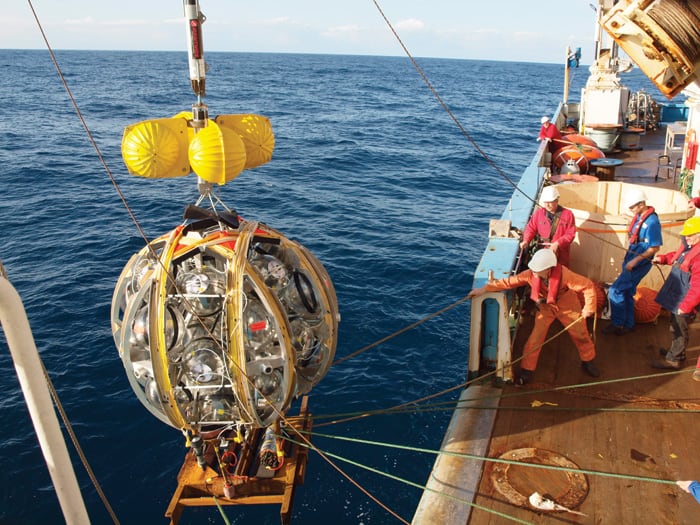
Destined for the depths: a KM3NeT line frame being deploying into the ocean. (Courtesy: CEA Ir fu)
ANTARES, with its unmatched pointing power and good coverage of the central region of our galaxy, is providing important results and complementary information to IceCube. It is also part of an ambitious “multimessenger” programme that seeks to correlate the neutrino events with other cosmic probes, including photons (from radio to gamma rays) and even the recently detected gravitational waves. Despite these efforts, and the presence of a slight excess of events in ANTARES data that could correspond to a cosmic signal, no attempts have succeeded in identifying a neutrino source so far. Confirmation can only come from an even larger detector: the Cubic Kilometre Neutrino Telescope (KM3NeT), which will be the successor of ANTARES.
The next generation: KM3NeT
Construction of KM3NeT began in 2015, with 240 scientists in 15 different countries embarking on the latest deep-sea adventure. And it will be massive. On completion in the early 2020s it will have 345 detection lines distributed across two sites in the Mediterranean Sea: one near Toulon, close by ANTARES, and a second one off the coast of Capo Passero in Sicily, Italy, creating a telescope with a detection volume of more than 1 km3. Subject to future funding, there may also be a third site off the coast of Pylos, Greece.
While neutrino detection in KM3NeT will still be reliant on the Cherenkov principle, the new project features significant technological improvements based on the decade-long experience of ANTARES and the other prototypes. In particular, 31 small photomultipliers – instead of a single, larger one – will be housed in each glass sphere offering several advantages in terms of photon-detection efficiency, photon counting and directionality – all of which are crucial ingredients for the reconstruction of the incoming neutrino energy and arrival direction.
The deployment procedure has also been redesigned: the full detection line is coiled into a spherical frame and attached to a line anchor, which in turn is equipped with an acoustic receiver. Researchers can acoustically monitor the descent of the detection unit from a surface vessel, allowing lines to be positioned to within 1 m. And there’s no need any more for courageous divers as the anchor is connected to the seabed network by a submarine vehicle remotely operated from the boat. Once the connection is verified onshore, an acoustic signal triggers the unfurling of the unit. The compact line frames also mean several lines can be deployed during a single cruise, saving time and money.
Although both detection sites will be based on the same technology, the two will pursue different physics goals. In Toulon, the emphasis will be on studying atmospheric neutrino properties in the GeV energy range, with a dense detector named Oscillation Research with Cosmics in the Abyss (ORCA). In Sicily, a larger and sparser detector called Astrophysics Research with Cosmics in the Abyss (ARCA) will focus on the study of astrophysical sources with energies ranging from TeV to PeV. At each site, the first lines of the arrays have been installed and the first background events have been observed.
Physicists working on the construction of KM3NeT are eager to share their data and provide new opportunities for earth and sea sciences through their cabled infrastructure. From oceanography to geophysics and from marine biology to climatology, the full scientific potential of deep-sea neutrino observatories is still to be explored. As a partner of the European Multidisciplinary Seafloor and water column Observatory facility, KM3NeT will help scientists understand the complex interaction between the geosphere, the biosphere and the hydrosphere, while continuing to hunt for cosmic neutrinos (see box below). So come 2020, there will be many more orderly glass bubbles confusing the fish while probing the depths to look afar.
A multidisciplinary observatory of the sea
A down-to-Earth glow: pairing ANTARES with mooring lines such as LION provides valuable environmental information. (Courtesy: Mathilde Destelle, www.mathildedestelle.com)
It is essential to calibrate and monitor the response of any undersea neutrino detector by measuring environmental parameters such as the optical properties of water, sea currents, bioluminescence and acoustic noise. This is why deep-sea neutrino telescopes not only scrutinize the cosmos from the abyss, but also contribute to more down-to-Earth research. Thanks to their permanent connection with an on-shore lab, facilities such as ANTARES and KM3NeT are providing new and valuable data for oceanographers, geophysicists and biologists, who usually rely on autonomous stations with limited data storage capacity. The long-term and real-time monitoring of deep-sea parameters, such as temperature, pressure, salinity and oxygen and carbon-dioxide content, will allow a better understanding of the marine environment and ecosystems, and of the impact of climate change on the oceans. The deployment of a seismometer and pressure gauges on the site will also contribute to the monitoring and early warning of seismic hazards such as earthquakes and tsunamis. Even the neutrinos registered by KM3NeT, having traversed the whole Earth, can be exploited by geophysicists to obtain indirect information on the composition of the innermost regions of the planet, complementing insights inferred from seismic waves.
The telescopes’ photomultipliers are also sensitive to the continuous background of bioluminescent light emitted by micro-organisms. Although physicists view this light as noise, to marine biologists it’s a valuable signal. One study, for example, combined data obtained by ANTARES and two independent mooring lines also located in the north-west Mediterranean Sea. Looking for correlations between temperature, current velocity and optical activity, the study has led to a better understanding of the link between bioluminescence and the mechanisms of deep-water formation: cold winters densify the surface waters that sink into the abyss by gravity, bringing oxygen and triggering a firework of bioluminescence around ANTARES.
Other discoveries have come from prototype hydrophone arrays in both ANTARES and the Italian neutrino telescope prototype NEMO. These arrays are primarily meant to study the possibility of enhancing the detection of highly energetic neutrinos by listening to their associated sound wave. But they also turn out to be a non-invasive way of monitoring the presence and activities of dolphins and other sea mammals by detecting their acoustic emissions, which can propagate for tens of kilometres in seawater. These range from ultrasonar echolocation “clicks” to frequency-modulated whistles used for social communication. Tracking these signals has even ended up revealing the continuous presence at great depths in the Mediterranean of a population of sperm whales much larger than previously inferred from sound recordings conducted close to the surface. Such studies are invaluable for marine biologists to study how dolphins move, feed, capture prey, communicate and mate.