Tides induced in the solid Earth by the Sun and Moon have allowed researchers to characterize the density of the deep mantle. The results suggest that two large, low-shear-velocity provinces (LLSVPs) under equatorial Africa and the Pacific are, on average, denser than the surrounding rock. The finding has consequences for our understanding of mantle circulation.
The existence of the two LLSVPs has long been known from seismic tomographic observations. Such studies, which make use of the seismic waves generated naturally by earthquakes, have indicated that the features extend for thousands of kilometres laterally, and for approximately 1000 km upwards from the core–mantle boundary (CMB).
Hot rocks
Low shear-wave velocities typically indicate the presence of hotter material, and the LLSVPs have been interpreted as the source of buoyant mantle plumes that ascend from near the base of the mantle. Sharply changing seismic properties at the edges of the features, however, are not consistent with a purely temperature-based origin, suggesting that compositional differences are involved. How these variations are reflected in the regions’ density distribution has long been an issue for debate.
Now, using probabilistic modelling based on high-precision global positioning system (GPS) measurements, Harriet Lau of Harvard University, and collaborators at Harvard, Columbia and Princeton universities in the US, the University of Science and Technology of China, and the University of Cambridge in the UK, have investigated the response of the Earth’s body tides to different density profiles in the lower mantle. The group’s surprising outcome is that, taken as a whole, the LLSVPs are not more buoyant than the surrounding mantle after all.
Mass concentration
For this conclusion to be consistent with the results of previous studies, the LLSVPs would both have to be heterogeneous features, in which the anomalously dense parts are restricted to within 100 km of the CMB. The spatial resolution of Lau and colleagues’ analysis means that this cannot currently be ruled out, but future work should better define the fine-scale structure.
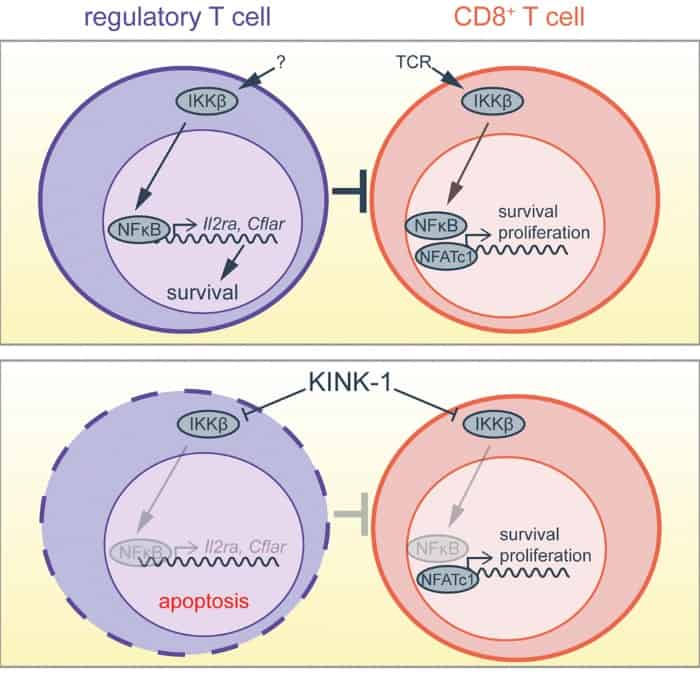
Researchers from the University of Bonn, along with colleagues in Germany and the USA, have observed increased antitumour immune responses as a result of inhibiting regulatory T cells. Their study, published in Cell Reports, reveals that prolonged exposure to KINK-1, an inhibitor of the IkB kinase β (IKKβ, a naturally produced immunostimulant), selectively reduces the number of active regulatory T cells without affecting killer (CD8+) T cells.
Using in vivo experiments on mice with skin cancer, the authors observed a delay in tumour growth after combining treatment with a tumour vaccine and subsequent KINK-1 treatment. These findings present IKKβ as a potential new druggable target of the immune system that could impact the development of future cancer treatments (Cell Reports21 578).
The immune system recognises cells that are infected by viruses, and stimulates CD8+ T cells to target and destroy them. In contrast, regulatory T cells suppress the immune response of CD8+ T cells to prevent them from targeting erroneously healthy tissue.
Cancer cells also induce an immune response from CD8+ T cells. However, they exploit immunological processes to evade this response. For instance, they capitalize on the immune suppression function of regulatory T cells and recruit them to recognise tumours as healthy tissue, which provides tumours with a “cloak of invisibility” and thus hampers the immune response.
In this context, the authors investigated the role of IKKβ in the survival of regulatory T cells and the effect of its inhibition in potentiating antitumor immune response.
Unveiling the tumours’ cloak of invisibility
The study revealed that prolonged exposure to KINK-1 resulted in a 50% reduction in regulatory T cells in cell culture and in mice, while the numbers of CD8+ T cells remained unaffected.
Survival and proliferation of T cells
To understand this resistance of the CD8+ T cells to KINK-1, the authors tested the role of the transcription factor NFATc1 in CD8+ T cell survival. They observed that blocking NFATc1 did not affect the survival of regulatory T cells. In contrast, CD8+ T cells started dying only after blocking NFATc1 and IKKβ in combination, further demonstrating the selective targeting of regulatory T cells with IKKβ inhibition.
Treating tumours using combined therapies
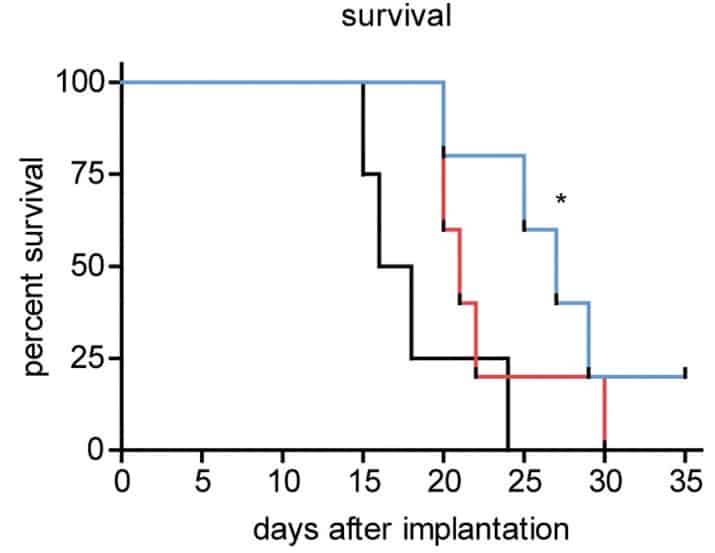
These findings led the authors to believe that selective targeting of regulatory T cells can boost the effect of CD8+ T cells in tumours. To test this idea, they implanted melanoma tumours in mice and followed a therapy protocol in which tumour vaccination was used together with KINK-1 treatment.
The authors reported a delay in tumour growth and an increase in survival time for mice treated with the combined therapy in comparison with tumour-vaccinated mice. They also concluded that vaccination was necessary to increase the number of active CD8+ T cells since IKKβ plays a role in their activation.
Survival of mice with implanted tumours
The study confirms the potential of combining targeted therapies with tumour vaccination to potentiate the immune response. Furthermore, it contributes to the body of research in cancer immunotherapies, in particular, to the development of immune checkpoint inhibitors, i.e., molecules such as KINK-1, whose targets regulate the immune response.
Supporting physics From left to right: Laura Greene, Roger Falcone and Francis Slakey. (Courtesy: APS)
What’s been your overall impression of Trump’s administration?
Laura Greene: There’s a tremendous divide in the US and what we’ll do as the American Physical Society (APS) is to keep our lines open to the legislature – to members of our Congress and senators – and ensure they understand that a big part of the American economy is supported by science and technology.
Roger Falcone: We live in interesting times politically but there’s a broader debate over the importance of science and technology to innovation, which translates into jobs and other benefits to people. It’s a much larger discussion and we should focus on that rather than any individual administration.
How well have you communicated with the Trump administration?
RF: There are typically two groups we want to talk to – one is the executive branch, such as the Office of Science and Technology Policy (OSTP), and the other is the legislative branch, or Congress. We still have great communication channels with the members and staffers in Congress, who are very interested in hearing our stories. Our ability to advocate for science and technology through Congress has not diminished. But there are fewer people to talk with in the administration, in the executive branch. That said, we have great communications with the executive branch agencies responsible for providing resources to scientists and engineers, such as the National Science Foundation (NSF) and the Department of Energy (DOE).
Francis Slakey: The administration is simply not staffed up to the extent that Obama’s was. The obvious example is the OSTP where there’s a skeleton crew there, just a couple of people. Under Obama, it was a robust office and you always found people to whom you had ready access. But those positions have not been filled – and may not be – so part of the trick has been to find ways in to the handful of people at the DOE or in the Office of Management and Budget.
What impact could this lack of communication have?
RF: I see two critical things for science and the country. First, we need science to inform anything our government is doing. We want to make sure science is included in all those policy discussions, and I’m not sure that is happening without senior scientific advisers in the government. We also need a good policy for science, which means knowing how best to invest precious tax dollars in science. Maybe there, via agencies and Congress, we’ve found more people to engage with.
Trump’s budget proposal for 2018 earmarks big cuts to the likes of the NSF and major national labs. What are the dangers for US physics if those proposals go through?
LG: The repercussions of those cuts need to be thought through and that’s what we’re trying to get through to our legislators. If you lose a hundred scientific jobs, you’re probably losing thousands of jobs for people who work in those locations. At the National High-Magnetic Field Laboratory, for example, most people aren’t scientists and the economic impact of the labs to that area is vital. We also have an educational role – training the next generation of students – and a big role in innovation, bringing new techniques to market. The US is still a leader in science and engineering – and deep cuts to science will be bad news.
RF: There’s no question the US faces significant challenges with respect to annual deficits in our budget and the integrated national debt. Science and technology comes under a portion of that budgeted funding that’s discretionary, which means we have to decide it every year and it’s not set in stone. It’s our job to argue that our precious dollars should be spent on science and to articulate why those investments are going to lead to innovation and jobs.
FS: The budget was not a surprise. We knew what was coming and had encouraged scientists to make the case for science to their local representatives and senators. We’d also learned from the first budget battle we’d fought in the spring, where we got Congress on our side to push back. To me, the issue is less about the 2018 numbers, but about what happens next February when the 2019 numbers are released and whether we are making any progress with the administration. The question will be: are we seeing better numbers? We’ll be fighting every year for the next three years.
How do you feel about Trump’s attempts to ban people from certain nations from travelling to the US?
LG: When I talk to young researchers in the US who have to come to work in this country, many of them tell me they are looking to find jobs elsewhere because they are worried about leaving the country and not being able to come back. The long-term impact is that we could have a brain drain of the brightest people in the world not wanting to come to the US any more.
FS: When the immigration ban was first announced, all the companies I talked to were opposed to the ban – not because the numbers coming from any one of those countries was going to impact their business, but because they were concerned with the tone and the complete disregard it showed for the importance of the free flow of talent around the world. American industry needs to be able to hire the best talent wherever they are in the world. The executive branch didn’t understand that point.
RF: At the APS, we recognize science is an international enterprise. For example, more papers are published in APS journals from scientists in Europe than from those in the US. The travel ban is creating bad climate and morale.
Do you think the March for Science was a success? Did it have any impact on the budget or on people not marching for science?
LG: That’s a very, very tough question. I know I was hesitant to get involved with it because I didn’t want to take a political stance. But when the march became really embraced on a worldwide stage as a pro-science, not a political statement, I think a lot of organizations such as the American Association for the Advancement of Science (AAAS) and the APS had a role in making sure it remained non-political. Did it have an effect? Well you’ve seen the president’s budget so it didn’t have an effect on that. But it did show just how science impacts on society, how much fun it is, how gorgeous the discovery process is.
On the march Thousands of people took to the streets of Washington, DC, in April 2017 to voice their support for science. (Courtesy: Shutterstock/Joseph Gruber)
RF: What I really liked about the Phoenix march, where I gave a talk, was that the biggest applause came when I thanked the science teachers. Bunches of teachers and their spouses came up to thank me. So I think the march boosted science teachers – gave them a sense of appreciation and recognition. That may not have been the major goal of the march, but the fact that so many regular people, who are not engaged in science and technology, could show their appreciation to schools and teachers was really powerful.
So no regrets about endorsing the march as a society?
RF: No, not at all. It was so much bigger than any individual person or society.
LG: It was not political. There were certain people who tried to politicize it. But it was so vast, so broad, so international. I was really nervous but I’m really happy right now.
Bill Foster is currently the only physicist in Congress. Do you think more physicists should get involved in politics?
LG: Yes we need more people involved. The APS, as does the AAAS, has a congressional fellowship programme to help train people to get involved. There were times we had as many as three physicists in Congress and I would definitely like to see more. APS members want to be involved. They’re starting to understand how important it is for their own survival.
FS: It depends what you mean by “involvement”. I want more physicists to make the case for science to their elected officials and about 1200 APS members have already done so.
The same issues we’re addressing in the US politically are happening all over the world. We must work across all societies in the US, Europe and Asia to articulate how science can best contribute to the issues we’re addressing
Francis Slakey
RF: The influence of science on social policy is enormous, whether it’s just saying that actions need to be data-driven, or we need innovation to create replacement jobs for people who’ve been displaced from low-skilled jobs by automation. That engagement [with officials] is as important as running for office.
FS: There’s no question that the same issues we’re addressing in the US politically are happening all over the world. We must work across all societies in the US, Europe and Asia to articulate how science can best contribute to the issues we’re addressing.
Laura, how do you feel about your presidency so far?
LG: I wanted to take the job on because I care about the APS and about physics and science diplomacy, and human rights. I don’t look like a calm person but I think I’m a calming influence on people who want to react very strongly and may damage our society and science in general. But yeah I’m having a blast. I love working with the people here.
Are you happy with the overall diversity of the APS?
LG: The APS has done tremendous things on diversity. The number of programmes for women in physics is huge. The Conference for Undergraduate Women in Physics started out [in 2006] with a hundred people and it’s now grown by orders of magnitude. About a year and a half ago we published an LGBT report that’s had a tremendous impact. We have a committee on minorities that’s been terrific, offering fellowships and identifying speakers and reminding people to invite minorities as speakers or to nominate them for medals or awards. The APS are world leaders in pushing diversity and I’m very proud of that.
Roger, what about your plans for your term as president in 2018?
RF: I’ve been trying to figure out how to follow Laura’s great leadership! We have a formal position of past president at the APS, who stays engaged in the decision-making process, so I’m really pleased she’ll be continuing to guide us. Her focus has been on science diplomacy, but I’ll focus more on how to articulate the role of science and technology in economic development for society.
In a word, how would you sum up the state of US physics?
RF: Optimistic.
LG: Innovative.
Any final message for the world’s physics community?
Swirling magnetic patterns of spins dubbed “target skyrmions” have been created without the application of an external magnetic field. The skyrmions appeared on small discs of a magnetic alloy and could be used to store information in terms of the rotation direction of the swirls.
Originally conceived as particle-like regions within a field where all field vectors point either towards or away from a single point in space, skyrmions were proposed in the 1950s by British physicist Tony Skyrme to explain aspects of particle physics. Since then, certain collective excitations of electron spins in solids have been shown to behave much like skyrmions. These solid-state magnetic skyrmions could be potentially useful in next-generation electronics and spintronics.
Chiral magnet
In this latest work, Jiadong Zang at the University of New Hampshire, Haifeng Du of China’s High Magnetic Field Laboratory and colleagues in Germany, China and the US studied skyrmions in a tiny disc of iron-germanium. This material is a chiral magnet that has a skyrmion unit cell – each unit cell being a circular magnetic structure of electron spins with a diameter of about 80 nm.
Their disc has a diameter of about 160 nm and is 90 nm thick. Using an electron microscopy technique called off-axis electron holography, the team showed that the centre of the disc is occupied by a conventional skyrmion with a diameter of about 85 nm. The outer region of the disc has a ring of electron spins that create a magnetic field that is opposite in direction to that generated by the skyrmion.
Two configurations
Writing in Physical Review Letters, the team describes the overall spin structure of the disc as a target skyrmion. They found that the structure has two ground-state configurations – one in which the magnetization of the inner skyrmion rotates clockwise and the other in which the rotation is anticlockwise. These states are stabilized, believes the team, by the magnetic field generated by the outer ring of electron spins. Furthermore, the rotational sense of the inner skyrmion can be switched between the clockwise and anticlockwise states by applying a magnetic field of about 200 mT.
The ability to flip the rotational sense of the skyrmion between two stable states means that the discs could be used to store digital bits of information and could even be linked together to create logic gates and other devices.
IBM quantum computers with 20 superconducting qubits will soon be available for online use by the firm’s clients – according to the US-based company. The quantum systems will be running by the end of 2017 and IBM also says that it has built and tested a prototype quantum computer with 50 qubits.
Part of the IBM Q family of quantum computers, the new systems are based on transmon qubits. These store quantum information in terms of the presence or absence of Cooper pairs of electrons on small pieces of superconductor. IBM launched its first web-accessible quantum computer in 2016 and today the public can use 5- and 16-qubit systems through the IBM Q Experience programme.
Longer coherence time
As well as boosting the number of qubits available, IBM says that its 20-qubit processor has a coherence time of 90 µs. Coherence time is a measure of how long a qubit can retain quantum information and 90 µs is twice as long as that of its 5- and 16-qubit systems.
“Now, we can scale IBM processors up to 50 qubits due to tremendous feats of science and engineering,” enthuses IBM Research’s Dario Gil. “These latest advances show that we are quickly making quantum systems and tools available that could offer an advantage for tackling problems outside the realm of classical machines.”
Researchers from National Tsing Hua University in Taiwan have used an injectable self-assembling hydrogel to treat brain injury. The nanopeptide hydrogel (RADA16) promoted neurovascular growth in the lab, as well as regenerating damaged neurovascular tissue in a zebrafish model of brain injury (Nanoscale9 16281).
Hydrogels are biomaterials that are highly saturated with water but have the physical properties of a solid. The biocompatibility and physical properties of hydrogels enable encapsulation and growth of cells in the lab, or in some cases, injection directly into the brain to aid recovery and regeneration.
RADA-peptide hydrogel
The RADA16 (peptide sequence RADA, with 16 repeats) hydrogel used in this study can be tuned physically for the intended application. To enable cells to attach to RADA16, an additional peptide sequence (SVVYGLR) is added to the hydrogel. Cellular attachment is important for cell proliferation and to translate external physical stimuli into alterations of gene and protein levels within the cell.
Hydrogel promotes regeneration of damaged tissue
The group showed that the RADA16-SVVYGLR hydrogel enabled angiogenesis (new blood vessel growth) and neurogenesis (increased neural growth) both in vitro and in vivo. These findings validate this biomaterial as a promising option for tissue engineering and disease modelling in the lab, and for treatment following brain injury.
Zebrafish model
For the in vivo study, the researchers created a wound in a specific region of the zebrafish brain, and subsequently injected RADA16-SVVYGLR into the wound site. Not only did this promote neurovascular regeneration, it also proved beneficial to the functional recovery of the zebrafish (as demonstrated in a series of cognitive behavioural tests).
The success of this hydrogel in the zebrafish model is encouraging, as a lot of naturally produced hydrogels (for example collagen) have been shown to cause adverse tissue–tissue adhesions when injected, damaging the surrounding tissue.
Physical properties and tuning
The authors note that the physicochemical properties of the hydrogel were easily tuned, with both pH and the concentration of nanopeptide altering the micro-environmental architecture surrounding the cells. This is important as different tissues in the body require different physical properties, such as mechanical stiffness, for example. Importantly for neurovascular tissue, the hydrogel could be tuned to lie within a suitable stiffness range for neurovascular development.
An additional advantage of the RADA16-SVVYLGR peptide sequence is that its physical charge allows the hydrogel to assemble into ordered β-sheets without any modifications; unlike many other hydrogel formulations, which require potentially damaging chemical processes to form solid structures.
This feature – along with the tuneable properties – enables potential optimization for 3D bioprinting, which would allow the development of layered tissue models or bio-fabricated tissues and organs for transplants.
Bench to bedside translation
The favourable results produced in vivo for neurovascular regeneration imply that this system could be utilized in clinics for treatment of traumatic brain injury, stroke or neurodegenerative diseases. Additionally, the in vitro results could lead to the use of this nanopeptide for neural tissue engineering and tissue modelling applications.
For the first time, cryo-electron microscopy (cryo-EM) has been used to study the most challenging material in lithium batteries – the lithium metal anode. Previously, it was impossible to study lithium and its interfaces with high-resolution electron microscopy because of the severe beam damage resulting from high electron doses. By using cryogenic conditions to prevent such damage, this international investigation across the United States, China and Germany reveals how lithium dendrites that cause battery failure form. They also show how tailoring electrolyte composition affects the structure of the solid-electrolyte interface.
Lithium-ion batteries have proven to be the most effective and commercially relevant power sources in electric vehicles and portable electronic devices. Current technology utilizes a metal oxide cathode, and an organic (carbonate-based) electrolyte and graphitic carbon anode. Researchers have focused on stabilizing the Li metal anode to improve the capacity from that of carbon (372 mAh/g) to that of lithium (Li) metal (3862 mAh/g), an order of magnitude increase. However, utilizing lithium metal as anodes comes with safety and practical issues.
During cycling, lithium does not deposit flat on the anode surface, rather it deposits long dendrites that can puncture the separator, causing short-circuits between the anode and cathode. These short-circuits generate heat, triggering device failure or possibly fires. In a recent article published in Science, this international team led by Stanford University scientist Yi Cui used cryo-EM to try and understand the formation of these Li dendrites. They gained new insights into the crystallographic planes Li dendrites will form along, and their interface in carbonate-based electrolyte compositions.
Taking a snapshot of lithium metal in a battery
Batteries are dynamic devices, constantly changing and undergoing multiple chemical reactions simultaneously. To preserve the chemical state of the lithium metal anode, Cui and his team had to borrow some strategies from biology. First, Li metal was deposited on a Cu metal electron microscopy grid in a battery system comprised of Li ions in the electrolyte, which form the dendrites. That grid was removed from the device and flash-frozen in liquid nitrogen, which preserved the relevant structural and chemical information. Transfer and flash-freezing was difficult due to the chemical reactivity of Li metal. However, by maintaining an internal temperature of ~–170 ºC in the cryo-EM vessel, the Li metal remained stable.
How dendrites grow
The exact structure of the Li dendrites has been difficult to determine since only low-resolution transmission electron microscopy (TEM), indirect-imaging and surface-sensitive techniques could be used to study the dendrites. The detailed nanostructure evaluated by the cryo-EM has exposed that the dendrites grow along the <111>, <211> and <110> crystallographic facets, with approximately 50% of those dendrites growing along the <111> direction. The major growth direction is rationalized from the low surface energy of that particular facet. The other two facets, <211> and <110>, also have a low surface energy. They switch at “kinks” in the dendrites and change their growth direction while maintaining crystallinity throughout the structure. These “kinks” could be heavily influenced by the solid-electrolyte interface (SEI).
Electrolyte composition tailors anode interface
The surface–electrolyte interface (SEI) on the Li anode is caused by electrolyte decomposition at the anode surface arising from the low potentials reached during the battery’s operation. This SEI consists of organic and inorganic (Li2CO3 and Li2O) components, which can prevent Li ion’s diffusion from the anode surface to the electrolyte. Excessive SEI build-up will create an insulating layer around the electrode, degrading battery capacity.
The nanostructure of the Li-ion SEI was explored for the first time with cryo-EM, showing that in a standard electrolyte (ethylene carbonate and diethyl carbonate) mixture, the SEI forms with a randomized distribution of organic and inorganic composition. However, with a common fluorinated additive (flouroethylene carbonate) in the electrolyte, the SEI formed is structured with the organic layer on the Li metal crystallographic surface and the inorganic SEI only formed on the organic surface. The fluorinated additive in the electrolyte has been studied extensively in battery literature and has proven to form a more stable surface, which elevates device operation throughout the battery’s lifetime. The work by Cui and colleagues is the first study to show that this surface could be the result of the ordered multilayer formation unique to this additive.
The future of the Li metal anode
The Li metal anode suffers greatly from the dendrite and SEI formation, but its theoretical capacity is an order of magnitude higher than current technology, making it an extremely desirable battery material. This information on nanostructure only available from cryo-EM is critical to the progress of state-of-the-art battery technology and uncovers a new opportunity to directly tune crystallographic facets of Li metal or SEI heterostructure to overcome anode degradation and potentially make Li metal a viable option for future energy storage devices.
Wobbly footbridges can both delight and terrify pedestrians. Now, researchers in the USA and Russia have developed a model showing how an apparently stable bridge can suddenly show alarming, potentially dangerous wobbles when a certain number of people walk across it.
Designing a footbridge can be a challenge because it can be difficult to predict how a structure will respond to the pounding of many feet at once. The London Millennium Footbridge across the River Thames, for example, opened with great fanfare in 2000, only to close within days after large crowds found the bridge rocking unnervingly as they walked. The bridge remained closed for almost two years while dampers were installed.
Bridges, like any other structures, have natural frequencies of vibration. It is well known that bridges can collapse if large numbers of feet simultaneously excite vibrations at these natural frequencies. The Albert Bridge – built across the Thames in 1873 – bears a sign instructing marching soldiers to break step when crossing. However, ordinary pedestrians do not march in step. Moreover, the Millennium Bridge oscillated left to right, not up and down.
Inadvertent amplification
In 2004 Steven Strogatz of Cornell University in the US, and international collaborators, modelled pedestrians on a bridge as coupled oscillators to show how, if a bridge does begin to vibrate naturally, pedestrians can fall into step with the vibrations to maintain their balance. In doing so, they inadvertently amplify the oscillations. This is analogous to the famous model, first developed by the Dutch physicist Christiaan Huygens in 1665, of pendulums suspended from the same beam becoming synchronized in phase because of motion transmitted through the beam.
Strogatz’ model has been highly influential in the applied mathematics community, but it cannot provide precise, quantitative predictions of the conditions under which a given bridge will wobble that could be used for computer modelling in the design of bridges. “The existing industry programs used to develop bridges are based on linear calculations,” explains Igor Belykh of Georgia State University in the US. “These are very outdated and cannot capture highly non-linear phenomena like this switching to larger wobbling as a result of very complicated two-way interactions between the pedestrians and the bridge.”
Belykh and colleagues in Russia combined crowd synchronization and bridge dynamics with a biomechanical model of walking humans as inverted pendulums pressing alternately on the ground with left and right feet. They considered many such pendulums on the bridge at once, with a range of frequencies and phases, and formulated two nonlinear differential equations for the amplitude and phase of the bridge’s oscillations.
Pendulum crowd
The researchers showed that, above a specific critical number of pendulums, a stable solution can appear in which the oscillators all fall into phase and the amplitude suddenly increases: “We were able to give specific estimates of the relationship of this critical size to the natural frequency of the bridge, to the mass of the bridge and to the natural frequency of human walking,” says Belykh. The model predicted oscillations of the Millennium Bridge would occur when more than around 165 people walked on it at once – matching the experimental findings of the engineering company Arup, who designed and fixed the bridge. In future, says Belykh, the work could predict whether the anticipated number of pedestrians using a planned bridge will cause problems, and whether additional dampers or other design modifications are needed. The researchers also developed a more mathematically abstract model that gives very similar predictions and can be solved analytically.
Questions remain, however, and it is uncertain how phase synchronization arises initially. For example, the Clifton Suspension Bridge in Bristol, UK, was closed to large crowds after it developed oscillations when thousands of pedestrians surged across it during the city’s annual Balloon Fiesta. However, the oscillation frequency of this bridge was different from the average pedestrian’s frequency and people did not fall into phase when crossing. The researchers are now investigating these phenomena in collaboration with John Macdonald and colleagues at the University of Bristol, who originally developed the inverted pendulum model.
Adilson Motter of Northwestern University in Illinois says the work fits into a body of complex systems research on bridges and synchronization phenomena that followed the Millennium Bridge affair: “A key step here is that they model what a person is on a bridge that is not very stable and try to understand how the person interacts with the bridge response,” he says.
Moving forward
Henk Nijmeijer of the Technical University of Eindhoven in the Netherlands agrees that “it’s a very interesting [piece of work] that brings together aspects of crowd dynamics and wobbly bridge dynamics, and there is still a lot that’s not well understood”. He notes, however, that, in using inverted pendulums to model the pedestrians, the researchers have ignored the crucial fact that pedestrians cross a bridge: “Pendulum clocks are not supposed to walk from left to right or right to left,” he says. “If you miss in the walker the forward motion which must be there, there is something weird in the model.”
Evidence for gravitational waves from binary supermassive black holes could be spotted in pulsar-frequency anomalies in the next 10 years, according to researchers in Germany, the UK and the US. Distortions in space–time caused by the passage of gravitational waves should temporarily alter the distance between Earth and certain highly regular pulsars, affecting the periods of the radio pulses received from them.
Frequency threshold
The recent observation of gravitational waves by the LIGO and Virgo experiments represents one of the most important astronomical breakthroughs of the last few decades. But although there is no overstating the potential of this new eye on the cosmos, there are some gravitational-wave sources to which the technique will always be blind.
Earthbound laser interferometers such as LIGO and Virgo are sensitive to gravitational-wave frequencies between 10 Hz and 10 kHz – a range that corresponds approximately to the human-audible sound spectrum. Some astronomical sources produce signals far below the bottom end of this range, however. When two galaxies collide and merge, for example, the gargantuan black holes at their respective centres can end up orbiting each other as a supermassive black-hole binary (SMBHB). Even if the objects are destined ultimately to coalesce, such relationships can last for billions of years, with gravitational waves emitted continuously at frequencies as low as 1 nHz.
Chance of detection
Writing in Nature Astronomy, Chiara Mingarelli of the Max Planck Institute for Radio Technology in Germany, and California Institute of Technology in the US, and a multi-institutional collaboration have calculated the likelihood of such an SMBHB being detected against the gravitational-wave background under a range of possible conditions. The group based their analysis on a catalogue of more than five-thousand suitably sized “local” galaxies identified by the Two Micron All-Sky Survey (in this context, “local” means within about 730 million light-years from Earth). The researchers then used the results of cosmological simulations conducted by the Illustris project to estimate that about 100 of these galaxies are likely to contain SMBHBs.
Currently available pulsar timing arrays were sufficient to reveal gravitational waves in fewer than 1% of probabilistic simulations based on these local sources, which helps explain the lack of positive results obtained so far. Projecting the addition of dozens of new pulsars to the pulsar timing array over the next decade, and assuming that the gravitational-wave background can be subtracted, the researchers found that continuous gravitational waves from at least one SMBHB could be detected in the next 10 years.
There are some questions in physics that no amount of physics research can answer. Why, for example, is doing string theory scientific despite its lack of empirical predictions? How should we interpret quantum mechanics? And what, while we’re at it, is so fundamental about physics? We can answer such questions dogmatically by appealing to textbooks or by making rough and ready pronouncements, but the underlying issues are best clarified with the help of the systematic, critical reflection that philosophy practises.
You’d expect me to say that; I am a philosopher after all. So I’ll ignore all the stupid and half-arsed remarks about philosophy that I’ve heard from physicists who should know better and come straight to the point: philosophers seek to understand, not what physicists know, but how they know it. And because physicists are constantly discovering new ways to know things, philosophy of physics is as alive, valuable and active as physics itself.
Three traditions
Philosophy comes in several traditions, of which three – “analytic”, “pragmatic”, and “continental” – have paid particular attention to physics. They are stylistically and methodologically divergent and, to outsiders, may erroneously look like political parties squabbling over ideological commitments. These traditions, however, have distinct perspectives on science. It’s a bit like how chemists, physicists and engineers have distinct perspectives on atoms: different features of the subject matter are put centre-stage, and analysed in different vocabularies for different ends.
Analytic philosophers, whose founding figures include logicians and mathematicians such as Rudolf Carnap and Bertrand Russell, are mainly interested in the logic of science and the meaning of its basic concepts. Starting with the language of scientific theorizing, they seek the logical conditions for its successes. Analysts tend to agree that concepts and theories are what can be known about the world, and that these are judged by testing models against observations. They focus on the “epistemology” of science – on its conceptual and methodological issues, on the logic of scientific inquiry, on evidence, and on the conceptual structure of its findings. Analysts essentially regard physicists as logicians of the world.
Pragmatic philosophers, whose founders include Charles Peirce (a physicist), William James and John Dewey, are interested in how scientists solve puzzles and what the consequences are. They know that humans don’t spring into being thinking like scientists but apprentice to become them. Pragmatists believe that true scientific ideas make a difference to the world and to science, that inquiry involves doing rather than just cognition, and that scientific work is judged by how well it explains, predicts, and gives us power over (rather than just describes) nature. Pragmatic philosophers view physicists as puzzle-solvers of the world.
Continental philosophers, whose founding figures include Edmund Husserl and Martin Heidegger, approach scientific activity as one way of life, among others, in which humans engage with the world. Continental philosophers agree that scientific activity gives a primacy to things that appear in a certain (framed) way – to things that can be measured and manipulated – and tends to ignore things that do not, such as the powerful metaphors, images and deeply embedded habits of thought that shape our thinking. Continental philosophers agree it’s a mistake to assume that the original human encounter with the world is cognitive, for all ways of being, scientific activity included, spring from a pre-scientific engagement with the world. Humans must be trained, technically and interpretatively, to think like scientists. Continental philosophers view physicists as disclosers of the world insofar as it is knowable and manipulable.
Three approaches
Philosophers of physics take their most important problems not from textbooks but from the practice of physics itself: what problems in physics can’t more research make go away? How a philosopher approaches such problems – the scientific character of string theory, say – depends on their tradition.
Analytic philosophers would start with their traditional description of scientific method – in which testability is essential – and add additional criteria to make string theory conform. Pragmatists wouldn’t be obsessed with whether string theorists were following any specific method, which might change with science itself. Instead, they’d judge string theory by whether it made a difference to physics – whether it yielded insights about existing physics (field theory for instance), and carried forward the aims of the theoretical physics community. Continental philosophers would start by investigating why physicists are stuck on this question – why one group of physicists thinks that ascertaining whether string theory is scientific should be settled by appealing to traditional concepts of “method” and “confirmation” while another group finds it sufficient to consult the actual experience of practising physicists. Each group evidently understands something about physics that cannot yet be articulated to everyone’s satisfaction, making such a controversy deeply revealing about physics itself.
The critical point
What philosophers can do, in short, is to encourage reflection on the practice of physics, especially on urgent and obstinate questions such as “Is string theory scientific?” The various philosophical approaches each bring different kinds of expertise to their analyses of this question and scrutinize in detail different features of what is taking place: logic, puzzle-solving, and interpretative and self-interpretative activity.
Analytic philosophers can stimulate the question of how much the answer has to do with methodology. Pragmatists can argue that answering such a question is less methodological and more a matter of evaluating the consequences of accepting or rejecting string theory. Continentals can point to the relevance of scientists consulting their own experience, so that they are not just reflecting on questions of method, confirmation, inquiry and community consensus, but also considering how the relationship between science and the wider world can become part of the regular practice of science itself.
Is encouraging these kinds of reflection of value to physicists? How could it not be?