Technologies working together

How did you get into cryogenics?

My physics degree at the University of Surrey, UK, included a “sandwich year” placement and one of the places I applied to was CERN. To maximize my chances of getting a job there, I wrote down whole areas that I would be interested in working in, including cryogenics. My interview with the cryogenics group at CERN didn’t go so well (I had actually forgotten what the word “cryogenics” meant), but somehow they offered me the placement anyway, and I loved it. I worked on the Large Hadron Collider magnets, looking at low-conductivity, high-strength materials such as carbon fibre and doing heat-transfer tests at cryogenic temperatures. By the end of the year I was hooked.

What did you do after you finished your undergraduate degree?

I did a PhD at the University of Southampton, UK, researching a type of cryocooler called a pulse tube refrigerator. Most commercial cryocoolers are of the Gifford–McMahon type, which use pistons to expand and contract gases; every time you expand the gas, it cools and you can, in effect, “store” the coolness in a particular area, which you then attach to whatever sample you want to cool down. The pulse tube is different in that it doesn’t have a physical piston moving, just a volume of gas, so there are fewer things that can break and less vibration because you don’t have mechanical things moving at high speeds. Pulse tube refrigerators are now a mature technology – you can buy them off the shelf – but at the time they were still very much in development.

What’s driving the adoption of technologies like that?

The great thing about coolers is that you can switch them on and leave them. You don’t have to continuously refill them with liquid helium and liquid nitrogen – you just press a button and as long as they’ve got electricity and water they keep on going for months, if not years. Another big driver is the cost of helium. Geoscientists have found more helium reserves, but they’re a long way from being brought online. That’s why everybody is turning towards cryogen-free cooling where they can. But liquid helium also has some big advantages. It’s got a lot of cooling power and it’s still relatively cheap to produce, even though the price has been going up. Plus, you need an awful lot of electricity to run cryocoolers. You need electricity to produce liquid helium too, but once it’s cold, it’s cold.

What are you working on now?

I work at ISIS, which is the UK neutron and muon source at the STFC’s Rutherford Appleton Laboratory. Our division provides support for the scientists and users coming to do experiments; we provide the equipment that gets very cold, very hot or reaches very high pressures. One system we’ve designed and built is a low-temperature stress rig – a sort of cold box that you can use to cool your sample, apply mechanical stress to it and then image it with neutrons. It has been used recently to do stress tests on high-temperature superconducting tape, which meant passing a current through the sample while cooling it and applying a tensile load, all while on a neutron beamline. In those circumstances, nothing is simple, not least because when you’re cooling things, they move and contract, and the properties of the material change. For example, many materials that are fine at room temperature become brittle once you cool them down.

Another system we’re working on is a low-temperature sample changer. Most of the time if you want to pull a low-temperature sample out of the neutron beam, you have to warm everything up, put your new sample in and then cool it back down again, which takes quite a long time. We’ve got a sample changer in production that works by attaching the sample to a little parachute, so that we can blow out the sample with helium, catch it with a robot arm, change it, drop in the new sample and let the gas out so that it sails down a tube where the temperature sensor makes an electrical connection at the base. At that point it gets cooled very quickly because it’s a small object and there’s minimal heat transfer. It’s similar to the sample changers used in some types of nuclear magnetic resonance machine. But there are lots of different technologies that have to work together: you’ve got the robots at one end, you’ve got the cryogenics, you’ve got the gas and the vacuum. As is often the case, cryogenics is only one part of a multidisciplinary system.

Aside from uncertainties in liquid-helium supplies, what are the other barriers to progress in cryogenics?

Here in Oxfordshire, we have a lot of cryogenics companies, and our biggest issue is the lack of skilled labour. Cryogenics is a specialized field and until recently you’ve not really been able to study it, either at school or at a technical college. We have helped to change that, and there’s now a university technical college down the road that will be training pupils up in cryogenics and vacuum use. There’s also a BTEC module (that is, a vocational qualification for 16-year-olds) in cryogenics and vacuum technology. We’re trying to make it part of the broader curriculum because cryogenics and vacuum are fundamental to so much of industry and technology. But even so, there’s a shortage of skilled labour. Cryogenics is very dependent on technical skills such as welding – you have to be able to build cryogenic vessels to certain safety standards.

The other issue I’d note is that most cryogenic companies are relatively small, and while they’re very good at what they do, they often don’t have the resources to expand. So if something new comes along, most of them won’t leap up and say “Right, okay, we’ll do that, we’ll develop it” because it’s too much of a risk for them. There’s just not the investment and the infrastructure here in the UK to support some of the big cryogenics projects coming up.

What would help with that?

It would help if there were funds available for riskier projects. Even in academic research, money is given for a specific project, and you cannot fail on that project, so you have to play it safe. And in industry, they can’t do basic development because they have to produce something and sell it – they can’t “play around” because they only get paid for what they deliver. I think that’s probably one thing that’s keeping cryogenic technology and superconductivity technology from growing as it should: industry can’t do development because they haven’t got money for it, and often academics can’t do it either because we’re not really here to develop things – yet if we don’t, industry can’t either. It’s especially hard in this economic climate, where there isn’t any spare money. Government officials like to put money in and get something out, just like in industry, but it’s quite hard when you’re developing technology because you don’t necessarily get the results as quickly as expected.

The British Cryogenics Council recently celebrated its 50th birthday. How has the field changed since it was founded?

Fifty years ago, the cryogenics industry was in its infancy. That’s not to say it was all about fundamental research, but superconductivity was still relatively new; the techniques of making superconductors work in practice were in the early stages; and cryogenics was very academically based. I think that’s been the biggest change. Cryogenics is an enabling technology now rather than a research area. Scientists are still using cryogenics because you can look at atoms and molecules more easily if you slow them down, but it’s also become an industrial tool, used in factories and MRI scanners as well as in particle accelerators.

What do you see as the major trends in cryogenics for the next 10 years?

There’s still a lot of development to be done on superconductivity, especially with high-temperature superconductors. At the moment, a lot of high-temperature superconducting materials are difficult to work with – you can’t roll them out into nice tapes like you can with low-temperature superconductors – so there’s more research needed to help them reach their potential. There are also some interesting “green” applications of cryogenics that may become more important. The so-called “hydrogen economy” has the potential to be huge for the cryogenics industry. If you’re going to run vehicles off hydrogen instead of fossil fuels, you’ll need a lot of hydrogen, and you’ll need to transport and store it somewhere either as a high-pressure gas or as a liquid, bearing in mind that hydrogen reacts with many metals causing embrittlement with long-term exposure. Then there’s the question of how you get the hydrogen into vehicles. If you have liquid-hydrogen filling stations, you’ll have to move liquid hydrogen from an underground tank up and into the vehicle while keeping it at a low temperature. All of that will involve cryogenic technology.

‘A week in which good practice and frustrations could be shared honestly’

By Sarah Tesh 

The International Conference on Women in Physics (ICWiP) was everything I hoped it would be – a fascinating event full of interesting discussions, talks and workshops, and inspiring women. Held at the University of Birmingham in the UK from 16 to 20 July, the conference was organized by the International Union of Pure and Applied Physics (IUPAP).

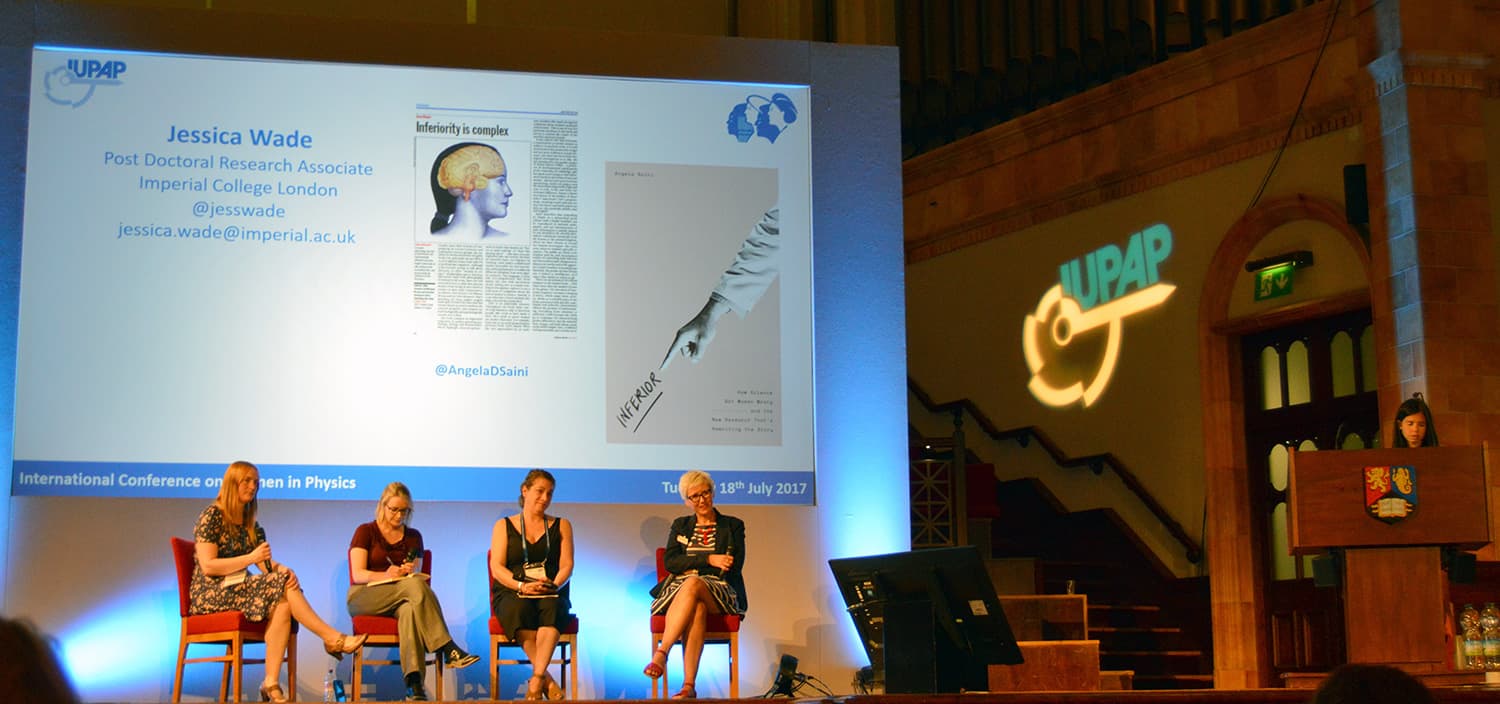
Over a series of blogs, Jess Wade from Imperial College London and myself have endeavoured to give you an insight into the conference – the international stories, the iconic women and the important hurdles still to overcome. To round this up and reflect upon the inspirational event, I spoke to conference chair Nicola Wilkin from the University of Birmingham.

“From the moment that Averil Macdonald started her icebreaker session, I knew that the programme we had put together was going to resonate with the fantastic, global audience that we had been able to bring together,” says Wilkin. “The Sun shone on us as well for that first all-important evening, facilitating the start of a week in which good practice and frustrations could be shared honestly.”

A key theme of ICWiP was that across all cultures, women are still in the minority in physics – and this only gets worse further up the academic pipeline. Discussions took place all week about how to combat the contributing factors such as unconscious bias and stereotyping, and it will be interesting to see how these translate into future practice. “I hope that further Project Juno type activities will be implemented across other nations,” says Wilkin, “as this has given us an infrastructure within which we can persuade people that they can speak out about workplace practices which are detrimental to all, and particularly women.”

For Wilkin, the “adrenalin peak” came when they veered from the published programme for a surprise address from Malala Yousafzai. “There were many damp eyes among the delegates, and also the university co-ordinator,” explains Wilkin. “I felt lost for words listening to her on the podium. Her powerful message will be remembered by all – and her commitment to our cause, which meant she fitted us into a phenomenally busy flight schedule.”

Another highlight for Wilkin was when she welcomed the delegates in the opening address. “I needed to remind myself that this predominantly female audience really was a physics one! This in itself was incredibly empowering. As I stood there I also felt that this was part of demonstrating ‘a working physics mother’ rather directly to my daughter who was in the audience as part of our fantastic student guide team.”

The conference will hopefully meet for the seventh time in 2020 and Wilkin hopes to see ideas and strategies for helping women get further through the academic pipeline – “I believe in a number of developing countries we have improved the early-stage career and we need to ensure that we have working practices in place to help these women thrive, and succeed rapidly.”

Until then, keep an eye out over the coming months for a feature on the great Dame Professor Jocelyn Bell Burnell, who received the Institute of Physics President’s Medal at ICWiP, and for a couple of podcasts on women in physics, which will include interviews with ICWiP delegates.

A special thanks must go to IUPAP, the Institute of Physics, the University of Birmingham and sponsors for organizing, hosting and funding such a great event. I’ve used the word inspirational a lot over these blogs, but it really is the best word to describe ICWiP. I am looking forward to ICWiP 2020 and hope to see you there!

the ICWiP logo

ALMA confirms Titan has membrane-forming chemical

Titan has molecules that may link together to form membranes resembling those of living organisms on Earth. The presence of acrylonitrile – also known as vinyl cyanide (C2H3CN) – on Saturn’s largest moon has been confirmed by an international team using data from the Atacama Large Millimeter/submillimeter Array (ALMA) in Chile.

Titan’s atmosphere mostly comprises nitrogen and some carbon-based molecules such as methane and ethane. While scientists suggest this chemical composition is similar to Earth’s primordial atmosphere, temperatures on the Mars-sized moon average at –179 °C – so cold that lakes, rivers and seas comprise liquid methane.

Hollow spheres

In 2015, scientists at Cornell University in the US predicted these extreme conditions could allow vinyl-cyanide molecules to link together and form sheet structures similar to lipid bilayers found in living cells on Earth – the main component of a cell’s membrane. Like the lipid bilayers, the researchers proposed that the sheet structures could form tiny, hollow spheres called “aztosomes”, which could act as small storage or transport containers. However, scientists had been unable to definitively confirm the chemical’s presence on Titan in among the planet’s array of carbon-rich molecules.

Now, using archival data from ALMA, Maureen Palmer of NASA’s Goddard Space Flight Center in the US and colleagues have identified that significant quantities of vinyl cyanide are indeed present on Titan. “The presence of vinyl cyanide in an environment with liquid methane suggests the intriguing possibility of chemical processes that are analogous to those important for life on Earth,” says Palmer.

Astrobiologically relevant

The team suggests that the chemical is probably most abundant in Titan’s stratosphere, where it likely rises, cools, condenses and rains onto the surface. This means that the moon’s second largest lake, Ligeia Mare, could have 10 million aztosomes in every millilitre of liquid – in comparison, coastal ocean water on Earth contains roughly a million bacteria per millilitre.

“The detection of this elusive, astrobiologically relevant chemical is exciting for scientists who are eager to determine if life could develop on icy worlds such as Titan,” says team member Martin Corinder. “This finding adds an important piece to our understanding of the chemical complexity of the solar system.”

The study is presented in Science Advances.

First Africa-led experiment switches on at CERN

The first Africa-led experiment at CERN is currently taking place at the Geneva-based lab’s ISOLDE facility. Researchers from the University of the Western Cape (UWC) in South Africa are studying the isotope selenium-70 to better understand how its nuclei shape relates to its energy levels. The group hopes that its presence at CERN will be a source of inspiration for other African scientists.

“The first thing it tells people in South Africa is that if we – a historically disadvantaged institution – can do it, any university in South Africa can do it,” says experimental lead Nico Orce of UWC. Determined to share the opportunity with as many colleagues as possible, Orce assembled a team of 11 people, which is more than the usual number for this type of experiment on ISOLDE. The team has nicknamed the experiment Ubuntu, a Xhosa word meaning “I am, because we are.”

Radioactive particles on tap

CERN’s Isotope Mass Separator On-Line (ISOLDE) facility provides the experiment with a low-energy beam of selenium-70 nuclei. These are smashed into a platinum target, which puts the nuclei into an excited state. By observing the gamma rays given off as the nuclei decay, the team can calculate the shape of the nuclei in the excited state. Results will test fundamental nuclear models and may also be relevant to nuclear astrophysics.

“UWC has a real battle to get funding and Nico has jumped through so many hoops to get here,” says David Jenkins of the University of York in the UK who co-led the experiment. “I wanted to get them involved at ISOLDE and help build the research expertise in the team.”

Capacity building

In supporting the African physics community, CERN works with other organizations including the Institute of Physics, which publishes Physics World. Both organizations support the African School of Physics, which seeks to build the continent’s capacity in fundamental research and its applications. In a related programme, when CERN upgrades computing equipment in its control centre it donates servers and other kit to African nations including Ghana and Senegal.

Perhaps the biggest impact of this first Africa-led experiment at CERN will be its symbolic importance in Africa and beyond. “Follow our lead” is the message the group wants to convey. “I’m so proud to be the only woman on this experiment and I feel like I’m representing all other women from Africa,” says MSc student Senamile Masango. “I would like to motivate all other women as well to come to science, to come to physics.”

A second South Africa-led experiment is already scheduled at ISOLDE. A team led by Hilary Masenda from the University of Witwatersrand will study the lattice sites, charge and spin states of iron using Mössbauer spectroscopy.

The above video is courtesy of Christoph Madsen and CERN.

Bias, stereotyping and harassment: what women battle

By Sarah Tesh about the International Conference on Women in Physics in Birmingham, UK

Have you ever thought about why, when asked to indicate your gender on a form, “male” comes above “female”? It’s not alphabetically first, so why is it listed first? I had never questioned this myself until Jocelyn Bell Burnell pointed it out in her Institute of Physics (IOP) President’s Medal lecture. This is an excellent example of bias in our day-to-day lives – while each one of us may believe we are fair and unprejudiced, we cannot always control what our brains do and many of us are unconsciously biased without meaning to be. Unfortunately, this is one of the factors holding back women in physics.

Bias, stereotyping and harassment were major topics during the International Conference on Women in Physics (ICWiP) last week at the University of Birmingham in the UK. Many delegates at the conference have experienced these issues to varying degrees and several of the talks focused on ways to combat them.

Maria Teresa Lago from the University of Porto in Portugal suggested that to improve the situation, it is important to address the question of fair competition, rather than gender balance directly. But in order to make the competition fair, you have to remove the obstacles unrelated to hard work or someone’s potential in physics – the bias and stereotypes regarding gender, race, religion and sexuality.

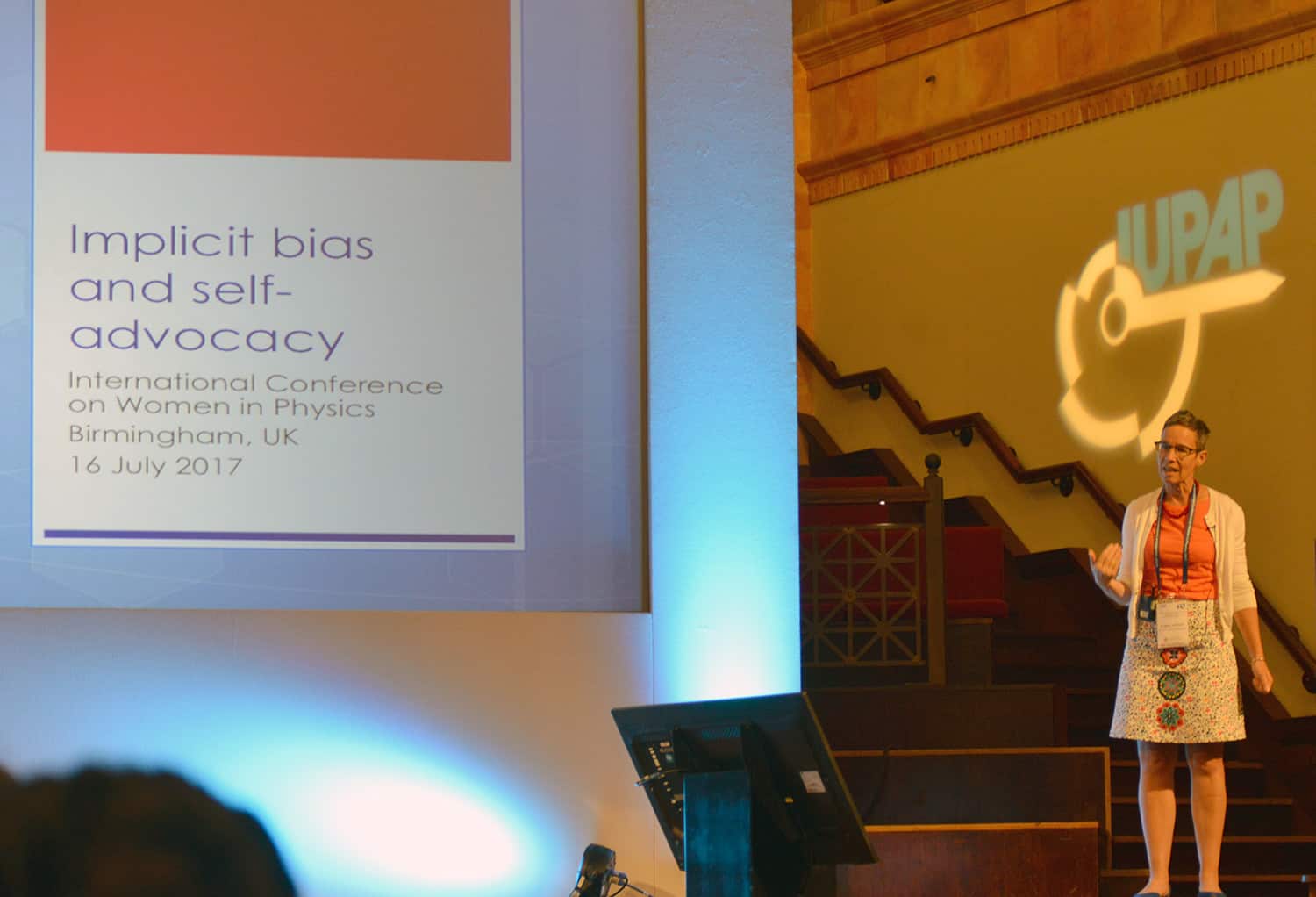
During two “Cultural perception and bias” workshops, we heard from Angela Johnson of St Mary’s College of Maryland in the US, and a panel of four UK physicists – Ruth Oulton from the University of Bristol, Emma Chapman from the Royal Astronomical Society, Jaimie Miller-Friedmann from the University of Oxford and the IOP’s Improving Gender Balance manager, Jessica Rowson. In both sessions, the speakers presented examples and statistics to get the discussion rolling.

Johnson noted that in her experience “being white made it easier to walk through doors” but being a woman and gay presented challenges. Some academic scenarios benefit the dominant social group while being harmful to the others. For example, studies have found that if challenging a stereotype while taking an exam, the extra pressure means you perform less well than those who fit the stereotype. As the stereotypical physicist and dominant group in the field is the white male, other groups experience problems.

Angela Johnson

Research has found that white women in America are 12.5 % more likely than their male counterparts to have their e-mails ignored when applying to doctoral programmes. For black women, the likelihood was 29.8 %, for Indian women 37.7 % and for Chinese women 77.0 %. In a similar study, researchers sent out CVs for lab-based jobs that were identical in every way except for the name of the applicant. As well as John being chosen over Jennifer, “white-sounding” names got 50% more call-backs than “black-sounding” names. This happened for all fields of science and all role levels. It also didn’t matter what gender the employer was – women can have unconscious bias against women.

Interestingly, Miller-Friedmann has found that successful women in physics, such as those who might be the employer, take on “masculine” identities in response to professional isolation during their career. In interviews these women began by listing their achievements from school grades to university degrees, and stated explicitly how they were different from the girly girls.

Bias and stereotyping can cause toxic working environments that, if allowed to fester (or if people are just plain horrible) can manifest in bullying and harassment. Chapman highlighted that in the US, 1 in 20 female undergraduates and 1 in 6 female postgraduates in astronomy have reported sexual harassment from a teacher or adviser. Meanwhile, in the UK, the Guardian reported in March that, despite 300 sexual-harassment claims in six years at 120 universities, only 37 alleged perpetrators left or changed jobs as a result, many simply moving to a different university.

Oulton, meanwhile, conducted a survey investigating the perceptions of gender and bias in a European research consortium. She found that all the women in the group had experienced harassment during their careers in the form of “intrusive comments about their body or unwanted sexual touching”. But their male counterparts were unaware of how common this was and fixated on their own perceived vulnerability to false accusations of harassment.

Despite these shocking findings, the true scale of sexual misconduct in academia is unknown, partly because people don’t know what to do in response. In her session, Johnson split us into groups and gave each a real-life case study, asking “what would you do?”. The cases involved racist and sexist comments, bullying, unwanted sexual attention and being cut off by colleagues because of differing gender identity. While most of us thought it best to talk to someone senior about the problem, Johnson stressed the importance of someone speaking up at the time – whether the individual, a colleague or direct senior. But that comes down to confidence and in each incident the subject had remained silent because they did not want to make things worse.

panel discussion

So, the question remains about how to counter all these problems and what strategies are needed. One key point is that it’s not just down to women to make changes; men need to be aware of the problem too. Worryingly, Oulton’s above-mentioned survey found that men and women “significantly disagree about the severity of inequality of opportunity in science and engineering” – half of the men do not think women are at a disadvantage despite evidence to the contrary.  They are therefore unaware of the role they play in encouraging bias and inequality. However, all agreed that those in authority need to provide clearer guidelines and action plans, and be seen to take “swift and fair action”.

Chapman proposes a “top-down change from the bottom-up” involving “grass-roots changes” such as codes of conduct and unofficial support networks, unconscious-bias training and awareness of gendered language at a higher level, and then policies for when things go wrong. However, “[the policies] need a lot of work and this change needs to come from the top”, Chapman points out.

Groups such as The 1752 Group, of which Chapman is a member, work with academics, student unions, universities, support services and national organizations “to conduct research that will lead to the development of best practice guidelines for the higher education sector”. The 1752 Group’s six strategic priorities for addressing staff-student sexual misconduct can be found online.

As well as taking action in higher education, there’s strong agreement that more needs to be done to remove bias and stereotypes at school level. While girls and boys may be equally interested in science at a young age, the attitudes of teachers and parents can hold girls back. For example, boys can dominate the classroom and get praised for hard work, while girls are praised for neat work. The Improving Gender Balance project suggests that to make a significant difference to students’ perceptions, work needs to be done across the whole school to challenge gender stereotypes. Rowson pointed out that good practice in the science department with regards to girls and STEM may be negated if gender lines are then enforced in other subjects, in break times, or in extracurricular activities. The project recommends strategies such as appointing a senior staff member as gender champion, providing teacher training in unconscious bias, highlighting positive role models and rethinking science clubs so that they don’t put girls off.

This only covers the tip of the iceberg regarding the problems women face in physics and the strategies under way to combat inequality. Change needs to happen so, as Chapman puts it “we can all just get on and do some science thank you very much”.

Ravens at LIGO, stained-glass physics, fake space pics

Stained glass physics plots

By Michael Banks and Sarah Tesh

Researchers working on the Laser Interferometer Gravitational-Wave Observatory might be answering some of the biggest questions in astrophysics, but last week they had a rather more down-to-Earth problem to solve. When spurious glitches were picked up by the detector characterization group at the LIGO detector based in Hanford, Washington, they went on an investigation to find the culprit. The team suspected that ravens were to blame as they had been seen causing mischief on tubes that vent nitrogen gas. These pipes are connected to the vacuum enclosure and any vibration could change the optical path length of light that is scattered from the test mass and reflected back. Upon closer inspection, LIGO researchers found peck marks that were “consistent with the size of a raven’s beak”. Not content with just watching the birds at play, the team even performed “simulated pecking” to see how this affected the machine’s performance. With the culprit now identified, you will be pleased to hear that the lines are set to be insulated to fend off the birds. “I guess we can’t blame [the ravens] for desiring ice on a hot desert afternoon,” writes Robert Schofield in a LIGO logbook post.

(more…)

Spintronic neuron recognizes speech

A spintronic device measuring just 375 nm across has been used to recognize human speech. The device is a spintronic oscillator, which behaves much like a neuron in the brain. Created by physicists in France, Japan and the US, the system is described as the first neuromorphic computer that is based on a nanoscale device.

Neuromorphic computers try to emulate the human brain. As well as having the potential to be faster and more energy efficient than conventional computers, they could also excel at learning how to perform certain tasks – rather than being pre-programmed to do so.

A spintronic oscillator comprises a non-magnetic layer of material sandwiched between two ferromagnetic layers – with each ferromagnetic layer being magnetized in a different direction. A voltage is applied to the device, causing a spin-polarized current to flow from one magnetic layer, across the non-magnetic layer, and into the second magnetic layer. This exerts a torque on the second magnetic layer, causing its magnetization to precess at microwave frequencies. This precession is monitored in terms of an oscillating voltage that develops across the device.

Nonlinear response

A minimum current is required for these oscillations to occur. As the current rises above this threshold, the amplitude of the oscillating voltage increases as the square root of the current. This current threshold and nonlinear response is similar to the behaviour of neurons, which is one reason why spintronic oscillators show promise for making neuromorphic computers.

The speech-recognition system was created by Julie Grollier and colleagues at Université Paris-Sud and Université Paris-Saclay, the National Institute of Advanced Industrial Science and Technology in Tsukuba and the National Institute of Standards and Technology, Gaithersburg, Maryland.

The process begins with a spoken word being captured by a microphone, digitized and then pre-processed to create an electrical current. This current is then fed into a spintronic oscillator, creating an oscillating voltage that is then analysed by a computer running a machine-learning program.

State-of-the-art performance

The team looked at how the system is able to recognize the numbers 0–9 when spoken by several different people. When the input signals were pre-processed using a “nonlinear cochlear filter” – the standard in such applications – the system achieved a recognition rate of 99.6%. Writing in Nature, the team describes this as a “state-of-the-art” performance that is normally achieved using much more complicated systems.

As well as being sub-micron in size, the oscillators can be made using the same fabrication methods as conventional computer chips. This, says the team, could allow one hundred million oscillators to fit on a thumb-sized chip. The researchers also point out that unlike other nanoscale oscillators, spintronic oscillators offer low noise operation, high stability and low energy consumption.

Judge approves telescope go-ahead

A judge has recommended that a construction permit should be granted for the $1.4bn Thirty Meter Telescope (TMT). Retired judge Riki May Amano called on the Hawaii Board of Land and Natural Resources (BLNR) to issue a new permit, so long as a number of conditions are met. If the BLNR agrees with Amano’s verdict, then construction of the TMT could begin in April 2018 with completion in 2022.

Once built, the TMT will be one of the world’s largest ground-based telescopes with a 30 m primary mirror that is made up of 492 hexagonal segments. The structure that will house the telescope will be 66 m wide and 56 m tall.

The TMT board chose Mauna Kea, which already hosts 13 other telescopes, as the observatory’s site in July 2009. Over the following six years, the organization received a series of necessary approvals and permits. However native Hawaiians, who regard the Mauna Kea summit as sacred – and who had previously objected to the growth in the number of telescopes there – carried out a protest at the telescope’s ground-breaking in October 2014.

Six months later, following further demonstrations, construction was postponed. Then in December 2015, the Hawaiian Supreme Court invalidated the TMT’s building permit, ruling that the BLNR had not followed due process when it was approved. The court then remanded the case back to the board, who appointed Amano to rehear the case.

Now, following 44 days of testimony by 71 witnesses, Amano released her judgement in a 305 page document. It calls for the permit to be granted, given that nine conditions, such as that building work abides by government rules, are met. The judge also calls for “additional conditions” to be met, including that employees attend mandatory cultural and natural resources training and that the organization creates “informational exhibits” for visitors that showcase the natural, cultural and archaeological resources of Mauna Kea.

The BLNR will now invite all parties to submit their response to Amano’s verdict before making a final decision to grant the permit. Meanwhile, TMT chose La Palma in the Canary Islands as a back-up site earlier this year.

Pulling proteins through a pore dissolves aggregates

Aggregated proteins can cause diseases such as Alzheimer’s and Parkinson’s. Using cryo-electron microscopy (cryo-EM), Daniel Southworth and his team at the University of Michigan, in collaboration with Jim Shorter at the University of Pennsylvania, discovered how yeast solves the problem of protein aggregates. They observed on an atomic level how a protein called Hsp104 recognizes and unfolds proteins, thereby dissolving harmful protein aggregates (Science 357 273).

Many organisms have adapted to the threat of aggregated proteins by producing so called disaggregases. Now for the first time, researchers have observed the molecular mechanism of such a disaggregase.

The Hsp104 complex consists of six subunits arranged in a spiral with a central channel through which the aggregated protein is pulled. By switching between two conformations, one subunit after the other releases its grip on the target protein and grabs it again further up the chain. Every switch pulls the aggregated protein further through the channel, thereby unfolding it. The cooperative action of six subunits powered by adenosine triphosphate (ATP) hydrolysis provides enough force to even dissolve stable aggregates.

Like many other disaggregases, Hsp104 belongs to a group of proteins powered by ATP. These proteins fulfil diverse functions by changing conformation upon ATP hydrolysis. When ATP is hydrolysed to ADP, energy is released that allows the protein to move to another conformation. In the case of Hsp104, two parts move like little arms to release the target protein and grab it again further down the chain.

In order to observe this fast process, in their study Southworth and colleagues used a molecule that is similar to ATP but is hydrolysed more slowly. This gave them time to observe the unfolding process using cryo-EM.

The low temperature in cryo-EM makes it possible to take images of protein complexes while minimizing radiation damage that results from the necessary electron beam. The researchers collected images of protein complexes at random angles and averaged these to yield a three-dimensional structure. Resolution down to 4Å, at which it is possible to see amino acid side chains, allowed Southworth and his team to observe the mechanism at great detail.

When proteins avoid water

Ideally, a protein assumes its intended three-dimensional structure, called the native state, after being synthesized. By moving to the protein centre, this process allows hydrophobic regions of the protein to avoid contact with water. If the hydrophobic regions end up on the surface instead, for example due to high temperature, they will bind to neighbouring proteins to avoid water. As a result, aggregates form. This process is irreversible because the proteins are in a low-energy state that makes them very stable so that they cannot refold without energy input and the help of other proteins such as disaggregases.

Large aggregates of proteins disrupt normal cellular processes especially in nerve cells. Apart from Alzheimer’s and Parkinson’s, there are many other amyloidoses, diseases caused by protein aggregates, including amyotrophic lateral sclerosis (ALS), famous from the ice bucket challenge, and bovine spongiform encephalopathy, also known as mad cow disease.

In their study, which was published in Science on 21 July, the authors used casein, a protein commonly found in milk that readily aggregates, as a model substrate protein. Their assumption is that the mechanism of disaggregases on casein is the same as for physiological substrates. The discovery of this general mechanism might help to find drugs and therapies against aggregated proteins.

Science, scepticism and fear at the theatre

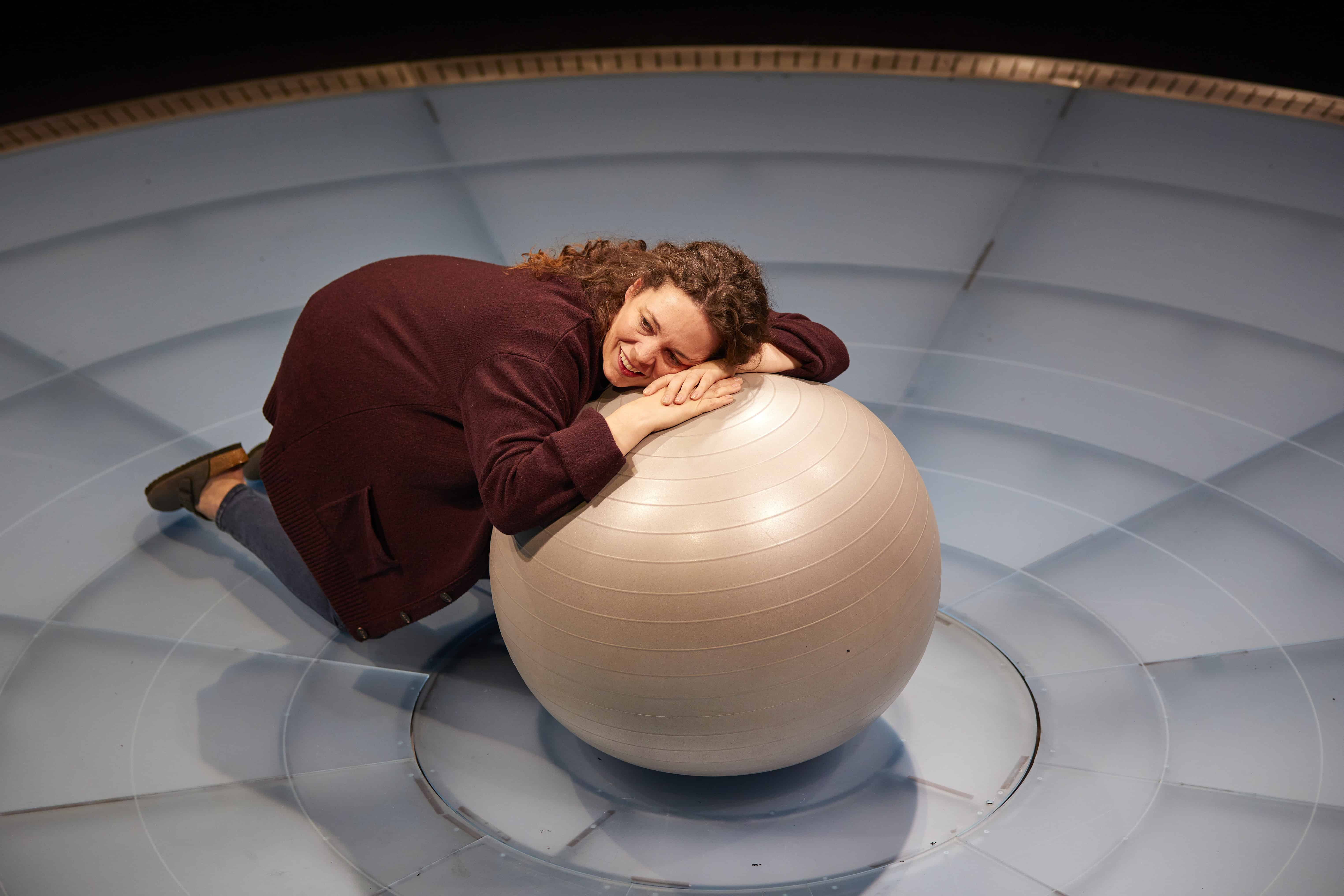
Olivia Williams (left) and Olivia Colman in Mosquitoes by Lucy Kirkwood

Working at Physics World for the last six years has taken me to some pretty cool labs – everywhere from CERN to the Laser Interferometer Gravitational-wave Observatory (LIGO). My job has allowed me to meet some quite famous people too…at least in the world of physics, that is. But getting to spend a morning at the National Theatre in London watching Olivia Colman and Olivia Williams rehearse for a play is not usual even for me. That is precisely why I jumped at the chance, when I found out that the pair star as sisters in the recently opened play Mosquitoes.

You may be wondering what a play with that moniker has to do with physics. Mosquitoes tells the story of rational and lucid Alice (played by Williams), a particle physicist at the Large Hadron Collider (LHC), and her often-illogical sister Jenny (played by Colman) “who spends a lot of time Googling” and is easily swayed by the bad science she chances upon. Written by Lucy Kirkwood and directed by Rufus Norris – the National Theatre’s current artistic director, the play follows the siblings through a family tragedy, as well as the fairly disastrous switching on of the LHC in 2008, and takes a hard look at our relationships with science, facts, belief and so much more. Kirkwood, whose previous successes include Chimerica and The Children, was commissioned to write the play by the Manhattan Theatre Club as part of its Alfred P Sloan Foundation initiative, which aims to “stimulate artists to create credible and compelling work exploring the worlds of science and technology and to challenge the existing stereotypes of scientists and engineers in the popular imagination”.

I’ll be honest with you: I had my doubts when I first heard about the play and read its short premise, which includes the line “When tragedy throws them together, the collision threatens them all with chaos.” But within a few moments of watching Colman and Williams rehearse (what I later learnt was) one of the play’s most brutal and powerful scenes, I was absolutely captivated. I won’t reveal much about what I watched them perform (spoilers!), but it was quickly apparent to me that Mosquitoes is the play we need in these times of “alternative facts”. The play is set in 2008 because that is when Kirkwood began writing it, and of course the science news making the global headlines at the time was the switching on of the LHC. After nearly a decade of writing, editing (she did a big rewrite after Brexit) and finessing, the play opened last week and is solidly sold out for its entire run until the end of September. In fact, the only way to get a ticket is to try your luck via the National Theatre’s weekly Friday Rush ticket lottery.

I caught up with Kirkwood to talk about art, science, the “human condition” and how it can be improved. “For me, as a lay person, the whole play is about how we engage with brilliant people…I’m split between Jenny and Alice myself when I try to understand science.”  She remembers the doomsday headlines about black holes and worse that surrounded the LHC and is intrigued by fear. “Where does such fear come from, especially from usually coherent people?” she ponders. She is quick to add though that she too can be quite irrational at times, and it is often when we are at our most vulnerable that misinformation and its purveyors can get their hooks into you.

This is one of the main themes that Kirkwood explores in the play, about how we are “somehow wired to be a bit fearful” and how this can affect the most rational of people, not to mention those who are more inclined towards unfounded belief. In a telling scene, a pregnant Jenny longs for a cigarette, insisting to Alice that their mother smoked while pregnant with both of them. In the same breath, she refuses to get an ultrasound scan, citing some study she found on the Internet that suggested the procedure was not completely safe. This sort of juxtaposition in reasoning is something that Kirkwood deftly uses throughout the play and is the main source of Jenny and Alice’s disagreements.

Olivia Colman playing a pregnant Jenny (Courtesy: National Theatre/ Brinkhoff Mogenburg)

For Kirkwood, this behaviour also links to the “current anti-intellectual and anti-expert strain…we can’t seem to separate fact from feeling”. As she and I talk about the false information that surrounded Brexit and the campaign for Britain to leave the European Union, she points out that “the people making these claims knew the information was false, but that didn’t seem to matter”, as these falsehoods would do most harm to the non-elite. In an age where information is power, Kirkwood worries about the “currency of fear”, which has the biggest impact on people who are at their most vulnerable.

As I talk to Kirkwood I can’t help but think of how Williams, who I also had a long chat with after watching the rehearsal, described the playwright. “Her extraordinary skill is in embracing complex philosophical, scientific and psychoanalytical ideas, and putting them into real people and turning them into scenes.” As I ask Williams more about the kind of topics Kirkwood likes writing about, she gets rather poetic herself, telling me “She is sort of boundless…my father used to collect Persian rugs and they say that with Persian rugs if you look at it they have a border on the outside but that the picture inside is infinite and that’s a bit like Lucy Kirkwood’s brain. That her outline is just containing infinite possibilities of thought and drama and we’re just seeing into a little window of her crazy brain.”

Williams describes Mosquitoes as embracing “everything from why we have mass, how the universe began, what the consequences of colliding particle might be and the elusiveness of the Higgs boson”. She adds that Kirkwood’s ability is to take “tangible things and spin them into another place”, for instance, she has turned the Higgs particle into a person who has disappeared. “The other thing she does is that she takes things that have a rational explanation and applies them to what we are, which is irrational beings…how do you know something if you can’t see it? It’s a huge philosophical question which [Kirkwood] tackles in an unbelievably conversational and domestic way…you know, two sisters having a fight about the safety of an ultrasound or the safety of a vaccine.”

Artistic vision: Rufus Norris and Lucy Kirkwood in rehearsals for Mosquitoes (Courtesy: National Theatre/rinkhoff & Mogenburg)

Indeed, the arguments and fights that the sisters have are simultaneously some of the most riveting and difficult-to-watch parts of the play. Williams worries that “I am going to be the most hated woman in Britain because I stand attacking a national treasure [Colman] shouting ‘you’re a retard….I reject you and we have to leave you behind and move on!’ ” The scene she is talking about happened to be one of the two I watched the pair perform and I myself couldn’t help feeling bad for Jenny, even though I agreed with much of what Williams’ character Alice was saying – but I suspect that it is these conflicting emotions from varying perspectives that Kirkwood wants us all to think about.

I asked Kirkwood and Williams if they had visited CERN to prep for the role and do research. “We [the National Theatre] have just had a half a million budget cuts so trips to CERN are not included,” says Williams, but she watched some lectures and spoke with a friend who is a producer of BBC Radio 4’s The Life Scientific to try get to grips with the science. She also tells me that in preparing for any role, “I do not need to know what they know…I need to know how to look like I know what they know and to inhabit their attitude of mind. I’m not going to be able to understand the physics but I have to understand how it makes me feel when I find something out or when I find something doesn’t work, or when someone like my younger sister does all her learning with irrational Googling. It’s a funny business because you find yourself asking people who do what you’re pretending to do what they think are the most tangential, bizarre and irrelevant questions…It tends to be things like ‘What shoes do you find comfortable when you’re at CERN?’ ”

 Looking ahead: Olivia Williams in Mosquitoes by Lucy Kirkwood (Courtesy: National Theatre/ Brinkhoff & Mogenburg)

Kirkwood concurs, telling me that she usually looks for “emotion rather than data”, although the script does include a lot of scientifically accurate vernacular – “I’m a word junkie and ‘quench’ is a great word!” For this, Kirkwood did have four particle physicists from CERN serving as consultants who regularly advised her on the science. She also confesses that “I have a history of writing plays that are difficult to stage and visualize…but I couldn’t help anthropomorphizing the Higgs boson because I love writing characters.”

Mosquitoes was partially funded by the Institute of Physics (which publishes Physics World), so I was interested to know how both Kirkwood and Williams felt about art–science collaborations and the impact they have on educating people. “I think something moving that has happened in the last 10 years is that I have had much more access to physics and science than I had since I was at school…and I do think there is a collision – please excuse the pun – between the arts and the sciences at last, thank god,” says Williams, adding “Unless people understand how the planet works, we’re going to fuck it up. If we keep rejecting science in all its forms…well the consequences are in this play.” Kirkwood agrees, telling me that just like Jenny and Alice, the arts and the sciences are two parts of the same world, which must come together and push to the future. Williams believes “We should all be hanging out in the same space and talk about each other’s work…so tell all the physicists!”

• Look out for a review of Mosquitoes by Arthur I Miller.

Copyright © 2026 by IOP Publishing Ltd and individual contributors