The UK government has launched the “Faraday Challenge”, which will invest £246m in boosting the country’s expertise in developing battery technology.
Running over four years, the first phase of the programme will include a competition to develop a £45m “Battery Institute” that will provide a framework for battery research and development. The institute will be a consortium of universities that will be selected by the Engineering and Physical Sciences Research Council, which provides government funding for research in the UK.
Promising research done by the Battery Institute and elsewhere in the UK will be moved towards commercialization through collaborations between academia and industry. This process will be facilitated by Innovate UK, which is a government body that provides funding to companies for the development of new products and services based on science and technology.
Manufacturing development
The Faraday Challenge will also fund a new National Battery Manufacturing Development Facility for the UK. A competition for hosting the facility will be led by the Advanced Propulsion Centre, which is an industry-led private company that seeks to develop technologies that can be used in low-carbon-emission transportation systems.
The Faraday Challenge was announced by business secretary Greg Clark, who has appointed Richard Parry-Jones to chair the Faraday Challenge Advisory Board. Parry-Jones spent much of his career working for the Ford Motor Company, where he held several senior positions before retiring a decade ago to work as an adviser to governments and industry.
Parry-Jones says: “The power of the Faraday Challenge derives from the joining-up of all three stages of research from the brilliant research in the university base, through innovation in commercial applications to scaling up for production.” He adds: “It will focus our best minds on the critical industrial challenges that are needed to establish the UK as one of the world leaders in advanced battery technologies and associated manufacturing capability.”
Construction has begun on a huge neutrino facility located at the Sanford Underground Research Facility in Lead, South Dakota. The Long-Baseline Neutrino Facility (LBNF) will study the properties of neutrinos in unprecedented detail, as well as the differences in behaviour between neutrinos and antineutrinos. Institutions in 30 countries are involved with the LBNF, which will take about a decade to build and once complete will be the world’s highest-intensity neutrino beam.
The centrepiece of the LBNF is a four-storey-high neutrino detector – dubbed the Deep Underground Neutrino Experiment (DUNE) – that will be built almost 1500 m underground in South Dakota. The detector is made up of four tanks that are each filled with 17,000 tonnes of liquid argon.
Underground journey
DUNE will measure the neutrinos that are generated by Fermilab, which lies around 1300 km away just outside Chicago. Fermilab will accelerate protons before smashing them into a piece of graphite. The particles that emerge from these collisions will go into a 200 m-long tunnel and decay into neutrinos. The neutrinos will first arrive at a “near detector” at Fermilab, where the beam will be characterized before heading on a 1300 km journey underground to DUNE. The neutrinos then interact with the liquid argon, which produces electrons that can be easily measured.
“The start of construction on this world-leading science experiment is cause for celebration, not just because of its positive impacts on the economy and on America’s strong relationships with our international partners, but also because of the fantastic discoveries that await us beyond the next horizon,” says US energy secretary Rick Perry. “I’m proud to support the efforts by Fermilab, Sanford Underground Research Facility and CERN, and we’re pleased to see it moving forward.”
Recent studies have suggested that lead halide perovskites may end the search for the ideal X-ray photoconductor. Common solution-process protocols for fabricating thin films of these materials, however, are difficult to scale to the large areas required for X-ray detectors. In work recently published in Nature Photonics, a team of German researchers has presented an alternative, physical method of processing perovskites to solve this issue. The wafers produced using this sintering technique showed comparable performance to commercially available X-ray photodetectors.
The search for an ideal X-ray photoconductor has led researchers to hybrid organic-inorganic perovskites (HOIP), a class of materials that is already a major target for use in photovoltaics, light-emitting diodes and lasers. Current commercial detection systems based on materials like amorphous selenium and cadmium telluride are limited by low absorption coefficients and stability issues at high energies. HOIP materials, however, have the intrinsic ability to effectively absorb high-energy radiation because their composition includes heavy metal and halide ions. Perovskite X-ray detectors may therefore be a more effective alternative to existing detecting systems.
To date, much of the research has focused on solution-processing of perovskite thin films. While this is an efficient method for producing samples in the sub-micron regime, producing thicker layers, especially over large areas, is extremely difficult. This problem has so far hindered the development of perovskites for medical applications like X-ray detectors.
To get around this problem, first author Shreethu Shrestha and colleagues at Friedrich-Alexander-University Erlangen-Nürnberg in Germany, in collaboration with researchers at Siemens and the Bavarian Center for Applied Energy Research (ZAE Bayern), produced layers of perovskite using the physical method of sintering. Squeezing methyl ammonium triiodide perovskite (MAPbI3) powder in a hydraulic press for just five minutes, the researchers formed compact layers, or wafers, that were more than a centimetre in diameter. Depending on the amount of powder used, the resulting wafers ranged in thickness from 200 μm to 1 mm.
According to team member Gebhard Matt, also at Friedrich-Alexander-University Erlangen-Nürnberg, this was remarkable because such a sintering process is not possible for covalent semiconductors like silicon, which lack the plasticity of perovskites. As well as producing large-area detectors, sintering also allows the perovskites to be fabricated at room temperature, which makes the procedure simpler and cheaper than solution-processing.
Scanning electron microscopy (SEM), x-ray diffraction and photoluminescence confirmed that the crystallinity of the material was preserved after the sintering process. The grain boundaries of the microcrystals remain well defined following sintering, but, says Matt, “the surface of the wafers is as smooth as the surface of the cylinder in the hydraulic press”.
The group tested the X-ray performance of their wafers against a commercial cadmium telluride (CdTe) system, Timepix, which is the current state-of-the-art system for X-ray and gamma-ray detection. The group found that their MAPbI3-based detector had sensitivity and conversion values comparable to the Timepix system. CdTe is expensive, and only a few companies worldwide can produce the crystals, so even though the perovskites did not perform better than Timepix, their simpler preparation process makes them an attractive alternative.
Still, the researchers report that much work must be done prior to implementation of perovskite-based X-ray detectors. One major issue they encountered in their device was the presence of a high and unstable dark current. To fix this, the researchers now plan to explore carrier-selective electrodes to improve the performance still further.
Gravitational waves from nearby pulsars could be detected using just a few kilograms of superfluid helium-4, according to physicists in the US. Their detector, which is yet to be built, would measure sound waves in the superfluid caused by gravitational waves in the 0.1–1.5 kHz range.
Gravitational waves are ripples in space–time that are created when massive objects are accelerated under certain conditions. The first gravitational-wave detection was made in 2015, when the LIGO observatory spotted a signal from a coalescing binary black hole. Two more gravitational waves have since been detected by LIGO, both associated with binary black holes.
LIGO is a wideband detector that can detect signals in the 10 Hz–5 kHz range. It is particularly good at detecting transient signals (that change in frequency) associated with coalescing black holes.
Low-noise measurement
Swati Singh of Williams College, Laura DeLorenzo and Keith Schwab of Caltech and Igor Pikovski of Harvard University want to build a detector that can focus on a relatively narrow frequency band to detect gravitational waves from pulsars. A pulsar is a rapidly rotating neutron star that is expected to continually broadcast gravitational waves at a specific frequency in the 1 Hz–1 kHz range – with the frequency depending on the physical characteristics of the pulsar. By making a narrow-band measurement over a long period of time, a very low noise signal from a pulsar could in principle be detected.
Singh and colleagues’ detector comprises several kilograms of superfluid helium held in a cylindrical container that is coupled to microwaves in a superconductor resonator. Confinement in the container means that the superfluid will resonate with sound waves at certain frequencies – just like a musical instrument.
This acoustic resonance also means that the superfluid should act like an antenna that is tuned to detect gravitational waves at specific frequencies. When such a gravitational wave travels through the detector it would create a strain field that would create sound waves in the helium. The microwave resonator would then convert these waves into a measureable signal.
Adjustable frequency
Although others have tried to make such antennas using metal bars, the team says superfluid helium offers several benefits – including the fact that the frequency of the detector can be changed by adjusting the pressure of the helium.
Writing in New Journal of Physics, the team reckons that, using state-of-the-art microwave transducer technology, the detector could measure signals from certain types of pulsars after running several months.
Is it possible for four neutrons to bind together to create an uncharged nucleus called a “tetraneutron”? The answer is a qualified “yes”, according to physicists in the US and France.
The idea of a tetraneutron goes back several decades, but it was not until in 2002 that the first tentative experimental evidence was found – by an international team of physicists working at the GANIL nuclear physics lab in France.
Near discovery
Then, in 2016, physicists working at the RIKEN nuclear-physics lab in Japan found evidence for tetraneutron in a different experiment that involved firing neutron-rich helium-8 nuclei at a helium-4 target. While they did not see direct evidence for a tetraneutron, careful measurements of the two helium-four particles produced in the collision suggest that the other four neutrons involved in the collision emerge in a bound state. The statistical significance of the measurement was 4.9σ – just shy of the 5σ needed for a discovery.
Despite this growing evidence, physicists do not have a clear theoretical understanding of how a tetraneutron could exist. Now, Kevin Fossez, Jimmy Rotureau and Nicolas Michel of the National Superconducting Cyclotron Laboratory at Michigan State University and Marek Płoszajczak of GANIL have done new calculations that are able to reproduce the energy of the tetraneutron observed at RIKEN.
Short lifetime
However, when the team used its method to calculate the energy width associated with the tetraneutron, the researchers found it to be significantly larger than that measured at RIKEN. A larger energy width corresponds to a short lifetime for the tetraneutron, and this has led the team to suggest that the four-neutron system may not stick around long enough to be considered to be a nucleus.
A team of scientists from the UK and China has for the first time observed Fermi arcs – a distinct signature of the presence of topological properties – in a microwave metamaterial. Recent experiments have revealed Fermi arcs in quantum matter, but this is the first time they have been seen in a classical 3D system. The finding paves the way towards the study of a new class of topological optical materials, which could have important applications in communications because of their promise to send signals around corners or over defects without any loss of signal strength from scattering.
Fermi arcs are known to provide the connection between two topologically different surfaces in a quantum material called a Weyl semimetal. The electronic band structure in this material features so-called Weyl points, the 3D version of the Dirac points observed in graphene and other two-dimensional materials, where the dispersion is linear and the electronic bands cross each other. These Weyl points have a definite chirality, which can be understood as topological “charges”.
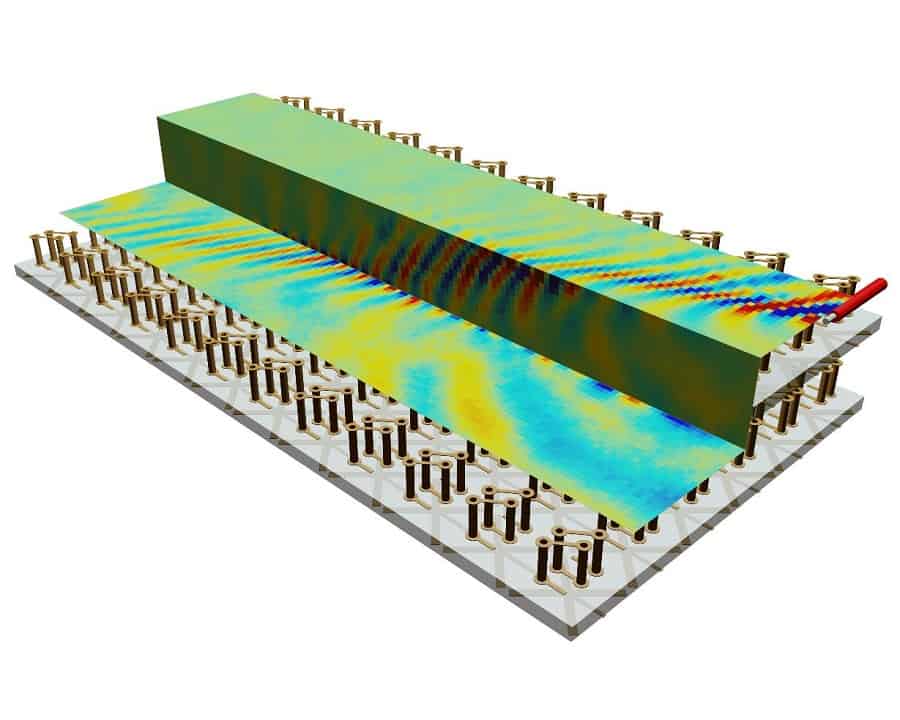
The researchers, led by Shuang Zhang from the University of Birmingham, therefore exploited chirality in the design of their topological metamaterial, along with hyperbolicity, to engineer the required dispersion. The material comprises a stacking of multiple tri-layers. The bottom layer possesses hyperbolic dispersion, which results from 200 μm-wide metallic wires running across its top surface, with metallic crosses superimposed on the wires to increase the capacitance and suppress non-local effects. The middle layer is a thin dielectric spacer that prevents electrical contact between top and bottom layers, while the top layer introduces chirality through the presence of metallic helices, each having 2.5 turns.
Backscattering-free surface wave propagating across a 3D step made of layers of chiral hyperbolic metamaterial (not to scale).
The researchers exploited a near-field scanning technique using microwave antannas to observe the Fermi arcs on both the top and side surfaces of their chiral hyperbolic metamaterial. The near-field distribution, once Fourier transformed into the frequency domain, clearly reveals the presence of Fermi arcs on the surface between the bulk states.
To further investigate the topological nature of the system, the group stacked several layers of the chiral hyperbolic metamaterial together to form a step. In this arrangement the topological protection of the surface state forces the surface wave excited at the top layer to bend around the step and to propagate forwards without any reflections from the edges. The absence of scattering as the surface wave propagates across the step confirms the topological nature of the chiral hyperbolic metamaterial.
One key feature of topologically protected states is that certain bands in the dispersion relation cannot interact, which means that a wave travelling in one band is not allowed to jump into another band. In this experiment, the researchers explain, the surface wave travels over the corner without any scattering because there is a topological charge difference between the Weyl points connected by the Fermi arc.
Next the researchers intend to investigate other systems that support topologically protected waves and find ways to more accurately steer waves on surfaces. Using simpler geometries, the group will be able to miniaturize these materials so that they can work at THz, infrared and optical frequencies.
Circa 1988: the Doomsday Clock during safer times. (Courtesy: The Bulletin of the Atomic Scientists)
By Hamish Johnston
This year marks the 70th anniversary of the Doomsday Clock that is produced by The Bulletin of the Atomic Scientists. Currently at two and a half minutes to midnight, the clock represents the likelihood of a human-caused global catastrophe. Originally, it focused exclusively on a nuclear Armageddon, but in 2007 climate change and other technologically-driven processes were added to the mix. The clock was initially set at seven minutes to midnight in 1947 and the Bulletin has produced a video that charts the ups and downs over the past seven decades. Is there any good news? In the image above you can see that South Africa was a nuclear power in 1988, and it has since disarmed.
A droplet of oil can be transformed into a Saturn-like ringed structure by placing it in a strong electric field – according to Quentin Brosseau and Petia Vlahovska, who did their experiments at Brown University in the US.
The fantastical effect is driven by a process called electrodynamic flow, whereby an external electric field causes the movement of electric charges at the surface of a liquid drop. In turn, this motion causes the liquid within the drop to circulate in cells – and this can distort the shape of the drop.
Brosseau and Vlahovska studied droplets of silicone oil suspended in castor oil and exposed to an electric field. Exactly how the drops distort is a function of the electrical properties of the two liquids, and this was adjusted by doping the castor oil with organic electrolytes.
Concentric rings
In one experiment, the researchers were able to flatten a millimetre-sized drop to create a lens-like disc with a relatively sharp edge. The edge is unstable, and a thin sheet of liquid begins to flow radially away from the edge. As the sheet flows outward, it breaks up into a set of concentric rings. Then, the rings themselves break up into a plethora of droplets, each about 10 μm in size. If the electric field is switched off before the process is complete, the large drop will become spherical again and the system will resemble the planet Saturn (see figure).
Brosseau and Vlahvoska found that this droplet-shedding process lasted for a few tens of seconds before the original drop was transformed into thousands of uniform droplets. Writing in Physical Review Letters, the researchers say that the phenomenon could be used for the large-scale production of tiny droplets of uniform size – something that could find a range of industrial and medical applications.
Canadian physicist Paul Corkum is among 17 scientists honoured by the Royal Society‘s annual awards. The prizes recognize researchers who have made outstanding contributions to science.
Corkum has been awarded a £10,000 Royal Medal for his contributions to laser physics and the relatively new field of attosecond (10–18 s) science. Currently working at the University of Ottawa, Corkum has pioneered concepts in this branch of physics. He has demonstrated how attosecond optical and electron pulses can be created by controlling the interaction between laser light and matter. Using such short electron pulses, he has made the fastest “real-time” measurements ever recorded and combined them with sub-0.1 angstrom spatial resolution.
“Truly wonderful surprise”
“When I received the notification informing me that I’d won the Royal Medal I thought that it was a scam – like when you get an e-mail saying you may have won $1,000,000,” says Corkum. “This was a truly wonderful surprise and compliment. Receiving the Royal Medal is a sign that the scientific community recognizes the importance of attosecond science, a field where there are strong future opportunities.”
Corkum and the three other Royal Medal winners will receive their medals at an awards dinner in the autumn. Meanwhile, Timothy Leighton of the University of Southampton has been awarded the Clifford Paterson Medal and Lecture for his research on the applications of acoustics.
A couple of weeks ago, Physics World received an e-mail that made my blood boil. The sender requested for his comments not to be published, so he shall remain nameless but here’s the jist of his message:
The latest issue of Physics World contained too many articles on women in physics (it had five small pieces on the topic). He finds the subject tedious and thinks it no longer needs covering – but it’s OK for him to say this because his daughter is doing physics at university.
In my opinion, this is an excellent example of exactly why it is important to talk about equality in physics. Some members of the community just don’t see that there is still a problem.
In an excellent coincidence, I signed up for the International Conference on Women in Physics (ICWiP) that very week. The conference is run by the Institute of Physics (IOP) and the International Union of Pure and Applied Physics (IUPAP) and has been taking place this week at the University of Birmingham in the UK. ICWiP gives people from around the world, and at all stages of their careers, a chance to discuss and tackle the many topics surrounding women in physics. These include under-representation, stereotypes, conscious and unconscious bias, inequality in pay, the drop-off as you progress through academia…the list could go on.
Most importantly, however, the event gives women physicists a chance to meet, share stories and network – a chance to realize you are not the only one. This sounds cheesy, I know, but considering the representative from Zimbabwe, Helga Danga, is the only female physicist she knows of in her country, it is also surprisingly accurate.
While I could only attend the first two days, there is so much I would like to talk about. Every woman in attendance was incredibly impressive and inspiring and I could write an article on each individual. Sadly, this is not feasible but I shall endeavour to give you an insight over a couple of blog posts and with the help of Jess Wade from Imperial College London.
When talking about women in physics, a common starting point is to look at the stats — for some people, especially scientists, it is only when they see the statistical evidence that they believe there is a problem. The data presented at ICWiP was damning and undeniable, and while too vast to list in detail here, it all points in the same direction — women in physics are significantly under-represented, paid less and promoted less.
But as well as looking at statistics, it is also important to listen to the stories of individuals and build a plan of action based upon personal experiences. A key theme of ICWiP was therefore interaction and collaboration. In her welcome address, conference chair Nicola Wilkin stressed that this was not to be a passive conference. She even set a “homework assignment” for delegates to get photographic evidence of themselves making two new associates. Nicola’s “partner in crime” Igle Gledhill, chair of IUPAP’s Women in Physics Working Group, also emphasized how the current political climate in some countries is making it harder for all scientists, let alone women in physics, and asked us to put our heads together as much as possible. “Please think – while it’s still legal,” she implored.
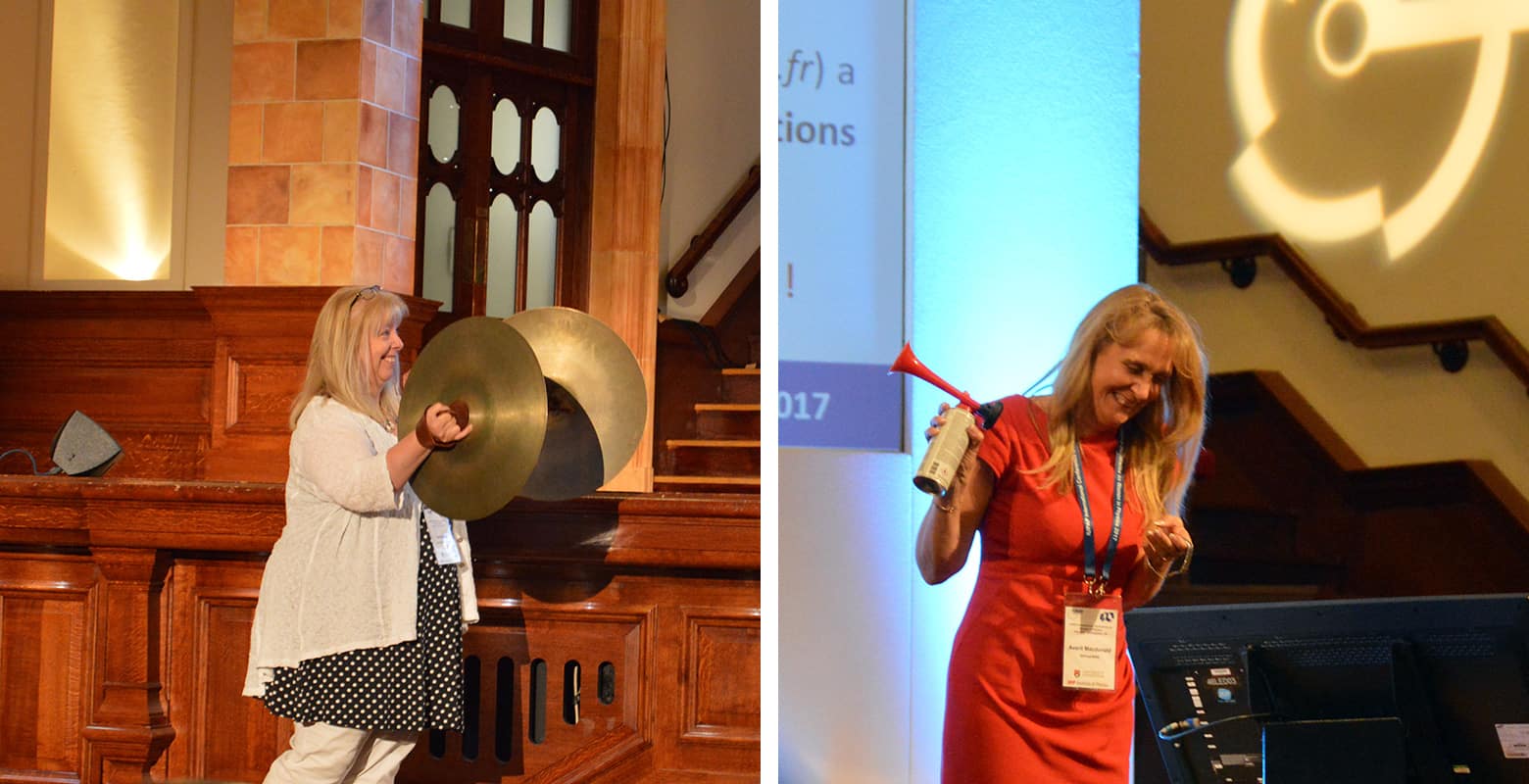
The format of the conference was designed to encourage these discussions through plenary talks, workshops, posters and social events. While, let’s be honest, many people do not find poster sessions the most enthralling part of a conference, the organizers of ICWiP used an ingenious method of nurturing interest. The delegates from 39 countries presented the overview of their posters in 90-second talks, attempting to entice us to visit their stands. We all know that time-keeping for presentations is a fine art, so Monday’s session featured chair Averil MacDonald sinisterly creeping up the stage stairs with a foghorn at the 15-second countdown. On Tuesday this was upgraded to a large set of cymbals brandished by chair Val Gibson.
Laughing alarms: chairs Val Gibson and Averil Macdonald providing entertaining time-keeping methods. (Courtesy: Sarah Tesh)
Macdonald and Gibson’s approach ensured a relaxed atmosphere with everyone enjoying the antics, while also making it easy to listen to the quick-fire presentations. I found it fascinating to hear about the status of women in physics throughout the world. While some countries face problems similar to those in the UK, others have to compete with extra obstacles.
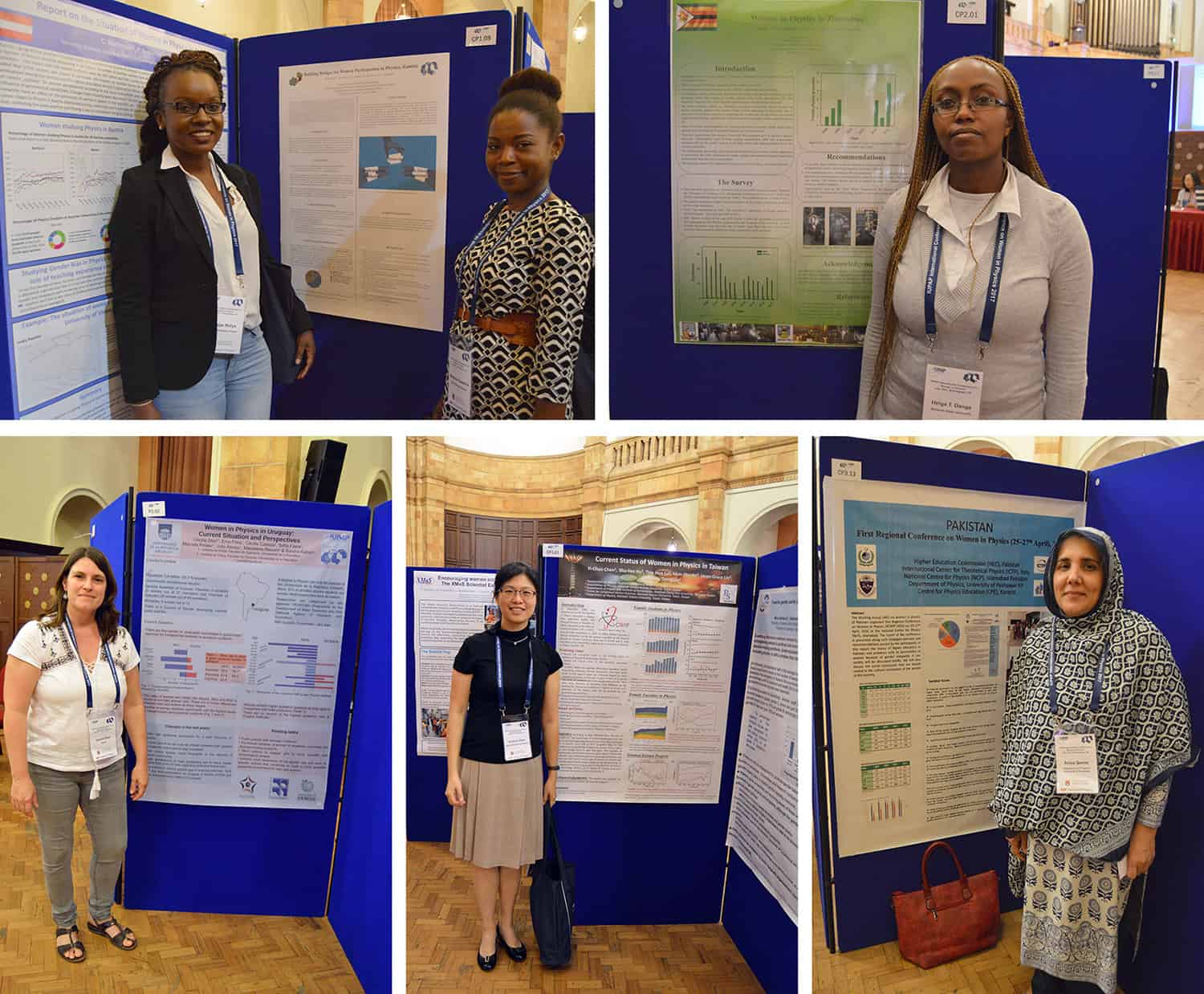
One of the more harrowing stories came from Anisa Qamar of the University of Peshawar in Pakistan. “The first problem is the war against terrorism,” she explained. Peshawar is in the Khyber Pakhtunkhwa province, bordering Afghanistan. “There is a completely chaotic situation in Afghanistan and that area. The Taliban are actually destroying the girls’ schools because they don’t allow women to learn.” She told me two-thirds of women in Pakistan cannot read or write and 36% of girls are out of school. As the first and only female professor in the province, however, Anisa is determined to make a difference. In 2016 she arranged the first Regional Conference on Women in Physics, despite the opposition of her head of department and the institute’s dean. Thankfully, she got funding from the Higher Education Commission of Pakistan and the International Center for Theoretical Physics, enabling around 150 female undergraduate and postgraduate students to attend and discuss the societal issues and constraints. One of their key conclusions was that women should be exposed to training in technologically advanced countries to help their professional development before returning to Pakistan. “One woman can change and educate a family. One woman can change a lot if she is determined,” she said.
A common problem in many countries is that the community does not understand what the point of a physicist is, which means fewer physicists and fewer career choices. Mwape Mofya and Mwansa Kawesha from the Cancer Diseases Hospital in Zambia described how women in their country are taking advantage of the opportunities and funding targeted at promoting women in science. Unfortunately, however, this is not translating to physics because people cannot make the link between the field and what it can do to help the community. Mwape and Mwansa hope that mentoring and role models may help spread awareness of physics.
While some countries are in the early stages of change, others are further down the pipeline. “We have seen a lot of improvement in the last 10 years in Taiwan,” said Yi-Chun Chen from the National Cheng Kung University. She highlighted two promising changes in policy. In 2007 the Ministry of Science and Technology (MOST) introduced a change to its funding policy, where female researchers who have given birth in the past five years are evaluated on the past seven years of research outcomes instead of five to take into account maternity leave. Furthermore, the Ministry of Education has since added a two-year extension to the tenure clock to account for parental responsibilities. While the number of female professors has increased in recent years, women are still outnumbered by men. “We would like to check if [the extensions] can continue to improve this in future years.” But it’s not just policy that is holding women back. “There’s still some social customs because women take much more time with their families,” explained Yi-Chun. And as in Zambia, there’s a lack of awareness of physics. “Female [science] students in Taiwan are encouraged to study medicine because their parents think they will get better jobs.”
Finland, meanwhile, is often considered a forerunner in equality, but Jennifer Ott from Helsinki Institute of Physics highlighted that for physics, not much has changed in recent years. For example, only 7% of physics professors are female. Jennifer explained how the physics community, although not negative or discriminating, can lack proactive attitudes. Consequently, in recent years women in science groups in Finland have been spreading the message with workshops, informative websites, seminars and outreach programmes for schools. Furthermore, while the country offers very long parental leaves of up to three years, it is very unevenly distributed between men and women, and discussions have been taking place on how to improve the situation.
Inspiring women: Mwape Mofya and Mwansa Kawesha from Zambia, Helga Danga from Zimbabwe, Cecilia Stari from Uruguay, Yi-Chun Chen from Taiwan and Anisa Qamar from Pakistan. (Courtesy: Sarah Tesh)
For me, the biggest highlight of ICWiP was hearing from all of these inspiring women. The firsts they have achieved and challenges they have overcome are incredible. The conference was also one of the most comfortable and friendly I’ve been too, with everyone willing to chat with strangers and discuss the issues and their lives.
Stay tuned for more posts on the event, covering bias and stereotypes, game-changing physcisists and the great Dame Professor Jocelyn Bell-Burnell. Later in the year there will also be a couple of podcasts on women in physics, which will include interviews with delegates at the ICWiP.