Chiral metamaterial enables scatter-free propagation

A team of scientists from the UK and China has for the first time observed Fermi arcs – a distinct signature of the presence of topological properties – in a microwave metamaterial. Recent experiments have revealed Fermi arcs in quantum matter, but this is the first time they have been seen in a classical 3D system. The finding paves the way towards the study of a new class of topological optical materials, which could have important applications in communications because of their promise to send signals around corners or over defects without any loss of signal strength from scattering.

Fermi arcs are known to provide the connection between two topologically different surfaces in a quantum material called a Weyl semimetal. The electronic band structure in this material features so-called Weyl points, the 3D version of the Dirac points observed in graphene and other two-dimensional materials, where the dispersion is linear and the electronic bands cross each other. These Weyl points have a definite chirality, which can be understood as topological “charges”.

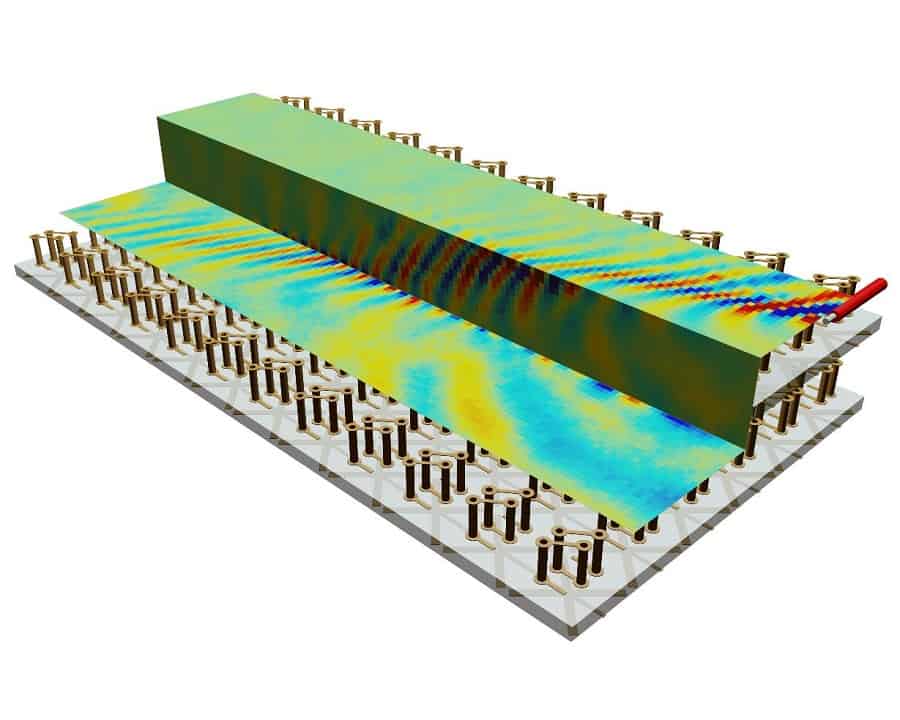
The researchers, led by Shuang Zhang from the University of Birmingham, therefore exploited chirality in the design of their topological metamaterial, along with hyperbolicity, to engineer the required dispersion. The material comprises a stacking of multiple tri-layers. The bottom layer possesses hyperbolic dispersion, which results from 200 μm-wide metallic wires running across its top surface, with metallic crosses superimposed on the wires to increase the capacitance and suppress non-local effects. The middle layer is a thin dielectric spacer that prevents electrical contact between top and bottom layers, while the top layer introduces chirality through the presence of metallic helices, each having 2.5 turns.

The researchers exploited a near-field scanning technique using microwave antannas to observe the Fermi arcs on both the top and side surfaces of their chiral hyperbolic metamaterial. The near-field distribution, once Fourier transformed into the frequency domain, clearly reveals the presence of Fermi arcs on the surface between the bulk states.

To further investigate the topological nature of the system, the group stacked several layers of the chiral hyperbolic metamaterial together to form a step. In this arrangement the topological protection of the surface state forces the surface wave excited at the top layer to bend around the step and to propagate forwards without any reflections from the edges. The absence of scattering as the surface wave propagates across the step confirms the topological nature of the chiral hyperbolic metamaterial.

One key feature of topologically protected states is that certain bands in the dispersion relation cannot interact, which means that a wave travelling in one band is not allowed to jump into another band. In this experiment, the researchers explain, the surface wave travels over the corner without any scattering because there is a topological charge difference between the Weyl points connected by the Fermi arc.

Next the researchers intend to investigate other systems that support topologically protected waves and find ways to more accurately steer waves on surfaces. Using simpler geometries, the group will be able to miniaturize these materials so that they can work at THz, infrared and optical frequencies.

The research has been published in Nature Communications.

The Doomsday Clock ticks over 70 years, an exoplanet Westeros

Circa 1988: the Doomsday Clock during safer times (Courtesy: The Bulletin of the Atomic Scientists

By Hamish Johnston

This year marks the 70th anniversary of the Doomsday Clock that is produced by The Bulletin of the Atomic Scientists. Currently at two and a half minutes to midnight, the clock represents the likelihood of a human-caused global catastrophe. Originally, it focused exclusively on a nuclear Armageddon, but in 2007 climate change and other technologically-driven processes were added to the mix. The clock was initially set at seven minutes to midnight in 1947 and the Bulletin has produced a video that charts the ups and downs over the past seven decades. Is there any good news? In the image above you can see that South Africa was a nuclear power in 1988, and it has since disarmed.

(more…)

How to make liquid drops with rings like Saturn

A droplet of oil can be transformed into a Saturn-like ringed structure by placing it in a strong electric field – according to Quentin Brosseau and Petia Vlahovska, who did their experiments at Brown University in the US.

The fantastical effect is driven by a process called electrodynamic flow, whereby an external electric field causes the movement of electric charges at the surface of a liquid drop. In turn, this motion causes the liquid within the drop to circulate in cells – and this can distort the shape of the drop.

Brosseau and Vlahovska studied droplets of silicone oil suspended in castor oil and exposed to an electric field. Exactly how the drops distort is a function of the electrical properties of the two liquids, and this was adjusted by doping the castor oil with organic electrolytes.

Concentric rings

In one experiment, the researchers were able to flatten a millimetre-sized drop to create a lens-like disc with a relatively sharp edge. The edge is unstable, and a thin sheet of liquid begins to flow radially away from the edge. As the sheet flows outward, it breaks up into a set of concentric rings. Then, the rings themselves break up into a plethora of droplets, each about 10 μm in size. If the electric field is switched off before the process is complete, the large drop will become spherical again and the system will resemble the planet Saturn (see figure).

Brosseau and Vlahvoska found that this droplet-shedding process lasted for a few tens of seconds before the original drop was transformed into thousands of uniform droplets. Writing in Physical Review Letters, the researchers say that the phenomenon could be used for the large-scale production of tiny droplets of uniform size – something that could find a range of industrial and medical applications.

Attosecond physicist honoured by Royal Society

Canadian physicist Paul Corkum is among 17 scientists honoured by the Royal Society‘s annual awards. The prizes recognize researchers who have made outstanding contributions to science.

Corkum has been awarded a £10,000 Royal Medal for his contributions to laser physics and the relatively new field of attosecond (10–18 s) science. Currently working at the University of Ottawa, Corkum has pioneered concepts in this branch of physics. He has demonstrated how attosecond optical and electron pulses can be created by controlling the interaction between laser light and matter. Using such short electron pulses, he has made the fastest “real-time” measurements ever recorded and combined them with sub-0.1 angstrom spatial resolution.

“Truly wonderful surprise”

“When I received the notification informing me that I’d won the Royal Medal I thought that it was a scam – like when you get an e-mail saying you may have won $1,000,000,” says Corkum. “This was a truly wonderful surprise and compliment. Receiving the Royal Medal is a sign that the scientific community recognizes the importance of attosecond science, a field where there are strong future opportunities.”

Corkum and the three other Royal Medal winners will receive their medals at an awards dinner in the autumn. Meanwhile, Timothy Leighton of the University of Southampton has been awarded the Clifford Paterson Medal and Lecture for his research on the applications of acoustics.

‘One woman can change a lot if she is determined’

A couple of weeks ago, Physics World received an e-mail that made my blood boil. The sender requested for his comments not to be published, so he shall remain nameless but here’s the jist of his message:

The latest issue of Physics World contained too many articles on women in physics (it had five small pieces on the topic). He finds the subject tedious and thinks it no longer needs covering – but it’s OK for him to say this because his daughter is doing physics at university.

In my opinion, this is an excellent example of exactly why it is important to talk about equality in physics. Some members of the community just don’t see that there is still a problem.

In an excellent coincidence, I signed up for the International Conference on Women in Physics (ICWiP) that very week. The conference is run by the Institute of Physics (IOP) and the International Union of Pure and Applied Physics (IUPAP) and has been taking place this week at the University of Birmingham in the UK. ICWiP gives people from around the world, and at all stages of their careers, a chance to discuss and tackle the many topics surrounding women in physics. These include under-representation, stereotypes, conscious and unconscious bias, inequality in pay, the drop-off as you progress through academia…the list could go on.

Most importantly, however, the event gives women physicists a chance to meet, share stories and network – a chance to realize you are not the only one. This sounds cheesy, I know, but considering the representative from Zimbabwe, Helga Danga, is the only female physicist she knows of in her country, it is also surprisingly accurate.

While I could only attend the first two days, there is so much I would like to talk about. Every woman in attendance was incredibly impressive and inspiring and I could write an article on each individual. Sadly, this is not feasible but I shall endeavour to give you an insight over a couple of blog posts and with the help of Jess Wade from Imperial College London.

When talking about women in physics, a common starting point is to look at the stats — for some people, especially scientists, it is only when they see the statistical evidence that they believe there is a problem. The data presented at ICWiP was damning and undeniable, and while too vast to list in detail here, it all points in the same direction — women in physics are significantly under-represented, paid less and promoted less.

But as well as looking at statistics, it is also important to listen to the stories of individuals and build a plan of action based upon personal experiences. A key theme of ICWiP was therefore interaction and collaboration. In her welcome address, conference chair Nicola Wilkin stressed that this was not to be a passive conference. She even set a “homework assignment” for delegates to get photographic evidence of themselves making two new associates. Nicola’s “partner in crime” Igle Gledhill, chair of IUPAP’s Women in Physics Working Group, also emphasized how the current political climate in some countries is making it harder for all scientists, let alone women in physics, and asked us to put our heads together as much as possible. “Please think – while it’s still legal,” she implored.

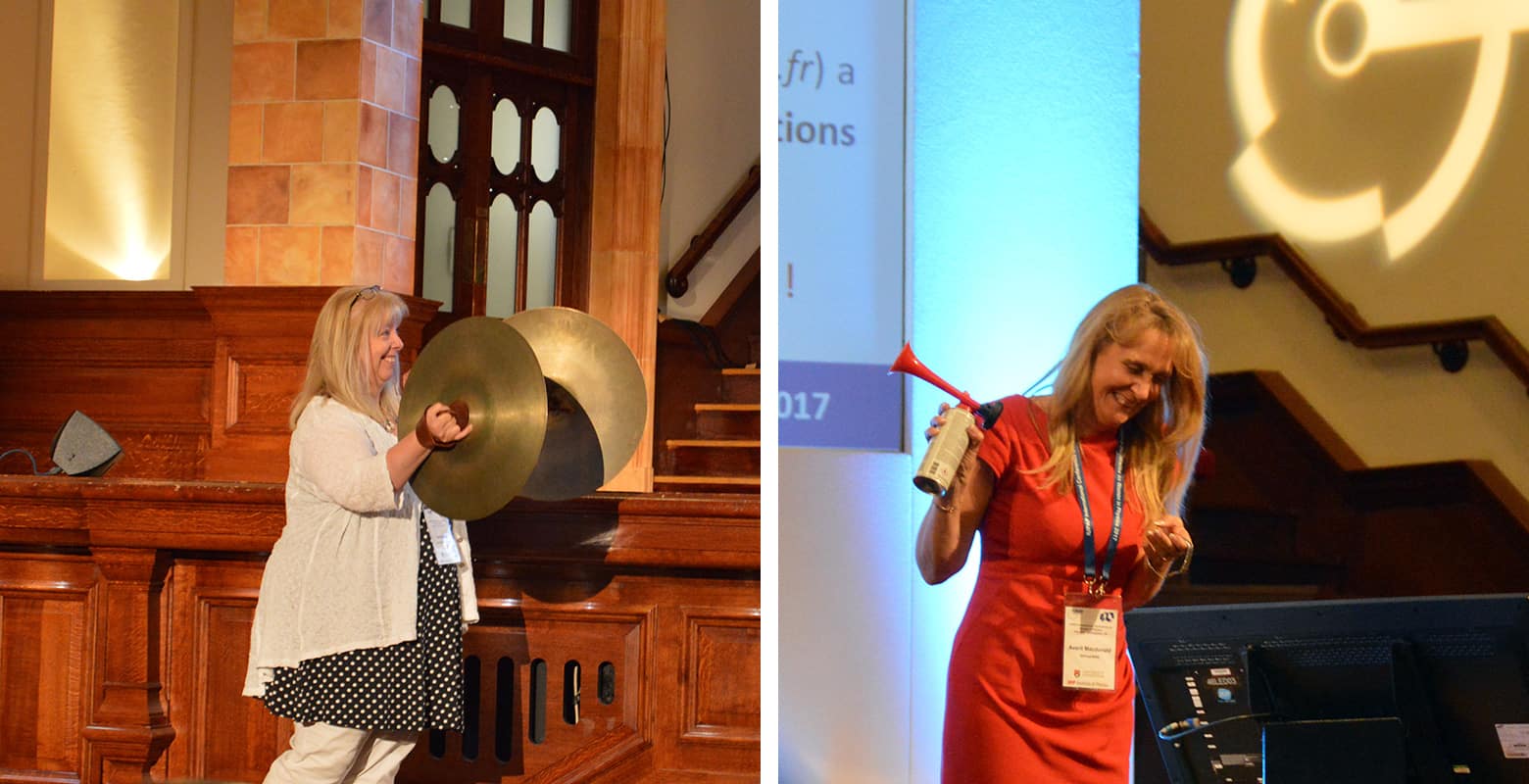
The format of the conference was designed to encourage these discussions through plenary talks, workshops, posters and social events. While, let’s be honest, many people do not find poster sessions the most enthralling part of a conference, the organizers of ICWiP used an ingenious method of nurturing interest. The delegates from 39 countries presented the overview of their posters in 90-second talks, attempting to entice us to visit their stands. We all know that time-keeping for presentations is a fine art, so Monday’s session featured chair Averil MacDonald sinisterly creeping up the stage stairs with a foghorn at the 15-second countdown. On Tuesday this was upgraded to a large set of cymbals brandished by chair Val Gibson.

Chairs Val Gibson and Averil Macdonald using cymbals and foghorns to maintain timings

Macdonald and Gibson’s approach ensured a relaxed atmosphere with everyone enjoying the antics, while also making it easy to listen to the quick-fire presentations. I found it fascinating to hear about the status of women in physics throughout the world. While some countries face problems similar to those in the UK, others have to compete with extra obstacles.

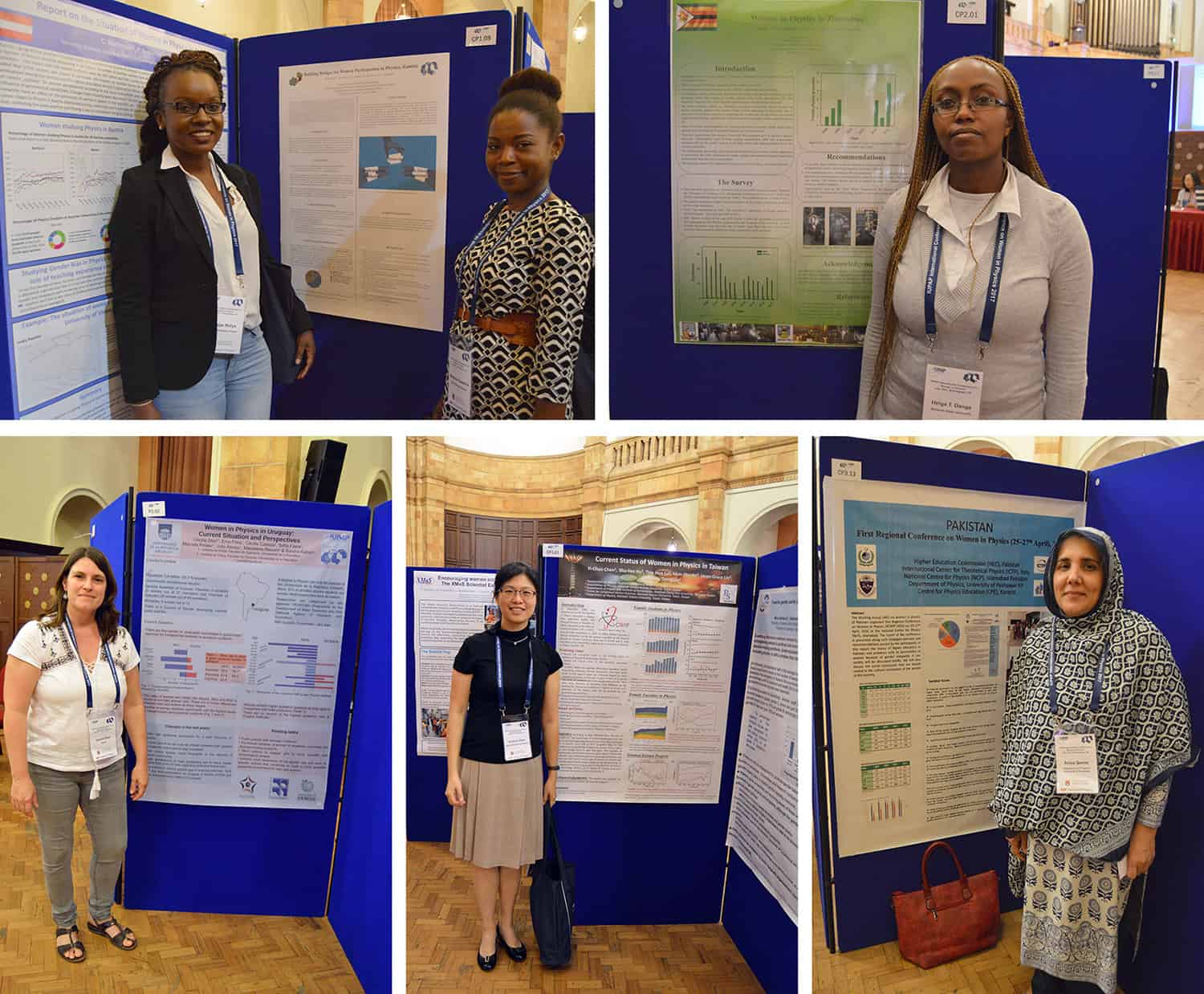
One of the more harrowing stories came from Anisa Qamar of the University of Peshawar in Pakistan. “The first problem is the war against terrorism,” she explained. Peshawar is in the Khyber Pakhtunkhwa province, bordering Afghanistan. “There is a completely chaotic situation in Afghanistan and that area. The Taliban are actually destroying the girls’ schools because they don’t allow women to learn.” She told me two-thirds of women in Pakistan cannot read or write and 36% of girls are out of school. As the first and only female professor in the province, however, Anisa is determined to make a difference. In 2016 she arranged the first Regional Conference on Women in Physics, despite the opposition of her head of department and the institute’s dean. Thankfully, she got funding from the Higher Education Commission of Pakistan and the International Center for Theoretical Physics, enabling around 150 female undergraduate and postgraduate students to attend and discuss the societal issues and constraints. One of their key conclusions was that women should be exposed to training in technologically advanced countries to help their professional development before returning to Pakistan. “One woman can change and educate a family. One woman can change a lot if she is determined,” she said.

A common problem in many countries is that the community does not understand what the point of a physicist is, which means fewer physicists and fewer career choices. Mwape Mofya and Mwansa Kawesha from the Cancer Diseases Hospital in Zambia described how women in their country are taking advantage of the opportunities and funding targeted at promoting women in science. Unfortunately, however, this is not translating to physics because people cannot make the link between the field and what it can do to help the community. Mwape and Mwansa hope that mentoring and role models may help spread awareness of physics.

While some countries are in the early stages of change, others are further down the pipeline. “We have seen a lot of improvement in the last 10 years in Taiwan,” said Yi-Chun Chen from the National Cheng Kung University. She highlighted two promising changes in policy. In 2007 the Ministry of Science and Technology (MOST) introduced a change to its funding policy, where female researchers who have given birth in the past five years are evaluated on the past seven years of research outcomes instead of five to take into account maternity leave. Furthermore, the Ministry of Education has since added a two-year extension to the tenure clock to account for parental responsibilities. While the number of female professors has increased in recent years, women are still outnumbered by men. “We would like to check if [the extensions] can continue to improve this in future years.” But it’s not just policy that is holding women back. “There’s still some social customs because women take much more time with their families,” explained Yi-Chun. And as in Zambia, there’s a lack of awareness of physics. “Female [science] students in Taiwan are encouraged to study medicine because their parents think they will get better jobs.”

Finland, meanwhile, is often considered a forerunner in equality, but Jennifer Ott from Helsinki Institute of Physics highlighted that for physics, not much has changed in recent years. For example, only 7% of physics professors are female. Jennifer explained how the physics community, although not negative or discriminating, can lack proactive attitudes. Consequently, in recent years women in science groups in Finland have been spreading the message with workshops, informative websites, seminars and outreach programmes for schools. Furthermore, while the country offers very long parental leaves of up to three years, it is very unevenly distributed between men and women, and discussions have been taking place on how to improve the situation.

Mwape Mofya and Mwansa Kawesha from Zambia, Helga Danga from Zimbabwe, Cecilia Stari from Uruguay, Yi-Chun Chen from Taiwan and Anisa Qamar from Pakistan

For me, the biggest highlight of ICWiP was hearing from all of these inspiring women. The firsts they have achieved and challenges they have overcome are incredible. The conference was also one of the most comfortable and friendly I’ve been too, with everyone willing to chat with strangers and discuss the issues and their lives.

Stay tuned for more posts on the event, covering bias and stereotypes, game-changing physcisists and the great Dame Professor Jocelyn Bell-Burnell. Later in the year there will also be a couple of podcasts on women in physics, which will include interviews with delegates at the ICWiP.

Roger Penrose asks if a cyclic cosmology is lurking in LIGO noise?

Correlated noise in the two LIGO gravitational-wave detectors may provide evidence that the universe is governed by conformal cyclic cosmology (CCC). That is the claim of Roger Penrose of the University of Oxford, who is proposing that the apparent noise is actually a real signal of gravitational waves generated by the decay of hypothetical dark-matter particles predicted by CCC.

Last month, physicists at the Niels Bohr Institute pointed out that some of the noise in the two LIGO detectors appears to be correlated – with a delay that corresponds to the time it takes for a gravitational wave to travel the more than 3000 km between the instruments.

Writing in a preprint on arXiv, Penrose argues that a significant amount of this noise could be a signal of astrophysical or cosmological origin – and specifically CCC.

Infinite aeons

First proposed over a decade ago by Penrose, CCC assumes that the universe consists of a succession of aeons. Each aeon begins with a big bang and proceeds into an unending future in which the universe expands at an accelerating rate. As this expansion becomes infinitely large, Penrose argues that it can be transformed back into the next big bang.

He says that a “reasonably robust implication of CCC” is that dark matter consists of particles called erebons – the name deriving from the Greek god of darkness Erebos. As dark matter goes, erebons are extremely heavy and have masses of about 10–5 g. This is roughly the Planck mass and on a par with a grain of sand and about 22 orders of magnitude heavier than a proton.

Near-instantaneous impulses

Penrose says that when an erebon decays, it deposits all its energy into a gravitational wave. While such waves have frequencies well above the detection capabilities of LIGO, their arrival at the detectors would be recorded as near-instantaneous impulses that could be mistaken for noise.

Physics societies sign up for unique ORCID identifiers

IOP Publishing, which produces Physics World, and the American Physical Society (APS) have signed an “open letter” committing them to collecting ORCID IDs for all authors submitting papers to their journals.

ORCID – Open Researcher and Contributor ID – is a not-for-profit organization that provides a unique identifier (iD) for every researcher, which means they can clearly distinguish researchers with the same name.

Avoiding confusion

“It is extremely important that researchers are correctly recognized for their work, whether as an author, reviewer or editor, and that the community is able to cite work without confusion,” says Jamie Hutchins, publishing director at IOP Publishing. “ORCID identifiers make this easier, by removing the confusion that can be caused by similarities between researchers’ names, name changes, inconsistencies in abbreviations and cultural differences in how names are presented.”

Matthew Salter, publisher at APS, adds: “With several major funders now requiring ORCID iDs as part of their grant application process, we hope that this will reduce the administrative burden on researchers as well as providing scholarly benefits.”

Easily discoverable

Laurel Haak, executive director of ORCID, says of the announcement: “As two of the main publishers in the physical sciences, use of ORCID iDs by IOP and APS means that authors will be clearly attributed and their body of work more easily discoverable.”

Refugee scientists under the spotlight

The final months of a postdoctoral research contract is a stressful time, but for Syrian climatologist Shifa Mathbout from the University of Barcelona, the stakes are higher. Her European Erasmus Mundus funding for studying Mediterranean rainfall trends runs out at the end of this month but she cannot return to Syria, admitting to having a “very big fear” about the prospect. “It’s very dangerous for me,” she stresses.

Mathbout mainly left Syria in 2013 because her brother is a member of the Syrian National Coalition, which opposes current president Bashar Al-Assad. She says she was “lucky” to get Erasmus funding, which is intended to support global co-operation. And while Mathbout can stay in Spain until 2021, she is clear what displaced scientists need. “The most important thing for us is to have work, to help us and our families back in Syria,” she told Physics World.

The trouble facing refugee scientists often goes unnoticed but recently has been examined by The World Academy of Sciences (TWAS), which is based at the Abdus Salam International Centre for Theoretical Physics (ICTP) in Trieste, Italy. It published a report in May – Refugee Scientists: Transnational Resources – that was based on conclusions drawn up at a workshop in March at the ICTP. At the workshop, where scientists, governments, educational institutions and other national and international organizations discussed the fate of scientists caught in the ongoing refugee crisis. Displaced scientists deserve relevant employment, the report concludes – and institutions must come together to ensure they get it.

“Scientists and science institutions in destination countries can do a great deal now to help identify displaced researchers and help them continue their work or studies,” says TWAS executive director Mohamed Hassan, who adds that some displaced people are highly qualified and so can benefit their destination countries. Finding them relevant work also helps maintain and enhance their knowledge, which can help rebuild their home countries once it is safe to return. The TWAS report notes that Iraq had 500 researchers per million population in 2008. “Countries such as Syria and Iraq previously had quite strong scientific communities – well-educated, published, respected,” says Hassan.

There are now four million Iraqi refugees around the world, with more than 65 million displaced persons globally at the end of 2015. However, there are no comprehensive figures of how many scientists are among this number, and the lack of detailed information is a central issue, according to Hassan. “How do you develop policy and programmatic responses when you don’t know the magnitude of the need?” he notes. Meanwhile, countries have been tackling the sudden recent surge of conflict-driven migration individually, but are now looking further afield. “We’re seeing strong interest in greater knowledge-sharing and co-ordination,” says Hassan. “Countries and programmes want to learn from each other’s experience.”

A work in progress

The UK’s Council for at-Risk Academics (CARA) and the Institute of International Education Scholar Rescue Fund in the US are good examples of how to support affected scientists. These organizations are “well-established and very effective at identifying scientists and other scholars in need and giving them crucial support”, Hassan says. Other efforts include the Philipp Schwartz Initiative, which was recently set up by Germany’s Humboldt Foundation to help universities and research institutions in Germany host “threatened foreign researchers” for a two-year period. Mathbout, for example, is currently applying for support from both CARA and the Philipp Schwartz Initiative.

CARA executive director Stephen Wordsworth stresses that the scientists his organization helps are not refugees, who are defined as people who have been granted asylum. Instead, they are scientists seeking temporary sanctuary who are eligible to enter the UK through the country’s visa system without claiming asylum. More than 110 UK universities, and others elsewhere in the world, help them continue their work until they can safely return home.

With the help of donations, CARA supports 260 displaced academics, up from just 50 in 2013. “In many cases their education has cost the British taxpayer not a penny so far and UK universities are getting the benefit,” says Wordsworth. However, CARA could not afford to support the increased numbers on its own and so relies on universities to provide funding for their research, living costs and accommodation. University contributions have increased from £600,000 in 2013 to £4.2m in 2016 with the money coming in some cases through fundraising directly from alumni.

Given that there is currently no organization similar to CARA in countries such as France and Italy, Wordsworth supports the TWAS call for better co-ordination. While institutional efforts are lagging behind, in other countries there are some grass-roots initiatives. For example, ICTP statistical physicist Matteo Marsili is collaborating with refugee camps near Trieste to offer internships for asylum seekers at ICTP or TWAS. “There is a need to support asylum seekers who have academic backgrounds or ambitions,” says Marsili. “In the time they spend travelling and in the camps this becomes a low priority issue to the point that they abandon their academic career because of more pressing needs.”

However, very few of the residents of the camps near Trieste, who are typically around 25 years old and from Pakistan, Afghanistan and Africa, have an academic background. “Scientists generally have more possibilities to find their way to northern Europe and they typically do so,” says Marsili. Thanks to the contacts established at the TWAS workshop, he is exploring how ICTP could help such physicists in danger. “I realized that helping is not so easy as one would naively think,” adds Marsili. “It’s still a work in progress.”

Limited choices

Ahmed Al-Tabbakh, a physicist at Al-Nahrain University in Baghdad, Iraq, exemplifies the benefit of international support. From 2002 to 2009 – during the worst years of war in Iraq – Al-Tabbakh worked at Pune University in India, gaining his PhD. Though he has not sought asylum, he admits he thought about it several times. “I always believed that my qualifications are my best means to overcome life challenges. As a researcher and a teacher in a country defying and fighting against terrorism on its land, I face many challenges and suffer many problems,” he says. “But I hope I do not get into a situation where I have to be an asylum seeker. I wish for my country to be safe and prosperous.”

Yet Al-Tabbakh, who works on nanomaterials for energy storage and conversion applications, faces difficult living conditions and a lack of research funding in Iraq. Since 2014 scientists have received no financial support to run their laboratories or even take part in international conferences and workshops. “Generally speaking Iraqi scientists live in hardship of resources,” he says. “Despite the circumstances, we are lively and productive.” As a TWAS Young Affiliate, Al-Tabbakh gets some support to attend international meetings and build collaborations. However, less fortunate scientists have fled to neighbouring countries as a result of the difficulties they face, even though it is also not easy to go elsewhere. “Choices are few sometimes,” he adds.

In a situation with similarly limited choices, Mathbout is counting the days until the end of her fellowship. As of late June, she was waiting to hear from the Philipp Schwartz Initiative. To work in the UK, she needs documentary proof of having worked as a paid lecturer or researcher in Syria. However, Mathbout says that she was being paid in cash when working in that position, so cannot just refer to her banking details. Consequently, she had to get written confirmation from the management of the university she worked at, which took more than a month.

“Communications in Syria are very bad,” Mathbout says. “When I think about this matter I feel like I just want to cry, because I have been five years without seeing my parents and my home country, my history, my memories, my books, everything. But I’m still OK. Let’s cross our fingers that this will be good. I hope so, really.”


Gedanken fictions

A soldier returning from war goes to visit the widow and young son of his fallen comrade Ted. During his stay with the family, the soldier takes on Ted’s name, chores and even his hobbies. Despite looking very different in appearance, he has effectively stepped into Ted’s life and his future is mapped out for him.

It doesn’t sound much like science, or even science fiction, but the short story “The tiniest atom” by Sarah Schofield is an exploration of “Laplace’s demon” – a thought experiment that explores the concept of free will in a universe that has to obey the laws of classical mechanics. As the accompanying essay by physicist Rob Appleby explains, Pierre-Simon Laplace theorized that if we know the forces acting on a body, and the precise location and momentum of all of its atoms, we can calculate its past and future. If everything in the universe obeys the same physical laws, then, with the right equations, we can determine the state of the universe – and everything and everyone in it – at any point in the past or the future. All of this suggests there is no free will.

This is just one of 14 pairs of short story and essay in Thought X: Fictions and Hypotheticals, which has at its root the concept that “thought experiments” in science and philosophy effectively tell stories as they build a scenario to prove some point – so why not get fiction authors, as well as scientists and philosophers, to explore them? After all, science and fiction share a capacity for taking the nub of an idea and stretching it far beyond immediate observations. This can lead to great stories and great breakthroughs.

The collection’s co-editors are Appleby, who works at the University of Manchester and the Cockcroft Institute, and Ra Page, who followed up his degree in physics and philosophy with a career in writing and editing short stories. The anthology – part of Comma Press’s ongoing Science-into-Fiction series – received funding from the Institute of Physics (which publishes Physics World) so perhaps it’s not surprising that the majority of the thought experiments here come from physics. From the grandfather paradox of time travel, to Maxwell’s demon, to Olber’s paradox, to Schrödinger’s cat, there is plenty to explore. The other thought experiments come from philosophy, and will perhaps be less familiar to Physics World readers, but no less fruitful.

As the name suggests, a thought experiment makes use of a hypothetical situation to prove or disprove a theory. Although such analyses have been dismissed in favour of practical experiment in modern times, they remain important where practical experiment isn’t (yet) possible – in new areas of physics and mathematics – or where practical experiment might be unethical, such as some strands of psychology. They also remain a very useful teaching tool. Indeed, some of them are simply analogies to explain a concept. Take the oldest example in this book: Galileo’s ship. Galileo knew that the Earth travelled around the Sun. Copernicus had done the maths; but people refused to believe it, because they couldn’t feel or see the Earth moving. So Galileo found a way to explain it that made sense to anyone who’d travelled on a ship.

The fiction in Thought X varies from purely metaphorical to more literal interpretations, but several stories try to do both. In “The tiniest atom”, the deceased Ted’s notebook is filled with jottings from public lectures and his own attempts to isolate the formula that will describe everything. In “Lightspeed” by Adam Marek a space pilot is damaging his marriage by taking longer and longer shuttle runs at near-lightspeed, increasing the physical and mental distance between himself and his wife. Physicist Tara Shears explains the effect of relativity on time and the resultant twin paradox – and why it’s not a paradox at all.

The genre, style, length and pace of the stories varies a lot for such a small collection. It’s unlikely one reader will love all of them, but it would also be a surprise if a reader didn’t find something to love here. The essays are uniformly clear and thorough, the only real variety being how much they interact with the story they follow. The best pairs of story and essay act to help explain each other. In “Tether” by Zoe Gilbert, Hark has built a house for Gertie. All he wants is to make her happy. But Gertie has discovered a shortcut to achieving pure happiness solo, so why would she choose anything else? Philosopher Jonathon Wolff explains that this is about the “experience machine” – a thought experiment by philosopher Robert Nozick that questions utilitarianism and authenticity. If all we value is achieving happiness, then we would all plug into the machine. But by plugging into the machine we cut ourselves off from the rest of the world, which does not give us pure happiness, but which we nevertheless value. Gilbert’s story perfectly illustrates this choice. And Wolff’s essay helps unpack a story filled with complex ideas and motives.

Thought X is a fascinating experiment and by choosing the right roster of writers, it achieves its aim.

  • 2017 Comma Press 272pp £9.99pb

Building bridges with the West

What is the origin of the Kavli Institute of Theoretical Sciences (Kavli ITS)?

In 2006 the Kavli Foundation endowed the Kavli Institute for Theoretical Physics China (KITPC), which was located at the Institute of Theoretical Physics of the Chinese Academy of Sciences (CAS). Last year, the CAS and the Kavli Foundation repurposed the KITPC as Kavli ITS, which is located at the University of CAS (UCAS). The change of the name reflects the broader fields that Kavli ITS will cover, and also avoid the name overlapping with the Kavli Institute for Theoretical Physics at the University of California, Santa Barbara

How will Kavli ITS differ from KITPC?

Kavli ITS has a new vision to establish its own high-quality research team. It will cover all sciences and not just physics. In the first stage we plan to focus on four areas: condensed-matter physics; particle physics; biophysics and quantitative biology; and quantum information and computing. The institute will cover other fields such as quantum chemistry and earth science at a later date.

What attracted you to Kavli ITS?

I carried out a PhD at Virginia Tech in the US in 1983 and spent the next two decades in the US and Europe before moving to the University of Hong Kong in 2003. At that time Hong Kong was considered a window between China and the West and I helped organize visitor programmes and annual workshops in the city that brought top Western and Chinese physicists together. That kind of activity benefited people very much and it is something I want to continue at Kavli ITS. Taking up the post was a good opportunity and challenge for me to do that.

What is the current status of the institute?

I started as director in January and the new institute started from zero. We are now actively recruiting new faculty members. Kavli ITS is temporarily located at UCAS’s Zhong-Guan-Cun campus in Beijing and the institute’s offices have just been finished. Space will gradually increase as we grow as an institute. The institute is planning its permanent building at UCAS’s Huai-Rou campus, which is in a suburb of Beijing. We hope to move there within the next three years.

How is Kavli ITS funded?

Where our faculty have joint appointments with UCAS, their salaries will be paid for by the university. In the first few years, our budget from UCAS will be around ¥6m each year (£670,000). On top of that we also have the endowment from the Kavli Foundation. The Kavli Foundation does not just give us funding – it also provides support.

How many people will work at the institute?

We are aiming for around 30 faculty, whom we will recruit over the next five to 10 years. The institute must be international, so there is a strong desire to hire both Chinese nationals as well as non-Chinese. I will try to have around a third foreigners and the rest Chinese.

How will you attract foreign researchers?

We aim to provide competitive salaries for those researchers from outside China. Indeed, it is a challenge to get foreigners to stay in China for long periods, mostly because of the different culture. Language is also a problem since English is not widely used in China except at the institute or university. We are also competing with other first class institutes in China and the world. For those researchers who do not want to move to China, we have a programme so they can visit for a limited time. Kavli ITS can become a second home to those researchers.

How will you also compete for domestic talent with neighbouring universities such as Peking and Tsinghua?

There is strong competition for us. One benefit is that we offer a salary comparable to that in the US or Europe. Another benefit is the brand name of the Kavli institute. I also hope that I have a good reputation for attracting young people here.

How do you think the Kavli Foundation can help Chinese researchers?

There are 20 Kavli institutes in the world that are all conducting first-class research. The Kavli Foundation can help Kavli ITS to be connected with the other Kavli institutes, and set a fine standard for researchers in China. I hope it can play a positive role as a bridge between China and the West. In the theoretical sciences, we like to exchange ideas, so it is important that we have the methods to exchange ideas with those from outside China and that is why I would like to have high-quality visitor programme.

How has physics in China changes in recent years?

In the past decade, science, and physics in particular, have developed rapidly. When I was in Hong Kong in the early 2000s, it was ahead of China in physics, but now if you compare facilities, in many aspects China is ahead. China is also much more modernized, being close to Western standards.

How would you compare China with the US now?

In terms of speed of advancement, China is ahead. There are a few topics, such as topological insulators and superconductivity, where China is on a par with the US, but overall China is still behind by a distance. Yet it is getting closer each year.

What is your focus for the coming year and beyond?

We need to recruit more physicists, including those from outside China. We are currently designing and building a dedicated building for the institute at UCAS’s new campus, which will be ready in 2020. The campus will also include apartment blocks and schools for employees’ children.

Copyright © 2026 by IOP Publishing Ltd and individual contributors