

Deck-of-cards heterostructures make ideal batteries

Increasing global demand for renewable energy makes energy storage in batteries a critical area of research. Two-dimensional (2D) nanomaterials could be excellent candidates given their layered structures, offering well-defined pathways for ion movement. However, no single 2D material has yet demonstrated the perfect combination of properties needed. Writing in Nature EnergyEkaterina Pomerantseva and Yury Gogotsi at Drexel University in the US propose a solution involving stacked nanomaterial architectures. The structures would combine the advantages of different 2D nanomaterials while eliminating their individual shortcomings.

Major technology breakthroughs within the past decade have produced a plethora of interesting nanomaterials. While these materials display a variety of useful properties, currently none can be used alone as an ideal battery electrode. Pomerantseva and Gogotsi propose the combination of multiple two-dimensional nanomaterials to achieve synergistic property enhancement. By interlayering different 2D materials within a deck-of-cards-like structure, the researchers believe higher energy and power densities can be achieved, as well as longer battery lifetimes.

Current battery limitations

The three critical battery properties are energy density, power density and lifetime.

Energy density is a measure of the amount of charge a material can store. An ideal phone battery, for example, would have a high enough energy density to allow the device to last a long time before dying. While some nanomaterials, such as transitional-metal dichalcogenides like molybdenum disulphide, show impressive energy densities, they also suffer from poor lifetimes, as the formation of a solid-electrolyte layer over time disrupts charge movement.

Power density refers to a battery’s ability to obtain charge. A phone battery with a high power density requires a short amount of time to charge, but also dispenses charge rapidly. Attention to application is required when considering a battery’s power density. The power density of nanomaterials can be manipulated by controlling particle morphology, which is not easily accomplished in a traditional 2D nanomaterial system.
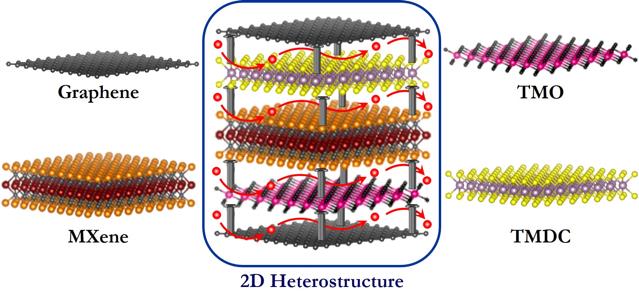
The lifetime of a battery is typically limited by the reversibility of intercalation (the insertion of a molecule into a layered structure) and the mechanical strength of the battery material. Nanomaterial transition-metal oxides (e.g. V2O5) show appropriate intercalation but poor electron conductivity. Transition-metal carbides and nitrides (e.g. Ti2C and Ti2CN) display better conductivity and are mechanically robust but require a complex synthesis.

Deck-of-cards heterostructure

The heterostructures proposed by Pomerantseva and Gogotsi combine known 2D materials in a deck-of-cards arrangement, where each card has a different composition. The properties of the structure as a whole are better suited to energy-storage applications than those of the components taken individually.

For example, the interstratification of a transition-metal oxide and a transitional-metal carbide could produce a battery with exceptional ion intercalation, electron conductivity and mechanical strength. Different combinations of known 2D nanomaterials in the form of heterostructures could theoretically produce efficient batteries boasting high charge density, appropriate power density and long lifetimes. Selecting the appropriate elements to be placed between the layers in a heterostructure could not only further facilitate the movement of ions, but also improve the stability of the electrode.

Pomerantseva and Gogotsi stress the need for additional experiments to evaluate the energy-storage properties of such 2D heterostructures. They also highlight the importance of assembling “a genome for 2D material heterostructures for energy storage” to bridge the gap between the electronic materials and energy-storage communities. Completion of such an extensive project could “open a door to next-generation batteries with improved storage capabilities, faster charging and much longer lifetimes.”

Full details of the research are reported in Nature Energy.

Quantum-computer node uses two different ion species

A node for quantum computing that uses two different species of ion has been unveiled by Chris Monroe and colleagues at the University of Maryland in the US. The system uses a barium ion to communicate externally via light and a ytterbium ion to store quantum information.

Trapped ions show great promise for use in quantum computers because they can store quantum information for long periods of time and can also be made to interact with photons, which serve as carriers of quantum information. A practical quantum-computing node must be able to do both of these things at the same time, and this is a significant challenge because the ions that are very good at storing information are usually not very good for interacting with photons and vice versa.

Long coherence time

One possible solution is to use two different types of ion – one for storage and one for communications – and transfer quantum information between the two. Now, Monroe’s team has done just that. A ytterbium ion was chosen as a memory because it can store quantum information for about 1.5 s, which is a very long coherence time in the world of quantum computing. This ion is also attractive because it is insensitive to the light used to manipulate the barium ion, which is located just a few microns away in the ion trap.

In contrast, quantum information can only be stored in the barium atom for about 4 ms, but this is long enough to both interact with the outside world via a photon and also transfer quantum information to the neighbouring ytterbium ion.

Motional modes

Quantum communication via light was demonstrated by causing the trapped barium ion to emit a photon and then showing that the ion and photon are entangled. The team also showed that quantum information can be transferred between the barium and ytterbium ions via two processes that involve the coupled motions of the ions in the trap.

Writing in Physical Review Letters, the team says that the process could be further improved and implemented in fabricated chip traps, which could ultimately form the basis of a practical quantum computer.

Interacting lasers shed light on topological defects

A new way of using a laser cavity to study the emergence of topological defects has been unveiled by researchers in Israel.

Topological defects emerge when a system makes a rapid transition from a disordered to an ordered phase – a process called quenching because it often involves rapid cooling. In the case of magnetic order, quenched magnetic moments form small domains in which the moments point in the same direction. Moments in neighbouring domains can point in different directions and the interfaces between domains are called topological defects.

These defects can occur in a wide range of systems, from atomic gases to the rapidly cooling early universe. Understanding how to eliminate topological defects could even be exploited to solve hard computational problems.

Multiple lasers

How topological defects emerge can be very tricky to study in the laboratory because controlling the rapidly changing temperature throughout a sample can be very difficult. In this latest study, Vishwa Pal, Nir Davidson and colleagues at the Weizmann Institute in Israel have used a set of up to 30 coupled laser beams to create a system with topological defects that can be studied more easily.

Their system comprises a laser cavity containing a mask with a number of holes arranged in a circular pattern. Each hole produces its own laser beam, which overlaps a bit with its two neighbours – leading to an interaction between beams. The laser cavity is pumped by an external light pulse and the interaction causes the laser beams to undergo rapid phase oscillations before settling into a steady state that is then measured by the team.

The laser cavity contains about 1000 modes and this provides the system with a large number of initial phase relationships between the laser beams. In most cases the beams synchronize, but occasionally the system gets locked into a state in which there are phase differences between the beams. These states can be described as topological defects, and the team found that their number increased as the number of holes is increased from 10 to 30 – and also when the intensity of the pump pulse is increased.

Pump intensity

The team reckons that when the pump intensity is high, the system reaches equilibrium much faster than when the pump intensity is low. This timescale is analogous to the cooling rate in a quenched system, in which more topological defects occur when the temperature drop is more abrupt. The ring is essentially a 1D system, and the team now plans to extend its work to a 2D system.

The study is described in Physical Review Letters.

Graphene Flagship experiments explore space applications

In the second experiment, young researchers from the University of Brussels in Belgium and the University of Cambridge in the UK will investigate whether graphene can improve the efficiency of heat transfer in loop heat pipes. These are cooling systems used in satellites and aerospace instruments. A significant part of loop heat pipes is the wick – typically a porous metal material. The team will coat the wicks with graphene-related materials and test their efficiency during low-gravity parabolic flights. The experiment will be in collaboration with the National Research Council of Italy and Leonardo Spa in Italy, while the flights will be operated by ESA and Novespace in France.

China targets lunar missions

When Zbigniew Brzezinski, a former US national security assistant, visited Beijing in 1978 he presented his Chinese host with a special gift: 1 g of lunar soil enclosed in plexiglass. At the time, few scientists in China knew how to deal with the sample, so geochemist Ziyuan Ouyang was summoned from the remote south-west to work on it. With limited instruments and techniques, his team studied half of the sample, deducing it was from Apollo 17 – the last manned mission to the Moon.

It was not until the late 1990s that China began to think about its own Moon programme. Ouyang and colleagues came up with an ambitious lunar plan, which was named after Chang’e, the mythical Chinese lunar goddess. They envisaged a series of unmanned missions – the first three of which were successfully launched in 2007, 2010 and 2013 – followed, eventually, by a manned mission. Now the last phase of China’s unmanned lunar exploration will begin with the launch of two more missions: in November Chang’e 5 is set to bring back 2 kg of lunar soil, while by the end of 2018 Chang’e 4 will land on the far side of the Moon for the first time in human history.

A major contribution

Chang’e 5’s mission, which is expected to last just a few days, will see the craft spend a few hours on the Moon’s surface at a site that has yet to be confirmed. It will drill into the soil and collect samples in a 2 m-long tube that can fit into the return capsule. “The Apollo and [Russian] Luna missions visited a total of nine sites, all on the near side quite close to the equator,” says Ian Crawford, a lunar exploration specialist from Birkbeck, University of London. “It is important to collect samples from other parts of the Moon and Chang’e 5 can make a major contribution.” Crawford adds that if China chooses to touchdown in the north-west of Oceanus Procellarum, as reported, it will be ideal because that region includes basalts of a wide range of ages, which will allow for a better understanding of how the lunar mantle evolved.

Clive Neal, a planetary geologist at the University of Notre Dame, US, is also excited about the prospect of investigating the Moon’s volcanic material, which has yet to be studied. “These samples will be important for understanding why volcanism occurred two billion years ago and to retrieve the mantle source and thermal history of the Moon,” he adds.

Ouyang told Physics World that any returned samples will first be studied by Chinese-based researchers via a proposal process. Applicants from outside China will also be invited to study the materials but will have to wait a year before getting their hands on them. Ouyang adds that a lot of the soils will be preserved at the National Astronomical Observatories of China (NAOC) in Beijing.

The far side

Due to tidal locking, the Earth only sees the near side of the Moon, with the far side not visible. Studies have indicated that there is a very different world on the far side, being geologically more ancient and dominated by highlands, unlike the plain landscape that prevails on the near side. Although both NASA and the European Space Agency have studied the feasibility of a mission to the far side, the Chinese are expected to be the first to visit.

Chang’e 4 was initially intended only as a back-up mission for the Chang’e 3 lunar lander but was repurposed to travel to the far side of the Moon following Chang’e 3’s success. The mission is expected to launch in late 2018 after China launches a relay satellite in mid-2018 that will be located at the Moon–Earth Lagrangian 2 point to help Chang’e 4 to communicate with Earth. Chang’e 4 will land in the South Pole-Aitken Basin area, which is the largest and possibly oldest impact basin on the Moon. The mission will not only include a topography camera and a penetrating radar but also a low-frequency radio antenna. The lunar far side is regarded among astronomers as one of the best places to measure the 21 cm hydrogen emission line that can be used to study the mass and dynamics of galaxies and will allow scientists to peer into “the cosmological dark ages” – a period between the Big Bang and the birth of the first stars.

Scientists will also aim to create a radio interferometer using Chang’e 4 by placing a radio antenna on the relay satellite as well as an antenna on two microsatellites that will orbit the Moon. “The mission will be very difficult, but if we succeed, we pave the way for a future large radio facility on or near the Moon,” says Marc Klein Wolt from Radboud University in Nijmegen, Netherlands, who is in charge of developing the antenna on the relay satellite.

Xuelei Chen from the NAOC, who is involved in the development of the two microsatellites, also highlights the uncertainty of this part of the mission. “We have a general idea of what to look at in this wavelength, but frankly, since this has never been done before, we are not sure what we will see,” Chen told Physics World. He adds that the main technical challenge is to reduce the radio noise of the satellite and lander. Failing to do so, he says, could “severely impact” the quality of the data it can collect.

Chang’e 4 is also the first time that China’s lunar programme has involved international collaborators, with four foreign-built payloads. “This is an important move and should be encouraged,” says Chi Wang from the National Space Science Center, who is deputy chief engineer of Chang’e 4 in charge of scientific payloads. “It will help clarify some misunderstandings about China’s purpose to explore the Moon. It can also promote lunar science in China in a more effective way.”

Beyond the Moon

China’s lunar endeavour, however, is not set to end with Chang’e 4. The to-do list after 2018 includes a possible sample-return mission from the far side, trips to the polar regions in search of water, as well as a Moon-based science station to be set up between 2020 and 2030 with long-running, unmanned research infrastructures. “I am sure science will be a major beneficiary of China’s lunar exploration programme,” says Crawford.

The to-do list after 2018 includes a sample-return mission from the far side, trips to the polar regions in search of water, as well as a Moon-based science station

Michel Blanc, an astronomer at the Research Institute in Astrophysics and Planetology in Toulouse, France, and executive director of the International Space Science Institute in Beijing, says that China is becoming the major player in lunar exploration. “When the time is ripe for China to select its scientific payloads via open international competition, it will be in the enviable position of being able to carry the best possible scientific investigations on the best-designed space missions: a key characteristics shared with the few leading space-faring nations on this planet,” he says.

Mars calling

With China’s Moon plans now firmly set, its scientists are already working on equally ambitious Mars plans. Though yet to be approved by the government, the first mission, which could launch in 2020, will consist of an orbiter, a lander and a rover and will involve collaboration with teams from Switzerland and Austria. “We are now developing the prototypes,” adds Wang. A second probe is expected to fly before 2030, which may involve bringing back samples from Mars.

Aldrin's faces for Trump, tunnels to the underworld, physics collides with art

https://youtu.be/kR54F7-rvVg


By Sarah Tesh

Buzz Aldrin pulled some spectacular facial expressions during a speech by Donald Trump this week. The President of the United States was announcing his executive order to revive the US National Space Council. During points of Trump’s rather rambling speech, the Apollo 11 astronaut looked a combination of unimpressed, confused and bored. But while he may be bemused by the president’s chatter (as many are), he posted a positive Tweet about the executive order, saying, “I’m happy that space is getting the attention it needs to move us forward to committing to plans to get back to the Moon & on to Mars #GYATM.”

(more…)

Experiments shed new light on iron superconductors

Two important breakthroughs in the understanding of iron-selenide superconductors have been made by two independent research groups. One team has shown that the electrons responsible for superconductivity in the material probably come from a specific atomic orbital. The other team, meanwhile, has measured the interaction between electrons and atomic vibrations in iron selenide, which is believed to be involved in its superconductivity.

The research could shed light on the mystery of why some materials based on iron selenide are superconductors at relatively high temperatures, which has puzzled physicists for more than a decade. While bulk iron selenide is a superconductor below 8.5K, this transition temperature can reach as high as 75K when an ultrathin trilayer of the material is grown on certain substrates.

Multiple orbitals

The superconductivity in iron selenide is thought to arise when electrons form Cooper pairs, which can then form a low-temperature quantum state that lets them flow unimpeded through the material. These electrons come from iron atoms in the material, and because of iron’s atomic structure, electrons from several different orbitals could be involved in the formation of Cooper pairs.

To find out how electrons in multiple orbitals pair up in the superconducting phase, an international team led by Séamus Davis of Cornell University and Brookhaven National Laboratory has used a scanning tunnelling electron microscope to characterize electrons associated with several different electron orbitals. The results suggest that one specific orbital is associated with superconductivity in iron selenide.

“We were able to show that almost all of the electrons in Cooper pairs in iron selenide were from a particular lower-energy orbital,” explains Davis.

Exciting vibrations

Meanwhile, a team led by Zhi-Xun Shen at Stanford University has used the Linac Coherent Light Source at the SLAC National Acceleratory Laboratory to look at the interaction between electrons and atomic lattice vibrations in iron selenide. Their experiment involved firing infrared laser pulses at the material to excite lattice vibrations before hitting it with ultrashort X-ray pulses and recording the resulting diffraction patterns to yield the positions of the atoms. At the same time, they shone ultrashort pulses of ultraviolet light at the sample, causing some electrons to be ejected. By detecting these electrons as a function of their emission angle and energy, they could characterize the electronic band structure of the material.

The measurements reveal that vibrations of the atomic lattice induce oscillations in the electronic structure of the material. Furthermore, the team found that the strength of the coupling between the atoms and electrons is 10 times stronger than had been predicted by theoretical calculations.

This could be an important discovery because the interaction between atomic vibrations and electrons is known to be a mechanism responsible for the creation of Cooper pairs. While the team says that the measurement does not prove that the strength of the interaction is solely responsible for high-temperature superconductivity in some iron-selenide-based materials, they believe it will provide important insights into the complicated interactions involved in the creation of Cooper pairs.

The studies are described in two different papers in Science.

Exploring Bristol’s physics heritage

Sir John Enderby and Felix James

By Felix James, a student on a work-experience placement with IOP Publishing

If you live in the UK, you are probably aware that at this time of year many school students are asked to do some kind of work experience. Teenagers like me find a placement we are interested in and then go there for a week – rather than school – to get a taste for what work is really like. For me this meant a week at IOP Publishing, which publishes Physics World, but it included an excellent tour of the physics department at the nearby University of Bristol.

(more…)

Owl wings could hold secret to noiseless aircraft

The silent flight of owls could help suppress aircraft and turbine noise. A team from Chiba University in Japan has studied the unique features of owl wings that allow them to fly noiselessly.

The wings of these nocturnal creatures feature serrations on the leading edge, fringes on the trailing edge and velvet-like surfaces. Focusing on the serrations, Hao Liu and colleagues analysed owl-inspired feather wing models with and without the comb-like features to understand the role they play in noise suppression. “We wanted to understand how these features affect aerodynamic force production and noise reduction, and whether they could be applied elsewhere,” says Liu.

Wind-tunnel experiments

To study how air flows around an owl’s wing, the researchers used computational simulations, particle-image velocimetry (PIV) and wind-tunnel experiments. They found that the leading-edge serrations passively control the transition between streamline and turbulent air flows over the wings. At shallow wing angles, however, Liu and team also discovered there is a trade-off between force production and sound suppression, as the serrated edge reduces aerodynamic performance.

The team hope the work, published in Bioinspiration and Biomimetrics, may have industrial applications. “These owl-inspired leading-edge serrations, if applied to wind-turbine blades, aircraft wings or drone rotors, could provide a useful biomimetic design for flow control and noise reduction,” explains Liu, “At a time when issues of noise are one of the main barriers to the building of wind turbines, for example, a method for reducing the noise they generate is most welcome.”

Images of 3D objects appear on nanostructured surface

A new nanostructured flat surface that appears like a 3D object – complete with realistic light shading and shadows – has been developed by Alexander Minovich, Anatoly Zayats and colleagues at Kings College London and the Rheinische Friedrich-Wilhelms-Universität Bonn. The optical illusion relies on a computer-graphics technique called “normal mapping”, which creates 3D objects with realistic lighting effects on a 2D display.

The surface comprises a gold film 180 nm thick that is covered with a 105 nm layer of magnesium fluoride. Squat rectangular pillars of gold 30 nm tall are arranged in an array on the surface of the magnesium fluoride, which acts as a transparent spacer between the gold film and the pillars.

Shadow and contrast

Normal mapping was then used to compute the orientation of each pillar so that light reflecting from the surface appears as a cube (see figure). What is more, when the surface is illuminated or viewed from different angles, the cube appears to have the appropriate shadow and contrast.

Potential applications of the surface include optical security features on banknotes and other objects prone to counterfeiting. “The normal mapping demonstrated with our metasurface is a completely new concept, but it could have very important implications for a wide range of optical industries, both in introducing new functionality and making products smaller and lighter,” says Minovich.

Copyright © 2026 by IOP Publishing Ltd and individual contributors