News: January 2002
Quantum wires probe electrons
Jan 31, 2002
Tunnelling could reveal unusual effects among electrons confined to one dimension
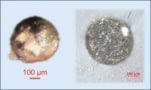
Organics aid planetary aggregation
Jan 28, 2002
Dust in the early solar system could have clumped together earlier than previously thought
Laser tweezers get a grip on DNA
Jan 25, 2002
Versatile optical technique could play a role in fields from biomechanics to nanotechnology
Secret of superconductivity in sight
Jan 24, 2002
Magnetic spin could be the key to a single theory of high-temperature superconductivity
Medics get a dose of physics

Jan 23, 2002
Statistical physics techniques are set to help heart and cancer patients

Electrical pulses break light speed record
Jan 22, 2002
Long-range 'superluminal' pulses raise hopes of ultrafast data transmission
First light on Gemini South
Jan 18, 2002
Giant infrared telescopes to give a super-sharp view of the whole sky
Probe to predict landslides and earthquakes
Jan 17, 2002
Electrical signals that herald seismic activity could lead to an early warning system
Neutrons reveal quantum effects of gravity
Jan 17, 2002
The step-like motion of falling neutrons could shed fresh light on the nature of gravity
Nuclei put a new spin on quantum computing
Jan 16, 2002
Electrical technique could allow quantum states of nuclei to store information
Crystal catches light pulses
Jan 15, 2002
The first solid to trap laser pulses could lead to super-efficient information storage
George Rochester
Jan 10, 2002
The celebrated physicist whose discovery kick-started modern particle physics dies at 93
Attractive advance towards magnetic refrigerator
Jan 9, 2002
New magnetic materials could lead to environmentally friendly refrigerators
Space-age material could restore sight
Jan 9, 2002
A novel light-sensitive ceramic may replace faulty cells in the human retina
Cool laser puts special relativity to the test
Jan 8, 2002
Speed check verifies the fundamental theory more accurately than ever
New look for Bose condensates
Jan 7, 2002
Quantum phase transitions are seen in an atomic gas for the first time