At all stages of your career – whether you're an undergraduate, graduate, researcher or industry professional – brightrecruits.com can help find the job for you.
Are you looking for a supplier? Physics Connect lists thousands of scientific companies, businesses, non-profit organizations, institutions and experts worldwide.
And in less than 10 seconds, I explain what dark matter is: =. Dark matter is consist of dark particles. The dark particles are Dirac virtual particles.
The "logical" reasoning offered by Luke Davies is like this: 'I cannot see "dark matter", but I know gravity exists, therefore "dark matter" must exist as well.'
Notice the non sequitur: gravity exists, ergo there must be "non-baryonic dark matter".
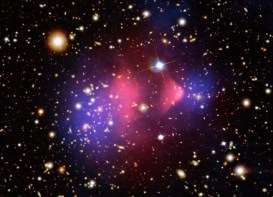
Suppose you go in a china shop and see all (baryonic) porcelain vases and cups arranged in the air, in a perfectly stable configuration, and wonder what the heck has designed and supported such an amazing configuration of fragile stuff. Then physicists [1] tell you that it is all due to an invisible dark dancing elephant, which is roughly four times larger than all vases and cups combined.
If you are a bit reluctant to swallow such 'dark (non-baryonic) dancing elephant', check out a simple, yet non-trivial, explanation here.
D. Chakalov -----------
[1] Jörg P. Dietrich et al., Nature 487, 202–204 (12 July 2012)
I thought it was a good little presentation. Luke ended up by saying "we can't say much else" which was bang-on. I'm glad he didn't get sucked into the presumption that dark matter must be comprised of particles such as WIMPs. Because as I am fond of saying: space is dark, it has its vacuum energy, that energy has a mass equivalence, and there's a lot of it about!
3 comments
Comments on this article are now closed.
What is dark matter?
The dark (non-baryonic) dancing elephant