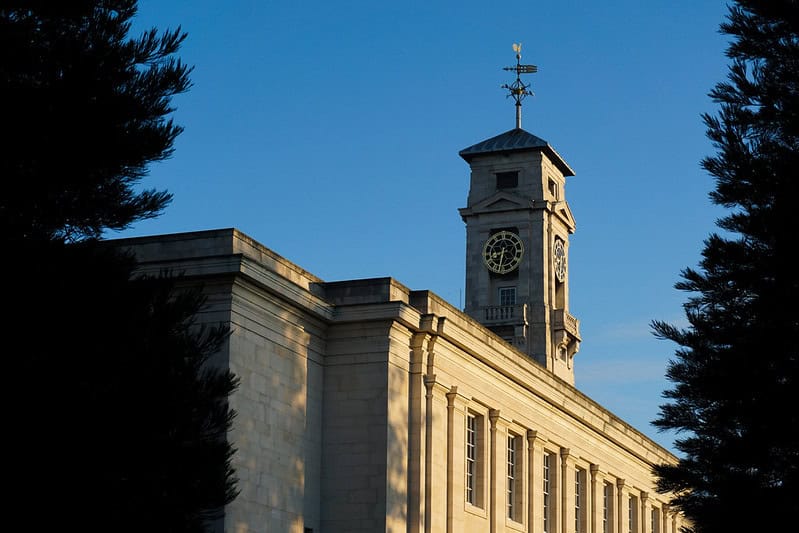
Almost 2000 scientists have signed an open letter criticising planned redundancies at the University of Nottingham in the UK. The signatories, which includes six Nobel laureates, call on the university to reverse its plan to reduce the number of staff members in the physics department from 71 to 51.
News of the possible job losses emerged on 12 May, when 2700 Nottingham staff were sent letters saying they were at risk of redundancy as part of plans to slash more than 600 academic posts throughout the university. The university says it is making the move because it could otherwise run out of money within the next five years.
Nottingham is a member of the “Russell Group” of 24 leading, research-intensive universities in the UK, with its school of physics and astronomy ranking seventh out of 44 UK physics departments in the most recent REF assessment. It is famous for its work on magnetic resonance imaging, through the contributions of the Nottingham Nobel-prize-winning physicist Peter Mansfield.
From the 2700 staff receiving letters, 56 are in physics and represent academic and technical staff across all levels. Antonio Padilla, a particle theorist at Nottingham, told Physics World that putting almost all members of physics staff at risk is an “act of academic sabotage”.
It takes years of dedication to build up a world-class reputation. I worry that it can be destroyed much more quickly
Antonio Padilla, University of Nottingham
“This is a school brimming with creativity and innovation,” he says. “There is excellence in all areas of physics, from particles to astronomy, from condensed matter to medical imaging. It takes years of dedication to build up a world-class reputation. I worry that it can be destroyed much more quickly.”
The open letter created by researchers at Nottingham in response to the cuts says that the proposals will cause “long-lasting damage” to what they claim is a “globally respected physics department”. It urges senior leaders at Nottingham to work with the University and College Union (UCU) to create “a more sustainable vision for physics and astronomy at the university”.
Stating that the job cuts will lead to fewer students applying to the university due a “decline in its reputation”, as well as a loss of student income, the letter has so far been signed by six physics Nobel laureates – Andre Geim, Andrea Ghez, Konstantin Novoselov, Roger Penrose, Didier Queloz and Brian Schmidt. Geim was once a postdoc at Nottingham.
“Physics underpins current and future economic developments; from AI, through quantum technologies to new medical imaging techniques,” the letter states. “Cutting the university’s strength in these areas is a short-sighted move that will deprive Nottingham students and the East Midlands of the capability to take advantage of these opportunities for growth.”
The university should exhaust every option to make the department sustainable before resorting to compulsory redundancies; shrinking it now is shortsighted
Catherine Heymans, Astronomer Royal for Scotland
Catherine Heymans, Astronomer Royal for Scotland, who has signed the letter, says that the UK needs “strong, geographically distributed physics departments” to help diversify the economy away from just a few centres. “The university should exhaust every option to make the department sustainable before resorting to compulsory redundancies; shrinking it now is shortsighted,” she says.
Those comments are echoed by Jim Wild, president of the Royal Astronomical Society, who urges Nottingham to reconsider the short-sighted cuts. “Reducing staff capacity by this magnitude will irreparably damage a world-class department, severely harming both its international reputation and its capacity to deliver high-quality education,” he says.
A ‘more careful approach’
Padilla, who is UCU representative for Nottingham’s physics and astronomy department, says that “a more careful approach” is required to protect staff at the university. He points out that the UCU has proposed an alternative financial model for the university that “doesn’t set fire to our academic reputation”.
Why academia should be funded by governments, not students

After two decades in which the UK university sector has boomed, there are now fears that the problems at Nottingham could be replicated elsewhere. “What happens at Nottingham now matters for the rest of the sector,” adds Padilla. “This isn’t just make or break for physics at Nottingham – it matters for science everywhere in the UK and beyond.”
Philip Moriarty, another at-risk Nottingham physicist, says that the UCU offer, which he says has been “carefully considered, costed and modelled” has been “rejected, out of hand, with no justification by the university”. Senior management at the university, he adds, “have provided no evidence to support their strategy, including, in particular, their university-wide 18-22 student-staff ratio target”.
On 18 May all affected staff across the university were sent an e-mail to participate in a “supporting you during change” programme that involves two 90-minute online webinars “to help you consider the proposed changes that have been announced and to help you plan for what you may wish to do next”.
“Nauseatingly, even the provision of ‘support’ for staff during this process has been outsourced to an external consultancy company,” adds Moriarty. “Alongside the complete disregard for data and evidence, it’s the disingenuousness and dishonesty that rankle most. Their repeated claims that they care about staff are baseless.”
In a statement, a spokesperson at the University of Nottingham noted that “doing nothing is not an option” given the “significant financial challenges” the university faces.
“We know that change of this scale is not easy, and we do not underestimate what it means for many of our colleagues and students. We will be doing everything we can to support our people through the next few months,” the statement says. “These are really difficult decisions and we have not taken them lightly. It is vital that we respond to the changing sector demands to ensure we are sustainable for future generations and continue to deliver world leading teaching and research and an excellent student experience.”