
Constant access to a supply of freshwater is critical for life on this planet, as well as for the growth of industry, agriculture and modern-day economies. But natural water supplies are depleting in many parts of the world, with around 2.2 billion people lacking safely managed drinking water, according to United Nations estimates.
Many countries rely on converting ocean water into freshwater using desalination plants. But the reverse osmosis and thermal distillation techniques currently used are energy intensive and leave behind brine that raises the salt level of the water (and reduces oxygen levels), which can harm sea life.
Researchers from the University of Rochester have taken a new approach by developing a solar-thermal desalination process that’s less energy intensive, doesn’t generate brine and doesn’t require chemical additives to pre-treat the water.
“Today, about one quarter of the global population lacks safely managed drinking water; but at the same time the oceans contain an enormous resource of both water and valuable minerals,” explains lead researcher Chunlei Guo. “We wanted to develop a technology that could address these challenges together, producing freshwater sustainably while turning what is traditionally considered waste into a resource.”
The novel desalination technology, described in Light: Science & Applications, is based on a multi-functional superwicking black metal (SWBM) panel created via femtosecond laser processing. Desalination involves evaporating and distilling the water, removing the salt in the process. To do this, materials that absorb sunlight and heat up, while wicking water, are required. The SWBM panel proved effective at both.
The SWBM panel is highly attractive to water and can pull a thin film of water upwards across its surface, while absorbing almost all solar energy. This uphill pulling of water against gravity means that the panel can be placed in any orientation, enabling effective solar tracking.
The evaporated and distilled water can be extracted from the panel and the remaining salts are directed away from the panel’s active region and deposited in its passive (untreated) regions. This not only self-cleans the active region of the panel, but enables continuous desalination to produce distilled drinking water.
Harvesting valuable minerals
This approach means that concentrated brines are not deposited back into the ocean, and the solid salt can be collected and used to produce common table salt. The process also extracts other precious minerals such as lithium, which could be used in battery manufacturing. As traditional land-based mining becomes more expensive, extracting lithium directly from ocean water could prove a lower-cost, more sustainable option.
“The most important advance is that our system can desalinate real ocean water continuously using sunlight alone, without generating waste, with little to no maintenance and while recovering valuable minerals such as lithium,” says Guo. “By using a superwicking, self‑cleaning surface invented in my lab to move salts away from the evaporation region, we overcame the clogging bottleneck that has limited solar desalination until now. This is the first time we have achieved stable, low‑maintenance, high‑efficiency and nearly 100% salt-recovery performance with actual seawater.”
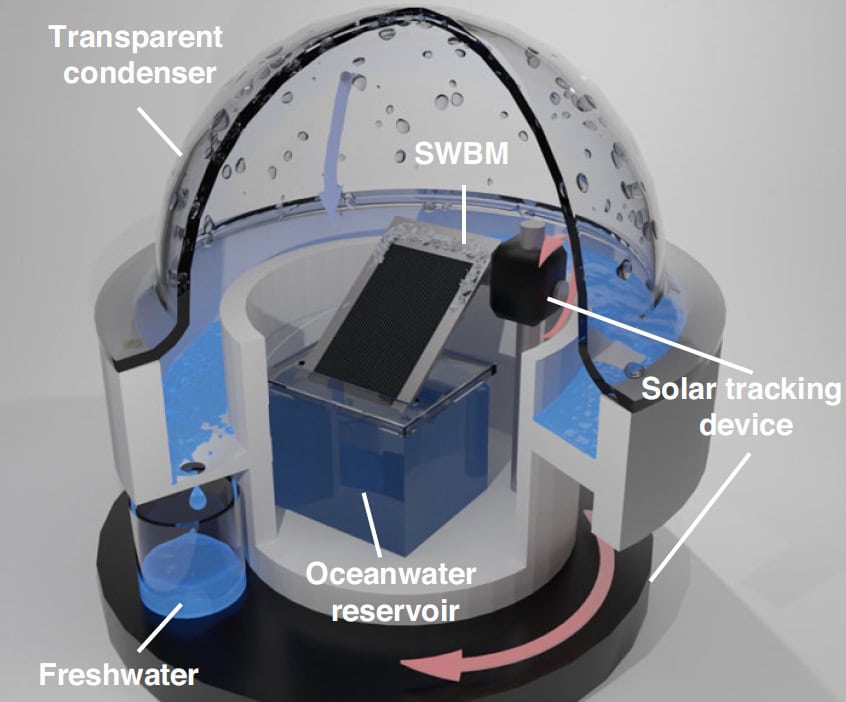
The self-cleaning mechanism is vital for use in real-world scenarios. Many desalination technologies work in the lab where the only mineral component is sodium chloride. Ocean water, however, contains many other materials, such as magnesium and calcium salts, that could crystallize on the panel and clog it. The self-cleaning process is driven by etched grooves that stop these minerals from staying on the panel. If oceans contain too high a mineral content, wider and deeper grooves can be etched into the panel by applying a higher laser power during fabrication.
The team tested the solar-thermal desalination panel using water samples from Pacific, Atlantic and Indian Oceans. When tracking the sun over a week to purify the ocean water, the panel demonstrated an average evaporation rate of 1.76±0.04 kg/m2/h and a salt harvesting rate of 61.74 ± 2.46 kg/m2/h under one sun illumination, corresponding to 74% solar-to-vapour conversion efficiency and near-100% salt extraction.
Waffle-shaped solar evaporator delivers durable desalination

The researchers are now working to scale up the technology and integrate it with other mature platforms, such as solar cells. “We have made significant progress by demonstrating that the desalination process can be used to cool the solar cells, improving electrical output while simultaneously producing freshwater. This approach could lead to a synergistic water-energy system that operates sustainably,” Guo tells Physics World.