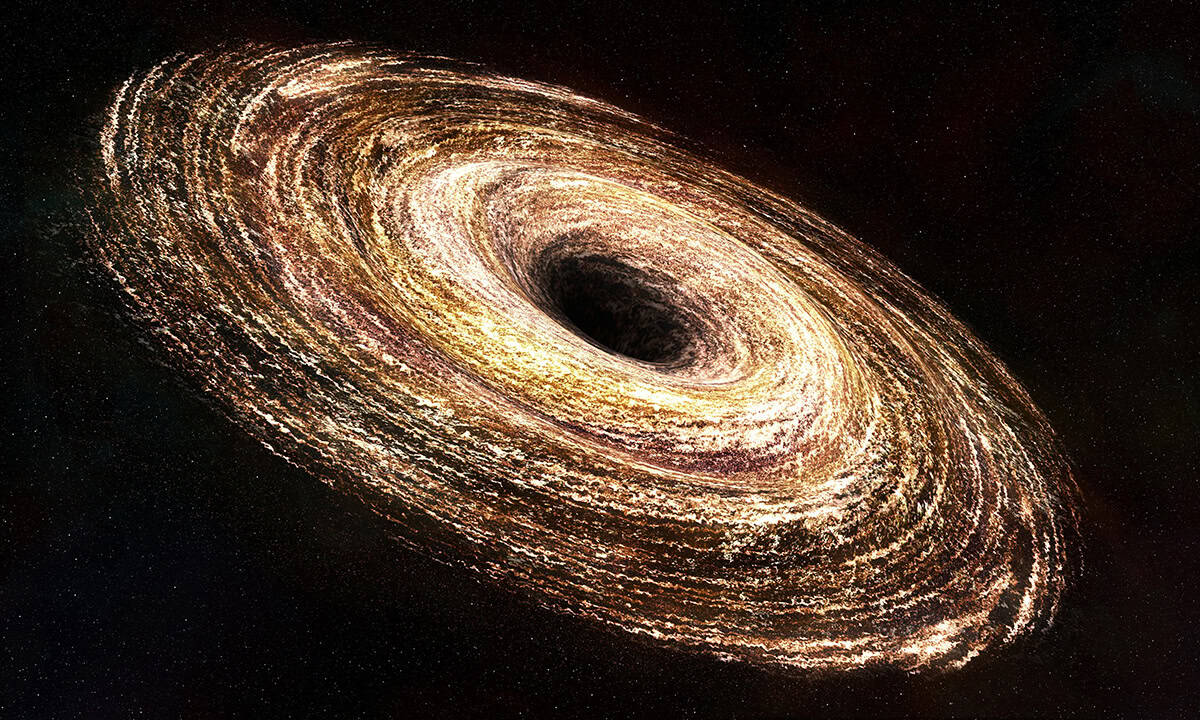
A radio signal has been amplified by scattering it from a stationary coin-sized electronic circuit that behaves as though it is rotating at an enormous rate. Conceived by a team at the City University of New York, the experiment is said to provide the first observation of rotational super-radiance involving electromagnetic waves. This wave-amplification effect is inspired by rotating black holes and was predicted more than half a century ago. Andrea Alù and colleagues found that only radio waves carrying a particular kind of twist were boosted, by as much as a factor of six in power.
In 1969 Roger Penrose pointed out that a rotating black hole holds a vast reservoir of energy that, in principle, can be tapped. “An object entering the region around the black hole can split into two parts, one falls into the black hole while the other escapes with more energy than the original object had, effectively taking some rotational energy from the black hole,” Alù, explains.
Two years later the Soviet physicist Yakov Zel’dovich realized that the same thing should happen to waves. “If a wave carrying angular momentum reflects from a rapidly rotating absorbing cylinder, the reflected wave could be amplified and come back stronger than it arrived,” says Alù. That amplification is called rotational super-radiance, which Alù describes as, “a process in which a wave becomes stronger by extracting energy from a system that rotates very rapidly”.
The catch has always been the word “rapidly”. For the effect to occur, the rotation must outrun the wave itself, and for light or radio waves that means rotational rates no mechanical object could survive. The effect has been coaxed out of water waves swirling around a vortex and out of sound waves bouncing off a spinning absorber, but electromagnetic waves had been out of reach. “While the idea is fascinating, no experimental demonstration was reported for electromagnetic waves, due to the required very fast speeds,” Alù says.
Clever solution
The CUNY team has found a clever way around the speed restriction. “Instead of physically spinning an object, we created an artificial rotation by periodically changing the properties of a network of resonators in space and time in a way that mimics rotation,” says Alù. The new device is disarmingly simple, comprising three small electrical circuits wired into a loop roughly two centimetres across, each one tuneable like a radio dial. The tuning of all three is wobbled up and down, with each kept slightly out of step with its neighbours, so the pattern sweeps around the loop like a wave passing through a stadium crowd.
“Although no physical object is rotating, this travelling modulation pattern acts like a rotating system,” Alù explains. And because the apparent speed is set purely by how quickly the electronics are driven, it can be pushed as high as one likes. “In fact, this speed can be faster than the velocity of light without violating any physical law.” Nothing material moves, so nothing outruns light.
The researchers fed a 100 MHz radio signal into the loop. This light was in a specific twisted state (possessing orbital angular momentum). They then swept the rotational rate from 5 MHz up to 195 MHz. Below 100 MHz the reflected light weakened steadily, as expected. Above 100 MHz, however, the synthetic rotation overtook the wave and the behaviour flipped. The reflected signals reappeared at the same frequencies as before — 60, 70 and 80 MHz — but were twisted the opposite way, and were stronger rather than weaker. That reversal, Alù notes, is “a key signature of entering the regime associated with super-radiance”. The gain arises in special windows the team calls angular-momentum bandgaps, which open once the synthetic rotation is fast enough and through which “energy can be transferred from the synthetic rotation to the wave”.
Fussy amplfier
The amplification was fussy about its input. “Our observed amplification was selective to the angular momentum of the input wave, only waves with particular angular-momentum properties experienced gain,” says Alù. Stranger still, the effect feeds on waste. In an ordinary amplifier, energy leaking out of the device is the enemy. Here a leakier circuit gave more gain, exactly as the thermodynamic reasoning behind super-radiance demands.
Rotating cylinder amplifies electromagnetic fields

Alù is careful about what the experiment does and does not deliver. “The experiment does not study actual black holes or quantum gravity. Instead, it creates a laboratory system that reproduces some of the same physical principles involved in rotational energy extraction.” What it offers, he says, is “a controllable analogue platform where researchers can test and explore concepts that are otherwise difficult or impossible to study experimentally in astrophysical black holes”.
Three circuits in the loop allow only three distinct twists, so the immediate goal is bigger loops supporting a wider range. Beyond that lies the jump from radio waves to visible light, and a quantum version in which synthetic rotation might conjure photons out of empty space. Practical spin-offs may arrive sooner. Amplifying only one twist at a time is a natural fit for encoding information, and, Alù suggests, “new forms of lasers, with selective emission of angular momentum, can be envisioned”.
The research is described in Nature.