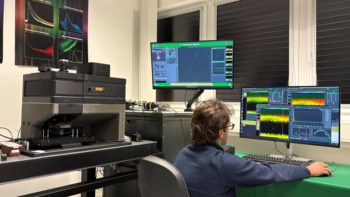
The key themes facing photonics industry and research in the UK were discussed at the recent Photon2026 conference in Newcastle, run by the Institute of Physics, as Michael Banks reports

“The UK is really good at photonics and it should be something that the UK celebrates.” That was the verdict of John Lincoln, chief executive of the national network organization UK Photonics Leadership Group (PLG) at a recent meeting of the photonics community in Newcastle. He was speaking in a panel debate at the Photon2026 conference run by the Institute of Physics (IOP) in Newcastle on 1–4 September. Attended by hundreds of delegates, the meeting focused on the strengths, opportunities and future potential for optics and photonics in the UK and EU.
The photonics industry, which has been in the UK for more than 60 years, is one of the country’s most economically productive sectors. According to the PLG, photonics generated £18.5bn in revenue in 2024 – up 20% from 2022 – and contributed £8.6bn to the UK economy. It now employs more than 75,000 people in over 1200 firms across all UK. Lincoln says that part of the UK’s success is the wide geographical spread of the hundreds of companies involved in photonics. Northern Ireland is Europe’s largest manufacturer of lasers by volume, for example, producing a million lasers per day, and is on course to be the world’s largest by 2028.
A national UK roadmap for photonics is expected to be published soon, which will feature recommendations to further boost the sector. Indeed, by 2035 photonics is estimated to be a £50bn industry where more than 60% of the UK economy will directly depend on photonics to keep it competitive. It is also expected to produce an additional 150,000 direct jobs and be one of the top three most productive manufacturing sectors in the UK.
The panel debate at Photon2026 was co-ordinated by physicist Jolyon De Freitas, chair of the IOP Optical Group, together with the European Optical Society – an umbrella organization for national optical societies across Europe. Speaking at the event, Ruth Oulton from the University of Bristol, who specializes in semiconductor quantum dots, said that many companies, including those in the US, want to move their companies to the UK given its focus and support on photonics and quantum. “The UK government has a very strong and coherent story to tell and it gives a bit of stability and clarity for people coming here, which is really promising,” she added.
Optics and photonics have important applications in several sectors including telecommunications, space and quantum technologies as well as defence and security. John Howell from Chapman University in the US, who is immediate past president of the International Commission for Optics, highlighted that improving access to optics and photonics instrumentation in the developing world can boost environmental and water monitoring and disease detection.
Opportunity knocks
Panel member Laura Young from the University of Newcastle, who works on medical technologies, said that the UK could improve further by making the most of “translational opportunities” when it comes to the application of optics into medical devices and getting those benefits out to patients. “Taking those early developments all the way through to products that have commercial or societal impact also makes it a more inviting domain for new talent to come to the UK,” she said.
That view is backed up by fellow panellist Chris Johnson, chief scientific adviser for the UK’s newly renamed Department of Business, Innovation, Science and Trade, which in July absorbed the science and innovation portfolios of the former Department for Science, Innovation and Technology under new UK prime minister Andy Burnham. Johnson said that photonics still has room for improvement when it comes to applications, pointing to the synthetic biology sector, for example, which has managed to engage with venture capitalist to grow from small, medium enterprises to larger businesses. He said that the photonics sector must have plans in place not only to generate start-ups and spin-outs, but also to plot their trajectory to growth beyond that.
The UK has a strong history in photonics research. Some 20% of global publications in photonics originate in the UK
As well as industry, the UK also has a strong history in photonics research. Some 20% of global publications in photonics originate in the UK. Yet Oulton, who also works at the foreign commonwealth and development office as an adviser on quantum technologies, added that scientists should explain more clearly to policy-makers why support for photonics needs to be continued. Oulton said it’s important that scientists clearly provide evidence for success and make international comparisons, rather than solely providing a wish list of support to government. “Make sure to read white papers the government produces like the modern industrial strategy,” she added.
Lincoln agreed, saying it’s important for researchers to clearly explain how photonics is critical to emerging technologies such as AI, energy, quantum and connectivity. Lincoln added that the government needs to embrace the complexity of photonics and its many varied applications and make sure the talent pipeline exists at all levels. “One of the things we are calling for is to make sure that skills support goes beyond PhD to engineers and technicians,” he said.
Continental effort
The panel debate at Photon2026 – the first time such an event has been hosted at a Photon meeting – was moderated by Anne Crean, associate director for science, business and data insights at the IOP. She noted that the UK and EU are “global leaders” in photonics featuring world-class research institution, innovative companies and strong partnerships, adding that the collaboration between the UK and EU will be “vital” in maintaining and advancing that position.
That collaboration was put to the test in 2016 when the UK voted to leave the EU, bringing with it significant amount of uncertainty not only for academia but industry too. Yet some of those initial issues are beginning to be resolved. Tom Grinyer, chief executive officer of the IOP, said that there are many positives about recent developments. “In 2022 we were outside of the Horizon funding framework and it felt like we were staring through a window,” he says. After negotiating back into the programme in 2024, Grinyer pointed out that the UK has received about 8.7% of optics and photonics funding in Horizon over the past two years, compared to other areas where the UK has received about a 7.6% share.

Lincoln added that it is critical for the UK to address the confusion around the UK’s involvement in the next European framework programme – FP10 – that will run from 2028 to 2034 with a proposed budget of €175bn. Delegates stressed that collaborating with the EU not only bring partnerships but also the ability to “scale” efforts.
“The UK and the EU are quite different in how they operate,” noted Oulton from Bristol. “The EU has scale and is the only body large enough to be competitive with the US and China but it can be quite slow from a policy perspective.” She pointed out that the UK has the ability to move more quickly into new fields, while the EU can piggyback onto those areas that show the most promise.
For all those benefits, Lincoln maintained that funding for photonics in Europe is “slightly out of phase” with the UK given that EU funding for photonics will be wrapped into the European Chips Act, which aims to strengthen the EU’s semiconductor industry and reduce its reliance on foreign suppliers for critical technologies. “We must adapt to a world where photonics is a semiconductor,” said Lincoln. Why optics is critical to meeting society’s grand challenges
While collaboration cropped up many times in the discussion, it does bring challenges. Johnson pointed out the importance of photonics to national security, whether it’s the production of chips or its use in defence, and the growing threat of industrial espionage that it brings. Some countries are looking at ways to protect research and innovation from other nations by demanding that collaborative research be limited particularly when it comes to “dual-use” technologies that may also find military applications. Indeed, there is a general move towards requiring dual-use applications when applying for research and development support.
Yet Lincoln urged scientists to “embrace” working in these areas and for policy makers to not see the world as a zero-sum game. “Collaboration makes everyone better,” he said. “Don’t think of it as us versus them, but look at it as how we can both win.”
Bringing together the UK optics and photonics community
The Photon2026 conference was jointly organized by several IOP special interest groups including environmental physics, optical, quantum electronics and photonics, and medical physics. Held in the UK every two years, Photon2026 was the 13th in the series and featured talks from leading physicists and technology experts as well as an exhibition showcasing the latest optics and photonics technologies.
At the conference, theoretical physicist Michael Berry from the University of Bristol delivered the 2025 IOP Isaac Newton Lecture titled “What we learn(ed) from rainbows?” in which he explored how centuries of studying rainbows have bridged connections across physics, mathematics, colour and optical illusions.