Terrestrial solar cells rely on capturing a broad spectrum of sunlight, particularly the low-energy, long-wavelength red and infrared regions between 800 and 1150 nm. Emulating this concept underwater fails because water acts as a fierce optical filter, strongly absorbing light at wavelengths of 630 nm or more. Furthermore, descending just a few metres deeper completely attenuates longer wavelengths. This forces the aquatic environment into a twilight zone, where virtually all red light has been absorbed, leaving only a narrow, faint blue-orange glow spanning 400 to 600 nm as the sole source of illumination.
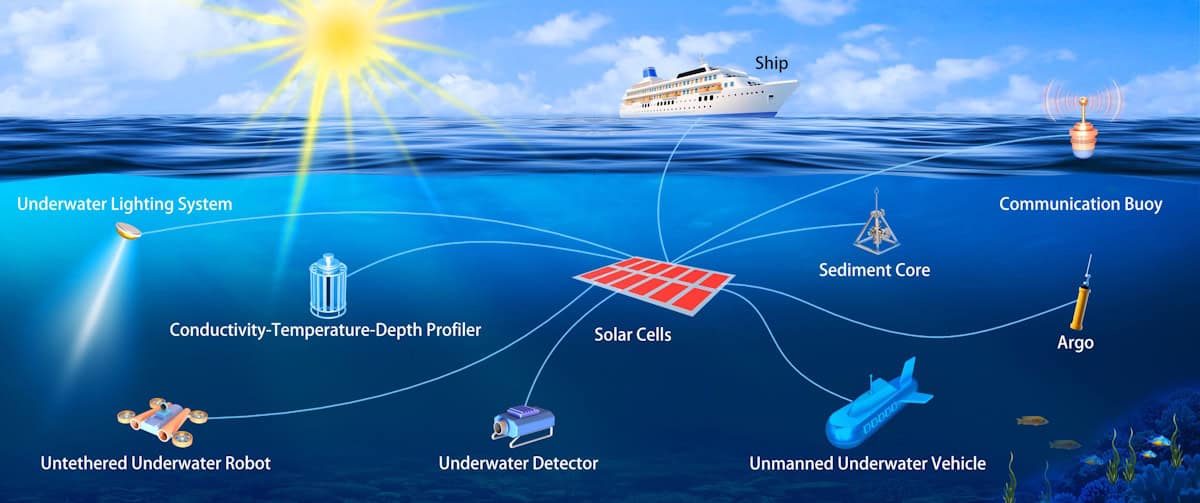
Consequently, conventional silicon, cadmium telluride or standard 1.55 eV perovskite solar cells are poorly suited for underwater operations, as their optimal absorption regions match photons that never reach them. While these constraints have long hindered the development of underwater solar harvesting, stalling the deployment of autonomous marine infrastructure like deep-sea sensors and environmental monitors, a research team in China has now charted a clearer path forward.
In a leap toward self-sustaining underwater solar harvesting, a research team led by Wen-Hua Zhang at Yunnan University has developed a functionalized solar cell for the deep sea. As detailed in Joule, the team built a wide-bandgap perovskite solar cell that thrives in dim environments by capturing the specific blue-green light that penetrates deep water. This unique design allowed the device to generate electricity underwater with a record-breaking 34.71% power conversion efficiency at a simulated depth of 10 m.
Tuning the physics of perovskites
The researchers achieved this breakthrough by engineering a mixed-anion lead halide perovskite cell with an optimized, wide optical bandgap of approximately 1.96 eV, precisely tuned to match the narrow blue-green window of deep water. While wide-bandgap perovskites are theoretically ideal for this application, they suffer from severe material vulnerabilities on land. Exposure to intense light and heat induces volatile halide-ion migration, phase separation and high concentrations of structural defects, causing rapid degradation.
This is where the unique physics of the underwater environment and intelligent molecular engineering come together. The naturally cool temperatures (typically below 25°C) and reduced light intensities beneath the waves act as an inherent shield against thermal degradation. To address the remaining internal defects and ion migration, the researchers introduced a specialized crystallization additive, polyhexamethylene guanidine hydrochloride (PHMG), into the lead halide perovskite matrix.
The addition of PHMG completely rewrites the crystallization dynamics and surface electronic properties of the perovskite film. On a molecular level, the polymer combines a water-repelling backbone with highly stable, chemically active ions (guanidinium cations). These ions act as multisite anchors that lock into empty gaps within the crystal structure, stabilizing and strengthening the entire framework. At the same time, they act like a chemical glue, binding tightly to lead and halide ions through hydrogen bonding to lock the crystal together and prevent structural decay.
This dual-action mechanism raises the activation energy barrier for ion migration from 0.07 to 0.21 eV, effectively freezing phase segregation in its tracks. Advanced testing (using ultraviolet photoelectron spectroscopy) revealed that the PHMG shifts the film’s electronic behaviour from hole-carrying (p-type) to electron-carrying (n-type) conductivity. This shift creates a favourable energy slope (band bending) at the surface, significantly accelerating electron extraction while dramatically driving down energy losses from trapped charges (known as interfacial non-radiative recombination).
From lab simulation to the open sea
These physical adjustments translated to extraordinary performance gains. Under standard terrestrial sunlight, the modified cell achieved a certified power conversion efficiency of 16.79%. But beneath the surface, it truly shone. Tested using an underwater solar simulator containing custom-engineered multilayer interference optical filters, the small-area (0.0895 cm2) cell registered an impressive 34.71% efficiency under 10 m-deep light illumination.
Scaling up the technology, the team built large-area modules with an active area of nearly 29 cm2. Shielded by a robust multilayer encapsulation of polyisobutylene, cover glass and protective epoxy resin, these modules withstood extreme hydrostatic pressures and salt-water corrosion.
Deployed on a miniature robot in the open waters of the South China Sea near Weizhou Island, the modules successfully harvested solar energy across varying depths. Even at a depth of 10 m, with severely attenuated illumination, the system maintained stable electricity production, successfully generating 324 mWh of energy to charge lithium-ion batteries underwater. These batteries were later used to illuminate a custom LED panel.
“In contrast to the lab-based static underwater solar simulator, waves, turbidity and suspended organic matter in real oceans can change the light intensity and spectral composition. This leads to substantial fluctuations in output power and reduces the power‑generation stability of the cells,” Zhang tells Physics World. “Therefore, in-field experiments of the large-area solar modules, as we carried out in the South China Sea, are indispensable to assess their real-world power generation.”
The team also performed high-temperature stress testing (accelerated thermal aging tests) and molecular decay modelling (Arrhenius degradation kinetics). These tests predicted a remarkable operational lifespan in which the device retains 80% of its initial efficiency (T80 lifetime) for approximately 48,094 h, translating to 5.49 years of continuous underwater operation at a standard temperature of 25 °C. Furthermore, mass spectrometry confirmed negligible lead leakage into the surrounding water, verifying the environmental safety of the design.
Bilayer approach ramps performance of all-perovskite triple-junction solar cells

By mastering the unique physics of underwater light transmission and overcoming the lattice instability of wide-bandgap perovskites, the researchers have advanced a frontier for photovoltaics. This development moves solar energy beyond its traditional terrestrial borders and lays down a path toward long-lasting, self-sustained energy networks beneath the ocean surface. Future marine biology sensors, deep-sea research cameras and submerged Internet-of-Things infrastructure could one day owe their autonomy to these high-performance underwater power grids.
When asked about how the device handles biofouling over extended periods, Zhang emphasizes the need for cross-disciplinary scaling: “The current research focuses on high-efficiency and stable solar cells, as well as the integrated application of photovoltaic energy storage systems. Indeed, biofouling is a critical challenge for the long-term operation of underwater photovoltaics. However, this issue involves multidisciplinary efforts and requires collaborative research from more scientists.”