Sean G Ryan reveals spectacular images of the 2026 solar eclipse taken using amateur astronomy equipment on the Isle of Wight
The UK’s hot, dry summer provided widespread clear skies for the solar eclipse that took place on Wednesday 12 August 2026. It was not a total eclipse – you had to be in northern Spain for that – but Britain still enjoyed a partial eclipse between around 6 p.m. and 8 p.m. BST, depending on location.
With typically more than 90% of the Sun’s disc covered – and with the event occurring after many people had finished work – the circumstances were ideal for a rare, immersive mass-engagement with physics.
Many people had got hold of eclipse glasses in advance or searched through kitchen cupboards for a colander to produce shadow patterns
Widespread public-awareness raising by professional and amateur astronomical societies had led to a strong build-up to the event in mainstream and social media. As a result, much of the public was aware the eclipse was coming, and many people had got hold of eclipse glasses in advance or, failing that, searched through kitchen cupboards for a colander to produce shadow patterns.
Here in the UK, friends and families gathered on west-facing hills, parks and village greens that evening with folding chairs, smartphones, cameras, telescopes and colanders, to enjoy the spectacle over a picnic tea. In built-up areas of towns and cities, many sought out west-facing windows of homes and offices.
I’m an old-school visual observer and recorded the eclipse sequence using 20-year-old equipment
While the eclipse on the UK mainland was deepest in Cornwall, I took my chances on the Isle of Wight, just off the coast of southern England.
Amateur astrophotography has been revolutionized over the last few years thanks to specialized high-sensitivity astronomical CMOS cameras, but I’m an old-school visual observer and recorded the eclipse sequence using 20-year-old equipment.
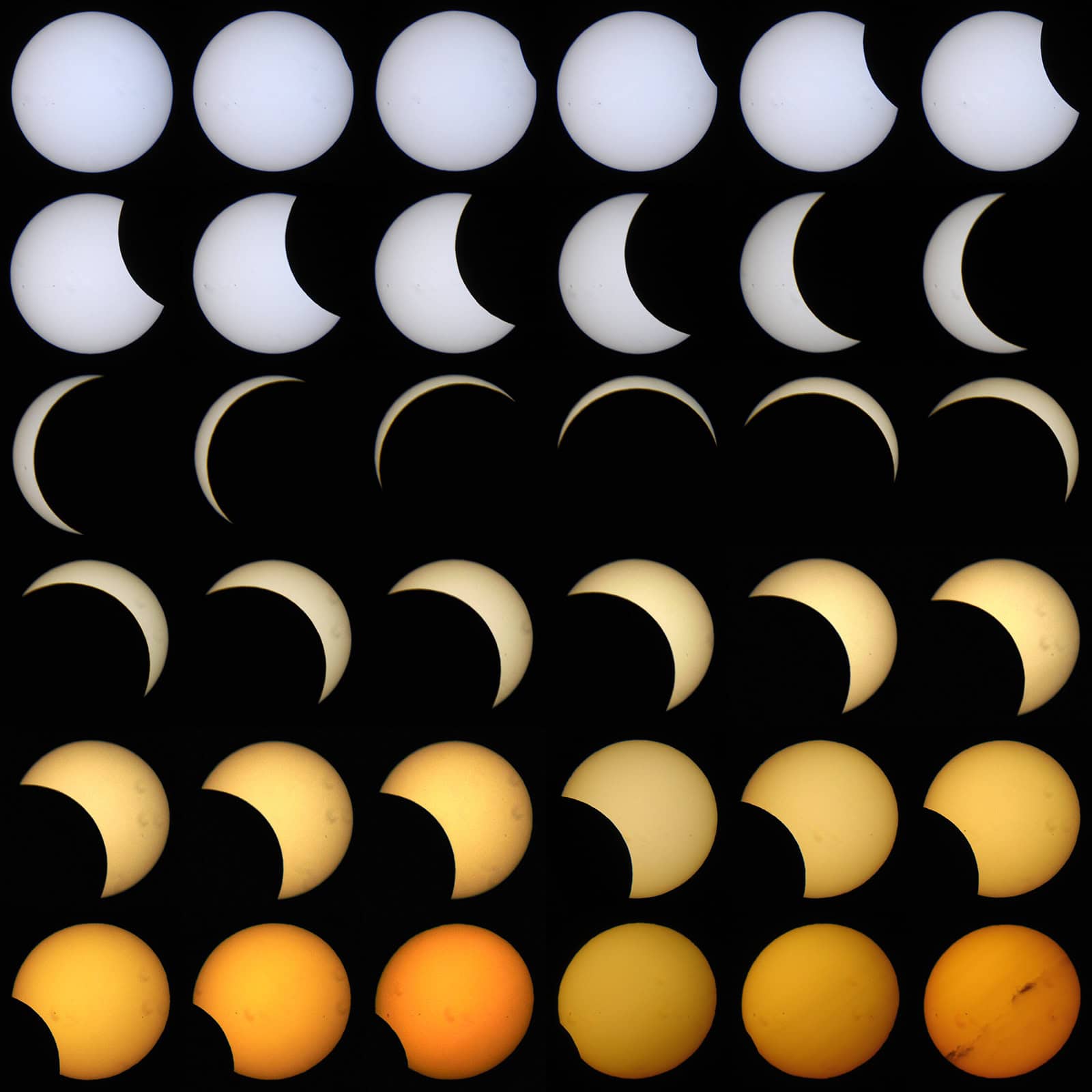
The montage presented here contains 36 frames spanning the entire eclipse sequence and packs in a wealth of physics. Besides the obvious relative motion of the Earth, Moon and Sun, three sunspot groups are visible, approximately delineating the solar equator; the camera was aligned with the sunspot groups and the equatorial mount maintained this orientation.
The Moon’s sharp-edged silhouette is a reminder that it has no atmosphere, whereas the Sun is brighter in the centre than the edge. Known as “limb-darkening”, it arises because of the temperature gradient of the tenuous solar photosphere – and is a reminder that the perceived edge of the Sun is merely a wavelength-dependent opacity transition.
An evening of landscape astrophotography

While we often describe the Sun as yellow, the transmission profile with the OD5 solar filter that I used here gives it a slightly silvery-blue tinge. But as the Sun sank lower in the sky during the evening, wavelength-dependent extinction and scattering reddened the light, so the silvery disc progressively turns distinctly yellow and then orange.
Along with the colour change, the solar disc takes on an oblate form in the final row of frames due to differential atmospheric refraction close to the horizon. Terrestrial clouds close to the local horizon are seen in the final frame.
For many people viewing an eclipse for the first time, talk of intersecting orbital planes is perhaps already too much physics for one evening, but for those who wish to look a little deeper, more questions – and more physics – pop up the closer you look. What have you spotted in the montage that I haven’t?
The technical stuff
I took these images using a portable 90 mm diameter Maksutov-Cassegrain telescope (a Meade ETX-90) on an equatorial mount with a battery-powered drive, a full-aperture glass OD5 solar filter, and a 25 mm focal-length eyepiece paired in eyepiece-projection mode with a 5 megapixel Sony Cyber-shot CCD digital camera.
The camera was set for manual operation: minimum ISO (100), minimum aperture (f/5.6), fixed focus (achieved at f/2.8), and manually adjusted exposure time (1/400 – 1/13 s). Image processing was minimal, conducted using ImageJ software, which is widely used in biomedical imaging.
Shadowing of the sensor by dust on the lens surfaces was partially corrected by dividing through by a normalized clear-sky exposure. Frames were cropped manually and re-scaled in intensity to compensate for increasing atmospheric absorption as the Sun sank towards the horizon, and for changes of exposure duration.