The gravity from entropy (GfE) theory has been used to explain how low-entropy structures such as galaxies emerge and endure in a universe in which entropy increases with time. Using the theory, Ginestra Bianconi of the UK’s Queen Mary University of London has shown how entropy density can decrease locally, while the total entropy of the universe increases.
The laws of thermodynamics are arguably among the most fundamental principles in most areas of physics. Perhaps none more so than the second law of thermodynamics, which states that the entropy of a system must increase over time. Uniquely, it is the only law of physics that captures the direction of time we experience.
Fundamentally, entropy is a measure of disorder: lower entropy means more structure and higher entropy means a less structured system. Increasing entropy is the reason diffusion occurs from a high concentration to a low concentration, gases expand, and coffee goes cold.
Cosmological paradox
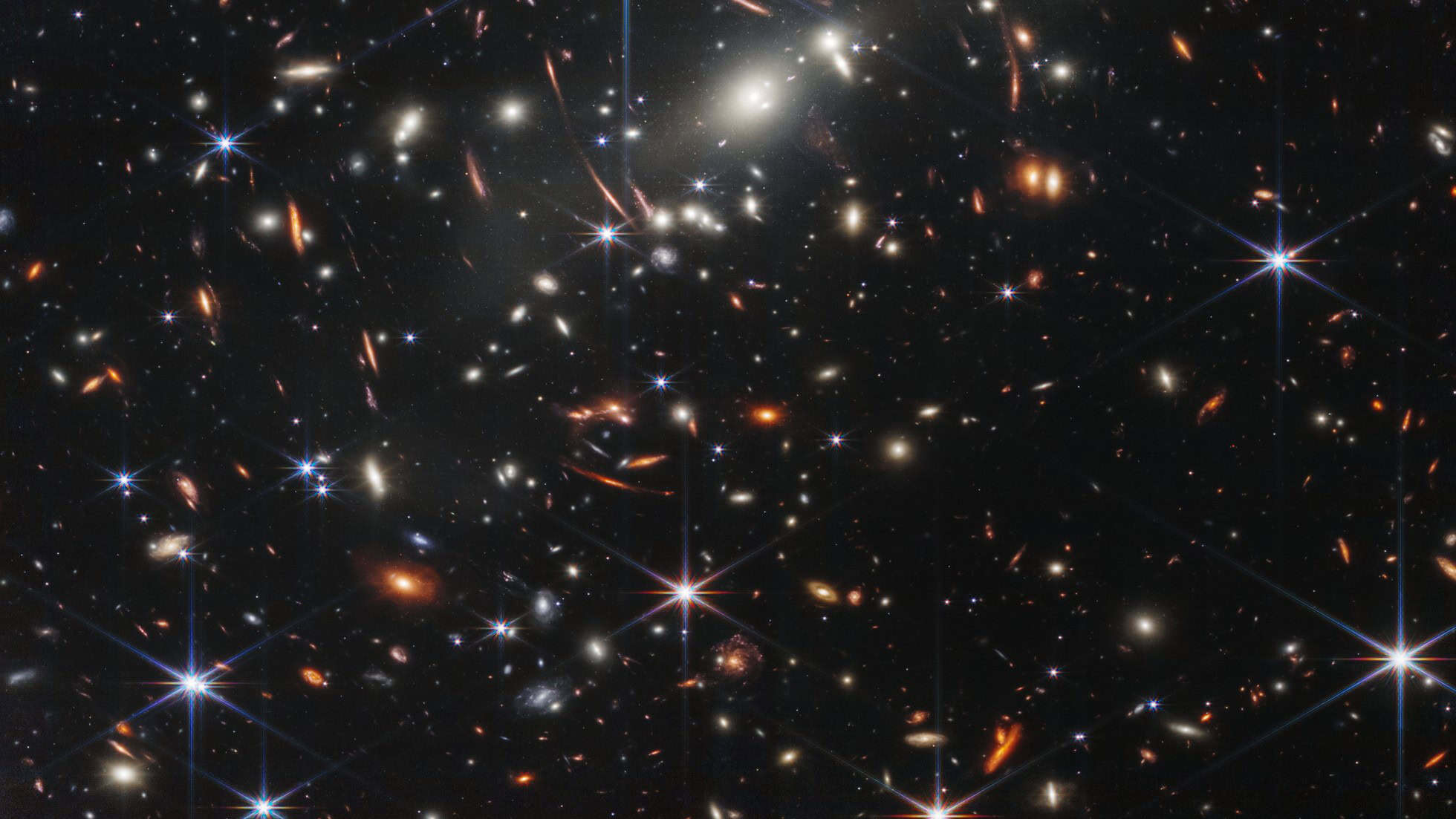
It is believed that the evolution of the universe also follows the second law. The early universe was in a state of low entropy, and it has evolved to states of high entropy. It is also true that during this evolution, the universe has given rise to some incredibly complex structures. Galaxies are a prime example of one of these structures, which are low in entropy but have formed in a high-entropy environment. Their creation seemingly violates the second law. This is a longstanding contradiction in the field of cosmology that is motivating the gravitational framework proposed by Bianconi.
In a recent paper called “Thermodynamics of the gravity from entropy theory”, Bianconi, built on her previous work on the GfE theory and applied it to the whole universe to tackle this challenging paradox.
In Einstein’s general theory of relativity, the metric mathematically describes how the space–time of a universe is curved. Mass follows this curvature, and this is how a gravitational force is realized. In quantum mechanics, operators are mathematical objects that can be applied to physical quantum states to transform them (for example the time evolution or reflection of a quantum state).
Quantum relative entropy
The key insight of the GfE theory is that these metrics are treated as quantum operators which encode the geometry of space–time. Quantizing the geometry of space–time in this manner leads to two notions of the metric – one that is the “true” metric, and one that is induced via mass and energy. The distinguishability between the true manifold metric and one that is induced from the mass, and energy is measured by a quantity rooted in quantum information theory, called quantum relative entropy (QRE). It is this interplay between the two geometries measured through QRE that, in this scenario, defines the dynamics of the space–time.
In other words, the QRE leads to equations of motion that describe gravity. Bianconi found that in the low curvature limit, classical general relativity is reproduced exactly from these equations. However, outside of this limit, the equations must be modified by a mathematical object called the ‘G-field’. This G-field generates a dark-energy term that is surprisingly dynamical. Dark energy is thought to drive the universe’s expansion directly. In standard general relativity, dark energy is driven by the static cosmological constant, which is why a surprising dynamical dark energy term from the G-field is an avenue that has the potential to be testable.
Preserving the second law
In a recent paper, Bianconi describes how the GfE theory can be applied to a Friedmann–Robertson–Walker (FRW) metric universe. The FRW model is one from general relativity that provides a first approximation to the universe’s behaviour, displaying simple characteristics such as isotropy (it looks the same in all directions when observed from a single point), homogeneity (globally uniform in distribution of its contents) and expansion (a property observed in the universe).
The expansion is driven by the dominant composition of the universe, such as dark matter, matter, or radiation. As the universe expands, its volume also increases, along with its total entropy. Due to this growth, the local entropy per unit volume decreases over time, as there is the same amount of entropy contained in a now larger unit volume; the entropy density decreases (along with similar decaying behaviour for the local energy density). This decrease in local entropy in a universe of entropy growth provides a mechanism for low-entropy structures such as galaxies and even life forms to be created in an expanding universe.
New research suggests gravity might emerge from quantum information theory

The question then remains: does this mechanism violate the second law of thermodynamics? Thankfully, Bianconi also answered this question for a non-empty universe described by the FRW metric. To find the total entropy of such a universe, the entropy density must be integrated over a space–time region, which, due to the fact that the volume increases, is a time-dependent quantity. This is a result of the expansion being faster than the decay of the entropy density. For radiation- and matter-dominated universes, then, the entropy is increasing in time, specifically following the second law of thermodynamics even when the entropy density is decreasing locally. To summarize, while entropy density decreases locally, the total entropy of the universe is still increasing in this model.
Bianconi emphasizes that the GfE theory is still in its infancy, and experimental verifications are required. However, this work highlights the intrinsically thermodynamic nature of the GfE theory, which opens new avenues for both classical and quantum gravity. By framing gravity in terms of quantum information and entropy, the theory may offer an alternative route towards quantizing gravity—one of the longstanding challenges in fundamental physics.
Bianconi describes her research in Physical Review D.