
Indu Satija celebrates the 50th anniversary of the publication of Douglas Hofstadter’s eponymous, iconic butterfly and explains its enduring, magnetic appeal
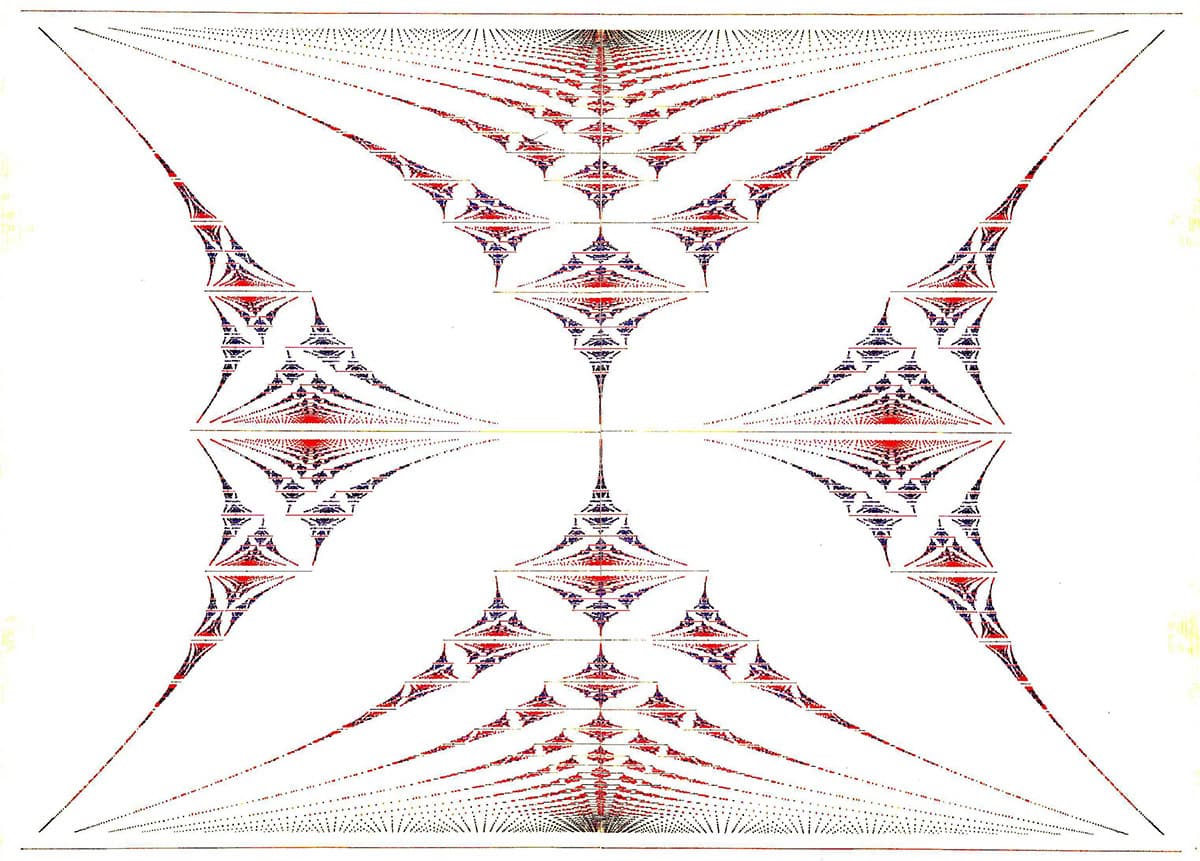
In the mid-1970s a graduate student wrestling with a deceptively simple quantum problem uncovered one of the most haunting images in modern physics. The pattern seemed almost impossibly intricate: delicate wings assembled from infinitely nested bands and gaps, a self-similar pattern born from the motion of electrons in a crystal under a magnetic field. First published in 1976 (Phys. Rev. B 14 2239), it came to be known as Hofstadter’s butterfly, after its discoverer Douglas Hofstadter.
Half a century later, the butterfly has not faded into scientific nostalgia. If anything, it has become even more important – reappearing in new materials, new experiments and in places no-one imagined when it was first plotted. Recent research by Kazuki Ikeda from the University of Massachusetts and Yaron Oz at Stony Brook University suggests that related patterns may even surface in the physics of black holes (J. High Energy Phys. 2026 38).
Each new realization adds another chapter to a story that is not really about a single graph, or even a single discovery, but about the unity of patterns across the physical world. A structure first seen in a simple model has become a symbol of how richness can emerge from basic rules, how beauty can arise from constraint, and how the quantum world still harbours forms strange enough to surprise us.
How the butterfly got its wings
What makes Hofstadter’s butterfly so compelling is the remarkable story of its birth and, more importantly, how far it has travelled from its original birthplace. Like many scientific breakthroughs, its discovery was fairly obscure initially and owed a great deal to luck. In 1974 Hofstadter – son of the 1961 Nobel-prize-winning nuclear physicist Robert Hofstadter – had just dropped out of graduate school at Stanford University in the US and was “in despair” according to friend and physicist Francisco Claro.
Having just completed a PhD with the renowned solid-state physicist Gregory Wannier at the University of Oregon, Claro suggested that Hofstadter should approach Wannier as well. As it happened, Wannier had been struggling with a problem that had puzzled him for years: he could not obtain an analytical solution to Harper’s equation, which describes the motion of electrons on a 2D crystal lattice subjected to a perpendicular magnetic field.
Named after P G Harper, who was a graduate student of Rudolf Peierls at the University of Birmingham, UK, this classic “magnetic problem” displayed a mysterious sensitivity to whether the magnetic flux was a rational or irrational number. It was a feature that immediately captured Hofstadter’s imagination and, with the rational–irrational dichotomy echoing in his mind, Hofstadter began his PhD studies at Oregon by immersing himself in solving the problem.
But he soon found himself equally stuck. Frustrated by the analytical approaches often discussed at the time, he pursued a different path: numerical computation. Using a programmable Hewlett Packard desktop calculator that by today’s standards looks laughably primitive, he displayed the numerical solutions graphically as the energy of electrons versus magnetic flux Φ per unit cell of the lattice. At that moment, he became convinced that he had uncovered the true structure of the problem. “All at once my eyes were opened,” Hofstadter recalls.
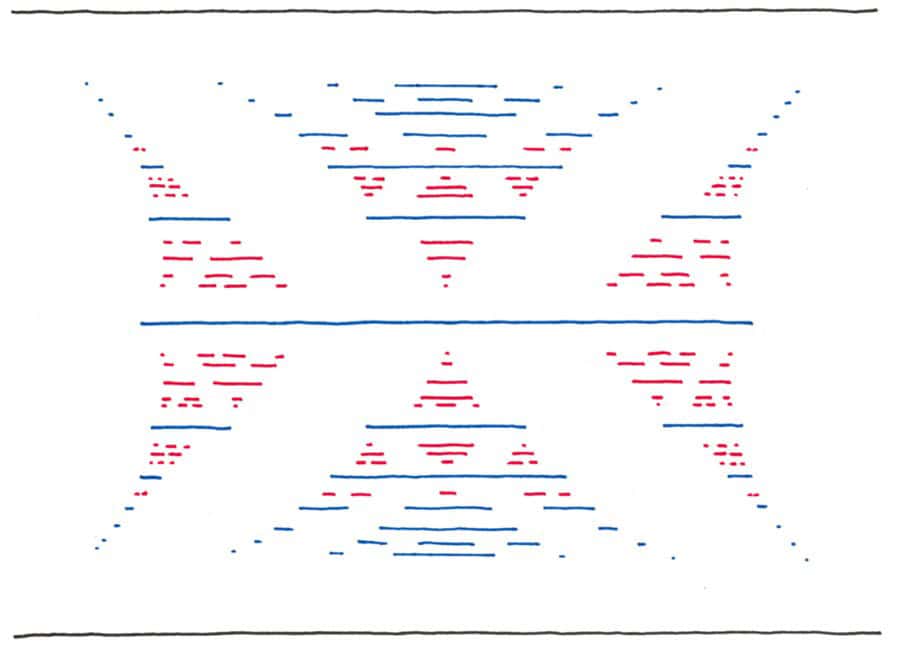
What he found was a complex recursive shape (or fractal in today’s terminology) hidden within the energy spectrum of electrons in a magnetic field. Resembling a butterfly, Hofstadter brought his hand-plotted diagram, which he codenamed “Gplot”, to Wannier, who was not impressed. According to Hofstadter, Wannier dismissed the result as “numerology” and even threatened to withdraw the PhD student’s funding.
But after nearly a year, Wannier came to recognize the validity and significance of Hofstadter’s work, ultimately awarding Hofstadter his PhD and accepting the butterfly as a legitimate description of the energy spectrum of electrons moving on a 2D lattice in a magnetic field. Wannier even added to the butterfly’s story with a paper titled “A result not dependent on rationality for Bloch electrons in a magnetic field (Phys. Status Solidi b 88 757). This work, along with further studies with Claro, introduced a set of integers uniquely labelling every gap in the graph, providing a simplified description of the spectrum (Phys. Rev. B 19 6068).
Douglas Hofstadter: in his own words
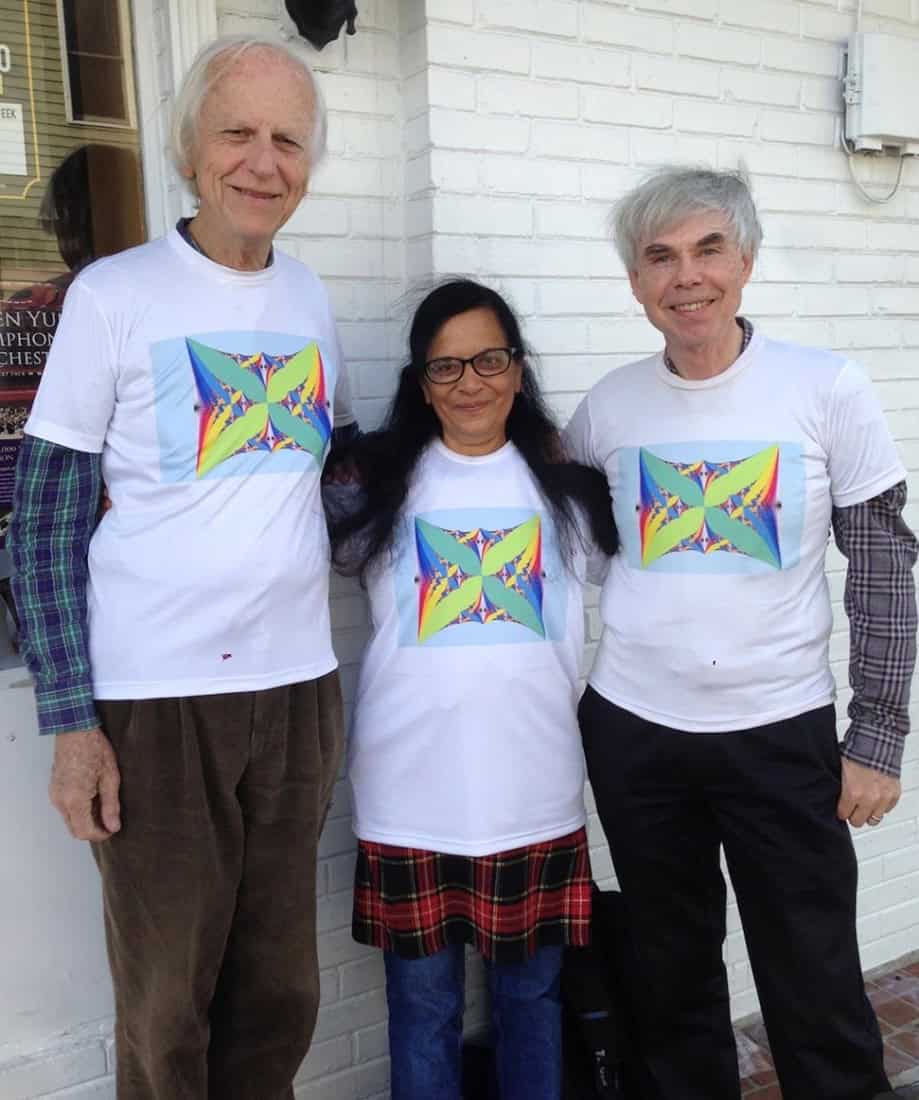
Born in 1945, Douglas Hofstadter discovered his eponymous butterfly while a PhD student at the University of Oregon in 1975, using computational modelling to make his breakthrough (see main text). Four years later Hofstadter published his Pulitzer-prize-winning popular-science book Gödel, Escher, Bach, which tackles cognition, mathematics and symmetry.
Currently a professor of cognitive science and comparative literature at Indiana University in Bloomington, US, Hofstadter is still active as a researcher and wrote a follow-up book I Am a Strange Loop in 2007. On the golden jubilee of the now-famous butterfly named after him, Hofstadter provided the following comment to Physics World.
“This graph was first computed using a programmable desktop calculator and was first plotted by hand using coloured felt-tip pens. I was just extremely relieved that by showing that my ‘Gplot’ graph was made of distorted copies of itself, I would at last be able to get a PhD thesis. I had no idea that Gplot would go on to become well known as the Hofstadter butterfly, and that variations on the theme would proliferate like wildfire over the coming decades.”
“As the years have gone by,” he continues, “articles about Hofstadter’s butterfly have grown more and more numerous and harder and harder for me to follow. For better or for worse, these theories are all way beyond me, but remembering the first wingbeats of the butterfly’s flight cheers me up.”
Statements about states
Hofstadter’s butterfly is more than a beautiful graph. It is a map of what happens when quantum particles are caught between two competing kinds of order: the regular periodicity of a crystal lattice and the circular orbits of a magnetic field. When these two scales contend with one another, the energy spectrum does something extraordinary. Instead of varying smoothly, it fragments into a hierarchy of allowed and forbidden energies, referred to as bands and gaps, respectively.
Zoom in on one region and new structures emerge. Zoom in again and the pattern repeats, endlessly varied yet ruled by strict mathematical order. It is one of the rare instances in which fractal geometry appears not only in abstract mathematics or artistic imagination, but in the measurable behaviour of matter itself.
The deep connection between this theoretical pattern and real-world matter became clear through an exotic quantum phenomenon known as the integer quantum Hall effect. It was discovered experimentally by Klaus von Klitzing at the Max Planck Institute for Solid-State Physics in 1980 – a breakthrough that earned him the Nobel Prize in Physics five years later.
The classical Hall effect is what happens when a voltage is produced in a bulk conductor at right angles to an applied magnetic field. Similarly, the quantum Hall effect is the appearance of a voltage across opposite faces of a thin 2D semiconductor when a current is passed along the plane of the material and a magnetic field applied perpendicularly it. But there is one big difference in the quantum version.
If you slowly increase the power of the magnet, the transverse electrical conductance does not grow steadily. Instead, it jumps up sharply, with plateaus in between like steps on a staircase. In other words, it assumes quantized values given by integer multiples of the fundamental constant e2/h, where h is Planck’s constant and e is the charge on an electron.
In 1982 the British physicist David Thouless and his collaborators at the University of Washington, Seattle, made another remarkable discovery: the effect, they found, is topological. Topology is the study of the global properties of objects and topological invariants are those properties that do not change regardless of how much you try to deform a given object.
Thouless and colleagues found that the integers underlying the quantum Hall effect are topological invariants arising from the global topology of the electronic wave functions. This seminal work, which was published in 1982 (Phys. Rev. Lett. 49 405), significantly contributed to Thouless earning the 2016 Nobel Prize in Physics, which he shared with Duncan Haldane and Michael Kosterlitz for their work on “topological phase transitions and topological phases of matter”.
1 Butterfly behaviour
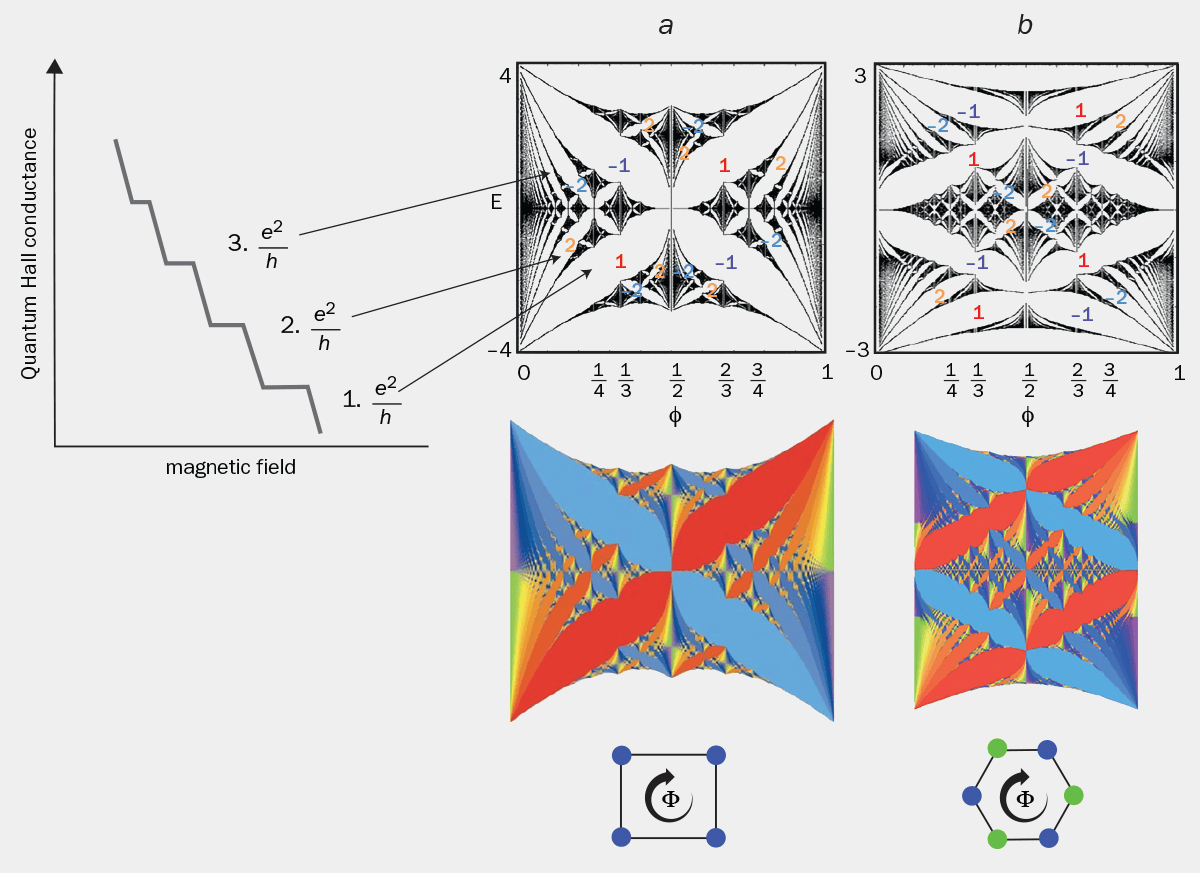
Hofstadter’s butterfly, in its original form, refers to the behaviour of electrons in 2D lattices subject to an applied magnetic field. (a and b) Shown here (top row) are graphs of the electrons’ energy (E) plotted against the magnetic flux (Φ) per unit cell for square and honeycomb lattices (bottom row). The relation between the quantum Hall effect (displayed in the staircase-like graph, left) and Hofstadter’s butterfly is shown via the arrows. The colours on the “butterfly graphs” (middle row) correspond to the quantum numbers of the Hall conductivity. Some of these integer labels are shown (colour coded) in the top row.
How all of this relates to Hofstadter’s butterfly is simple: the butterfly model describes all integer quantum Hall states, where the integers of Hall conductivity label the gaps in Hofstadter’s butterfly – the exact same integers that Wannier and Claro introduced in the butterfly spectrum (figure 1). In other words, the butterfly is not merely a chart of recursively split energy levels; it is also a coded map of topology in quantum matter under a magnetic field.
A pattern repeating across physics
That connection places it squarely within one of the central themes of modern condensed-matter physics, namely the realization that certain physical properties are protected not by local details, but by global features of the quantum state. But what is fascinating is that in the 50 years since Hofstadter’s butterfly was discovered, physicists have found that the same spectral architecture in it can also arise in a remarkable range of settings. It has appeared, for example, in other lattice geometries, in engineered semiconductor devices and in so-called moiré materials.
The forgotten pioneers of computational physics

The butterfly’s migration into moiré systems has been especially fruitful. Such materials are created by stacking two atomically thin materials onto each other with a slight twist, creating a moiré pattern with different properties from the individual layers. Utilizing moiré materials, in research that began in 2013 led by Philip Kim of Columbia University (Nature 497 598) and continues apace with a team led by Ali Yazdani of Princeton University (Nature 639 60), the butterfly structure can now be tuned, probed and in some cases directly imaged on modern quantum platforms.
Over the last 50 years, the butterfly itself has also evolved into other forms. For instance, in some systems, the butterfly emerges without an external magnetic field. As a team of researchers led by Xu-Tao Wan from East China Normal University showed in 2025 (Phys. Rev. Lett. 136 033401), the fractal pattern can be controlled by twist angle – that is, by geometry alone.
Each time physicists add a new layer of realism – spin, interactions, periodic driving or lattice complexity – the butterfly adapts, and re-emerges in new forms, so long as it is not overwhelmed by strong interactions, disorder or thermal effects
In other realistic systems, electron spin – the particle’s intrinsic magnetic orientation, absent from the original simplified model – becomes an essential part of the physics. Even when a magnetic field splits the system into spin-up and spin-down states via Zeeman splitting, the butterfly spectrum survives. More striking still, the butterfly can emerge independently for each spin state, as Xiaomeng Liu and Zhida Liu of Cornell University discovered in 2025 (Nature Phys. 21 1873).
This persistence of the fractal structure, despite the added complexity introduced by spin, highlights the extraordinary robustness and universality of the underlying quantum phenomenon. More generally, what these new iterations of Hofstadter’s butterfly reveal is that what once looked like a specialized theoretical curiosity now seems more like a recurring motif in quantum matter.
Indeed, this is part of its enduring fascination: each time physicists add a new layer of realism – spin, interactions, periodic driving or lattice complexity – the butterfly adapts, and re-emerges in new forms, so long as it is not overwhelmed by strong interactions, disorder or thermal effects. This durability prompted a friend to once joke that whenever he undergoes an MRI scan, he cannot help wondering what kind of butterfly his body might be producing.
Beauty from simplicity
As my friend’s joke reveals, there is something unmistakably human about the butterfly’s appeal. Physicists are drawn to it not only for its usefulness, but for its beauty. It belongs to that rare class of scientific objects whose visual grace seems to gesture toward deeper truths. And yet its deepest charm may lie in the fact that its immense complexity grows from remarkable simplicity.
2 Baby butterflies
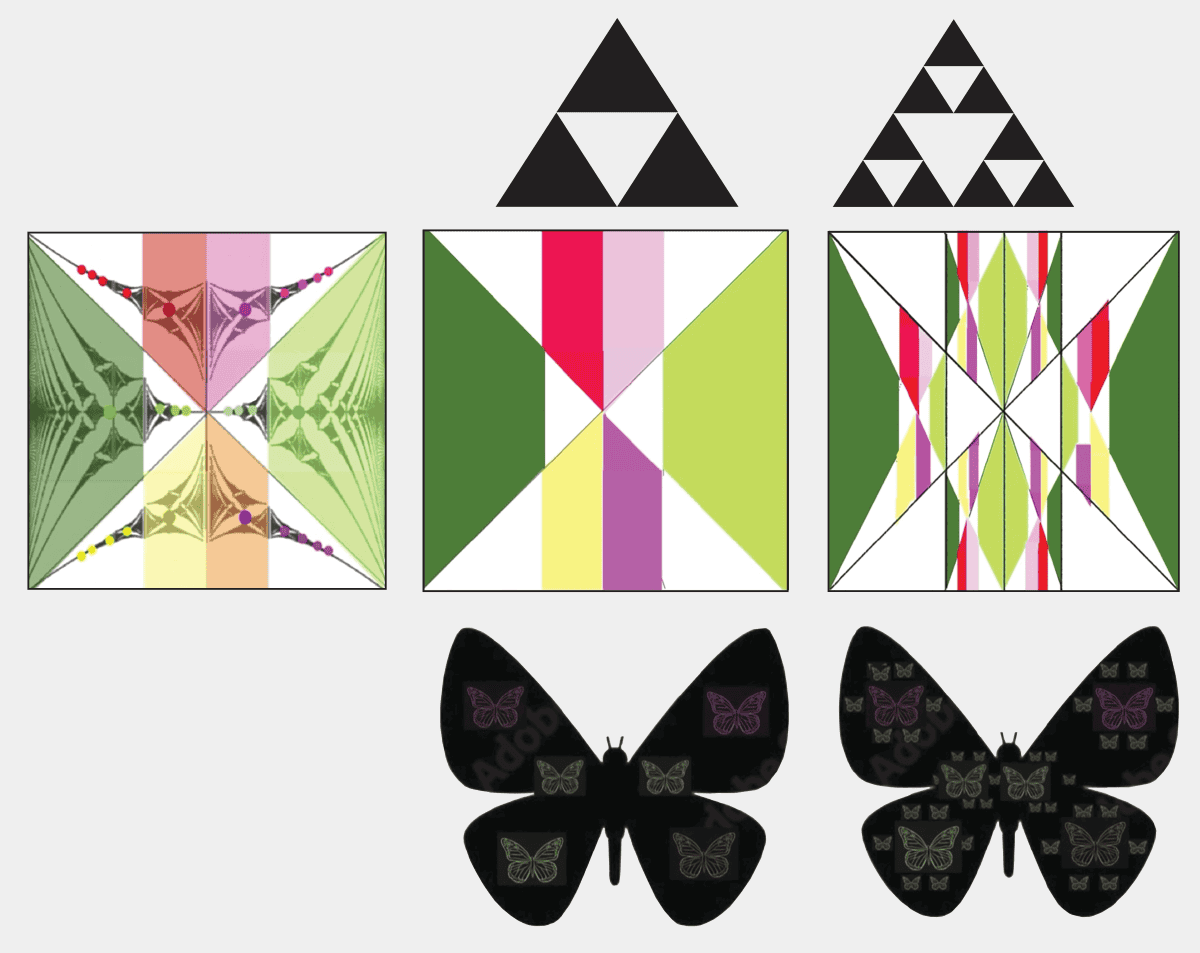
A simplified representation of Hofstadter’s butterfly, commonly known as the butterfly skeleton, interpreted as a 2D tessellation of trapezoids and triangles. It is shown in parallel with the “Sierpiński gasket” (top), which is made entirely from triangles. The iterative construction underlying this fractal consists of a parent butterfly generating six “baby” butterflies, represented by the six colour-coded trapezoids. Each baby butterfly is accompanied by a tail – an infinite chain of progressively smaller butterflies, indicated schematically by dots in the corresponding colour. The two butterflies at the bottom provide a schematic illustration of the hierarchical organization of the structure.
Beneath the intricate pattern are integers, recursion relations and number-theoretic structures that connect it to fairly simple geometric patterns, including the Farey tree, the tree of Pythagorean triplets and fractal packings such as the Apollonian gasket. In fact, this complicated quantum fractal admits a surprisingly simple geometric description: the butterfly landscape can be organized as a hierarchical lattice of trapezoids, bringing it into close parallel with geometric fractals such as the Sierpiński gasket (figure 2). It is extraordinary to think that this geometric harmony underlies such a complex and beautiful graph.
Fifty years on, Hofstadter’s butterfly remains exactly what great scientific ideas are supposed to be: elegant, prolific and unfinished. That interplay of beauty, mathematics and physical reality is what keeps the butterfly alive. Its evolution under interactions, spin effects and new forms of engineered geometry continues to reveal unexpected physics. And with each turn, the butterfly reminds us of something rare and precious in science: that the universe can hide immense complexity within simple forms, and that sometimes, if we are lucky, those forms are beautiful enough to be unforgettable.