Weather forecasting relies on many different types of data to make accurate predictions: temperature, humidity and wind data are all used to build an accurate forecast. Researchers have now found a new way to improve weather forecasts, by adding data on water isotopes in the atmosphere.
For predicting weather, water vapour isotopes integrate key information on the history of their evaporation, condensation, mixing and transport. Heavy water (containing either deuterium or oxygen-18) exists in the atmosphere and the way that these water isotopes condense and evaporate is different to that of normal water molecules.
The release and absorption of latent heat when water condenses and evaporates is the primary energy source for atmospheric circulation. The vertical heating profile plays a major role in large-scale circulation, wave propagation, storm track positioning, cloud development and precipitation patterns. However, vertical heating structures and convective activity cannot be measured directly by satellite networks and have to be inferred instead, leading to biases and inconsistencies that degrade the accuracy of weather models.
Stable heavy water isotopes can provide a direct physical link between the latent heating processes in weather patterns through isotopic fractionation. Heavier water isotopes preferentially condense into the liquid phase because they have a greater binding energy and lower diffusive velocity. Additionally, heavy water doesn’t evaporate as easily as normal water.
Even though these water isotopes exist in small quantities, their relative abundance alters during evaporation and condensation. Observing this change in abundance of the isotopes allowed the researchers to understand where the water came from and what happened to it along the way – providing insights into the atmospheric conditions.
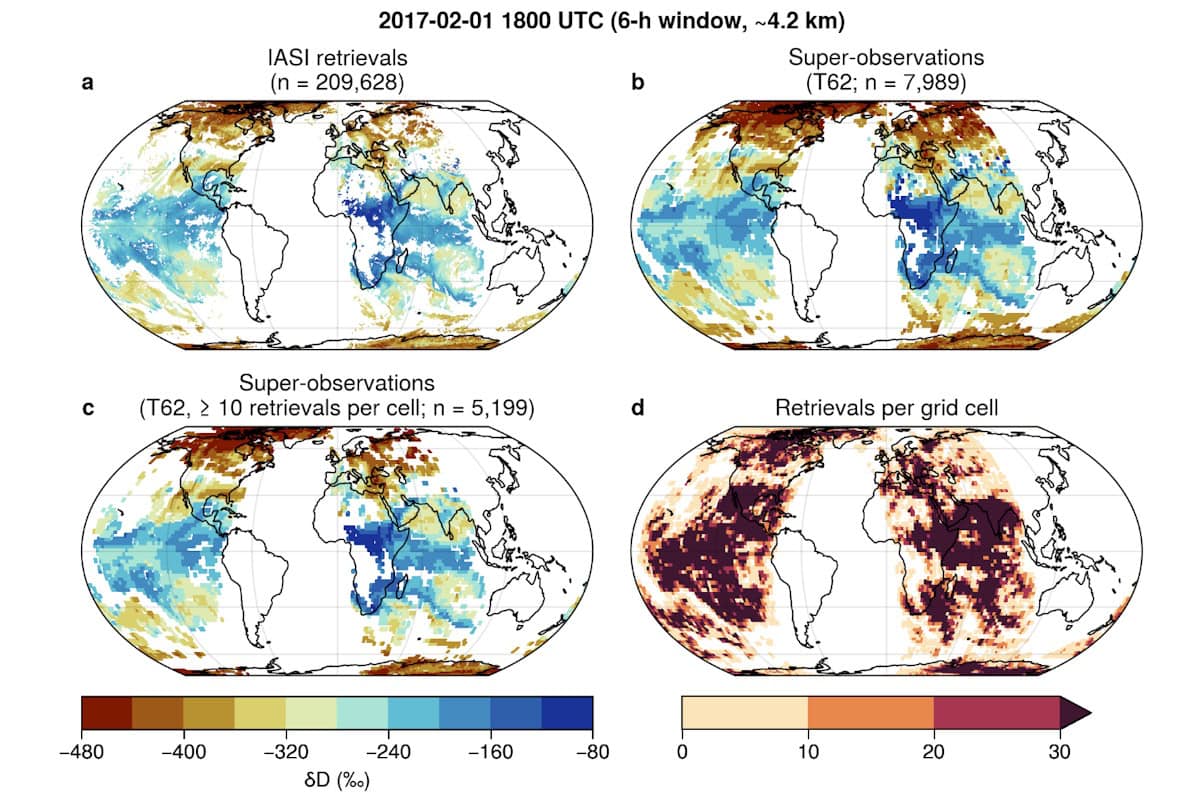
The research team – led by Kinya Toride from University of Colorado Boulder, NOAA and the University of Tokyo – examined data from the Infrared Atmospheric Sounding Interferometer (IASI), which provides large amounts of accurate long-term data on water vapour isotope ratios in the mid-troposphere. The researchers fed the data collected from satellite observations into a weather model using a technique called data assimilation. This approach takes the different isotope signals and translates them into the atmospheric variables that are used in weather forecasting – as the vapour behaviour alone was not sufficient to reveal atmospheric variables such as temperature, wind and humidity.
They found that inclusion of these data improved the estimation of wind, temperature and water vapour in the atmosphere, leading to more accurate weather forecasts. This included improving forecasts for up to five days ahead and providing more accurate predictions on heavy rainfall across many regions.
While it has long been theorized that water vapour isotopes could improve weather forecasting, this is the first study that has been able to show it using real-world data, rather than inside a controlled lab environment. But while the study was performed in conditions close to real operational forecasting, the researchers emphasize that it’s not something that can be implemented straightaway.
This is because there are limited real-time isotope data available and the operational forecasting models employed today by meteorologists are not designed to use such data. For isotope observations to be used in our everyday weather forecasts, a lot more real-time data will need to be collected and processed. Then either new models that incorporate these data will have to be developed or the current models will need to be adapted to include the water isotope data.
Physics-based models still beat AI for predicting extreme weather events
However, with more and more satellites being launched into our atmosphere, and the costs of them continuing to come down, it’s likely that more weather satellites will be available to provide these data in the coming years – and both meteorologists and weather presenters should be able to make good use of them.
The study, published in Nature Communications Earth & Environment, demonstrates the benefits of using water isotope data, particularly for predicting heavy rainfall. “Our long-term goal is to develop more accurate satellite observations of water vapour isotopes and integrate them into operational weather forecasting systems,” says co-author Kei Yoshimura from University of Tokyo in a press statement. “This additional layer of information can help make everyday forecasts more reliable.”