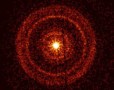
On 9 October 2022, a gamma-ray burst called GRB 221009A sent an enormous amount of high-energy radiation toward Earth. The Large High Altitude Air Shower Observatory (LHAASO) detected thousands of photons from the event, including some above 10 TeV. More than an hour later, the Carpet cosmic ray detector recorded something much harder to explain: a photon-like event with an estimated energy of 300 (+43/-38) TeV. At that energy, according to standard physics, the photon should have disappeared during its journey to Earth.
Giorgio Galanti of INAF and Marco Roncadelli of INFN have now examined what could allow such a photon to survive. Their explanation, reported in Physical Review Letters, involves two hypothetical effects: axion-like particles, or ALPs, and a possible violation of Lorentz invariance.
The space between galaxies is filled with background light, including the cosmic microwave background (CMB), the faint radiation left from the early universe. A 300 TeV gamma ray can collide with these low-energy photons and produce an electron and a positron. At this energy, the CMB is the dominant source of absorption.
“The CMB is extremely dense,” Galanti explains. A 300 TeV photon therefore has a mean free path far shorter than the distance from GRB 221009A, making the universe effectively opaque to it.
The numbers are difficult to put into perspective. Galanti and Roncadelli calculate that conventional propagation would result in only about 10-96 expected photons in the Carpet energy range. The Carpet event itself is also unusual because the detector did not find the muon signal expected from a hadronic cosmic-ray shower. The collaboration estimated the probability of a hadron being misidentified as the event at about 3 × 10⁻⁴.
Galanti says the researchers are taking the published Carpet result at face value while leaving open the question of whether it will ultimately prove to be a signal of new physics.
Two options to consider
One possible explanation involves ALPs, hypothetical particles that can mix with photons in magnetic fields. A photon can convert into an ALP, travel through a region where photons would be absorbed, and later convert back into a photon. This mechanism could help explain the LHAASO photons detected between roughly 10 and 20 TeV. But it runs into trouble at 300 TeV.
“ALPs alone fall short by roughly two orders of magnitude at 300 TeV,” Galanti says. They remain useful at lower energies, but the CMB absorption becomes too severe at the Carpet energy. The researchers found that within the range of ALP parameters under consideration, the expected number of Carpet photons stays below about 10-4, lower than the 0.0513 required at the 95% confidence level.
That led the researchers to consider another effect: a possible violation of Lorentz invariance, one of the foundations of relativity.
In the scenario they studied, the Lorentz invariant violation (LIV)-induced modifications of photon propagation change the threshold for photon–photon absorption. A 300 TeV photon can then interact with higher-energy background photons, which are much less abundant than the CMB photons responsible for ordinary absorption. The universe then becomes more transparent to the photon.
The researchers calculate upper limits of 1.22 × 10²¹ GeV for the linear LIV scale and 2.03 × 10¹³ GeV for the quadratic case, at 95% confidence.
The interesting part is that they don’t use LIV as a replacement for ALPs. As Galanti explains, ALPs function at LHAASO energies but not at Carpet energies, while LIV operates at Carpet energies but not at LHAASO energies. Their model incorporates both effects into a single theoretical framework.
There is another clue. A separate analysis by Dmitry Ofengeim and Tsvi Piran found that the more-than-one-hour delay between the LHAASO and Carpet events can also be explained with quadratic LIV. Their estimated scale is consistent with the limit obtained by Galanti and Roncadelli.
Bright ‘nearby’ gamma-ray burst dazzles astronomers
But Galanti is careful about what the result means.
“A single candidate photon from a single cosmic event cannot be claimed as an undisputed discovery,” he says. Confirmation would require repeated observations from multiple distant sources showing the same energy-dependent signatures.
Future observations from facilities including ASTRI Mini-Array, CTAO, SWGO and the expanded LHAASO could test whether similar high-energy signatures appear in gamma-ray bursts and distant active galaxies.
For now, the 300 TeV event remains an unusual observation with a possible explanation that goes beyond standard photon propagation.